Home Blog Page 8

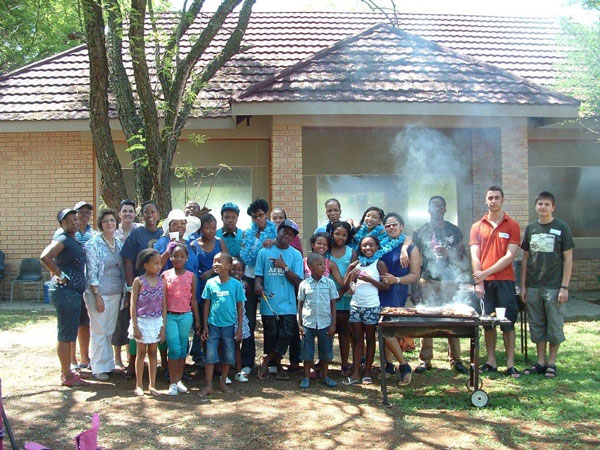
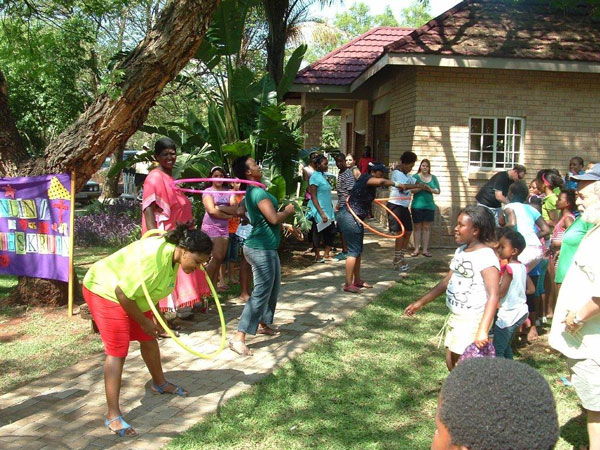
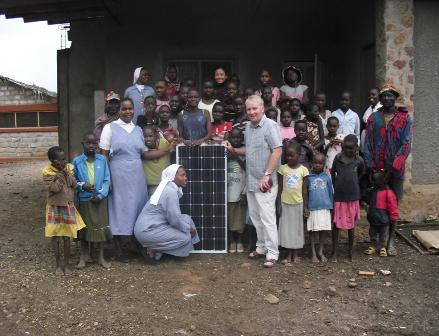
Ballygawley school reaches out to Zambia school children…

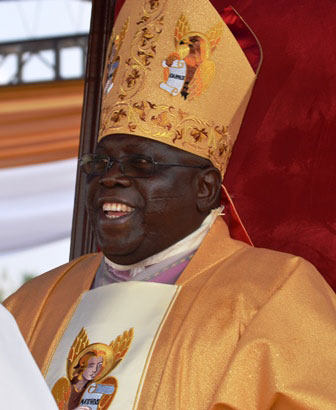
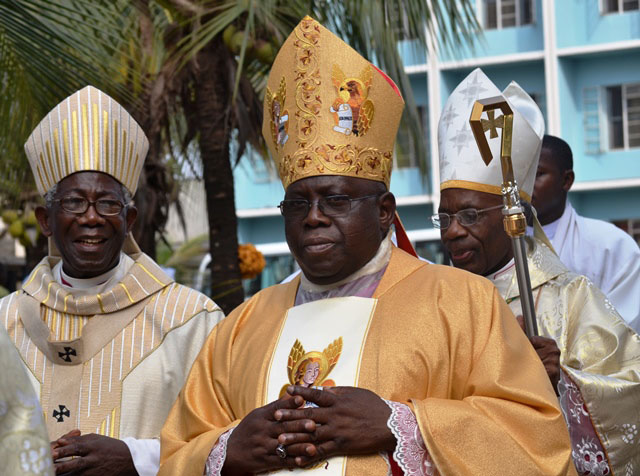
Mulenga-Opening-ceremony

Psalm 94 admonishes the people for their hard-heartedness:

“For forty years I was wearied of these people,
And I said: ‘Their hearts are astray, These people do not know my ways.”
Then I took an oath in my anger:
Never shall they enter my rest.” (verses 10 – 11)

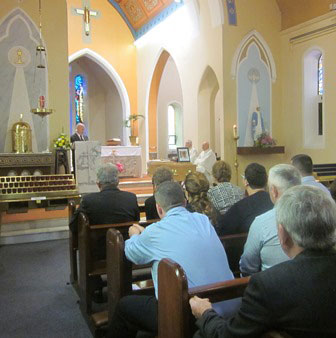
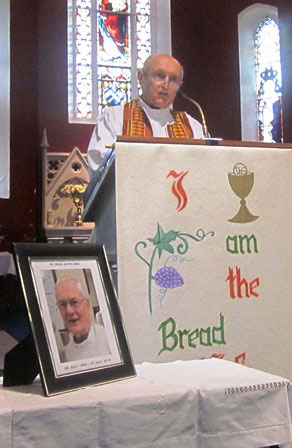
For forty years the Catholic people of Mulenga township longed to be a community alive to new possibilities: longing for a place to pray, a dwelling place for the Lord which would be a beacon in an area of terrible poverty. Today, we thank God that He did not turn against the people of Mulenga but listened to their heartfelt pleas, crying in the wilderness.

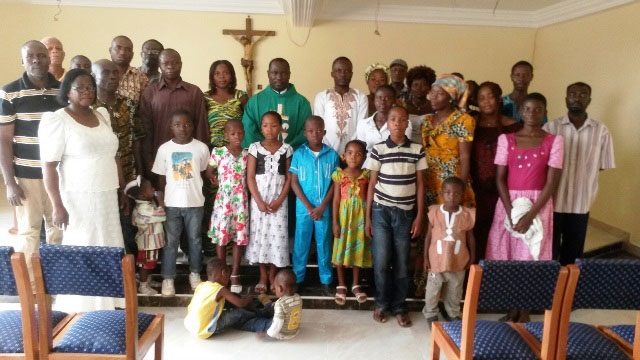
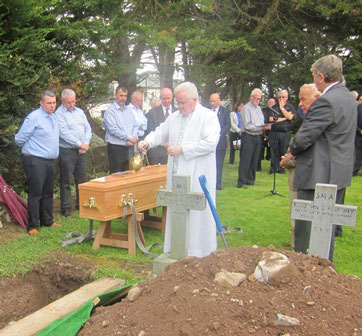
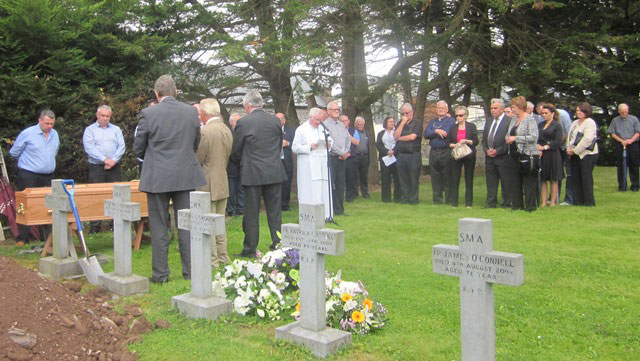
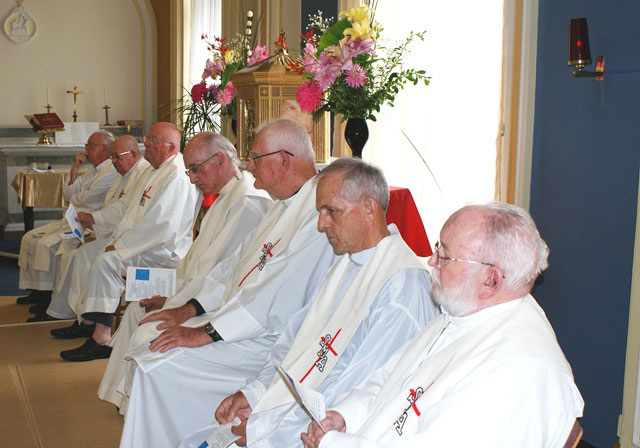
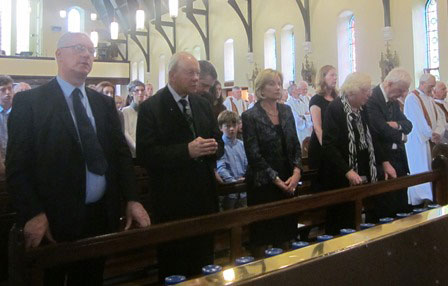
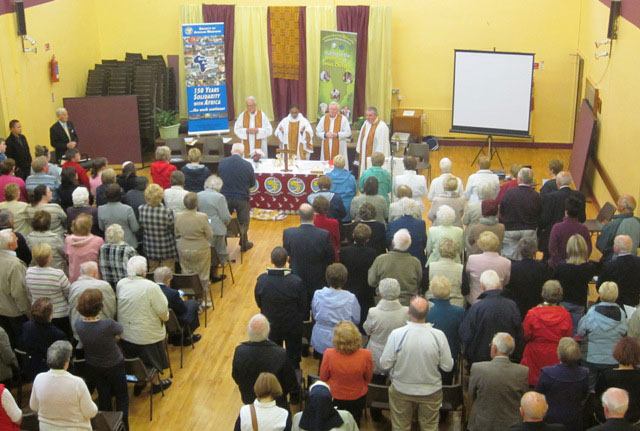
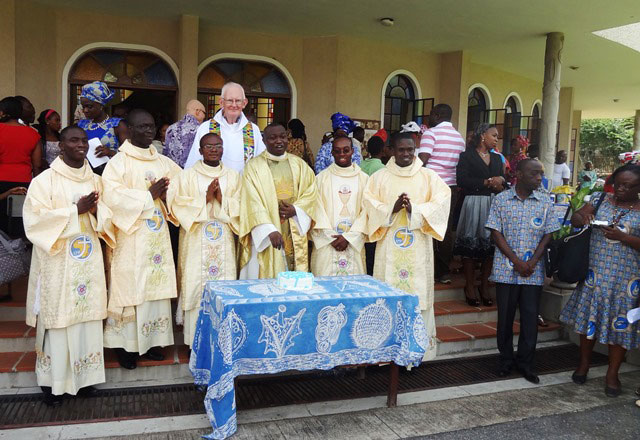
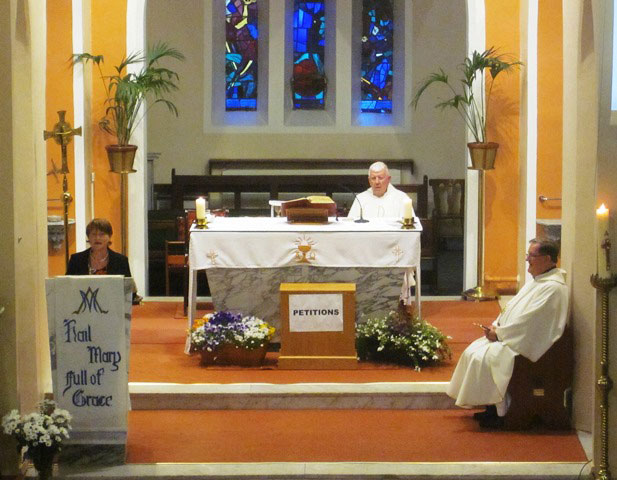
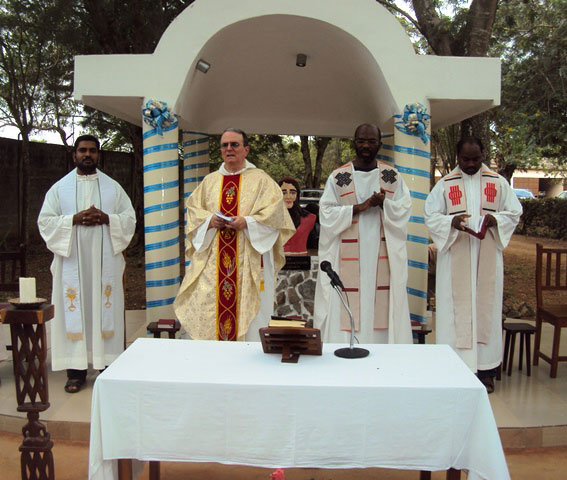
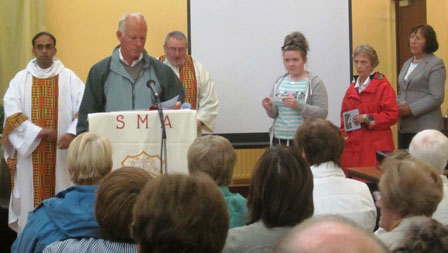
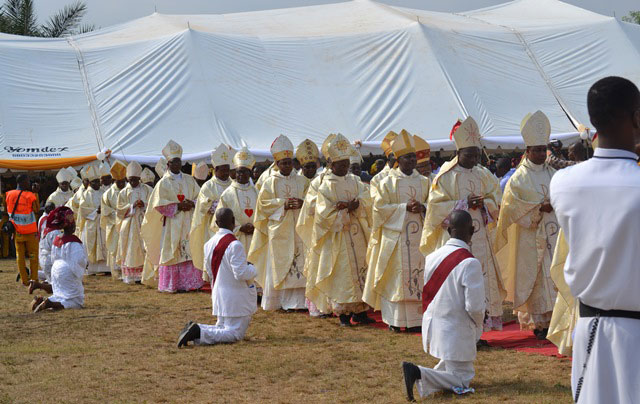
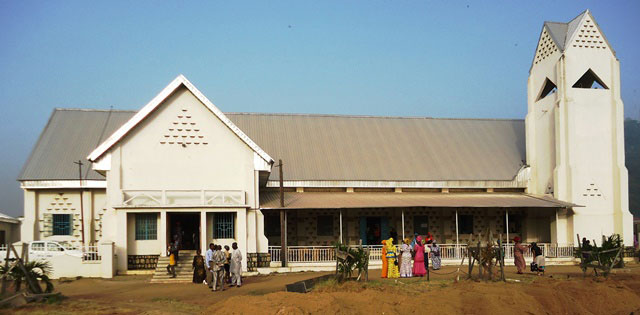
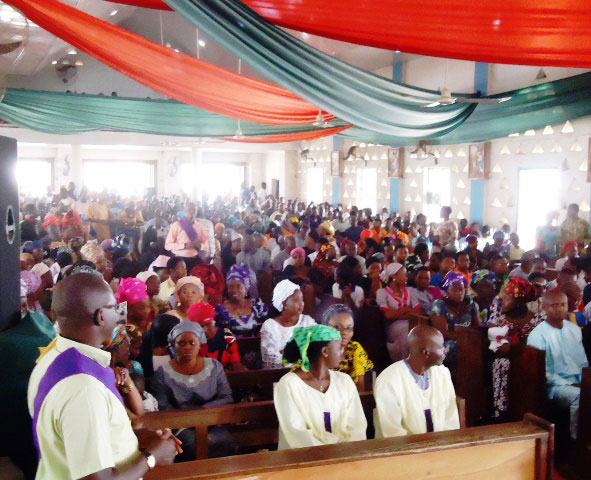
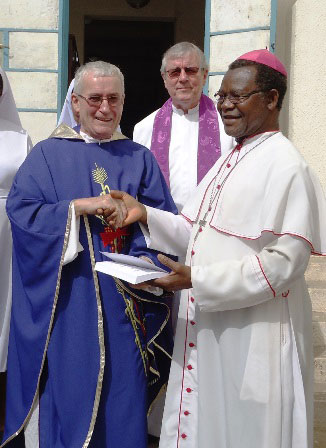
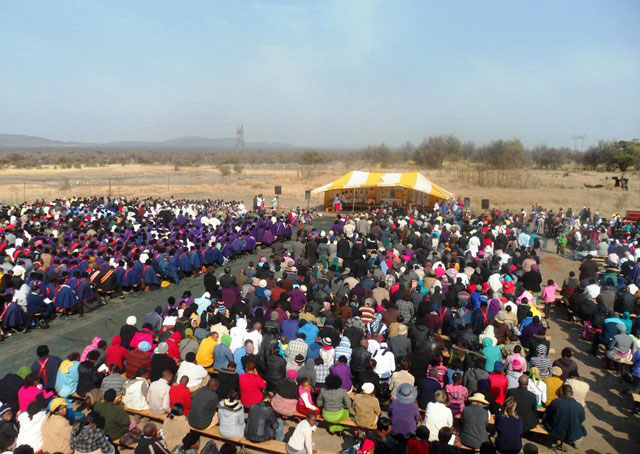
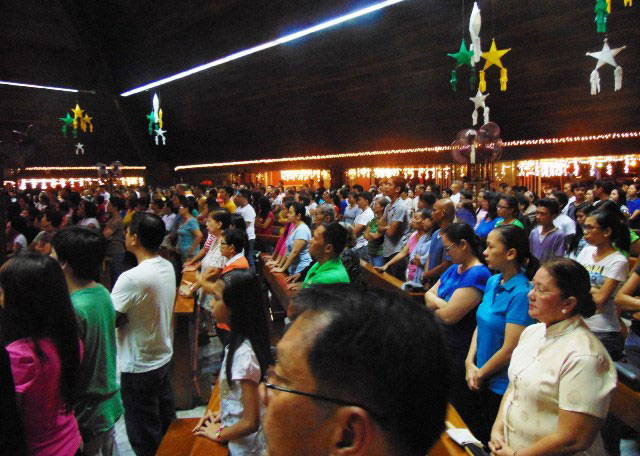
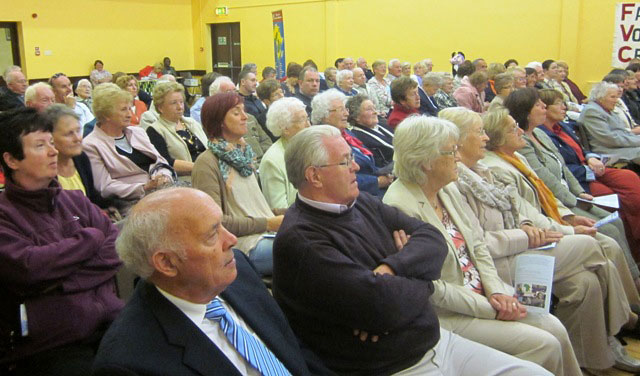
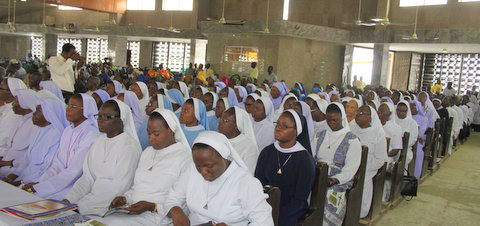
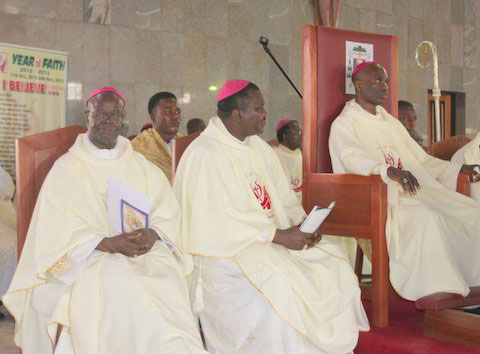
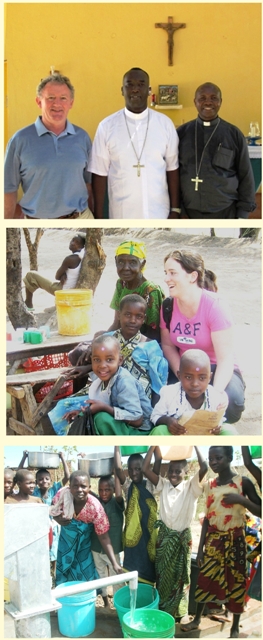
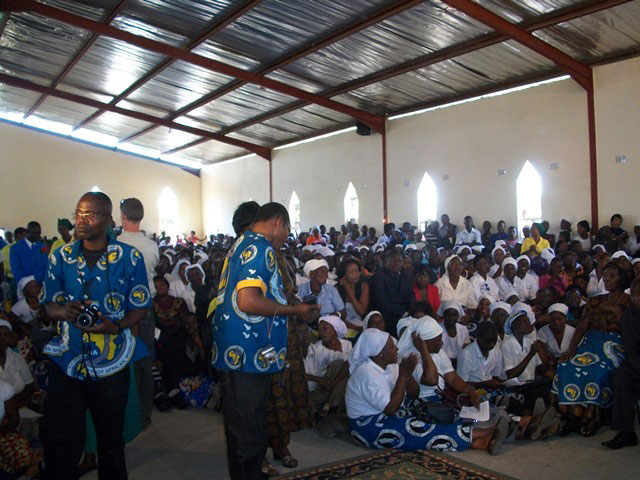
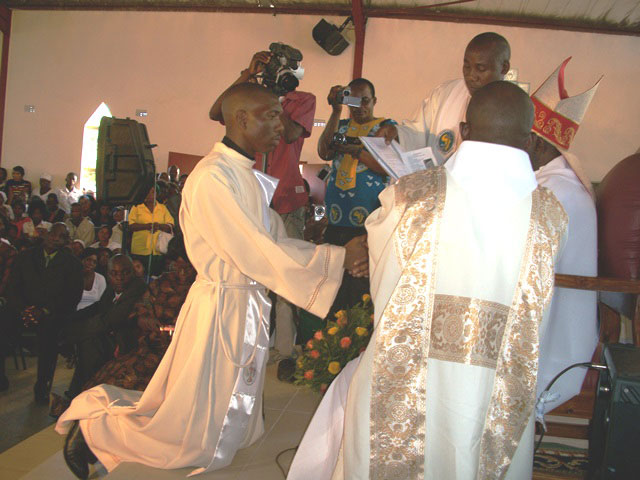
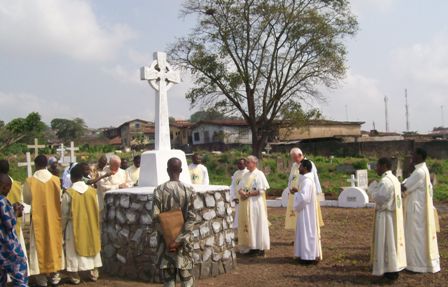
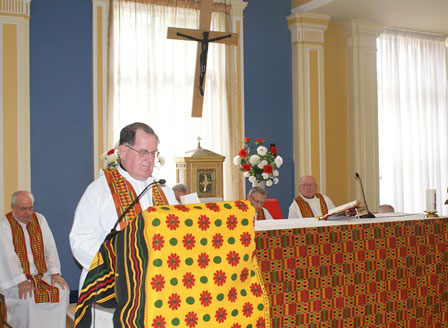
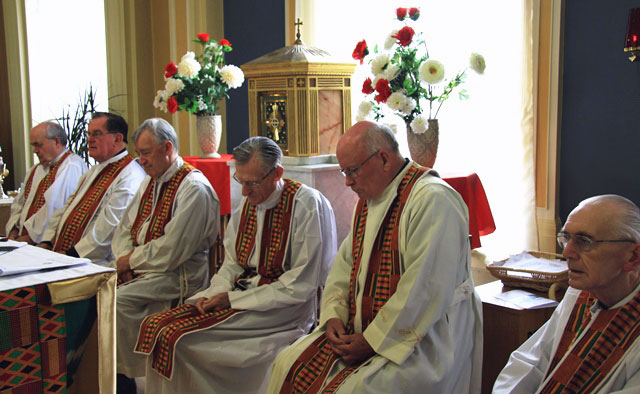
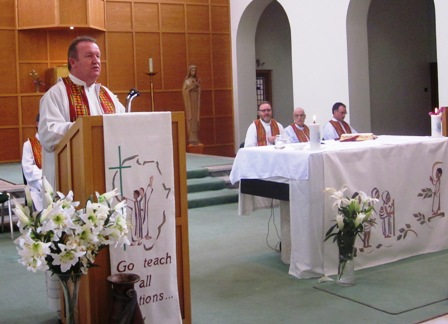
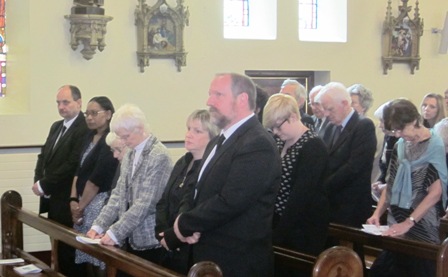
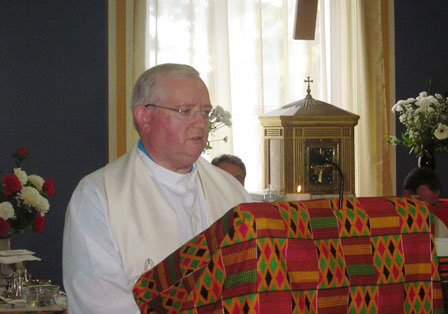
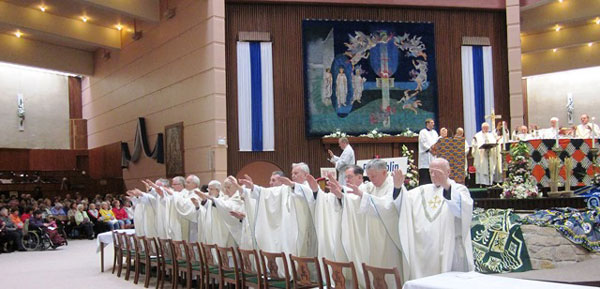
The congregation during the joint Church Dedication and Ordination ceremonies

Mulenga-Opening-ceremony

In 2007 remote preparations began when an ad hoc committee purchased a plot of land from Bana Mulenga. It is on this piece of land that the Church to be dedicated today is built. Up to then, the Catholics attended the different parishes in the area –  Chamboli, Wusakile, Ndeke or Luangwa. In response to the pleas of the people in Mulenga, Bishop Noel O’Regan SMA, Bishop of Ndola, invited Fr PJ Gormely SMA (Augher, Co Tyrone) to take up the challenge of establishing a parish community in this area. This missionary project was endorsed by Bishop O’Regan’s successor, Bishop Alick Banda. And so Fr Gormley began the painstaking work of identifying, with the community, what their needs were. Only when they had recognized what their true needs were could a start be made at meeting them. And so, since 2007, we have been working to become a self-ministering, self-supporting and self-propogating Catholic community in this part of Ndola diocese.

William--MatthiasThe first nine months was a period of evangelizing the community leaders into what all this would entail. It was a period of visible growth and commitment to the mission of Jesus Christ. Over a period of time, Small Christian Communities were established throughout the area. These lay leaders, women and men, identified different problems within the community. Some of them seemed to be insurmountable. However, rather than lie down in the face of such challenges, the community decided that the first step should be to establish a pre-Nursery school for 4 – 6 years old children. Our children are our hope for the future.

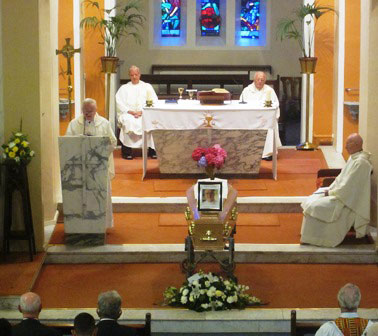
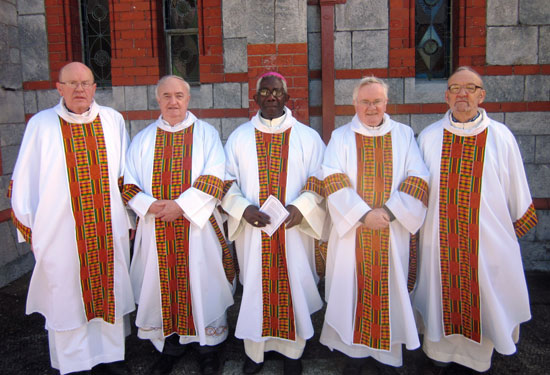
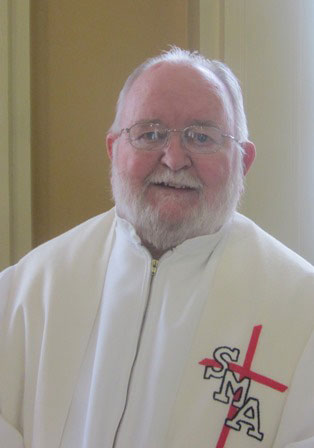
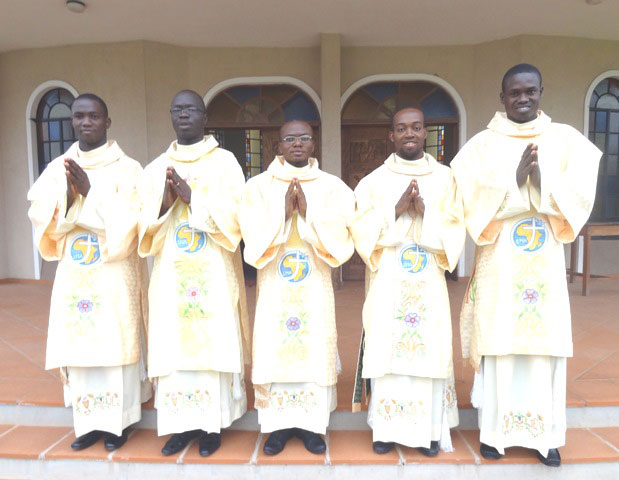
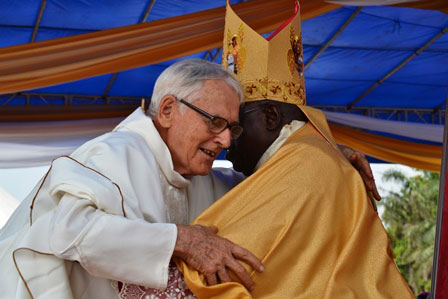
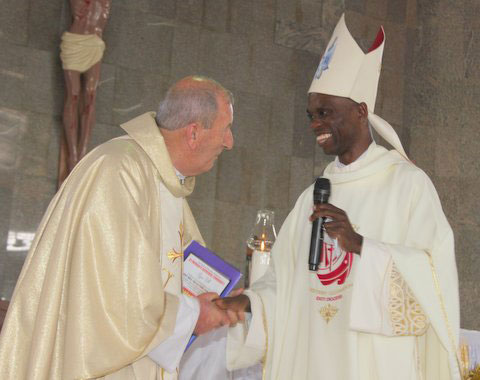
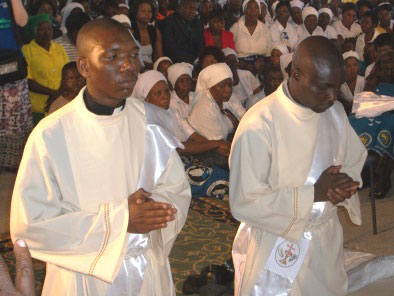
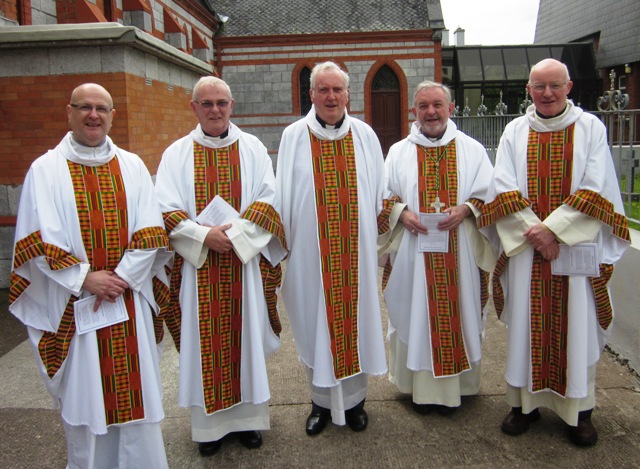
Fathers William & Matthias during their Ordination ceremony

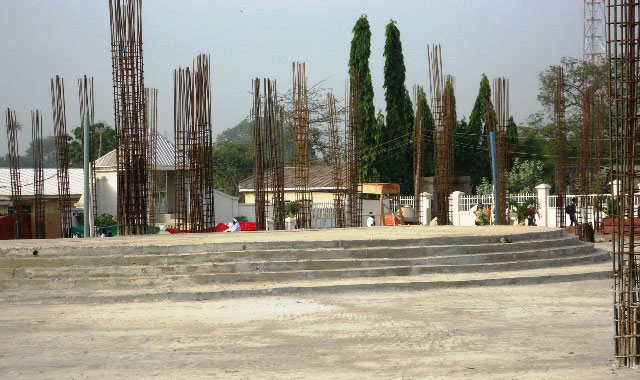
After six years of planning, fundraising (within the community and abroad) the school opened in January 2013. The entire complex, school and church, were built with the physical efforts of the St Mark, St Mary, St Maximillian, St Nicholas, St Elizabeth and St Denis’ Small Christian Communities.

But let us step back a little: by January 2011 the community was ready to celebrate the presence of Christ among us in the Eucharist. And so Mass was celebrated in one of the unfinished classrooms of the school. It soon outgrew its usefullness and we had to use two classrooms. And so everything grew and developed, in God’s time and way. Today, the Holy Trinity parish community of Mulenga, Kitwe are challenged to keep this mission alive.

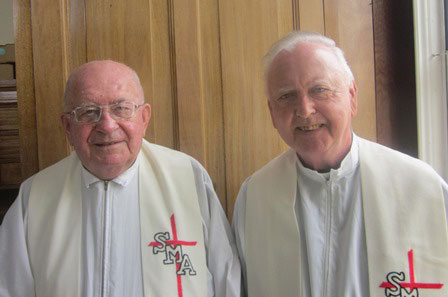
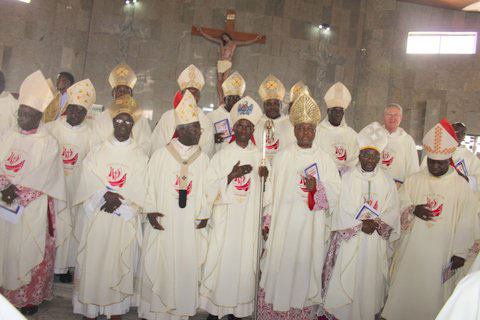
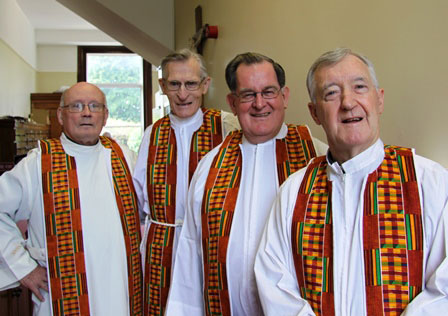
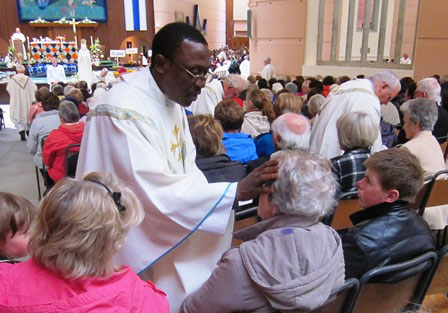
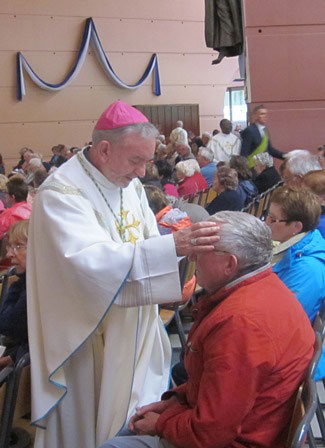
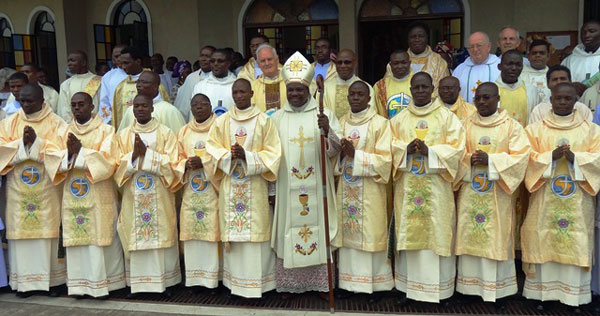
Mulenga-Ordination-ceremonyAs we celebrate the opening of our Church we equally rejoice in the ordination of two priests who will also be missionaries – African Missionaries, members of the Society of African Missions – who will leave our country to announce to other communities the Good News of Jesus Christ. In turn they will, like Fr Gormely in Mulenga, walk with similar communities in identifying their needs and then planning how to meet them.

Fr William promises obedience and respect to his Superiors during the Ordination ceremony

May Fathers Mathias Chungu and William Sinkala do great things for God. Amen.

We take this opportunity to thank our local and overseas donors, particularly DAFA (Direct Aid for Africa) and St Ciaran’s Secondary School, Ballygawley, Co Tyrone. Without the assistance of our donors much of what we see about us today in Mulenga would still be a pipedream.

Ubwingi bwa nseba, kwimina pamo.

The above article is taken from the booklet produced by the Mulenga Catholic community for the dedication of their Church and the Priestly Ordination ceremony of Fathers Chungu and Sinkala.

Feast of the Assumption 2013 – Year C

The Assumption of the Blessed Virgin Mary, Mother of God

15 August 2013

Revelation 11:19, 12:1- 6, 10
1 Cor 15:20-26
Luke 1.39-56

Two missionary priests made an agreement that whoever died first would contact the other about what happened. Some years later one of the priests had to go back to Ireland for medical treatment. Then one night the priest still on the missions woke up during the night convinced that there was someone in the room with him even though he couldn’t see anyone. Later he heard that that was the very time the other priest had died. One may not believe this or may dismiss it as pure coincidence. Whatever the reality we don’t have to base our trust in the resurrection on things like that.

In faith, today’s solemnity of the Assumption of the Blessed Virgin Mary is telling us that God did indeed assume Mary body and soul into heaven at the end of her earthly life as a promise of our own resurrection from the dead after we die.

Mary’s greatness comes from her faith. Elizabeth, in today’s gospel says of Mary: ‘Blessed is she who believed that the promise made her by the Lord would be fulfilled’. Mary’s response is to give all the praise and glory to God who made it possible. Mary does not proclaim this song of thanksgiving as an isolated person but as the daughter of a people. This is clearly Luke’s intention. With her people Mary sings the greatness of God whose power is revealed through history in his people by way of his saving deed. Mary’s greatness is not based on a blood relationship with Jesus but because she was above all, the woman of faith who accepted God’s plan for her, even though it would involve a lot of suffering. She is someone very human like us experiencing many of the ups and downs of life as we do and so she knows what we go through having many of the same experiences, if not in the same detail, but certainly with the same joys and struggles of being human.

Mary is truly a model of the Christian life. Sometimes saints can be presented in such a way that we feel they are almost superhuman beings, almost angelic whom we could never imitate. This is certainly not true and especially it is not true of Mary. Mary is the greatest of all the saints because she never sinned. She was sensitive to the call of God and lived her life in total obedience to that call. Hopefully, most of us Christians try to live in obedience to God’s will in our lives but the obvious difference is that we sin from time to time, Mary never did.

Yet in many ways her life was very similar to the life of most women. She was married, gave birth to a child, and did her best to raise him as she believed. But there were times as in the case of all mothers when there were great misunderstandings between her and her son. When he was 12 years old and went missing for 3 days, she and St. Joseph must have been frantic with worry. The answer he gave was hardly satisfying on a human level. ‘Did you not know that I must be busy with my Father’s affairs?’

At the age of about 30 when he decided to leave home to be an itinerant preacher how would his mother have reacted? She most probably questioned him about the wisdom of it – where would he sleep, eat, what would support him etc? Of course, if we don’t really accept Jesus being fully human then we can give easy answers. At the wedding feast of Cana would Mary not have been like any other woman there, out dancing, enjoying the company, delighting in the newly wed young couple until her sensitivity to the lack of wine made her approach Jesus and ask his help. It shows the power of Mary’s intercession with her son.

So Mary was no plaster saint, totally different from other humans. She never heard confessions, celebrated Mass or performed miracles in the ordinary sense of the term. But hers was the greatest miracle of all – never to have sinned, never to have resisted God’s will. And she was faithful to the very end. She followed Jesus to Calvary and saw him crucified cruelly.

Today’s solemnity then is, above all, the triumph of God’s grace over evil and sin in a human being, Mary. The first reading from revelation is simply telling us that God is victorious in the struggle with evil and sin. The Assumption is the celebration of what God can do for us humans if we allow him

For a long time this thanksgiving song of Mary was seen in terms of a spiritual hymn only. But in recent times the emphasis is also very much on God’s preferential option for the poor, the underprivileged, and the marginalised. This is a theme running right though the bible and Mary’s song highlights it. In effect it speaks of God turning the ordinary way of looking at things upside down. –‘God pulls down the mighty from their thrones and exalts the lowly; the hungry he fills with good things, the rich he sends empty away etc. This, of course, was what Jesus proclaimed and carried out during his public ministry.

St. Paul says ‘eye has not seen nor ear heard what things God has prepared for those who love him’. I wonder what it must have been like for Mary, when she was assumed into heaven by God’s choice, to have come face to face with Jesus whom she had last seen physically hanging on a cross before being put in the tomb. What an incredibly joyful encounter it must have been.   (See below)

Today’s solemnity is a reminder to us that we too are called to the same destiny as Mary – to be with her Son forever in heaven. However in the meantime, we need to pray often for a great increase of faith and trust in God so that like Mary we will be faithful to the call each of us has from God. We too are called to work for justice –to let go of prejudices against any group of people, like AIDS victims, immigrants; to be those who are concerned for the underprivileged to the extent that we can be.

“Lord Jesus, thank you for the gift of your mother Mary. May she continually intercede for us. Amen”

Fr. Jim Kirstein, SMA

The feast of the Assumption is not merely about the logistics of how Mary’s body was assumed into heaven, but rather about the ultimate destiny of our humanity. Mary is an icon for the beauty that lies in the heart of humanity. There is a beauty in our humanity with which God is constantly falling in love and which God calls to himself. That is at the heart of our celebration today. Mary is called in her totality, body and soul, into the presence of God. She is an icon for our humanity. In looking at her, we see the beauty of humanity that cannot be destroyed, no matter what, and which God calls to himself.

18th Sunday in Ordinary Time 2013 – Year C

4 August 2013

Ecclesiastes 1:2, 2:21-23
Colossians 3:1-5, 9-11
Luke 12.13-21

Some time ago I met a friend who works as a stockbroker. On the day I met him he was quite sad. The reason being that a couple both in their mid 80s came to him, even though quite rich, and they were very anxious to invest some money they had just inherited and wanted him to advise them where to get the most return for it. What saddened him most was the fact that the idea of sharing it with the poor and those in need never entered their minds. He felt they were so focused on themselves they had little thought for others in need.

The readings today focus on our priorities and attitudes in life. Nowhere in today’s readings or in the Bible does it say that having possessions is wrong. The question is what importance do we give them in our lives? The first reading today is from the Book of Ecclesiastes or as it is sometimes called Qoheleth, a name meaning ‘preacher’ or ‘teacher’. When he says that ‘all is vanity’ he does not use the word ‘vanity’ in exactly the same way as we do today. He uses the word in the sense of ‘illusion’ or ‘mist’, i.e. it is an illusion to think that wealth or possessions in themselves can give true happiness and especially if we put them in the place of God so that they become an idol. We then act as if we are independent of God. Many rich people have got cancer and all their money couldn’t prevent them dying from it. A question: Did you ever see a hearse with a coffin inside pulling a trailer behind it with the riches of the dead person?

In the gospel Jesus refuses to get involved in a dispute regarding an inheritance between two brothers. He takes the opportunity to warn people against avarice or greed of any kind. Greed can become an idol because it consists in putting our trust in something other than God. Jesus is not talking only about material possessions. He is talking about anything that can become an idol for us. It might be drugs, drink, sex, work etc. Today computers and modern technology may take up so much of our time that we haven’t time to pray or go to Mass as we used to.

In the parable Jesus speaks about a man who is already rich. He wants to pull down his barns and build bigger ones. It is clear that the focus is on himself. He is self-centred. He doesn’t seem to consider the needs of those less well off than he is. Jesus is saying that riches are a blessing when they are shared and in fact a deadly violation when they are stored up for personal identity or security. Gandhi, the Indian leader repeated many centuries later what the early Fathers or theologians of the Church had taught.

He said: “Even if it is not stolen, something is to be considered stolen if one keeps it without needing it. The rich possess a great abundance of superfluous things they do not really need and that therefore remain unused and are lost, whilst millions die of hunger because for them there is no food. If everyone kept no more than what is really necessary, no one would lack anything and everyone would be contented with what one has”. Even though not a Christian, Gandhi says clearly what Jesus speaks about in the gospel today. Maybe a call for each of us to examine our conscience about what place or importance our possessions have in our lives. Do they possess us in the sense that we are enslaved by them? Or do we use them for our needs but also to help others in need?

The Good News of today’s readings is a gentle reminder that we are here on earth only for a short time and that our true home is in heaven as St.Paul says in the second reading. The real riches that we take with us to heaven are those we have given to the poor or whatever we have shared with others here on earth. Jesus is reminding us of this so that we might have the freedom that gives us a deep peace and joy now. Obviously if I have many riches I may need a lot of security around my house. If I have money invested I may start getting anxious if there is a recession or a slowdown in the economy. Money can become devalued very quickly. It is the opposite with God. God never becomes devalued! In fact the opposite is true – the more we trust in him and follow his ways with the help of his Spirit the more peace and joy we will have now and later too.

I feel that many people try their best to share with others and are conscious of their call to help those less well off. Today’s readings are a gentle reminder from our loving God that if we have been blessed with more material possessions than when we began life, he is asking us if we are using them in a Christian manner. Or if they are being given more importance in our lives than is good for us and therefore for others whom we could have helped.

“Lord Jesus, we thank you for the many ways you have blessed us. Every good gift comes from our Heavenly Father. Help us to use these gifts in a Christian manner for our own good and for others less well off. Amen”.

Fr. Jim Kirstein, SMA

17th Sunday in Ordinary Time 2013 – Year C

28 July 2013

Genesis 18: 20-32
Colossians 2:12-14
Luke 11:1-13

One day in a supermarket I witnessed a small 6-year-old boy persistently calling his father: ‘Daddy, chewing gum’. He kept on repeating just these few words. In all whilst I was there about 15 times. But as he left the place with his father he went without getting his chewing gum. Obviously his father did not think it was good for him. Refusing him didn’t mean he loved him less, in fact it was because of his love and knowing better than his son did that he refused his request when it would have been easier to give in.

Perhaps prayer is a bit like that. The readings for this Sunday invite us to reflect on the dimension of prayer in the Christian life. It is an attitude of trust in God our kind Father who is always ready to listen to his children but who like the father of the little boy doesn’t give us always what we want because it would not be best for us. Luke in his gospel delights in frequently presenting Jesus praying. In all the important moments of Jesus’ life, Luke never forgets to point this out. Jesus’ frequent prayer and his unique way of starting it with “Abba” (more like our Daddy or Papa today) is the best sign of his relationship with his Father

So Jesus always begins his prayer addressing his father as “Abba” meaning ‘Daddy’ in Aramaic the language Jesus spoke. Is this not telling us that first of all prayer is about a relationship – one between our loving heavenly Father and us his children? It is interesting to note that this model of how we ought to pray puts the focus first of all on God our Father. We start by calling God, “Father”. Of the 5 petitions in the Our Father today the first two focus on God. We are told to pray: ‘may your name be held holy’. For the Jews a name was the same as the person. Thus we are asked to adore, honour and glorify our Father in heaven. Before mentioning any of our requests, praise and adoration of God are foremost. Then, in praying ‘your kingdom come’ we are told the how this might be carried out in our lives. Working to bring his kingdom about is more than just words. It calls upon us to be peacemakers, to work against all kinds of injustice, to live the truth of God’s love and forgiveness in our lives. We are called to do this wherever we are, in our homes, with our families, in our workplaces, when we recreate etc.

Then the next three petitions allow us to pray for our own needs and those of others. They represent all time: the present (give us this day our daily bread), the past (forgive our sins, that is all we did that was contrary to God’s kingdom), and the future (do not put us to the test – that is ‘do not demand more of us than we are capable of doing). So in asking our generous Father for our daily bread we are asking him to give us what is best for us – we may not get what we think is best like the little boy in the story. Or now may not be the best time to get it as God knows we are not ready yet. Of course, God may want to give us certain gifts but others may refuse to cooperate with God’s plan. Forgiveness is mentioned quite a number of times in the gospels and it is included here. We promise God to forgive others, though this is not always easy. That is why in the second parable that follows, Jesus tells us that God’s best gift to us is the powerful Holy Spirit who enables us to do what God asks of us to bring about his kingdom and to forgive others. Our Father knows that will power is not enough, we need Spirit power to live as God’s children and to act accordingly.  

The first of the little parables that follow the Lord’s prayer tells us of the need to persevere in prayer and not to give up if at first we don’t receive what we ask for. I knew a woman whose husband left her. She prayed daily for his return. Then one day he walked into her house again. This was after 19 years. She really persevered in prayer and believed God would answer her. Jesus tells us that there are 2 conditions needed to have our prayers answered by God. In John’s gospel ch.14.13 he says
1) ‘whatever you ask for in my name (that is according to my will) I will do and
2) ‘so that the Father may be glorified in the Son’ (that is that it will give glory to God).
Many times we forget this and want God to respond to our demands.

Sometimes, of course, we try to bargain with God: ‘If my sick husband lives a few year’s longer, I will go to Mass daily and pray a daily rosary’. Yet God doesn’t think this is foolish. In the first reading we heard about Abraham bargaining with God. He was saying in fact that he trusted God enough to bargain all the way. It doesn’t mean we will always get what we want but it does show a great trust in God and I feel God appreciates this bargaining as we take him seriously as he does us.

Ultimately prayer is about a relationship of trust. We trust we have a loving Father who passionately cares for us. More than anything he hopes we will develop an ever greater intimacy with him and he asks us to work to bring about his kingdom. He takes all this so seriously that the best gift he can give us now is the Holy Spirit who can empower and enable us to respond to his invitation.

“Lord Jesus, thank you for teaching us how to pray by giving us the best model in the “Our Father”. May we say not only the words but also put them into practice in our daily lives. Amen”.

Fr. Jim Kirstein, SMA

16th Sunday in Ordinary Time 2013 – Year C

21 July 2013

Genesis 18:1-10
Colossians 1:24-28
Luke 10:38–42

One night in a big town where I worked in the North of Nigeria I decided to visit an African family who were members of our parish. I lost my way and decided to knock on a door to ask the people the way. The family were obviously Muslim and were eating their evening meal. We had never met before. Immediately they invited me to sit down with them and share the meal. Their custom was that the unexpected guest was to be treated as one of the family and even if they hadn’t enough to eat themselves they would make whatever sacrifices necessary to look after the stranger. For me it was real example of true hospitality.

In the first reading today we read about Abraham welcoming three strangers with great hospitality. He doesn’t realise it then but in welcoming them he is welcoming God himself. Later on in the gospels Jesus will say, “whoever welcomes you welcomes me and whoever welcomes me welcomes the One who sent me”

The gospel tells us of the welcome given by Martha and Mary to Jesus. Last Sunday in the story of the Good Samaritan we read about what it was to be a true neighbour – anyone who needed our help is our neighbour and this was to be shown in concrete acts of love. Today’s gospel shows us two Good Samaritans in action, Martha and Mary. Martha is the one who actually welcomes Jesus into her house and appears to be the cook and organiser. Jesus would have appreciated having a good meal after his journey. It is her way of welcoming Jesus. Mary on the other hand welcomes Jesus by sitting at his feet and listening to him. These are two different ways of welcoming someone. It is not correct to say that Mary’s way was best. What Jesus meant by saying that “Mary had chosen the better part” was that at that particular moment that was the best response for her. At another time she might need to take on the role of cook and organiser.

We must remember that at this stage of his life Jesus was on the way to Jerusalem where he would die on the cross. He was probably fearful of what was ahead of him. So when he comes to the house of Mary and Martha perhaps he just wants to relax and take a break before continuing his journey. Maybe the last thing he wanted was someone fussing over him and so he appreciates Mary’s quiet attentiveness as she listens to him speaking. It is obvious that Jesus knows the two sisters well and it would not have been his first visit. That is why Martha’s complaint about her sister would come from a relationship of trust and friendship with Jesus where she felt o.k. about complaining to him. One would not do this with strangers. Her familiarity with Jesus gave her that freedom. Jesus’ response to Martha then is that she not giving herself fully to what she is about. She wanted her sister to do the same work of cooking and organising just then.

Here we touch on a deeper meaning in the incident. At the time of Jesus only men sat at the feet of the Rabbis or Teachers of the Law. It was not the place for women. The cultural roles would have been quite rigid as regards the role and place of women in society. So Jesus is emancipating or freeing women to be equally entitled to do this. Is he not the first real feminist? He is saying that God’s love and word is addressed to everyone, men and women alike. So Jesus criticises Martha for being a prisoner of what she considers to be the proper role of women. He is inviting her to break away from the concept situating a woman as one to be confined to housework only. As a woman, each is entitled to have others interests and concerns too, if this is possible.

Mary, and in fact every woman has the right to listen to the Word of God. House tasks must not suppress that interest. This is a woman’s right which is still not recognised in many cultures even in the so-called developed countries. By his words and deeds Jesus liberates women from a concept which maintains them in a secondary role as mere housewives with no other possibilities to develop themselves.

Jesus then it teaching us that an active life which leaves no time for prayer and listening to God will soon become dry and barren. On the other hand a relationship with God that does not bother with the neighbour is nothing but cult worship that may well cut a person away from the realities of life.

Is there not a Martha and Mary in each of us? As the Book of Ecclesiastes says: “there is a time for everything under heaven”. Sometimes the call is for active service of my neighbour, at other times a time for prayer and contemplative listening to God’s word. When it is time for activity let our focus be totally on that. When it is a time to listen and pray that should be our focus. What is the Lord calling me to do at different times? If I am asked to be active and and am simply wishing I had time to be quiet or if I am called to pray and am all the time thinking about what I should do, then am I not fretting and worrying like Martha?

“Lord give us the gift to truly listen to you speaking to us and at each moment may we be guided by the Spirit to choose the better part. Amen.”

Fr. Jim Kirstein, SMA

Working for Justice – 25 Years for Justice and Peace

Faith justice3

AFRICA EUROPE FAITH AND JUSTICE NETWORK (AEFJN)

Motivated by Christian faith, a profound respect for human dignity and a priority concern for the poor, the AEFJN works for just relationships between African and Europe and for the global common good. 

It aims to establish:
A world where all can enjoy their fair share of the  gifts of creation.

Where people have the opportunity to fulfil their God-given potential.

A culture where people, especially the poor, are at the heart of economic and social policy.

An Africa that can hold its own in its relations with other world powers.

Faith justice3


Working for Justice – AEFJN, 25 Years for Justice and Peace

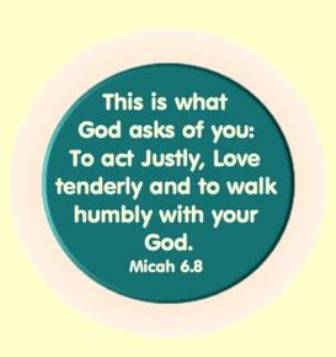
Micah

At the core of Christian life is justice, for we cannot love our neighbour without treating them justly.  Faith and Justice cannot be separated. Faith therefore, not only implies belief but also a way of life. This is why SMA’s and other missionaries have not only preached but also dug wells, built schools and hospitals as well as Churches.  

In previous editions of this magazine we highlighted the work of SMA’s such as Frs John Haverty, Donal Fennessy, Oliver Noonan, Anthony Kelly, Sr Kathleen McGarvey OLA and others. They have not only preached the Good News but also loved their neighbour by working for Justice.  They have, and still are, doing this through actions that promote human development, recognise the dignity of each person and provide individuals with the opportunity to fulfil their God-given potential.  Such work is an essential  part of the Church’s mission.

International Work for JusticeFaith justice1
Here in Ireland and in Europe, the SMA also works for justice in Africa by contributing to the work of the Africa Europe Faith and Justice Network (AEFJ
N).  It was formed in 1988 following a request made by Pope John Paul II for “missionaries to be present wherever decisions are made that affect the lives of people in the developing world.” The role of the AEFJN is to highlight and challenge the unjust effects that decisions made by European Governments and Corporations may have on African peoples and countries.  Trade practices, policies and legislation often maximise corporate profits and protect European interests at the expense of the African countries providing the materials and produce that generate wealth in Europe.  

The AEFJN is guided by the Gospel and Church Teaching and recognises the right of every human person to enjoy their fair share of the resources of creation.  Sometimes this is denied. Economic and social policies adopted by the European Union may directly affect the price an African farmer gets for his Cocoa, Ginger or Grain.  In turn, this affects his children, the food they eat, whether or not they get the medicines they need or even if they can go to school.  

It is a sad reality that  business and economic decisions made in Europe contribute to the fact that millions of Africans do not have the basics we take for granted and which we see as fundamental human rights.  The right to clean water, to adequate food and to medicines are a reality for most people in Europe; they are NOT for most people in Africa. 

Faith juatice2By working within the European Union structure in Brussels and through branches in European and African countries the AEFJN gathers information about inequalities caused by unfair trade and political relationships. This is published as widely as possible in order to raise awareness of the injustice.  The AEFJN also acts by lobbying and campaigning in order to influence fair decisions at EU and Governmental level in European Countries. The SMA sees the action and advocacy of the AEFJN as an expression of the faith from which justice cannot be separated – it is a practical and necessary way of loving our African neighbour.

Together for 25 Years
This year the AEFJN celebrates its 25th year.  Since 1988 it has helped to bring about positive change and succeeded in reversing unjust trade practices.  Nationally and through its Bru
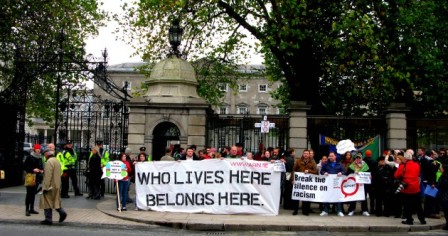
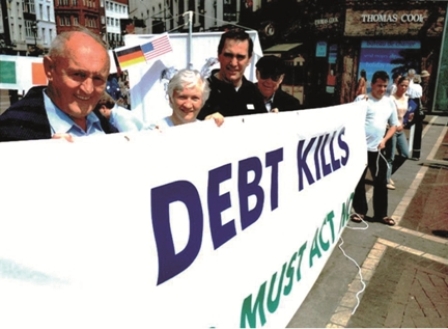
ssels Office the AEFJN has worked to exert a positive influence on those who make decisions.  In the photograph below we see an example of  an occasion when members of the AEFJN have campaigned on the streets of Ireland against the unfair burden of illegitimate International Debt on Africa.  

Efforts on this issue made by the AEFJN and other organisations have had significant success.  The work of informing and lobbying has also borne fruit by influencing the terms of trade agreements, practices affecting the availability of medicines in Africa and other positive changes in policies.

Still a long way to go
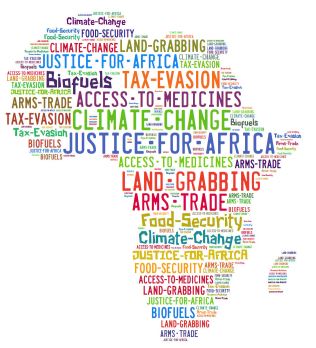
While the AEFJN has much to celebrate it is acutely aware that Africans are still suffering because of problems originating in the developed world, e.g. climate change.  This problem created largely by the profligate use of fossil fuels in the developed world is turning African farmland into desert.  Tax Evasion by multinational companies and the leasing of huge tracts of African land (amounting to more than 16 times the landmass of Ireland) are also robbing Africans of what is rightly theirs, depriving them of the wealth and resources with which they could develop and support themselves.  These are issues that the AEFJN and the SMA will continuFaith justice4e to highlight as matters of injustice needing a fair solution.

Living our Faith and loving our neighbour is something every Christian is called to.  We do this in different ways. The AEFJN and the SMA witness to this call, in Africa and where decisions affecting the lives of Africans are made. We are all called to be just and loving in our work, in family situations, in how we relate to our neighbours, friends and even to enemies.  We will do well if we follow the principles and aims that have guided the AEFJN.  If we respect human dignity, give preference to the poor and seek the common good, then we will be loving our neighbour as ourselves.     

AEFJN Ireland has members from 33 religious congregations and societies and also lay persons. All are deeply concerned about Africa and its people and want to contribute actively to bringing about more equitable relations between Europe and Africa.  The role of the AEFJN Ireland is to create awareness and to be a voice for the reform of structural injustices found within Irish and European policies that negatively affect populations in Africa.


This information was first published in the African Missionary Magazine No.21 Spring/Summer 2013  


Follow this link to the AEFJN Website

Fr Malachy Flanagan SMA

Prov-Bursar-Prov-Asst

Fr Malachy Flanagan, from Tullyallen parish (Drogheda, Co Louth) is the son of the late Mary (Oliver) and the late John Flanagan. Born in 1962, he did his schooling at Tullyallen National School and Drogheda Technical School where he completed his secondary schooling in 1979.

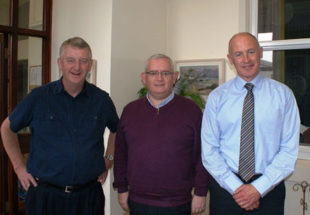
Pictured are Fr Fachtna O’Driscoll (SMA Superior General, 2013-2019), Fr Malachy Flanagan and Mr Paul Murphy (Assistant Provincial Bursar)

A little over a year later he began his studies with the SMA and, after the Spiritual Year programme in Cork, he went to Maynooth where he completed his Philosophy and Theology studies. Speaking about why he joined the SMA, he said “I came to know of SMA from Fr Peter Devine SMA who comes from my parish. When I felt I wanted to be a priest he encouraged me to become a missionary with SMA. I felt drawn to missionary work… attracted to reach out to the most abandoned… to be a messenger and instrument of hope… to build up a local indigenous church… to help people in their struggle against illiteracy and injustice and lack of basic health facilities.”

Malachy was ordained a priest on 25 June 1989 in the church where he was baptized, the Church of the Assumption, Tullyallen, by Cardinal Tomas O’ Fiaich, Archbishop of Armagh. He was one of two SMA priests ordained that year. The other is Fr Paddy O’Rourke from Tullyco, Co Cavan.

Fr Malachy was appointed to southern Nigeria where he spent 17 years, first in the diocese of Ilorin (1989-1996) and then in the Prefecture Apostolic of Kontagora which had been created from parts of Ilorin and other neighbouring dioceses. This part of Nigeria is often referred to as an area of Primary Evangelisation – i.e. the frontline of the missionary apostolate, where the Gospel is unknown, telling people for the first time about the love of Jesus Christ.

He served as Chancellor of Kontagora for 10 years and was an essential part of the team there as the fledgling Prefecture grew, eventually becoming a Vicariate in 2002. As Chancellor he has a lot of administrative responsibilities during the week but at weekends he is fully occupied traveling to outstation churches attached to different parishes in the Vicariate. In an interview he did at that time he explained his work: “I am responsible for diocesan building projects and for many water development projects which I supervise regularly. In the dry, desert conditions around Kontagora the provision of clean drinking water is a necessity. The Vicariate makes a huge contribution to well-digging and water purification systems.” Having the skill of ‘water diviner’ he was an integral part of the well-digging programme, finding places where water could be found.

This programme provides water to hundreds of villages scattered throughout the Vicariate. It still continues as there are still many villages which don’t have a source of clean water.

flanagan-sma-fr-malachyFr Malachy was a valued collaborator with Bishop Tim Carroll SMA until he was asked to return to Ireland in 2006 and work in the office of the Provincial Bursar. He succeeded Fr Jarlath Walsh as Provincial Bursar in September 2007 and held that position until his election as Irish Vice Provincial Leader in 2013. On 10 July 2019, Fr Malachy was elected to the position of Provincial Leader, succeeding Fr Michael McCabe who had completed his six-year term.

As we wish Fr Malachy wish him well in his new role we also assure him of our prayers. May the Holy Spirit guard, guide and direct him.

Working for justice, peace and understanding between Christians and Muslims

dislogue street

dislogue streetWorking for justice, peace and understanding between Christians and Muslims

Since the Second Vatican Council Dialogue with people of other religions and particularly with Muslims has become an integral part of the Church’s Mission.  “The plan of salvation also includes those who acknowledge the Creator, in the first place among them are the Muslims: these profess to hold the faith of Abraham, and together with us they adore the one, merciful God, mankind’s judge on the last day.”  (Documents of the Second Vatican Council)The Church’s Mission of Dialogue with Muslims means that it wishes to promote mutual respect, understanding and cooperation between Muslims and Christians.  This openness to interaction and cooperation reflects the Gospel call to “love one another as I have loved you.” In the past few decades Ireland has changed.  There are now about 45,000 Muslims living here.  Muslims are a permanent part of our community and are among the neighbours we are called on to love.There are many places in the world where the relationship between Christians and Muslims is marred by violence, persecution and injustice.  Thankfully this is not the case in Ireland.  Part of our Christian calling is to prevent this from happening by building positive relations with Muslims present here and so provide an example of tolerance and cooperation that can be followed by Muslims and Christians in other parts of the world.  

Peace bdialogue pope-domeetween us …..
Below are two quotations, one from an address made by Benedict XVI in 2006 .  The second is from a letter signed by 137 Muslim Scholars and Leaders  which was sent to Christian leaders in 2007.  Both highlight the urgency and need for Muslims and Christians to work together in order to create the conditions of trust and cooperation that will allow both communities to live in peace with each other.

“Inter-religious and inter-cultural dialogue between Christians and Muslims cannot be reduced to an optional extra. It is, in fact, a vital necessity, on which in large measure our future depends”    Pope Benedict XVI , 2006

“Muslims and Christians together make up over half the world’s population. Without peace and justice between these two religious communities, there can be no meaningful peace in the world. The future of the world depends on peace between Muslims and Christians.”    Muslim Leaders, 2007

The urgency implied in these statements is made clear by the growing polarisation between Muslims and Christians in many parts of the world.  This has been fuelled by wars, persecution, by injustice and by individuals and groups stirring up religious divisions in order to achieve political or material gain.  

Here in Ireland
Here in Ireland, over the past twenty years the Muslim population has grown. In contrast to what has happened in other countries relations between Muslims and Christians have been good, marked by cooperation and peaceful coexistence.  This  is good and very much in line with what the Church teaches about relations between Muslims and Christians.  Yet we do not live in isolation – we are influenced by what we hear and what is happening elsewhere in the world.  So for us in Ireland there is also a sense of urgency, a need to do something now, both to preserve and build upon the good relations that we have.   The  Papal Encyclical Redemptoris Missio points to what we all can do when it says,

“Each member of the faithful and all Christian communities are called to practise dialogue, although not always to the same degree or in the same way.”   Redemptoris Missio

dialogue womanEach of us, in our own way, has a part to play in bringing about a just society in which we can, faithful to our beliefs, live  as good neighbours with people of other religions.  This is part of the  mission we as Christians are called to.  In response to this, Cois Tine set up by the SMA to provide pastoral support to immigrants, is running a project to promote Dialogue between Muslims and Christians in Ireland.  This project aims to promote mutual understanding, respect and cooperation between  members of these two religions who now live together as neighbours in the same towns, streets and communities.

In Africa John Onaiyekan
In the last few years Nigeria has made international news headlines because of terrorist attacks involving bombings, violence and destruction. Unfortunately, the perpetrators claim to be doing so in the name of and for the good of Islam.  Although Muslim leaders have publicly condemned these actions they have polarized Muslims and C
hristians in Nigeria.  Commenting on the violence Archbishop John Onaiyekan has said, ‘the good neighbourliness that has characterized many communities where Christians and Muslims live together has been put under serious strain.  The engineers of division are almost succeeding in … making us enemies of one another.’In Nigeria informal dialogue and interaction does exist.  Muslims and Christians work together, live together and engage with each other in the course of everyday life.  However, openness to engaging in this this kind of dialogue is waning especially in the Northern States. 

In addition to religion, ethnicity also plays a part in this division.  By and large Muslims are Hausa-Fulani, while Christians are of numerous minority tribes. Different ethnic groups, have different cultures, different perspectives on history and different visions of the path to a better tomorrow. There are also formal occasions of interreligious dialogue organized by government, faith-based bodies, and NGOs.  These are important as they involve individuals who are influential religious and political leaders in their own communities.  While Muslims and Christians live together peacefully in some parts of the country this coexistence is becoming less evident across the Northern States. Division along religions and ethnic lines is growing and mutual fears and suspicions are multiplying.  Archbishop John Onaiyekan recently said that Nigerians seem “to be getting used, more and more, to rejecting one another.  Ugly rumours and hate messages fill the air and we are getting immune to the lack of compassion, solidarity and sympathy with one another.  There is danger in the air”.  While many are sceptical about the effectiveness of dialogue there is no doubt that, in the North of Nigeria  it is the only way forward.  It is only through dialogue that mutual distrust and fear can be addressed.  Dialogue is necessary. There is no other way.

 A Mission of Dialogue  
As a response to the situationdialogue stakeholders in Northern Nigeria the Interfaith Council of Muslim and Christian Women’s Associations was established when Sr Kathleen McGarvey invited women leaders of the major faith groups to come together for a one-day seminar in May 2010. This event made it clear that women in Northern Nigeria, whether Muslim or Christian, shared many common concerns. Among these are the lack of peace, unemployment, poverty, illiteracy, domestic violence, violations of women’s rights, poor educational and health services, women’s voicelessness, and incompetent and corrupt government. The women believe that they have a role as peacemakers in society and they must do so in dialogue with one another.  By being Mothers of a culture of peace, women can by example show that harmonious religious co-existence is possible.

 Sr Kathleen reports that since the first meeting the Council has grown from strength to strength as more women’s faith groups joined the organisation.  They have run seminars, workshops, and conferences  on the subjects of conflict, peace, women, and dialogue.  Political, traditional and religious leaders of both faiths have participated in these events as well as hundreds of Muslim and Christian women. Collectively the women have made Press, TV and Radio statements calling for harmonious co-existence. They have also joined together in visits to show solidarity with those displaced by the interreligious violence and conflict.  The Women have also initiated an Interfaith Council of Muslim and Christian Youth Associations thus spreading their call to Dialogue.   This mission for Dialogue is a mission for Peace.

 This information was first published in the African Missionary Magazine, No19 Spring/Summer 2012

Working for Justice

Working for Justice

Dialogue-Sr.Kathleen


Working for Justice Peace and Understanding between Christians and Muslims.
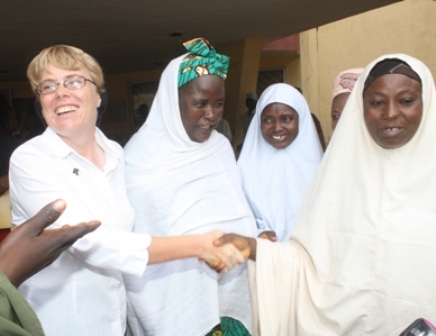
A report on work being done both here in Ireland by the SMA’s Cois Tine project and by Sr Kathleen McGarvey OLA in Nigeria. 
Read more
 

twafwane 1


Working for Justice – Homes for Street Children.
A report on work by Fr Anthony Kelly SMA in Kitwe, Zambia.   Read more


Faith justice4  

Working for Justice – 25 Years for Justice and Peace. 
Report on the work of the Africa Europe Faith and Justice Network on the occasion of their 25th Anniversary.
Read Mor
e

 Sccr cover


Working for Justice – Shalom Centre for Conflict Resolution and Reconciliation (SCCRR). 
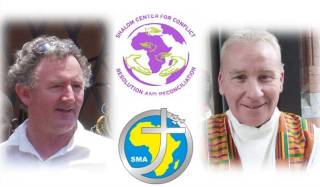
Frs Patrick Devine and Oliver Noonan SMA work to reconcile inter-ethnic conflicts in Kenya and in bordering countries.  Read more

Working for Justice (2)

Dialogue-Sr.Kathleen

Working for Justice

Dialogue-Sr.Kathleen


Working for Justice Peace and Understanding between Christians and Muslims.  A report on work being done both here in Ireland by the SMA’s Cois Tine project and by Sr Kathleen McGarvey OLA in Nigeria. 
Read more
  twafwane 1


Working for Justice – Homes for Street Children. A report on work by Fr Anthony Kelly SMA in Kitwe, Zambia. 
Read more

 Faith justice4  

 Working for Justice – 25 Years for Justice and Peace.  Report on the work of the Africa Europe Faith and Justice Network on the occasion of their 25th Anniversary.
Read More


Calavi celebrates 20 new SMA members

Calavi oath 25 June 2013 www

SMA welcomes 20 new members

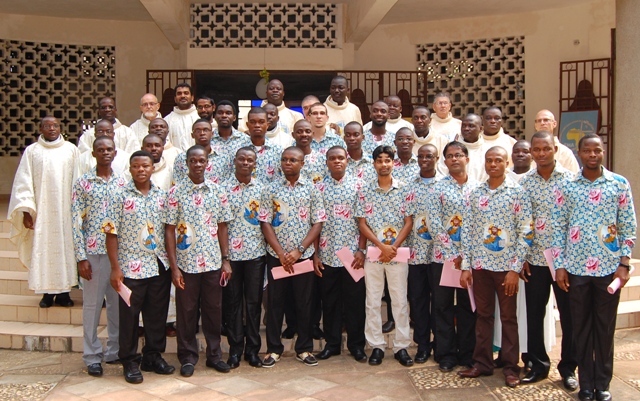
The anniversary of the death of the SMA Founder, Bishop de Brésillac, was celebrated with the admission to temporary membership of twenty more seminarians at a colourful and joyful Mass on 25 June last at the end of their International Spiritual Year (ISY) programme. The ceremony took place at the Centre Brésillac, Calavi, Benin Republic.

Calavi oath 25 June 2013 www

After a short holiday each will be assigned to an experienced SMA priest who will help initiate them in the work of missionaries, a Stage experience.

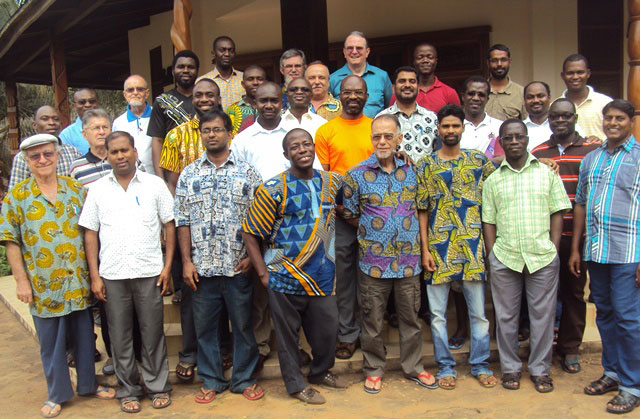
They are pictured above with the Formation staff and other SMA priests who are working in Benin Republic.

The new members come from Benin, Central African Republic, DR Congo, India, Ivory Coast, Kenya, Nigeria, Poland, Tanzania and Togo. There are five SMA priests responsible for their formation: Basil Soyoye (Bight of Benin DF, Nigeria, who is the Superior); Raja Lourdusamy (Indian DF), James Shimbala (Great Lakes DF, Tanzania), Pierre Garreau (Lyons Province) and Wilfried Kouijzer (Dutch Province).

Provincial Assembly 2013 photos 2nd week

EHartnett leads Eucharist
E Hartnett leads Eucharist

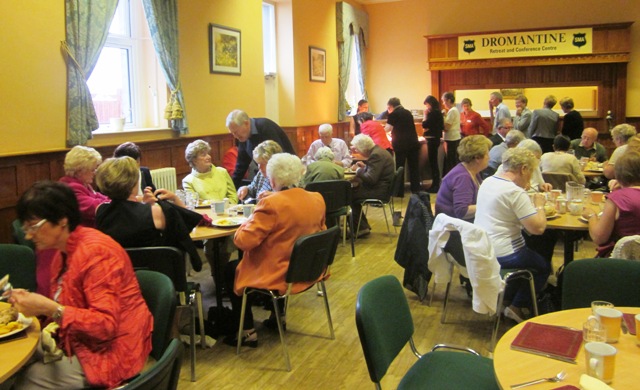
A further selection of photographs, formal and informal, taken during the 16th Irish Provincial Assembly taking place at the Dromantine Retreat & Conference Centre, Newry, Co Down.

EHartnett leads Eucharist

 Fr Eddie Hartnett led the Eucharist on Monday assisted by Frs Colum O’Shea and Maurice Henry

Colum reads about Corks defeatWith soaring temperatures in Dromantine there’s lots of opportunities to relax, read a paper, go for a walk… even read about Cork’s defeat by Kerry in the Munster Senior Football Championship 

In this second week there’s a lot more work to be done in the Working groups of which there are four.

The Chairmen are John Brown, Tom McNamara, Martin O’Farrell and Kevin O’Gorman. They are ably assisted by the WG Secretaries: Vincent Brennan, Maurice Henry, Hugh Lagan and Ollie Noonan.

Overseeing all the ‘technological stuff’ is Tom Curran.

 V Brennan makes point to Gay RedmondThe new Provincial Leader, Fr Michael McCabe, took over from Fr John Dunne as Assembly President. The animator for the Assembly is Mr Gay Redmond who can be seen here listening to a point from Fr Vincent Brennan.

Though the day is busy with many discussions there is a spiritual hinge to it all – the day begins with Lectio Divina, we celebrate Eucharist at midday and the afternoon sessions finish with an Evening Prayer liturgy. Working Groups take it in turn to animate the Eucharist and the Liturgy Committee (Frs Damian Bresnahan, Tim Cullinane and Paddy O’Rourke with the technical help of Tom Curran) look after the other liturgical acts. Their creativity helps us to remain focused on the central reason for this Assembly: we are about the work of the Lord.

Fr John Gallagher makes his point clearly to Fr Hugh Lagan and afterwards he goes for a brisk walk…

John Gallagher makes a pointJohn G  MK walking


Call for reform of Direct Provision System

Calls for Reform of the Direct Provision System

Irish Times 24 July 2013 
Another call to reform Direct Provision System.
In addition to the recent articles introduced and linked to below the new Child and Family Agency’s chairwoman Norah Gibbons has said she is concerned about children being brought up in the housing system for asylum seekers. Read More

Over the last week the media spotlight has turned, once again, on the deficiencies of the  Direct Provision System in which asylum seekers are required to live as they await decisions.  This attention is largely due to an article written by Ms Emily O’Reilly, who last week secured the role of European Ombudsman, in  “Studies” the  Jesuit quarterly review that examines Irish social, political, cultural and economic issues in the light of Christian values. In this article she said, “there were real fears for the safety of children living in direct provision (DP) centres” and warned conditions were not suitable.  Below are links to Newspaper articles written following the Studies publication and also a link to the full text of the article itself.

Irish Times, 9 July
Treatment of asylum seekers may be ‘our next national scandal’, warns Ombudsman.  Read More

RTE 9, July
Ombudsman calls for urgent reform of arrangements for asylum seekers in Ireland.  Read more

Irish Examiner, 10 July
State owes apology to asylum seekers. – Read More

Studies, Summer 2013
Dealing with Asylum Seekers: Why have we gone wrong? – Emily O’Reilly –  Read More


Pope Francis Prays for Asylum Seekers

lampedusaPope Francis prays for Asylum seekers
During a visit to the Island of Lampedusa in southern Italy, the place where thousands of asylum seekers arrive by boat the Pope called for a “reawakening of consciences” to counter the “indifference” shown to migrants.  He said:  “We have lost a sense of brotherly responsibility,” he said, and “have forgotten how to cry” for migrants lost at sea.  Read more

PA2013 photos

TC looks after the technology

A selection of photos from the 2013 Irish Provincial Assembly taking place in at the Dromantine Retreat & Conference Centre from 1 – 18 July 2013.

TC looks after the technology

Tom Curran, Assembly Secretary, looks after the technology 

Plenary session 2

Feedback from WGs during plenary sessions

Sean Joe  John

Sean Healy, Joe Egan and John O’Brien taking coffee (Fairtrade)

Assembly Candle

The Assembly Candle

Joe Egan has an attentive audience

Joe Egan has an attentive audience in his Working Group (from left: Anthony Kelly, Hugh Lagan, Seamus Nohilly, Damian Bresnahan, Tom McNamara, Joe Egan and (with his back to the camera, Denis Ryan)

Plenary session

Some of the delegates at a plenary session

Des Corrigan makes a point

Des Corrigan makes a point to his Working group: Maurice Henry, Eddie Hartnett, Colum O’Shea, Martin O’Farrell, Malachy Flanagan and Sean Healy


Jean-Marie Coquard – a review

AB At Coquards grave
Memorial at the grave of Fr Coquard

Edmund M. Hogan, Cross and Scalpel: Jean-Marie Coquard among the Egba of Yorubaland (Heinemann Educational Books, Nigeria, 2013)

Reviewed by Peter Costello, for the Irish Catholic Newspaper, June 27 (Dublin, Ireland)

With Ireland now a new mission­ary territory in the eyes of many, Irish historians have been active in the last decade or so in exploring the nature and meaning of missionary activity in the wider modern world.

This book, by a Cork-based historian and archivist of a missionary society (the Society of African Missions), explores a fascinating aspect of the great epic.

Hero

The hero of Fr Hogan’s book, Frenchman Jean-Marie Coquard, is a larger than life character – a heroic figure in all senses of the word. He was brought up in Brittany and like so many of his con­temporaries went to sea at an early age. But the sense of a religious vocation grew on him. This was frustrated at first but eventu­ally he was sent to Africa under the auspices of the SMA Fathers based in Lyon. His destination was a place called Abeokuta, now to the north of Lagos, but then a more or less independent kingdom outside of the Brit­ish protectorate along the coast of which Lagos was the capital.

What makes his career ex­ceptional was that he threw himself into the provision of medical care, learning by himself from text books not only how to treat patients but also to undertake quite serious operations. On a visit to France he was able to have some immediate experience in a Lyon hospital but essen­tially he was self-taught. This seems extraordinary but then he was an extraordinary man.

Radical

He was in fact a radical practitioner. He became interested in the use of a Vietnamese herbal treatment for leprosy which had been used by St Damien on Molokai. Even today this would be still considered ‘fringe’ medicine by many. But for him it worked. However, this career was only part of the story that Fr Hogan has to tell. Through the life of Coquard he is able to relate aspects of the development of colonialism in West Africa, the rivalry not only between France and England in the region, but also the ambitions of the local kings and chieftains. This is quite fascinating, but towards the end with the arrival of Frederick, later Lord Lugard the full extent of British rule was extended over the district.

The author remarks early in the book that in Ireland the Church was originally not keen on such mission­ary work, preferring to use its own priests at home or among the Irish diaspora in England, Australia and the US. However, towards the end of the century, he notes the ar­rival of Irish missionaries in the area, whom Coquard, patriotic Frenchman though he was, welcomed because of their native command of English and their better un­derstanding of the British imperial mind.

Also of interest is the in­teraction of Coquard with his own superiors in France, and later when he assumed more senior roles himself with the authorities in the Vatican.

However, nowhere does he lose sight of Coquard as a human being and a priest. Even today there are those who say the role of a mis­sionary should be to preach the Gospel and baptise. They should leave ‘social work’ alone. But that was not Coquard’s view – as it is not the view of many today. The cure of souls goes hand in hand with the care of bodies.

I would have liked a more extended discussion of the limiting effect of neo-Thom­ist theology on mission work which is alluded to at one point as the more recent theological developments of the notion of ‘the anonymous Christian’ will clearly have consequences here at home.

Development

This is a richly detailed book, finding room also for the de­tails of Coquard’s relations with his own family back in France. But, overall, it is about a hero of missionary work who deserves to be better known. Fr Hogan’s work will help his readers understand not just important aspects of the development of Nigeria -though the Muslim aspect of that country is not alluded to simply because at this date it did not impinge on Coquard’s work. He dealings with were pagans and ‘other denomina­tions’, many of whom were among the crowd at his fu­neral.

Fr Hogan has added a great deal to a detailed understand­ing of how the individual life plays out in the larger socio­political scheme. This a won­derful comprehensive book which will greatly enlighten all who read it.

This book is available for 15 Euro + postage, from: Archives, Society of African Missions, Blackrock Road, Cork, Ireland. On Amazon it costs 40 Euro + postage

A stubborn individualist with a contentious streak

This is one of the assessments of Rev Dr Edmund Hogan, SMA Provincial Archivist, in Cross and Scalpel – Jean-Marie Coquard among the Egba of Yorubaland, a book he has written about an extraordinary French SMA priest who spent 25 unbroken years in Nigeria at a time when most missionaries were lucky to survive half that time.

Two reviews have recently been published on this book – one by Peter Costello in the Irish Catholic (read it here) and the second, by Fr Michael McCabe of Tangaza College, Nairobi, Kenya was published in JORAS (3), 2013. We present it here to give an insight into this remarkable missionary, priest and medical practitioner.

Edmund M. Hogan, Cross and Scalpel: Jean-Marie Coquard among the Egba of Yorubaland (Ibadan: HEBN Publishers Plc), 2012.

This is a thoroughly engaging and beautifully written account of the life and ministry of a remarkable Catholic missionary who laboured among the Egba people of Southern Nigeria for almost 40 years, spanning the closing decade of the nineteenth and the early decades of the twentieth centuries. Jean-Marie Coquard, who hailed from Brittany in Northern France, began life as a sailor in the merchant navy from 1873-1882. Following rejection by the Sacred Heart missionaries of Betharram in 1885, he joined the Society of African Missions (SMA) and was ordained a priest in 1890. He immediately embarked on the Society’s mission in West Africa, taking up a medical apostolate in Abeokuta – an apostolate already initiated by both Catholic and Protestant missionaries – and opening the first Catholic hospital there. With only two trips abroad, the first in 1896, to Brazil to collect funds for a minor seminary in the Benin vicariate, and the second in 1907, to attend an SMA General Assembly in France, he was to remain in Abeokuta until his death in 1933 at the age of 74.

Without any formal training, Coquard gained an apparently well-deserved reputation as a doctor and surgeon among the local people and even among the Protestant missionaries and British representatives in the region. His medical skills, acquired mostly from personal study combined with practical experience, were honed later during a five week’s apprenticeship at the prestigious Hôtel-Dieu hospital in Lyon in 1899. The surgeons who trained him also provided him with medical equipment and funds for his hospital. Though small of stature, Coquard was a man of enormous energy, intellectual acumen, boundless self-confidence, and considerable practical and administrative skills. In addition to his prowess as doctor and surgeon, he functioned as an engineer, architect, fund-raiser, superior of the Abeokuta mission and SMA “visitor” – a position which made him responsible for the spiritual and material well-being of the SMA members in the vicariate. He was also a superb chronicler with a capacity to bring an event to life with a few telling phrases. Indeed the book contains several wonderfully illuminating passages from his letters and “Chronique d’Abeokuta”.

Coquard’s missionary career was remarkable not only because he survived 25 years in Africa without a break, but principally because of his achievements: the founding and administering of Sacred Heart Hospital, “one of the best built hospitals in West Africa” (p. 434) – a hospital with maternity and child care facilities; the establishment of a leprosarium; the promotion of education though acquiring land for the building of schools for both boys and girls; and the transformation of a precarious Catholic mission into a thriving enterprise – achieved mainly through the success of his medical apostolate.    

While his portrait of Coquard is a generally sympathetic one, Hogan does not overlook his protagonist’s shortcomings. “A stubborn individualist with a contentious streak” (p. 243), Coquard’s self-belief and tendency to self-promotion bordered on arrogance at times, especially when his position in his beloved hospital was threatened. This led to frequent clashes with his superiors, both on the home front and on the mission. Lacking in diplomatic skills, he could be abrasive in his exercise of authority. He failed conspicuously to establish harmony among his confreres, many of whom were behind various unsuccessful attempts to have him removed from the Abeokuta mission. At the same time, he was capable of winning the friendship and support not only of the local people, but also of the British colonial representatives and Egba chiefs – a support and friendship which proved vital in promoting the interests of the Catholic mission. Coquard’s work was so highly regarded by the British that in 1929 “he was invested with the Order of the British Empire (OBE) at a ceremony presided over by Sir Frank Baddeley, then the officer administering the Nigerian Government” (p. 421-422). After his death, the Egba people honoured him by naming a locomotive after him in 1935 and, in 1954, erecting and a life-size bronze stature of him in front of his original hospital building.

Hogan’s lengthy – over 500 pages – biography is the fruit of meticulous research of mostly primary sources. With the professional acumen of the trained historian, he situates Coquard’s life and ministry against the background of the political (international and local) and ecclesiastical factors at play, prior to and during his long sojourn in Abeokuta. The value of the book is augmented by several brilliant pen pictures of the leading characters in the story and further enhanced by ten appendices, over thirty pages of end notes, a select bibliography, a chronological table, a list of dramatis personae, and a name index. Cross and Scalpel offers, not only an engaging account of the life and times of a remarkable missionary, but an illuminating insight into a seminal stage in the history of Catholic missionary expansion in Southern Nigeria.

This book is available for 15 Euro + postage from:
Archives, Society of African Missions, Blackrock Road, Cork, Ireland
.

On Amazon it costs 40 Euro + postage.

Brief Introduction to Catholic Social Teaching

Catolic-Social-Teaching-icon

Brief Introduction to Catholic Social Teaching
Source: http://homelinks.dor.org/linkservid/E8F3CBF5-9A66-E67D-4D91B01BD5EBF91B/showMeta/0/ 

What is Catholic Social Teaching?
Catholic Social Teaching (also known as Catholic Social Doctrine) sums up the teachings of the Church on social justice issues. It promotes a vision of a just society that is grounded in the Bible and in the wisdom gathered from experience by the Christian community as it has responded to social justice issues through history.


Methodology: See, Judge & Act

Since Vatican II the methodology that has been promoted asks us to read the ‘signs of the times’ using the ‘see’, ‘judge’, ‘act’ method that Cardjin mad
e popular in workers’ and students’ movements. It asks us to work inductively, looking first at the social justice issues as they exist in our communities, before assessing what is happening, and what is at stake. Finally we need to discern what action to undertake in response.

Key Themes in Catholic Social Teaching
doveMany texts on CST move chronologically through the key documents of the social magisterium examining their content. By tracing ideas and themes through these documents we can see how this rich body of thought has developed through time. To provide a brief introduction to some of the most important principles of the social magisterium let us look at six of the key themes evident in these documents. Every commentator has their own list of key principles and documents, and there is no official ‘canon’ of principles or documents. In practice, the most important principles

and documents to draw on will be those that most directly speak to the situation in question.

Human Dignity & the Unity of the Human Family
Human dignity is the starting point and central concern of Catholic thinking about human rights. Each person is created in the image and likeness of God and so has an inalienable, transcendent God-given dignity. It follows that each member of the human family is equal in dignity and has equal rights because we are all children of the one God. We are sisters and brothers to each other.

We understand God to be a trinity of persons and so we see the image of God reflected not only in individuals, but also in communities. Together in community we bear the image of our God whose very nature is communal. The Catholic tradition is opposed to anything that is opposed to life itself, or that violates the integrity of the human person, and anything that insults human dignity. Human rights are the things due to us simply because we are human beings, they are the claims made by human dignity. From this principle we can derive the following criteria to help judge a social situation: “does this situation respect and promote human dignity?”, And, “what is happening to people, and to their human dignity?”

Solidarity
Solidarity has been described as a: “Unanimity of attitude or purpose” (Catechism of the Catholic Church no 1885) and also as
a firm and steadfast determination to committ oneself to the common good.”  (Pope John Paul II, Sollicitudo Rei Socialis, No.38)

The principle of solidarity means basically that we are all really responsible for each other. It is not about a vague sort of compassion or shallow distress at others’ misfortune, but involves a determination to commit oneself to working for change so that everyone will be able to reach their potential. It is about respect for and the promotion of the dignity and rights of our sisters and brothers.

The Common Good
“The common good consists of three essential elements: respect for, and poromotion of, the fundamental rights of the person; prosperity, or the development of the spiritual and temporal goods of society; the peace and security of the group and its members”
 (Catechism of the Catholic Church 1925)

The doctrine of the common good also emphasises that we are connected with other people. The common good is understood as the collection of social conditions that make it possible for each social group and all of their individual members to achieve their potential. It means that each social group must take account of the rights and aspirations of other groups, and of the well-being of the whole human family. The rights and duties of individuals and groups must be harmonised under the common good.Questions that flow from these principles when judging a social situation might include: “are the benefits enjoyed by some groups attained only at the cost of other groups?”, And, “what are the consequences of this policy for those living in poor countries?”.

Universal Destination of Goods
The universal destination of goods refers to the fact that God intended the goods of creation for the use of all. Everyone has the right to access the goods of creation to meet their needs. People and nations have no right to squander resources when others are in need. The key question here is: “does everyone have access to a large enough share of resources to meet their needs?”

Participation
Because of their intelligence and free will, people have both a right and a duty to participate in those decisions that most directly affect them. They are actively to shape their own destiny rather than simply accept the decisions of others.This right to participate belongs not only to individuals but also to groups and communities. One way to reflect on participation is to ask: who wins? Who loses? Who decides?

Subsidiarity 
The Catechism of the Catholic Church calls us to live in solidarity with all peoples: “In the sanctorum communio, ‘None of us lives to himself, and none of us dies to himself.’ fn.487 ‘If one member suffers, all suffer together; if one member is honoured, all rejoice together. Now you are the body of Christ and individually members of it’ fn. 488 (No. 953).  

The principle of subsidiarity places responsibility as close as possible to the rassroots. The people or groups most directly affected by a decision or policy should have a key decision-making role. They should only be interfered with in order to support them in cases of need, and to help coordinate their activities with the activities of the rest of society with a view to the common good.


Sandie Cornish B.Ec. (Nctle), Lic. Soc. Sci. (PUG), M. Pub. Pol.(UNE)

2013 Trafficking in Persons Report

2013 Trafficking in Persons Report
Article written by David Lohan, co-author of the Cois Tine Publication: “OPEN SECRETS, an Irish perspective on Trafficking and Witchcraft.

The annual launch of the Trafficking in Persons Report was held at the Franklin Room in the U.S. Department of State building in Washington D.C. on June 19th, evening just prior to 9pm GMT. The report was launched by Secretary for State, John Kerry. The launch was broadcast live via the U.S. Department of State website http://www.state.gov. The report evaluates the adherence of some 188 countries and territories to the minimum standards of protection, prosecution and prevention (3Ps). The report also provides insight into the contemporary situation in, through the narratives it provides on, each jurisdiction.

2013 Golden Jubilee homily

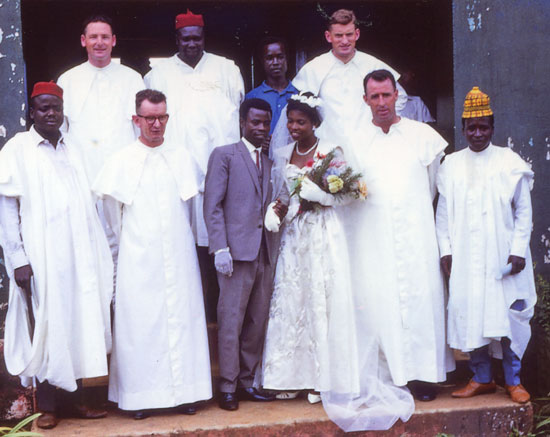
GJ13-DC-preaching

Fr Dan Cashman preached at the Thanksgiving Mass on the occasion of the Golden Jubilee of the 1963 Ordination class. The Mass took place on 15 June 2013 at the African Missions, Blackrock Road, Cork. Fr John Dunne, SMA Provincial Leader, was the Principal Celebrant.
GJ13-DC-preaching

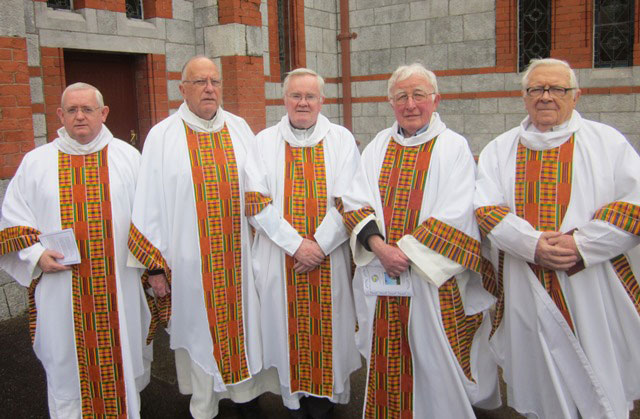
Fr Dan Cashman preaches as Frs Denis Collins, Maurice Kelleher, Sexton Doran and Jim Tobin listen attentively

Genesis 10:1-9
1 Corinthians 11:23-26
John 13:1-5, 12-15

One weekend, about 15 years ago, I was asked to help out with preaching at the Mission Appeals in the British Province. After the last Mass on Sunday evening a young boy of about nine / ten years came into the Sacristy and handed me an envelope. ‘That’s my pocket money’, he said. I opened the envelope and found a ten pound note in it. I was very reluctant to take the money but he insisted and then dropped a bombshell. ‘Take it, Father’, he said, ‘for my mother told me that you are the poorest preacher we ever had’.

Now that I have established my credentials let me say that it is a privilege to join the Jubilarians today in thanking God and congratulating the class of 1963.

It is true that all missionaries get older with the passing of years, but the priesthood never ages for each time we offer the Eucharist, Christ is made present again. Furthermore the grace of each sacrament we celebrate is created anew for the person who is looking for a closer union with God and God’s love. The priesthood is as young each day as it was on the day of ordination for the class of 1963.

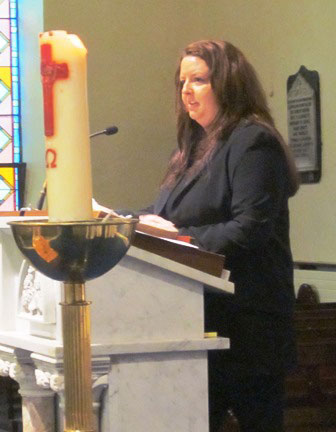
GJ13-First-ReadingOur reading from the Book of Genesis (read by Denis Collins, pictured left) speaks of the call and journey of Abraham to a distant land. He accepted the challenge and set out, with whatever he had accumulated over the years to find the fulfilment of a dream. I like to think that it was like that for the 1963 class as they gathered together all their notes on epistemology, dogmatic theology and, of course, the vademecum of every missionary: De Reaper. That book, it was said, contained all a missionary needed to know.

The young men of the ’63 class set out on a journey to a strange new land with enthusiasm and hope. No ‘Stage’ in those days; no ‘dipping a toe’ in the water to see if one could take the pressure of missionary work. It was in at the deep end to either sink or swim!

Nigeria was the destination for most of the class and it really was an exciting country in those days. The people had gained independence in 1960 and so the Nigerians themselves were searching for their own identity. That search led them down the path of Civil War and the missionary work moved in a new direction.

Many of the lay leaders in the Church at that time, mostly from the eastern states, just disappeared and so a new community emerged. This new church was slimmer but also more in touch with the customs of the local people. Like the long line of great SMA missionaries who preceded them the 1963 class were sufficiently flexible in their approach to mission that a few years after the end of the Civil War they had a truly local church with not only local lay leaders but an influx of local priests, Rev Sisters and even the beginning of Nigerian bishops.

The Civil War itself threw up a variety of other problems especially in the area of security. Expatriate missionaries were looked upon with great suspicion especially by the Nigerian Army and one had to tread very carefully indeed.

GJ13-Reflection-moment-2One member of this class had to lie on the floor of his Mission House for hours as the bullets whizzed above his head, hitting the walls and scattering chunks of plaster around the room.

Then, as suddenly as it started, the war ended. There was no demand for a Truth & Reconciliation Commission as happened elsewhere. The Nigerian people just got on with life.

Not everyone could relax, however, at the end of the war. Many a Schools Manager had panic attacks when his former teachers returned, besieging the Mission demanding arrears of salary for the three years of the war.

But let us return to our reading from Genesis. We see towns and settlements mentioned like Shechem, Bethel, Ai and the Negev. These give us a picture of Abraham’s journey. Uromi, Aghalokpe, Akure, Ekpoma, Uzuarwe, Ibadan, Pankshin, Ilorin, Shendam, and later Ndola and Tapita, plot the journey of our Jubilarians. The place names are different but the purpose of the journey is the same: to make known a merciful God, to unite all peoples and to open the hearts of all so that they wound understand that God is not a God of fear but of love. Just as Abraham was blessed in his journey our Jubilarians were blessed in theirs, as was the missionary tradition that they lived and the personal gifts they shared with the people. Our Jubilarians were Graced.

Grace, I believe, is a gift we recognize with hindsight. Sometimes we only see God’s intervention in our lives long after it has taken place. Grace quietly enters our spirit and smoothes over the mistakes, lapses and often sheer nonsense that is part and parcel of all our lives. It enables us to forgive ourselves for all the errors we have made in the exercise of our ministry and allows us to focus on what God can do and what God has done in spite of everything. Grace is what keeps us striving to be a sign of Christ’s concern for his people.

GJ13-4-priestsSo how does this grace take over our lives? I believe we find the answer in the second and third readings which focus our attention on the Eucharist. The Eucharist is absolutely central to priestly life. St Paul celebrates the Eucharist in the second reading and, in one sense, St John in the Gospel reading shows us the Eucharist in action.

Pictured left: Jim Tobin, Sexton Doran, Denis Collins & Mossie Kelleher.

There have been many changes in the Church over the past 50 years as a result of the Second Vatican Council. Big changes have also taken place in the SMA.

We know that the formation the Jubilarians received was based on teachings that, remarkably, remained unaltered for the best part of a century, so it may have disturbed some to find that Noldin, Tanquery and Bouscaren did not have a monopoly on wisdom and that pastoral options were not always limited to the Pauline or Petrine Privileges and when things got out of hand or too complicated the all-embracing Sanatio! Added to that the upheaval the Society as it set out its own goals and objectives which changed many aspects of our traditional view of Mission.

The prevailing atmosphere and attitudes of the time eliminated the stability of previous years and some were left floundering. That the class of 1963 was able to rise above the uncertainties and fulfil their missionary oath is surely a miracle of grace. It may be that God first sowed the seed for that gift in the preparation they received from the Formation team in our seminary and the prayers of our supporters.

GJ13-GSDuring all these changes the central role of the Eucharist never altered. The Eucharist was the one constant in their lives and through their Eucharistic prayer they reached calmer waters.

Fr Gerry Sweeney, ministered in Nigeria and Liberia, was involved in the training of Irish SMA seminarians in Cloughballymore, Wilton and Maynooth, was part of the staff of the Dromantine Conference Centre followed by pastoral work in Clonfert diocese before ill health forced his retirement to the SMA community in Claregalway.

It was the Eucharist that brought them to realize that they, with their people, are the Body of Christ and that we are all interconnected. So they celebrated the Eucharist in their churches and washed the feet of the suffering and marginalised in the streets. It was all Eucharist.

They found that they could offer up in that Eucharist their frustrations and sacrifices associated with their pastoral work and personal concerns. It was this that kept them in ministry and enriched it for as the Second Vatican Council Constitution on the Liturgy says ‘the most holy Eucharist holds within itself the whole treasure house of the Church’.

I suppose as we all look back over our lives we might easily apply the words of Padraig Pearse who wrote: ‘I have squandered the splendid years which the Lord gave to my youth, in attempting impossible things, deeming them alone worth the toil. But Lord if I had these years back, I would squander them all again’.

It is that spirit we are celebrating today.

We thank God for his faithfulness which never ends and which continues to burn in the lives of the class of 1963. So we congratulate you, our Jubilarians, and wish you many more years of fruitful and faithful service in whatever situation you may find yourselves.

2013 Silver Jubilee homily

Jubilarians P ORourke

Jubilarians P ORourkeWhen Fr. John Dunne asked me to give the homily at the Silver Jubilee Mass this year, I was at first hesitant because I tend to shy away from formal occasions. But as time went on I began to see it as an opportunity not just to reflect on the meaning of the Silver Jubilee for the seven men involved, but also an opportunity for myself to reflect on mission and priesthood.

Fr O’Rourke preaches as Fathers Denvir, Olivoni and Faherty listen.

So I am honoured and grateful for this opportunity, firstly to be present here with our six Jubilarians: Fathers Alberto, Chris, Damian, John, Padraig and Tommy to share in the celebrations of a collective 125 years of service to mission as priests. I also am mindful of Fr Ken Cooney who is not with us today as he is still in South Africa.

That is a lot of years, a lot of days, blessing and touching the lives of numerous communities and individuals in different parts of the world. None of us will fully understand the full extent of the good work that has been done by these seven men, not even the Jubilarians themselves. The kind word, the listening ear, the compassionate presence, helping someone find a way where there seemed to be no way, these simple things will have made a world of a difference to many that each of you have met over the past twenty five years.

Sat Nav

In the past few years I am sure many of us who found ourselves travelling to place that were new or unfamiliar with the aid of that new gadget called a Sat Nav. When we take the wrong direction, immediately you hear the words “recalculating, recalculating” from that lady with the mechanical voice repeated many times. And within seconds you receive directions on the next turn you need to take to get back on track. Wouldn’t it be nice if we had a Spiritual Sat Nav which would alert us when we have taken a wrong turn and then give us directions on how to get back on track. Actually we do have a guidance system which helps with directions through the journeys of life: Psalm 119 tells us that the work of God is a lamp for our feet and a light for our path.

Let Go, Let God

Jubilarians Peter ThompsonFr Peter Thompson read from the prophet Isaiah.

About twenty years ago I attended the Intercession for Priests in All Hallows College for two days. During that time, participants were asked to go in two’s on an Emmaus Walk, to share something of their faith journey together. I was coupled up with an elderly priest, whom I will call Fr. Brian. He shared with me about how he took a religion class every Friday afternoon at the local convent school with a group of girls attending a Secretarial Course. Fr. Brian often felt he was wasting his time during these Friday sessions, as the girls seemed to more preoccupied with fashion, boys and where they were going to socialise that weekend. But Fr. Brian kept going every week to the religion class as he enjoyed the girls youthful spirit and spontaneity. Some years later Fr. Brian, now working in a different parish, was walking down the street and a very good looking young woman, beautifully dressed, came up to him smiling and gave Fr. Brian a big hug and told him how happy she was to see him. Fr. Brian hadn’t a clue who this woman was. She then told him that she was one of the girls on that Friday Secretarial Course. “I am delighted to have this chance to meet you again Fr. Brian,” she said “because for a long time I have wanted to thank you for something that you said one day during RE Class, which has been of great help to me during some very difficult times in the past few years”. Fr. Brian had no recollection of the bit of wisdom he had shared all those years before, but he said that the experience of meeting that young woman thought him one very important lesson: “Say your prayers, do your work, and the Holy Spirit will work in spite of you”.

Say your prayers – Start with God, reminding yourself its Gods work, Gods call, Gods mission, Gods ministry. We are just but workers in his vineyard. By saying our prayers implies that we continue to remind ourselves daily, it is not my work, but I am called to participate in it, I am responding to an invitation. Prayer creates a space of allowing, allowing God to do Gods work, in and through me. With the right intention and listening heart, I am ready for the next stage.

Do your work – I get out of bed every morning with a thankful heart, with a sense of purpose, a mission, a task at hand. I am not afraid to pull up my sleeves and get fully involved in what that new day presents to me. I make available with a generous heart the gifts and abilities God has given to me for the service of others… Through our work, the dreams and plans and inspirations of our hearts, become manifest in reality. The word becomes flesh. We co-create something new with God grace.

The Holy Spirit will work in spite of you – being very mindful of the first reading of Isaiah chapter 61 today where we are reminded that the Spirit of the Lord has been given to us, that we are anointed and sent out in its power. It is a spirit of action, inviting us to bring Good News to the poor, healing broken hearts, announcing Liberty to captives, freedom to prisoners and comfort to all who mourn. You almost get the image of water that is ready to burst forth through a dam, wanting to bless, renew and restore.

Fr. Brian’s words “the holy spirit will work in spite of you,” reminds me in some way of the image of St. Paul in Second Corinthians 4 comparing us to Earthen Vessels, containing a treasure. We are like fragile pots, with our weaknesses and human shortcomings, but containing treasure far beyond our wildest imagining. The invitation to us is to continue to be Co–Creators in God’s work. Maybe we can sum up what our task is in the phrase, “pray as if it all depends on God, act as if it all depends on you.

Jubilarians Mark MonaghanSt Paul in the Romans 12:4-8, which Fr Mark Monaghan (pictured) just read, says, “God has given each of us the ability to do certain things well”. Paul is stating what most of us would see as an obvious fact: that we are all gifted in different ways. Among you, the 1988 class, these gifts are many and varied.

I am sure you have heard the phrase: God does not want so much your ability as your availability. Thank you for the way you used your gifts / talents at the service of the building of God’s Kingdom. Your unique contribution which is particular to each one of you, which only you could have made, has added to the rich heritage of the mission activity of the SMA. Each one of you, with your unique and varied contributions and particular personalities has made the SMA a much more interesting group to be members of, and we thank you for that.

You have spent a substantial number of years working in six countries of Africa, as well as the Philippines, England and Ireland. Your activities have been wide and varied, including such work as evangelization in urban and rural apostolate, youth work, education, formation work in Nigeria and Philippines, organising and running of project in war torn Liberia, the study and teaching of local languages in South Africa, involvement in leadership on diocesan, regional and at provincial levels, providing medical and health care facilities in Nigeria, mission promotion work in Ireland, conflict and peace work in Kenya, and much much more.

Daily Routine or Daily Renewal

Some years ago I was the main celebrant at the Eucharist of a small group of SMA at our Regional House in Mwanza, Tanzania. After Communion time we were having a quite time of reflection, during which time I could hear some low level murmuring going on. I was a little irritated with the behaviour and asked what the problem was. One of the group replied by asking me “What about us?” I suddenly realized that at Communion I had consumed everything, purified the chalice and left the other three people present with nothing. This happened at a time when I was living on my own for some months and had often celebrated Mass on my own.

How easy it is for a daily practice to become a mechanical routine during which time you can so easily leave your heart outside the door. How easy it is to miss the crucial point of what is actually taking place.

Today’s gospel from Luke 22 is a great example of how we can miss the point. At the celebration of the Passover we heard that Jesus took some bread… gave thanks… broke it… he gave it to his disciples. He did the same with the cup after supper.

Here we have Jesus offering his very self to the disciples (the same self-giving which we encounter in each celebration of the Eucharist). But the disciples attention is in a completely different place, concerned with who should be regarded as the greatest among them.

Each day as we celebrate and participate in the Eucharist, we are given afresh, an opportunity to encounter that self-giving of Jesus, and to respond in giving ourselves, our talents and energy to the service of the Gospel. Sometime our response has been lacking and may have been caught up in self interest and fear, rather than generosity and service to our brothers and sisters.

In the words of Thomas Merton’s Prayer of Abandonment, I pray that you, Chris, Damian, John, Tommy, Alberto, Padraig and Ken, and each one present here, for now and for all the years that the Lord gives us on this earth:

My Lord God, I have no idea where I am going.
Nor do I really know myself, and the fact that I think I am following your will,
does not mean that I am actually doing so.

But I believe that the desire to please you does in fact please you
and I hope that I have that desire in all that I am doing.

And I know that if I do this,
you will lead me by the right road although I may know nothing about it.

Therefore will I trust you always though I may seem to be lost and in the shadow of death,
I will not fear, for you are ever with me and you will never leave me to face my perils alone.

Don’t go back to work, and above all, don’t go home!

 
Reflection for July 2013

 Imagine waking up one morning, doing the usual routine, breakfast, helping to get the children out to school and setting off for work.  At your lunch break a friend warns you:  “Don’t go back to work, and above all, don’t go home. The military are looking for you”.  Another friend, vocally critical of the regime disappeared two days ago and now you are under suspicion and could also disappear.  You have to flee, but you can’t tell your family at home.  You have nothing, just the clothes on your back, a small amount of money and a mobile phone  – no papers, no proper identification.  You have to get out you must run. 

Refugees are the invisible people of our time

According to Fr Mauro Armanino, an Italian member of the Society of African Missions (SMA), “refugees are the invisible people of our time.” Fr Mauro, formerly a missionary in Ivory Coast and Liberia and now working in Niamey, Niger was speaking to FIDES, a Vatican News Agency. He was speaking as the world celebrates World Refugee Day on 20 June.

“There is much talk about them at the moment. They become visible as the result of a crisis and are put into camps which are set up not too far from the borders. But, if they are in a town, they often become invisible, invisible as the poor”, he says.

“Refugees have a history which is too heavy to carry and too complicated to tell: words fail to do so. They experience displacement and marginalization in solitude.

Theirs is often an experience of abandonment and sometimes rejection. But in some cases they do experience some sense of solidarity, in small ways. For refugees, it is above all a renewed sense of faith in God that is perceived as their only comfort in life.”

Fr. Armanino believes that “the definition of a refugee is clear but it should be updated in the light of what is happening in our globalized world. It is now difficult – he explains – to establish the difference between a refugee who has no choice but to escape from his Country to save his own life and those who leave for climatic or economic reasons.”

But beyond these differences what matters, concludes the missionary is “to ensure that what is hidden becomes visible and recognized. Sharing this experience is an important sign of civilization and openness. We can humanize ourselves only by remaining together.”

[With thanks to an Agenzia Fides article, 20/6/2013]

Ireland rejects more asylum seekers than most European Countries

Ireland rejects more asylum seekers than most European Countries
19 June 2013:
This article from the Journal.ie presents the latest statistics showning the continuing decline in the number of asylum seekers coming to Ireland and also the fact thatr those who do apply for asylum here are rejected at a far higher rate than most European countries. Read more

Four churches burned in Borno State, Nigeria

According to the Vatican News Agency – Agenzia Fides – Four churches were burned in an attack probably committed by members of the jihadist group Boko Haram in Borno State, one of the three northern states of Nigeria where a state of emergency has been imposed.

According to the Archbishop of Jos, Most Rev Ignatius Kaigama, a group of armed men with improvised explosive devices and petrol bombs attacked the Hwa’a, Kunde, Gathahure and Gjigga communities on Gwoza Hills, burning the 4 churches, raiding and looting cattle and grain reserves belonging to the population.

Unfortunately I do not have precise information and do not know what communities the Christian churches destroyed belong to,” Archbishop Kaigama told FIDES. The Archbishop is also the President of the Catholic Bishops’ Conference of Nigeria. “All communications have been cut off with the areas affected by military operations and it is impossible to get in touch with the Bishop of Maiduguri,” he explained.

Despite this incident, the Archbishop said that “the operation of the Nigerian army and the imposition of the State of emergency has made the population feel better and safer.

It seems certain that Boko Haram is coordinating with jihadist groups expelled from Mali and are now operating in Niger, to the north of Nigeria. The Archbishop believes that “Boko Haram is a regional issue and should be resolved with a regional approach. We are paying the price of terrible negligence on behalf of our intelligence and our police forces who did not deal with the phenomenon in time. Now we need to bring together the resources of Nigeria, Niger and Mali to address the threat of jihadist groups. I think, however, that eventually they will be defeated.”  (Agenzia Fides 17/06/2013)

IRISH BISHOPS on the G8 Summit

bishops conference

bishops conferenceIRISH BISHOPS on the G8 Summit – June 2013
During their recent meeting in Maynooth Irish Bishops noted that the forthcoming G8 summit will be taking place in Enniskillen on 17 – 18 June. Bishops discussed the values that inform our choices in matters of social and economic policy, and they underlined the need for the value of solidarity to be the guiding principle in decisions currently facing world leaders.

They agreed that, against the backdrop of the widespread suffering caused by poverty, inequality and social exclusion, solidarity is needed to rebuild trust, restore relationships and give hope for a real and lasting recovery. Bishops wished to add their voices to those calling for greater transparency in matters of finance and taxation and stated that the protection of the rights of the poorest and most vulnerable is not only a question of charity, but is primarily a question of justice. It is a responsibility arising from our duty to care for our neighbour. It is also an essential prerequisite for a truly prosperous society; without fairness and social cohesion we will never achieve lasting prosperity.

Bishops said: It is a scandal that, despite all the extraordinary technological advances of the present age, one in eight people throughout the world are still going to bed hungry – including millions of children, who are not getting the start in life they deserve. As has been effectively highlighted in the ‘IF’ campaign, a more just and equitable distribution of resources is both achievable and imperative.

In the context of the forthcoming G8 summit, Trócaire, the overseas development agency of the Irish Bishops’ Conference, has called for action to address structural injustices that have contributed to one billion people going hungry every day. With the current Millennium Development Goals (MDGs) set to expire in 2015, there is a need to strengthen efforts to tackle the underlying causes of poverty post-2015.

Trócaire, along with other development agencies from Ireland and the UK, is calling on the G8 leaders to take the political decisions at their upcoming summit to ensure that G8 Erneeverybody in the world has enough food. It is asking the leaders to address: tax transparency, trade reform, climate change, and the negative impact biofuels have on food production.

Recognising that many people will be taking part in public manifestations on the margins of the G8 summit to highlight these and other social justice issues, bishops said it is vital that they are able to do so safely, peacefully and respectfully.

Bishops concluded:We pray that the forthcoming G8 summit will be a fruitful and productive experience, bringing us closer to peace and prosperity throughout the world.

Auxiliary bishop of Niamey installed

Bishop Djalwana Laurent Lompo was ordained as the Auxiliary Bishop of the Archdiocese of Niamey (Niger) on Sunday, 9 June 2013. He will assist Archbishop Michel Cartateguy SMA in administering this huge diocese which covers 200,000 sq kms (more than twice the size of Ireland). A second diocese, Maradi, is five times larger at 1 million sq kms! According to the latest statistics the two dioceses between them have just 20 parishes (and dozens of outstations) with 50 priests to cover them all.

Memebrs of the Society of African Missions from France were the founding members of the Church in Niger. The Redemptorist Congregation also work in the country. Today there are 13 SMA missionaries in the country, all working in Niamey Archdiocese.They come from Argentina, France, India, Italy and Spain.

The Coat of Arms of the new bishop features a calabash held in two hands (looks a bit like a pumpkin cut in half). It symbolises ‘welcome’ and during the ordination ceremony it was presented to the new bishop. It is filled with water and is offered to the traveler and to anyone who visits the house. The other features of his Coat of Arms are an open Bible and the yellow background of the Sahel with the words underneath: “There is more joy in giving than receiving“.

Bishop Lompo prayed for the gift of simplicity.

There was some anxiety before the celebration concerning security. But the civil authorities of this overwhelmingly Muslim country have great respect for the Catholic Church and the work it does among all the people and the security forces maintained a presence and ensured everything passed off peacefully in the Sports ground where about 3,500 people gathered.

The Archbishop of Niamey, Michel Cartatéguy SMA (from the Basque Region) presided over the ceremony which was attended by most of the bishops of Burkina Faso. The songs, the dances, the symbols and especially the atmosphere of unity turned the event into a celebration of life for all.

Bishop Lompo is from the Gourmanché people and is the first Catholic Bishop in Niger who is a native of the country. The Gurmanché people can be found in both Burkina Faso and Niger. There are Zerma / Sonhrai, Hausa and immigrants from Benin Republic, Togo, Ivory Coast, Liberia and other countries along  the Atlantic coast living and working in Niger.

Niger has an approximate population of 19 million people, of which 25,000 are Catholics. Of that number only 20% are Nigeriens. The remaining 20,000 come from neighbouring countries. The presence of the Catholic Church is the “natte”, i.e. a sober, humble presence. Another way of celebrating the Gospel.

During the ceremony two white doves were released, as a symbol of peace. Establishing true peace is one of the challenges facing all in the Sahel area of Africa.

One World, One Future

Mission Today & Tomorrow was the theme of a recent conference aiming to address the reality of modern day mission, the work of missionaries and their role in Ireland’s overseas development programme.

The Minister for Trade and Development, Mr Joe Costello, paid tribute to the missionaries, hailing them as key partners of the Irish government in their continuing work across the developing world. His address to the Conference echoed some of the key ideas in the recently published Irish Aid policy document on development: One World, One Future. The Irish Aid document states that work of our missionaries remains an important aspect of Ireland’s contribution to development.

Though quite a substantial document it deserves to be read as it clearly demonstrates that, despite what is often trumpetted in various media, Irish people believe that we as a country should continue to reach out to the less well off in the world and support efforts to alleviate their poverty: “There is strong public support – including across political parties – for the aid programme. People want Irish Aid to maintain the high quality of its work, for which it has been internationally recognised, and they want us to keep them informed of progress.” (page 7 of OWOF).

Mrs Nora Owen was the Chairperson of the Expert Advisory Group who conducted the Review on which the new policy is based. A great debt of gratitude is due to her and the other members for putting so much effort and time, including travel to some mission areas for ‘in the field’ experience of how Irish Aid and particularly the millions of Euro given to projects under the care of Irish missionaires, is used to a very effective degree.

One of the key commitments – to achieve the target of 0.7% of GNI allocated to international development cooperation – was restated.

Read some extracts from Minister Costello’s address to the Mission Today & Tomorrow Conference, as released by the Irish Embassy, Abuja, Nigeria.

Social Icons

facebook youtube twitter

Funeral ceremonies for Fr Donal O’Connor SMA

DOC Family

Following his death at the SMA House, Blackrock Road, Cork, Fr Donal Michael O’Connor, was laid to rest after Concelebrated Funeral Mass at 12 noon on Monday, 3 June 2013.

Obituary            Homily at Requiem Mass

The following is an account of the different ceremonies for Fr Donie before his burial in Wilton cemetery.

Fr Donal O’Connor’s remains returned to Blackrock Road on Saturday afternoon at 5.30pm. Fr Colum O’Shea and the community along with Honor O’Connor, Annette Ricketts and his cousin Sr Brenda Mary were there to receive the remains. Following the placing of the coffin before the Altar, Evening Prayer for the Dead was recited by all.

At 7pm, one of Donie’s students, Martin Kavanagh, led the Rosary. After each decade verses from Psalm 23 (The Lord’s my shepherd) were read. At the end of the Rosary prayers the community sang one verse of the hymn – Day is done, reminding ourselves that though Donie’s days on earth are complete he has now begun his eternal life with God.

Day is done, but love unfailing dwells ever here

Shadows fall, but hope, prevailing, calms every fear.

Loving Father, none forsaking, take our hearts of Love’s own making

Watch our sleeping, guard our waking, be always near.

At 7pm on Sunday evening the community gathered again for prayers and the removal of Fr Donie’s remains to St Joseph’s SMA Church, Wilton. Fr Colum O’Shea led the prayers and gave a brief reflection which is summarised here.

“Fr Martin Kavanagh, who was a student of Donie’s in Maynooth, spoke about him last night. He spoke fondly of the man that he and all his former students held in high esteem and with great respect. Others who knew him in different situations would agree.

I knew him briefly in the 80’s when he was in Maynooth and he struck me as being cool and calm.

I did not meet Donie again until a couple of months ago when he took up residence here. Those of us who have been with him during these weeks could not but have been touched by the way he accepted the inevitable. Those qualities of coolness and calmness were manifested again. They were tough weeks for him but he never complained. He was resigned to God’s will.”

For someone who gave his life in serving and caring for others here he was now dependent on others. He was well cared for by the nursing and caring staff of St Theresa’s and by Annette. They did everything possible to make his final days as comfortable as possible. He died peacefully on Friday evening, with Annette and Sharon at his side, the feast of the Visitation of Our Lady.

May his gentle soul rest in peace.”

Removal to Wilton

After the final prayers Fr Donie’s remains were brought across the city to St Joseph’s SMA Parish Church at Wilton where they were received by a former student, Fr Jarlath Walsh SMA. Fr Con Murphy, who was on the SMA Maynooth formation staff with Donie, read from the Book of Wisdom and Fr Jarlath read from St John 14: “In my Father’s house are many rooms; if it were not so, I would have told you. I am going there to prepare a place for you. And if I go and prepare a place for you, I will come back and take you to be with me that you also may be where I am. You know the way to the place where I am going.” Afterwards all were invited for light refreshments in the community Dining room.

Funeral Mass and burial, Monday, 3 June @ 12 noon

DOC Family

Fr Donie’s sisters, Catherine and Honor, and his good friend Annette Ricketts are joined by other relatives and friends at the Requiem Mass in St Joseph’s SMA Church, Wilton.

Fr John Dunne, SMA Provincial Leader, led over 50 priests in the concelebrated Requiem Mass for Fr Donie. Principal concelebrants were Bishop Kieran O’Reilly SMA (Bishop of Killaloe, and a former student of Donie in Maynooth), Fr Patrick N McGuire SMA (British Provincial Superior, also a former student of Donie in New Barnet, London), Fr Kevin Mulhern SMA (who worked with Donie in Walthamstow) and Fr John Brown SMA (Fr Donie’s successor as PP of Walthamstow).

Among the other concelebrants were classmates Frs Michael Igoe and Richard Wall (home on holidays from his parish in Nigeria) as well as many former students, both non-ordained and ordained. Another classmate, Fr Derry O’Connell, had returned to his mission in Jos Archdiocese (Nigeria) a few hours before Fr Donie’s death.

The Bishop-emeritus of Lodwar diocese, Rt Rev Patrick J Harrington SMA, was also among the concelebrants.

Relatives and friends travelled from many parts of Ireland (including Kerry, Dublin, Kilkenny, Mayo, Wexford and Wicklow) to join Donie’s sisters Kate and Honor as they said their final farewell to their beloved brother. Fr John Brown SMA, who succeeded Donie as Parish Priest of Walthamstow came with a group of parishioners to pay their respects to a gentle and kind pastor. OLA, Presentation, Mercy and other congregations of Religious Sisters were also in the congregation for the Mass.


Bishop Kieran O’Reilly SMA, assisted by Fr John Dunne, leads some of the prayers during the burial of Fr Donie.

DOC Cemetery


After the Final Prayers and Commendation in the Church, Fr Donie was carried to his final resting place by his nephews and friends. Bishop Kieran O’Reilly blessed the new grave and Fr Tom McNamara SMA (a former student of Donie’s and who worked with him in Walthamstow) led a decade of the Rosary. Before the end of the ceremony Fr Pat O’Mahony SMA (a former student) led the mourners in singing the Salve Regina.

DOC Walthamstow

Some parishioners and Fr John Brown SMA came from Walthamstow to commend Fr Donie, their former Pastor, to the Lord.


A friend from the past…

During his illness in Cork, Fr Donie was visited by a former pupil from Egypt: Gerard Momjian and his wife, Kay. Gerard was a member of the Armenian Community in Cairo, Egypt, and he attended the St George’s College, Heliopolis, founded by the SMA. During his years there (1959-1962) the teachers (which included Fr Donie) made a big impact on him and he visited the SMA Houses in Cork recently to pay tribute. Though very ill at the time, Donie received Gerard graciously. In a moving conversation they spoke about the school and about Egypt and Fr Donie told Gerard and Kay that he would be soon going to God and would remember them and their family to Him.

After completing his education Gerard emigrated to Australia, and later, after he was married, went to live and work in Paris, France, where he now lives. His wife, Kay, is an Australian and they have two grown-up sons.

During his visit to Cork Gerard and Kay visited the SMA Motherhouse at Blackrock Road and the SMA cemetery at Wilton, where he saw the resting place of some of his former teachers, including Fr John Joseph Murtagh, who was Headmaster of St. George’s College, during his time there. He also had very fond memories of Fr. Eugene Melody, an SMA priest who was later incardinated in an Irish diocese.

Read Obituary here.                     Homily of Fr John Dunne SMA

Fr Donal M O’Connor SMA – funeral homily

DOC Concelebrants

Fr John Dunne, SMA Provincial Leader, led the concelebrated Requiem Mass for Fr Donal Michael O’Connor on Monday, 3 June 2013 at St Joseph’s SMA Church, Wilton.
The readings for the Mass were taken from Ecclesiastes 3, 1-7,11; Romans 14: 7-12 and Matthew 5: 1-12.

DOC Concelebrants

Pictured before the Requiem Mass were the Principal Concelebrants: Fathers Kevin Mulhern, Patrick N McGuire, John Dunne (Provincial Leader), Bishop Kieran O’Reilly and John Brown.

The following is Fr John’s homily on that occasion.

Thanksgiving is sweeter than bounty itself.
One who cherishes gratitude does not cling to the gift!
Thanksgiving is the true meat of God’s bounty; the bounty is its shell,
For thanksgiving carries you to the heart of the Beloved.
Abundance alone brings heedlessness,
Thanksgiving gives birth to alertness…  
The bounty of thanksgiving will satisfy and elevate you,
And you will bestow a hundred bounties in return.
Eat your fill of God’s delicacies,
And you will be freed from hunger and begging.  [Rumi]

We gather today to celebrate the life and work of Fr Donal O’Connor or Donie as many of us knew him. Over the last month or more we have been blessed to spend time with him as his life slowly drew to a close. That was not an easy time for him or for family and friends due to the nature of his illness. But now it is time to remember and celebrate his life of 80 years full of living and giving.

Fr Donal O’Connor will be remembered by many in different ways today and hereafter. One of the things I’m conscious of is that he did not use two words where one would suffice; he could sit in silence in your presence. I think he would not like me or anyone else using too many words about him on this occasion. However, I have no doubt he would like to be remembered quietly. The Scripture passage chosen for the first reading today speaks eloquently about life and its hidden mystery; and it also reminds us about the life of Donal. There is a time for every purpose under heaven. Too often perhaps we rush to fix the time and to manage it in our way and this in turn prevents us from grasping and appreciating the grace of the present moment:

“… Life is not hurrying on to a receding future,

nor hankering after an imagined past.

It is the turning aside like Moses

to the miracle of the lit bush, to a brightness
that seemed as transitory as your youth
once, but is the eternity that awaits you.”
[The Bright Field, RS Thomas]

If we do not see the beauty of the truth that for everything there is a time and a season, then at a time of mourning or loss we may want to rush ahead or to hold back. But there is a time to be born and a time to die; a time to hold on and a time to let go.

Looking now at how Donal lived the years of his long life we can see that there were many different seasons or invitations to do different things right from the beginning in Tralee where he was born on 28 April 1933. Then there were the years of family life with his parents, the late Catherine and Michael, RIP, his sisters, Kate and Honor. Good, happy years I believe! Then there followed his school years at CBS and his interest and involvement in local activities and sport. With his decision to enter the SMA – he became a member on 2 July 1952 – and the subsequent years of formation in preparation for ordination on 13 June 1956, a whole new range of seasons opened up for him bringing new challenges, opportunities and graces. Throughout these years and seasons he gradually learned that there was a time for every purpose under heaven. He was a man who was conscious of the need to live in the present while also acknowledging the stories of the past in order to better live in each new phase in preparation for the next season. He knew there was a time to seek, a time to let go and a time to find.

DOC Concelebrants 1

Some of the concelebrating priests and congregation during the distribution of Holy Communion

We all search for something important, a pearl in our lives. The poet RS Thomas reminds us of an important truth for living and dying:

I have seen the sun break through
to illuminate a small field
for a while, and gone my way
and forgotten it. But that was the pearl
of great price, the one field that had
treasure in it. I realize now
that I must give all that I have
to possess it
.”

The treasure for Donie was his call to missionary priesthood. Once he found it he gave it all he had through his commitment to different ministries. His early assignments were for relatively short 4-year periods in Cambridge, Egypt and Ibadan, Nigeria. The range and scope of the challenges provided by each of these different ministries were invitations to Donie to respond to the challenge of embracing and letting go, of planting and uprooting, of weeping and laughing.

Our second reading reminds us of how our lives are connected to others and how what we do and say has an influence far beyond what is merely visible. Like Christ we are each invited to give our lives in love for the service of the other. Donie did this in many ways, but particularly during the eighteen years of ministry in formation work with young men who wished to join the SMA and many of who became SMA missionaries. There are over eighty of our priests, many of whom are here present today, who met him and knew Donie in this ministry either in Ireland or England. He endeavoured to challenge people to see what was the priority or the treasure in their lives and to choose that way of life and then take responsibility for their choice. He did not answer questions they could, and should, respond to themselves. He had a great respect for the person and he knew and understood the human capacity both to escape and to respond to what was central. He sought to help people to discover the dream of God for them through their vocational choices.

Yet another new season presented itself through his ministry in parish and pastoral settings over 16 years. He was dedicated and committed to helping people find shared faith answers to questions that were important. In the SMA parish in Walthamstow, Donie was central to creating a faith community that was inclusive and open to all people irrespective of class or origin. His dream and that of the SMA for Walthamstow was not just to run a typical parish of the time, but rather to attempt to build community by acknowledging the gifts and the differences of people and from this to grow something new and life-giving. Again a season emerged for doing a new thing and this offered a treasure to be sought after in collaboration with others.

The Gospel chosen for his funeral Mass is the familiar passage of the Beatitudes. These were the same Gospel principles or virtues that guided his ministry in the pastoral commitments he was assigned to and especially in Walthamstow. He was conscious that in life, “things which matter most must never be at the mercy of things which matter least.” [Goethe]

The journey continued for Fr Donal and he arrived at the season of retirement. Whatever his dream might have been we know that retirement was a short season as illness came as a new and unexpected guest. Aware that even the unexpected guest in life is sent for a purpose as a guide from beyond; sent to clear us out for some new delight, Donie accepted his illness and eventually welcomed death.

In all the seasons of his life Donal learned about change and grew towards an awareness of the mystery of God and the presence of person of Jesus in his life and work. Ever conscious of the truth:

“With the drawing of this love and the voice of this calling

we shall not cease from your exploration

and the end of all our exploring

will be to arrive at where we started

and know that place for the first time.”                         [T S Elliot]

When life’s journey draws to a close there is the harvest time, a time of reaping and blessings. For the fullness of time, which encompasses all seasons, we depend ultimately on the mercy of God from whom our salvation comes.

Rising from the dead, Christ became the light that illuminates all peoples, that lightens and saves the path of humanity and allows us to catch a glimpse of the face of God beyond the tunnel of death. Christians, who have been marked by the seal of the Holy Spirit, are the enlightened ones. Dying with Christ they rise again with Him in the dazzling light of the Lord’s Day and the new creation. They are new creatures, they are like the stars and they have a mission to illuminate the dark and sometimes tragic path of history.

Fr Donal has now joined them and he shared in that new mission so we pray:

May the road rise to meet you, Donie.
May the wind always be at your back.
May the sun shine warm upon your face,
and rains fall soft upon your fields.
And until we meet again,
May God hold you in the palm of his hand.   [Celtic blessing]

DOC Clergy procession

The procession of priests and people to the grave was led by the MC for the celebration, Fr Kevin Conway SMA.

Ar dheis lámh Dé go raibh a anam dílis.

Account of the funeral ceremonies     

Silver Jubilees 2013 Cork – homily

SJ13-Preacher

Fr Malachy Flanagan SMA (pictured below) preached at the Mass to celebrate the Silver Jubilees of Ordination of Fathers Chris Brennan, Damian Bresnahan, Tommy Faherty and Alberto Olivoni. Three of the Jubilarians live in Blackrock Road and the fourth, Fr Alberto Olivoni, was home from his mission in Nigeria. It was an opportunity for the community to celebrate with them. The official Provincial celebration for the entire class will take place in Dromantine in June. The following is the text of Fr Malachy’s homily on the occasion.

SJ13-Preacher25 years ago brings us back to 1988. A special year in the life of our jubilarians – the year of their ordination. Let us jog our memories to a few events that took place that year – to put things in context. It was the year Ireland beat England 1-0 in the European Cup. It was the year Dublin celebrated its official 1,000 birthday and in that same year, Nelson Mandela was awarded the freedom of the city of Dublin.

I would like to pull together a number of themes that are important to bear in mind as we gather to mark the silver jubilees of our (four) brothers. The themes are interwoven through that of Calling, Service, Witness and Gratitude.

Just like the young Samuel in the first reading, our Jubilarians answered their own divine call many years ago. And I’m sure that each one of them would explain it as coming in a unique and very personal way. 

Speak Lord, your servant is listening” is something each one of these men felt in their heart as they responded to that calling. And the call didn’t end there but continues right up to today. It’s a daily call from the Lord to serve him.

Just as the divine call is very personal and unique so too are the gifts that each one of these men brought to his vocation. Just as there are many gifts in the body of Christ, as St Paul speaks of in his letter to the Colossians, so too are found many gifts in our jubilarians:  all are pastors and missionaries, but one was involved in medicine, one in formation and also proficient in Irish Dancing, one in diocesan administration and one in secretarial and promotion work. Each one brought his own different gifts and talents and applied them to his ministry.

There’s a story told of a monk who had prayed all his life that he might be blessed by seeing a vision. At last, one day, his prayers were answered. Just as he was beginning to absorb the full impact of the vision, the monastery bell rang. It was the bell which notified that there were beggars at the monastery gate waiting to be fed. On this day, it was the monk’s turn to attend to the beggars. For a second, he hesitated, (Will I or Will I not go?) and despite the attractiveness of the vision, he turned his back on it, and went to feed the beggars.

There were more beggars than usual and it was well over an hour before he returned to his place of prayer. To his surprise and delight, the vision was still there. Then Jesus in the vision spoke to him and said: “had you not gone to feed the beggars, I would not have stayed”.

Jesus can come at the most awkward of moments. Service is about putting oneself out. Putting the other first. It would have been so easy for the monk to remain at his place of prayer and forget about the beggars. Our 4 jubilarians have given 100 years of missionary service. In each of their missionary journeys the call to service was uppermost and we commend them for their service.

A quick look at Damian’s missionary journey, we’ll see he spent many years in Ibadan, Nigeria in parish ministry and I remember visiting him in the parishes of Moorplantation and Oke-Bola. He spent some time then in the formation house, Bodija and finishing up his time in Nigeria as the vice regional superior in Nigeria South. Back in Ireland he was the Superior of Blackrock Road House and then for the past 6 years as Provincial Councillor.

For Alberto, we know he spent many years in Ondo, Nigeria as a medical doctor before ordination. And after ordination, he returned to Nigeria as doctor and priest and preformed both roles throughout his entire ministry – From Ondo to Ilorin Diocese working in Bacita Hospital and generously helping out in the parish at weekends alongside Paddy McGovern who was in charge of the parish. And then to Kontagora and his work at Kwimo and from there on to Bauchi. I worked alongside him in Ilorin and Kontagora and was very happy to benefit from his medical expertise when sickness came calling.

Three people were discussing some recent translations of the Bible. One said: “I like the New American Version. It is so much clearer than the older version and is much easier to read”. The second said: “I like the Jerusalem Bible. It’s not only clearer, but its more poetic which makes it more suitable for us in prayer”.

The third said: “I like my mother’s translation best of all. She translated the Bible into actions – which makes it so much easier to apply to daily life”.

As Christians, it is what we are that is our message, rather than anything we may say. Witnessing is central to being a Christian.

As witnesses to Jesus, we have a responsibility to make him present among our people.

SJ13-CakeWe have often heard it said and we have first hand experience that while on mission, we receive more than what we give. The poor which we work with actually evangelise us.

Alan Paton in his book: “Cry the Beloved Country” says: “Do not look for me just in the sanctuaries, or in the precise words of theologians, or in the calm of the countryside: Look for me in the place where people are struggling for their very survival as human beings“.

Our photo shows Frs Damian, Alberto and Tommy cutting the Jubilee cake at the lunch after Mass.

For ourselves, this means, that when we are ready, when we are willing, when we appreciate the great privilege of ministering to Jesus in his poor, then we will find him in the poor. In our recent General Assembly, we re-affirmed that as SMA missionaries, a vital part of our mission is to the poor and most abandoned.

The Gospel today reminds us of detachment – freeing ourselves from the things of this world in order to be free for the Lord. It speaks too that With the Lord, all things are possible. I am sure that our jubilarians can think of many things and events that happened over the past 25 years – that if it were not for the Lord’s help – they would not have been possible.

A quick look at Tommy – and we see that he spent a number of years after ordination in the pastoral ministry in Ndola in Zambia. Then he was recalled and spent some years as the Anglophone secretary in the Generalate in Rome. Then back home in Ireland he spent a number of years on promotion work with the Mission Boxes in Northern Ireland. Then some years on promotion work with FVC in Munster and now presently working in the Archives. In all the different works that Tommy was involved in – he was able to apply his secretarial skills in recording with great detail very important information related to that particular work.

And then Chris (in abstentia)  – practically all of his time since ordination was spent in Liberia, in Gbarnga Diocese. First in the pastoral ministry, then during the civil war in that country. He worked with the Liberian Refugees along the Ivorian  – Guinea borders. Then with the transfer of the Bishop of Gbarnga Diocese to Monrovia – Chris was appointed as Apostolic Administrator of that Diocese. A position he held for a number of years until last year when a local Bishop was appointed. Just recently he was appointed as a member of Staff in this house and already his handiwork is evident.

From all the jubilarians – we can see the richness and variety of their ministries. Ministries of Service and Witness together which makes a very substantial contribution to SMA Mission over the past 25 years.

– A Jubilee always calls for a celebration. Celebrating the fact of having reached a certain milestone on the journey. (which is what we’re doing today)

– A Jubilee calls us to look back over what has been, all that has happened – be it good times and for those not so good times and which often brought pain or misunderstanding or hurts.

– A Jubilee calls us to learn from the past and move on.

– A Jubilee calls us to look to the future with a renewed vision.

So as I’ve just said that while we look over the past, Jubilees also face us towards the future and this is an opportunity to re-focus ourselves, re-commit ourselves to the task ahead. God will never abandon us – He is with us every step of the way. He who calls us will never leave us. Like Mary in the Magnificat, we must renew our “Yes” to God. Place the future, the unknown into His hands trusting that He will lead and guide us all the way.

The African People have taught us many things about the importance of celebrating life, being grateful and thankful for life’s blessings.

As we remember and reflect with Damian, Chris, Tommy and Alberto on the past 25 years of priesthood – it is really something to thank God for.

To God be the all the glory and gratitude for what He has done through these 4 men – our brothers and confreres.  May the Lord continue to bless you and be with you and supply you with all the power and graces you need as you face into the next 25 years of ministry.

Body & Blood of Christ 2013

bread-of-life

2 June 2013

Genesis 14:8-20
1 Corinthians 11:23-26
Luke 9: 11-17


bread-of-lifeOne time I remember visiting a bush village in Africa. It was a very poor area. It was the dry season so there was little water around. The farmers were waiting for the arrival of the rains to plant their seeds. The previous farming season had been a poor one because of the small amount of rain that fell. The amount of grain still left wasn’t much so they could only eat once daily. On the day I was there a son of one of the farmer’s arrived from the city far away where he worked and he brought with him some sacks of grain. His family was delighted. What really touched me was that the father immediately called all the other families together and he sat down and divided all the contents of the three sacks of grain equally among all of them. He did not keep them for his own family only. He shared because he cared.

It seems that the gospel story is precisely about that. We see Jesus sharing on a number of different levels because he cared for the people. He had hoped to be alone with his disciples but the crowd got to know where he was and went after him. So Jesus, instead of being annoyed and resentful, shares with them.

First of all he shared his time and himself. We are told that ‘he made the people welcome’. Then he shared with them his vision of the ’kingdom of God’. It involved caring for people on all levels of their being. Next Jesus cures those who were present and in need of healing. Then there is a sharing of food.

Jesus does all in his power to meet the basic human needs of those present. The people are touched by a wave of compassion and sharing. What results are waves of compassion and sharing among themselves. It is not farfetched that many others, in turn, must have been moved to share what food they brought for themselves.

Indeed if we fully understand the Eucharist, the celebration of it challenges us to share and care for others, for together we form the one Body of Christ. At one stage St. Paul had to remind the early Christians of the proper attitude they should have when they came together for the celebration of the Eucharist. (read 1 Cor. 17-22).

For St. Paul, the Eucharist will only be a real ‘remembrance’ of the Lord Jesus when those who partake of it are moved to share with others less fortunate. When there is enough generosity to share and care for all then the Eucharist becomes a real “memorial” of Christ whose love and compassion for the crowd make miracles of a change of heart and a transformation of the whole person possible.

Just as bread and wine which are parts of creation are transformed into the Body of Christ during the Eucharist, why cannot God change others parts of creation, you and me who are present at the celebration, into what he wants us to be? What does He want us to be? To be people more and more formed into the likeness of his Son who care and share for others once we leave the celebration of the Eucharist and go out into a world so much in need of caring and compassion.

So we go to the Eucharist to adore, praise and thank God for all his love and goodness towards ourselves. But we also go in order to be nourished from the table of the Eucharist. Having received freely from a God of sharing and caring, we are then empowered to go forth to do the same for others. Jesus took the loaves and fishes, blessed them, broke them and gave them to the disciples to distribute. He invites us to continue the work of distribution in our world today by whatever talents and gifts he has blessed us with.

Jesus was given a small amount of bread and some fish. These he took, blessed and multiplied and gave out for distribution. We may not feel that we have much to give God at the Eucharist. But whatever little we think we have but seems so small, why not offer this to God to multiply and allow him to use us to distribute to others who are more in need? When we shake ourselves out of our own self-centredness and start sharing our lives (with all our limitations) with others we will be amazed at how much we are blessed with in return.

When I first went to Nigeria I went to work with one of our SMA priests. In a rather backward area he had a cooperative organised as well as a Credit Union. He also had a clinic with some nurses from overseas who came for a few years to help the people. He also had different prayer groups etc. When I asked him what he saw his vocation as being he replied immediately. “I see myself as a sign of God’s concern for his people”. That has always remained with me. This priest, now dead, not only celebrated Eucharist daily for the people but he became, he lived Eucharist in his daily life. He shared all he could because he cared greatly. What about us who go to the Eucharist? How is it being lived out in our lives? Do we live a Eucharistic lifestyle?

“Lord Jesus, thank you for gifting us with the sacrament of your body and blood. You first of all lived it out in your daily life even to shedding the last drop of your blood. Thank you for so much love. Help us too to live Eucharist in our daily lives for the good of those you give us to share with. Amen.”

Fr Jim Kirstein SMA

For an interesting article about a Corpus Christi tradition in the Canary Islands click here.

Fr Donal O’Connor SMA

OConnor-Fr-D-M

OConnor-Fr-D-MThe SMA regrets to announce the death of Fr Donal Michael O’Connor which took place at the St Theresa’s Nursing Unit at the SMA House on Blackrock Road, Cork. Fr Donie, as he was known among his confreres, who died at 5.40pm on Friday, 31 May 2013, had been battling cancer for some time.

One confrere described Donie as ‘a man of courage and independence’. In his last months, he demonstrated that, quietly resigned to the terminal nature of his illness and reconciled to his impending death. And why not, for Donie was a man who walked with God everyday. And as he faced his death, Donie knew he was returning to the House of the Father. May he now rest in peace.

Fr Donie was born at 22 Castelcountess, Tralee on 28 April 1933, to Michael O’Connor and Catherine (née Ryle). He was the only boy in a family of three children. His sister, Honor O’Connor, lives in Tralee and his other sister, Catherine (Maguire) lives in Co Wicklow. He was baptised two days after his birth and made his confirmation on 15 May 1944. His early schooling was at the local Primary school and he did his Leaving Cert at the CBS Tralee (The Green).

Donie had two cousins in the SMA, Fathers Tom and Micheál Kennedy. Perhaps that influenced him to join the SMA, which he did by entering the SMA Novitiate at Cloughballymore, Kilcolgan, Co Galway. He became a member of the Society on 2 July 1952 and, after completing his theology studies in Dromantine, Newry, Co Down, he was ordained in St Colman’s Cathedral, Newry on 13 June 1956.

Academically gifted it was decided that the newly-ordained priest should pursue Further Studies at Cambridge from 1956 to 1960 and he graduated with an MA Degree. The SMA has always seen education as a means of escaping from poverty and Fr Donie was thus sent to teach at St George’s College in Cairo, Egypt (1960-1964). That year he was transferred across the continent to the teaching staff at St Patrick’s College, Bashorun, Ibadan in western Nigeria. His cousin, Fr Micheál, was Principal of the other Catholic College in Ibadan: Loyola College. Four years later Fr Donie was recalled to Ireland to assist in the training of SMA seminarians at the Novitiate at Wilton, Cork as Director and Acting Superior.

Recognizing the need to have suitably qualified formators to ensure a holistic training for SMA seminarians Fr Donie was then sent to Boston College to undertake studies in Counselling (1969-1971). On his return he was appointed to the teaching staff at the SMA Major seminary at Dromantine. When the Society decided to transfer all its students to study at St Patrick’s College, Maynooth, Fr Donie was asked to be part of the reduced formation staff there.

From 1972 to 1983 he served in different roles, as Dean of Students, Spiritual Director and Rector at the SMA House in Maynooth. After a Sabbatical Year in Berkeley, California where he deepened his understanding of Spirituality and Counselling, Fr Donie was seconded to the SMA British Province initially as a member of the Formation staff and later as Superior of the SMA House in Lyonsdown Road, New Barnet, London.

From 1990 to 2006 Fr Donie was the Parish Priest at the SMA parish in Walthamstow: Our Lady and St Patrick’s. Those SMA priests and deacons who served with him there found him to be a gentle and deeply spiritual man. But he was also determined in anything he felt needed to be done. His quiet-spoken voice belied a man of steel when such was needed. At the same time, Fr Donie inspired many people in the parish and he was surrounded during his years there by devoted friends and parishioners.

Fr Donie retired in 2006, initially in London and, since 2010, in Tralee. In recent months, following hospitalisation in Tralee and Cork, Fr Donie came to Blackrock Road where, with the devoted care of his friends and Nursing staff, he died peacefully. He is deeply regretted by his two sisters, nephews, nieces, other relatives and friends as well as his confreres in the Society of African Missions.

His funeral Mass and burial will take place on Monday, 3 June 2013, at St Joseph’s SMA Church, Wilton, Cork.

Requiescat in pace.

Reflection June

flood

floodREFLECTION FOR JUNE 2013
Recently it was discovered that, due to human activity, the concentration of carbon dioxide in the earth’s atmosphere was 2% higher than it has been since well before humans lived on earth.  No one knows for sure what the exact long term consequences of this may be however, the UN High Commissioner for Human Rights  has said;  “Climate change poses an immediate and far-reaching threat to people and communities around the world.”   It is certain that the high CO2 level is due to the pollution that we in the developed world cause. We pollute while others pay the price for our modern energy consuming lifestyle. 

It is a fact there are now more climate refugees than political refugees worldwide. These now include victims of the recent tornado in Oklahoma.  In spite of their misfortune they will not have to flee to another country as the United States has enough resources to rehouse and care for these citizens. There are many places that do not enjoy this luxury. 

Justice Issues Arms Control

ARMS CONTROL

Arms proliferation in Africa has happened for three reasons:

because weapons and ammunition are illegally imported.

because weapons imported legally are then illicitly diverted either within countries or across borders to neighbouring states.

because exporting countries have irresponsibly exported arms into areas where there is a high risk that they will be misused.  

In Africa this illicit trade is mainly limited to light weapons such as assault rifles, machine guns, mortars and grenades. These have caused an alarming increase in casualties and helped to sustain and fuel conflicts across the Continent.

Read more on this issue via the links below.

Global Conflict and the Arms Trade Read More 
For an overview of this topic as it affects Africa click on this link to the SMA Justice Briefing
  –  AFRICA – Arms Trade

An Arms Trade Treaty at last:  After seven years of negotiations the UN General Assembly has finally agreed a binding Arms Trade Treaty (ATT).  Although it is far from perfect the treaty is a welcome step forward, it opens the way for future improvements and hopefully will have a positive effect in reducing arms proliferation in Africa.   –  Read More

Small Arms Factsheet:  (prepared by AEFJN) Small Arms2

 
KNOW MORE

http://www.smallarmssurvey.org/

http://www.iansa.org/home

http://www.controlarms.org/news.php

https://www.amnesty.org/en/what-we-do/arms-control/ 

JUSTICE ISSUES

AFRICA Justice
CLICK ON THE LINKS BELOW FOR MORE INFORMATION ON ISSUES THAT EFFECT THE LIVES OF MILLIONS OF AFRICANS

Climate Change:  Africans are already feeling the effects of the climate change caused largely by the carbon emissions of the western and industiralised world. Read more

Access to Medicines in Africa:   In Europe we take access to the medicines we need for granted.  In Africa it is not so easy, very often medicines are either not available or else are not effective.    Read more

 Biofuels:  Also called Agri‐fuels they are liquid fuels made from plant material, mostly food crops at present. They are used to power transport vehicles. Biofuels burn with lower emissions of carbon monoxide. There are different forms of Biofuel.  The production of crops for biofuels (e.g. Maize, Sugar Cane, Palm Oil and Jathropa) has a negative effect on food production, access to water and human habitation Read more 
 
Food Security:  Is the situation in which all people, at all times, have physical and economic access to safe and nutritious food that meets their dietary needs and food preferences for a healthy life.  In Africa this is threatened by reasons ranging through climate change, land lease by foreigners, wars, etc.  Read More
 

Arms Control:  In mother childAfrica the consequence of a poorly regulated arms trade has been the proliferation of weapons across Africa. In monetary terms it is estimated that armed conflicts cost Africa €18 billion a year. The human cost in terms of lives lost or destroyed is incalculable. Read More  
 

To view  other Justice and Peace related articles published on this web site click here

See also the SMA Justice Briefings section for concise information on other issues  affecting
Africa such as,  International Debt, Land Grabbing, Tax Evasion, Urbanisation/Slums,
Human Trafficking, Migration, Street Children
and others  Click here

RESOURCES

JUSTICE RESOURCES

SunsetPrayer Guideline for the Eradication of Poverty can be used by Schools, Parishes or concerned Groups based on the theme the Eradication of Poverty in the light of the Millenium Development Goals,
Prayer Service for World Day of Social Justice.
The prayer is developed using the principles of Catholic Social Teaching. This prayer is suitable for us in parishes, schools, colleges, universities and other ministerial realities.


Catholic Social Teaching
Brief Introduction to Catholic Social Teaching
Principles and values which inform the agenda of Justice, Peace, Integrity of Creation (JPIC)  article by Fr Kevin O’Gorman SMA DD, Lecturer in Moral Theology at St Patrick’s College, Maynooth.
The Principles of Catholic Social Thought... A Chapter from CORI Justice’s Values, Catholic Social Thought and Public Policy p.11-13


Resources from the Cois Tine Website: 
Cois Tine is a project run by the SMA Justice Office:  Cois Tine has, in addition to providing support services for immigrants, researched and published material on the the issues of Muslim Christian Dialogue and also Human Trafficking.

Muslim Christian Dialogue
Human Trafficking
OPEN SECRETS an Irish perspective on Trafficking and Witchcraft:  Free Kindle download
Pastoral and Liturgical Resources


PRAYER FOR JUSTICE AND PEACE

                                praying blue        

PRAYER FOR JUSTICE AND PEACE

Here is my servant, the one I uphold; my chosen, who brings me delight.
I’ve put my spirit upon him; he will bring justice to the nations.
 
Is. 42: 1 

Servant: Lord, you  call us to serve you by recognising the image of Jesus, God made man, in every human being.  May we be instruments of your peace through work for Justice.  Bless all who work for what is right and who seek to heal the wounds of bigotry and religious division.

Uphold: Lord, you speak to us through Scripture, the Church and the Holy Spirit.  May we listen and so be more effective in doing your will.  We pray for all who uphold truth and defend the rights and dignity of those who are abused. 

Chosen:  Lord, you have chosen us to know, love and serve you.  May we take delight in doing your will by recognising the inestimable value of every human being.  May we see the face of Jesus in all who are distressed, maimed or diseased.  Strengthen all who care for the sick and comfort those who suffer.

Spirit: Lord, through the power of your Sprit strengthen us so that we may be instruments witnessing to faith, giving hope to those who despair and showing love to those who have been rejected.  Protect all refugees and those who work to care for them.

Justice: Lord, may we not fear seeking the justice without which peace cannot exist.  Where there is hatred may we sow love and forgiveness.  We pray for the most abandoned, the homeless, those forced to flee and those who suffer as a result of armed conflict.  We pray for those who are enslaved and used to satisfy the greed of others.  Sustain and guide all who promote human rights and who work to ensure that every person has a fair share of the world’s goods and resources. 

Nations: We pray that the nations of the earth recognise a common humanity and the equal rights of people of every tribe and tongue.  We pray that leaders may overcome selfishness and vested interest.  Bless all who work for equality and inclusion, who seek to protect migrants and who welcome the stranger.                                                                             

Lord make us instruments of Justice and Peace   AMEN

Knock Pilgrimage 2013 photos

K13-Toome-group

K13-Toome-groupWe are happy to publish more photos from the 2013 Annual SMA / OLA Pilgrimage to Knock which took place on Saturday, 25 May 2013.

On left are some pilgrims from Toomebridge and Randalstown, who have come faithfully every year by bus, for nearly 20 years.

Despite an overcast day, with some light rain in the afternoon, it was a great opportunity for our supporters to gather with us, OLA Sisters and SMA priests and brothers, to pray for particular intentions of the Novena. The Rosary procession was able to take place before the rain began to fall. It was as one lady put it, “a soft rain” to keep us cool!

Our pilgrimage was also an opportunity for us to meet up with some of our supporters and to thank them personally for their prayers and support down the years.

K13-Anointing-1

An important part of our Pilgrimage is the celebration of the Sacrament of Anointing, praying God’s healing touch on those pilgrims who are in particular need of this sacrament at this time.

K13-Anointing-3After the prayers of invocation etc the priests moved through the congregation anointing those who sought the sacrament.

K13-Anointing-2Fr Reginald Nwachukwu SMA (from Nigeria) and Bishop Kieran O’Reilly SMA of Killaloe anoint some of the pilgrims.

Bishop O’Reilly also preached the homily. Read it here.

When all those who sought the sacrament had been anointed the Mass continued with the Prayers of the Faithful which were led by representatives of the different FVC areas in Ireland.

The Offertory Procession was enlivened by the beautiful music and dancing of the Mary Baxter School of Irish Dancing from Omagh, Co Tyrone. The young girls and boys danced in groups and the gifts for the Mass – bread and wine – were carried by some of them to the Altar while eight of the boys danced in praise of God. It was a moment much appreciated, and remarked on positively later, by the entire congregation. Our photo below shows one of the groups from the School who participated in the celebration.

The various parts of the Mass – Alleluia, Sanctus, Lamb of God – as well as the different hymns were sung by the multicultural choir under the guidance of Sr Marie Dunne.

K13-Baxter-School-3

K13-OLA-2 OLA Sisters Eileen Cummins and Martha Ahern were among the pilgrims.

K13-Tyrone-group

Brian Devenney (from Castlederg, Co Tyrone) and Bridget McAleer (Sion Mills, Co Tyrone) have been Head Sponsors for too many years to mention…. Many thanks for your continued support.

K13-3-Cork-sistersThe Irish branch of the SMA was founded in Cork so it was to be expected that many of our pilgrims would come from the Rebel County! Mrs Judy O’Leary (on left) came from Cork City with her two sisters, Frances and Nuala.

We also met Marion O’Mahony with her friend, Marie Tobin, all five of them coming on the buses organised from the SMA parish in Blackrock Road, Cork.

Other pilgrims used the SMA Wilton bus and buses from other parts of the county. Some of the OLA SistersK13-Cork-pilgrims and SMA priests accompanied the pilgrims on several of the buses, coming from Cork and Dromantine particularly.

As has been the tradition for Dromantine pilgrims, the Vigil Mass for Sunday was celebrated in Dromantine upon their return, about 11.15pm, followed by some tea and sandwiches, before the weary pilgrims got in their cars to drive the final lap to their homes all over counties Down and Armagh.

Many of the pilgrims asked after Fr Fachtna O’Driscoll SMA who has led our pilgrimage for the last eleven years and who would have led this one had he not been elected to the Office of SMA Superior General last month. Fr Fachtna is now based at our Generalate in Rome. He and the new SMA General Council were prayed for during the Mass.

In his closing remarks at the Mass, Fr Dunne thanked Fr Gibbons and all the staff at Knock Shrine for their warm and ever-courteous welcome.

We look forward to the 34th SMA Pilgrimage in 2014.

For other photos and report click here.

Lively multicultural liturgy closes SMA Pilgrimage to Knock

Knock 2013 procession www

The annual SMA Novena in honour of Our Lady closed with SMA and OLA members along with supporters, family and friends gathering at Our Lady’s Shrine at Knock, Co Mayo for the ninth and final day of the Novena. Though overcast, the rain stayed away until all were gathered into the Basilica for the 3pm Mass.

Knock 2013 procession www

The SMA Provincial Leader, Fr John Dunne, along with more than 50 SMA priests celebrated the Mass in the Basilica at 3pm on Saturday, 25 May. Among them were Fr Reginald Nwachukwu, the SMA Superior for the Bight of Benin District-in-formation, Fr Richard Wall who was home on leave from Nigeria and who has completed 57 years in that country, Fathers Pauric Kelly and Michael O’Shea who were home on leave from their work in St Augustine’s Major seminary in Zambia.

K13-Congregation

Among the Principal concelebrants was the emeritus Bishop of Paisley (Scotland), Rt Rev John Mone who leads a group from Scotland to Our Lady’s Shrine at this time every year.

The Bishop of Killaloe, Rt Rev Kieran O’Reilly SMA, preached the homily.

K13-Flags

A multicultural choir, under the care of Sr Marie Dunne CHF, led the singing of the revised Mass for the Spread of the Gospel which Sr Marie composed for the celebration of the 150th Anniversary of the foundation of the SMA in 2006.

K13-Baxter-School-1Members of the FVC and other SMA supporters participated in the Mass and the earlier Pilgrimage ceremonies (Rosary Procession, Stations of the Cross and Benediction).

Students at the International Religious Formation Ministry programme at Loreto House, Dublin animated the Alleluia and Gospel Procession while members from the Mary Baxter School of Irish Dancing in Omagh participated in a lively, and much appreciated way, in the Offertory procession.

Fr John Dunne concluded the Mass with expressions of gratitude to all our supporters, those gathered in Knock and those who participated in the Novena from their homes, as well as all who helped to make the closing Mass such a lively and joyful celebration.

K13-OLAThe OLA Sisters were also involved in the Pilgrimage, with Sisters from their different communities in Ireland as well as Sisters home on holidays or visiting from Nigeria, Ghana and Tanzania. Sr Patricia McMenamin and Sr Theresa Kusi (from Ghana) carried their banner in the Rosary procession.

After Mass the pilgrims headed back to their buses or cars for the long drive home to all parts of the country: Maghera, Lurgan, Toomebridge, Achill, Claregalway, Tarmonbarry, Dublin, Neilstown, Wexford, Drumcollogher, Cork, Skibbereen and Waterfall to name a few.

In his remarks at the Mass, Fr Richard Gibbons, Parish Priest of Knock and Rector of the Shrine, said that the SMA Pilgrimage was among the most colourful and ‘lively’ of the annual pilgrimages. We are grateful to all those who helped to make this, the 33rd pilgrimage, live up to that billing!

God grant we meet again on the 4th Saturday of May 2014.

More pictures and report here.


Bishop Kieran O’Reilly – Knock 2013 homily

Knock 2013 homily www

Bishop Kieran O’Reilly SMA, Bishop of Killaloe and former SMA Superior General, preached at the Closing Mass of the SMA National Novena in honour of Our Lady which took place at Knock Shrine on Saturday, 25 May 2013. The following is an edited version of the homily the Bishop delivered to the pilgrims, both from the SMA Pilgrimage and other groups who joined with the SMA and OLA Sisters in the Mass.

Knock 2013 homily wwwI join with Fr John Dunne in welcoming all of you – SMA and Sisters of Our Lady of Apostles – supporters and friends, all of us pilgrims to Our Lady’s Shrine here in Knock. Also members of other Religious congregations, individual pilgrims and a pilgrim group from the Diocese of Paisley led by retired Bishop John Mone.

This is the 33rd SMA Pilgrimage to Our Lady’s Shrine here at Knock and is celebrated at the close of the SMA Novena in honour of Our Lady.

Around the Basilica today we hear the different accents of the pilgrims from the four corners of Ireland and further afield. Fr Damian Bresnahan of the Provincial Council and the five FVC Directors – Frs John Bowe, Lee Cahill, Brendan Dunning, Fergus Tuohy and John O’Brien – have put a lot of effort into organising our pilgrimage here today. As, indeed, the many people who have helped with the music and liturgy preparations for the Pilgrimage – it is wonderful to see so many of our FVC members arriving in Coaches, Minibuses and cars.

I welcome all who are on pilgrimage here in the basilica this afternoon and I invite you to travel with us during this liturgy to the great continent of Africa where many of our missionaries – priests, religious and lay missionaries have worked to spread the Gospel over many years. We invite you to join with us in this celebration of joy.

I hope your visit to this sacred place will give you an insight and a deeper understanding of your faith in this Year of Faith together with a joyful sharing of your faith with family, friends and indeed strangers who become our faith partners in this Eucharistic celebration. In the words of today’s second reading from the 1st letter of St Paul to the Corinthians “though there are many of us, we form a single body, because we all share in this one loaf” (10:16-17)

Pilgrims have journeyed here to Knock for over one hundred years since the first apparition in August 1879. Over the decades, many have sought help for physical and spiritual ailments and found it here in the company of pilgrims. Our celebration of Mission and of each person’s commitment to the spread of the Gospel is what draws us here today, especially in this Year of Faith of which Pope Benedict said:

“The “door of faith” (Acts14:27) is always open for us, ushering us into the life of communion with God and offering entry into his Church. It is possible to cross that threshold when the word of God is proclaimed and the heart allows itself to be shaped by transforming grace. To enter through that door is to set out on a journey that lasts a lifetime” #1

Today’s readings from Scripture – from Isaiah 9 and the Gospel from Luke’s Infancy narrative – are normally heard at Christmas when we are in the time of the shortest days of the year. We now read these texts when we are at the moment of the longest and brightest time of the year. It is good to bring these readings into the light of the brightest time of the year.

Two interesting actions in today’s Gospel (Luke 2:15-19), the first is the phrase to describe the Shepherds reaction to hearing the news of the birth of Jesus: Let us Go……

Missionaries have continually answered that call to go… it is re-echoed in other passages in the Gospel of Luke – in a key passage is to be found in Chapter 9 when Jesus sets his sights on Jerusalem, “he resolutely turned his face to Jerusalem”. St Luke’s Gospel is a Gospel of movement with the disciples invited to participate and partake in the Life and mission of Jesus as he journeys to Jerusalem.

The phrase “Set out into the deep” comes from Luke 5 and is the opening theme of Blessed Pope John Paul II’s invitation as we embarked on a new millennium.

At the beginning of the new millennium, and at the close of the Great Jubilee during which we celebrated the two thousandth anniversary of the birth of Jesus and a new stage of the Church’s journey begins, our hearts ring out with the words of Jesus when one day, after speaking to the crowds from Simon’s boat, he invited the Apostle to “put out into the deep” for a catch: “Duc in altum” (Lk 5:4).

“Peter and his first companions trusted Christ’s words, and cast the nets. When they had done this, they caught a great number of fish” (Lk 5:6). Duc in altum! These words ring out for us today, and they invite us to remember the past with gratitude, to live the present with enthusiasm and to look forward to the future with confidence: “Jesus Christ is the same yesterday and today and forever” (Heb 13:8).

Our missionary task is about being about the work that the Lord has called us to engage in. Let’s Go – Up into action, it is not about hiding or being afraid, it is about being missionary in every corner of the life of the church we are called to participate in. It is an invitation to engage in a New Evangelization. Last year, a Synod of Bishops was held in Rome on the theme of New Evangelization and the transmission of the Catholic Faith. The Synod described three forms of evangelization and all three are present here today:

Primary Evangelization… our Missionaries from many countries in sub-Saharan Africa and in countries preparing missionaries to work in Africa they are the ones who GO, leave their own country to bring the Good News of Jesus Christ.

Ordinary Evangelization undertaken by all who engage with the passing on of the faith, in the home, in school in our daily lives in the manner in which we witness to the Risen Lord.

New Evangelization and now all together we are asked / invited to seek out new ways and means of understanding how we can bring the gospel into our world.

We are pilgrims and disciples of a pilgrim Church, each one called to engage in mission as the Lord has called us. The major factor that is changed is now the context into which we bring the Gospel message. We bring the Gospel to our world in a context that is often unfriendly, but yet, not to be feared, hostile but this hostility does not become an insurmountable obstacle.

Coming here to Knock we are all Pilgrims, all missionaries are pilgrims. Pope John Paul II wrote about the Pilgrims who were coming to observe the Holy Year of 2000. The same words could be attached to this holy place of Knock:

“As I observed the continuous flow of pilgrims, I saw them as a kind of concrete image of the pilgrim Church, the Church placed, as Saint Augustine says, “amid the persecutions of the world and the consolations of God”.5 We have only been able to observe the outer face of this unique event. Who can measure the marvels of grace wrought in human hearts? It is better to be silent and to adore, trusting humbly in the mysterious workings of God and singing his love without end: “Misericordias Domini in aeternum cantabo!” (“I will sing the mercies of the Lord for ever”)

We return to the person who draws us to this sacred place – Our Lady. The Synod on the New Evangelisation entrusted the work of the New Evangelisation to Mary as follows:

As Mother of the Redeemer, Mary becomes a witness of God’s love. She freely fulfils God’s will. She is the strong woman, who along with John, remains at the foot of the Cross. She always intercedes for us and accompanies the faithful in their journey as far as the cross of the Lord.

As Mother and Queen she is a sign of hope for suffering and needy peoples. Today she is the “Missionary” who will aid us in the difficulties of our time and with her nearness open the hearts of men and women to the faith. We fix our gaze on Mary. She will help us to proclaim the message of salvation to all men and women, so that they, too, may become agents of Evangelization. Mary is the Mother of the Church. Through her presence, may the Church become a home for many and Mother of all peoples.” Proposition #58

Earlier, I mentioned two actions, the second action I take from the passage of the Gospel read today: “(MARY) TREASURED ALL THESE THINGS AND PONDERED THEM IN HER HEART.”

We leave this sacred place pondering how we may best participate in the New Evangelisation to which we are all called at this time in the life of our Church. With the Shepherds in Luke’s Gospel we say… Let us Go and turn our sights towards Jerusalem and the fulfilment of the promises of Jesus.

+ Kieran O’Reilly, SMA

Funeral of Archbishop Michael Francis

The funeral of the late Archbishop Emeritus of Monrovia, Most Rev Michael Francis, took place in Monrovia, Liberia on Saturday, 1 June. The Archbishop, who died peacefully in his sleep on Pentecost Sunday morning, was 77 years of age. Fr Tom Ryan, Vice Provincial of the British Province and who worked in Liberia for some years attended. The Irish Province was represented by Fr Lee Cahill who worked in Liberia for many years and served as SMA Regional Superior in the country during part of the Civil War. 

Archbishop Michael Francis was born on 12 February 1936 in Kakata, Liberia. His early education was undertaken with the FMM Sisters there and, later, with the SMA missionaries in Sanniquellie. After studies for the priesthood he was ordained a priest for the then Vicariate Apostolic of Monrovia on 4 August 1963. He was to succeed the bishop who ordained him, Rt Rev Francis Carroll SMA (who was also the Apostolic Pro-Nuncio to Liberia) on 28 October 1976. Five years later, 19 December 1981, Monrovia was raised to the status of an Archdiocese with Archbishop Michael Francis as its first Pastor.

From then until 2004, when he suffered a serious Stroke which left him seriously incapacitated and unable to discharge his duties as Archbishop, he built up a vibrant Church in Liberia and was an internationally recognised, and honoured, voice for the protection of human rights, particularly in Liberia which was enduring a long and vicious civil war. Despite the many threats to his life, Archbishop Francis never wavered in speaking the truth and demanding accountability from those responsible for so many attrocities against the Liberian people.

Reacting to the news of the death of his predecessor, the present Archbishop, Most Reverend Lewis Zeigler, said that Archbishop Francis stood for justice because he strongly believed in the Gospel of Jesus Christ.

“My reaction is that of sadness, and then coupled with that, I would like to give thanks to God for his many blessings.  Nine years have gone by and he has been suffering.  While I grieve, I also thank God that He has called him to go home and rest. He was a firm believer in the Gospel of Christ and, because of his faith, he stood for justice.”

Read more about Archbishop Francis and his ministry here.

It was fitting that a man who was so full of God’s Spirit and preached fearlessly should die on the Feast of the Holy Spirit. May he now enjoy eternal life with the Lord.

The changing face of the SMA

Ibadan-Diaconate-2013

On Saturday 11th of May, nine deacons were ordained for the SMA at the SMA Formation House, Bodija, Ibadan by Bishop Emmanuel Badejo, Bishop of Oyo. From a Report prepared by Fr  Tim Cullinane, a long-time missionary in Nigeria, we give an edited account of this important event and also on the return to Ireland of several other SMA members.

Ibadan-Diaconate-2013

The deacons left to right in the picture with Bishop Badejo are Revs Pierre-Paul Dossekpli (from Togo), Walter Woamede (Togo), Ouensavi Eleuthere (Benin Republic), Raymond Koffi (Ivory Coast), Bonaventure Kone (Ivory Coast), John Amuda (Nigeria), Raphael Tchassiwa (Togo), Victor Azibli (Togo) and Patrick Machayi (Solwezi, Zambia).

It was fitting that the deacons should be ordained by Bishop Badejo of Oyo diocese for this year his diocese is celebrating its Golden Jubilee. The seeds of faith in Oyo were planted by SMA missionaries who arrived there in 1886. Four of the early missionaries are buried beside the Cathedral in Oyo, all of them dying at an early age including Fr Benoit Venessy who died in 1886 after only two months in Nigeria.

In the course of his homily the Bishop spoke about the fact that we live in an age in which the Church is betrayed and brutalized not just by enemies from outside but by friends from within. Speaking directly to the deacons to be ordained he said, “I urge that your diaconate be a mission, not a career. It must begin at the altar of the Lord and in prayer but must not stop there. Look around and you discover too easily that far too many of us clergy today get it all wrong giving too much attention to ‘gains’ rather than ‘gifts’, to power rather than love… .Earlier this week, the Holy Father, Pope Francis, told the International Union of Superiors, ‘The men and women of the Church who are careerists and social climbers, who use people, the Church their brothers and sisters – whom they should be serving – as springboards for their own personal interests and ambitions are doing great harm to the Church. He had earlier in April told some newly ordained priests to remember that they are ordained for the things that pertain to God. Be pastors not functionaries, said the Pope. These are words which you need to remember as you begin your ministry. In the same vein I say to you brothers: stay focused. Stay with the great legacy and tradition of the Society of the African Missions. Be faithful to your charism and live like your founder.”

A large congregation gathered for the occasion, priests, sisters, family and friends and SMA supporters, some of them coming from as far away as Kano, Asaba, Lagos and the Republic of Benin. In Nigeria alone, there are now 37 Nigerian SMA priests with three more to be ordained this July, most of them working in different parts of Africa. More and more the SMA is taking on an African face with up to 236 seminarians in different SMA Formation House across Africa.

Adieu to Nigeria

The changing face of the SMA was evidenced in a dinner organized by the Irish Embassy for departing Irish SMA missionaries in Lagos, just two days after the ordinations in Ibadan. The dinner took place in the home of the Irish Consul, Mr Connie Guilfoyle and was attended by the Irish ambassador, His Excellency Paddy Fay and the SMA Regional Superior for Nigeria, Fr Maurice Henry.

Our picture shows the four departing missionaries who are leaving the Archdiocese of Lagos. From left Fr Noel O’Leary, Ambassador Fay, Consul Guilfoyle, Frs Eamonn Finnegan, Val Hynes and Andy O’Sullivan. Between them they have served Africa for over 150 years in total.

Departing-missionaries-2013

The Ambassador spoke in glowing terms of the contribution of the Irish missionaries. They give a very positive image of Ireland and also give the Embassy staff easier access to important Nigerian personalities, many of whom attended schools staffed by Irish SMA missionaries. The Consul spoke of the great possibilities for Irish investment in Nigeria, the fastest growing economy in Africa. Soon Nigeria will outstrip South Africa as the economic engine of Africa just as Africa is surpassing Europe as the missionary engine of the SMA.

Reading Michael McCabe in a go-slow in Lagos, as I returned from the Embassy dinner, I was struck in the light of my weekend experience in Ibadan and Lagos how apt was what he wrote in the Special Bulletin, Preparing for the Provincial Assembly 2013, “Today, 80% of our vocations come from Africa. In a decade or two the western (white) dimension of SMA will disappear as we will not have members from the traditional provinces working in Africa. The working force (excluding retired) of the SMA will be entirely in the hands of the new units of the Society. The vast majority of these will be from the 14 countries of Africa from which we are now receiving nearly all our vocations. We will be not just a Society of Missionaries to Africa but will in truth be the Society of Missionaries of Africa (although with a significant number of Indian members)” and I add for SMA Europe, a Society of missionaries after Africa.

Fr Tim Cullinane SMA

Fr Hugh McLaughlin SMA Funeral homily

Fr Damian Bresnahan SMA preached the homily at the Concelebrated Requiem Mass for Fr Hugh McLaughlin which took place at St Joseph’s SMA Church, Wilton on Wednesday, 15 May 2013.

Ecclesiastes 3:1-7,11        2 Corinthians 4:14 – 5:1         Matthew 5:1 – 12a

“A few weeks ago in the library in our SMA House at Blackrock Road one of the priests, Fr Con O’Leary, said to me ‘you know Damian I have come to appreciate more and more that the two things most important in life are ‘’to say your prayers and to be nice to people’’ ‘.

We have gathered here today to celebrate and give thanks for the life of Fr Hugh McLaughlin who tried his best to do these two things and we have gathered to pray him home to the God he journeyed with in faith.

For every child born in to our world there is a story of joy and excitement surrounding the experience of the first breath of new life – so too there is awe and wonder in the experience surrounding a person’s last breath.

We are reminded in today’s first reading from Ecclesiastes (3:1-7, 11) that there is a time for everything, a time for every purpose under heaven. Hugh McLaughlin’s time for death seemed to come rather unexpectedly – on Friday 10th as he celebrated his 82nd birthday it was probably the last thought in anyone’s mind – quite a sobering thought really and a reminder to us all that we never know the time that God will call us home to Himself and so we are invited to be ready – ‘to say our prayers and be nice to people at all times’.

The Psalmist reminds us that ‘the love of the Lord is everlasting’. Our journey of faith is to grow in the awareness of that love that God has for each one of us – to nourish ourselves but also so that we have plenty to share with the people we meet on the road of life – which is really the core of the call to mission.

For Hugh McLaughlin – coming in touch with God’s love was made easier because he was surrounded by love and a living faith in his family home at Barrington’s Avenue – with his father and mother (Charles and Mary) and his younger sister Mary and brother Arthur – he grew up in a happy home where love and life and prayer went hand-in-hand. Of course living in the shadows of the OLA Sisters in Ardfoyle and the African Missions further up the Blackrock Road it was probably hard enough for a young fella not to be involved in Church activities and the active practice of the faith.

It was nice last night at the Removal to see so many fellow altar servers who had served Mass with Hugh as boys at the SMA Church, Blackrock Road many years ago.

The secure and happy environment of Hugh’s early years all helped to form a good self-image – in many ways he was ‘special’ and had a lasting sense of that throughout his life – even after his parents death Mary and Arthur continued to nurture that special family bond – in fact last Thursday when the three of you were out for lunch little did you think it was your last outing together – you last meal as a family.

In today’s world and in religious congregations we talk about giving time and attention for wellness and well-being – Hugh’s good self-image made it easier for him to allow his person to be nourished and cared for in love.

Hugh was a happy man – he was happy with his life as a member of the Society of African Missions and he was happy wherever he served on mission.

His arrival in Nigeria, West Africa coincided with a time of great development in education and so it was somewhat inevitable that a lot of his missionary life would be spent teaching and in the field of education. His mission appointments brought him to Annunciation College, Ikere-Ekiti where he would have taught with another Cork City man Fr Sean MacCarthy, Stella-Maris College, Okitipupa, St Patrick’s Secondary School, Oka, Sacred Heart Seminary, Akure – later when he went full time in to pastoral work he ministered at the Sacred Heart Cathedral, Akure and then at St. Matthew’s Parish in Ondo Town. All his thirty-one years in Nigeria were spent in the diocese of Ondo.

During his time on mission in Nigeria, Hugh was known to be very conscientious and very hard working. As a highly organized person he always applied himself to any task on hand and carried things out with great efficiency. As a teacher and principal he was approachable and understanding to teachers and students alike and as a SMA confrere he was kind, generous and humorous.

Some would describe Hugh, or Lockie as he was affectionately known, as a character. Lockie had a way of saying things that people remembered – like at breakfast this morning I heard someone remember how he used to talk of porridge as a great start to the day but that about 11.00am it would let you down with a bang. And of course his infectious, hearty laugh was enjoyed by all.

Wherever Hugh lived or worked he endeared himself to people. It continued when he came to Cork diocese – to Passage, Ballydehob and Goleen and then to retire in the SMA Community, Blackrock road. His positive and happy disposition made it easy to be with him and then his gracious and appreciative nature enabled him to both reach out to people and also to receive from people.

In the Yoruba language from Nigeria – people would say he liked a bit of ‘Fari’ – which meant he liked a bit of attention – that readiness to celebrate life and show forth the positive side. So often we stay with the negative but Fr Hugh had no problem letting the positive aspects of his life be seen in a simple almost child-like way. It was acknowledged when he was honoured with three Chieftaincy titles by the Obas (Kings) of Ondo and Akureland for his contribution to the socio-educational development of the area where he worked. His nature attracted the little bit of attention and public acknowledgement. I suppose we all like a bit of acknowledgement in one way or another. Here in Cork over the last few years of retirement a group of 12 – 15 women would travel from Goleen to Blackrock Road to celebrate Christmas with Fr Hugh and they’d bring with them all that was needed for the party. It was a great tribute to the esteem they held Fr Hugh in and I know that many are here today from Goleen and Ballydehob and Passage.

Hugh always liked the sunshine – the only request he made when he retired to SMA House, Blackrock road was to have a room with sunshine – it didn’t matter that it was the smallest room in the house. Probably because he took in the sunshine he had plenty of sunshine to share with others.

The second reading of scripture from Paul to the Corinthians (4:14-5:1) speaks ‘our outer body may be falling into decay, the inner person is renewed day by day’. Hugh lived life to the full – we may all know some people who die at 60 and aren’t buried until they’re 80 but not Hugh McLaughlin – he lived life to the very end. Day by day his person was renewed in faith and in love. Hugh was so faithful to his prayer life and then he was never adverse to a bit of female attention – he always had a Mary in his life to care for him whether it was the women of Ballydehob or Goleen, or the nurses and carers of SMA House, Blackrock Road and of course his mother was called Mary and his sister Mary – how appropriate then for him to bow out on a Feast of Mary – Our Lady of Fatima.

There might have been disappointment that Fr Hugh did not make the Diamond Jubilee of his ordination to priesthood in the SMA next year with his classmates (some who are here today: Michael Evans, Frank Meehan, John Clancy and Paddy McGovern) but his journey in faith continues with God in heaven – no doubt when his classmates are celebrating in Wilton or Blackrock Road Hugh will be celebrating in heaven with his father and mother, with Arthur’s wife Peggy and with all those whose paths he crossed and shared life with and blessed.

May he rest in peace.”

After the Mass, Fr Hugh was laid to rest in the adjoining SMA community cemetery with his sister Mary, brother Arthur, other family and relatives and a large gathering of SMA and diocesan priests, led by Bishop John Buckley of Cork & Ross.

Read an Obituary of Fr Hugh here.           Read a Report of Fr Hugh’s Funeral Rites here.

Fr Michael Darcy Funeral homily

Darcy Fr Michael 2 www

Darcy Fr Michael 2 wwwThe funeral Mass for Fr Michael Darcy SMA took place in St Mary’s Catholic Church, Swanlinbar, Co Cavan at 11am on Monday, 13 May 2013.

Fr John Dunne, SMA Provincial Leader, was the Principal Celebrant and preached the homily for the Mass, drawing on readings from Isaiah 25: 6-9; Romans 14: 7-12 and John 14: 1-6.


Since Fr Michael died in Cork on Friday last many people who knew him spoke about him and how they remembered him. I am sure it was the same for you, his family and friends. Everybody loves to be remembered. But if we want to be remembered we have a duty to remember. Memory is a powerful gift and rightly used it is a form of immortality. It keeps the past alive. Those we remember never die; they continue to walk and talk with us. Their influence can still be felt among us. There is nothing better or more helpful than a good remembrance. Jesus asked his disciples to remember when at the Last Supper he said “do this in memory of me”. Our Mass today is our response to this invitation; it is one key way of remembering Jesus who is our Saviour.

Death is inevitable; it is the gateway to our true home. However, to face our own death is not an easy thing. When a loved one died we are left with a real emptiness and the pain of loss and loneliness. So we need a context or a way of remembering those who pass from our sight to a new way of being. As Christians we are blessed to have the Word of God to guide our remembering. With the readings chosen for our Mass today we can put the life and death of Fr Michael – and our own too – into context and this then allows us to mourn, to remember and to give thanks.

The first reading is from the ancient prophet Isaiah. It speaks to us of a promise which was made to our people thousands of years ago. It is message of hope which uses the image of a banquet; it is inclusive as it speaks of all people; it tells of God doing something for us – removing the mourning veil – and not us trying to win something or achieve the impossible. This allows us to accept our failings and weaknesses in the context of a belief that God will destroy death; he will wipe away tears and take away our shame. Those who die in faith will say, “see this is our God in whom we hoped for salvation”. Fr Michael together with all our deceased will say, “we exult and rejoice that God has saved us”.

Our second reading is a wonderful reminder. It grounds us very quickly as it highlights the importance of our lives, no matter who we are or what we do. Sometimes people live thinking they are not important or saying to themselves ‘sure I don’t make any difference to places or people’. Sometimes we defer to those we consider powerful or important and thereby deny our own unique importance. St Paul was not slow to point out time and time again that the life of each one of us has its influence on others. He wants us to live with this awareness. If we choose to do this we will make a difference to our world. The issues of the day are ours and must not be left to the few to decide. We must take responsibility for our world and how it is; all of us – yes, you and I – are the ones who make it as it is. We can choose to engage or not to get involved. But either way our choice makes a difference. We choose to have a good or a negative influence. And it is to God that each of us will have to give account when life’s journey is over.

The Gospel for today’s Mass is the lovely story of Jesus inviting people like us who may be worried, broken hearted or burdened in any way, to trust in God and in himself. He wraps this invitation in the story of the Father’s house; in My Father’s House… there are many rooms and among them a place for you and for each one of us. This image is similar to the one of the banquet of rich food in the first reading. Not only does He invite us to trust but He gives us good reason for doing so when He announces, “I am going now to prepare a place for you and then when I have gone and prepared you a place I will return to take you with me so that where I am you may be too”. Then He goes on to say “I am the way, the truth and the life”. He assures us that we don’t have to find our way alone; it is not a question of us struggling to find the way through some obscure, well-hidden path at the risk of getting lost and frustrated in our efforts. No, it is much more like a gift; it is something offered to us by the One who claims to know the way because he made the journey himself and who now wants to be our companion and guide on the journey.

Michael Darcy was born nearby on 2nd October 1933. He was ordained a priest in the Society of African Missions on 21st December 1960. He ministered in Nigeria and in Ireland for over 48 years. He was retired for the last 4 years in Cork. And he died there on 10th May 2013. This is Michael’s life in summary.

But for us and those who knew him well there is a much larger story, which is made up of the events of his early life at home in Dromconra with his parents Con and Celia and his two brothers, Con and Philip. Then there is the period of his adolescence and secondary education at Ballinafad College, Co Mayo, followed by his entry into the SMA and his studies in preparation for ordination to priesthood. This is followed by the story or stories of his life in Nigeria where he served for 27 years working as a missionary priest in the Diocese of Jos, northern Nigeria and finally his years of ministry and retirement in Ireland.

In Africa he ministered in parishes like Jos, Shendam, Pankshin, Kwa and Bukuru. When Fr Michael arrived in Nigeria the church was still in its infancy in the north of Nigeria. This brought its own challenges; life was not so easy for the early missionaries as they coped with the issues associated with developing structures and programmes for the formation of new and young Christians. But the work was blessed and so the church grew and began to flourish. Churches, schools and medical facilities were built. Missionaries worked with the local people and their catechists to spread the Good News and so today the fruits of their labours can be seen in a strong vibrant self-supporting church. The former diocese of Jos is now an Archdiocese and four other dioceses have been established from and through it.

Politically, Nigeria had its own share of struggles which resulted in the 1960s in a civil war. The impact of this was acutely felt in the north and especially in the Diocese where Fr Michael worked with other missionaries. He was then working in a parish in Bukuru where many lives were lost. He stood firmly by those who were threatened and saved the lives of many as he put his own life at risk by ferrying them to train, bus and lorry stations to get transport so that they could return to their own home towns. It was a difficult time for the people and for the missionaries. The church suffered many casualties; some communities were almost wiped out. But it was also the beginning of another era in the growth of the local church.

The growth of the local church means missionaries work to replace themselves. In Jos and the surrounding areas the local clergy began to grow as it was blessed with new members and with vocations to priesthood and religious life. Communities grew gradually but steadily. In this process there is call for the missionary to let go and make place for local people. This is always a delicate challenge; it is about knowing the right time and the best way to make the transition. Fr Michael was part of this process in Jos when it had its own Bishop and growing numbers of local vocations. He loved his work there and was rightly sad when the time came for him to move on having handed over the others.

Each person is called to use one’s personal gifts for the good of all. Michael had his own unique gifts which he put at the service of others during the 53 years of his priesthood, 48 of which were spent in active ministry in Nigeria, in the Diocese of Cork & Ross and in the Archdiocese of Tuam. He loved his years in Louisburg. Michael was a quiet man and not always full of confidence. Being a missionary quickly identifies one’s Achilles heel and so one is called to face the shadow side of life. While blessed with good health Fr Michael who had his own gifts for ministry also had to deal with a personal problem around alcohol. When he accepted this and got professional help he spent a good number of years enjoying sobriety. He wrote that this was a grace and a blessing that came from the higher power. He was ever grateful for the gift and thankful to those who supported him in his struggle to find the right path. This was one of the last things he wrote. We can now see the importance of the Word of God which tells us that with God all things are possible, that our lives do have an impact on others and that our shame will be wiped away.

When all is said and done, when life’s journey comes to an end we depend ultimately on the mercy of God from whom our salvation comes. Rising from the dead, Christ became the light that illuminates all peoples, that lightens and saves the path of humanity and allows us to catch a glimpse of God’s eternal kingdom beyond the tunnel of death. Christians, who have been marked by the seal of the Holy Spirit, are the enlightened ones. Dying with Christ they rise again with Him in the dazzling light of the Lord’s Day, of the new creation. They are new creatures, they are like the stars and they have a mission to illuminate the dark and often tragic path of history. Fr Michael has now joined them and he shared in that new mission.

So we say eternal rest grant unto him O Lord and may perpetual light shine upon him.

Ar dheis lamh De to raibh a anam dílis.

Read an Obituary of Fr Michael Darcy here.

Fr Hugh McLaughlin SMA

McLaughlin-Fr-Hugh-www

McLaughlin-Fr-Hugh-wwwFr Hugh McLaughlin died peacefully at the Cork University Hospital on 13 May 2013, after a brief illness. He had celebrated his 81st birthday just three days before his death. Fr Hugh had been admitted to the hospital on Sunday evening and died there early the following morning, at 00.15am, with his sister Mary and Fr Eddie O’Connor SMA at his side. He is survived by his sister Mary and brother Arthur. May his gentle soul rest in peace.

Fr Hugh had great devotion to Our Lady – he was ordained in the Marian Year (1954), set up a Legion of Mary Praesidium during his studies in UCC (1954-1958) and died on the Feast of Our Lady of Fatima.

Hugh McLaughlin, the eldest of three children born to Charles and Mary (née O’Leary), was born in Cork on 10 May 1931. The family lived at St Anne’s, Barringtons Avenue, Ballintemple. He was baptised in St Finbarr’s (South Chapel) on 12 May 1931 and confirmed in St Patrick’s on 26 May 1942.

His Primary education was in Ballintemple Primary School and he attended CBS Cork for his secondary schooling, completing the Leaving Cert in 1948. With the African Missions, Blackrock Road so close to him, and where he regularly attended Mass, it was no surprise when Hugh decided to respond to a call to be a missionary priest. In September 1948, he entered the two-year Novitiate / Philosophy programme at St Columba’s College, Cloughballymore, Kilcolgan, Co Galway, becoming a member of the Society on 29 June 1950.

Owo-Parish---X2258

Fr Hugh with parishioners of his last parish in Nigeria: Owo.

Hugh studied theology at the African Missions Major seminary in Dromantine, Newry, Co Down. He became a permanent member of the Society on 15 June 1953 and was ordained a priest exactly one year later along with eleven classmates, on 15 June 1954, at St Colman’s Cathedral, Newry. Gifted academically, the newly-ordained Fr Hugh was sent to do a BA and HDip at the University College Cork, graduating with Honours in 1958. He arrived in western Nigeria in September 1958 and was to spend the next thirty-three years in Ondo diocese. He returned to Ireland in 1991 and served in the diocese of Cork & Ross for fifteen years.

The education apostolate and the formation of clergy were two key elements of the Society’s missionary work. Upon his arrival in September 1958, Fr Hugh was appointed as Vice Principal of Annunciation College, Ikere. From 1960-1961 he was the Principal of Stella Maris College, Okitipupa and for the following four years he was Principal of St Patrick’s College, Oka. 

In 1960, Bishop William Field SMA had commissioned Br Tom Fitzgerald to build a Minor seminary in Akure. It opened in January 1960 with Fr Michael Igoe its first Principal (1960-65). In 1965 Fr Hugh was appointed to succeed Fr Igoe, serving there until 1972 when he became Diocesan Secretary to Bishop Field.

He moved into fulltime pastoral work in 1974, serving as Administrator of the Sacred Heart Cathedral, Akure, until 1982. He was appointed as Vicar General of the diocese on 31 May 1977.

McLaughlin-Fr-Hugh-2-wwwIn 1979, his Silver Jubilee Year, as a result of his education work, he was conferred with a Chieftaincy title – Akuwajo of Akure – from the Deji (King) of Akureland, Oba Adelegan Adesina III. He was the first European to be conferred with an honorary chieftaincy in the history of Akure. At the conferring in the Oba’s Palace, His Highness spoke of Fr Hugh’s contribution to Akure over the past twenty-five years. On the occasion, Bishop Alonge paid tribute to Fr Hugh and all missionaries when he said: “Father McLaughlin is typical of many expatriate missionaries, both men and women, who have selflessly dedicated their entire lives to the establishment of the Christian Faith in this country through educational, medical and social institutions. We can never be sufficiently grateful to them.

In 1982, Fr Hugh was transferred to St Matthew’s parish, Ondo. He took a six months Sabbatical / Holiday in 1989 and, on his return in January 1990, he was appointed as Parish Priest of Owo. 

During his years in St Matthew’s Fr Hugh was conferred with three further titles: Obayegha of Ondo (1984), Oyejunwa of Igbindo (1988), both conferred by the Osemaywe (King) of Ondo. His fourth title was conferred by the Chief of the Ibo community in Ondo in 1989.

He returned finally to Ireland in 1991 and was to serve as Curate in Ballydehob (1991-94), Passage West (1994-1999) and Goleen (1999-2006). In May 2006, Fr Hugh retired to the African Missions, Blackrock Road.

Funeral homily of Fr Damian Bresnahan

Report on the funeral rites of Fr Hugh.

May his soul now enjoy everlasting peace.


SMA Bight of Benin District-in-formation 2013

The Bight of Benin District-in-formation covers the territory of Bénin Republic, Niger, Nigeria and the Central African Republic.


Bight of Benin DF
Superior

Nwachukwu-Fr-ReginaldFr Reginald Nwachukwu (Nigeria)


Vice-SuperiorFr Barka-NadoFr Francis Barka-Nado
(Central African Republic)


Secretary & BursarZinsu-Fr-EmmanuelFr Emmanuel Zinsu (Nigeria)


Bight of Benin District-in-formation,
Aboderin Street,
Orita-Challenge,
GPO Box 1298, IBADAN,
Oyo State, Nigeria.

Mob. +234 803 3652249


Missionary Priorities
The missionary priorities of the District-in-formation can be summed up as “a commitment to mission ‘ad gentes’ and ‘ad vitam’, particularly in areas of Primary Evangelization”.

Members
The BBDF has 69 permanent members who come from Bénin, Central African Republic and Nigeria. The 62 priests are working in 12 different African countries as well as doing Further Studies in Italy or the USA. The 7 deacons will be ordained in 2013.

As of 1 May 2013, the breakdown of the above is as follows:

Benin / Niger has 16 priests and 3 deacons;
Central African Republic has 1 bishop, 8 priests and 1 deacon;
Nigeria has 37 priests and 3 deacons

The BBDF also has seconded members, SMA priests on loan from other SMA units.  They are working full-time for the BBDF in the Formation Houses, in Administration or in Fundraising. 

Ministries
Missionaries from the DF are engaged in

  • pastoral (parish) work, particularly in areas of Primary Evangelization,
  • administering programmes for those suffering from HIV/Aids,
  • ministering to marginalised groups in some countries, running literacy programmes
  • searching for sources of clean water,
  • developing relations with Islam,
  • building and administering schools etc. 

Formation in the DF

As of 1 May 2013 there were 7 Deacons, 28 temporary members (19 in Theology and 9 on Stage) and 51 other seminarians in the DF initial formation process. Those seeking to be an SMA missionary have to become fluent in both English and French, the two languages of the Society. As most of our seminarians are already fluent in one or the other language he will learn the second language during his formation, especially in the early years of studies.

Those seeking to be an SMA priest undertake the following studies:
An Introductory Programme (usually in their country of origin);
Philosophy studies (a 3 or 4 year programme, at a diocesan or inter-congregational seminary in Africa);
International Spiritual Year (ISY) programme (at one of our ISY Centres, in either Calavi [Benin Republic] or Silang [Philippines]. At the end of this nine-month programme the seminarian formally asks for admission to the SMA. If accepted he takes a one year Oath of Temporary membership in the SMA. He then goes for his Stage programme.
Stage (a supervised Pastoral Year with an experienced SMA priest) in some mission outside his country of origin. In some cases, the seminarian will do his Stage in the ‘other language’ of the Society (e.g. a student from Nigeria may be sent for Stage to Togo);
On completion of Stage, the seminarian is assigned to theological studies. This takes place at one of the three SMA Houses of Theology in Africa – in Kenya, Nigeria and the Ivory Coast. Towards the end of these studies the seminarian may seek admission to Permanent membership and ordination to the Diaconate.

Initial formation concludes with Ordination to the Priesthood.

Would you like to know more about life as an African Missionary?

If so, contact Fr John Suakor SMA at [email protected] or SMA Director of Vocations, P O Box 7414, SHOMOLU, Lagos State

Further information on the BBDF (NOT Vocations) can be got by contacting the DF Secretary, Fr Emmanuel Zinsu, at [email protected] or by phone +234 806 364 7840 or +234 818 281 4565

Funeral Mass for Fr Michael Darcy SMA

The funeral Mass for Fr Michael Darcy SMA took place in St Mary’s Catholic Church, Swanlinbar, Co Cavan at 11am on Monday, 13 May 2013.

Fr John Dunne, SMA Provincial Leader, was the Principal Celebrant, assisted by V Rev Fr Donald Hannon, PP of Killesher & Kinawley parish. Bishop Leo O’Reilly of Kilmore presided.

Seventeen other priests concelebrated.
Priests of Kilmore diocese: Fathers Gerry Comiskey (PP Staghall), Fintan McKiernan (PP Derrylin), Tomas McManus (PP Corlough), John Murphy (PP Bailieboro) and Thomas Woods (Swanlinbar). 
Fr John McGovern (a relative of Fr Michael, from Killaloe diocese) and two priests from the Archdiocese of Tuam: Fathers Paddy Mooney (PP Glenamaddy) and Mattie Long (PP, Louisburgh) where Fr Michael ministered for several years also concelebrated.
Three of his SMA classmates were also there: Fathers Eddie Deeney, Bill Ghent and Sean Kilbane. The remaining SMA priests were: Fathers Malachy Flanagan, Martin Kavanagh, Daniel McCauley, Seamus Nohilly, Colum O’Shea and Gerry Sweeney.

Mrs Annie Darcy, a sister-in-law of Fr Michael was the chief mourner along with her children and grandchildren. Different members of the family participated in the Mass in various ways: reading, prayers of the faithful, offertory procession.

Before the removal of Fr Michael’s body from the Church, Bishop O’Reilly spoke to the congregation and gave thanks for the dedication and example of Fr Michael as a missionary. The Bishop hoped that such an example would encourage young people of the parish to consider giving their lives to God as a priest or in religious life.

Fr Dunne preached the homily for the Mass, drawing on the three readings from Isaiah 25: 6-9; Romans 14: 7-12 and John 14: 1-6.

Read the homily here.

Fr Michael Darcy SMA

Darcy Fr Michael www

Darcy Fr Michael wwwThe Society of African Missions is mourning the death of Fr Michael Darcy on Friday, 10 May 2013, which took place at 2am in St Theresa’s Nursing unit in the African Missions, Blackrock Road, Cork. Fr Michael was 79 years old.

Funeral arrangements

Michael Darcy was born on 2 October 1933 in Drumconra (Kinawley parish) near Swanlinbar in the diocese of Kilmore, the second of three sons born to Cornelius and Cecilia (McGovern). His two brothers, Con and Philip, predeceased him. He was baptised in St Mary’s, Kinawley the day of his birth. After completing his Primary education at Uragh Boy’s National School, Michael went to the Sacred Heart College at Ballinafad, Belcarra, Co Mayo for his secondary education.

Ballinafad was the equivalent of a minor seminary for the Society of African Missions and Michael was there from 1949-1954. After completing his Leaving Certificate, Michael went to the Society’s Novitiate – St Columba’s College – at Cloughballymore, Kilcolgan, Co Galway where he completed the one year Novitiate programme, becoming a temporary member of the Society on 26 June 1955.

The 1960 Ordination class. Fr Michael is 2nd from the left in the middle row.

Darcy-Fr-M-1960-class

In September 1955, he began his Philosophy studies at the African Missions College at Wilton, Cork. Due to a change in the SMA formation programme, Michael did his second year Philosophy studies at the African Missions College, Dromantine, Newry. This was the location for the Society’s Major seminary since 1926 and Michael was to complete his Philosophy and Theology studies there, becoming a permanent member of the Society on 14 June 1960.

He was ordained a priest on 21 December 1960, one of a class of 24 who were ordained in that class. Fr Michael was to serve nearly 27 years in the diocese of Jos, Nigeria. When he arrived there in 1961 the diocese was under the leadership of Bishop John Reddington SMA and when he left it, in 1989, Jos was an Archdiocese with Archbishop Gabriel Ganaka as Pastor of a growing and vibrant church.

Darcy-Fr-M-1964-NigeriaDuring his years in Jos, Fr Michael served in St Theresa’s (Jos), Shendam, Pankshin, Kwa and Bukuru. Fr Jeremiah O’Connell recalls that in 1966, just after the outbreak of the Nigerian Civil War (when Biafra seceeded from the Federation), Michael saved dozens of Ibo parishioners from Bukuru. Many people were being attacked, from different ethnic groups, and Fr Michael used his car to bring many Ibos to the safety of the Police Headquarters in Jos Town. Despite several warnings that his life was in danger as he passed through different road blocks Michael brooked no opposition as he continued his trips in and out of Jos.

Our 1964 picture shows some SMA priests who were working in the north of Nigeria. Fr Michael is in the front row, extreme right. 

In 1974, Fr Michael was involved in promotion work in Cork for the African Missionary magazine but returned to Jos in 1975 and left finally in 1979.

The original diocese of Jos has given birth to several new dioceses, surely a sign of God’s blessing on the work of the missionaries and a huge band of dedicated Nigerian laity and clergy.

On his return to Ireland, Fr Michael served in the SMA parish, Wilton for some months. In 1991, he was on loan to the diocese of Cork & Ross where he ministered in Tracton parish. From 1994 to 2009, Fr Michael served in different parishes in the Archdiocese of Tuam.

Increasing ill health forced his retirement to the SMA House in Blackrock Road in 2009. Along with 13 of his classmates, Fr Michael celebrated his Golden Jubilee in 2010. Fr Michael had health problems for many years and in recent weeks his health deteriorated but it was only in the final week of his life that he was confined to bed. Two of his nieces, Bernadette and Fionnuala, visited him the day before his death and visits by his nieces and other family members, both to Dromantine and Blackrock Road, were always a source of great joy to him.

jubilarians-2010--provinci

Our picture shows 12 of the class on the occasion of their Golden Jubilee Mass with the Provincial Leader, Fr Fachtna O’Driscoll. Fr Michael is third from the left in the back row.

Fr Michael’s passing is deeply regretted by his sisters-in-law, Annie and Anne, nieces, nephews, other relatives and friends as well as his confreres in the Society of African Missions. At his request he will be buried in Killaduff cemetery, Swanlinbar, Co Cavan.

Funeral homily of Fr John Dunne SMA.

May he rest in peace.

Women’s Interfaith Council speaks on peace issues

Interfaith Council of Muslim and Christian Women’s Association (a.k.a. Women’s Interfaith Council – WIC)

Seminar on United Nations Security Council Resolution (UNSCR) 1325

held in Kaduna, Nigeria on 16 April 2013

Communiqué

Introduction

The need for women’s participation in peacemaking and peacekeeping has been recognized by the international community through United Nations Security Council Resolution (UNSCR) 1325. This Resolution calls on U.N. member states, all parties to armed conflict and other civil society actors to ensure a gender perspective in conflict prevention, peacekeeping, conflict resolution and peace building. Among other priorities, it seeks to ensure the equal and full participation of women in all peace processes, and attention to the special needs of women and girls in post-conflict recovery.

The Interfaith Forum of Muslim and Christian Women’s Associations (a.k.a. Women’s Interfaith Council) is very much aware of the urgent need to find ways to better implement this Resolution in Nigeria. To this effect, on Tuesday the 16th April 2013, the Women’s Interfaith Council hosted a seminar on the theme: UN Security Resolution 1325 on Women, Peace and Security. The Seminar was held in the Women’s Multipurpose Centre, Kaduna.

The Seminar provided an opportunity for the voice of women and the voice of the top security agencies to meet, as they seldom do, and to share ideas and perspectives on how women of faith in Kaduna might be more involved in security measures (planning and implementation) in line with UNSCR 1325.

The following Observations and Recommendations were made:

OBSERVATIONS

  1. Nigeria is a very diverse country and is not exempt from conflicts and these conflicts always manifest along sectarian lines such as religion and ethnicity;
  2. Globally, the nature of conflicts has fast changed into a very complicated trajectory with civilians now being more primarily targeted, leaving women and children more highly and devastatingly impacted;
  3. The north of Nigeria is presently bedevilled by a very dangerous level of insecurity that has threatened almost all aspects of its socio-political and economic life, thus deepening the cycle of violence and its impact especially on women and children;
  4. World over, all people suffer vulnerability as a result of all manner of violence. Women, and children are always the most hard hit, but they can be, and very often are, agents of security and instruments of peace in many different ways, not least by influencing their children and people around them positively;
  5. Nigeria is a signatory to UNSCR1325 and, therefore, is obligated to abide by the Resolution, which underscores the need for all Nigerians, especially women, to know its cardinal principles and for Nigeria to operationalize same;
  6. Nigeria, regrettably, is only now working on her National Action Plan, thirteen years after the adoption of the Resolution – better late than never! The states, as it were, are yet to start work on their respective State Action Plans;
  7. In Nigeria, women are very much marginalized from matters of peace building, security and conflict prevention in spite of their demonstrated ability to manage crisis in the home and the immediate society. Where they are even considered, their contributions are undervalued and underutilized. This may be due to a poor understanding of the concept of conflict prevention, peace building and security;
  8. Women are capable of playing critical and pivotal roles, as underscored in UNSCR1325, in conflict prevention, peace building and security;
  9. While women seek more representation in the process, they also realize the critical difference between representation and effective participation; they therefore note, with a high degree of concern, the poor lot of women educationally, economically, and socio-politically in Nigeria, especially the north;
  10. There is a critical lack of sufficient and effective structures to address issues of violence against women (VAW) and other gender based violence (GBV) such as the right laws, courts, rehabilitation facilities and well trained personnel to assist in coping with attendant traumas;
  11. Relief interventions, whether in internally displaced persons’ camp or otherwise, do not yet adequately cater for the special concerns of women and children, and also Sexually Transmitted Infections (STIs);
  12. Abuse of drugs and the lack of good structures to productively engage youth and also provide employment in the Nigerian society contribute greatly in the participation of youth in violence and other vices;
  13. Failure of the Nigerian state to live by the rule of law has engendered the conflicts and insecurity experienced in the country today;
  14. The problem of insecurity of Nigeria will only be solved by dialogue and negotiation; no problem is unsolvable. There is the ever-increasing need to know each other better and to work together and more closely;
  15. Nigeria’s borders are mortally porous and immigration measures are next to non-existent, thereby allowing persons of questionable character and motives go about without due check.

RECOMMENDATIONS

  1. Compliance to the Constitution of the Federal Republic of Nigeria should be the basic precondition that provides the right framework for the operationalisation of UNSCR1325. Thus, rule of law must be seen to be vigorously pursued;
  2. All states of the federation should respectively develop their State Action Plans, adapting from the National Action Plan, to reflect their realities and peculiarities. This should be done with the full representation and participation of women;
  3. Drug abuse is a critical factor in violent conflicts; therefore, drug programs should be mainstreamed in the Action Plans at national and state levels;
  4. Sexually Transmitted Infections programming should be mainstreamed in the National/State Actions Plans being developed;

Justice and Healing

  1. Stringent laws should be enacted to cover gender based offenses within and outside the context of crises situations;
  2. Perpetrators of gender based violence (GBV) must be prosecuted according to the laws of the land;
  3. A robust transitional justice program should be developed in Nigeria and special courts for the prosecution of violence against women (VAW) during and after conflicts should be established;
  4. Collaboration between CSOs, security and law enforcement agencies should be fostered in the prosecution of VAW;
  5. Justice and truth commissions are needed to help in the process of healing and reintegration after the violent conflicts that have ridden the nation;
  6. There is need also to explore our traditional African alternatives to justice and conflict resolution;

Women in the Security Process

  1. Women should be better represented in the security and law enforcement agencies in Nigeria so as to better mainstream gender thereby responding more effectively to such concerns should they arise;
  2. On a constant and continuous basis, early warning and early response (EWER) mechanisms should be installed and appropriate trainings be carried out for citizens, especially women and youth;
  3. Women must be allowed at all times to speak for themselves particularly on issues that affect them;
  4. Girl-child education must be vigorously pursued if women are to engage more effectively in security matters as captured in the UNSCR 1325;
  5. Women must be ICT savvy not just so as to cope with the demands of the 21st century, but also to be able to access relevant resource material to be able to participate effectively in matters that affect them, especially, in this case, security and peace building;
  6. Early marriage is a factor that has to be addressed for women, especially in northern Nigeria, to be able to attain a sufficient level of education so as to participate effectively. This must be pursued with sensitivity to and within the context of diversities such as religion and culture;
  7. Because women need to participate in policy making, they necessarily must also occupy such position. Therefore women must work to contest and win elections. They must also work to achieve a reasonable degree of economic power;
  8. Women must work, even at the family level, to fight against corruption and injustice which have been identified as major factors that lead to conflict in Nigeria. This intervention, though remote, is critical to conflict prevention and peace building;
  9. Effective border policing and immigration laws and policies should be pursued, so as to keep tab of immigrants and their activities in the country, as a means to strategy insecurity in the country.

CONCLUSION

The UNSCR 1325 is a comprehensive political framework within which women’s protection and their role in peace processes can be addressed. This Resolution deserves to be known and implemented in Nigeria at large and in Kaduna state in particular, so that the security of women and girls is ensured during conflicts and so that women more actively and directly participate in conflict prevention and peacebuilding as well as in post-conflict efforts.

Women’s faith groups appreciate the opportunity provided by this Seminar to grow in awareness of the issues involved and to dialogue with the Security Agencies on these very pertinent issues. Our faiths, Islam and Christianity, impel us to be committed as instruments of reconciliation, peace, and security in our land and today we renew our commitment to this responsibility. The observations and recommendations expressed in this communiqué will be our guide as we collaborate with the Security Agencies and other leaders in our society to build a better Nigeria for our children, as Women of Faith, Working together as Mothers of a Culture of Peace.

Signed on behalf of the participants:

Rev. Sr. Kathleen McGarvey OLA

General Coordinator


               Mrs. Comfort Fearon

Christian Coordinator

                                             Hajiya   Amina Kazaure

                                                 Muslim Coordinator

Mary helps us to grow, to face life, and to be free

On Saturday, 4 May 2013, Pope Francis returned to take possession of the Basilica of St. Mary Major with the traditional kiss of the crucifix. The day after his election the Pope visited St Mary Major to place the ministry he had just received under Mary’s protection.

According to the Vatican Information Service (VIS), in his homily, the Pope highlighted three aspects of Mary’s maternity: she helps us to grow, to face life, and to be free. Their edited version of the Pope’s comments are reproduced here:

“With his Passion, Death and Resurrection, Jesus Christ brings us salvation. He gives us the grace and the joy of being God’s children, of calling him truly BY the name of Father. Mary is a mother and a mother worries above all about the health of her children … What does this mean that the Madonna safeguards our health? I am thinking mainly of three aspects: … she helps us to grow, she helps us to face life, and she helps us to be free.”

Mary helps us to grow

A mother helps her children to grow and wants them to grow well. This is why she teaches them not to give in to laziness—which is something that also arises from a certain well-being—not to not to slip into a life of ease that desires nothing beyond material possessions. A mother takes care that her children grow always more, that they grow strong and capable of taking on responsibility, of committing themselves in their lives, and of holding high ideals. … This is exactly what the Madonna does in us. She helps us to grow humanely and in faith, to be strong and not to yield to the temptation of being superficial persons and Christians, but to live responsibly, always reaching higher.”

Mary helps us to face life

Then a mother thinks of her children’s health, also teaching them to face life’s difficulties. You can’t teach, can’t care for one’s health by avoiding problems as if life were a highway without obstacles. A mother helps her children to look realistically at life’s problems and to not get lost in them but to tackle them with courage; not to be weak and to know how to overcome them with the healthy balance that a mother “feels” between the limits of safety and the areas of risk. … A life without challenges doesn’t exists and a boy or a girl who doesn’t know how to face them, putting themselves on the line, is a boy or a girl without a backbone! … Mary lived many difficult times in her life, from the birth of Jesus … until Calvary. And like a good mother she is close to us so that we never lose courage in the face of life’s adversities, in the face of our own weakness, in the face of our sins. She gives us strength, pointing us to the path of her Son. From the cross, indicating John, Jesus tells Mary: ‘Woman, here is your son’, and to John: ‘Here is your mother!’ We are all represented in that disciple.”

Mary helps us to be free

One last aspect … a good mother also helps to make important decisions with freedom. … But what does freedom mean? Certainly not doing whatever you want … Freedom does not mean, so to say, throwing whatever we don’t like out the window. No, that isn’t freedom! Freedom is given to us so that we might know how to make good choices in life! Like a good mother, Mary teaches us to be, like her, capable of making … important decisions at this time when, so to speak, the ‘philosophy of the temporary’ rules. It is so difficult to commit ourselves definitively. And she helps us to make definitive choices with that full freedom with which she answered ‘yes’ to God’s plan for her life.”

“How difficult it is, in our times, to take make definitive decisions! The temporary seduces us. We are victims of a tendency that pushes us towards the ephemeral… Part of it is the fascination of remaining adolescents our entire lives! We must not be afraid of definitive commitments, of commitments that involve and affect our whole lives. In this way life becomes fruitful! And this is freedom: having the courage to make these decisions with greatness.”

“Mary’s whole existence is a hymn to life, a love song to life … The ‘Salus Populi Romani’ is the mother who gives us health in our growth, gives us health to face and overcome problems, gives us health in making us free to make definitive choices. She is the mother who teaches us to be fruitful, to be open to life … to never lose hope, to give life to others—both physical and spiritual life. This is what we ask of you this evening, O Mary, ‘Salus Populi Romani’, … give us the health that only you can give, so that we may always be signs and instruments of life.”

2013 Holy Communions photos

1 May 2013 a

We present a selection of photos taken at the Thanksgiving Procession & Mass on the parish feastday, 1 May, commemorating our patron, St Joseph. The children who had made their First Holy Communion a few days before were the centre-piece of our celebration and they participated actively in both Procession and Mass.

1 May 2013 a

Our First Holy Communion banner…. and the names of the children are at the bottom of this page…

1 May 2013 m

Some of the parents and parishioners walking in the Rosary Procession

1 May 2013 k

Before the Mass everyone gathers at the front of the Church

1 May 2013 h

Everyone listens attentively as two of the children proclaim the Word of God

1 May 2013 g

Fr Kevin gets the help of some of the young ones (and one or two not so young!) to help make the puzzle!

1 May 2013 i

The congregation during the Offertory of the Mass

1 May 2013 d

Fr Kevin and Fr Tommy praying the Eucharistic Prayer

1 May 2013 b

Well done to all 26 children who received their First Holy Communion in 2013.

Thanks to their parents and teachers who helped prepare them for their special day.

May all of us be ever faithful to following Jesus and making His love present in the world.

BARGAINS COST MORE THAN WE PAY

The labourer is worthy of his reward. 1 Tim.5:18

We all get a thrill when we find a good bargain, whether it’s clothes, fruit and veg, a PC, or whatever. But we rarely ask why so cheap or dig deeper to discover who is paying the real price.  Where do our bananas, coffee, tea come from?  Many plantations are owned by very large multinational companies where profit is king.  Plantation workers are often exposed to dangerous chemicals, must work long hours for little money and are prevented from joining together to demand better working conditions.

The garment industry is notorious here. The appalling loss of life in the Bangladesh factory complex cannot be described as an accident – it was a tragic incident just waiting to happen. When factory owners can ignore building regulations, pack machinery and hundreds of workers in unsafe conditions, they will, blinded by greed, ignore risks and safety in order to make profits from “High Street chains” in Europe. Demand for cheap clothes exists – it must be supplied. We, shoppers just want a good bargain; we don’t consider the labour, conditions or the human cost.

As a little personal exercise in awareness raising try this some morning when eating your breakfast: First look to see where your coffee or tea has originated. Then take your cereal or fruit. Where have they come from?  How many miles has your food travelled?  How many workers do you need to thank for providing you with your breakfast?  How much have they been paid?  What are their working conditions?  Of course we can’t answer all these questions, but it’s useful for us to formulate the question, and maybe do a little research.

We live in an interconnected world. Our relative comfort depends on manual industrial and agricultural workers in the poorer continents and countries. The harsh truth is that this comfort and the accessibility of goods we enjoy also depend on unjust working conditions and sometimes virtual slavery of workers elsewhere.  

If some of these workers come here looking for a better life have we the right to say no to them?  As one African woman said at a Conference in Paris many years ago: “we welcomed you to our countries (which you then exploited for your own use), but when we come to your countries you want to send us away”.

God is not unjust; he will not forget your work and the love you have shown him as you have helped his people and continue to help them.  Heb.6:10

Fr Porcellato elected as Vicar General

Fr Toni Porcellato April 2013

Fr Toni Porcellato April 2013Delegates to the 20th SMA General Assembly, meeting in Rome, elected Fr Antonio Porcellato as Vicar General of the Society, to assist the recently-elected Superior General, Fr Fachtna O’Driscoll. They will serve for a six-year mandate, up to the 2019 SMA General Assembly

Fr Antonio was, up to now, Vice Provincial Superior of the Italian Province. As part of his formation he spent one year in the African Missions, Wilton doing his Spiritual Year programme.

Fr Antonio was born on 28 March 1955 in the diocese of Treviso in Italy and joined the SMA in 1974. After his ordination in 1980, he was appointed to the Ivory Coast. During his time there he obtained a Master’s degree in Pastoral Theology at the Catholic Institute of West Africa (ICAO). He also served in San Pedro diocese.

Recalled to Italy he served as Vocations Director and was part of the Italian Formation team. He was also a member of the Italian Provincial Council.

In 1995 he was appointed a staff member of the International Spiritual Year programme in Calavi, Benin Republic. He then served on the formation staff of the SMA House of Studies in Ibadan, Nigeria. In 2001 he was appointed by the Superior General as the Vice-Superior of the African District-in-formation (ADF) in 2001. Conscious of his many talents and sound spirituality and judgement his own Italian confreres elected him as the Italian Vice-Provincial in 2007. In that role he has been responsible for vocations and mission animation in Italy. He was living at the SMA / OLA community in Feriole, near Padua in Italy.

As Vicar General, Fr Antonio will take responsibility if, for some reason, the Superior General is unable to discharge his office. This was the case a little less than three years ago when the then Superior General, Fr Kieran O’Reilly, was appointed as the Bishop of Killaloe. His Vicar General, Fr Jean-Marie Guillaume, took over and led the Society until the election of Fr O’Driscoll on 20 April last.

After Fr Antonio formally accepted his election as Vicar General, the delegates then elected the two remaining members of the General Council. They are Fr Francois Gnonhossou, from Benin Republic and Fr Francis Rozario from the Indian District-in-formation.

SMA General Council 2013

FOD-Claregalway-Feb-11

FOD-Claregalway-Feb-11The 40 delegates attending the SMA General Assembly have elected the LeaderToni-Porcellatoship team who will guide the Society for the coming six years, up to the next General Assembly, scheduled for 2019. The 2013 Assembly is drawing to a close and is scheduled to conclude its work this week when delegates will vote on the Action Plan 2013-2019.

Superior General – Fr Fachtna O’Driscoll, up to now the Irish Provincial Leader, pictured left;

Vicar GeneralFr Antonio Porcellato, since 2007 the Italian Vice Provincial Superior. To read a biography on Fr Antonio, pictured on right, click on his name.

There are two other members of the SMA General Council:

General Councillor – Fr Francis Rozario, born in 1975, is from the diocese of Salem, Tamil Nadu in India and is a member of the Indian District-in-formation.

Fr Francis began studies with the Society in 1992 at the SMA House in Mangadu, near Chennai. He completed his Philosophy studies at Arulanandar College, Madurai which is under the care of the Society of Jesus (Jesuits). For his Stage (Pastoral Year) in Africa he was assigned to the SMA team in Egypt. Following this he was assigned to the SMA Formation House in Cote d’Ivoire where he took his permanent oath of membership in 2002, followed by ordination as a priest in 2003. He is the 19th Indian SMA priest and was ordained by Bishop Singarayan in Salem, his home town.

After ordination his first appointment as a priest was to the Apostolic Vicariate of Kontagora in Nigeria where he worked with Fr. Patrikson Francis in New Bussa parish and then alone in Agwara parish.

In 2006, recognized for his intellectual capacities, he undertook Further Studies in Scripture at the Pontifical Bibilical Institute in Rome from where he graduated in 2010 with an LSS (Licence in Sacred Scriptures).

Fr Rozario returned to Nigeria to join the Formation team at the SMA House of Studies in Ibadan, where seminarians seeking to be SMA missionary priests are trained. He is also a member of the teaching staff at the Ss Peter & Paul Major Seminary where about 700 seminarians from various dioceses and congregations study.

Rozario-Fr-Francis--studen

Fr Francis, pictured above 3rd from right with SMA seminarians, has several books to his name. His latest work, Nigerian Christianity and the Society of African Missions, was published earlier this year.

Francois-Gnonhossou-SMAGeneral Councillor – Fr Francois Gnonhossou, born in 1961, is originally from the Archdiocese of Cotonou, Benin Republic. He is a member of the Bight of Benin District-in-formation.

After third-level studies at the University of Cotonou, Francois joined the SMA and was ordained a priest on 26 July 1997. He was appointed to the then Prefecture of Kontagora (it became a Vicariate in 2002) and ministered in Guffanti and New Bussa parishes.

After studies in Formation in Paris Fr Francois was appointed Vice Superior of the then African District-in-formation and after three years in that position he was, in 2007, appointed as its Superior. In 2009 he was asked to establish an SMA parish in Quebec, Canada. Up to his election he was still involved in pastoral work in Canada.

Seventh Report – 27 April

To see me is to see the Father

Saturday, 27 April, was the anniversary of the independence of Togo and we had a special thought for the Togolese people and for all SMA members working in Togo. Today our reflections on the formation, spirituality and lifestyle, administration and finance continued.

The meditation below was given by Father Malachy Flanagan, from the Irish Province.

I begin with a story. A man was at an airport waiting for a flight. He feels hungry and so goes to the kiosk to buy a packet of biscuits. He buys them and puts them into his travelling bag and sits down in the only available seat next to a lady. When seated, he reaches down into his travelling bag and pulls out the packet of biscuits. As he does so, he notices the lady beside him watching him closely. As he eats the first biscuit, the lady reaches over and takes one of the biscuits and eats it.

The man is amazed at this but he says nothing. However, not only did she take one biscuit – she alternates with the man. For every biscuit he took, the lady would take one.

This continued till there was only one biscuit remaining and the lady reaches over and takes it, breaks it in half, and gives half to the man. Then she gets up and without a word, she leaves.

The man is dumbfounded and not very happy. He thinks to himself, who does this lady think she is?

So he goes back to the kiosk and buys another packet of biscuits. He was just about to open the new packet when he notices the original packet of biscuits in his bag still unopened. Only then does he realise that when he reached for his packet of biscuits earlier – he reached into the lady’s bag and grabbed her packet by mistake.

Up to now he was looking at the lady very negatively. But now to his own embarrassment, he sees things from a new point of view. Can we imagine ourselves doing something like that man? Many a times we are clouded by our own instincts and notions. Unfortunately, these do hamper our relationship with others. It’s so important to be non-judgemental and to look beyond the obvious.

The Jews in the 1st Reading were blind and unable to see beyond themselves when they rejected Paul’s teaching. Paul responds and tells them that since they have rejected this message, then he has no choice but to turn to the pagans. He quotes Jesus by saying: “I have made you a light to the nations – that my salvation may reach to the ends of the earth”. The first reading is another case of “God writing straight with crooked lines”. A God of surprises – using what seemed like a failure into something wonderful. (the Jews’ rejection is turned into the wonderful opportunity of salvation for the pagans).

In the Gospel, Jesus tells us that “to see me is to see the Father”. To see Jesus is to see God. Jesus is the invisible God made visible. When people look at us – what do they see? What image or aspect of Jesus do we show?

We have been spending these days of Assembly looking at ourselves again; Looking at our SMA Mission; Looking towards our future. What did we see there? What is our vision for the future?

“Have I been with you all this time and you still do not know me”?

To be a more effective missionary – we must first know him.

To be a light to the nations – we must first have that light within us.

A torch without batteries gives no light. At the Easter Vigil, we sang and proclaimed: “Lumen Christi”. “The Light of Christ”. Christ’s light must shine in and through us. For we must be empowered by Jesus.

In these days of Eastertide and of our planning, may we continue to be guided by the Spirit and be enlightened by Jesus to see the way He wants us to go.

Eight Report – 29 April 2013

Bethany, A place of rest and meeting

After a Sunday of rest with good weather in the spring sunshine, the delegates of the 20th SMA General Assembly continued the third phase reflections on formation, spirituality & lifestyle, administration and finance.

Today journalists from Vatican Radio came to conduct interviews relating to the SMA General Assembly and our missionary work in Africa.

The Superior General, Fachtna O’Driscoll presented the Society and our work in Africa today; Jean-Marie Guillaume, former Superior General presented the topic of SMA and its mission today and vision for the future; Augustin Houessinon, a missionary in Abomey-Calavi (Benin Republic) spoke of SMA pastoral work among the street children of Cotonou, and Maurice Henry, the SMA Regional Superior of Nigeria spoke of the SMA mission amidst the security challenges that Nigeria is facing in light of Islamic extremism.

The celebration of the feast of St. Catherine of Siena, Doctor of the Church, co-patron of Europe and Patron Saint of the media coincided with the birthday of Gabriel Noury ​​(Vice-Provincial, Lyons Province) and the 40th anniversary of the priestly ordination of Lionello Melchiori (Provincial Superior of Italy). They presided at the Eucharistic celebration

Here is Fr Noury’s homily at that Mass, based on Luke 10: 38-42.

“The Gospel has become so sacred for us that we sometimes refuse to taste some passages so human and so close to us. The passage that we have just heard is one such example. Like us, Jesus needs a place of rest where he can relax and meet friends, away from his usual work. Bethany is the resting place for him where he likes to come to meet his friend Lazarus and his sisters Martha and Mary. But during his stay we have a scene of jealousy between an active Martha and the contemplative Mary. Even though Jesus supports Mary for listening, he does not disapprove of Martha for her willingness to serve.

This scene is closely connected with what Jesus tells us elsewhere in the Gospel: there are several places in the house of my Father. Each of us has received talents, qualities that we need to improve on. We tend to compare ourselves and of course think that we do better than others. Oh we’re not going to do like the Pharisee who prayed, “I thank you Lord that I am not like this publican
…” We have enough sense not to exaggerate. Yet our attitudes, words show that we often compare ourselves to others, instead of putting ourselves in front of God, to see what we have done with what we have received. I remember the words of a confrere who said, “others have flaws … fortunately not the same as mine, otherwise life would be difficult.”

I invite you to look at yourself as you are, not comparing with others, but in front of God listening again to this passage from St. Paul’s letter to the Philippians Chapter 2, “be of the same mind, having the same love, being in full accord and of one mind. Do nothing from selfish ambition or conceit, but in humility regard others as better than you.”

On Tuesday, 30 April 2013, the 40 delegates of the Assembly will elect the Vicar General and General Councillors from a list of names submitted by the Superior General, following his consultation with delegates. We request your prayers that the Lord inspires us to choose the correct persons who, together with Fr Fachtna O’Driscoll, the Superior General of the SMA will lead us for the following six years!

Sixth Report XX SMA General Assembly

Our ministry is a gift from God

This Friday, 26 April 2013, the 18th day of the SMA General Assembly, we continued the reflections on Formation, Spirituality & Lifestyle, Administration and Finance.

The homily for the Mass of that day was given by Father José Ramón Carballada SMA, Superior of the Spanish District. It is based on John 14: 1-6.

The disciples were worried

This scene shows Jesus telling his disciples of his departure, back to the Father. This announcement creates uncertainty and anxiety among them. They are worried. They ask questions, questions that the Johannine community asked at the end of the first century, the questions we ask today.

Their questions:

Thomas said he did not know the way;

Philip wanting to clear up all uncertainties asked Jesus, “Show us the Father, that is enough.”

Then Jude expresses another aspect of uncertainty of disciples, saying to him, “why are you showing yourself to us alone and not to the world?

Our questions:

Like the three disciples, three important questions. Let us imagine ourselves around Jesus, the SMA Assembly delegates and this SMA community in Rome. Our questions and our worries. Let us think of all our challenges and priorities, of our feared or desired changes. Behind every challenge there are concerns, uncertainties, fears and weaknesses which show that the SMA mission is not simple. Think about your own mission and of the SMA unit you represent.

When an elderly Province or District says that it can no longer bear the burden of SMA mission alone at home and the Society says that it will help the unit to maintain its presence, the feelings of each other are found in this scene from the Gospel: we must provide security and support, as Jesus prepared his disciples to change, “do not be worried.” He shows his affection for them, “you believe in God, believe also in me.” Maybe the older units would like to hear younger ones say, “We are reliable, and you are precious to us.” They can live without this affection and find it elsewhere, among them, their families and their communities. But the one who left everything and risked everything to follow Jesus in the SMA in Africa needs love with the happiness of old age in the same SMA.

Let us avoid exclusion

In my father’s house many will find their abode. We SMA like to build houses but the text talks of divisions in the community. Everyone thinks they are right, just like us “salvation or the solution to this or that problem is to do as we do or to do as we say.

Jesus said that there are differences that are compatible because “in my Father’s house there are many rooms.” It is not necessary that all the disciples think alike. But we have a common reference: Jesus is the revelation of the Father and love and service are the link that binds communities. This applies to our SMA communities.

Jesus goes and will come again

Jesus bids farewell, he says he will make us a place and will come back to take us with him. He wants us to be with him forever. The return that Jesus speaks is the coming of the Spirit whom Jesus will send to help us live as Jesus lived.

– “It’s not complicated, he told them, you know the way.”

– “How can you say this is not complicated, said Thomas, when we do not even know where you’re going!

– “But Thomas, I am the Way, and the Truth, and the Life, no one comes to the Father except through me.”

Yes, it is clear that to go to the Father we must go through Jesus. We find the image of the lost sheep. I think of the houses in Republic of Benin, always surrounded by a fence. Sometimes the fence is broken down, in ruins, but one does not step over; one has to go through the gate. We also, as a structure, have certain norms that define the space in which we live our vocation which we must respect. This fence is our land, our heritage, an area of the church and the world our Founder, Bishop de Brésillac, gave us. This is the path that our fathers have gone, this is our path, the “Way of Jesus.

In the SMA we feel loved

SMA is not only a structure in which we live our vocation; in our Society we have many witnesses of God who have shaped our lives and have made us identify strongly with this missionary family. Why in the SMA? Because in SMA we feel loved and whenever we are loved we are also illuminated. Without it we would not be here today.

Think of our ministry, what a gift from God!

Think of our ministry: What a huge responsibility when we look at men, women, children who, inspired by the Spirit, not by us, hear our words and interpret our actions as the way, the truth and the light and the warmth of God in their lives.

Let us give thanks to God around Eucharistic table for all these graces!

Fifth Report XX SMA General Assembly

25 April 2013 – Italian Liberation Day

No report was sent for Wednesday, 24 April.

On 25th, Thursday, we sent you the Newsletter from the SMA International website (Media Centre in Lyon). This Newsletter is devoted essentially to the General Assembly which is in its 16th day. The highlight of the day was the adoption in plenary session of the text on the challenges and priorities for formation, spirituality & lifestyle, finance and administration. These preliminary texts will serve as basis for the development of the Action Plan (AP) for the next six years. Discussions on the AP began this morning.

Let us leave an instant via della Nocetta to let you know that today Italy celebrates its liberation by the Americans. On this occasion, the Italian Provincial Superior, Father Lionnelo Melchiori, offered a bouquet of flowers to the USA Provincial Superior, Father Mike Moran as a sign of gratitude. It was a public holiday in Italy, in the whole territory of the Republic, except at 111 Via della Nocetta where the General Assembly delegates worked the whole day and were satisfied with a coffee break.

Italy has elected its President a few days ago, and finally they have chosen a prime minister to form a new government, but Pope Francis remains the most popular man in Italy. In Rome, the new Pope, friend of the poor, attracts pilgrims, curious simple people who find in him the image of the true pastor. A confrere who was at St. Peter’s Square said that he met a man who told him, “This is the first time I meet a Pope who speaks simple language that I can understand”

On this day when we celebrate the feast of St. Mark the Evangelist, it was an opportunity for Father Nelson Adjei-Bediako, Superior of Gulf of Guinea District-in-formation (GGDF) to remind us of the importance of humility to serve the Lord, the desire to participate in the construction and development of Christian communities. St. Mark, the disciple of Peter, cousin of Barnabas, Paul’s companion and founder of the Church of Alexandria is for us the example of dedicated missionary who does not hesitate to take every opportunity to proclaim the Good News.

Trinity Sunday 2013 – Year C

The HOLY TRINITY
26 May 2013

Proverbs 8.22-31
Romans 5.1-5
John 16.12-15

Recently I was at a meeting during which one woman said to another, ‘After all these years of marriage I think I will never fully understand my husband. What he did recently really surprised me. I never knew he could be so creative’. No doubt men say similar things about their wives. I remember my good father shaking his head from time to time as he saw some aspect of my mother’s personality that was new to him.

Isn’t this really the experience of each of us? No matter how long we live with another in a family or in a community, people will continue to surprise us by new ‘revelations’ of their personality. If this is so true for us on the human level should we be surprised if God is like that, continually revealing himself to us in new ways. My father would have said to me more than once: ‘you know your mother is a great mystery to me at times’. If that is true of us humans how much more true is it of God?

Mystery in the religious sense means that we cannot know everything about God. But we can know more and more about God than we did at an earlier stage as he progressively reveals himself to us. Our God is a revealing God. There are many things that parents cannot tell a 6-year-old child. Yet 10 years later they know he is now ready to hear them. The parents are not being difficult. They are being wise. Is it not even more true of God who is Wisdom itself?

We can tie ourselves into all kind of knots if we try to give a mathematical explanation of how there are Three Persons in the One God. Various examples were given to help us explain this. Like in a catechism class the teacher would light three matches at the one time and say: ‘Look, only one flame etc” – meaning three persons in the one nature of God. Personally I think it is much better to show from Scripture what God has already revealed to us about himself.

So in the gospel today Jesus says to the disciples: ‘I still have many things to say to you but they would be too much for you now. When the Spirit of truth comes he will lead you to the complete truth’.

Now that Jesus has gone back to his Father he has given us the powerful Holy Spirit who will make known to us and to successive generations the meaning of what he revealed when on earth to his apostles. There would have been little point in Jesus speaking about ‘cloning or genetic engineering’ to his disciples. But now the Spirit is with us to help us give a Christian response to this reality of the 21st century.

What then are some of the things we can say about the Blessed Trinity that have been revealed to us already? God is not a loner, someone so far away in the heavens that we cannot dialogue with him. Also, using human language, God is a community of love, totally focused outwards toward the other and towards all others. In the gospels, Jesus does not focus on himself. He tells us a number of times in the gospels – ‘I have come not to do my own will but the will of the one who sent me’. He also says that the Holy Spirit will reveal all things to you. Thus Jesus focuses on the Father and the Holy Spirit. When the Father’s voice is heard on the mountain and at the baptism of Jesus at the river Jordan he refers to the Son: “This is my beloved Son, listen to him”. So the focus of the Father is the Son. Jesus himself tells us that the Spirit will not focus on himself but will reveal to us more and more who the Father and Jesus are. God therefore is always concerned for the other. When Jesus came he lived out the same dynamic. He never worked a miracle for himself. He was concerned only to show God’s loving concern for us by healing, forgiving, feeding the crowds etc. Jesus’ focus was on others and their greatest needs.

In the gospel Jesus has announced the kingdom and love of the Father. Jesus came as a life-giver, his message is life-giving. Its demands, which the Spirit will make known to us, are always new and surprising. The Spirit is always at work in us to develop our potential and he invites us to work to make the world a better place to live in by having the attitudes of Jesus. This is the work of the Trinity inviting us.

Jesus shows us the way to the Father, and says the Spirit will be with us on our journey. The Spirit will sometimes lead us in ways we have not foreseen. I know a Frenchwoman who after the death of her husband decided to work as a lay in missionary in Africa etc. So the Spirit blows where it wills. The Spirit may lead us paths we have not foreseen. This can make us afraid and distrustful. We would prefer to be settled, to live with the security of the known, of the tried and trusted. But the same Spirit empowers us with courage and hope. If we cling to our own paltry security how will we be in solidarity with all those in need: the poor and needy, prisoners, those with AIDS, unemployed etc. Convinced that the Most Holy Trinity wants us to participate in its life of love and service let us be people of hope in our world today. Glory be to the Father, the Son and the Holy Spirit.

“Lord Jesus, help us return to the source of hope – You, the Father and the Holy Spirit. Help us to believe the words of St.Paul that hope in you will not disappoint us because ‘your love has been poured into our hearts by the Holy Spirit that you have given to us. Amen”

Fr. Jim Kirstein, SMA

XX General Assembly – 22 April 2013 homily

This is the account of the 14th day of our SMA General Assembly – Monday, 22 April 2013.

We continued Working group reflections on formation, spirituality and lifestyle, structures and administration, finance.

Fr Paul Quillet SMA, a missionary in northern Benin Republic, gave the following homily at our Eucharist:

“St John 10 speaks of the Good Shepherd (the true shepherd). Yesterday we heard the verses 27-30: “I am the good shepherd (the true shepherd). Today we take from the beginning, verses 1-10 that speak of Jesus the Pastor of his sheep.

For a few years I had a hut in a Fulani village, going there regularly for a few days. I remember how the camp leader, early each morning before the household woke circled the herd, approaching each sheep, caressed, calling each one by name. Only after doing that did he go around each house to greet all members of the camp, his wives, his children, his shepherds.

When the animals make a cry, the shepherd knows it is time to move to other pastures, towards salty land. He went out with his flock for days with a very small bag, a mat, a water bottle, hat, his stick, and a big knife, living only on milk and sleeping on the ground. There is nothing he would not do for his animals. He does not think of himself but of the good of his flock.

No wonder that God chose to reveal himself through this parable, so oft repeated in the Bible. Through this beautiful parable God tells us who he is, he reveals to us how he sees us.

Psalm 22 (23) is one of my first translations in Fulani language. It is immediately understandable for the Fulani people. If God is my shepherd, I lack nothing, I fear nothing … Moreover, God (shepherd) prepares the table for me, and he invites me to eat, to be in communion with him. This gives meaning to our lives. It is of this shepherd that Jesus speaks in the Gospel. Jesus takes this parable to talk about himself. “I am the good shepherd”, “I am the gate” for the sheep.

This “I am” has a particular resonance, in that it is the name that God revealed to Moses in the burning bush. The biblical scholars tell us that in the Hebrew the verb ‘to be’ there is no notion of being in itself, but of ‘being in relationship’: ‘I am for you, I’m with you …’. Jesus calls himself the ‘Good Shepherd’. It is not a title; it is a life, a life is given, life-giving. “The good shepherd lays down his life for his sheep” (v.11)

The sheep know his voice, he knows each one by name, and they follow him. He brings them out. The sheep, no more than the pastor, are not made to stay trapped within the sheepfold. If they do, they will get sick, they will of hunger.

Pope Francis said that pastors must be impregnated with the smell of the sheep. In his Letter to the Argentine bishops he recalls the need of missionary commitment in the light of the Gospel: “We need to go out ourselves to all peoples … A church that does not go out will become sick sooner or later … He said the sickness of a closed Church will occur if it is confined to being self-referential, self-contemplating, closed in on itself.

Jesus brought out his sheep through the door, “I am the door.” He brought out Peter from his Jewish world to go to the uncircumcised pagans, the unclean. Jesus the Good Shepherd calls us out of ourselves. Is that not what we want? Is that not what lies behind all the work we are doing here, our Action Plan, the work that we will continue to do? It remains for us to live what we say and what we write then we will be good shepherds with Jesus.

May the Lord bless the pastors that he has already given, and may he continue to give us good shepherds to lead the Society of African Missions.

May each of us be a Good Shepherd for those who are entrusted to us, able to go to the farthest, most abandoned and the poor. Amen. “

Fr Richard Wall 80th birthday celebration

Monsignor Joseph P Omesa delivered the homily on the occasion of the 80th Birthday celebration for Father Richard Wall by the Catholic diocese of Uromi, Nigeria at St Anthony’s Cathedral, Uromi on 3 April 2013.

Happy Easter, my brothers and sisters in Christ.

First of all, I wish to thank the Administrator of the Catholic Diocese of Uromi, Very Rev. Father John Akhidue and the Administrator of this Cathedral, Very Rev. Father Peter Egbe, for the kind invitation to be with you and say a few words to mark the 80th birthday of Very Rev. Father Richard Augustine Wall, SMA. Still in the mood of the Easter season, today’s readings tell us in one case of the man (at the Beautiful Gate) who struggled to be set free to be like others. He was as enthusiastic as a little baby who wants to lift himself up to hold the bars of the cot and rattle them as if to demand release into the wider world. This man was put down beside the temple to ask for alms. His plea for help is answered, in a way he could never have expected; healed in the name of Jesus, the Nazarene, he is given the power to walk and he went into the temple jumping with joy. In the second case, two disciples, (on the road to Emmaus) walking down the road in sorrow, are transformed through their meeting the Risen Christ. Their hearts burn with enthusiasm for life again, and their returning steps to Jerusalem are much quicker than those of the outward journey.

The Lord who has caused these transformations is a Lord who had to suffer, and so enter into his glory. The joys of life do not come without some sorrows, and for many people it is the sorrows that seem to ultimately bring triumph. The early missionaries accepted these sorrows with joy. They faced each day with enthusiasm, and with hearts that burned within them.

Very Reverend Father Richard Augustine Wall was born in 1932 in Shandangan, Co. Cork, Ireland. He is the sixth child in a family of five girls and two boys. His priesthood owes much to the influence of his sister Eileen and some priests he met in his early years. He was ordained a priest on the 13th day of June, 1956.

After ordination to the priesthood Father Richard came to Nigeria as a missionary in 1956 to the Diocese of Benin City. When he arrived there were 80 SMA and six Nigerian priests. Today this figure has been reversed, an indication of the growth of the Church in this region. He was appointed that year as assistant priest to Sapele in Benin Diocese where he worked for a short time under Fr. Joseph Conboy until he was appointed as Secretary to Bishop Joseph Patrick Kelly. On his return from leave in 1961, he was posted to St. Joseph’s Catholic Church, Asaba and three years later, to Ogwashi-Uku where he remained until 1968. Father Wall in obedience saw himself back to Bishop Kelly’s Secretary’s desk for the second time. While in this position, he was elected as deputy Regional Superior to Fr. Mick Drew in 1969 and had to go to Uromi, doubling as Parish Priest of this Church. When Fr. Drew died while on leave in 1973, Father Richard Wall was elected Regional Superior , a post which he occupied with distinction for ten years. He relinquished this position to become the Parish Priest of St. Mary’s Catholic Church, Eme-Ora for five years. In 1989, he was appointed to Irrua and in 1993, he established a Parish at Eidenu an outstation of Irrua. Five years later he moved to Iruekpen. In 2001, he was appointed to St. Patrick’s Church, Ebhoiyi to assist Fr. Festus Omede. In 2001 he moved to his present residence at the SMA House, Uromi where he has been exercising pastoral ministry in a variety of places. It is a well known fact that Father Wall in his pastoral zeal helped towards the building of Churches in sixteen outstations in the present Uromi Diocese.

Father Richard has been exemplary in the rural outreach programme of the Church. What I have mentioned here is a rather conservative listing of his activities in this area. You may wish to know that this great missionary served at Iruekpen, Eme-Ora for several years without complain or grumbling.

While many shy away from rural assignments, Father Wall has always been ready to work anywhere. He has always been pastoral in his approach. His life of perseverance and dedication to his priestly call, one can say makes him takes his assignments seriously. Father Wall came with a missionary heart and his task has been to find the Catholics scattered across the then Diocese of Benin, often in the face of hostility and skepticism by the people.

He is a member of the greatest generation, a generation of men and women who during the most difficult period of the growth of the Church here in Nigeria were never deterred at encountering difficulties but performed great acts of courage and selflessly shaped the Church after the Second World War and during and after the Nigerian Civil War. When Reverend Father Wall came to Benin Diocese, there were about 80 SMA priests. He has remained in the then Benin Diocese to witness the tremendous growth of the Church, from Warri Diocese, to Issele-Uku, to Auchi, Bomadi and Uromi, dioceses and to the transformation of the then Benin Diocese to an Archdiocese in 1994.

Today as the living archive (he has an encyclopaedic knowledge of priests, parishes and parishioners in the entire region) of this Province, Father Wall dared to bring values of the beatitudes to the people he served, values that continue to confound people.

I thank all those who have arranged this Mass of Thanksgiving in his honour to mark the occasion of his 80th birthday which was actually nearly a year ago. We extend to him our hearty congratulations. It is right that we should assemble like this and recognise his worth and service while we can still see one another’s eyes. May God bless you all. Amen.

Rev Msgr Joseph P Omesa

Corkman elected to lead SMA worldwide

ODriscoll-Nov-2012

Delegates attending the XX SMA General Assembly in Rome have elected Fr. Fachtna O’Driscoll to lead the Society as Superior General for the coming six years.

Fr. O’Driscoll, a native of Rathcormac, Co Cork, is the 13th successor to the SMA Founder, Bishop Melchior de Marion Brésillac. He is also the 5th Irishman to hold the Office. Former Irish Superiors General include Bishop Patrick J Harrington of Lodwar, Kenya and Bishop Kieran O’Reilly of Killaloe, Ireland.

Fachtna O’Driscoll, son of the late Jerome and Bridget (née O’Connor), was born on 10 February 1954, has two sisters (Kathleen and Noreen [Hogan]) and two brothers (Gus and Brendan). His senior brother, Gus, is also an SMA priest and is Parish Priest of the Good Shepherd Parish in Manila, Philippines.

After primary schooling in Rathcormac National School he did his secondary education at St Colman’s College, Fermoy. He began his training with the SMA at Wilton, Cork in September 1971. After taking his first oath of membership in June 1972 he went to the SMA House of Studies at Maynooth where he studied for a BA and later a Bachelor of Divinity. He became a permanent member of the Society in 1978 and was ordained a priest in 1979.

During his time in Maynooth he won medals with the College Fitzgibbon Cup team (hurling) and in the Devine Cup competition (soccer) with the SMA team.

From 1979 to 1986, Fr. Fachtna served in Ekiti diocese, Nigeria where he was noted for his fluency in the Yoruba language. He was recalled from Nigeria by his Superiors and sent to undertake studies in Counselling in Boston College, USA.

Having completed his Masters he was appointed as the Rector of the SMA House in Maynooth, a post he held until elected to the Irish Provincial Council in 1995. As a member of that Council he had particular responsibility for Justice & Peace matters. After his six year term of office Fr. Fachtna looked forward to a return to Africa but his confreres elected him as Provincial Leader at the 2001 Provincial Assembly and reelected him in 2007. His second mandate was due to expire in July this year.

Fr. Fachtna is a committed GAA fan, keenly keeping an eye on his local Bride Rovers team as well as following the ups and downs of the Cork hurling and football teams. From his time in the US he is a keen supporter of American football. Other interests include walking and reading as well as, on occasion, a game of golf.

As Provincial Leader, he participated in many international meetings of the Society and impressed many by his experience and balanced assessments. He has now been entrusted with leading the Society, with more than 800 priests and brothers from Africa, the Americas, Europe, India and the Philippines. Many of them are working in 16 African countries, from Egypt in the north to South Africa, from Morocco in the west to Kenya and Tanzania in the east.

In the coming days Fr. Fachtna will present a list of candidates for his Council and the Assembly delegates will elect from that list those who will serve as Vicar General and Councillors. May God bless Fr. Fachtna and those who will be chosen to serve for the coming six years on the General Council and give them the wisdom they need in their new tasks.

As a consequence of Fr. Fachtna’s election as Superior General the Irish Province will now be led by Fr. John Dunne, from Mitchelstown until the Irish Provincial Assembly in July. An election will take place to fill the vacancy on the Provincial Council. The electors will be the members of the Stream 2 Leadership stream. The new Councillor and Fr. Damian Bresnahan (from Omagh) will assist Fr John until that time. All of them are commended to your prayers.

Martin Kavanagh, SMA Communications Director

Fourth Report XX SMA General Assembly

17 April 2013 – 9th day of the XX SMA General Assembly

Meeting with San Egidio community

We continued our reflection on mission in today’s world.

Today was marked with a visit to the San Egidio community in Trastevere. Its aim was to listen to the witness from some of the San Egidio community who are involved with Africa, with a view that the SMA would establish some means of collaborating with them.

The San Egidio community, founded in Rome in 1968 by Andrea Ricardi, gathers Catholic clergy and laity together. It objectives are to pray, witness to the Gospel, show concern and help to the poor and engage in the service of peace.

Prayer is the fundamental work of the community. Meditating on the Word of God, the community members, sisters and brothers, engage in an authentic conversion which leads to a greater love for all. Prayer is the source of their communion and fraternity. During our visit we had time to pray with the community in the basilica of Santa Maria in Trastevere with the intention of remembering the mission of the SMA.

Living and spreading the Word of God are one and the same. Spreading the Word necessitates concrete action: befriending the poor and at the service of peace.

San Egidio’s BRAVO Project (Birth Registration for All Versus Oblivion) seeks to ensure the civil registration of all children. They work to make civil authorities and people of good will aware of the consequences of the non-registration of children and the effects this can have on countries in terms of their stability and development, notably in Africa. Burkina Faso, Rwanda and Burundi have already benefitted from this project and which needs to extend to other countries. The SMA has also, for several years, been involved in a similar initiative among the Pygmy peoples of Central Africa.

Another aspect of San Egidio’s work relates to HIV/Aids. The community provides care and assistance to those with the infection or are affected by HIV, particularly women. They seek to reduce the maternal mortality rate and help bring about an HIV-free generation in Africa.

Particular attention is given to elderly people, especially those suffering as a result of the Rwanda genocide.

In the service of peace in the world, particularly in Africa, San Egidio was deeply involved in the peace process which came about in Mozambique with the signing of a peace accord on 4 October 1992, bringing an end to that civil war. They have also been involved in the conflicts in Algeria, Central African Republic and Guinea Conakry.

San Egidio works strongly to counteract an « Afro-pessimism » and seeks to present a positive image of the continent, convinced that Africa is the hope of the world and of the Church of the future. Certain SMA units already collaborate with San Egidio, for example the Italian Province.

SMA confreres are involved with San Egidio in their parishes in Africa, especially in the Ivory Coast.

We concluded our meeting with a time of prayer and a meal provided by the community to us.

       An edited translation by the SMA Communications Director from the original French text of Fr André N’koy Odimba

Cause of the Founder – XX SMA General Assembly Report

SMA logo

Father Bruno Semplicio SMA, Postulator, presented his Report to the General Assembly on the Cause for the canonization of our Founder, Bishop Melchior de Marion Brésillac.

The context of the Cause

The rather complex procedure needs to be studied to understand the necessary procedures. There are also a large number of Causes under consideration and the examination of each takes time. When the particular Servant of God has a great reputation of holiness among the faithful, is the subject of great devotion, accompanied by numerous graces obtained through his intercession, the Cause moves easier and quicker.

And if there is such an extraordinary grace which can be submitted as a possible miracle, this makes the procedure move in the quickest way possible. This needs faith: the simple and humble faith of God’s people who pray to the Lord. And it also requires the cooperation of our SMA confreres.

The current situation of the Cause of the Founder In our case, the time we are spending is not wasted when we take account of the following points and the present state of the process because:

1) Due to several circumstances, we waited for more than a century before the introduction of the Cause. Normally it should be done in less than thirty years.

2) Bishop de Brésillac was little known in the SMA and outside, sometimes even ignored.

Today our Founder is much better known not only by us but also by lay people who are close to us as friends and benefactors. Various publications have made him known. Different celebrations we had in recent times and also the commitment of many confreres, particularly young confreres, have made him better known.

On the usefulness or necessity of the Cause, let me say that I consider it especially a means to engage in how we respond to God’s call to holiness and our call to a fruitful missionary life. The life and teaching of Bishop Brésillac and his intercession can help us.

In this context, we have the document entitled “Our Founder today”, sent three times a year (to commemorate the beginning of Lent, 25 June and 8 December). They are texts written by different confreres.

There is also the recently published book in French “Spirituality for the mission” which a number of confreres have already received. I wrote this book with the collaboration of thirteen members. It can be a practical tool for our spiritual and missionary formation and at the same time it is an answer to one of the questions that justifies a Cause.

The question we ask witnesses is: “Do you believe that the Servant of God still has a message to communicate to the world in which we live?”

To date, the answer we have is ‘yes’, especially in terms of a missionary’s personal spirituality and the involvement of his community in the mission in the name of Jesus Christ, and that of His Church.

The progress of a cause like ours depends largely in making him known, the constant interest, the firm commitment of all SMA confreres and especially those who are engaged in formation, mission animation and pastoral work. Contact with them is very useful to me.

Fr Bruno Semplicio SMA , Postulator – Rome 11th April 2013

Third Report XX SMA General Assembly

The SMA, for what mission ?

A week after the start of the General Assembly this is the question which the delegates are now trying to define.

The title echoes the Questionnaire which all SMA members received several months ago in preparation for GA13).

Our mission will address the challenges, priorities and plans for SMA mission for the coming six years.

Our work, in groups and plenary sessions, was guided by the following priorities :

          An insistence on the traditional mission of the SMA which comes from the Founder, Bishop de Brésillac : Primary Evangelization and a presence with the most abandoned. At the same time as we seek a consensus on what these terms mean we also take note that they have a geographic and sociological understanding.

          In dealing with the above we need to be attentive to the following :

armed conflicts;

religious extremism (especially in the Muslim areas);

the need to protect children and vulnerable adults;

involvement in Justice & Peace and Environmental issues;

promoting greater solidarity among peoples and ourselves;

our need to be more transparent in the use of resources (material and personnel) and our interpersonal relationships.

        The necessity today to work with the local Churches, and not for them. In collaboration with other religious institutes, the SMA will seek ways to respond to the pastoral needs of these Churches through the formation of clergy and lay persons, and through new methods of evangelization, particularly media, psychological accompaniment, inter-cultural dialogue…

This work of the Groups will finish on Wednesday, 17 April. It will help us in formulating a detailed text in relation to Challenges and Priorities, and help us define an Action Plan to be put into practice over the coming six years.

The above report is an edited translation from the original French text by Fr André N’koy Odimba

Second Report XX General Assembly

We began the second day of the General Assembly (GA) with Morning Prayer of the Church.

It was a day for Reports: the Financial Report from the Bursar General and presentation of the different Society units (Generalate, Provinces, Districts and Districts-in-formation) and the GA participants. We also had to adopt the Methodology to be used at the GA.

There are delegates from six Provinces (Lyon, Ireland, Great Britain, Holland, USA and Italy), three Districts (Spain, Canada, Strasbourg), 6 Districts-in-formation (Bight of Benin, Great Lakes, Gulf of Guinea, India, Philippines and Poland). A Lay missionary from the United States represents all SMA Lay missionaries.

From the presentation the following points are worth highlighting:

– The ever present desire on the part of our members to continue the missionary work begun 156 years ago by Bishop Marion Brésillac

– The desire to provide young people with the right qualities needed for the mission, the necessity for good academic training, a simple lifestyle and spirituality rooted in Christ.

– The desire to increase collaboration between units, particularly in the areas of personnel management, in initial and ongoing formation work, in mission animation and challenges of mission in Africa and beyond Africa.

– Concern of the young units regarding financial self-sufficiency, their efforts to reach the level recommended by the 2007 General Assembly: i.e. that each unit must source 50% of its budget locally.

– The ageing of members in the older units is compensated by the abundance of vocations in the Districts-in-formation. It was noted that 2/3 of our membership is from the northern hemisphere.

A friendly and fraternal environment is present during our sessions. Your prayers support the common will of the whole Society to always go forward.

XX SMA General Assembly Reports

The XX SMA General Assembly is into its final week of deliberations. This week the delegates will elect the Vicar General and Councillors to assist Fr Fachtna O’Driscoll in his leadership of the Society throughout the world. Let us pray the guidance of the Holy Spirit on the delegates that they will elect the best possible team for the coming six years.

They must also finalise the Action Plan for the 2013-2019 period.

Read below the different reports we’ve received from Fr Andre Nkoy Odimba SMA about the deliberations and other activities during the General Assembly. Click on the following links to read his reports…

First Report.           Second Report.           Third Report            Report on the Cause of the Founder          Fourth Report           Monday 22 April homily       Fifth Report – 25 April         Sixth Report – 26 April          Seventh Report – 27 April      Eight Report – 29 April


If God calls you to be a missionary don’t stoop to be a King

On Saturday, the Catholic Church in the Archdiocese of Lagos remembered the celebration of the first Mass in modern times in Nigeria. The celebrant was Fr Francesco Borghero, a member of the Society of African Missions (SMA). It took place in the home of an Italian trader in the city. At the close of the 150th Anniversary Year, His Grace Archbishop Alfred Martins celebrated Mass in St Leo’s Catholic Church in Ikeja (itself built by SMA priests in the 1980’s). A veteran of 46 years in the Archdiocese of Lagos, Fr Eddie Hartnett (from Cork City) was given the task of preaching on the occasion.

Herewith is a shortened edition of his 45 minute homily, (part of which he sang).

Greetings!

Your Grace, Archbishop Alfred Adewale Martins, the Metropolitan Archbishop of Lagos, Your Eminence Anthony Cardinal Okogie (in absentia), Bishop Albert Fasina, the Bishop of Ijebu Ode Diocese, Monsignor Christopher Ajala, the Vicar General and Administrator of Abeokuta Diocese, Rt. Rev. Monsignor John Aniagwu, the Vicar General of the Archdiocese of Lagos, Episcopal Vicars, Major Religious Superiors, Very Rev Fr Maurice Henry SMA and Very Rev Fr Reginald Nwachukwu SMA, Rev. Monsignori, Brother Priests, Religious Sisters, Catechists, Family Vocation Members of the SMA, Friends of the SMA, and all you people of God.

Welcome! E kaa bo! Sannu De Zua! Nno o! Mi ku tho zonlin! Bienvenue! You are all welcome o!

The 150th Anniversary celebration is really three celebrations-in-one:

  • The 1st Holy Mass in Lagos on the 9 March 1862;
  • The celebrant of that 1st Mass, Fr Francesco Borghero SMA, was the first SMA Missionary to arrive in Nigeria;
  • The coming of the Catholic Church to Nigeria in the Modern Era.

We are familiar with the Words of Jesus in Luke 9:12 “If you put your hand to the plough … do not look back”. I am sure we will be forgiven if we look back a little after 150 years! We also hope to talk about “the present” – today and tomorrow!

I am very conscious of the part played by many missionary societies, the Religious Orders and the diocesan clergy, in the evangelization of the peoples of Nigeria. They are part of the History of the Catholic Church in Nigeria.

For the duration of today’s celebration, the SMA Religious Superiors have given me the authority to make everyone present here today honorary members of the SMA. So I salute you one and all. Congratulations and Celebrations. E ku odun ojo oni o!

These celebrations started one year ago today in the SMA Apostolic Communities throughout Nigeria, and many Diocesan ceremonies have also taken place. These ceremonies marking the 150th Anniversary of the First Holy Mass by the First SMA Missionary Priest in Nigeria, are not only for the SMA Fathers, but they are for the Catholic Church throughout the length and breadth of Nigeria.

The first Catholic Bishop ever in Nigeria was Bishop Jean Baptiste Chausse SMA, who was consecrated Bishop on 12 July 1891; the first indigenous Nigerian Priest, Rev Fr Paul O. Emechete, was ordained on 6 January 1920, by Bishop Broderick, SMA. Today we have over 20 million Catholics in Nigeria. These events all look back to the beginnings of the Catholic Church in Nigeria, in the Modern Era, and especially to the 1st Holy Mass ever celebrated in Lagos. To God be the Glory! Amen!

The President of the Catholic Bishops Conference of Nigeria, His Grace Most Reverend Ignatius Kaigama sent a Letter to every Bishop in Nigeria, informing them of the 150th Anniversary Celebrations. We are happy today to have with us as the Chief celebrant, His Grace Alfred Adewale Martins, the Archbishop of Lagos. We are grateful. E pe fun wa o!

We begin now in the ancient Kingdom of Badagry, where they pride themselves in saying that Christianity first came to Nigeria through the Atlantic Sea Front at Badagry. This town, on the south west corner of Nigeria, was one of the Slave ports in history and the descendants of the slaves began returning to where the slaves left Nigeria “on the road of no return.”

A young Baptist Minister came to see me one day in the Parish House at Badagry. He told me that they were taught in Theological College that the Catholic Church was the First Church to bring Christianity to Nigeria in the 15th to the 18th Centuries: to Warri, Benin, Borno, and Katsina! Is the story from Badagry a correct one? I answered that he was right as regards the beginnings of Christianity in Nigeria in the early centuries; but Badagry were right in saying that Christianity first came to Nigeria in the “Modern Era” when the Methodist Church first arrived there in September 1842. Then the CMS Church – the Anglican Church – came in December 1842; the Baptists in 1850 and the Catholic Church in 1862.

The Methodist Church and the Baptist Church were here in Nigeria twenty years before the Catholic Church in the “Modern Era”

The late Fr. Joe Kenny, OP, a great Arabic scholar and historian, wrote a book on “The Catholic Church in Tropical West Africa”, which dealt with the arrival of the Catholic Church in Nigeria in the early Centuries. Another great Dominican, Fr. Joe Kenny, died recently. May His soul Rest in Perfect Peace! I went to see him early last year, and in our discussion on the History of the Catholic Church in the early centuries in Nigeria and again in the “Modern Era” Fr. Kenny OP remarked that the ‘mandate’ to bring the Catholic Church to Nigeria and establish it after fading out for many years before that, was given to the SMA Fathers. Sure, there were some Catholics in Nigeria, but no one was given the ‘mandate’ to re-establish the Church, except the SMA Fathers. When they came and celebrate the Eucharist in the area that was entrusted to the care of the SMA Fathers, which was the “Vicariate Apostolic of Dahomey” and later called the “Vicariate Apostolic of Benin Coast” then that date in History was taken as the beginning of the Catholic Church in Nigeria in the “Modern Era.” Fr Francesco Borghero SMA arrived in Lagos on 8 March 1862 and celebrated the First Mass in Lagos the following day. “He was the first SMA Missionary to arrive in Nigeria although Rev. Fr. Irenee Laffitte SMA, made a stopover in Lagos as a visitor on his way to Ouidah in September 1861. The visit of Fr. Borghero SMA was a planned Missionary Breakthrough.”

Fr. Francesco Borghero SMA celebrated the 1st Holy Mass in Lagos Island on 9 March 1862 in a house belonging to the Carrena family, who were Italian like Fr. Borghero. A journalist captain, Richard Burton writing in the 19th century says that the “the Carrena House was one of the Finest in Lagos, fronting the water, near the Wesleyan Mission House, then the Wesleyan Chapel … … then the Church Mission House

This description locates the place of the 1st Mass on Lagos Island, where the Cathedral Parish of Holy Cross stands today. The First Mass was not celebrated in the area of Elegbata as some people mentioned. Elegbata did not feature for a number of years later.

Fr. Borghero said of Lagos: “This City is the most important on the Coast and the natural centre for a mission.”

It is worth noting that Fr. Borghero never met the Catechist and Prayer leader, Pa Antonio or Padre Antonio as he was fondly called. The story of Pa Antonio asking Fr. Borghero to recite the Rosary in the Portuguese language, and then recognizing him as a Catholic Priest and then welcoming him to Lagos is not recounted in Fr Borghero’s Diary. It is a “Lagos Story” made up from some “gossip” or other. Even then Lagos was a well known place for ‘isokuso’ or ‘gossip!’ Fr. Bouche SMA was the first Priest to meet Padre Antonio in 1868, and he went to his house, and he was surprised that the gossip that people were saying about Pa Antonio was untrue. He did not celebrate the Mass in his house or keep a tabernacle there! He only baptized people when necessary, and celebrated the funerals of the Catholic members.

In a letter to Fr Augustin Planque SMA, the SMA Superior General, Fr Bouche praised Pa Antonio for his prayer leadership and devotion to the Catholics.

Fr Borghero celebrated the first Mass in Badagry on 2 October 1863 and first Mass in Epe on 17 April 1864. The first Mass in Abeokuta was celebrated on 15 May 1864. We hope that celebrations will be held in Badagry and Epe to honour the 150th Celebrations in these towns.

We often say that Nigeria is for Nigerians and Lagos is for Lagosians! Lagos Na wa o! If you are born in Lagos or grow up there, it confers on you a lifelong capability for “Survival” from which one always benefits! Fr Borghero was a ‘survivor’ having been to Lagos in those years.

Lagos has its own Oriki or Praise name:

Eko Akete,                  –           Lagos
Ilu Ogbon,                   –           Capsule of wisdom
A Ro’mi sa,                 –           Bedecked with unending stretches of water
Legbe legbe,                –           swinging precariously,
A ro de de,                  –           from side to side
Ti ko le ja,                   –           never to crash
Oba ma pa ’lu Eko re o!          –         May the good Lord never destroy Lagos
Eko o ni baje o!                       –         Lagos will never spoil (never be destroyed)

Lagos was a Station Church of Porto Novo in 1862 and remained so for some years. Fr Noche SMA who came to relieve Fr Borghero in Lagos died suddenly and there were difficulties in establishing an SMA team in Lagos in the early years. In the first 50 years of Mission, we know of at least 49 SMA Priests who died after one year on Mission, and 83 SMA Priests died before they reached 30 years of age.

Chief Harrison, the Secretary to the Akran of Badagry queried me one day, and asked if the Missionaries who came after the early Missionaries had heard the stories of what happened to their predecessors? ‘The First Missionaries came and they died after a year or two. More came and they died, still more came and they died too. Did they not hear the story of those who came before them, and yet more came again and again! I can never understand this!’ I told him that I find it very it hard to understand too! If I knew the story of the early SMA missionaries before I went to the Seminary, I am not sure that I would have come here too.

Today, there are 37 Nigerian SMA Priests and 3 Deacons, and we have 236 SMA Seminarians from all over Africa and beyond. In Nigeria today we have 60 SMA Missionaries on mission all over the country, coming from different African and European lands, including my own country.

Bishop Marion de Brésillac founded the SMA Fathers on 8 December 1856. Less than three years later, June 1859, he and all his companions died in Freetown, Sierra Leone, after spending just six weeks in the country. They died from Yellow Fever.

Originally a diocesan priest he worked for two years in his home town before he got the call to go on Mission in India. He joined the Paris Foreign Missionaries (MEP). Before he went to India, he wrote these resolutions, which still come back to inspire every SMA over the years:

  1. “To be a Missionary with all my heart
  2. To neglect nothing for the advancement of God’s work
  3. To seize every opportunity for preaching God’s Word
  4. To use every means I have – to contribute towards the formation of a native clergy – and it is there that I implore your blessing, o my God

The SMA Fathers now work in seventeen African countries, often teaching in Minor Seminaries and Major Seminaries where diocesan Priests are trained for the priesthood. The Founder of the SMA from the beginning associated the SMA with the promotion and training of the indigenous clergy where ever the SMA go and work in Africa.

There are other SMA members besides Fr Francesco Borghero SMA in the challenge to establish the Catholic Church in Nigeria in the Modern Era:

Fr Jean Marie Coquard SMA in Abeokuta;
Monsignor Carlos Zappa SMA and Fr (later Bishop) Thomas Broderick SMA in Asaba and the Upper Niger;
Fr Cermenati SMA in Okenne and Kaduna;
Bishop Jean Baptiste Chausse SMA in Lagos;
Bishop P J Kelly SMA in Benin City;
Fr Julius Poirier SMA, Prefect Apostolic of the Upper Niger;
Fr Theodore Holley SMA in Oyo, Ibadan, and Abeokuta;
Fr Kevin Carroll SMA in Lagos, Borgu, Gitata, and Ilorin to name but a few!

I must also mention Monsignor Stephen Adewuyi in Yewa Land. The older SMA missionaries often spoke of Monsignor Adewuyi in the same way as they spoke about the first SMA missionaries in Nigeria. Monsignor Adewuyi was a real missionary, always reaching out to new areas of evangelization, gifted with languages and a humble touch with the people he loved so well. He was often seen as a match-maker for young people! His name and fame have been passed on from one generation to another. He was at one stage asked to be the Bishop of Porto Novo and even forty years after his death, some Catechumens mentioned his name as the Archbishop of Lagos!

After Lagos, the Church opened up new Missions in Abeokuta, Lokoja, Asaba, and Ibadan before the year 1900. After 1900, Shendam, Ubiaja, Ondo, Ekiti, Ilorin and Ijebu-Ode. And in 1920 in Kano, Kaduna and Jos.

The success of the first thirty years of Mission was the ordination of the first ever Bishop in Nigeria, (1891) in the person of Bishop Jean Baptiste Chausse SMA of the Apostolic Vicariate of Benin Coast which included Lagos. The success of the next twenty years of Mission in Nigeria in Modern Era, produced the first ever Nigerian Priest in the person of Rev Fr Paul O. Omechete from Benin, ordained in January 1920 by Bishop Broderick SMA.

The first coming of the Catholic Church to Nigeria in the early 15th to 18th centuries were never established enough to produce a Bishop or an indigenous Nigerian Priest! These sign-posts on the road to establish the Catholic Church in Nigeria, came in the Modern Era of Evangelization, that began with the First Mass in Lagos 150 years ago!

At a recent marriage in Lagos I expressed the wish, at the end of the Wedding Mass, to get to know the family of the groom of the day, as we socialized afterwards; the Bride and her family were well known to me for years. When I met the father of the groom, who was a professor in Obafemi Awolowo University, Ile Ife, he said “I know you”. I asked where had we met? I don’t seem to remember now. He replied, “I know you, when you said you are SMA, I know you well he said; when I went to school at Loyola College in Ibadan I was taught by SMA Fathers”, and he began to name some of the SMA Priests for me. Then he said that when he went to the University of Ibadan, one of his professors was an SMA Father, the late Fr Jim Foley SMA. “I know you well Father!” We shook hands as if we knew each other for years.

So many people in Nigeria know the SMA Fathers through Schools, Colleges of Education, and Institutions of Higher learning, either founded by the SMA Fathers or staffed by the SMA Fathers. One member in Holy Cross Cathedral, the Late Pa George often used to say, when we knew the SMA Fathers, the SMA meant “Senior MA!”

In the town of Badagry where I live, the first Grammar School there was founded by the SMA Fathers in partnership with the government, and all the first principals of Badagry Grammar School were SMA Fathers, and their names are still remembered up to the present day.

Other places I could mention are St Gregory’s College and St Finbarr’s College in Lagos, up to St John’s College in Kaduna, over to Immaculate Conception College in Benin City, to St Patrick’s in Asaba, St Thomas Teachers Training College, Ibusa, and St Leo’s Teachers Training College, Abeokuta, to mention but a few.

The SMA Fathers invested heavily in education whenever they went throughout Nigeria. The Topic: “The SMA Fathers and Education in Nigeria” would need another forum, and hopefully that history will be written one day soon.

We thank the people of Nigeria who welcomed the missionaries down the years, and accepted them as messengers sent by God. The missionaries also learnt a lot from the people about God, and for this we are always grateful.

I had just arrived in Ebute Metta in 1970, and was in the Parish office one day, when a young girl (17 years old) came and greeted me. She then sat down and asked to book the Sunday Mass for a “Thanksgiving.” I said that it is always great to thank God. I asked her why she is thanking God today? She mentioned that she had just finished secondary school and done her WAEC Examination. I asked her how was the result in the examination, thinking she might have done very well to come and thank God! She said that she failed; she did as well as she could and she was thanking God because “God had helped her to do her best!” Since then, over the years, I have never seen anyone else to come and thank God ‘because you fail’ in something or to thank God because he helped them to do their best! Sure, God will help you to do your best but no more! Blessed Mother Teresa of Calcutta once said: “Do your best, it may not be enough for some people, never the less, do your best!” Anyway, what is “failure” and what is “success?” Someone who is a failure today can become a success tomorrow! And someone who is a success today can become a failure tomorrow. Who can measure failure or success?

When we were in the language school shortly after coming to Nigeria, we were given the wisdom of the elders, when they said; ‘if you want to learn a new language, start by learning one or two songs in that language, to get the rhythms and the tune of the words in the language.’ Shortly after I arrived in Lagos, one of the popular musicians, known as the ‘Miliki King’ – Ebenezer Obey – brought out this song and after learning a great lesson in life from the girl who thanked God for helping her to do the best, I decided to learn the song:

“Ko so’gbon to le da
Ko si’wa to le hu
Ko so’na to le gba
T’o le fi te aye lo’run o
Ile aye fun igba die ni o
Omo araye, e se rere o
Do your best and leave the rest.”

I now want to return to the Kingdom of Badagry, to Topo Island in fact, to the place where the First experimental agricultural Farm was established by the SMA Fathers in July 1876 when Fathers Poirier and Baudin with Brother Elias started the Farm with coconut trees, cattle, sheep and goats. The Topo Experimental Farm was a great help to the Catholic Church in the Archdiocese of Lagos and helped to fund many Church projects: the Badagry Grammar School; the Minor Seminary at Oke Are in Ibadan; Mount Carmel School in Ebute Metta and the Boys School and Girls’ Teacher Training College on Topo Island.

On Topo Island, there is a cemetery and Church building. Many of the early missionary and first Catholics of Badagry are buried in that Island cemetery, overlooking the lagoon on one side, and the Atlantic ocean on the other side. A few years back, the OLA Sisters from Southern Nigeria came to spend one day on Topo Island and celebrate the Holy Mass especially for all the OLA Sisters who are buried there. Towards the end of the ceremonies, an elderly Sister came forward to address everyone present and took out of her pocket, what seemed an old letter, and she began to read from the paper:

Sr Monique OLA, died 25 years ago, buried here on Topo Island; Sr Jean Marie, OLA died 23 years ago buried here on Topo Island; Sr Marie Terese OLA died 27 years ago buried here on Topo Island and on and on, she read out names and the ages of the Sisters who were buried on Topo Island. Nearly all of these Sisters died when they were 20 years or 30 years of age. (Editors note: this letter goes back to the early 1900’s)

Then the Sister put the paper back in her pocket and spoke to all the Sisters present: These Sisters who are buried here on Topo Island had a ‘Dream’, and they were ready to pay the price to make their ‘Dream’ come true. Sisters of today, do you have a ‘Dream?’ What is your ‘Dream’, and if you have a ‘Dream’ are you ready to pay the price to make the ‘Dream’ come true? All eyes were down cast in case the old Sister might ask any of us to speak!

I don’t tell my Dreams to others, but I will make an exception today:

I have a dream that

  • Catholics everywhere in Nigeria will use this Year of Faith to deepen their friendship with Christ and find it a great joy to tell others about their friendship with Him;
  • The Priests and Religious will go out every week to teach the Faith and the new Catechism of the Catholic Church – having learnt so much for so many years, the time has come for us to pass on our knowledge of the faith to others;
  • The Church in Lagos will send a team of Priests on Mission to another African country and we will see the Archbishop of Lagos blessing them as they bring the story of the Church in Lagos, after 150 years, to another lands and bring back the story of Catholic Church in another lands and enrich the Catholic eye in Lagos;
  • Being blessed for over 150 years, receiving missionaries, priests, religious, the time has come to receive the blessing of Giving, because “it is blessed to give than receive”;
  • The SMA Fathers when they look into the future of the Society of African Missions will take up a new Apostolate for all the children and youth caught up in “Human Trafficking” Today, after the drug trafficking, the next worst crime in our world today is “Human Trafficking” where very small children are trafficked for their organs and so many of our youths are sent off into slavery and prostitution.

We often say in Lagos, when you cannot find the word or the way to say something, the best way is to use a proverb: “ti oro ba sonu, owe ni a fi n wa”. All that I have been saying can be summed up in this proverb “If God calls you to be a Missionary, don’t stoop to be a king!

My final words in song, are a salute to Fr Francesco Borghero SMA and Monsignor Stephen Adewuyi, both of whom worked with the Ogu people in the Kingdom of Badagry, and appreciated the language and the culture of the people:
Leblanu no we Oto, Jehova sie                                } 2ce
A whlen mi je egbe, gigo n kpa                                } 2ce
Me kpo kpo ni wa sen Oto, Gbigbo Wiwe              } 2ce
Me da’yihon me lekpo                                                           
we miule to kpe do na
Mi na kpa gigo na ’to
Ho do e na se                                                              } 2ce
A whlen mi je egbe, gigo n kpa

God our Father is a merciful God
To have kept us till this day
We glorify you
All Nations come to worship God
In the Spirit and truth
The Creator of the Universe is the one we appreciate
We glorify the Father and say amen
To have kept us till this day
We glorify you!

Fr Billy O’Sullivan SMA Funeral Prayers

Prayers for the Dead and Rosary for the late Fr Billy O’Sullivan SMA were recited at the community Oratory in Blackrock Road on the evening of Tuesday, 26 March 2013. There was an overflow congregation. One person remarked afterwards that Fr Billy was always good to draw a crowd.

The prayers were led by the Community Leader, Fr Colum O’Shea.


Usually on occasions like this Fr. Billy would be in the thick of things, meeting people, making sure everyone is comfortable, offering people tea and ‘currantie cake,’ leading the rosary.

He was so full of life and energy it makes it all the harder to accept his death.

We all have our own memories of Fr. Billy.

My first contact with him was way back in 1961. I was a Mass server here in Blackrock Road and Fr. Billy appeared on the scene – a fine young man, tall dark and handsome.

He retained his youthful looks and youthfulness throughout his life. That might have had something to do with his long association with the Boy Scouts.

1961 was the beginning of his years as SMA Vocations Director. While he will be remembered far and wide for the great success he enjoyed in this ministry, he also ministered in other capacities in Nigeria, in England as well as in Ireland.

Our paths crossed again in the SMA seminary in Ibadan where we soldiered together for a number of years.

Fr. Billy was good company, a great man to tell a story and he had plenty of them. This ability to tell a good story seems to be a family trait.

He also had a great memory, he could recall incidents that happened years ago, and not only that but could put a date and a time on them.

He was a dedicated priest, a great missionary. One lady remarked earlier today that “Fr. Billy was a great priest and a good tonic.”

He was a man of faith. He was a man who cherished his faith above everything else. He had great devotion to Divine Mercy, Padre Pio, Our Lady.

He was very much a family man. He took great interest in his family and extended family. During recent weeks, when Fr. Billy was in hospital his family turned out in numbers to show their love and affection for him. He was never on his own. I’d imagine he never felt alone. If he had been able to communicate he would probable have asked ‘do ye have any homes to go to.’

He was a proud Blackpool and Glen Rovers man.

For the past seven years he was on the staff of this house. He was ever ready to drive people to the hospital or station or airport at any time of the day or night. He was most generous and obliging.

He will be sadly missed by the community here and by his family and friends. We offer our sympathy to his sisters, Eileen, Kathleen, Noreen; his brothers Michael and Jerry, to their respective spouses and families.

May he rest in peace.

Fr Billy O’Sullivan SMA Funeral homily

Fr Fachtna O’Driscoll, SMA Provincial Leader, was the Chief Celebrant at the concelebrated Funeral Mass for Fr Billy O’Sullivan SMA at St Joseph’s SMA Church, Wilton, Cork on Wednesday, 27 March 2013.

The Readings for the Mass were taken from Job 19:1, 23-25; Hebrews 4:1-5, 11 and Matthew 7:21, 24-27

Fr Fachtna preached the following homily at the Mass

All things are born and die in time, but only in the case of human beings is an awareness of temporality constitutive of their identity. Without remembrance, we know not who we are, can make no plans and have no hope. We learn, or fail to learn, to live and speak the truth – and truthfulness takes time. This quotation from the theologian, Nicholas Lash, contains two elements that were central to Billy O’Sullivan’s life: the importance of remembering and the commitment to truthfulness. It is through remembering we know who we are. Billy O’Sullivan had an extraordinary capacity for remembering. He could describe an event that happened decades ago, sometimes an event that might appear to others to be rather inconsequential, in the most precise detail to the last hour and minute of the day. We often smiled at the precision of recall; this was vintage Billy.

I think Billy would enjoy the fact that we present his body back to the dust from which it came, as his spirit continues on in God, during Holy Week, the most sacred week of the year. We are about to embark on the re-enactment of the passion, death and resurrection of Jesus Christ, the central dramatic expression of our whole faith, a faith that Billy lived for eighty years and one to which he dedicated his life as a missionary priest for just short of 56 years. More than once have I shared in Billy’s telling of the precise place he was prostrated in the Dromantine chapel at the precise hour on April 7th, 1957, the day of his ordination to SMA priesthood. It was a proud and happy day for Billy and his entire family. Billy always saw priesthood as a wonderful gift. That day he made a lifetime commitment to this gift, a commitment he was blessed to live with fidelity for the next 56 years.  

We gather here this afternoon to pray Billy home to the God he strove to love. Our faith tells us that today his life is changed, not ended. In the Office of the Church yesterday, the reading of which I would be fairly sure Billy rarely missed, there was a beautiful passage from St Basil that captures our faith very well: “Before beginning this second life, we must bring the first to an end. As in the double course (where the competitors must run to the turning point and back to the start again) a halt, a brief respite separates the outward run and the return, so also for a change of life it seemed necessary that death intervene between the two lives, to make an end of all that went before and a beginning of all that follows.”

Our prayer is that Billy will be resurrected again on the last day and that we too will one day join him in paradise. This is the promise held out to us in our readings today. In the Book of Job we read: “after my awaking, he will set me close to him, and from my flesh I shall look on God”. The figure of Job in the Scriptures may well have been referring to mortal existence but with the development of faith, we believe that promise is held out into eternity.

The Hebrews reading is unequivocal in its testimony of faith. “The promise of reaching the place of rest God [has prepared] still holds good, and none [should] think they have come too late for it…. We who have faith shall find a place of rest”. Billy O’Sullivan believed that with utter conviction. He imbibed such faith from his parents and in the loving home environment around Madden’s Buildings where he grew up as the eldest child of Jeremiah and Catherine. Being born on the feast of SS Peter and Paul, it was perhaps no surprise that Billy pursued a vocation to missionary priesthood.

His vocation developed in a somewhat unconventional way. Schooled at the North Pres and then the North Mon, he then was to spend four years working in the local brewery. Billy and breweries were never bosom pals: a life-long pioneer with a certain proselytising bent, he attributed his choice to having seen too much alcohol in those years at the brewery. When the notion of missionary priesthood came into his mind he was to dedicate himself wholeheartedly to its pursuit. Having followed the traditional formation route through Clough and Dromantine he was first appointed to Kaduna in Northern Nigeria. The greater part of Billy’s time in Nigeria was given to spiritual direction of students preparing for priesthood. He was involved in this first in Jos with diocesan seminarians and later worked in the newly opened SMA Formation house in Ibadan. And he was to spend some years too in this ministry in SMA House, Maynooth. While in Nigeria he also dedicated many tireless hours caring for prisoners. His care and concern extended far beyond the normal chaplaincy service: he was present with and blessed prisoners as they walked towards execution; he organised cleaning parties for prisoner cells; along with the OLA Sisters he did countless other tasks to help prisoners live their lives with some degree of dignity.

Billy had a varied missionary career between Nigeria, Ireland and a short stint with the British Province, but there is no doubt that Billy will always be mostly identified with his eighteen years in Vocations ministry for the Province. In this work Billy – or Liam, as he was perhaps better known in the early years – is legendary. Billy could regale you with stories of those he succeeding in persuading to become SMAs and those who slipped the net. Other vocation directors were of the view that once Billy was in touch with a young man he either joined the SMA or no one at all. I think his dedication and tenacity is well captured by something his sister Kathleen said to me last week: if a young man told Billy he’d meet him at the top of Croagh Patrick at 6.30 in the morning, Billy would be there before him at six o’clock. His method was simple and straight forward – “do you want to be a missionary? If so, contact Fr Liam O’Sullivan at SMA, Blackrock Road.” He believed in sowing the seed and it was up to the Holy Spirit after that. His sowing was fruitful; a sizeable proportion of today’s concelebrants, owe our presence in SMA to Billy’s power’s of persuasion. More than one third of the membership of the Province were recruited by Billy.

Jesus says in the gospel passage of today: “It is not those who say to me, “Lord, Lord”, who will enter the kingdom of heaven, but the person who does the will of my Father in heaven”. For Billy O’Sullivan doing the will of God was intimately bound up with doing the will of his superiors, i.e. true obedience best understood as deep listening. Some of the tasks given to Billy were ones he would not have chosen for himself. His call home to Maynooth in 1992 was not what he would have chosen for himself. Having stated his own preference to remain in the Nigerian assignment he graciously undertook the role offered. Such was to be his way in subsequent appointments also.

Such a dedication was born out of a huge spirit of generosity. Colum spoke about it last night at the Rosary. Billy was a kind of unique mix: a team player who played with a very individual style. He was an SMA first and last. He nourished his priesthood in daily prayer and especially his devotion to Our Lady and in latter years to Divine Mercy. It was significant that he died half ways through Mercy hour, at 3.30pm on Monday afternoon. His last public ministry was spent at the Divine Mercy conference in Dublin; how he would have wished to celebrate again Divine Mercy Sunday in two weeks time. He will celebrate it now in the presence of Sr Faustina. He will be missed by companions and friends on the pilgrimages to Paray Le Monial and other Marian shrines.

Billy was a holy priest but he was not a ‘holy joe’. There was a spirit of wit and fun about him and a great affability. He found it easy to relate to people. He had a tendency to use wise sayings, a habit that could either irritate or amuse you depending on one’s own disposition at the time. Some of the most memorable are “wonders never cease for those who never cease to wonder” and “you never get a second chance to make a first impression.” When Billy is recalled, as he is being recalled these days in Nigeria and elsewhere, many of these saying will be recalled with joy and laughter.

His generosity of spirit was lived out too in the Boy Scout movement. It is so good to see so many of his Scout colleagues here today, and they will commemorate him with a small ceremony at the grave side. I suspect there were very few scouts that escaped the invitation to join the SMA; that fact that some did is probably a testimony to the grace of God.

This lifestyle that I have described did not happen by sheer accident. It was built on a very obvious devotion to a life of prayer. Prayer was the rock on which this sensible man built his house. Over the years rains came, floods rose and gales blew, but his house was never in fear of collapsing. It was too firmly founded on the rock of prayer.

There is one danger in all of this, of course, that one might get the impression that it was his goodness than won him salvation. Nothing could be further from the truth. Billy, like all people, will be saved by the free gift of God. He has not earned it; he has simply responded to it. Today we celebrate in thanksgiving that his response was faithful.

His joyous outgoing and affable presence will be sorely missed. By his blood family for whom he was always present at the key moments and was always ‘The Boss’, by his confreres in the SMA and by his wide circle of friends. The Hebrews text today told us: “God’s work was undoubtedly all finished at the beginning of the world”. Billy’s participation in God’s work in this life is now finished. It may be finished but its effects will be long-lasting. He has fought the good fight, he has run the race. May he now enjoy the rewards of his labours.

Ar dheis lamh De to raibh a anam dilis.

New Life – Alleluia Alleluia

The hours of daylight are at last getting longer. The return of light and of sun was anxiously awaited in early human society and we see signs of this in various ancient pre-historic sites of worship in Ireland and elsewhere in Europe.  In fact the name Easter derived from Oestre. The ancient Saxon goddess who represented the sunrise, spring-time and fertility and the renewal of life ..

This Spring- time season also marks the great Christian feast of the death and resurrection of Jesus Christ, the Son of God. The great reality of the Christian Easter is that death is more a passage than an end, because Jesus Christ, the Son of God, who suffered an ignominious death rose to an altogether new life.

The journey of life through death to a new and better life, is a familiar pattern in all our lives, but perhaps particularly marked in those who for one reason or another have to flee their homes and countries, leaving all that is loved and familiar behind. Here is one of these stories:

In a forest in the Democratic Republic of Congo, Aimee and her baby son were held captive with 25 others.  After seven days, 13 were taken to be shot – with Aimee last in the line. With her son Daniel in her arms, she saw the terrified men and women killed one by one.

But when it came to her turn, the soldiers lowered their guns. Aimee said: “I was crying. I thought I was going to die with my child. Then I heard them argue about what they would do with my child. For some reason they changed their minds. I don’t know why, only that I am alive today.”  Aimee escaped from the Congo, fled to the UK.

A local voluntary service helped her adjust to life in her new home. She also regained contact with her family through the Red Cross international tracing and message services.  Finally she was reunited with her children – Daniel, then eight, Rodrigue,15, and 16-year-old Nelly.  Aimee said: “When I saw them at the airport it was like being transported to a fantasy world.  “I dropped my bag and threw my arms around them. Even then I couldn’t believe it. To see them again was the best thing that has ever happened.”

Aimee knew the terror of facing almost certain death, and finally, the joy of receiving her life back again at a wholly new level. She had (almost) died, and now has truly experienced a Resurrection. Refugees, who have finally found safety, know the meaning of Easter from the inside. 

“The disciples were filled with joy when they saw the Lord, and he said to them again: ‘Peace be with you.”  Jn 20:20

(Story taken from internet site of the British Red Cross).

Fr Billy O’Sullivan SMA – Funeral homily

OSullivan-Fr-Billy

OSullivan-Fr-BillyThe family and many friends of the late Fr Billy O’Sullivan SMA gathered with his SMA confreres for his concelebrated Funeral Mass on Wednesday, 27 March at 2pm.

The Principal Celebrant was Fr Fachtna O’Driscoll, SMA Provincial Leader, assisted by Fathers Tomás Walsh, Eddie O’Connor, Tom Ryan (Vice Provincial of the British Province) and Vincent Lawless. There were also more than 50 other priests (from several congregations and the diocese of Cork & Ross).

Read Fr Fachtna’s homily here.

After the Mass Fr Billy’s mortal remains were laid to rest in the adjacent community cemetery. The Scouting movement, which Fr Billy was associated with for all his life, also played a part in the final obsequies at the grave. It was a fitting tribute to a man who was always ready (Bí ullamh)… and he was certainly ready when the Lord called him on 25 March 2013.

On the evening of 26 March the SMA community and others gathered in Blackrock Road for Prayers and Rosary. Fr Colum O’Shea shared some thoughts with the congregation on Fr Billy’s life. Read them here.

To read the Obituary of Fr O’Sullivan click here

The Flower of Friendship

The Flower of Friendship

There is a flower that blossoms
In the meadows of the heart.
I met this flower out in a field
Out standing in crowds of grass.
‘Twas waiting in a January field
for the Sun’s autograph.

In Summer fields of plenty
It stood among the trees
From the palm of its opened heart
Gave perfume to ther breeze
And the nectar of its goodness
To passing honey bees.

Some flowers will wave
On sunny days
But will not last the year.
When the winds of life
Cut to the bone
They fold and won’t appear.

I saw my flower in winter fields
When other flowers had fled,
It stood among the failing grass,
Held high its petalled head.

But every flower will wilt and fade
In the meadows of the heart,
When the winds of death come up the road
Then all flowers must depart.

But the seeds have all been blown
Across the streams of death,
And in the Spring time fields of heaven
Have raised their flowering heads.

The above poem, written by Bishop Tim Carroll SMA, won Second place in a competition organised by Caring for Carers on the theme of Friendship.

Fr William (Billy) O’Sullivan SMA

OSullivan-Fr-Billy

The death has taken place on Monday, 25 March 2013 of Fr William (Billy) O’Sullivan at the Bon Secours Hospital, Cork. Fr Billy had been hospitalised for several weeks. Earlier today we and his family were informed that he was dying. His family were with him at 3.25pm when he died.

OSullivan-Fr-BillyBilly O’Sullivan was the eldest son born to Jeremiah & Catherine O’Sullivan (née Crowley) on the Feast of Ss Peter & Paul, 29 June, 1933 at 21 Maddens’ Buildings on the northside of Cork City. He was baptised the following morning in the nearby Parish Church.

His early schooling took place at the nearby North Presentation Convent. He then went to the North Monastery but soon left to work, for four years, as an Office Boy in the local brewery. A lifelong Pioneer, when asked how he could work in the brewery and not take a drink, his response was: I saw enough of it there to last me a lifetime. During his time there, with the idea of priesthood in his mind, he went to Night classes to do his Leaving Certificate.

Armed with the necessary educational qualification, Billy responded to a call from God and entered the SMA Novitiate at Cloughballymore, Kilcolgan, Co Galway where he became a member of the Society on 2 July 1953. He undertook his theological studies at the SMA Major seminary at Dromantine, Newry. Due to his young age Billy was not ordained with his classmates (December 1956) but had to wait until 7 April 1957 for priestly ordination.

The next three years were spent in the diocese of Kaduna, Nigeria. From 1961 to 1965 he was the SMA Vocations Director in Ireland where he travelled the country seeking vocations to the missionary priesthood. And God certainly blessed his efforts. Between 1961 and 2000, Billy spent 18 of those years in this ministry.

At present the Irish Province has 191 members; and at least 70 of them were ‘recruited’ during the years when Billy O’Sullivan was on the Vocations team! It was said by the Vocations Director of another missionary Society: ‘If Billy O’Sullivan was in touch with you, you either joined the SMA or you decided not to join anyone at all’.

Billy had a simple approach to ‘recruitment’: pose the specific question to a young lad: ‘do you want to be a missionary?‘ His ad in the Christian Brothers schools magazine – Our Boys – back in the 1970’s was typical of this view. The half-page ad had the following: ‘Do you want to be a missionary? If so, contact Fr Liam O’Sullivan SMA, African Missions, Blackrock Road, Cork’. No pictures, no gimmicky images. Just a simple straight question. In this age of advertising campaigns, Billy was direct and to the point. And he was like that to the end – direct in all his dealings with others.

Fr Billy was seconded to the British Province (1981-1982) as Rector of the SMA Formation House in New Barnet. After one year there he returned to Nigeria to act as Spiritual Director, first at St Augustine’s Major seminary in Jos and, in 1989, at the new fledgling SMA African Foundation Formation House in Ibadan. He continued this ministry when appointed to the SMA House in Maynooth from 1992 – 1999. From 1995 he, once again, took on the additional work of Vocations animation and, after 1999, lived at the SMA House in Ranelagh, Dublin. 2001 – 2002 was given to Mission Animation, travelling around parishes speaking about the work of mission.

The following three years were spent back in the SMA Formation House in Ibadan, built by Fr Des Corrigan SMA, as Spiritual Director. After a Sabbatical break, during which he did the three-month Spirituality programme at St Beuno’s in Wales, Fr Billy was appointed (2006) to a completely new type of work: Local Bursar at Blackrock Road. After handing on that work to Fr Eddie O’Connor he remained a member of the House staff until his retirement earlier this year.

In his remarks on the occasion of Fr Billy’s Golden Jubilee celebrations, Fr Fachtna O’Driscoll, Provincial Leader, said that Billy’s forte was working with young people, particularly in the Scouting movement and his Vocations animation for the Irish Province. “Billy has a great generosity of spirit” was one of the phrases Fr Fachtna used about him.

Fr Billy is deeply regretted by his sisters and brothers (to whom he was always lovingly ‘the Boss’) – Eileen, Noreen, Michael, Gerry and Kathleen – as well as their families, other relatives and friends as well as his confreres in the Society of African Missions.

May he rest in peace.

Philippines District-in-formation 2013

map of philippines

The Philippinesmap of philippines

The Philippines District-in-formation (DF) was formally erected in May 2001. The number of Philipino members of the Society was judged sufficient to be able to function as an independent unit of the Society, though still needing financial support, especially for its missionaries working in Ghana and Tanzania.

The SMA presence in the Philippines began in 1985. Two Irish SMA priests – Frs John McCormack SMA and Pat Kelly SMA arrived to work in a parish and seek young men who wanted to dedicate their lives to the service of Africa as SMA priests.

The Philippines, with the largest Catholic population in Asia, was chosen as the place to develop an Asian branch of the Society and could be a good source of priestly vocations.

At the same time the SMA was also considering “returning to its roots” in south India.

The Society has two Formation houses in the Philippines and has also responsibility for a parish in Las Pinas City, Metro Manila.

Parish
Good Shepherd Parish, Sanggumay Street,
Manuela Subd.
1742 Las Piñas City, M.M.

There are three priests assigned to the parish:
Fr Augustine O’Driscoll SMA (Irish Province)
Fr Tony Gelaga SMA (Philippines DF)
Fr German Patiga SMA (Philippines DF)

SMA Administration centre, Cubao

Fr Alan de Guzman SMA (DF Superior)
Fr Alan Canoneo SMA (DF Bursar)

House of Studies
SMA House of Studies, 7 Bouganvilla Street, New Manila, 1112 Quezon City.

The House is the Formation House and also the Vocations Department. As of December 2012 we have four students there – two studying Theology and two undertaking studies in Philosophy.

The formation staff:
Fr Jerson Pineda SMA
Fr Francois de Paul Houngue SMA

International Spiritual Year (ISY)
This is the location for the Spiritual Year which is an essential part of the Formation programme for all SMA students.  At the end of the ISY the students are admitted to temporary membership of SMA. For the present 2012/2013 academic year there are five students – 1 each from the Philippines, Kenya and India and 2 from Togo.

There are two priests on the formation staff:
Fr Robert Sagayam (Indian DF) – Superior
Email: robertsagayam @ gmail.com

Fr Joseph Tile Nomhwange (from Nigeria, a member of the Bight of Benin DF).

Republic of the Philippines

Area: 298,100 sq. km.
Population: 84.6 million.
Population Growth Rate: 1.9%
Capital: Manila
Head of State:
President Benigno Aquino
Independence:
12 June 1898 (from Spain)
Ethnic Groups: Christian Malay 91.5%, Muslim Malay 4%, Chinese 1.5%, other 3%
Religion: Catholic 83%, Protestant 9%, Muslim 5%, Buddhist and other 3%

SMA involvement in the Philippines
Currently there are 10 SMA missionaries working there: 6 Filipino and 1 each from India, Ireland, Nigeria and Togo.
The DF Superior is Fr Alan de Guzman SMA who was ordained in 2003 and until his appointment in 2010 was working in Ghana.
He is assisted, as Vice Superior, by Fr Jerson Pineda SMA and Fr German Patiga SMA as DF Councillor.

The DF Bursar is Fr Alan Canoneo SMA

Contact Fr de Guzman at:
[email protected]

Tel: +63 2 5845162


Filipino SMA missionaries minister in Ghana and Tanzania:

– Fr Roy Marana is on the Formation House staff at Sowutuom in Ghana.

– Fathers Raulyn dela Pena Estalane and Julieto de Casapao are in pastoral work in Tanzania.

First Mass of Fr Borghero in Lagos celebrated

ABp-Alfred-Martins

The Church in Lagos came out in style on Saturday 9 March 2013, at St Leo’s Ikeja, to commemorate with the SMA the first Mass celebrated in Nigeria in modern times. On 9 March 1862, Fr Francesco Borghero SMA celebrated Mass in the home of an Italian trader, Mr Carena near the present Holy Cross Cathedral, 151 years ago to the day. This first Mass was also the birth of the Church in Nigeria.

ABp-Alfred-MartinsThe principal celebrant of the Mass was the Archbishop of Lagos, Most Rev Dr Alfred Martins, assisted by Bishop Albert Fasina of Ijebu-Ode and up to eighty priests. Among the concelebrating priests were Monsignors Aniagwu, Okodua, Hoteyin, Ogunmodede, Boyo and, at the age of 102, Monsignor Pedro Martins.

Many other congregations sent representatives including the St Patrick’s (Kiltegan) Fathers who were represented by Frs Pat Murphy and Tommy Hayden. Most SMA’s who could be there were present. The SMA Regional Superior, Fr Maurice Henry, from Abuja, and Fr Tom Treacy from Kano travelled long distances to honour the occasion.

Sisters even surpassed the priests in numbers with OLA Sisters led by their Provincial Sr Assumpta Mordi as well as Sisters from the following Congregations: Eucharistic Heart of Jesus, St Louis, Holy Child, Franciscans of the Immacualte Conception, Paulines and Carmelites. At least 600 others attended, which was much less than expected.

Borghero-sculpture-carried-A very moving part of the ceremony was the offertory procession when a beautifully-sculpted image of Fr Francesco Borghero SMA ‘appeared’ in a boat holding an open bible in his hands, borne aloft by six SMA seminarians accompanied by a troupe of young Nigerians in traditional dress dancing their way to the altar to the thunderous applause of the congregation. As the boat came up the Church the commentator used the words of Pope-Emeritus Benedict in his last general audience and applied them to the continuing journey of the SMA and the Church in Lagos:

“...I can say that the Lord has truly guided me, He has been close to me, and I could feel His presence every day. It has been a stretch of the Church’s journey, which has had moments of joy and light, but also difficult moments; I felt like St. Peter and the Apostles in the boat on the Sea of Galilee: the Lord has given us many days of sunshine and gentle breezes, days when the fishing has been plentiful, and there were also times when the water was rough and the wind against us, as in the whole history of the Church, and the Lord seemed to sleep. But I always knew that the Lord is in the boat, and I always knew that the boat of the Church is not mine, not ours, but it is His. And He will not let her sink. It is He who leads it, certainly also through the men he has chosen, because so He has willed it. This was and is a certainty that nothing can obscure. And that is why today my heart is filled with gratitude to God because He has never left me or the Church without His consolation, His light, His love.”

Sisters--clergy-at-St-Leo

Reflecting on the journey, Archbishop Martins said that when Fr. Borghero SMA said the first Mass there was only one priest and no religious in Lagos but that now there were 120 local clergy, 78 from other dioceses and 100 religious and Society priests.

E-Hartnett-preachesIn his 45 minute homily, which deserves to be read in its entirety, Fr. Eddie Hartnett SMA gave an historical overview of the growth of the Church and the work of the SMA, not only in Lagos, but throughout Nigeria. Much to the delight of the congregation he moved effortlessly from English to Yoruba, to singing in Ogun and back again. It was a time for once, he said, to blow the SMA trumpet and he did it well but gently. An interesting point that he made was that before the SMA came on the scene there very many efforts to establish the Church which did not bear fruit as they were more or less freelance efforts. What made the SMA different was that they came with a mandate and set up structures leading to the first bishop in Lagos, Bishop Jean-Baptiste Chausse SMA in 1891 and the first Nigerian priest, Fr Paul Emechete in 1920.

He also pointed to the great contribution of the SMA to education. The letters SMA, he said, act as a kind of passport. When you tell people that you are an SMA some who are not Catholics will say, “You are an SMA, I was educated by the SMA, I am an SMA too. What can we do for you?”

Fr-R-Nwachukwu-presents-CarTowards the end of the Mass Fr. Reginald Nwachukwu SMA, Superior of the Bight of Benin, announced that the Archbishop-emeritus of Lagos, His Eminence Anthony Cardinal Okogie, had been admitted to Honorary membership in the SMA by the SMA Superior General and Council. Archbishop Martins accepted this honour on behalf of the Cardinal, who is in Rome for the Papal Conclave. Much to the delight of all present Archbishop Martins announced that henceforth the Cardinal will be addressed as His Eminence Anthony Cardinal Okogie, SMA.

In the very colourful brochure produced for the occasion, the Cardinal himself spoke of his connection with the SMA and paid tribute to the work of our missionaries: “My association with the SMA began in 1936… The association continues even in retirement and I believe it is going to be a lifelong affair, call it a romance, if you will. It is stating that much of what has happened to me over the past 76 years plus, I owe to priests of the Society of African Missions. We have journeyed together and it has been an eventful and highly rewarding journey indeed…What the SMA has achieved in Lagos and Nigeria in the past 150 years is the stuff of legend.

The Mass lasted just over three hours and was followed by a reception in the parish hall, not a “chicken and jollof rice affair” but a full sit down meal with a variety of dishes: European, Nigerian and Chinese and different types of drinks. At the meal each guest was presented with a Borghero SMA 150 Jubilee bag filled with SMA mementos. When I asked Fr Val Hynes SMA, who was sitting beside me at the meal, “who paid for all this?” His reply was “The generosity of the people, money just kept pouring in.”

Great credit is due to the organizers of the celebration, Fr. Debres Trinkson SMA (India) assisted by Fr John Suakor SMA and Fr Henry Obiora SMA from Nigeria. As the SMA moves forward it seems that there is a change of crew and if the organization of this celebration is anything to go by, the SMA can sail into the future with confidence.

With the celebration taking place in St. Leo’s at Ikeja it was also a time for older people in the parish to ask about former crew members who in the past piloted the boat through Ikeja waters: Dan Murphy, who got the land for the Church, Jimmy Morrison, Hugh Ford who built the Church, Martin Kavanagh who wrote his most powerful letters from here, Willie Cusack, John Hannon, Mick Ryan and Jimmy Friel to name a few.

The day was a day of memories but, a day of celebration, a celebration of the SMA, a celebration of the Archdiocese of Lagos, but most of all a celebration of Faith, the Faith preached by Fr. Borghero SMA and those who came after him. It was, therefore, very appropriate that during the Mass the well-trained St. Leo’s choir should lead the congregation in singing with gusto the ancient Hymn “Faith of our Fathers” which the Archdiocese has adopted as its “Year of Faith Anthem”

Faith of our fathers, living still
In spite of dungeon fire and sword:
Oh, how our hearts beat high with joy,
Whenever we hear that glorious word!
Faith of our Fathers! Holy Faith!
We will be true to thee till death.


“The weak can never forgive.

st-patrick

The weak can never forgive. Forgiveness is the attribute of the strong, Mahatma Gandhi.

st-patrickWe are often amazed and moved by stories about forgiveness.  It is deeply moving to read individual stories of how people came to forgive those who wronged them grievously, for example during strife and wars such as those in Liberia, Rwanda and  Northern Ireland, etc.

 Joedafi is a Liberian who was caught up in the terrible war in is own country.  He was taken prisoner, he witnessed violence, atrocities and the soldiers disregard for life – “They made us drink from human skulls, bury dead bodies, and live on leaves.  Yet Psalm 23 was giving me the feeling that out of this valley of the shadow of death, God would deliver me.. I took faith in the teaching I heard, that the Lord delivers those who trust Him, and commit their ways to Him. Truly Jesus saves! While laying down one evening, as I was dozing off to sleep, I heard a silent voice call my name, commanding me to rise up and walk away from my captors. It was so commanding, I obeyed instantly, and walked past sleeping guards out onto the main road and to freedom.  ….I have found new life in Jesus and have forgiven those soldiers. Though it was not easy, but I understand from the Bible that I should forgive and let go of bitterness.” Jodafi found his way to Ghana where he lives as a refugee.

This story has many similarities with that of St Patrick whose Feast Day we celebrate on March 17th.  He was captured as a young boy and brought across the sea from England to Ireland. There he was sold as a slave and spent his days and nights on the bleak hills, in harsh weather, minding sheep. But what is really remarkable about Patrick is that after he escaped and had become adult, he answered a call to return to this inhospitable land as a Christian bishop, to bring to the people the love of God.  His experience had not made him bitter, but gave him a capacity to grow in understanding and compassion for those who had caused his suffering.  He forgave and this forgiveness led him to greatness.

Jodafi, now a refugee, also had the strength to forgive.  How many of the refugees in Ireland have experienced suffering like Jodafi?  How many of them have been able to forgive? In the future how many of them will achieve greatness?  We do not know – we cannot answer these questions.  But, what we do know is that they left their own lands to get away from something bad, their leaving was not a choice freely made but one forced upon them.  Let us not put further obstacles in their way but let us nurture the hope that they will be able to forgive and that they will achieve greatness.  Let us be strong in resisting the temptation to judge or to reject – may we hear the Gospel call to welcome the stranger.

SMA in South Africa – 1870’s and 1980’s

DIFs

The Society of African Missions has very deep roots in South Africa. The first SMA priests (from France) went on mission there in 1873, just seventeen years after the foundation of the Society. The following year they were entrusted with the Prefecture of Central Cape. They established five mission stations: Mossel Bay, Georgetown, Oudtshoorn, Pella and Jamestown (in St Helena). However, after some years the mission failed and the priests were reassigned to other parts of the continent.

When the French missionaries first arrived they were received by an Irish-born priest, Fr James O’Haire, acting on behalf of Bishop John Leonard. Fr O’Haire, educated at All Hallows College in Dublin, was impressed by these young enthusiastic missionaries. “A good relationship was established, and in discussions during the next few years O’Haire suggested to the French that they would best meet the demands of their English-speaking missions by recruiting Irish students for the society.” (The Irish Missionary Movement, Dr Edmund Hogan SMA, Dublin, 1990, page 78)

In general, the “Irish priests who went abroad did not go to preach the Good News to the pagans of Africa or Asia, but to minister to their emigrant compatriots. To say that they were not missionaries is not to belittle their vocation or their pastoral achievements. It can scarcely be doubted that many of these Irish priests did have the capacity to be missionaries to the pagans.” (page 284, Mission to West Africa, volume 1, Patrick Gantly SMA, Rome, 1991)

DIFsLittle did the first SMA missionaries TO Africa (in the 1870’s) realise that a little over 100 years later the SMA would have missionaries FROM Africa going to all parts of the continent. Our map shows the three SMA African Districts-in-formation: Gulf of Guinea, Bight of Benin and Great Lakes.

When O’Haire first went to South Africa, in 1868, he ministered to the Hottentot (Khoikhoi) community so he was open to reach out to the local people and preach the Good News. He saw the need “to start the movement in favour of the pagan mission, to battle against the strong tide that was running against any mission other than the quasi-chaplaincy ministry to Irish settlers in Britain, the United States and elsewhere” (ibid). This was not shared by many others in the clergy there, including the bishops. He returned to Ireland and began ‘recruiting’ for the SMA to provide such missionaries. It was not easy to recruit candidates in Ireland either as the French origin of the SMA made them ‘suspect’ among many of the Irish clergy. However, O’Haire persevered in his efforts. Those he recruited went to Lyons to be trained and thus began the extension of the SMA beyond its French roots.

In 1882 the SMA handed over their missions to the Holy Ghost Congregation (CSSp) and left South Africa. It brought to a close a short chapter in the life of the Society. Or did it?

One hundred and two years later Fathers Colum McKeogh and Vincent Brennan re-established the SMA presence in South Africa. They came to staff St Clement’s parish, Modimong in the diocese of Rustenburg, in response to an invitation from Bishop Hallett CSsR. Many more SMA’s (from Ireland, Ivory Coast, Nigeria and Togo) were to follow them. Today, the SMA team in the country numbers 16. Fr McKeogh has since gone to his eternal reward and Fr Brennan, thank God, is still working in Rustenburg diocese. Though most of our missionaries are still working in Rustenburg, we also have missionaries in Pretoria and Johannesburg.

The SMA presence in Pretoria Archdiocese began with the appointments of Fr Con Murphy and Fr Kevin O’Gorman to teach at the two seminaries then in existence in the Archdiocese of Pretoria. After some language preparation, Fr Murphy went to St. John Vianney’s Major Seminary in Pretoria in January 1991 until June 1996 when he was asked to join the SMA staff at the SMA House of Studies in Nairobi, Kenya where he served until 2005. From 2005 until 2012 he was in fulltime pastoral work at Our Lady Queen of Peace parish in Embulbul, in the diocese of Ngong. After a Sabbatical programme, he is now Curate at St Joseph’s SMA Parish, Wilton, Cork.

In 1991, Fr O’Gorman began teaching at the Philosophy seminaries at Hammenskraal and Garsfontein. In 1996, when all seminary training was moved to St John Vianney’s, Fr O’Gorman joined the staff there. That same year, he was elected as SMA Regional Superior for South Africa. He continued to teach at St John Vianney’s until 1999.

In 1993/4 Archbishop George Daniel and Fr John McGuinness (Belfast) paid a visit to the SMA Provincial House in Cork and requested priests for the Archdiocese. In response to this request Fr Michael Nohilly and Fr Eddie Deeney were appointed in October 1994 and, after language learning in Rustenburg, they were assigned to the parish of Marapyane about 150 kms north of Pretoria at Easter 1995. A little over two years later the Archbishop, anxious to develop an additional parish in the Montana area of the city, asked the SMA to look at possibilities for such a development.

Fr Eddie Deeney and Fr. Kevin O’Gorman and some local Catholics in the area were given the task of finding a suitable place. Eventually the site of the present Church of the Presentation of the Lord in the Temple was purchased, with the help of the Archdiocese. The final deeds came through on 2 February, the Feast of the Presentation of our Lord in the Temple. Hence, it was fitting that the parish should be called the Parish of the Presentation.

The first Mass was said on the verandah of the house by Archbishop Daniels with Fr. Eddie and Fr. Kevin concelebrating for a congregation of about one hundred. When the winter set in a garage at the back of the house was turned into a temporary church. The man who owned the plot left behind a large number of a rare breed of chickens. Children had great fun chasing them after Mass. One little girl was heard to say to her friend “I go to the chicken church”. One of the first achievements of the new parish was the completion of a substantial Hall for parish use.

Montana-parish-congregation

Our photo shows the congregation at one of the two Sunday Masses.

In 2000, Fr Deeney handed over to the present Parish Priest, Fr Michael O’Leary. He is now based at the African Missions in Dromantine, Co Down. Fr O’Gorman continued in his role as Regional Superior and in November 2001 he completed his term of office and left Montana parish. He is now Lecturer in Moral Theology at St Patrick’s College, Maynooth.

Over the years it has grown into a vibrant multicultural parish with increasing numbers. One of the challenges the parishioners have taken up is to reach out to others in need. The donation to MSF is just one example of same.

There are at least twelve different cultures represented in the parish and, in April 2013, an International Fun Day will help raise funds for the International Red Cross. Each group will share their particular cultural traditions and food.

In recent years Fr. Michael has transformed the parish hall into a beautiful church and has put his expertise in the area of catechetics to good use in the parish.

Check out the parish on their website: www.montanacatholicchurch.com

There are three other SMAs in Pretoria Archdiocese: Fr Evantus Kene SMA (from Nigeria) works in Sunnyside parish and Fr Michael Flattery (Clara, Co Offaly) is in Meerhof parish. The SMA involvement in seminary formation continues through Fr Hugh Lagan SMA (Maghera, Co Derry).

Cross and Scalpel now available online

AB Sisters Nurses SMA Coquard

Copies of Dr Edmund Hogan’s book on Fr Jean-Marie Coquard are now available for sale through the African Book Collective and Amazon.com. This most informative book traces the life of this French-born missionary among the Egba of Yorubaland. The book was officially launched at a ceremony in the Abeokuta, the Ogun State capital, Nigeria.

Before the official launching Fr. Hogan sketched the career of Fr. Coquard and the significant role he played in the life of Abeokuta, in particular his single-minded commitment to the planning and construction of the Sacred Heart hospital. Fr. Hogan succeeded in capturing and retaining the attention of his audience by blending scholarly research with occasional quirky asides, thanking the people for being considerate in naming a State after him (Abeokuta is in Ogun State) and forgiving them for omitting the H at the beginning, plus light-hearted references to his lack of fluency in the Yoruba language.

Fr Jean-Marie Coquard: a brief biography can be read here.

Fr. Hogan also referred to the prominent role played in Sacred Heart Hospital by the Sisters of Our Lady of Apostles (OLA) who first came to Abeokuta in 1886. The Sisters have been associated with Sacred Heart Hospital since 1936.

AB Sisters Nurses  SMA Coquard

OLA Sisters and Nurses from the Sacred Heart Hospital are pictured with SMA members at Fr Coquard’s grave.

Sr. Consolata, OLA (Sr. Bridget Murphy from Co. Cork) arrived in Abeokuta in November 1936 and she was to be the first in a long line (which continues to the present day) of professionally-trained OLA Sisters, Irish and Nigerian, who worked in the hospital in both the clinical and administrative capacities.

Louisa Rodriguez: Fr. Hogan also paid tribute to the monumental role played by Louisa Rodriguez, a Catholic of Brazilian extraction, who had been raised with the OLAs in Porto-Novo. She had expressed a desire to become a Sister but got no encouragement. Despairing of ever becoming a Sister she expressed a wish to work without payment for the rest of her life in Abeokuta hospital. She did so with amazing ‘devotedness and self-sacrifice’ (Fr Hogan refers to Luisa in the book as Fr. Coquard’s ‘right arm’). This incredible lay woman later took private vows as a consecrated laywoman. Fr. Hogan unreservedly referred to her several times as ‘a saint’ and insisted that she deserves a special mention in the history of the Church in Abeokuta.

Mrs Katie Oruwariye laid to rest

SMA priests and seminarians gathered on 1 February last to say a final farewell to a greatly beloved member of the wider SMA family, Mrs Katie Oruwariye, who died on 10 January 2013.

Daughter of an English mother and Ghanaian father, Katie Efua Smith-Kaye was born in London on 6 October 1916. Her father died while Katie was still a young girl. Her mother, despite all the odds, raised her and her siblings on her own. After completing her secondary education Katie went to work with a German Jewish family who were preparing to go to Palestine. A chance meeting with a west African student helped turn Katie’s life away from Palestine and towards west Africa where she came in 1939.

Popularly known as Auntie Katie this remarkable Christian lady was to spend the rest of her life in Nigeria, first near the Cameroon border with her Nigerian husband and then for the rest of her life in Ibadan where she became a valued and greatly esteemed and loved member of the wider SMA family.

Read Just a little about her – a Tribute from the Nigerian Wives Association, Ibadan Branch.

Click on the following links for further information: Report on the Funeral Mass. Homily of Fr Tim Cullinane SMA.

Interview – Cork City Community Radio

radio

Interview on Cork City
Community Radio

Following the publication of the new Muslim Christian Dialogue Resource  “A Journey Together”   Nura Haji and Gerry Forde, who researched and compiled the Resource, took part in an interview on Cork Community Radio discussing the publication and what it aims to achieve.

The Intcork city fm  logoerview is the second part of the stations  “Le Cheile” Programme.  To hear the interview click on the link below.  The interview begins 27 minutes into the podcast –  click the play button and then move the slider to about the middle of the time track  Click here 

6th Sunday of Easter 2013 – Year C

5 May 2013

Acts 15.1-2, 22-29
Revelation 21.10-14, 22-23
John 14.23-29

A certain couple had 5 children and the dream of the parents for them was to show them as much love as possible, give them a good education which hopefully would lead to a good job and that whatever choice they made in life would leave each of them satisfied and happy. Obviously, this would be the dream of other parents too. But no matter how much the parents did to make their children happy it also depended on the desire of the children to be open to receive such love and help. In fact, one of the children, a boy did not respond positively and getting involved in drugs and drink as well as moving about with bad companions he was a very unhappy person and was even put in prison for awhile for stealing. The parents never gave up on him and were always there for him should he turn to them. They were wise enough to know they couldn’t force their love on him. The choice was his.

In the gospel today we have something similar. Jesus knows that he will die soon and that his disciples will need support after he has gone. He offers them some marvelous gifts that they will need when he goes – that the Father and Jesus will make their home in them; the Father will give them another Advocate who will teach them everything and remind them of all Jesus said; that Jesus will give them his peace which is not the peace the world offers. He will have to go away but shall return. But Jesus knows he cannot force his love, his gifts on them. Like the boy in the story they have to be open enough to receive the gifts Jesus is offering them. So in this passage he consoles them for the difficult times ahead. In promising the Advocate which is the Holy Spirit Jesus gives them/us the very best. We all know that in a court of law it is very important to have a good advocate or lawyer to plead our case so as to obtain justice.

Jesus assures us that this Spirit will teach us everything that we will need in difficult times. Even more, he will remind the disciples of all that Jesus had been teaching them. The Spirit is the interpreter of what Jesus is about. In going back to his Father Jesus did not leave them/us alone. The Spirit takes the place of Jesus, not in a physical sense but by a divine indwelling. With the Spirit’s help we will be able to discern in each subsequent age what God wants of us so as to be courageous in following Jesus and having the gift of knowing the way forward depending on the challenges of the time.

We see a practical application of this in the first reading. There was disagreement among the early disciples about what the Gentiles wishing to become Christians should be asked to do. It is a measure of the extraordinary openness of the leaders of the Jerusalem Church that what has been called the First General Council of the Church came out with a very liberal decision. These church leaders, Peter and the other apostles, were living in Jerusalem. Despite the Jewish faith and practice which they themselves had grown up with and which they still revered they decided it was not necessary for converts to the Way of Jesus to follow all the Jewish Mosaic Laws, especially all the ritual aspects of it. So pagan converts didn’t have to follow all the laws about the washing of hands, eating pork etc.

What they were asked to follow as regards the Jewish Law was kept to a minimum: ‘to abstain from anything polluted by idols, from blood, from fornication and from the meat of strangled animals’. That was all, no dietary regulations, no obligatory circumcision etc. In the situation of the time this was a revolutionary decision. When it was proclaimed, the elders of the Church used a very significant phrase: “It seemed good to the Holy Spirit and to us”. They didn’t appeal to tradition alone to justify their decision but to the Spirit. They trusted the Spirit would guide them to make the correct decision.

Today’s gospel is a gospel of consolation, a gospel of encouragement. But like the boy in the story will we be open to receive all the gifts God wants to give us especially those mentioned above? Just as a container cannot be filled up with pure clean water if there are many dirty leaves, bits of wood etc in it neither can we benefit from all the gifts God wishes for us if parts of our hearts are closed off from God. For example, my heart may be partly occupied with selfishness, unforgiveness, anger, fear, undue anxiety, infidelities regarding my primary relationship, my vocation etc. It is not that God will not give us all that is possible but we can reduce our capacity to receive the Spirit by whatever in our lives is contrary to God’s will. This can fill up the space in our hearts that the Holy Spirit wants to occupy.

Let us pray often for the gift of the Holy Spirit to soften our hearts, to open our minds, to convert where necessary so God can lavish us with his love and other gifts as he so desires. Like the parents above he has even a more marvelous dream for each of us. Will we allow him to realise it in us?  

“Lord Jesus, thank you for the free gift of the Holy Spirit. Help us to call often on this Holy Spirit and to trust more and more his guidance in our daily lives. Amen.”

Fr. Jim Kirstein SMA

5th Sunday of Easter 2013 – Year C

28 April 2013

Acts 14.21- 27
Revelation 21.1-5
John 13.31-35

Mark was a young man of 25 who had been working in an office for 4 years when he contracted a blood disease. He was told by his doctors that he would have to get a complete change of blood which would probably clear up the problem for him. He had an unusual blood type but amazingly two coworkers had the same blood type. In spite of the amount of blood involved they were able to give the necessary quantity of blood. What surprised Mark most was the fact that he didn’t know the donors very well at that time.

These blood donors put into practice what Jesus commands us all to do in today’s gospel: ‘I give you a new commandment: ‘Love one another just as I have loved you’. What is really new in this commandment? Already in the Old Testament, God’s chosen people were given the commandment to love – ‘you must love your neighbour as yourself’. So is there any difference? Yes, there is – it is the measuring standard of love. Jesus’ love is the model and the measure of how we should love our neighbour. This is what he asks of each of us who claim to be disciples of his.

What is typical of this love of Jesus?

  • It is a serving love. Jesus himself said ‘I came not to be served but to serve and give my life as a ransom for many’. Jesus summed up his whole life’s attitude in the humble act of washing his disciples’ feet, in serving, in stooping down. He stoops down to all who are weak especially the poor, the hungry, the sick, the pagans, the non-Jews of his time. Above all, he cared for those whom society marginalised. He showed what attitude a true disciple of his must have in relation to women, to different ethnic or religious groups or to those whose skin colour is different etc. Jesus’ command to love is quite simple but very demanding.

It may be easy to love our families, our friends, those we like. But he commands us to love those we do not like, people who may have hurt us, people we have prejudices against, other ethnic groups etc. In Matthew’s gospel Jesus is realistic enough to know that we cannot love all others with the same affection as we love family and friends. Love at its very least means not to wish or do any harm.

  • Jesus’ love is a merciful, forgiving love. He is not someone who came to seek revenge: ‘Father, forgive them they do not know what they are doing’, he said on the cross as he prayed for his enemies. He came to witness to us who our Heavenly Father really is. He is not a God who seeks revenge when we sin, not a God who wants to punish us or send us to hell. Our own choices decide that – not God’s desire. God asks us to respond to his incredible love for us, not out of fear but because of gratitude by loving others.
  • The love of Jesus is a constant, dedicated love. He is not a moody God, who one day is in good form and at another time is in bad humour, seeking to chastise us for our wrongdoing. Jesus’ love was a total lifelong commitment to love, service and forgiveness even when the going got very difficult.

I know a man whose wife has Alzheimer’s disease. He gave up his job and is constantly there at the service of his wife’s needs. It is a very demanding life for him now. But it reveals the true love that Jesus himself lived out in practice. This man, in fact, does not believe in God but he is living a life of service and love. Going to Church, to Mass, praying rosaries, attending novenas are no guarantee of being a true disciple of Jesus unless they lead us to practise the kind of love Jesus himself lived whilst on earth.

Hopefully most of us do this daily in our family lives, in our homes even if we fail from time to time. Or do my actions witness to a lack of love, with a focus on my own selfishness etc. Jesus is not trying to frighten us or threaten us with punishment but he is saying that we and those we relate to will only have real peace and joy here and now by living his command to love. Putting it as simply as possible: ‘If you want to be truly happy here and now, seek and work for the happiness and the peace of others. If you want to be unhappy, seek your own happiness and peace only’.

In the second reading today we heard how Paul and Barnabas were faithful to their mission in spite of much persecution and suffering. Theirs was a costly love. The writer of the second reading today speaks of his vision of a new heaven and a new earth, something not yet achieved. Will you and I respond to the invitation of Jesus in bringing it about by cooperating with him in loving our brothers and sisters in our daily lives?

“Lord Jesus, it is not easy to love always as you did. It is hard to forgive those who hurt us. It is easier to be selfish at the expense of others. Help us to realise that we cannot do it alone. Give us your Holy Spirit to help us bring about your kingdom here on earth. Amen”.

Fr. Jim Kirstein, SMA

4th Sunday of Easter 2013 – Year C

21 April 2013

Acts 13:14, 43-52
Revelation 7:9, 14-17
John 10. 27- 30

A certain young man was studying at the university as he had a great desire to become a teacher. After he qualified he had great joy in working as a teacher. It gave him a lot of satisfaction. What saddened him was that he met some of the others who had been at university with him who were also teachers. But they told him they had no great love of teaching. They did it because it was a well paid job. Obviously their hearts were not in it.

Today is traditionally known as Good Shepherd Sunday when the Church asks us to pray especially for vocations to the priesthood. Perhaps the need to do this has never been greater. We need priests whose hearts are in it, who are truly good shepherds to the people God has entrusted to them. I feel that I am particularly blessed by God because I really enjoy being a priest and all that this involves.

As parents you are asked to be shepherds of the family God has given you. It is the same for teachers, farmers, fishermen, doctors, lawyers, etc. Is our primary concern to care for and help others to a better quality of life? If we are in it just for our own good then no matter what title one has one is not a shepherd with the heart of Jesus. Don’t we all have a great responsibility?

Sometimes it may cost a great amount if we try to listen to what we believe we are called to do and put it into practice. In the gospel today Jesus is speaking to the Jews and he says ‘the sheep that belong to me listen to my voice; I know them and they follow me’. This does not just apply to priests but to all who would like to be real disciples of Jesus. The theme of the Good Shepherd unfolds against a background of conflict and the threat of death as is more clear in the verses in John that follow today’s passage.

Down through the ages up to our own time anyone trying to really listen to the voice of God and put it into practice will suffer in one way or another. It will make demands on us. We see people who try to be faithful in marriage despite difficult relationships, others who withstand the pressure to have an abortion, others again who refuse to give or take bribes etc. This is in no way a condemnation of anyone who may have given into temptation on any level. In fact, haven’t we all at some stage or other?

In our world today there are many voices calling out to be heard. Either on television or radio, by advertising, on the Internet, pressure from well meaning friends, peer pressure etc. There is also the voice of God calling us. Which voices will we listen to? ‘My sheep hear my voice’, says Jesus. Many religious leaders of his time refused to listen to Jesus. They thought they were honouring God by killing Jesus and that they were saving religion by multiplying sacrifices, commandments, prohibitions etc. Isn’t it much safer and more secure to follow the law and tradition slavishly instead of risking to follow Jesus, who spoke about love, service, forgiveness, compassion etc being the core of true religion?

A friend of mine has a fish tank in which he has some small fish. He also keeps some canaries in a big cage. The fish and the birds belong to him. But in a sense he belongs to the fish and birds. If he doesn’t care for them they die. But I know he takes great care to feed them daily and clean their tank and cage from time to time. So they live longer and he gets great pleasure from them as Jesus does from us. Jesus says in the gospel that the sheep that belong to him listen to his voice. So in belonging to Jesus, he belongs to us and we know from experience that our belonging to him means that he does all he can to care and love us if we allow him. Very often we don’t. We stray away to follow other voices. Yet he keeps inviting us back to the true path that alone gives real peace and joy. This is the Good News.

To whom do we as Christians belong? It is not enough simply to say that we belong to Jesus. What we do and think will give us a good idea. Are we regular in going to Sunday Mass, to some daily prayer? Are we forgiving to those who may have hurt us or to those who think differently to us? Do we pray to put our trust in him and allow ourselves to be guided by his will?

He says also in this very short gospel: ‘I give them eternal life’, which for John the Evangelist does not just mean just life after death. Rather it involves the beginning of eternal life now – that is, a quality of life which gives peace, freedom, joy, but will also involve suffering and trial if we follow the Good Shepherd. It is especially about our relationship with God which begins here and continues into eternity.

In spite of your and my weaknesses Jesus gives us the great promise that as his brothers and sisters no one can steal us from him because the Father who is greater than anyone will not allow this.

Like any true shepherd Jesus will pull put all the stops to love and care for us. He does this especially through the friends and other disciples he gives us to care for us now.

‘Lord Jesus, true Shepherd of your flock, thank you for sharing this vocation with each of us. May your Spirit enable us to be true life givers and carers of your flock, those you have entrusted especially to us. Amen’.

Fr. Jim Kirstein SMA

3rd Sunday of Easter 2013 – Year C

14 April 2013 

Acts 5.27- 32, 40- 41
Revelation 5.11-14
John 21.1-19

A certain businessman would travel abroad from time to time on company business and on his return would take a taxi from the airport to his home so as not to disturb his wife who otherwise would have had to collect him. Then one day she decided to surprise him by going to the airport to welcome him home. Imagine her horror when she saw her husband with his arm around another woman and also kissing her. She was devastated as she felt totally betrayed. She found out that the husband had been having an affair with this woman for quite some time. She felt she could not forgive him and now they are separated.

In the gospel today we hear about the forgiveness of Jesus in relation to Peter and the other disciples despite their betrayal of him and their infidelity. In fact, he calls them ‘friends’.

The disciples had been out fishing all night and caught nothing. It was obviously dark. Now Jesus the Light of the world appears on the shore and having been told they had caught nothing suggested they cast their nets again and they catch a huge number of fish. Obviously he did not withhold his forgiveness and compassion from them despite their infidelity and betrayal of him. We see that Jesus was concerned to save them from the embarrassment of returning home to tell their families they had failed to catch anything. Also it was during their normal work that he appeared to them. This is important for us to know. Jesus does not try to embarrass us when we betray him by our sins and he is concerned and cares for us that our daily tasks would go well. He is with us if only we are aware of this. We also see the concern of Jesus in providing a meal or them. They had worked hard all night without success and were probably cold and tired so he calls to them and says ‘Come and have breakfast’.

When the disciples came ashore after the miraculous catch of fish they found a charcoal fire ready with fish cooking on it. You may remember that it was around a charcoal fire when Peter was warming himself that he betrayed Jesus 3 times. Now Jesus is telling Peter that he is fully forgiven for his betrayals but before Jesus can allow him to shepherd the flock he wants to hear directly from Peter if he loves him.

Jesus asks Peter three times ‘Do you love me?’ This question, asked three times, and answer do not imply that Jesus has doubts about Peter but that Peter’s love for Jesus is sincere and that he has the devoted love for Jesus, which is at the heart of all true discipleship. Jesus wants to hear the reply from Peter himself. Jesus then tells Peter to feed his lambs (the weaker members of the community), to feed his sheep (the stronger ones) and to care for all of them. This is the role of the shepherd.

This is a very important exchange because it reveals to us what the essence of Christianity is. Is it not true to say that Christianity is a person, Jesus Christ and so it is about our relationship with him and all that involves? So why do I go to Mass on Sunday or why do I try and keep the commandments? Is it because I think I may go hell or that God will punish me, which is untrue?   Or is it because of my relationship with Jesus? If so who is the Jesus I relate to? Who really is Jesus for me? How well do I know him? Can I have a deep relationship with someone if I do not know him/her very well? How do I deepen any relationship? Is it not by spending time with the person and getting to know him/her?

That is why Jesus came – to offer us a deep personal relationship with him. He wants us to be his friends as he says in John’s gospel. Firstly he reveals himself to the 7 disciples. He is constantly trying to reveal himself to us in the ordinary events of each day, through our friends, in prayer etc

If we can see Jesus in this light as someone doing all he can to invite us into his friendship then we might want to be his disciples not because of any law but simply because we would like to. Christianity was never meant to be a religion of fear and threats of punishment if we didn’t measure up. It was meant to be a relationship between Jesus and us and, between God whom Jesus revealed and us. The Laws and Commandments were given to help us avoid trouble. So if I kill and get caught I may be hanged or electrocuted so God says – Don’t kill. If I steal and am caught I may end up in prison, etc.

It is by living according to the value system of Jesus, attending Mass, by personal prayer, celebrating the sacraments and reading scripture that we deepen our relationship with Jesus. If we could only understand and accept how passionately and unconditionally Jesus loves us then the more we would respond out of love and not fear. His death on the cross sums up this love. But it isn’t easy. Peter was told by Jesus at the end of today’s gospel that he would suffer if he tried to be faithful to him.

‘Lord Jesus, thank you for your invitation to us to a deep, personal friendship with you. With the help of your Holy Spirit, help us to be more aware of this and to respond generously. Help us to forgive others as you forgive us always if we ask you. Amen’.

Fr. Jim Kirstein SMA

2nd Sunday of Easter 2013 – Year C

7 April 2013

Acts 5:12-16
Revelation 1: 9-13, 17-19
John 20.19- 31


A certain man in his late thirties had had many girlfriends but he never met anyone he felt he could marry. He wanted to be very sure before committing his life to someone he believed was the right person for him. But there were always doubts in his mind when he met a woman he felt might be the one. His family and friends told him that he could never have the certitude he wanted before marrying. In fact, the man never married as he always felt the risk was too great.

The end of the gospel passage today states: ‘There were many other signs that Jesus worked and the disciples saw but they are not recorded in this book. These are recorded so that you may believe that Jesus is the Christ, the Son of God, and that believing you may have life through his name’.

Faith or belief is not just about believing in things we do not see. Faith is about taking a risk and making commitments, even if what lies ahead is unclear, even if we are not sure. The man in the story above could not take this risk. This is what Jesus was challenging Thomas about. He was inviting Thomas to believe him even though he did not see him. Moreover, he is inviting Thomas to commit his life to him and this will involve risk.

The gospel is telling us that the name Thomas means Twin. It seems that John the Evangelist is very subtly telling us that Thomas is really our Twin. In our following of Jesus as his disciples we often find ourselves doubting, questioning, hesitating, even challenging. John is expressing an insight about our very basic human nature. Most of us, at least a lot of the time, have to see and to touch in order to believe. Not that this is actually sinful in itself – it is just who we are as human beings.

But our faith calls us to go deeper. Before the death of Jesus most of his followers stopped following him. Whilst he was performing miracles and signs they had what they needed as proof but as he nears his Passion and death on the cross nearly everyone abandons him. Their conditions for following Jesus, the signs were no longer evident. So they simply stopped following him.

In the gospel of John the word faith or belief occurs about 98 times and it is never a static noun but always an active verb. It means a close following of Jesus, a commitment of our lives to him even when the signs are not too clear. Basically it is about trust – will we trust Jesus, will we be faithful in following him when our conditions are not met but allow him to act as he knows best, not always understanding why he acts this way?

This was basically the problem of Thomas. We read that he set up his own conditions for believing in Jesus. “Unless I see the holes that the nails made in his hands, and can put my finger into the holes they made, and unless I can put my hand into his side, I refuse to believe”. Then when the compassionate, understanding Risen Jesus Christ appears again, we see his sensitivity to the doubts of Thomas. There is no actual condemnation on the part of Jesus, simply kindness and gentleness.

This is our God – he knows that in life difficulties will come our way, sometimes causing us to doubt God’s love and care for us. But today’s gospel is a litany of God’s incredible understanding and sensitivity to where we are at. First, he appears to the disciples locked in a room for fear of the Jews. His first words are not those of condemnation but of consolation – he offers them Peace and this fills them with joy. In fact, three times in this gospel passage he says ‘Peace be with you’. Not only are they locked in a room but also they are locked into their fears. They are in a sense paralyzed by fear. Jesus becomes a life-giver to them. Joy replaces fear.

In what way do we allow our fears to dominate our lives? I suppose each of us is in a different space but I know many people who are locked into situations they feel imprisoned in – it may be a non life-giving relationship, a drink problem, fear of people, fear of the future, fear of dying etc. etc. Jesus came to free each of us. He may not always come directly but if we ask him in faith and trust, he will help us by using others to have the freedom and peace these frightened disciples of his had after he appeared to them.

Jesus appeared to the disciples and firstly showed them the wounds in his hands and his side. He is telling us that it is alright to go to God in our woundedness, ours sins and shortcomings – that we are assured of a total welcome. We don’t have to pretend that we are otherwise; we can go as we are. Jesus appreciates honesty.

He also breathes on them and gives them the gift of the Holy Spirit for their life’s work, not only to them but to us as well. We each have a call from God to be bringers of joy and peace as well as being channels of God’s forgiveness to others. Knowing how difficult it is to do this always, we each are given the Holy Spirit also. But do we pray as often as we might for the gift of this Spirit – to allow the Spirit to energise and empower us daily?

Jesus was truly a life-giver to his disciples in this gospel passage. So where do we go for life? Who or what is life-giving for me? I know that the reason I believe in the Risen Jesus is that I have experienced a great amount of freedom in my life through my faith in the Risen Jesus – a gift I ask for daily.

Lord Jesus, give us a monumental increase of faith, trust and love in you. Help us to be a bringer of joy, peace and forgiveness to others with the powerful help of the Holy Spirit. Amen”.

Fr. Jim Kirstein SMA

Ascension of the Lord 2013 – Year C

12 May 2013 

Acts 1.1-11
Ephesians 1.17-23
Luke 24. 46-53

A certain man was telling his friend that his wife whom he loved had many marvelous qualities but one thing she did which really frustrated him was that she could not throw out anything from the house even if it were of no further use. ‘She just keeps clinging on to everything we have, unable to let go’, he said.

The Ascension is the feast of letting go.

After he appeared to Mary Magdalene she clung to his feet so that he had to say to her: ‘Do not cling to me’ (John 20.18). The amazing fact in today’s gospel is that the apostles, after seeing Jesus ascending to his Father, went back to Jerusalem full of joy and were continually in the temple praising God. One would have thought that they would have been quite depressed and sad having seen Jesus departing. But no, they now fully accept that it was necessary for him to go, so that the Holy Spirit would be given to them. They did not cling to Jesus but accepted their call to be witnesses relying on the powerful Holy Spirit.

Neither did they feel themselves orphaned or abandoned by Jesus when he ascended to heaven. For the apostles the Ascension was an ending. One stage was over and another had begun. Formerly Jesus was with them physically. It was also a beginning. They were to take the place of Jesus and continue his work. The Ascension gives the disciples the certainty that they had a friend not only on earth but also in heaven. That same Jesus who on earth was so marvelously kind, compassionate and forgiving, awaits them and us. To die is not to go out into the dark. It is to go to him.

The Ascension does not lament the absence of Jesus. Rather it celebrates the new way Christ becomes present to his people through the gift of his Spirit. He is closer to us now than he ever was before. When Jesus was on earth he was limited like us in space and time. This is no longer true of him. He is, so to speak, out and about. He is present to us in an equally powerful but different manner. We can turn to him in any place, in any situation knowing he is there for us. It is important to realise that the apostles and disciples never regretted the departure of Jesus after his Resurrection and Ascension.

In Acts 1.8 we heard: ‘you will be my witnesses …even to the ends of the earth’. So today’s Solemnity, like that of Pentecost is a feast of Christian maturity. It is a call to each of us to continue Jesus’ mission in today’s world amid the difficulties we face there. The power of the Spirit is with us. In the reading from the Acts of the Apostles, Jesus warned his disciples to stay in Jerusalem until they were clothed with power from on high, the promise of the Father. It is as if Jesus were saying to the disciples: ‘please don’t claim to be working on my behalf as my witnesses unless you wait for, receive and live out of the power of the Spirit. If not, you will fail’.

So we should pray often, even daily: ‘Come Holy Spirit’.

We must not keep looking up to heaven lamenting the absence of the Lord like the disciples did in the first reading. Of course, heaven is our goal eventually. We must face here on earth what God asks us to do and keep our feet firmly on the ground. We must set out to bring his gospel, his Good News to the ends of the earth. This is why any attempt to keep Christians in an attitude of dependency and immaturity without real responsibilities and voice in the Church is contrary to the meaning of the feast we are celebrating today. The Second Vatican Council strongly emphasized this.

And it is happening. In comparison to when I was growing up when the priest did everything, now in very many countries we have Permanent Deacons, Lectors, Eucharistic Ministers, Parish Pastoral Councils etc. In some countries because of the absence of priests, the laity do even more, like acting as Catechists (preparing peoples for sacraments, pre-Baptism programmes for parents who want to have their children baptised…) conducting Sunday and funeral services… But we need to pray more and more to the Spirit to lead us into the way of all truth and to have the courage to let go of traditional practices which no longer are meaningful today. Will we have the courage to follow the lead of the Spirit, painful as this may be if it is not what we would like to see happening ourselves?

Rather then than seeing the Ascension just as the departure of Jesus, we should see it as the sending of the Church on mission (in place of Jesus). Rather than seeing the Church as an orphan as a result of the Ascension of Jesus it needs to be seen as being given adult status by God, as being given responsibility to witness to Jesus Christ through the power of his Spirit.

And as St. Paul tells us there is a variety of gifts, that is, a variety of ways of being Church be it as laity, priests or religious. No one group is called to dominate the others since we are all brothers and sisters of our one heavenly Father who uses each of us in different ways. If we want to compete with each other let it be in the area of service to the poor, forgiveness of our enemies, love of all God’s children no matter what unfortunate labels they are given such as – those with AIDS, immigrants, prostitutes, homosexuals, alcoholics, drug addicts, divorced people etc.

‘Lord Jesus, Give us your Holy Spirit to be real witnesses of your loving concern in our world. Amen.’

Fr. Jim Kirstein, SMA

Pentecost Sunday 2013 – Year C

19 May 2013 – Pentecost Sunday

Acts 2:1-11
1 Cor 12:3-7, 12-13
John 20:19-23

Some years ago I met a doctor friend of mine. He told me he had received a phone call from the Social Services in a part of England where his brother had worked as a lawyer. The message to the doctor was simple. Come immediately because your brother has no money, he is living in very poor conditions and has no one to take care of him. We have done our best but he is your responsibility. Even though he hadn’t heard from his brother for years the doctor went and was appalled to find the terrible conditions in which his brother was living. He decided to take him home to Ireland. Before leaving he started to gather the few belongings of his brother. He was amazed to find stuffed in an old dirty bag, a great amount of money, more than 300,000 Euro. This man who lived like an animal could have had a very comfortable, enjoyable life if he had used the money he had accumulated over the years. But he did not and suffered greatly as a result.

At times I wonder if we Christians are not like that. We have a great treasure, the Holy Spirit and yet do we use and live out of the power of this Spirit? How often do you and I call on the Spirit in our daily lives? He is the life-giving Spirit of God. Yet where do you and I go for life? The Spirit is the giver of peace and joy. Where do you and I seek for these? We could call today the Feast of the Holy Spirit.

The death of Jesus, his execution on the cross, produced terror and fear in those who had followed him. All the gospels speak of the fear that these events caused. The same gospels, especially that of John, tell us that the opposite of faith is fear. Having faith means trusting. So instead of announcing the message of Jesus, the disciples had gone into a house and locked the doors because of fear. They were closed in on themselves. You can imagine their amazement and delight when Jesus comes and empowers them to leave their locked room, the room of their fears behind them and go forth into freedom with the encouragement, the power, peace and joy the Spirit gives. The presence of the Spirit in the Church, in each one of us, must lead us to defend the dignity of God’s children wherever their rights to life and truth are being violated. Becoming paralysed with fear of the powerful or of losing our comfort and privileges in society means that we refuse to receive the Spirit of love and instead allow the spirit of fear and terror to dominate us like the disciples were when locked behind the closed doors. Do we pray for an ever-greater trust in the Holy Spirit?

There is a priest who works with us and many people visit him. Why? Because he has the great gift of restoring confidence in people. He is so positive that no matter what people have done, no matter how discouraged or downhearted they are, they seem to be able to go away from him greatly encouraged and empowered to face their difficulties without feeling overwhelmed by them. It is as if a certain power emanates or goes forth from him, just like the fearful disciples of Jesus in today’s gospel account whose fear was replaced by trust. Not only does Jesus replace their fear and terror with peace and joy but also he empowers them to go forth and do likewise for others. This is their mission. It is the mission of the Christian Church. Is this what we have experienced from our Church. Have we experienced freedom, peace, joy and encouragement or more fear and guilt? If so, what spirit is guiding the church in the area where we live? We might want to call more often on the Holy Spirit to empower us to go forth on the mission Jesus sends us on with his life-giving, encouraging attitudes.

In the reading from the Acts of the Apostles, the Holy Spirit inspires the disciples to find suitable language for the proclamation of the Good News. The text provides us with an important detail which contradicts a superficial, though frequent interpretation. It is not a matter of using only one language but rather of being able to understand one another. All those present from the different nationalities understood in their own language the message of the disciples, empowered by the Spirit. Cultural differences did not impede the message of Jesus being understood by all. The message of Jesus was a cause of unity, not disunity. We all know that people who speak the same language can be bitterly divided because of ethnic differences or prejudices. The Spirit comes to unite and bring peoples together.

Thus evangelisation does not mean a superimposed uniformity but rather fidelity to the message and to understanding in diversity. That is, the Church is a communion of peoples from different cultures and languages in which every member has a function. So writes St.Paul in the second reading today from First Corinthians. All members count and must, therefore, be respected in their own charisms and talents.

“Lord Jesus, you went to the disciples showing them your wounds. Are you not telling each of us that despite our wounds, our failings, our weaknesses, that you wish to send us forth too as your disciples, to be givers of peace and joy to others. Just you yourself replaced fear and terror in the disciples with trust and encouragement, you ask us to do the same for others. In order to be better able to do this, you ask us to rely as fully as possible on the power and the life-giving energy of the Spirit. Empower us to do this more and more. Amen”

Fr. Jim Kirstein SMA

Easter Sunday 2013 – Year C

31 March 2013 – Easter Sunday

Acts 10:34, 37-43
Colossians 3:1-4
John 20:1-9

resurrection3Many years ago I knew a young married couple, very happily married. Then after 15 years of marriage the husband died suddenly. Sadly they had had no children. For the woman life all but ended with her husband’s unexpected death. She said to me once at that time that the sun would never shine again for her in her life. She didn’t see any point in living. She was totally devastated. This went on for about 4 years. Being the quiet retiring person she was, she had depended very much on her husband and after his death, she felt totally alone. Others helped her for awhile but then they had to look after their own families. With the help of a few close friends and her faith in God, she gradually started to live again. In fact, because her husband was no longer there to depend on, she had to develop talents she never knew she had. Bit by bit she grew in self-confidence and now this woman thinks nothing of travelling to the far end of the world alone where before she would hardly go a 100 kilometers. She had matured out of all recognition and the sun certainly shines again for her in her life. I know that it was her faith in God and the support of a few friends, which made all the difference. But it took time.

Perhaps Easter Sunday is something like that. Up to the moment of the Resurrection, after the terrible death of Jesus on Good Friday, the disciples of Jesus were devastated. The one they had leaned on was gone. They never imagined Jesus would be taken prisoner and crucified. In that instant their dreams evaporated like that of the woman when her husband died suddenly. The disciples experienced a dreadful loss and no doubt were shattered, their hopes taken away in those short few days. They were also afraid for their lives and half expected to be caught and punished by the religious leaders who plotted the death of Jesus and had him crucified. For them too at that terrible time, they never expected the sun to shine for them again in their lives.

Now in today’s gospel, a woman no less, Mary of Magdala reports to Peter and John that the tomb is empty. In nearly all the Resurrection accounts, it is the women who first experience the Risen Jesus. Women at that time as in many places still today were looked down upon. This may be why the disciples did not believe them. It seems that the proclamation of life of the Risen Jesus starts with the very people who were marginalised and who count for little in society. In any case the curiosity of the 2 is awakened and they run to the tomb. Peter sees the linen cloths on the ground in an empty tomb. He did no more than merely ascertain the facts. However, it is said of John that he ‘saw and he believed’ even though his own faith was not yet perfect because the full impact of the vision of faith of the Scriptures had not yet dawned on him. It took Thomas even some days to surrender and accept – very consoling for us. To discover fully how rich faith is, takes time and growth and God in incredibly understanding and patient.

Maybe we all stand condemned in some way by the woman interviewed on an international radio programme. Because of modern technology, after an operation she was able to see for the first time in her life at the age of 54 and her comments in that radio interview were. “I cannot understand how all of you who were born with the gift of sight can be so unmoved by the beauty of life. You seem to take it all for granted – the beauty of a flower, so many marvelous colours, the dimples on the hands of a new born baby, the serenity in the faces of old people who are content with life, etc. etc. I feel she is correct – faith is like a new way of seeing. The resurrection does make a difference. If we believe, our eyes are opened to enormous possibilities. Jesus was in a tomb for 3 days and then burst free from its darkness and the stone that imprisoned him.

For me, that is my experience of resurrection. Whilst the empty tomb has its importance I know that I have experienced much freedom because of the gift of faith in the resurrection of Jesus God gives me. So anywhere I see love in action in life I see the power of the Risen Jesus at work. Mary Magdalene went in the dark and found an empty tomb. Since Jesus was not there it was indeed darkness, but later in meeting Jesus a new light dawned for her and all other believers.

The resurrection doesn’t mean that we gloss over pain, suffering and difficult daily life situations, but it does give us a new vista or outlook on life. It gives us the freedom to face the dark side of life, and even death with confidence knowing that Jesus broke the bonds of human limitation and slavery in our lives. Jesus is alive and if we really have experienced the joy of the Risen Jesus in our daily lives we don’t have to wait until we die to experience resurrection now – deep joy, peace and serenity because of Jesus, now alive and out and about. In the first reading today Peter says that he and the disciples are now witnesses of all they saw Jesus doing even if for a few days they were paralysed by his death and seeming failure. If you and I have experienced the Risen Jesus at work in our lives we are like the woman who lost her husband suddenly. If we are faithful despite the great difficulty of these times of loss, Jesus is there with us then and he will surely help us experience the sun shining again. Not only that we will begin to develop talents and gifts we never knew we had because fear gives way to trust. This empowers us to break free of former limitations.

“Thank you Lord Jesus for the gift of our faith in your resurrection. May we be witnesses of gospel joy and peace to others still searching and doubting. Amen”.    

Fr. Jim Kirstein, SMA

Palm Sunday 2013 – Year C

24 March – Palm Sunday – 2013

Isaiah 50:4-7
Philippians 2;6-11
Luke 22:14–23, 56

When I worked in Nigeria many years ago several times each week I crossed over a bridge near where I lived. Both cars and pedestrians used the bridge. At each end of the bridge were a number of beggars looking for help from the passers-by. One such beggar was a man of about 45 years old. He looked very dirty and badly fed. Someone told me that at one stage that he was a very famous footballer and had played for the Nigerian football team. He was very well-known and at that time the crowds at football matches would chant his name and praise him for his many skills. How life had changed for him now. No one recognised or praised him in later years.

He reminded me of today’s reading and indeed of the readings for this Holy Week. On Palm Sunday, Jesus riding on a donkey, is proclaimed by the crowds as ‘the king who comes in the name of the Lord’. Yet five days later he is being mocked, scourged and crucified. Probably some in the crowd on Palm Sunday were shouting for his death only a number of days later. It raises the question for each of us – are we as faithful in following Jesus in time of trial, temptation and suffering as we are when life is going well for us? Do we pray to thank God as much in good times as we do when we ask for help when life is difficult and painful? So the readings today invite us to be faithful on our journey as Jesus was.

The focus of today’s celebration and indeed for all the readings of Holy Week is on Jesus, the faithful one. During all this week we are celebrating his fidelity not only when he was being praised and honoured as a king but also during the terrible times of suffering and crucifixion. The first reading today is from the prophet Isaiah. He foretells the mysterious One who is to come whom we know now as Jesus, by saying ‘I gave my back to those who beat me, my cheeks to those who plucked at my beard, my face I did not shield from blows and spitting. The Lord God is my help, therefore I am not disgraced. I have set my face like steel knowing that I shall not be put to shame’. This was exactly what Jesus did. He trusted that his father would strengthen him to be faithful to the end especially when suffering. The Good News is that God our Father will strengthen us also.

The liturgy of Holy Week is telling us of the incredible love of a God who will never give up on us no matter if having praised him in good times we will turn around and forget his love in hard times. It is very important to note that nowhere in any of the gospel readings today or of this week does Jesus condemn anyone. Neither does he condemn you and me. The ultimate proof of this is that whilst hanging, in terrible agony on the cross, Jesus prays: ‘Father, forgive them, they do not know what they are doing’. To the so-called Good Thief he promises immediate paradise, so the thief cannot ever claim to have been gifted with heaven because of any novenas or rosaries he made at that time. The gift of heaven is Jesus giving his total love unconditionally.

For years we are seeing on TV the never-ending cycle of violence between the Palestinians and Jews in Israel. It seems to get worse and worse. Jewish soldiers kill some Palestinian youths. The Palestinians then send in suicide bombers and kill 2 Jewish boys. The Jews reply with more killings of Palestinians – mostly teenagers. It can only get worse unless they follow the example of Jesus and this is far from easy. On the cross Jesus broke the cycle of violence. Instead of taking vengeance on those killing him and returning hatred for hatred he returned forgiveness and love. Jesus, the totally disarmed one, as the Letter to the Philippians says ‘did not regard equality with God as something to be grasped”. He actually emptied himself and took on the condition of a slave, humbling himself even unto death on the cross. Jesus did not act out of a power stance or with any superior force but met bitterness with gentleness, hatred with love, rejection by accepting the others in their anger.

Jesus on the cross is telling us what the real meaning of glory is in the Christian sense. It does not first of all mean having people putting their clothes or palm branches in our paths and praising us with words and songs. It does not mean receiving titles and honours only, neither does it mean being famous or popular. No, Jesus tells us that the real meaning of glory for a Christian is being faithful to God’s ways in humility and love especially in times of trial, temptation and suffering. People may mock or judge us as being foolish for following Jesus and accepting his way as being the true way. His way is the way of humility, of forgiveness, of love, of service.

For me, to follow Jesus faithfully is not easy. It is much easier to go to Mass, pray the rosary or say novenas. All these indeed help us. But Jesus asks us to follow his example by living daily with the same attitudes that he lived by. Yet this is the way that leads to real peace and joy.

“Lord Jesus, thank you for breaking the cycle of violence that you were confronted with. The Good News is that you invite us to do the same because you trust we can do it too in our world today by relying on help of the powerful Holy Spirit which you give us freely. Amen”.

Fr.Jim Kirstein, SMA

5th Sunday of Lent 2013 – St Patrick’s Day

17 March 2013 – St Patrick’s Day


Isaiah 43.16-21

Philippians 3.8-14

John 8.1-11

Once I met a woman who told me that the biggest crisis in her married life was the time she found out that her husband was unfaithful to her. He was having an affair with another woman for over a year. She was shattered and consulted a close friend who asked her one question: “Do you really love your husband still in spite of this?” When she answered that she did, her friend said she should confront her husband and tell him she was prepared to accept him back. She did and now many years later the marriage is working well. But at that time it wasn’t easy and many would not have been surprised if she had refused to forgive her husband and not had given him another chance.

She reminds me of today’s gospel that is primarily about who God is and how he treats us. Like the woman in the story Jesus gives the woman caught in adultery another chance. Instead of sending her to her death, Jesus sends her to life. Jesus is telling us as clearly as he can who God is and how he acts towards each one of us. We feel that if we do good we will earn or merit a heavenly reward and if we consistently do bad God will punish us. What Jesus is saying is ‘If I look on you with God’s gaze of love, with God’s forgiving attitude then you are totally and freely loved and forgiven’.

It is God who decides all this. We cannot make God’s love and forgiveness depend on our worthiness or goodness. What a misunderstanding of how God relates to us. Unfortunately it is not our human experience. We often want to exact revenge or punish those who hurt or wrong us. Not so God – it is so far from the God Jesus is witnessing to. Of course that does not mean if God loves me like that I can sin merrily. In fact it is the very opposite – realising how very much God loves me so unconditionally I will try to respond by trying to please him. I will pray to be able to do the same to others as God does to me. Just as the woman in the story who forgave her husband. He later told a friend that having been forgiven by his wife he would spend the rest of his life responding to her marvelous love for him even though he didn’t deserve this because of his actions.

The first reading from Isaiah briefly recalls Israel’s past and tells them that ‘God is doing a new deed’. Our God is not a God who keeps reminding us of our past sins. His focus is much more on what he can still accomplish in our lives from now on no matter what our past has been. It is as if he is saying to us – ‘you haven’t seen anything yet!’

So a group of Scribes and Pharisees brought to Jesus a woman who had been caught committing adultery. It is interesting to note that the man had not been brought along and obviously Jesus immediately sees the double standards here. Jesus’ gesture is one of forgiveness of the sinner but also a rejection of the cruelty toward the woman and the double standards towards women and men. The woman because she is a woman sins seriously, while the man’s sin is seen as less serious. Jesus sees the inconsistency and tenderly tells the woman who has sinned to ‘go away and don’t sin any more’. The other double standard and inconsistency that Jesus is condemning is also our own constant practice. Don’t we often criticise others whilst ignoring our own sinful behavior; sometimes the very thing we condemn in others? Jesus here rejects the practice of all of us who say one thing and do another. If we are very honest with ourselves we all know that inside each of us are many thoughts and desires that we would not want others to know about. We don’t necessarily put them all into practice but we could. And do we not in some areas of our lives?

When the Scribes and Pharisees persisted with their question to Jesus trying to trap him, he refuses to get involved in a debate about what the law allowed or not. He knew what the Law of Moses taught just as they did, so he refused to play word games with them. Instead he simply tells them that those without sin should cast the first stone. Immediately the accusers become excusers. They were very quick to accuse the woman as well as humiliating her, but now they are equally as quick to excuse themselves when they hear the words of Jesus. In fact the only person in the scene who had a right to condemn her, Jesus, had not the slightest interest in doing so. And when all had left Jesus is left alone with the woman. As St. Augustine puts it, only misery and mercy remained.

Jesus does something for the woman that goes beyond the law.

The law condemns, Jesus forgives.

He shows how God deals with sinful people, that is, with each of us. He changes our view of God. At the same time he asks us to change our view of sinful people. Each one of us, no matter what our sins are, has the capacity to change. Our sins are not the sum total of who we are. They are parts of who we are, for sure. But God can do a new deed for and in all of us if we allow him.

“Lord Jesus, thank you for showing to us again in this gospel that you have no interest in condemning us. You do not deny that we sin but you constantly give us new opportunities to change. Help us by your Holy Spirit to be ever ready to excuse others for their failings as you do ours. Amen”.

Fr. Jim Kirstein, SMA.

4th Sunday of Lent 2013 – Year C

10 March 2013

Joshua 5:9-12
2 Cor 5:17-21
Luke 15:1-3, 11-32

There is a widow, who lives not too far from us who has two sons. One is hardworking and obedient, the other has been causing her great problems for years. He is an alcoholic, has been in and out of prison a number of times for stealing. He continually promises his mother that he will change but so far has not. Her relatives and friends tell her to throw him out of the house and have nothing more to do with him. But she says she cannot do this as he is her son and she loves and forgives him despite the great shame and suffering he causes her.

She reminds me very much of the father in today’s story. We are told a man had two sons. Evidently, the younger brother is a scoundrel. Even his decision to return home is based on self-interest. There are three people in this story. Let us turn our attention away from the prodigal son, so-called, because the parable is mainly interested in the father.

Isn’t it hard to believe fully the parable of Jesus? What human father would have acted in that way? We would call him a crazy father since he knew what type of character his son was and yet he gives him half the share of his inheritance. The son is true to form and spends it wastefully on a life of debauchery. What is unexpected is not so much that the father welcomed him back but that he holds a great feast for him.

To accept the son back, to forget everything, to begin things again as they were before may be acceptable. But to organise a feast, to kill the animal that was being kept for the big occasion, to give the son, a cloak, a ring and sandals as if for a sumptuous marriage celebration – that is impossible to imagine.

But the parable does not speak in a way we human beings do things or are accustomed to act. Our parable is speaking of God exactly as he is. God is the prodigal father who runs towards the lost son, clasps him in his arms, without asking for any explanation, without giving him a scolding or criticising him.

To tell us who God really is, Jesus tells us this story and invites to be a participant in the telling. God is so different from what we expect God to be. It is so different from our experience that it is hard to imagine that this is who God really is. Usually we say to ourselves ‘if I were God this is what I would do, especially in the case of someone convicted of a very serious crime’. But I am not God and my ways are not God’s ways which is exactly what Jesus is trying to get us to accept.

God is extravagant. He is extravagant in his love and mercy towards us. He comes to meet us as we are, sinners, often so undeserving of his love. Yet he comes to us to lead us to a terrific feast in heaven, the foretaste of which is the Eucharist. Jesus is trying to help us to a different way of looking at God. Because for the most part we have been brought up with the idea of a profit and loss God. That is if we are good we will be rewarded and if we do bad we will be punished. This is difficult to reconcile with today’s parable.

Look at the experience of Jesus. He spoke to sinners who listened to him – Matthew and Zaccheus the tax collectors who defrauded others; prostitutes, people caught in adultery, social and religious outcasts, like the 10 lepers. He broke the Sabbath when the higher law of love for another human being demanded this. No wonder all these people flocked to Jesus to hear his liberating message. Yet he still challenged them as he does us to turn away from attitudes and behaviours that are not life-giving or life-empowering for others.

Jesus met the elder son in the Pharisees and lawgivers of his day, many of whom were locked into their own conviction that they were right and knew the way to earn God’s acceptance and a place in his kingdom. They thought they had rights over God and guarded him jealously. Jesus understands these people too and tried his very best to get them to come to know God as he really is but they were too engrained in their ways and finally got rid of him because he was too subversive, according to their way of thinking.

Basically Jesus came to teach us who God really is. He came to bring the Good News of freedom, to invite us all, sinners and virtuous alike to the banquet. We may not want to accept this, we may not want to sit down with those we consider unworthy.

Which of the two sons in the parable do I identify most with, the younger son or the older one? Maybe there is part of each in me?

The most important question of all is this: Who is the God I believe in?

Is it the prodigal father Jesus describes for us today?

Do we fail to see the sheer gratuitousness of God’s love and so fail to understand the gospel message? Do we convert the Good News of Jesus into a mere set of obligations or laws sometimes empty of moral worth because they no longer serve their original purpose?

St. Paul invites us to be ambassadors of the newness of the message of Jesus, of a God who has a feast prepared for us.Will we be ambassadors of this good news or ambassadors of a God of fear and sanctions?

“Lord Jesus, help us to accept fully the great Good News that God is exactly as you describe him in the parable of the Prodigal Son. Help us to spread this message by the way we live our lives as Christians”

Fr. Jim Kirstein, SMA

3rd Sunday of Lent 2013 – Year C

3 March 2013

Exodus 3.1-8,13-15
1 Cor 10.1-6,10-12
Luke 13.1-9

Some time ago a woman said to her friend that she felt God was punishing her for some sins of the past. It seems she had had an abortion and also an extra-marital affair as well as having stolen some money. Six months earlier her husband was tragically killed in a car accident and a few months previous to that her only son died after a short illness due to cancer. She was convinced now that God was taking revenge by punishing her for her past sins.

Sad to say there are many Christians as well as people of other religions who also believe that God does this. It is certainly a very false understanding of who God is.

We usually see Lent as a time of penance, with the focus on fasting, which can indeed be helpful. But it is better to view it as a call to repentance as Jesus does in today’s gospel. The real meaning of this word ‘repentance’ is not so much a turning away from sin to virtue or going from bad to good. It is much more correct to see it, as the gospels tell us today, as a ‘new way of looking at who God is, at life, at reality’. The gospels, that is the Good News of Jesus, were given to us to free us from a narrow and oppressive view of sin and its consequences. And especially to come to know God as Jesus revealed him, not a false idea of God as the woman in the story had.

The two events that Jesus uses in today’s gospel underline an important aspect of his message: there are no connections between sin and the misfortunes that may happen to us, whether their cause is human (Pilate, Luke 13.1) or accidental (verse 4).

By this statement Jesus goes against a very common concept of his time and perhaps ours also according to which diseases, misfortune and poverty are the consequences of sins committed by people in those situations. Thus, in addition to their harsh lives, the poor and sick are burdened by a painful sense of guilt. Sin carries its own inbuilt punishment, it is not of God’s doing.

The Good News is that Jesus came to free us from all the things that enslave us, like concepts such as this. Thinking like this can prevent us from facing the real causes of poverty and other evils by attributing them to some type of fatalism – that we are totally at the mercy of events and cannot do anything to overcome our situation. This is like the statement ones hears from some fundamentalist groups: ‘the devil caused me to steal or commit adultery etc. What a wonderful escape route for me instead of accepting my responsibility for my sin!! These attitudes also present erroneous images of the God of love and life.

Putting it very clearly, sinning is a failure to bear fruit according to our talents and possibilities, as Jesus states in the short parable that follows (v. 6-9). God is waiting for our good deeds and is very patient. Jesus in fact turns the question around by asking another of his hearers: “Is the real miracle not so much about those who have been struck down but rather that you have escaped?” So he follows this by the parable describing God’s incredible patience which passes all understanding. God keeps on coming into our lives looking for fruit and when he doesn’t find any he keeps on giving us more opportunities and time. As St.Peter says “Think of God’s patience as your opportunity to be saved

In the second reading St. Paul gives us an important principle for interpreting the Old Testament: what is narrated here is not merely something belonging to the past: instead it conveys a message for us now. The first reading from the Book of Exodus describes the moment when God entrusts Moses with the liberation of his people. God gives him that mission because he heard the cry of his oppressed people enslaved in Egypt and he wants to lead them into the freedom of the Promised Land where they can build a just society.

This is the immediate context of the revelation of Yahweh’s name, which is often translated as ‘I AM WHO AM’. Nowadays scripture scholars tell us that a better translation is ‘I AM THE ONE WHO IS FOR YOU, WHO IS WITH YOU”. God is revealing himself as being with us in our struggles, in our pain. He is not the God who punishes, rather he does everything to help us to be free, most especially in using humans like Moses, like you and me to bring about his reign here on earth, a reign of justice, love and peace.

If then we see repentance as a call to look at life and others as God, as Jesus does will we not be amazed that God is totally on our side, especially in times of tragedy and suffering? He asks us to bear fruit by focusing ourselves on how best to help others to have a better life, a life unburdened from guilt and whatever materially, spiritually or psychologically still keeps us enslaved, keeps us unfree.

“Lord Jesus, help us repent in the sense you ask us to. Open our eyes to come to know God, your Father and ours too, as God really is – a God whose last desire is to punish us. Rather help us accept him totally as a father who seeks, by using others and us to free people from all that enslaves them. Jesus, Emmanuel, the God who is always with us and for us, increase our faith, our trust in this total reality. Amen.”

Fr. Jim Kirstein, SMA.

2nd Sunday of Lent 2013 – Year C

24 February 2013

Genesis 15. 5-12, 17-18
Philippians 3.17 – 4.1
Luke 9.28-36

Some time ago an elderly man was telling me that when he was 22 years old he was attending university. He had been born and raised a Catholic. However, at that time he had lost interest in going to Church. He still prayed a bit but not much. He felt that religion had little to offer him.

One night on his way home in a bus from the university he had a vision. It came totally unexpectedly, out of the blue. He felt he was surrounded by God’s love. As he looked around him at the other passengers in the bus he felt convinced that they were truly his brothers and sisters and felt totally at one with them. On leaving the bus this incredible experience vanished never to return. But it had a profound effect on his life. He started to attend Mass regularly, prayed daily and got involved in charitable activities. He said he often wished the experience would return as it was so powerful and life transforming for him but it never did.

He reminds me very much of the experience of the three disciples on the mountaintop with Jesus in today’s gospel.

When Jesus took the three disciples with him as he went up the mountain to pray he was transformed or transfigured. It is important to note that it was while he was at prayer that this happened. If we commit ourselves to pray often to know and do God’s will, little by little we will find ourselves being transformed too. It seems that Jesus is saying that everyone has this potential in his or her lives of being transfigured too, provided we pray and seek to work for God’s kingdom here on earth.

The three disciples saw that Jesus was speaking with Moses and Elijah. It is important to realise that they were talking to Jesus about his exodus or passing which would involve great suffering and finally his death on the cross. St.Paul reminds us in the second reading that our homeland is in heaven, that here we have no lasting city. Whilst Moses, Elijah and Jesus were talking about his exodus or passing, it also implies an exodus for us, a letting go or departure from everything which prevents us from living in full communion with God and with all others. This exodus is going to involve painful and unavoidable aspects of suffering and struggles for us in life as it did for Peter, aspects which we would like to avoid at all costs. Peter wanted to escape. Peter is mistaken. We cannot stop on the way as we follow Jesus. We cannot put down roots or seek refuge in a tent. Peter wanted to stay on the mountaintop with that incredible experience of seeing Jesus transfigured. Like the young man in the story at the start who had a somewhat similar experience and wished it to return again and again. It is the same for Abraham in the first reading.

God is asking Abraham to leave the safe world he knows. The faith rooted in Abraham’s heart makes him accept the adventure or challenge. He leaves where he was in order to enter a far better inheritance not only for himself but also for his descendents – the Promised Land that God would give them. But they did not see it then. They had to trust God would be faithful and would fulfill his promise fully later.

When Jesus went down the mountain with the three disciples they immediately faced the ups and downs of ordinary life. This is what Peter wished to avoid by staying on the mountaintop. The episode of the Transfiguration reminds us that our being Christians has to be lived in the midst of the ups and downs of daily life. We all have our own personal experiences of how difficult life can be. We know that we may have to face sickness, unemployment, being misunderstood, the sudden death of a loved one etc. God is no less with us at these times though it is harder to see and be aware of this. However, even if we are promised the fullness of the kingdom after we die, it has already here if we respond to God’s call.

We need to remember that Jesus fully entered into our human experience. Like us he experienced joy and good times with his family and friends. But he also suffered greatly, experienced rejection, betrayal by those whom he chose, the disciples. Yet he did not run up the mountain again or use his divinity to avoid any of this. He knows us fully from the inside. He shared our human struggles to the very last. He was not doing this just to give example. He was fully human and lived his humanity fully and all it involved.

How did he survive? How did he get through all these trials? Though he was in the world, he was not of the world insofar that he did not take on the values of the world which he knew would not lead to lasting peace and joy. He was faithful to his father’s promise. This meant that he repeatedly disengaged himself from the noise of the crowd to be alone in prayer with his Father. The disciples realised the importance of prayer for Jesus because he often went apart to pray. Can it be any different for us if we want to follow Jesus closely and deepen our relationship with Him, the Father and Holy Spirit?

‘Heavenly Father, give us the powerful Holy Spirit to teach us how to pray and to give time to prayer often. Help us to really listen to Jesus as you commanded the disciples when you spoke to them in the cloud on the mountaintop. Amen’

Fr. Jim Kirstein, SMA

1st Sunday of Lent 2013 – Year C

17 February 2013


Deuteronomy 26.4-10
Romans 10.8-13
Luke 4.1-13


A young Irishwoman I know had a very good job with a large company. She decided to leave the company and go to Ethiopia, a country suffering from severe famine. She said she felt the call of God to work with these unfortunate people. She wanted to be in solidarity with them. It meant leaving her home, family, country to risk all to be with these people. Of course her family and friends thought she was crazy and tried to get her to change her mind but she was determined to go. When she got there she had to live a very difficult lifestyle. Little clean water, at times not enough to eat. Several times she was tempted to return home and live the much easier and enjoyable life she was used to. But she stayed and was faithful to her commitment despite all the hardships involved.

This young woman reminds me very much of the gospel today. Jesus too left heaven and all that involved to be with us. He decided to enter into solidarity with us. He chose to take on a very difficult lifestyle. It meant depriving himself of all the comforts and happiness he could have had whilst on earth if he acted out of his power as God. But as St. Paul says in the letter to the Philippians ‘Jesus emptied himself to take on the condition of a servant and being as all humans are, he emptied himself even more, even accepting death on a cross’

So in the gospel today Jesus is tempted just as we are, even though he was filled with the Spirit. The devil comes and tempts him in three ways; the same ways men and women are always tempted. First, the devil tempted Jesus and us too to quench our senses and be filled sensually as if this will make us happy – the temptation to drugs, sex, drink, pornography etc.

Secondly the devil tries to seduce Jesus and us by the idea of having power over others. Here it can be political power, ecclesiastical power, employer power, parent power, teacher power etc.

Thirdly, the devil entices us to take God’s love and faithfulness for granted and to test his merciful love and protection.

Ultimately the devil is trying to make Jesus forget he is, as a human being like us, totally dependent on his father to care for him. He is tempted to act from a power stance and not from the will of God. The devil tries to tempt Jesus to cheat on his humanity and satisfy his hunger and to use his power to deny his Incarnation – that he really human and will not call on God power when the going gets tough. Just as the young woman in the story was tempted to go back to an easier way of life when life in Ethiopia was very tough, Jesus is being tempted not to accept fully his human condition and all the limitation that that involves. He wants to be in total solidarity with us, allowing himself to be tempted as we are and struggling to overcome the temptation, not to seek a quick fix. This was especially so in the Garden of Gethsemene when he was tempted not to go though with his Passion and death because he foresaw the terrible suffering and rejection it would involve.

I suppose what the devil is tempting Jesus to do is to take the road of instant gratification, a short-cut to immediate satisfaction. Jesus knew that this does not usually lead to long term peace and joy.

We must remember too that Jesus never worked a miracle for himself. It was always for the sake of others. Jesus is tempted to go beyond human limitation and use his divinity to make life easier.

In the first reading the Israelites are encouraged to remember how God brought them out of Egypt and freed them from oppression. But it took time and they had much suffering before they eventually escaped. The gospel tells us that it is a great temptation to forget we are God’s children, that he cares for us. We can be tempted especially in time of prosperity to forget God and act as if we don’t need God. Jesus was always very much aware of being a child of his heavenly Father and it was his constant awareness of that reality that determined how he would live his life.

The example of the gospel is clear: in his life Jesus proclaimed the primacy of God and his kingdom. We cannot use our gifts and talents for our own personal prestige or to dominate others politically, materially or spiritually. The attitude of Jesus must be our own and that of the Church. Its message and its power are not to serve itself but to serve God and his chosen ones, the poor.

As we begin our Lenten pilgrimage let us remember that Lent is not an end in itself, it leads by way of the cross to the Resurrection and Ascension of Jesus and to his sending us the Holy Spirit. Rather than asking what we should give up for Lent maybe better ask what temptation we should not give into. The Good News is that Jesus knows from his own personal experience what it is to be tempted and the struggle to overcome temptation. He will not abandon us no matter how often we fail as long as we keep on trying relying on his Holy Spirit for help.

Lord Jesus, it is never easy to overcome temptation. Help us not to rely on ourselves but to pray often for the gift of the Holy Spirit to be with us. Amen

Fr. Jim Kirstein SMA

5th Sunday in Ordinary Time 2013 – Year C

10 February 2013


Isaiah 6.1-2, 3-8
1 Cor 15.1-11
Luke 5.1-11


A certain man was told by the General Manager of a big company that he was to be appointed assistant general manager. However, instead of being delighted with this good news, he said that he did not consider himself worthy of this, as he had not continued his education after high school. Besides, he had to be honest and say he had spent a month in prison when younger for drunk and disorderly conduct. The General Manager assured him that the company had examined his educational background and also knew about his prison experience. Still the Board of Directors considered him capable of this new job.

We could call today “Good Excuse” Sunday. In each of the three readings – Isaiah, Paul and Peter feel they have very good excuses for not accepting God’s call. None of them feels worthy or capable enough.

Isaiah’s reply is “What a wretched state I am in, I am a man of unclean lips”.

Paul says that he hardly deserves the name of apostle, being the least of the apostles because of his persecution of Christians.

Peter tells Jesus after the miraculous catch of fish: “Leave me Lord, I am a sinful man”.

Each of the three knows that he is in the presence of the Holy One and they believe that they are totally unworthy of God’s choice of them. They experience what we might call ‘Spiritual Inferiority’.

This, of course, is whole point of today’s readings. God chooses us because he is good not because we are worthy. Jesus does not deny what Peter says about being a sinful man but he calls him in the hope that Peter will realise that the work Jesus is entrusting to him could never be accomplished by man or woman without the powerful help of God’s Spirit. It will take Peter, as it does all of us, a whole lifetime to realise how totally we need God’s help. So here Simon as he was then called gets a new name, Peter, a new job and a new image. All three take time to complete their transformation.

This is indeed Good News for each of us this Sunday. In that we are baptized, we too like Peter, are called to witness to God in the world. We may immediately reply that we are not worthy and that we are sinners, maybe even great ones – another case of spiritual inferiority!! But God considers us worthy and that is all that counts. It is not Isaiah, Paul and Peter who choose God. It is the very opposite and that is what matters. Maybe we don’t want to be called. Perhaps we can see the demands involved. We might prefer to opt out. If that is our choice then God will leave us free to do so if we wish. But we will never have the deep peace and joy we seek if we search for it in other places apart from God.

God sees the marvelous potential in each of us. Some of the great saints, like Teresa of Avila, Charles de Foucauld etc lived mediocre or in the case of the latter very sinful lives early on. But God then touched them and they responded. Do we not pray in the part of Eucharistic Prayer ll after the consecration ‘giving thanks that you have held us worthy to be in your presence and minister to you’. If God considers us worthy who are we to object? We each have different roles to play in God’s plan to bring about his kingdom of truth, justice and forgiveness here on earth, be it as parents, priests, religious etc.

Peter had worked hard all night and caught nothing. Jesus asked him to try again. He could have objected saying he was exhausted or that there were no fish where they had failed to catch any. However, he responded to Jesus and tried again. Look at the result. Sometimes we too may get tired of trying to be good Christians. We may get bored, disillusioned with what we sometimes see going on in the church. We may want to give up on ourselves or on others who disappoint or even betray us. To all of us Jesus says, ‘try again’. I am with you. I count you worthy. You have great potential. But we must, like Isaiah, Paul and Peter, realise deeply that we cannot succeed alone. Like Peter we may fish all night in darkness, but Jesus invites us to call on his help. He will make our efforts fruitful in his own way and in his own time. When Jesus was not with them, they caught nothing. But when he was with them, what a difference? Not only a catch of fish but a great abundance. Their obedience was rewarded.

Ultimately of course it is only out of our own personal understanding of who God is that we will witness to others here and now. If we think God is out to punish us and send us to hell which is totally false then that is the God we will reveal to others. If my experience of God is of someone who loves me passionately and unconditionally, chooses me to work for him despite my failings and sins, knowing that I am forgiven, a loved saved sinner, then that is the God I will witness to.

“Lord Jesus, we thank you for counting us worthy to stand in your presence to serve you and others. Amen”.

Fr. Jim Kirstein SMA

Mrs Katie Oruwariye – funeral homily

Mrs-Katie-Oruwariye-2012

Mrs Katie Oruwariye was a lifelong friend of SMA priests and brothers and, since the 1990’s, the SMA seminarians training in Ibadan. At her request the funeral Mass was celebrated in the SMA Formation House Chapel at Bodija with His Grace, Most Rev Dr Felix Alaba Adeosin Job as Principal Celebrant. Fr Tim Cullinane SMA preached the following homily.

Let us lift up our hearts to the Lord… Let us give thanks to the Lord our God.

Your Grace, Rev Fathers, Sisters, Family and friends of Auntie Katie

As a young missionary priest I was very moved at the funeral of an uncle of mine who died in Lagos at an advanced age. Before that I thought of a funeral whether it is of a young or old person as a very sad occasion but what touched me at that funeral in Lagos was the way Nigerians celebrated the death of an old person. Instead of the sadness, I expected there was singing and dancing and a band playing. It was real celebration of life, a time of joy not sadness. Today too, though we are sad to see Auntie Katie leaving us, our strongest feeling should be one of thanksgiving joy and celebration.

Mrs-Katie-Oruwariye-2012In this Mass we celebrate her life. We thank God that He has blessed her with a long life. The Bible says our length of days in 70 or 80 for those who are strong but Auntie Katie has gone far beyond this and was in her 97th year when she died. God has also blessed her with 4 children of her own, two adopted children and many grandchildren, living as she did to see her children’s children.

Our 2012 picture is of Mrs Uruwariye at an SMA celebration.

St Paul says, “The life and death of each of us has an influence on others.” Not only was Auntie Katie’s life, long but it was also very fruitful for her family and the community. She had a passion for charity work and really lived out today’s gospel so I have no doubt the Lord will say to her, “come ye blessed of my father… With her gentle and charming presence she had a gift of getting money out of people who might otherwise be reluctant to give. She was involved in supporting the St Joseph’s Motherless Babies home and many other charities. In last week’s Independent Dr Ajayi mentions how after attending a lecture of his in which he said that there were over a million people in the Nigeria with visual impairment due to cataracts, she was so moved that she came to him later and said that her 90th birthday was coming up shortly and that she would like to tell her friends that instead of giving her gifts for her birthday they should donate the money to Dr Ajayi’s clinic for cataract operations. As a result sight was restored to 60 poor people who otherwise could not afford cataract operations

She was also very concerned about the material and spiritual welfare of her children and grandchildren and was so happy when did well in life. A woman of deep faith herself, with a great love for the Mass she did her best to pass on here deep faith to them. I remember last year when one of her grandchildren was getting confirmation in New York all the trouble she went to get information about the child’s baptism in Nigeria so that the confirmation could go ahead and how happy she was to tell me that her grandchild had been confirmed.

She was a real mother to all of us here in SMA Bodija and was a great supporter of the work of the house. She took a special interest in the students and even in her late 80s made the long journey to Korogho in North Ivory Coast for the Priestly ordination of Jean Baptiste Traoré SMA. On a personal note, this year I do not know how I will celebrate St Patrick’s Day without her chocolate cake. No one could bake chocolate cake like Auntie Katie

She was a very good teacher of English and took a special interest in her students. She taught in the Nigerian College of Arts and Technology, St Anne’s School, Ibadan, St Theresa’s School Ibadan and SS Peter and Paul. It is good to see so many of her former pupils here today many of them ordained priests and even a bishop, Bishop Badejo of Oyo.

I am told her grandchildren call her BLG …What does it mean? “Be like Grandma.” Not only her grandchildren but all of us have a lot to learn from her especially from her positive outlook to life. Though in her life she had sorrowful mysteries as well as joyful mysteries, she always looked at the positive side of life, seeing the glass half full and not half empty. As she saw it life is good, God is good, the world is good and there is good in everyone. Shortly before she died she said to one of our priests, “Africa has been good to me. I have no regrets.”

In giving a funeral homily the Church advises us that we should not go overboard in praising the person who has died. Even a Saint like Saint Thérèse of Liseux said at the end of her life, “I come before the Lord with empty hands. Rather we should, today, praise the God who has worked should great thinks in the life of Auntie Katie. What was great about Auntie Katie was the way she responded to God’s grace in her.

A funeral Mass is as much about ourselves as it is about the person who has died. The death of anyone, and today the death of Auntie Katie, makes us pause from our work and think about our own life. She was a great lover of English literature and one of his poems talking about death John Donne says, “never seek to know for whom the bell tolls, it tolls for you.” And the novelist Saul Bellow says “death is the dark backing that a mirror needs if we are to see anything.”

As followers of Christ, it is our faith that can give us hope in the face of death. St Paul says, “No eye has seen or heard what God has prepared for those who, love him” (1 Cor 2:9). St Cyprian (d 258) wrote: ‘Let us shut out the fear of death, and keep our mind on the immortality that follows death…what man who lives in a foreign country would not hurry to return home?’ We reckon paradise to be our home. A great throng awaits us there of those dear to us, parents, brothers, sons, daughters. A packed and numerous throng longs for us, of those free from anxiety for their own salvation, who are still concerned for our salvation. What joy they share with us when we come into their sight and embrace them… What pleasure there is there in the heavenly kingdom, with no fear of death, and what supreme happiness with enjoyment of eternal life.

Jesus himself said, at the Last Supper when the apostles were saddened by his impending departure “Do not let your hearts be troubled, trust in God still and trust in me… there are many rooms in my Father’s house… I am going now to prepare a place for you. I shall return to take you with me so that where I am you may be too” (John 14:1-4).

Our belief is that Jesus has come and taken Auntie Katie home to himself. At the funeral of Pope John Paul II the present Pope in his homily used a very moving image. In Rome every Sunday at midday the Pope comes to the window of his apartment in the Vatican and blesses the people in St Peter’s Square. Pope Benedict said that he saw the late Pope looking down from his window in heaven and blessing the crowd assembled for the funeral.

This morning I get a sense that though Auntie Katie may have left us in body this she is looking down on us from the window of her room in her Father’s house and still praying for us as we continue to pray for her in this Mass. For us who are left behind and who mourn for I offer these words:

“We can shed tears that she has gone or we can smile that she lived.

We can close our eyes and pray that she’ll come back or we can open our eyes and see all that she has left.

Our hearts can be empty because we can’t see her or we can be full of the love she shared with us.

We can turn our back on tomorrow and live yesterday or we can be happy for tomorrow because of yesterday.

We can remember her and only that she has gone or we can cherish her memory and live on.

We can close our minds, be empty and turn back or we can do what she would want: smile, open our eyes, love and go on.”

Mrs Katie Oruwariye laid to rest

Mrs-Katie-Oruwariye-coffin-

Mrs Katie Oruwariye was born in London in 1916. She died in Ibadan, Nigeria on 10 January 2013, aged 97 years.

Mrs-Katie-Oruwariye-coffin-At the age of 23 years she first set foot on African soil when she came to Nigeria. Fourteen years later she married Dr Ona Oruwriye and they had four children and adopted two others. Her husband had a hospital at Oke-Ado.

Mrs Oruwariye, or Auntie Katie as she was known to everyone in the SMA, was a wonderful woman, full of faith. She was a gifted teacher of English – her students at the Nigerian College of Arts, St Anne’s College, St Theresa’s College and at the Ss Peter & Paul Major seminary, all attest to her teaching skills and kindness. Her Christianity was not mere words but also action. In 1962 she was the driving force behind a Home for Motherless babies, next door to the OLA Hospital in Ibadan. Mrs Oruwariye was also involved in several other charitable organisations in Ibadan. On the occasion of her 90th birthday she used it as an opportunity to raise funds for cataract operations for the poor.

At her request, her Funeral Mass was celebrated at the SMA Chapel in Bodija, Ibadan on Friday, 1 February, attended by large numbers from all walks of life: politicians, doctors, those from the legal profession, businessmen, former ‘motherless babies’ whom she assisted and were now university graduates. Up to a short time before her death she attended Mass in the seminary chapel and was a familiar sight to all and sundry saying her private prayers and devotions.

His Grace the Archbishop of Ibadan, Most Rev Felix Alaba Job was the Principal Celebrant, assisted by the Bishop of Oyo, Rt Rev Badejo. Also concelebrating the funeral Mass were many SMA and diocesan clergy whose lives Mrs Oruwariye had touched in so many different ways. Among the SMA priests present were Frs Edward Muge (Rector of the SMA House of Formation), Francis Rozario (staff member), Noel O’Leary (former Rector of the SMA House of Formation), Fr Francis Barka-Nado (Vice Superior of the Bight of Benin District-in-formation), Fr Trinkson Debres, John Suakor, Benjamin Ubi, Emmanuel Zinsu and Tim Cullinane who preached the homily. Read Fr Tim’s homily here.

Among the OLA Sisters present were Sr Mary Anthony, Sr Agnes Hassan, Sr Victoria (Maryhill School), Sr Josephine (Matron of Oloyuro Hospital) and Sr Bridget from the OLA Novitiate at Maryhill.

Mrs-K-Oruwariye-coffin-2-

After the funeral Mass Mrs Oruwariye was buried in the beautiful garden of her house at Oruwariye Close near Challenge, Ibadan, where she often used to entertain visitors, among them many SMAs who are no longer in Nigeria. One of her great friends, Fr Damian Bresnahan, was one those no longer in Nigeria who enjoyed Auntie Katie’s legendary Lemon cake in the same garden where she now rests until the Resurrection on the Last Day.

Auntie Katie, from your place with God, continue to pray for all of us who continue our earthly pilgrimage.

A Saint for Our Time and a Saint of Sudan

bakhita2

 A Saint for Our Time and a Saint of Sudan
One of the shocking realities of our age is the fact that today more people are enslaved through human trafficking than there were during the entire 400 years of the transatlantic slave trade.  Worldwide it is estimated that twenty seven million people are enslaved through trafficking. Their freedom has been taken away and their inherent human dignity denied.

St Bakhita is an example of endurance, determination and hope against adversity – an example of true freedom for those enslaved through trafficking or abusive relationships.  She is a sign that trauma and the scars of abuse caused by enslavement can be healed and that a the dignity of a fully human life can be regained.

Pope John Paul II referred to her as “Our Universal Sister” – an example of faith and forgiveness to us all and a source of hope for those who are in any form of slavery or who need to find peace, forgiveness and reconciliation in their lives. A missionary described St Bakhita’s relevance today by saying – “Bakhita taught us the path of liberation.  The path she followed and that lead her from slavery to freedom still has to be walked by so many people that are subject to a variety of forms of slavery.”  

Bakhita is also the patron saint of her homeland Sudan and has become a symbol of faith and unity for Sudanese Christians.  On the occasion of her beatification, Pope John Paul II praised her for “leaving us a message of reconciliation and evangelic forgiveness in a world so much divided and hurt by hatred and violence.  She, that was the victim of the worst injuries of all times, namely slavery, herself declared:

‘If I was to meet those slave raiders that abducted me and those who tortured me, I’d kneel down to them to kiss their hands, because, if it had not been for them, I would not have become a Christian and religious woman’.”

Reconciliation and forgiveness are essential to the future of both Sudan and Southern Sudan.  The divisions, mistrust and animosities that caused the South to become an independent state remain and, even within the new State of South Sudan ethnic and political differences are a cause of division.  Many fear that these divisions may lead to a civil war.  St Bakhita’s example of reconciliation and forgiveness was never more relevant.  We hope and pray that her example may lead all Sudanese to peace and reconciliation .

PRAYER
Heavenly Father, Your Son Jesus Christ, through His suffering and death on the cross,
gave Himself as a gift of love for the reconciliation and salvation of all peoples.
He continues to express this love by giving us St. Josephine Bakhita.
She too offered herself through her suffering in slavery.  
We humbly pray that through her intercession
You may save her brothers and sisters in Sudan from slavery and persecution.
May she obtain for her people and for the whole world the gift of justice and peace.
We ask this through  Christ our Lord.

Rt. Rev. Macram Max Gassis
Bishop of El-Obeid Diocese, Sudan

A Life Transformed

pope-benedict-1-sizedA Life Transformed
As a slave Bakhita endured a saga of trauma, abuse and torture. She had many masters and suffered much. Yet, as a Sister in the Convent at Schio she was renowned for her calmness and good humour – a profound transformation had taken place.   In His Encyclical Spe Salvi, Pope Benedict XVI explains the reason for this transformation:

“Bakhita came to know a totally different kind of “master… the living God, Jesus Christ… she had known only masters who despised and maltreated her, or at best considered her a useful slave. Now, however, she heard that there is a ‘master’ above all masters, the Lord of all lords, and that this Lord is good, goodness in person…..Now she had “hope” —no longer simply the modest hope of finding masters who would be less cruel, but the great hope: “I am definitively loved and whatever happens to me—I am awaited by this Love. And so my life is good.” Through the knowledge of this hope she was “redeemed”, no longer a slave, but a free child of God.”         Spe Salvi  3 

  bak prayer

From Slavery to Freedom

bakhita1

From Slavery to Freedom

bakhita1


 Josephine Bakhita was born in Darfur, Sudan in 1869.  Kidnapped at the age of seven, she was sold and resold five times in the markets of El Obeid and Khartoum. She experienced all the humiliations, sufferings and deprivations of slavery.   

In 1883, she was bought by Callisto Legnani, Italian consul in Khartoum. For the first time she was treated with care, rather than being beaten. Two years later he took Bakhita to Italy and gave her to his friend Augusto Michieli. She became Nanny to Augusto’s daughter.  While preparing to go to Sudan to run a Hotel on the Red Sea coast the Micheili’s left their daighter and Bakhita in the care of the Canossian Sisters at a convent in Venice.  When the time came to travel Bakhita refused to go.  During the ensuing court case, the judge concluded that since slavery was illegal in Italy, she had actually been free since 1885. Bakhita, now twenty years old, found herself in control of her own destiny. She chose to remain with the Canossian Sisters.  She was baptized and confirmed in 1890, taking the name Josephine.

She became a Novice in 1893 and made her profession as a Sister three years later.  In 1902, she was transferred to the city of Schio, where she lived until her death.  Her gentleness, calmness, and good humoured nature earned her the affectionate title of Nostra Madre Moretta (“Our Black Mother”) among the local people.

Following a long illness Bakhita died on February 8, 1947. She was named a saint of the Church on October 1st 2000.  During her canonization Mass in St. Peter’s Square, Pope John Paul drew out  the full meaning of her life in the following words:    “The law of the Lord is perfect, .. it gives wisdom to the simple. (Ps 19: 8) These words from today’s Responsorial Psalm resound powerfully in the life of Sr Josephine Bakhita.  Abducted and sold into slavery she suffered much at the hands of cruel masters.  But she came to understand the profound truth that God, and not man, is the true Master of every human being, of every human life.  This experience became a source of great wisdom for this humble daughter of Africa.  In today’s world, countless women continue to be victimised, even in developed modern societies.  We find a shining advocate of genuine emancipation. The history of her life inspires not passive acceptance but the firm resolve to work effectively to free girls and women from oppression and violence, and to return them to their dignity in the full exercise of their rights.”  

Dromantine Retreats programme 2013

The Dromantine Conference & Retreat Centre is offering a variety of Retreats (Preached and Directed), Workshops and Recollection Days in 2013.

There are 5 Directed retreats (of various lengths) and the Preached retreats last 5 or 6 days. This variation is in response to your requests and to the needs of the preachers.

As well as our retreats we have 2 workshops – one for priests in June and the other a weekend for all with Fr. Daniel O’Leary in September.

Lenten Recollection Days – 10am to 5pm – 16 February, 9 and 23 March

Advent Recollection Days – further details from Conference Centre


Spirituality of the Venerable Catherine McAuley

This year the Sisters of Mercy are organising their own retreat here in Dromantine on the above theme. Those interested will find information on the Dromantine website. We welcome other congregations who wish to do something similar. .

We look forward to welcoming you to Dromantine for your Annual Retreat.

Many congregations use Dromantine for their Chapters and Assemblies. Get in touch with us if you would like to know more about using Dromantine for your meetings. We are fully-equipped for all types of meetings: WiFi, en-suite rooms, several meeting rooms of various sizes… as well as our beautiful grounds which are an important element when a group come for an extended period. Some details here.

We are happy to hear from you at any time and you are most welcome to come and view Dromantine if interested.

Fr Martin Nolan SMA – Funeral homily

Concelebrants

The SMA Provincial Leader, Fr Fachtna O’Driscoll, was the Principal Celebrant and homilist at the Funeral Mass for Fr Martin Nolan SMA at St Joseph’s SMA Church, Wilton, Cork at 12 noon on 1 February 2013. His remains arrived in Wilton on Thursday evening. See Report on the Reception of the remains here.

Concelebrants

The Readings for the Mass were: Isaiah 40: 1-3, 7-11, Titus 2: 11-14, 3:4-7 and Luke 12: 35-40.

Fr O’Driscoll delivered homily. He is pictured above with the principal concelebrants, from left: Fr Paddy O’Rourke, Fr Martin Costello, Fr O’Driscoll, Fr Tom Curran and Fr Robert Nolan.


Death is not the cursing of the dark because the light has gone out, but the extinguishing of the lamp because the dawn has come”.

The dawn of transformed life opened for Martin Nolan at c. 9.15pm on Tuesday night last. It was in the end a very gentle passing over after days and even weeks of fairly acute unsettlement. It was the mercy of God that granted him the final hours of serene peace. For that we give thanks to God.

“Anois teacht an Earraigh beidh an lá dúl chun shíneadh,
Is tar eis na féil Bríde ardóigh mé mo sheol.
Go Coillte Mach rachad ní stopfaidh me choíche
Go seasfaidh mé síos i lár Chondae Mhaigh Eo.”

I quoted these very lines, that we all learned at school, from the poet Raftery, on this very day last year when we buried here our much loved honorary member, Sadie McDonagh. Apart from the Easter Octave itself, it is hard to imagine a more ‘resurrection-tinged’ day to be buried than the first day of Spring. La Fheile Bride, St Brigid’s Day – secondary patron of Ireland. Signs of new life are budding up all over nature. Such signs support a faith position that attests that in human life, too, death signifies a change rather than an end. On this day we gather to pay our final respects and bid a fond farewell to a gentle and much loved confrere, Martin Nolan. His family, his friends and his companion brothers and priests gather round his mortal remains today to pray him home to God. Funeral-Procession

And we give thanks this morning for a long life well lived. A life of persevering commitment to the call to missionary priesthood. And as we give thanks we also pray to the God we know only as merciful that he will receive Martin home into the bosom of the Father, the Son and the Spirit. There he will be able to perform two tasks for us: continue to walk with us as a companion, albeit now on the spiritual plane; and be our advocate, our patron, the one who can intercede for us all as he lies close to the breast of the Lord.

Our gospel reading today is that familiar passage where the Lord reminds his disciples that they must be dressed and ready for action. This referred most probably to the necessity to be always ready to advance the kingdom; but it can equally be interpreted, as the Church has done so down the ages, as a reminder that we are not in control of life. It is in God’s hands to give and to receive. And, so, it is necessary to be prepared when the Lord sends that invitation. My sense is that Martin was ready for this call. Martin prepared with meticulous attention to detail for every event in life. He certainly would not have taken the chance of appearing before the Lord ill-prepared.

Born into a family of seven children, four boys and three girls on May 8, 1934, Martin grew up in that famed hurling country around Oylegate and Glenbrien. He went first to the local school, before tuning in to a possible call to be missionary and so headed off to the SMA minor seminary at Ballinafad. From there he proceeded on the SMA formation road, taking a BA degree in UCC along the way, before ordination at Lurgan on 10 December 1961, in that unique televised ordination ceremony. Assigned to the diocese of Jos in Nigeria, he was to spend the next twenty two years in loyal service to the people of the Plateau. Ten years in teaching posts in St Murumba’s, Barakin Ladi minor seminary and Kafanchan Teacher Training College were followed by twelve years in parish ministry at Pankshin, Akwanga and Langtang. Ill health dictated that he could no longer live in the Coffintropics, so he spent a pleasant two and a half year spell as curate in Castlehaven parish in West Cork. Since 1987 he has been ministering at various tasks for the SMA community in Dromantine.

The opening reading this afternoon from the prophet Isaiah paints a beautiful pastoral scene where the Lord is depicted as a shepherd gently caring for his flock. “He is like a shepherd feeding his flock, gathering lambs in his arms, holding them against his breast and leading to their rest the mother ewes”. For me this reading captures some of the gentleness that Martin displayed. This reading also carries that beautiful message of consolation. The promise is that the time of service will be ended and sin atoned for. That promise from the Old Testament was fulfilled through the passion, death and resurrection of Jesus Christ. He took upon himself the sin of all humanity and redeemed it. That is the promise that sustained Martin Nolan into his 79th year. It was the promise that inspired him to commit over fifty years of his life to missionary priesthood in the SMA.

Universally regarded as a ‘gentle’ gentleman, Martin displayed this gentleness of the shepherd in different dimensions of his life: on the hurling field, where the skills which enabled two sibling’s to collect All Ireland medals were also visible in Martin’s play; he displayed it in his teaching profession and later as a parish curate or when dealing with his confreres, lay staff and mission supporters at Dromantine.

The passage also suggests a softer image of God than what we often see. In fact, many scholars suggest this is a clear expression of the feminine dimension of God, which offsets the often harsher, judgemental, more masculine image presented. And, in a way, that too is fitting to Martin’s character. There was in Martin a kindness and a decency, a gentleness and a courtesy that belied an exterior that sometimes suggested discomfort with physical closeness. His was a personality that attracted the affection of many.

However, before we get carried away in extolling Martin’s virtues the second reading reminds us that it is not really who we are or what we do that saves us but simply the sheer compassion of God. It is worth listening to Paul again as he writes to Titus: .. it was for no reason except his own compassion that he saved us, by means of the cleansing water of rebirth and by renewing us with the Holy Spirit which he has so generously poured over us through Jesus Christ our saviour. He did this so that we should be justified by his grace, to become heirs looking forward to inheriting eternal life.” Cemetery-2Martin, like all of us, will be saved through the mercy and compassion of God but his life response to the graces received was generous and sincere.

Aligned to Martin’s gentleness was a quality of steel. He was conscientious, compassionate, committed, courteous and tremendously loyal, but he was no push over. Martin held firmly to strong views on all matters sporting and ecclesiastic. He was the loyal servant of the gospel who in his thinking did not move far outside the box, to use the latest jargon. But within that box he was utterly trustworthy. His attention to detail was legendary, whether it be the counting of the pennies in the Treasury, the security of doors and windows at night, the perusal of car number plates to ascertain their provenance and possible purpose, or the celebration of liturgy. In all things he was nothing but meticulous.

So, as we say our final farewell to Martin this afternoon we know we will miss him dearly. Now we will look for him in the very presence of God himself. Because God has told us that it is so. It is Jesus’ wish that we be with him, as our gospel proclaimed to us today. God has desired Martin since his very conception to be with him for all eternity. We trust that he is already on the way.

Ar dheis lamh De go raibh a anam dilis.

Read Obituary of Fr Nolan here.

Fr Martin Nolan SMA – Wilton ceremonies

Aileen-Nolan

Fr John O’Keeffe, SMA Community Leader in Wilton, received the remains of his former colleague at St Joseph’s SMA Church, Wilton at 7pm after its arrival from the African Missions House, Dromantine where Fr Martin had lived for the last 25 years.

After blessing the remains and placing the Book of the Gospels, the Crucifix and a Stole (symbol of priesthood) on the coffin, Fr Tom Harlow read from the Letter of St Paul to the Philippians (4:4-9) and Fr John then read from Matthew 5: the Beatitudes.

After the Gospel reading Fr John shared the following:

On behalf of the Wilton SMA Community I offer sincere condolences to Annie, Pat, Jimmy, Eileen and Mary, their families, Martin’s nephews and nieces, grand-nephews and nieces, other relatives and friends. We in the SMA share your grief in the passing of our brother in the priesthood, Martin.

I welcome you all here this evening recognizing particularly the OLA Sisters, Fr Fachtna O’Driscoll, our Provincial Leader, my brothers in the SMA and others who have come to share in our moment of prayer for Fr Martin. I particularly welcome those who have travelled from Wexford and other counties to pay your respects, and to honour the life of our departed brother, missionary and priest.

Christ has given us our true meaning and identity. He tells us who we are” (Joseph Pollard). For Martin to live without Christ would be to live a meaningless life. His priesthood enveloped him. He strove every day to serve Jesus and to live through Him, with Him, and in Him. Fr Martin found happiness in his work – he was never half-hearted in his priestly duties nor in his daily tasks. He lived his vocation to the full, accepting his different appointments and applying himself meticulously to the spiritual and mundane duties of each day. He was indeed happy in his vocation and shared his happiness with his communities in Nigeria and Ireland.

We pray for the repose of his soul and that he is now united eternally with his dear parents and his brother John. May they rest in peace.

Funeral Mass – 12 noon – 1 February

Aileen-NolanA large gathering of family and friends from Co Wexford gathered with the Wilton SMA community to ‘pray Fr Martin home to God’ as the SMA Provincial Leader, Fr Fachtna O’Driscoll reminded us in his introduction to the Mass. The principal concelebrants were, from left: Fr Paddy O’Rourke (Co-Leader, SMA Dromantine), Fr Martin Costello (a classmate of Fr Martin), Fr O’Driscoll, Fr Tom Curran (SMA General Councillor in Rome) and Fr Robert Nolan (a cousin on Fr Martin and Parish Priest in Adamstown, Co Wexford).

Fr John O’Keeffe was the MC and Fr Angelo Lafferty led the singing.

Aileen Nolan (pictured) and Paul Fortune read from the Prophet Isaiah (40: 1-3, 7-11) and the Letter of St Paul to Titus (2: 11-14, 3:4-7) respectively. Fr Angelo sang the Responsorial Psalm with the sung response: My soul is longing for your peace, near to you, my God which was something Fr Martin looked forward to throughout his priestly life, in Nigeria and Ireland.

Fr O’Driscoll read from the Gospel of St Luke (12: 35-40). Read Fr O’Driscoll’s homily here.


Fr Martin Nolan – Dromantine ceremonies

Paul-Fortune

Funeral Rites for Fr Martin Nolan SMA in Dromantine

The remains of Fr Martin Nolan returned to Dromantine from Craigavon Area Hospital on the afternoon of 30 January and for several hours family members and SMA confreres received many of our neighbours and friends who came to pay their last respects. At 9.45pm we gathered to recite the Rosary around Fr Martin’s coffin.

The following morning the community gathered for Morning Prayer of the Church. 

Go dtuga Dia na Flaithis dó.

At 11am on 31 January  Concelebrated Mass of Thanksgiving in the community Chapel brought nearly 100 people to pray for the happy repose of his soul. Fr Paddy O’Rourke SMA was the Principal Celebrant, assisted by the Dromantine community: Frs John Denvir, Peter Thompson, Kevin Mulhern (who led the singing), Maurice Kelleher (who acted as MC), John Travers, Sean Ryan, Eddie Deeney and Des Corrigan. Also concelebrating was a cousin of Fr Martin: Fr Pat Mernagh (Chaplain to the Forces, McKee Barracks, Dublin) and Fr Martin Kavanagh SMA.

Paul-FortunePaul Fortune (pictured) read from the Book of Wisdom (3:1-6, 9) and Aileen Nolan read from St Paul’s Letter to the Romans (8:28-30). The Gospel, from the 17th Chapter of St John, was read by the Dromantine Co-Leader, Fr John Denvir.


Fr Peter Thompson delivered the following homily:

One of the nicest pieces in the Gospels is chapter 17 of St John’s Gospel. In it we have a scene vividly described for us – Jesus is sitting with his followers for the last time. Very soon he himself would begin His final journey that would lead to the Cross and Death and Resurrection.

In this Gospel story we see Jesus speaking with His friends about many things. He prays to His Heavenly Father too and this prayer goes like this “I have glorified you on earth and finished the work that you gave me to do”. His life was drawing to an end. He was accepting the reality, accepting the will of His Father.

To-day we gather to celebrate the life of Fr. Martin. He had a relatively long life, a busy and very fulfilled life. We are told that the Hindu people refer to death as the quenching of a lamp because the dawn has come. It’s a nice homely image and one that fits very well, I think, in the case of Fr. Martin.

His death when it came on Tuesday night was quiet and not entirely unexpected. It was, we could say, the silent quenching of the candle flame – the fading out of life, the gentle withdrawing of a gentle soul to the shores of eternity, to the source of all life and energy.

Our Mass here in Dromantine today is essentially one of thanksgiving for Martin’s life – for the person he was. We celebrate a life of goodness and kindness, of love given and love received in return.

Born on 8th May 1934, Martin was baptised in the Church of Glenbrien, Co Wexford the following day. He attended Glenbrien National School and then moved to CBS, Enniscorthy before deciding that he wanted to begin his studies for the Priesthood with the S.M.A. Fathers in Ballinafad, Co Mayo. After completing his Leaving Certificate in 1954 Martin entered the SMA Novitiate, in Co Galway. From there he moved on to study at UCC and later came here to Dromantine to study theology. He was ordained in St. Peter’s Church in Lurgan in December 1961 by the late Bishop Eugene Doherty.

Those of us who were contemporaries of Martin here in the Seminary would agree that he was nothing if he wasn’t entirely consistent in what he did and said right through his life. What you saw was what you got at all times. The virtues of uprightness, honesty, integrity and justice shone through every fibre of his being. He had no time for what he would term nonsense in any shape or form. His great love was sport, hurling being his priority but he was also keenly interested in Gaelic Football, Soccer, Golf and Rugby. He was blessed with a phenomenal memory and was often called on by his community members to recall the name of a sports star or a significant historical event.

Dampar-1984After his ordination, Martin was appointed to Northern Nigeria and soon found himself on the staff of St. Murumba’s College in Jos. Later on he taught in the minor seminary in the Diocese of Jos and also in the teacher training college at Kafanchan where he was much loved, respected and appreciated as an English teacher. Having spent another 12 years in the pastoral ministry in Jos, he worked in several parishes: Pankshin, Akwanga, Langtang and Shendam, names that regularly fell from his lips as he loved to recall various incidents of note that made a lasting impression in his life in Nigeria.

Our picture shows Fr Martin from a 1984 photo taken at Damapr, near Shendam, Nigeria with Sr Mary Magdalen OLA and ‘friend’!

Tall and very athletic though Martin was, his health always tended to be somewhat frail and so it was that in 1984, he was told by his doctors that his days in Africa had come to an end. After some months recuperating, he took up an appointment in the diocese of Cork and Ross. At that time the Society Superiors were looking for more personnel for the staff of Dromantine and after 2 years in Cork Diocese, Martin joined the staff of this house. That was just over 25 years ago. It is no exaggeration to say that Martin has made a huge contribution to Dromantine over the years. Five years ago he had a hip operation from which he made a great recovery and continued to be responsible for the Treasury office – a work that entailed responsibility for travelling to banks North and South of the border often in difficult weather conditions and sometimes over rough roads – a work that involved reading all the many letters that come here each day, often telling of personal problems and making special requests. Martin always ensured that those letters were acknowledged and in so far as possible all requests were followed up.

We can truthfully say of Martin that his entire life was spent in the spreading of God’s word. He was truly remarkable for the great witness he gave. Witness has many qualities. In Martin’s case his witness was his example of total dedication. No doubt he was mindful of the words of Christ when he said to his apostles “you will be my witness until the end of time”. Martin’s witness was given in the school, the parish and the office. His witness was always public faithful and courageous. It was clear and truthful and it reflected the values of the Gospel.

Martin’s death, like every death tells us many things. It reminds us that, whether a life is long or short death always comes. It comes as the great proof of our human situation. It is a reminder that we don’t have all the answers that the last word is always with God. Death always spells loss as well.

Dampar-1984-MassOur picture shows Fathers Frank Meehan, Martin Nolan and Leo Silke celebrating Mass in an outstation of Langtang.

Saying goodbye to a much loved priest, confrere and friend is not easy. It is often said that in the world of nature, the two high points of the day are the sunrise and sunset. These are very special moments. Birth and death, we can say are special moments too in the life of every human being. At these times especially, we realise that every person is unique. People seem larger to us when they are born and when they die – more especially when they die. It is only then that we get a glimpse of their worth. We get an overview of their contribution to life. At death we regard a person not just as unique and precious but also as sacred. With death we are in the presence of a mystery. Each and every death is a mystery. Just as each and every person is a unique gift from God. Just as Martin came into being 78 years ago he went back again to the creator of all life. His pain and discomfort is now finished and we are all left with a lot of very good memories – memories of someone always ready and willing to help out in situations where help was needed – always willing to do duty on phones and doors in times of staff shortages. Up to the very last weeks, Martin would check to ensure that windows and doors were securely locked at night time. He was indeed Dromantine’s ‘minister for security’. These are memories to cherish – memories of someone who cared deeply about other people someone who was a good brother, a good friend and above all a good priest.

To-day we pray for Martin, conscious that prayer for the dead is very deeply ingrained in our Catholic tradition. It expresses some of the deepest truths of our faith. It helps us in our belief that those who live well and die well are gone to God.

Martin had a great awareness of God’s presence. A very private person, his prayers too were said in private for the most part. What we knew was that he usually walked the corridor as he said his Rosary to which he was very faithful – together with faithfully praying all the Hours of the Breviary.

In conclusion we can say that death came to Martin as the harvest time of the spirit. It came as the logical conclusion based on the natural order of all created things. As we read in the Book of Ecclesiastes “there is a time to be born and a time to die

Martin has left us with many memories and memory is a great gift. It helps us to recall incidents and events and it makes us realise just how precious and how unique love is. Martin’s wit and sense of humour, his ability to make and hold friends make up the legacy that he has left behind.

When loved ones die they leave us a parting gift – the gift of spirit. That spirit comforts us and maintains the link between us and them. But the spirit also summons us to life. We are challenged to grow – to shine in our own right and we are often led to discover within our selves sources that we never knew existed. So we can feel that, though we lose something in death, we gain something too. We are helped to see life and death bathed in a new light. We believe that beyond death there is a life where broken things are mended and lost things are found – where there is rest for the weary and joy for the sad.

Today the story of Martin’s life is complete. It is all over now – the hustle and the bustle and the worry of life. Like very person who lives and dies, Martin made his own very definite contribution to life. His loved ones can now be at ease and reconciled to his death. Death and life as we know come from the same hand – the hand of God.

All Martin wants now is to be remembered at the Altar of God. We gladly do that for him as we pray that his soul will rest in perfect peace for all time.

Beefburgers? – Who Pays

bogof

bogof
Beefburgers? – Who Pays

The recent discovery of horse DNA in some beef burgers produced in Ireland raise questions way beyond finding the source of this DNA.  Beef burgers are usually a cheap food option, and naturally very popular. We all want cheap food – we crave a bargain – the special offer – the buy one get one free. Cheap food however, also means cheap ingredients and, in making them cheap inevitably someone else pays.  

Perhaps it is a farmer in Westmeath who, in order to maintain the profit margins of the Supermarket chain, is forced by them to sell his produce for a price that barely covers production costs.  This is what is happening on a local level – this time he pays.

On the global level this injustice is multiplied a hundredfold and is costing lives and livelihoods.  Global politics, multinationals and corporate greed have been involved in food production for decades. It’s one of the causes behind food shortages in developing countries. Far too much control over food growth and production is given to huge multinational companies. The cheap “cash crops” they produce in the developing world end up on supermarket shelves in attractive packaging. They give us a cheap product and still generate huge profits for western shareholders and corporations.  In this case the poor of the developing world pay.

Beef is a typical example: massive tracts of land are changed from food crops to cattle grazing; or to grow grain for cattle feed. Scarce water has to be diverted, again for cattle rearing to produce cheap, processed meat, but not for the local market. It’s a complex story, but when rural people lose the ownership and control over their land in the interests of big multinationals engaged in mass production of cheap food products the shareholders gain – the poor pay.

While rightly concerned about global warming, increasing deserts, destructive flooding in Africa and elsewhere pushing people to migrate and emigrate for a better life, let’s also remember that the drive for mass produced cheap food is equally destructive of people’s ability to survive and thrive when their land has been taken over for cash crops, whether it’s cattle, genetically modified soya, rice or some other commodity…Cheap food begs some questions: Who pays?  Who is losing?  Do we care?

You must love your neighbour as yourself Matt 22.39


Boko Haram ceasefire?

FIDES, the News Agency for the Congregation for the Evangelisation of Peoples, quoting an article on the Nigerian Tribune website, is reporting that part of the Islamic sect, Boko Haram, which operates in northern Nigeria, has agreed to a ceasefire. According to the website, a group suspected to be members of the Boko Haram sect claimed to have held a closed-door meeting with the Borno State Governor, Alhaji Kashim Shettima, and other top government officials and religious leaders from the state.

Briefing journalists Sheikh Abu Mohammad Abdulazeez Ibn Idris, commander of Boko Haram in Northern and Central Borno, said that after due consultation with the leader of the sect, Shiekh Abubakar Shekau, have all come to terms and agreed to lay down their arms. Sheikh Abdulazeez added, however, that the government should immediately release all their members of Boko Haram in detention unconditionally. The leader of Boko Haram has recognized that because of their attacks, large numbers of Muslim women and children have suffered, and that they have decided to lay down their arms to avoid further suffering to civilians. Boko Haram has carried out several attacks on churches and other Christian places of worship, but has also hit Islamic leaders, considered “moderate.”

There is no confirmation that the information supplied by the Nigerian Tribune is correct though all peace-loving Nigerians and those beyond the country will pray earnestly that it is so. 

SMA presence in the west of Ireland

The presence of the SMA in Ireland goes back to 1876 when the then SMA Superior General, Fr Augustin Planque, sent Fr James O’Haire (a priest working with Irish immigrants in South Africa) to recruit English-speaking priests from Ireland to join the Society. In 1878 Fr Francis Devoucoux SMA came to Mayfield, Cork to take charge of the Apostolic school founded by Fr O’Haire.

SMA presence in the west of Ireland

In 1883 he was replaced by Fr Joseph Zimmerman SMA “who may rightfully be hailed as the father of the Irish Province of the SMA.” (AM, Autumn 1978). But Fr Zimmerman needed willing and able supporters and, in the early years, few were as devoted as Llewellyn Joseph Blake of Cloughballymore, Co Galway who later inherited his father’s estate at Ballinafad, Belcarra, Co Mayo. The Blake family were one of the most prominent Catholic families in Mayo and Galway since the time they arrived from Wales in the twelfth century. Count Blake (the title was a Papal one which was bestowed on him at the request of the SMA in 1907) was impressed by Fr Zimmerman’s zeal and sincerity and when the time came for him to settle his affairs (his marriage not having produced any children) it was the young Society of African Missions that appealed most to him. What impressed him most was Fr Zimmerman’s concept of an independent Irish missionary force. And so the SMA received the gifts of his estates at Cloughballymore and Ballinafad and numerous financial donations for the education of students for the missionary priesthood. Count Llewellyn Blake died on 8 September 1916 and is buried beside the SMA Church, Wilton, Cork. The SMA owes an immesurable debt of gratitude to this promoter of the missions.

The Ballinafad property was turned into an Apostolic school for young men who needed their secondary education before going on for seminary studies. It closed as a Secondary School in 1975 and the property was sold. Cloughballymore was used as the SMA Novitiate.

A property at Kinury, near Westport, Co Mayo was given to the SMA in 1914 by Miss Sofia Crotty. It was used as a Novititate for Brothers and closed in 1924.

When the SMA left Ballinafad they maintained their ‘Connacht’ presence with a House near Knock, Co Mayo (1983 – 1994).

And now, with the opening of the SMA House in Claregalway a new chapter has opened in the rich tradition of the SMA presence in the west of Ireland. Long may it bear fruit!

Formation of SMA students

Chapel and Library at the SMA seminary, Ibadan, Nigeria

… the Missionaries of Tomorrow

The Programme is based on the SMA Charter of Formation. Those who seek to be members of the Society must have, at least, completed their secondary education. There are various phases:-

  • An Orientation Programme where the student reflects on what is a ‘vocation’ and on the mission of the SMA with a view to entering the formal training programme.
  • Philosophy studies and a University Degree may take 4-6 years depending on the Institute or University course being followed. Philosophy studies may be undertaken in Ireland or in an SMA House of Studies elsewhere.
  • The Spiritual Year is a 1-year course in spirituality and SMA mission and work. It is done in an international setting in one of two locations – in Silang, Philippines or the Centre Brésillac in the Republic of Benin. At the end of this year students take temporary membership in the Society.
  • In-the-field Training called “Stage” is for 1-year when students live with experienced SMA missionaries in Africa.
  • Theology studies is the final phase and take 3 or 4 years. We have three Formation Houses – in Africa – where a seminarian can study theology: Nairobi (Kenya), Ibadan (Nigeria), Anyama (Cote d’Ivoire). There are also Houses of Theology in India, Philippines and Poland.

At the end of the course the student becomes a permanent member of the Society and is ordained to priesthood.

A Journey Together – remarks of Fr Fachta O’Driscoll

fachtna3
Fr. Fachtna O'Driscoll SMA

fachtna3I am very happy to be here this evening and to be part of this unique event. To the best of my knowledge this is the first time ever in Ireland that a resource which is the fruit of communication, cooperation and consultation between Muslims and Christians has been produced.

So often what we hear about relations between Muslims and Christians is negative and concerns violence and intolerance. Yet here tonight the focus is very much on the cooperation, mutual understanding and respect things that are at the core of interfaith dialogue. The process that led to the existence of this resource is testament to the fact that this cooperation and respect is possible.

Cois Tine’s involvement in promoting interfaith dialogue formally began early in 2009 when a presentation on Islam and Muslim Christian Dialogue was prepared and delivered in a number of locations around the country. But prior to this Cois Tine was in a very practical way and on a daily basis engaging in dialogue with those who were Muslims among the immigrants who came to and were welcomed at Cois Tine – this work continues today.

Since 2009 Cois Tine’s work in the area of dialogue has become more formal through the work of Gerry Forde and through involvement in the Cork Integration Project that is co-financed through the European Integration Fund. Over a more than two year period this project took up a lot of time and effort and resulted in a series of Workshops, meetings and the many hours of work spent in preparing for them and in following up on the tasks generated by them.   The SMA has been happy to commit resources to this project and we feel it is time well spent. Why?

Because we know from experience of working in countries where Muslim and Christian populations mix that Dialogue between Muslims and Christians is a must – it is the only way that can allow Muslims and Christians to live together.

One sentence in the resource that the Lord Mayor has just launched stood out for me – it encapsulates my hopes and provides an aspiration that we can all work towards – this sentence reads “Therefore, there is a sense of urgency, a need to build upon the good relations that we have, and to provide an example of understanding, trust and cooperation that can be followed by Muslims and Christians in other parts of the world.”

It is my hope that the involvement of Cois Tine in the area of dialogue will lead to better relations between Muslims and Christians here in Ireland and that the example we give here in Ireland can influence in a positive way what happens elsewhere in the world.

A Journey Together

Journey-Together-3

Cois Tine, part of the SMA Justice Office, launched A Journey Together, a unique resource to assist Muslim-ChristianJourney-Together-3 cooperation on 16 January 2013. There was a capacity attendance at the launch, by the Deputy Lord Mayor of Cork, Councillor Emmet O’Halloran, in the City Council Chamber of the Cork City Hall.

Addressing several Muslim and Christian leaders as well as the general public, Councillor O’Halloran reminded us that Ireland, with 199 different nationalities living in the country, is now clearly a multicultural society, representing a broad diversity of cultures, ethnicities and religions. Engaging positively with this diversity is a crucial and ongoing task for government, both local and national. Playingf its part, the City Council is in the process of drawing up a Cork City Integration Strategy.

A production of the SMA Justice Office, it is the fruit of more than two years of research, meetings and workshops and was compiled by Mr Gerry Forde, who has extensive expertise in this field, having worked for many years in the north of Nigeria and Egypt.

Gerry has academic qualifications in the area of Islamic Studies from the Pontifical Institute for Arabic & Islamic Studies [PISAI] in Rome, Dar-Comboni Institute in Cairo and has an MA in Islamic Studies from the School of African and Oriental Studies in London.

Addressing the guests at the launch, the Provincial Leader of the Society of African Missions, Fr Fachtna O’Driscoll said “So often what we hear about relations between Muslims and Christians is negative and concerns violence and intolerance. Yet here tonight the focus is very much on the cooperation, mutual understanding and respect things that are at the core of interfaith dialogue. The process that led to the existence of this resource is testament to the fact that this cooperation and respect is possible.” Read Fr O’Driscoll’s text here.

Journey-Together-4Sheikh Umar Al-Qadri of the Al-Mustafa Islamic Educational Cultural Centre in Ireland, who was very involved in the preparation of A Journey Together told us that there are now more than 50,000 Muslims living in Ireland. An Islamic scholar, the Sheikh, pictured with Fr Angelo Lafferty SMA [Director of the SMA Justice Office], has lived in Ireland for the last 10 years. Paying tribute to this production of Cois Tine, the Sheikh said that many government bodies and local organisations, some of which he has been part of, acknowledge the need for inter-faith dialogue and religious pluralism but none of them has produced a resource like A Journey Together. “This is unique and I cannot tell you how important it is for me as an Imam because many times Christians come to the Mosque to know more about Islam. They don’t come to convert; they just want to know more about what is Islam.”

He further explained that if people are looking for more information about Islam or Christianity, very often the books available denigrate the other faith. But A Journey Together does not do this.

“This is unique. If someone comes to the Mosque now in Dublin I can give him this resource and I will be 100% confident that this book will not convert the person, is not going to be a way of converting him to be a Muslim. It’s going to be genuinely giving him information about what is Islam, genuinely telling what Islam and Christianity have in common.”

Following the addresses there was a common prayer moment at which different guests prayed and spoke on different aspects of the Prayer of St Francis – Lord, make me an instrument of your Peace.

Journey-Together-2

Bishops John Buckley and Bishop Paul Colton led some of the prayers along with some members of the Islamic faith.

Afterwards refreshments and vegetarian food was able for all.

Click here to enter resource

cover

This resource is aimed at both Muslims and Christians in Ireland.  It promotes the development of mutual respect, understanding and cooperation between them, especially on the level of everyday life in local communities

          Click here           
to enter Resource

cover

Conflict intensifies in the Central African Republic

Central African Republic conflict widens

FIDES, the News Agency of the Vatican Congregation for the Evangelization of Peoples reports that “South Africa has sent about 200 soldiers to support the security of the capital of the Central African Republic, Bangui, under threat from Seleka rebels. Despite the peace talks that open on 8 January in Libreville, the capital of Gabon, the rebels captured Alindao and Kouango on 5 January, two cities near Bambari, the main town in the centre of the country.”

The Seleka rebels are near Damara, about 90kms from Bangui. Both sides see this as an ‘unsurpassed red line’. There are nearly 800 foreign soldiers in the Multinational Force of Central Africa (FOMAC), supporting the government side: 400 from Chad and 360 soldiers from Gabon, Cameroon and Congo.

South African President Jacob Zuma said that this South African military group were sent to the CAR in accordance with the agreements previously signed by the two countries. France and US Special Forces are also present in the country. South Africa already has a group of soldiers (whose mission will end March 31), helping to train the local army and start the process of disarmament, demobilization and reintegration of the rebels.

“Representatives of Seleka have criticized the South African decision, saying that mercenaries and South African arms have already been sent to the Country (see Fides 03/01/2013), suspecting the existence of agreements for the exploitation of mineral resources by local South African corporations.”

The Society of African Missions has a significant presence in CAR for many decades, working in several dioceses. The dioceses of Bossangoa and Berberati have SMA bishops leading them. We also have SMA priests from the country working as missionaries in other parts of Africa. Our Formation House in Bangui hosts SMA seminarians who are studying Philosophy at the nearby diocesan seminary. If you want to help support their training you can Donate Online here – Training of SMA seminarians.

Fr John O’Hea Golden Jubilee homily

Fr John O'Hea at his Mission in Oke Ado

Fr Fintan Daly preached the following homily at the Mass celebrated at the SMA House of Studies, Bodija, Ibadan, Nigeria on Friday, 4 March 2010 to mark the Golden Jubilee of the Priestly Ordination of Fr John O’Hea SMA.

The first aim of every prayer and every religious celebration should be to give thanks and praise to God. And this evening we thank and praise God for many things.

First we thank God for life and health and for the gift of faith. And this evening we thank God for you seminarians, for your vocation and for the wonderful gifts and talents that God has given you.

Second, we thank God especially this evening for the life of Fr. John O’Hea who is a man of sincere faith and who is devoting all his energy now to handing on the faith to others.  Since some of you may not know Fr. O’Hea very well I think I should say a few words about his life.

John was born in Co. Cork, Ireland 78 years ago. He was born into a very special house, because 15 priests were born in that house.  Yes – 15 priests. That must surely be a record.  These 15 were not all brothers. They belonged to several generations. He has one senior brother Fr. James, who is an SMA priest and who only retired from Ibadan in 2007 after 55 years of faithful service in Ibadan.  The other priests were uncles, grant uncles and great grand uncles.  One of his uncles was also an SMA priest who worked in Liberia for many years. He also had an uncle who was bishop of their home Diocese.

Some of the other uncles worked in Dioceses in Ireland and in America.

So John grew up in a house where there was a tradition of vocations to the Priesthood and to the Missions, but when John finished his secondary school, he did not think of the priesthood.  Instead he studied at a College of Agriculture and there he learned a lot about machinery and technology which he was already interested in.  Then he worked for a while with a Telephone Company where he became more interested in technology but eventually the call to the Missionary life came to him and he joined the SMA.

He studied at the SMA seminary and the University of Cork and was ordained on 21st. December 1960.

One interesting thing about that ordination was that it was the first ordination ever to be televised by the BBC. Many people expected to see the ordination during the TV News programme that evening, but only a few seconds of the celebration was shown and it came after the price of turkeys! That was a lesson to the newly ordained priests. For them the ordination was the most important thing that could happen, but for some people, the price of turkeys before Christmas was more newsworthy than an ordination.

In 1961 Fr. O’ Hea was appointed to Ibadan, and he has given dedicated service during the past 50 years.  His first appointment in Ibadan was to teach in Fatima College, Ikire.

Then he taught at Oke-Are Seminary.

After Oke-Are he served in the parishes of Iwo, Ikire, Oke Offa, the Cathedral and Apata.

I must mention a few interesting things about him during these years:

1             In 1966 he went to the small village of Lashegba to spend school holiday time working in the farm of a Yoruba family, hoping in that way to learn the Yoruba language. The farmer rejoiced to have a European working as a labourer in his farm.

2             Later when he was in Iwo he built mud houses for lepers. And he built the parish house and church on a refuse dump. When I saw the refuse dump I thought it was a crazy place to think of building anything.  But John was able to see beyond the smoke and the smell and  a fine church and parish house were built there.

3             Many parishes and religious houses have called on John when they had problems with engines or electricity or plumbing. Indeed he is a jack of all trades and a master of them as well.

4             He also has done many things to help people in ways that we would never think of. For example a few years ago a tailor had a serious accident on a motor cycle.  The fingers on his right hand were severely damaged and he feared he would not be able to do tailoring again.  But John bought a left-handed scissors and encouraged him to use it. The tailor is continuing his tailoring as well as ever. 

And there are many others that he has helped in many different ways.  He hardly spends any money on himself but he provides a lot for others. It was due to his initiative when he was in the Cathedral that Ile Alafia – Home for the Needy – was started and that home now feeds about 300 poor people every day.

5             John has also a great sense of humour. I will tell you about one funny incident that happened in 1970.  At that time John was returning from leave. He brought back some apples for his brother Fr. Jim. It was the time of the civil war and soldiers were at the customs and they were very strict in examining every bit of luggage.  When the soldier saw the apples he said ‘This is illegal, you cannot bring these into the country.”

John said, ‘Sorry, but what will happen to them now”?   The soldier said, ‘They have to be destroyed –and you must pay to have them destroyed”.

John said, “I will destroy them myself” and he started to eat one of the apples. The soldier joined in and the two of them ate all the apples and they parted as the best of friends…

That tells you a lot about John, how he can make the best of a difficult situation.

But John is above all a dedicated priest and a very zealous missionary. We thank God that there is a great friendship and respect for priests and religious in Nigeria, and in many other African countries also. Sadly in some parts of the world, scandals have caused many people to lose their respect for priests. I pray that will never happen here in Nigeria or in Africa.

In the 50 years since Fr. O’Hea was ordained there have been many changes in the church and in the world. But we have seen nothing yet. The changes in the future will be much greater than anything we ever dreamt of. How can you young people prepare for the future?

Well there may be many things we can do, but the most important thing for us is to focus our attention on Christ.

Thank God we know something about Christ, but we are only beginners. Christ is so wonderful in every way that we can always learn more about him. Pope Paul VI certainly knew a lot about Christ, yet when he was in Nazareth he said he would like to go to school once more so as to be close to Mary in the sublime school of Nazareth and learn more about Jesus.

Another time Paul VI gave a long sermon on Christ, he said, Christ is the secret of history and the key to our destiny. He is the mediator, the bridge between heaven and earth” and he ended by saying, “I could never finish speaking about him”. And we can never finish learning about Christ and we should try to learn more about Christ because St. Paul said in his letter to the Philippians, “Nothing is more important than to know Jesus Christ.”

The motto of the Jubilee Year 2000 was “Christ the same yesterday, today and forever. The point being made was that is the key to every age and to every place. So if we focus on Christ it will help us to cope with the changes that we will meet in the years to come.

At the beginning of this Millennium John Paul II wrote a beautiful Letter in which he told us to “Launch out into the deep“. Here the Pope was appealing to people to move out and be involved in

evangelisation. All of us here are missionaries. Let us hope that we will always be zealous missionaries. Fr. O’Hea has certainly given us an example in this regard. I know that Fr. John’s sincere wish is that each one of us would hand on the faith. We must be missionaries not only by word, but also by example. It is interesting that in that same letter Pope John Paul II quoted the words of the Greeks to Philip, “We want to see Jesus”. The Pope said that people still want to see Jesus and they expect to see Jesus in us.

In 1972 there was a big Congress for the Laity in Rome. During the Congress a lady from India said for the past five days many things had been discussed, but nothing had been said about Christ. Her question then was: “Why do you send us missionaries who are interested in many things but who do not show us the face of Christ?”

I hope that will never be said about the SMAs or the OLA Sisters.

But it does remind us that people expect to see the face of Christ in us, and they will only see the face of Christ in us if we see the face of Christ in the many ways he is present in the world around us.  John Paul II told us to contemplate the face of Jesus with the eyes of Mary. Think of the love with which Mary looked on the baby Jesus as she held him in her arms in Bethlehem, and think of how sorrowfully she looked on him as he hung on the cross. In order to contemplate the face of Jesus with the eyes of Mary we need to purify our vision. If we purify our vision we will see the innocent face of Jesus in the innocent face of a child. And we will see the loving face of Jesus in the loving care of a mother for her children, or in the loving care of a nurse for the sick.

And we will see the sorrowful face of Jesus in the face of those who suffer. But Jesus also has a glorious face and we see the glorious face of Jesus in those who joyfully serve the Lord in spite of difficulties and doubts and confusion around them.  We also see the glorious face of Jesus in the face of those who rise up from failures and from disgrace and sins.

If we purify our vision we may even see the face of Jesus in the world around us. Like the poet we may be able to say, “I see his blood upon the rose… I see his face in every flower“.

Above all we see Jesus in the Eucharist and we hear his voice in the Scriptures.

And if we attentively listen to His word every day and reverently receive Him in the Eucharist, this will help us to see the face of Jesus in the many ways he is present in the world.  If we try to contemplate the face of Jesus with the eyes of Mary, we will learn a lot about him, but we will never exhaust the wonder and the mystery of Christ. That is why heaven will not be boring. Each new day in heaven will be like a new adventure, a new opportunity to explore the wonder and the beauty of Christ, and of the Father and Holy Spirit – and the beauty of the Lord far surpasses all the beauty that we ever dreamt of.

So let us launch out into the deep, let us enter into the mystery of Christ and let us hand on this wonderful gift to others. Let us with all our zeal join with Fr. O’Hea in handing on the faith.  The faith is needed now more than ever before.  The world is a troubled place at the present time. So many countries in Africa and the Arab world are in trouble. We pray for the many people who are in danger and we pray that the Lord may touch the hearts of those leaders who are oppressing their people. But in spite of everything we must be people of hope.

And it is interesting that Pope John Paul II and Pope Benedict XVI have written about the importance of hope. 

And the Second Vatican Council said “The future belongs to those who are strong enough to give succeeding generations reasons for living and hoping”.

We have reasons for living, we have reasons for hoping. So as well as handing of the faith, let us also hand on hope because you cannot have one without the other and of course love joins faith and hope together. So let us keep in mind the dying words of our Founder, which were Faith, Hope and Love.

May we have a living faith to inspire us to launch out into the deep,

may we have hope that is strong enough to survive every storm and every temptation

And may we have love that is pure and enables us to see the face of Christ in the people we meet so that we will treat everyone with respect.

Finally we end as we began, with a word of thanksgiving. We thank the Lord for all his blessings. We thank Him for the life of Fr. John – and John we thank you yourself for your dedication and faithful service and for the many ways.

My advice to you now that you are a Golden Jubilarian and aged 78: I say don’t begin to feel you are old.

When Pope Leo XIII was celebrating his 93rd birthday someone shouted “May you live to be 100”.  He replied, “Why set limits to God’s providence?” 

So do not set limits to God’s providence. St. John Vianney said, “It is always springtime in the heart of those who love God”. We know you John love God so we hope your heart will always have the freshness of Springtime.

The very last words of our Founder were “Thank you”.  So we conclude by saying Thank You Lord, Thank you John and thank you all.

Baptism of the Lord – Year C – 2013


13 January 2013

Luke 3:15-16, 21-22

Some Christian traditions finish their ‘Christmas season’ with the Feast of the Epiphany (6 January). We in the Catholic Church however conlude the celebration of Christmas with the feast of the Baptism of the Lord. This feast is the beginning of the making known of Jesus to Israel and the rest of the world. Today we remember and celebrate the end of His “hidden life” and the start of his public ministry – to preach, to teach and to heal.

But in seeking to be baptised Jesus is associating himself with sinners. In today’s Gospel passage we read of the reaction of John to this (he was scandalised by it) but nonetheless Jesus insisted that John should baptise him. Through his baptism in the Jordan Jesus was confirmed as a Son; so too we through baptism are also assured that we too are children of God (cf. Romans 8:15-17).

Just as Jesus was confirmed as the Beloved Son, so too each one of us – through our Baptism – are confirmed as beloved sons and daughters of God. Many Christians fail to realise the great power that has been given them – the indwelling of the Holy Spirit. Each of us, through baptism, have been called and chosen to make God’s Light shine in our own lives and in the lives of those around us. It is an awesome responsibility but as St Augustne wrote: ‘Jesus did not say succeed, but strive’.

Gregory of Nanianzus wrote: “Christ is baptised, let us descend with him that we may also ascend with him.”

Lord God, thank you for the gift of my baptism. Enlightened by Christ may I share that Light with all others I meet on my pilgrim journey. Amen.

Dialogue Resource


CHAPTER 6 RESOURCES

celtic cross

CHAPTER 6:
RESOURCES
celtic cross

GUIDELINES FOR CHRISTIAN-MUSLIM DIALOGUE:  These guidelines written by Dr Kenneth Cracknell, a Methodist scholar and theologian, were among the best found while researching this resource.  Although they were written to guide a wider interfaith dialogue, they also apply to Muslim Christian dialogue.  Click here

RELATIONS WITH OTHER FAITHS: This Australian website provides practical information. Click here

calligraphySCARBORO MISSIONS: A Canadian website that provides clear, well laid out principles and also some practical guidelines for interfaith dialogue.
Click here

THE AMERICAN MUSLIM WEBSITE: Click here This site is well worth having a look at.  For those who want a deeper reading it also has a section containing articles written by Muslim, Christians and Jewish writers on the topic of dialogue. This section can be accessed directly by clicking here

THE CORDOBA INITIATIVE: Founded in 2004, the Cordoba Initiative is a multi-national, multi-faith organisation dedicated to improving understanding and building trust among people of all cultures and religions.  Click here  

CENTRE FOR MUSLIM-CHRISTIAN UNDERSTANDING, GEORGE TOWN UNIVERSITY: The Centre’s mission is to improve relations between the Muslim world and the West and enhance understanding of Muslims in the West. This website is a good source for information on current events affecting relations between Muslims and Christians. Click here   

THE WORLD COUNCIL OF CHURCHES WEBSITE: A worldwide fellowship of 349 churches seeking unity, a common witness and Christian unity.  Click here

RELIGIONS FOR PEACE: Religions for Peace is the largest international coalition of representatives from the world’s great religions dedicated to promoting peace. Click here
    

ROYAL INSTITUTE FOR INTER-FAITH STUDIES: This was established in 1994 in Amman, Jordan, under the patronage of HRH Prince El Hassan bin Talal. It provides a venue in the Arab world for the study and rational discussion of religion and religious issues, with particular reference to Christianity in Arab and Islamic society.   Click here

A COMMON WORD: This website is based on the letter.  “A Common Word Between Us” that was addressed to Christian leaders around the world, and signed by 138 Muslim scholars. This letter is an important contribution to Christian Muslim relations and dialogue. In addition to providing the text of the letter itself this website gives responses to it.  Click here

DUBLIN CITY INTERFAITH FORUM: DCIF works with interested members of faith communities to deliver interfaith gathering s and activities in Dublin City. DCIF seeks to provide the space and opportunity for Faith Communities to build relationships with and between Dublin City communities, statutory and voluntary organisations and the residents of Dublin City.  Click here
 

UNDERSTANDING ISLAM AND CHRISTIAN-MUSLIM RELATIONS: This website set up by Dr Chris T R Hewer, an Anglican Scholar, who has a background in Christian theology, education, Islamic studies and inter-faith studies. He has worked in the field of Christian-Muslim relations since 1986. This website contains various articles that can be downloaded.  Click here

LINKS TO CHRISTIAN-MUSLIM AND INTERRELIGIOUS DIALOGUE INTERNATIONALLY: This website set up by Norwegian Professor Oddbjørn Leirvik is in itself a vast resource with links to many other websites. Be sure to check the Resources section.  Click here

GLOSSARY OF ISLAMIC TERMS:  Click here
  

Disclaimer: The above sites are referenced solely in regard to their content concerning interreligious dialogue. This publication does not endorse or necessarily agree with any other content in these websites.

G Forde
Cois Tine, SMA Justice Office
Wilton, Cork, IRELAND
2013

CHAPTER 5 FOCUS ON IRELAND

limerick

CHAPTER 5:
FOCUS ON IRELAND

A major change that has occurred during the last decade is the growing presence of Muslims, who now make up the second largest religious community in Ireland after Christians. Even though Muslims here come from many countries, including Ireland, they constitute a group that has a world view noticeably different than that of most of the population. Therefore, how Muslims and the rest of the population get on together will have a major impact on Ireland’s future and on the vital process of integration.

Dialogue can help to insure that Muslims and Christians, as individuals and communities, build bridges rather than walls, and include rather than exclude each other. Interfaith Dialogue aims to bring about the understanding, mutual respect and cooperation essential for both integration and social harmony. The negative situations that have developed in countries such as France, Germany and the UK put the need for interfaith dialogue  into perspective.

Over the past two years, a project entailing a series of workshops and meetings involving Muslims and Christians has taken place at various locations around the country. Set against the background of Ireland’s changing population over the last ten years the workshops have helped us to understand some of the difficulties we face in Ireland and also identified responses to them (Reports from some of these events are available at www.coistine.ie/dialogue ).
The workshops began by assessing the current relations between Muslims and Christians in Ireland.

limerick
THE CURRENT SITUATION IN IRELAND

  • The workshops identified a general lack of understanding and even ignorance of each other’s religions.
  • There is a lack of both formal and social communication and interaction between Muslims and Christians.
  • The present goodwill between Muslims and Christians in Ireland is very positive. However, it is superficial, and needs to be deepened through education for greater mutual understanding and through interaction that builds relationships and trust.
  • The importance of Interreligious Dialogue to the future social wellbeing of Ireland is not fully understood or appreciated.
  • Interfaith dialogue must be prioritised, especially by leaders who can best affect change.
  • Many people, Muslim, Christian, and those of no faith, are apathetic towardsinteg ration and dialogue.
  • The media poses a huge challenge – Islam is often portrayed negatively, engendering an unfounded fear of Muslims living here in Ireland.
  • There is a lack of education and training for dialogue.
  • The need for religious leaders to come together and to lead by example emerged as a core issue during the workshops. Since interreligious dialogue is, for members of both faiths, something new, unfamiliar and which may cause anxiety, the participation of religious leaders is crucial for its success.
  • There is a need for people with expertise in dialogue who can guide and help people to engage in meaningful dialogue.
  • Common ground for dialogue needs to be established: this includes the building of mechanisms, and providing occasions and structures through which people can meet and engage with each other in a safe and constructive manner.

The workshops and meetings also made practical suggestions as to how relations and interaction between Muslims and Christians in Ireland can be improved.  Ultimately these suggestions can only be implemented by the joint action of members of the Muslim and Christian communities. A certain level of dialogue will take place naturally as we meet and interact. However, for dialogue to be successful, leadership and organisation are essential. Faith groups have organisation, structures, established networks and direct contact with local communities. If religious leaders are willing to participate in dialogue then these invaluable resources could be used to promote contact and cooperation.

There is also a role for government, both national and local, in facilitating dialogue as a means to achieving the social cohesion and harmony that is the very reason for their existence. The following practical suggestions were made in the workshops:

PRACTICAL SUGGESTIONSnotes

(a) ESTABLISH OCCASIONS AT WHICH MUSLIMS AND CHRISTIANS INTERACT AND MEET. These could focus on areas of common interest such as community safety, neighbourhood concerns, or simply to exchange information about customs or religious occasions. These events will help to break down barriers, overcome stereotypes and create relationships. This will allow trust to grow and will, in time, allow tensions or contentious issues to be addressed in a constructive and non-polemical way.

During one of the workshops, a methodology for initial meetings between Muslims and Christians emerged. It specified that it is better to focus discussion on a specific issue rather than a broad topic such as interreligious dialogue. Focusing on a particular issue will let people know that the occasion is not a debate or about potentially contentious religious differences. This is a much more practical approach that will help the development of the shared common ground upon which people of both faiths may safely engage in dialogue. Using this method participants can:

  • Come to know that they are welcome.
  • Gain an experience of interaction which is constructive and not argumentative.
  • Realise that their beliefs will be respected.

A neutral body could best facilitate initial contact between Muslims and Christians in a local area. Perhaps a voluntary organisation or the local authority could fulfil this function. In this way, Muslim and Christian communities would be equal participants in the process. Initial meetings should take place in a communal location where all participants can feel welcome and comfortable.

(b) ESTABLISH A REGIONAL OR LOCAL MUSLIM CHRISTIAN FORUM. This structure could be both a forum for discussion and be responsible for overseeing the implementation of many of the suggestions made here. To succeed, a forum needs the participation of religious leaders from both faiths who could oversee the dialogue process in the local area. Agreed guidelines for dialogue could be established. The forum could, if necessary, have a mediation role that helps prevent community tensions and also be a credible body to challenge unfair media coverage.

(c) MAKE USE OF EXISTING CULTURAL, ART, SPORTING, SOCIAL AND LOCAL COMMUNITY EVENTS as occasions where mutual understanding appreciation and trust can grow, and where Muslims and Christians can experience “we” rather than “us” and “them.” Muslims should be invited to participate and also be willing to do so.

(d) OCCASIONS FOR EDUCATION AND EXCHANGE ARE NEEDED. Talks and presentations can help to increase understanding and to overcome barriers. If and when visits to each other’s places of worship take place, these occasions need to be explained and guided. This will ensure that offence or embarrassment is avoided and that the mutual respect needed for dialogue is shown.

(e) RESOURCES, INFORMATION MATERIALS, WORKSHOPS AND COURSES SHOULD BE MADE AVAILABLE by Muslim and Christian groups to promote a true understanding of each other. Courses could also have a particular focus on preparing people to engage in dialogue.

(f) MAKE BETTER USE OF THE MEDIA.  Faith groups should use local media positively to promote interreligious understanding and respect. Journalists should be provided with information, thus making it easy for them to publish good news stories about Muslims and Christians. The media could also be used to publicise interfaith activities or events. In addition, inaccurate or biased reporting should be challenged.

(g) CONTACT LOCAL FAITH GROUPS with a view to engaging them in the dialogue process. Send faith groups information promoting dialogue in a concise form at that could then be easily used on notice-boards and in church or mosque bulletins.

(h) SEEK OR FACILITATE WAYS FOR FAITH LEADERS TO MEET AND ENGAGE WITH EACH OTHER. This is essential for meaningful dialogue.

(i)    ORGANISE OR PARTICIPATE IN AN INTERFAITH PRAYER EVENT.

WHAT WE CAN DO AS IN DIVIDUALS
crosscress
Make a personal commitment to dialogue and to preparing oneself for dialogue. You do not have to be an expert; but using the internet or resources such as this booklet to inform yourself about your neighbour’s faith will help.

  • Engage in dialogue – make an effort to communicate and cooperate with neighbours of different faiths. Be the one who takes the first step.
  • Greet neighbours on the occasion of their religious feasts.
  • Show respect for the religious customs and practices of others.
  • Challenge stereotyping or prejudice.
  • Use any opportunity available to interact and mix with members of other faith communities.
  • Focus on what we as Muslims and Christians hold in common as the context for dialogue.
  • Encourage and teach children to respect people of other faiths and cultures, and to reject prejudice and bias.
  • Seek to include or welcome members of other faiths in any activity, community service or voluntary work you may be involved in. Invite them to participate.
  • Participate in courses or events at which one can learn more about the faith of others.

DO’S AND DON’TS

To facilitate interaction, contact and dialogue, there is a need to be sensitive to each other’s differing religious requirements and social norms. Some of these are listed here. Hopefully, this information will remove some of the initial fear we may have of causing offence to our dialogue partner.

SENSITIVITY TO GENDER SEPARATION: A Muslim woman is not expected to be alone with any male other than her husband or close male relatives. Therefore, in arranging any meeting or activity involving Muslim women it is courteous to let them know in advance who will be present.

SHAKING HANDS: In general Muslims do not shake hands with people of the opposite sex. If shaking hands does take place, do so with the right hand. It is important that men do not shake the hand of a Muslim woman, unless the latter takes the initiative by holding out her hand.

SHOES: These should be removed when entering the prayer or carpeted area in a Mosque. Some Muslims also remove their shoes at home. Non- Muslims should follow their lead.

DRESS: Muslims, male and female, are expected to dress modestly. This forbids tight body hugging or revealing clothes. Men are expected to be covered from elbows to knees, and women from neck to feet. Muslim women are also expected to wear some form of head covering. In practice, this can vary greatly. Some wear no head covering at all, while others use a variety, such as:

  • the hijab, a simple headscarf.
  • the niqab, revealing only the eyes.
  • the burkah, completely veiling the head and body.

This variety is due to different interpretations of Islamic teaching, culture and social norms. Personal choice and local customs also contribute to this variety. 

zam zamGREETINGS: “As-Salamu Alaikum” (Peace be upon you) is the norm al greeting that Muslims use with each other.  While a tiny minority reserve its use for Muslims only, the vast majority of Muslims are happy and will not be offended if a non-Muslim greets them in this way.  The response to this greeting is “Wa-alaikum as-Salam” (And Peace be upon you too).

RELIGIOUS DIETARY LAWS: Muslims do not eat pork (this includes ham, bacon and anything made from it like sausages, and many pizza toppings). Meat such as beef, lamb and chicken must be Halal (permitted) – i.e. slaughtered in accordance with Islamic law. Fish is permitted and vegetarian food is always acceptable. Most Muslims will eat prawns and similar seafood, but a minority will not.  Food such as pastry will not be halal if it is made with lard or animal sourced ingredients. Alcohol is forbidden. For more information see:
www.islamhalal.com and also www.utsc.utoronto.ca/~facilities/documents/GuidetoHalalFoods.pdf

For Christians, no particular foods are forbidden. Alcohol is permitted by most Christian denominations, but becoming drunk is not. Some Christian denominations forbid alcohol. For occasions where Muslims and Christians socialise, the simplest approach would be to serve vegetarian food, fruit and soft drinks. If meat is served then it should be halal.

PLACES TO MEET: Meeting in a Coffee Shop is acceptable, but for many Muslims meeting in a place where alcohol is served is not. If the occasion is a formal interfaith meeting or discussion, a public or communal location would be advisable. When a relationship of trust is established, then meetings could, by mutual agreement, be rotated between Mosque and Church meeting spaces. With regard to times for meetings, avoid Fridays or Sundays, as these are the days for communal prayer in Muslim and Christian communities. Account also needs to be taken of the Feast Days of each religion (see below).

PRAYER TIMES: Muslims pray five times a day (morning, mid-day, mid- afternoon, evening and night). The specific clock times for these prayers varies throughout the year. Interfaith events or meetings may coincide with prayer times. Having a quiet and clean place available for prayer will be appreciated.

SOCIALISING: Muslims have strict views about dress, alcohol, dietary laws and the unsupervised mixing of genders. It is unlikely that Muslims would attend social events where alcohol or pork is served, or where teenagers, male and female, mix freely. These facts need to be taken into account if an interfaith event or social occasion is being organised.

VISITING A MOSQUE OR CHURCH: When visiting the place of worship of the other faith, whether as a group or as an individual, it is best to arrange the visit in advance with the Imam or the Priest/Minister in charge.

In the mosque women are expected to wear a scarf or some head covering and to wear loose, non-revealing clothing that cover the arms and legs. Everyone is required to remove their shoes before entering the main prayer room of the mosque. A mosque will have separate prayer areas for men and women. Christian tradition also expects women to dress modestly in Church. Women may wear a head covering in Church if they so wish, while it is generally accepted that men do not. If however, an Imam was visiting a Church, his traditional headwear would be acceptable. Shoes are not removed.

A non-Muslim present in a Mosque during the Salat Prayer (i.e. the formal prayer that Muslims perform five times each day) should stand respectfully behind or to one side while the prayer is going on. For a Muslim attending a Christian service sitting or standing respectfully is acceptable.

RELIGIOUS HOLIDAYS AND OCCASIONS:
CHRISTIAN: Ash Wednesday, Palm Sunday, Good Friday, Easter, Pentecost, and Christmas are the major Christian Feasts. Individual Saints also have particular days when they are remembered. For example, in Ireland, St Patrick’s Day, the 17th of March, is marked both as a feast day and a national holiday. Many Christians also mark the period of Lent, the forty days before Easter, as a time of reflection, fasting and for turning to God. Unlike the specific requirements of Ramadan, the activities of Christians during Lent are a matter of personal choice.

MUSLIM: During the month of Ramadan, the month of the first revelation of the Quran, Muslims fast for 30 days during daylight hours. This concludes with Eid-al-Fitr – the celebration of the breaking of the fast. Eid -al-Adha, the Feast of Sacrifice recalling Ibrahim’s/Abraham ‘s sacrifice of his son Ishmael, takes place at the end of the annual Hajj Pilgrimage. Milad -un-Nabi (the Prophet’s birthday) is also celebrated by some Muslims.

Note: The Islamic Calendar is lunar, and the year is shorter than the Solar Gregorian Calendar used in the western world. Therefore, according to the solar calendar, Muslim feasts occur about eleven days earlier each year.


quran-text-closeupbible matt 25CONCLUSION

At present, many people are simply unaware of the need for interreligious dialogue. Some are not interested while others actively oppose interfaith cooperation. These facts should not stop our efforts to build interaction and understanding between Christians and Muslims.

In Ireland, the multi-religious and multicultural nature of our society is still a relatively new experience. Therefore, for many, the need to make an effort in order to insure that we live together in peace and justice has not yet been fully realised. As people of faith and as people who wish to build social harmony and justice, we have a role to both raise awareness of this need and to  actively respond to it. There are people who will listen and who do appreciate the need for mutual respect, understanding and cooperation between Christians and Muslims.  We can begin with these and through them others will be convinced of the need for openness and interfaith dialogue.


To move on to Chapter 6 – Resources click here

CHAPTER 4: ENGAGING IN DIALOGUE

composite womens event aug 12

CHAPTER 4: ENGAGING IN DIALOGUE

composite womens event aug 12

For most people, involvement in dialogue between Muslims and Christians will take place in the ordinary passage of everyday life, through the contact we have with neighbours, during our work, or in the street. Some of us may be more formally involved with a local church, mosque or a voluntary group through which we come into contact with people of other religions. Others may also be actively seeking to engage in interfaith dialogue and cooperation. Hopefully, this resource will be of use to all, by making it clear that our faith calls us to dialogue with each other and by providing guidance on how to engage in it.

Some people may shy away from dialogue as they fear causing offence due to a lack of understanding of the other’s faith. The information in these pages will help us to avoid unintended offence. We should also be encouraged by the fact that if we behave in a respectful way, and in accordance with what our Muslim or Christian faith expects, there is little chance that we will get it badly wrong.  If someone does unintentionally get it wrong, we should be patient and correct gently.

Much of the contact or dialogue between us may not directly concern what we believe. However, all such occasions are valuable, as they lead us to know, understand and appreciate each other. Elsewhere in this resource is practical advice regarding customs, dress and food. Worries about these things should not prevent us from mixing with each other.

A basic principle of dialogue is that we do not have to sacrifice, change or dilute our own beliefs. In fact doing this would be a disservice to our dialogue partner. Dialogue is primarily about people meeting to gain a true appreciation of each other’s faith.

Dialogue does not entail engaging in contentious debate or arguing about religion. It does however, call for a willingness to be open, to listen, and to respect the other. A willingness to set aside our own sense of religious superiority will also help us to see what is good and positive in the faith of the other.

sheikh umarSpeaking at a recent Muslim Christian Workshop in Limerick Sheikh  Umar Al-Qadri quoted a saying (a Hadith) of the Prophet Muhammad (pbuh), about God speaking to a person on the Day of Judgement.

There was a man who was hungry and if you had fed him you would have attained my pleasure, there was a man thirsty and if you had quenched his thirst you would have attained my pleasure.” (Sahih Al-Muslim)

Christians will recognise that this is very similar to what is said in the Gospel of Matthew (25.35) – “For I was hungry and you gave me food, thirsty and you gave me drink.”  Explaining the Hadith, Sheikh Umar then said:  

“According to our divine texts and your divine texts, our way to get closer to God is to care for humanity.  Interfaith dialogue is not about preaching, it is about sharing. It is not about converting, it is about serving.  It is not about winning, it is about loving.  It is not about becoming religious, it is about becoming spiritual.  It is not about proving, it is about understanding.  It is not about why, it is about why not and the possibilities.  It is not about confrontation, it is about cooperation.  It is not about becoming superior, in fact it is all about becoming human.”

Dialogue, in all its forms, involves a certain amount of patience and humility. Differences exist between us, but we share a common humanity and a wish to serve the God who made us. Both Islam and Christianity see serving our fellow man as being a way to serve God. Both faiths call on us to love our neighbour. DIALOGUE IS LIVING OUR FAITH IN THE PRESENCE OF PEOPLE OF OTHER FAITHS. IT IS A MEANS OF LOVING NEIGHBOURS WHO ARE NOT OF MY FAITH BY REACHING OUT TO THEM IN A SPIRIT OF OPENNESS AND TOLERANCE. In doing this, we do not have to engage in deep theological debate or depart from what we hold true. We do however, have to respect, cooperate, and live in peace with each other.

It will take time to build up relationships, to gain understanding, and to come to trust one another.  Dialogue should begin by focusing on things we have in common and on practical things we can do together (see below). There are obstacles that prevent or make dialogue difficult. These need to be acknowledged and challenged.

OBSTACLES TO DIALOGUE
On a world level there is a tendency for both Muslims and Christians to generalise their perceptions of each other. This leads to stereotyping, such as all ‘Muslims are terrorists or support terrorists’ and ‘all Christians are decadent, immoral and unjust’. The reality is that the vast majority of Christians and Muslims are none of these things.  To engage in dialogue, this tendency to generalise needs to be rejected and overcome. Interaction and contact with each other will show that such generalisations are untrue.

Without doubt, history is a major factor in shaping the way Muslims and Christians view each other. Our shared history has been marked by a variety of experiences, ranging from peaceful coexistence and cooperation to mutual vilification and armed conflict. It is a fact that there have been atrocities and injustices between Christians and Muslims. This history is something we should learn from but not live in. There have been centuries of negative arguments and debates (polemics) between Muslims and Christians. These often focused on comparing the ideal or theory of one faith with the worst examples of practice in the other. Efforts were also made to discredit, disprove or denigrate the other’s belief. This type of argument serves no constructive purpose and is the opposite of dialogue which presupposes having a true understanding of the others religion rather than one that is exaggerated or twisted by bias.

Media coverage of Muslims and Islam in the western world, (perceived as the Christian world by Muslims), is often biased.  In the world of films,the “bad guy”, Red Indian, later replaced by the Nazi German, has now become the Muslim terrorist. The media often portrays Islam as a fanatical religion, in which all Muslims support terrorism.  This is clearly not true. The overwhelming majority of Muslims reject terrorism and Islam as a religion does not condone it.

Western films and TV programmes, beamed by satellite around the world, give Muslims the view that the western world is a decadent, immoral and corrupt place. The perceived acceptance of personal and sexual freedom, the decline of religious practice, high crime rates, drug and alcohol abuse, all reinforce the stereotypical view that Christians are immoral, corrupt and unjust.

These generalised and stereotypical views are false and encourage polarisation. Dialogue and contact between Christians and Muslims are a means of breaking down stereotypes and false views.

Another obstacle to dialogue is self-sufficiency. This is the belief that we, Christians and Muslims, have nothing to learn from or offer to each other. However, as we have already seen, our scriptures and traditions call us to dialogue. We worship the same God and serve Him through serving our fellow human beings. This common purpose should lead us to cooperate with each other to establish justice, peace and to care for the world we live in.

Yet another difficulty in dialogue is the fact that when we speak with each other, we may use the same words or terms but understand them differently. This can cause confusion and misunderstanding, thus preventing fruitful exchange. When we speak using terms like prayer, fasting, scripture etc., it is important that we take the time to make sure we understand them in the way our dialogue partner does.wilton small

WHAT DIVIDES US AND WHAT WE HAVE IN COMMON
The fact that there are irreconcilable differences between Islam and Christianity on matters central to both faiths will make dialogue difficult. For example, we differ regarding the status of Jesus.  For Muslims he is a Prophet, for Christians Jesus is God made man. The unity and transcendence of God central to Islam are at odds with Christian belief in the Trinity and the Incarnation. We have different understandings of Revelation and Scripture and of God’s relationship with humankind. For Christians, God’s revelation is not only in the Bible, but also a revelation of Himself in the person of Jesus Christ.  Christian scripture is inspired by God, but the words are the words of men.  For Muslims, revelation is the Holy Quran, the verbatim word of God, revealing His will for humankind and sent down by Him to the Prophet Muhammad (pbuh).

Christians see themselves as beloved children of God.  Muslims cannot accept this as it implies humans being on the same level as God, thus compromising both His unity and transcendence.  Instead Muslims see themselves as adoring and loving servants whose duty it is to submit to the unquestionable will of Allah.  The status of women and differing views of religious liberty are also contrasting points between Christians and Muslims that cannot be denied.

In dialogue, each participant remains true to their own beliefs.  Therefore, it must be accepted that there will be points upon which we can only differ. Even so, we can respect each other.  If a relationship of trust has been built, then points on which we differ can be discussed in an atmosphere of respect rather than in the negative, polemical and destructive manner that has often characterised interaction between Muslims and Christians.

While fundamental differences exist, we also share many common beliefs and values. Belief in One God, creator of us all, is central to both Islam and Christianity.  We all believe in holy books or revelation.  We believe in prophets, the day of judgement and in the afterlife. Muslims and Christians also value prayer, fasting, worship, almsgiving and pilgrimages to holy places. We both trace our faith back to Abraham/Ibrahim, we both honour Maryam/Mary, and although we differ in our understanding of Jesus/Isa, he is central to both religions.

These common points, together with our shared respect for human dignity and our common responsibility to care for creation, provide broad areas in which we can cooperate for the good of humankind and the created world.  Even more basic than these broad areas of common concern is our shared wish to live in a place that is safe for our families, friends and community. Dialogue is a means of building such a place and, as we have seen, is a means consistent with what both Islam and Christianity teach.


To move on to Chapter 5 – Focus on Ireland click here

CHAPTER 3: DIFFERENT KINDS OF DIALOGUE

inter event

CHAPTER 3:
DIFFERENT KINDS OF DIALOGUE

Dialogue is a means of building the openness, understanding and trust needed for Christians and Muslims to live and cooperate with each other despite their differences.  It can take place in different ways and on different levels. These are briefly described here:

THEOLOGICAL DIALOGUE OR DISCOURSE:This takes place on academic or official levels between experts, theologians and religious leaders. This kind of dialogue helps to clarify issues, to create greater understanding and remove prejudices. By establishing links and relationships between leaders, such dialogue can facilitate and enable practical cooperation and action on the other levels described below. The aim of this exchange is not to reach a common belief, but rather to clarify what each partner believes, to appreciate each other’s spiritual values and to have a better understanding of differences.

Dialogue on this level has been happening  for m any years in places around the world, and has helped to increase understanding and cooperation. Unfortunately much of the good has been undone by the polarisation of Muslims and Christians taking place due to fanaticism, violence and socio-political unrest. More dialogue, not less, is needed to counter these negative trends. Here in Ireland dialogue between religious leaders is only just beginning and is a welcome development. The engagement of religious leaders in the dialogue process gives both encouragement and an example for people of both faiths to follow.

PRAYER OF ST FRANCIS
Lord, make me an instrument of your peace.
Where there is hatred, let me sow love;
where there is injury, pardon;
where there is doubt, faith;
where there is despair, hope;
where there is darkness, light;
and where there is sadness, joy.

O Divine Master, grant that I may not so much
seek
to be consoled as to console;

to be understood as to understand;
to be loved as to love.
For it is in giving that we receive;
it is in pardoning that we are pardoned;
and it is in dying that we are born to eternal life. Amen

THE DIALOGUE OF RELIGIOUS EXPERIENCE:This involves interfaith prayer and also occasions when spirituality and religious texts are studied by members of both faiths. This kind of dialogue also requires a level of expertise.  Great care needs to be taken when preparing a Muslim Christian prayer service (or any interfaith event). It is important that there is a real reason or need for the shared prayer: for example, when something significant happensn local communities calling for people to come together in prayer.

It is difficult to find forms of joint prayer that respect the sensibilities of both Muslims and Christians. One Prayer that is acceptable and often used is the Prayer of St Francis. Interfaith Prayer events often take the form of each participant listening respectfully to the prayer of the other. Silent reflection is also a powerful symbol.

When preparing an interfaith prayer event the guiding principle should be that of respecting the beliefs of the other. All preparation should be done jointly with texts, words, symbols, actions and music discussed and agreed. Having a practice “dry run” of the planned event is a good idea as it will give all those organising the event a clear idea of what will happen, thus avoiding unforeseen and avoidable causes of offence or embarrassment. Once a format and Order of Service has been agreed, stick to it.

Examples of Interfaith Prayer Services and guidelines for preparing them can be found on the internet. Click here for information about a Cois Tine interfaith event and here for an Australian website.
See also http://assembly.uca.org.au/rof/religious-gatherings    

“Without dialogue between people of faith, the vacuum in communication and understanding can quickly and easily be filled by gossip, mistrust, prejudice, bigotry and racism.  Bigotry is fed by fear and ignorance.  Without dialogue and mutual respect, extremism and hatred can grow.

A proper approach will embrace learning about what adherents of a particular world faith say about their own faith rather than relying on what is alleged by others on their behalf.  When interfaith co-operation works well, all of our lives are enriched. The knowledge and understanding of others enhances our lives, helps us to understand difference, gives substance to our belief and points us towards lives rooted and grounded in love”.

GUIDELINES FOR INTERFAITH EVENTS AND DIALOGUE. Committee for Christian Unity and the Bishops of the Church of Ireland p 31


THE DIALOGUE OF COMMON ACTION:
Christians and Muslims can work together to promote and preserve peace, liberty, social justice and moral values. Both faiths place a strong emphasis on justice and peace and on respect for human dignity. Both religions see human being s as stewards of God’s creation, entrusted with the care of the earth. We share common concern for humanitarian values, the environment and for the proper use of the world’s resources.  We should, therefore, collaborate in addressing social concerns based on these common religious motives and values. On a local level, we can work together to build better communities, and to provide voluntary services and facilities. Issues of social concern such as housing, drug abuse, street violence, unemployment, refugees and education are areas where Muslims and Christians can cooperate.

Civilized people solve their problems through dialogue.”

FETHULLAH GULEN 

A Turkish Muslim scholar and an advocate for dialogue

THE DIALOGUE OF LIFE: This is where people strive to live in an open and neighbourly spirit, the ordinary everydaybusiness of getting on with each other, of being good neighbours and living in peace and harmony. This can be hard enough for a people of a common background but, where religious and cultural differences exist, more effort is needed. Note, the word “strive” is used above. There will be a need to make an effort to reach out, to understand, to break down our own prejudices and to overcome the barriers, stereotypes and suspicions that are in us all. This will not be easy and it will require perseverance. We will have to be patient, be willing to listen and to accept that people are different, or have a world-view different from our own. To live in peace as our faith requires demands this effort. 

We can all engage in the Dialogue of Life and the Dialogue of Common Action. These require no specialexpertise, but they do require an openness to interact with the other in a spirit of respect and cooperation. These kinds of dialogue are important because they have a direct bearing on our daily lives and on how Muslims and Christians live together in the now multicultural and multi-religious Ireland.

inter event

The Dialogue of Life and of Common Action can take place in both formal and informal settings. Informally,involvement in residents’ associations, parent-teacher meetings, youth groups and sports clubs. It can happen between individuals, neighbours, friends and people we work with.  All of these are occasions where mutual understanding and an appreciation of the other can grow. Faith may not even be discussed in these situations, but it can be witnessed to through action, respect and mutual support. Individually our involvement in the Dialogue of Life is very much about our attitude to each other and our disposition towards engaging with each other.interfaith5

To move on to Chapter 4 – Engaging in Dialogue click here

CHAPTER 2: WHAT OUR FAITH (ISLAM AND CHRISTIANITY) TEACHES

calligraphy
NOSTRA AETATE
The Church regards with esteem also the Muslims. They adore theone God, living and subsisting in Himself; merciful and all- powerful, the Creator of heaven and earth, who has spoken to men; they take pains to submit wholeheartedly to even His inscrutable decrees, just as Abraham, with whom the faith of Islam takes pleasure in linking itself, submitted to God.

Though they do not acknowledge Jesus as God, they revere Him as a prophet. They also honour Mary, His virgin Mother; at times they even call on her with devotion. In addition, they await the Day of Judgment when God will render their deserts to all those who have been raised up from the dead.  Finally, they value the moral life and worship God especially through prayer, almsgiving and fasting.
Nostra Aetate 3  (1965)

CHAPTER 2: 
WHAT OUR FAITH (ISLAM AND CHRISTIANITY) TEACHES

 Both Islam and Christianity call for dialogue and cooperation between Muslims and Christians.

CHRISTIANITY: The Gospels and especially the Parable of the Good Samaritan (Lk 10.25-37) teach that the call to love our neighbour does not just mean loving the person next door or a member of our own particular group or community. Reflecting this Gospel message, Church teaching regarding interreligious dialogue is very positive.

“The plan of salvation also includes those who acknowledge the Creator; in the first place among them are the Muslims: these profess to hold the faith of Abraham, and together with us they adore the one, merciful God, mankind’s judge on the last day.” 
(Second Vatican Council, Lumen Gentium 16)
.  

The Second Vatican Council’s Statement on the Relation of the Church Church to Non-Christian Religions, commonly called Nostra Aetate (right), portrays the positive attitude towards dialogue with Muslims that is reflected in most Christian denominations.

This document urges Christians and Muslims “to strive sincerely for mutual understanding” and “to make common cause of safeguarding and fostering social justice, moral values, peace and freedom.” In 1971 the World Council of Churches (WCC) representing Anglican, Protestant, and Orthodox churches, established an Office for Dialogue with People of Living Faiths. Since then both the WCC and the Vatican have sponsored m any meetings between Christians and Muslims. Unlike in the past, there is now, among most Christian denominations, a wish to promote mutual respect, understanding and cooperation between Muslims and Christians. This openness to interaction and cooperation reflects the Gospel call to “Love one another as I have loved you.”(Jn 13.34)  All Christians therefore, have a part to play in creating a just society in which they can, faithful to their beliefs, live as good neighbours with people of other religions.

“All our encounters with people of other faiths must be based on the Christian principles of faith, hope and love. They ought also be based on respect for human rights, tolerance of difference and openness to new experiences and fresh learning. ”
GUIDELINES FOR INTERFAITH EVENTS AND DIALOGUE
Committee for Christian Unity and the Bishops of the Church of Ireland, p 9

MUSLIM RESPECT FOR THE PROPHET
Muhammad is revered and respected like no other human being. This is something many non-Muslims underestimate or find hard to understand. This respect is reflected in the practice of saying “Peace and Blessings up on Him (Salla lahu alayhi wa sallam) each time his name is mentioned. In print this is abbreviated as “pbuh”

For Muslims the Prophet is the exemplar of true Islam – his life example is seen by Muslims as the perfect model of how to be Muslim. Respecting this, the letters pbuh will be inserted each time the name of the Prophet is mentioned in this text.

 ISLAM: The Holy Quran, when referring to the attitude that Muslims should have towards Christians and Jews, says: “ argue with them in ways that are best ” (16.125) and calls on Muslims to “compete in good works” (i.e. to out-do Christians in their good works). The existence of different religious communities is recognised in the Quran:  “Had thy Lord willed, he would have made mankind one nation.” (5.48) Muslim s are also called on to be patient in dialogue: “Bear, then, with patience, all that they say, and celebrate the praises of thy Lord , before the rising of the sun and before (its) setting”(50.39). There are many instances in the life example (the Sunna) of the Prophet Muhammad (pbuh – see over) that give guidance to Muslims on how to engage with Christians.

One such example is the Charter of Najran in which the rights of Christians are protected and guaranteed.   

CHARTER OF NAJRAN
“This is a message from Muhammad ibn Abdullah as a covenant to those who adopt Christianity near and far we are with them. Verily, I the servant the helpers and my followers defend them because Christians are my citizens and by Allah I hold out against anything that displeases them.  No compulsion in religions is to be on them, neither are their judges to be removed from their jobs, nor their monks from their monasteries.  No one is to destroy a house of their religion or to damage it or to carry anything from it to the Muslims houses. Should anyone take any of these he will spoil God’s Covenant and disobey his Prophet.  

Verily, these are my allies and have my secure charter against all that they hate.  No one is to force them to travel or to oblige them to fight.  The Muslims are to fight for them.  No one of the Muslim nation is to disobey this covenant till the last day.” 

www.ijtihad.org/Prophet%20Muhammed’s%20Promise.htm

Al Quran
“Invite (all) to the Way of thy Lord with wisdom and beautiful preaching; and argue with them in ways that are best and most gracious.” Quran 16.125    

“And dispute ye not with the People of the Book (Christians and Jews), except in the best way, unless it be with those of them who do wrong: but say, We believe in the revelation which has come down to us and in that which came down to you. Our God and your God is One; and it is to Him we submit.”  Quran 29.46

“Had Allah willed He could have made you one community. But that He may try you by that which He hath given you (He hath made you as ye are). So vie one with another in good works.” Quran 5.48

   calligraphy


To move on to Chapter 3 – Different kinds of Dialogue click here 

CHAPTER 1: WHAT IS INTERRELIGIOUS DIALOGUE?

Interreligious Dialogue is defined as:

“All positive and constructive interreligious relations with individuals and
Communities of faith which are directed at mutual understanding and enrichment, in obedience to truth and respect for freedom.

DIALOGUE AND PROCLAMATION 1991
(A document of the Catholic Church)

Chapter 1:
WHAT IS INTERRELIGIOUS DIALOGUE?

Interreligious dialogue, also referred to as interfaith dialogue, is about people of different faiths coming to a mutual understanding and respect that allows them to live and cooperate with each other in spite of their differences. The term refers to cooperative and positive interaction between people of different religious traditions, (i.e. “faiths”) at both the individual and institutional level. Each party remains true to their own beliefs while respecting the right of the other to practise their faith freely.

Interfaith dialogue is not just words or talk. It includes human interaction and relationships. It can take place between individuals and communities and on many levels. For example, between neighbours, in schools and in our places of work – it can take place in both formal and informal settings.  In Ireland, Muslims and Christians live on the same streets; use the same shops, buses and schools. Normal life means that we come into daily contact with each other. Dialogue therefore, is not just something that takes place on an official or academic level only – it is part of daily life during which different cultural and religious groups interact with each other directly, and where tensions between them are the most tangible. 

“I believe that interfaith dialogue is a must today, and that the first step in establishing it is forgetting the past, ignoring polemical arguments, and giving precedence to common points, which far outnumber polemical ones.”

M. FETHULLAH GULEN

The Necessity of Intrerfaith Dialogue: A Muslim Perspective


WHAT DIALOGUE AIMS TO ACHIEVE

Dialogue seeks to:

  • Increase mutual understanding and good relations.
  • Identify causes of tension in Christian Muslim relations. These are often economic, social or political rather than religious.
  • Build understanding and confidence to overcome or prevent tensions.
  • Break down the barriers and stereotypes which lead to distrust, suspicion and bigotry.

 
Interfaith Dialogue is not:

  • About talking away or brushing aside differences. It does not aim at coming to a common belief.
  • A way of converting the other. In dialogue each party remains true to their own faith.
  • A space for arguing, attacking or disproving the beliefs of the other. It is about increasing mutual understanding and trust. 

WHY DIALOGUE AND COOPERATION BETWEEN MUSLIMS AND CHIRSTIANS IS IMPORTANT.
Below are two quotations that highlight the urgency and need for Muslims and Christians to cooperate. The first is taken from an address made by Pope Benedict XVI to Ambassadors from Muslim countries in 2006 in which he said:

“Inter-religious and inter-cultural dialogue between Christians and Muslims cannot be reduced to an optional extra. It is, in fact, a vital necessity, on which in large measure our future depends.”

The second quotation is from a letter signed by 137 Muslim Scholars and Leaders from across the Muslim world and sent to Christian leaders in 2007. It says:

“Muslims and Christians together make up over half the world’s population. Without peace and justice between these two religious communities, there can be no meaningful peace in the world. The future of the world depends on peace between Muslims and Christians.

“We believe in the same God, the one God, the Living God who created the world… In a world which desires unity and peace, but experiences a thousand tensions and conflicts, should not believers favour friendship between the men and the peoples who form one single community on earth?…Dialogue between Christians and Muslims is today more urgent than ever. It flows from fidelity to God. Sometimes, in the past, we have opposed and even exhausted each other in polemics and in wars … I believe that today God invites us to change old practices. We must respect each other and we must stimulate each other in good works on the path to righteousness.

Pope John Paul II, 1985. From a speech delivered to over 80,000 Muslims in Casablanca.

These statements highlight the urgent need for Muslims and Christians to address the polarisation that is growing between them. This has been fuelled by wars, persecution, injustices and by individuals and groups stirring up religious divisions to achieve political or material gain. Dialogue between Muslims and Christians is needed now more than ever before to address the issues causing this growing division. The fact that Muslims and Christians make up over 50% of the world’s population makes dialogue and cooperation imperative.

Here in Ireland, over the past twenty years the Muslim population has grown to almost 50,000. Muslims are a permanent part of the Irish community. While the process of integration in Ireland has a long way to go, it is true to say that so far it has been a positive experience. Comparatively speaking, in Ireland, the relationship between Muslims and Christians is very good. This is not so much because of what we have done or achieved but because:

In Ireland we do not have the historical grievances that prevent dialogue and interaction between Muslims and Christians in many parts of the world.
We do not share the accumulation of racial divisions and inequalities that plague relations between Muslims and Christians in European countries such as France, Germany and the U K.
In Ireland there have been no major racial clashes or incidents. Neither have we experienced the explosion of right-wing xenophobic politics evident in other European countries.

As a result of these factors the distrust and violence that marks the relation-ship between Muslims and Christians in some places is currently not evident in Ireland. These advantages greatly increase the possibility of Muslims and Christians living together in peace, harmony and cooperation. Yet we do not live in isolation – we are influenced by what we hear in the media and by what is happening elsewhere in the world. THEREFORE, THERE IS A SENSE OF URGENCY, A NEED TO BUILD UPON THE GOOD RELATIONS THAT WE HAVE, AND TO PROVIDE AN EXAMPLE OF UNDERSTANDING, TRUST AND COOPERATION THAT CAN BE FOLLOWED BY MUSLIMS AND CHRISTIANS IN OTHER PARTS OF THE WORLD.

Key to this is the promotion of respect and understanding between Muslim and Christian neighbours in local streets and residential areas. Members of both faiths need to come to know each other personally. Local interfaith contact, cooperation and interaction, in short dialogue, is of great importance as it makes a major contribution in helping to create an integrated and cohesive community at ease with diversity and secure in a sense of common purpose.


To move on to chapter 2 What our Faith Teaches click here

FOREWORD – Sheikh Umar al-Qadri

sheikh umar

FOREWORD

The world has become a global village where happenings in one part of the world have their bearing on the rest of the world. Therefore the need to foster positive understanding and interaction among all religions has increased manifold, especially in view of the peculiar nature of threats posed to global order and peace.

n the past the Mughal emperor Akbar the Great tried to bring Muslims and Hindus together by contriving his own divine religion (Din-e-Ilahi). This philosophy of amalgamating “Raheem” (Muslim God) and “Ram” (Hindu God) could not succeed. The reason forth is failure was its unrealistic approach in which the identities of both religions were eliminated by the imposition of a uniform religious structure.

This resource explains that there is no need to eliminate differences in order to construct a good society. It also emphasises the need to respect and understand the beliefs of others. These form the basis on which believers of different religions can live together. The followers of different religions and faiths need to join in opening the doors of dialogue and interaction in order to live peacefully and to eliminate terrorism and extremism.

Islam and Christianity are the two largest religions and Muslims and Christians together make up well over half of the world’s population. Without peace and justice between these two religious communities, there can be no meaningful peace in the world.

This publication is an effective resource aimed at Muslims and Christians living in Ireland that not only in detail explains the importance of interfaith dialogue but also the most effective and practical approach to it. What makes this publication unique is that it is the result of a two-year project in whicsheikh umarh many meetings between Muslims and Christians took place around Ireland.

I congratulate Gerard Forde for compiling this resource and am confident that it will not only result in better understanding and interaction between Muslims and Christians in Ireland, but also around the World.

Shaykh Umar Al-Qadri
PRESIDENT AND IMAM, AL-MUSTAPHA ISLAMIC AND CULTURAL CENTRE, IRELAND

To move on to Forewords by Bishops Buckley and Colton click here

FOREWORD – Bishops John Buckley and Paul Colton

bishops2

FOREWORD

During the last fifty years Interfaith Dialogue has been recognised as an integral part of the life of the Church as well as an important aspect of human life in our globalised world. This has led to the establishment of interfaith commissions, international meetings, academic, humanitarian and spiritual initiatives all aimed at creating greater understanding and cooperation between people of different faiths.

In recent decades dialogue between Muslims and Christians has become an imperative needed to counter a growing polarity created by the course of world events. Dialogue is a necessity, needed to counter extremism and to promote the justice and peace that befits our common faith in one God who is Lord of all humankind and of all creation.

Here in Ireland, the existence of a mixed Muslim and Christian population is a relatively new and so far harmonious experience. Dialogue is needed to maintain and to promote the understanding, cooperation and mutual respect needed for us to live together. As it says elsewhere in this text “Dialogue is living our faith in the presence of people of other faiths. It is a means of loving neighbours who are not of my faith by reaching out to them in a spirit of openness and tolerance.”

This resource, especially with its firm focus on the ordinary everyday interaction between Muslims and Christians, is a welcome contribution to the promotion of mutual understanding, respect and cooperation between Muslims and Christians in Ireland.
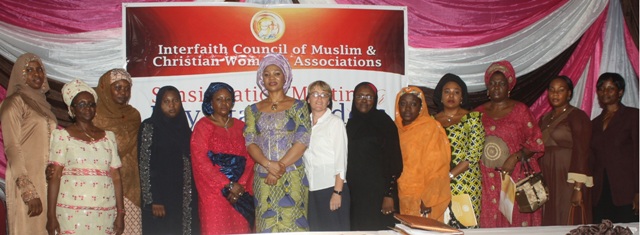
Dialogue is not an easy task. There can be misunderstandings and disagreements. This resource will help avoid some of these. What dialogue is and what it seeks to achieve are clearly explained. Practical information on how to engage in it is provided.  Hopefully these pages will guide many to discover that dialogue can also lead to moments when different faith traditions allow us to see the light of God that shines in so many places.

bishops2

We congratulate Cois Tine and all who contributed to the meetings of Muslims and Christians that led to the development of this useful resource. We hope it will help Muslims and Christians to be good neighbours.

The Most Reverend John Buckley
ROMAN CATHOLIC BISHOP OF CORK AND ROSS
The Right Reverend Paul Colton
CHURCH OF IRELAND BISHOP OF CORK, CLOYNE & ROSS


 To move on to Chapter One – What is Interreligious Dialogue click here 

Acknowledgements

crosscress

Acknowledgements

MUSLIM CHRISTIAN DIALOGUE PROJECT STEERING GROUP MEMBERS  

Kathy O’Connor
Chairperson, Integration Centre Southwest Integration Officer  
Emer McCarthy
Secretary and  Cork Integration Project Coordinator
Nura Hagi
Somali Human Rights Advocacy Group in Ireland (SOHRAGI)
Sheikh Ihab Ahmad
Imam, Blarney Street Mosque
Abdelkarim Abdullah
Cork Muslim Society
Fr Sean O’Sullivan
Roman Catholic Diocese of Cork and Ross
Rev Daniel Nuzum
Church of Ireland Diocese of Cork, Cloyne and Ross
Gerard Forde
Cois Tine, SMA Justice Office

The Muslim Christian Dialogue Project and this Resource could not have been completed without the participation and contributions of many people. We are grateful to all who attended and participated in project events and meetings in Cork, Dublin and Limerick over the last two years. The learning from these events has been incorporated in this resource.

Thanks to all the members of the Steering Group who for more than two years provided guidance, expertise and many practical suggestions.

A number of individuals also assisted by giving of their time, expertise, advice and in helping organise and run events. I am grateful to: Sheikh Umar Al-Qadri, Moawia Eldjack, Adrian Christea of Dublin City Interfaith Forum, Fr Angelo Lafferty SMA, Dr Chris Hewer, Rev Dr Keith Scott, members of the Mid-West Interfaith Network, Karen McHugh and Abed Aldakar of Doras Luimni. Thanks also to Ciara Flanagan our POBAL Project Officer for her on-going support, encouragement, guidance and patience.

Special thanks are reserved for a number of people and organisations.  Firstly, to the Society of African Missions (SMA), especially Fr Fachtna O ’Driscoll whose direction instigated Cois Tine’s work in the area of Christian Muslim Dialogue. Thanks also to the SMA for providing match funding and for allowing the use of staff time beyond what was originally envisaged when the project began.

We are also grateful to the Integration Centre for allowing the participation of Kathy O ’Connor, their Southwest Integration Officer, who served as Steering Group Chairperson, Workshop Facilitator and Editor, thus making a major contribution to this resource and to the project in general.
crosscress
Thanks also to NASC the Irish Immigrant Support Centre for their role as lead partner in the Cork City Integration Project, for managing administration and monitoring requirements and also for their help in organising and running events in Cork City.

Finally a special word of thanks to Kathy O ’Connor and to Emer McCarthy whose genuine interest, commitment and work for the project was beyond the requirements of their employment. Their help was invaluable and greatly appreciated.

G. Forde  


To move on to Foreword by Seikh Dr Umar al-Qadri click here

A Journey Together Intro

street

street

INTRODUCTION
This publication is aimed at Muslims and Christians living in Ireland and is meant as a resource that will help us understand, respect and cooperate with each other as neighbours, work colleagues and friends. It is the result of a two year project during which many meetings between Muslims and Christians took place at various locations around Ireland. At these meetings one point highlighted  repeatedely was the fact that most Irish people Irish people know very little about Muslims or Islam the faith they profess.

Navigate this Resource by using the Menus on the right and left.

The right menu gives access to each chapter of the resource.

Having finished a chapter  click on the Resource home Page  button (top left) and then chose the next chapter you wish to read.

Alternatively just follow the links at the end of each page.

In response a brief overview of Islam was prepared and may be accessed by clicking here this aims to provide readers with a basic understanding of Islam. For Muslims, the book ‘Christianity the Complete Guide(Edited by John Bowden and published by Continuum, 2005) provides an encyclopaedic overview of Christianity.

Interaction and dialogue between Muslims and Christians dates back to the beginnings of Islam in the seventh century. Both religions trace their roots back to the patriarch Ibrahim/Abraham and share belief in one God (monotheism). The fourteen centuries of shared history between Muslims and Christians has been marked by periods of violence and hostility as well as times of tolerance, cooperation and peaceful coexistence.

Organised interreligious dialogue only began in the 1950’s when the World Council of Churches (WCC) and the Vatican held meetings with representatives of other faiths. In the 1960’s the Second Vatican Council marked a major step forward in Christian openness to interreligious dialogue. The World Council of Churches established a programme for Dialogue in the 1970’s. In this period the efforts of Christian Churches focused on increasing awareness and understanding of Dialogue through the publishing of reports, articles and books written by both Muslims and Christians. By the 1980’s organisations such as the Muslim World League and the World Muslim Congress together with Christian organisations had established both formal and informal structures and programmes for Muslim Christian Dialogue.  Increasing mobility and the real time communication that is now possible mean that Muslims and Christians hear about each other and come into contact with each other as never before. Here in Ireland this has become very true in the last decade. As a result, we Muslims and Christians need to understand, communicate and cooperate with each other especially in our everyday encounters as neighbours, friends and work colleagues. Dialogue, therefore is a necessity.

To move on to Acknowledgements click here

4th Sunday in Ordinary Time 2013 – Year C

3 February 2013

Jeremiah 1.4-5,17-19
1 Cor 12.31-13.13
Luke 4.21- 30 

A young woman had been with her boyfriend for some years and then one day she told him that she was leaving him. He was very upset and asked why. Her answer was that she found him too unpredictable. Some days he would be in very good form and then suddenly for no apparent reason he would become moody, even a bit depressed. She felt that she couldn’t continue the relationship as it was causing her too much stress trying to deal with his various moods.

In the gospel today we find the people of the town of Jesus, Nazareth, like that. At first they are astonished at the gracious words that came from his lips. Soon they start complaining as they know him well, one of their own. They wonder where he learned all his wisdom and how he was able to work miracles in nearby towns. Was this jealousy, envy or what? Rather quickly they get very angry with him and even want to kill him. Later on he would experience something similar. On Palm Sunday people put branches in his path and sang, ‘Hosanna to the Son of David’. A few days later some of this same crowd cried out, ‘crucify him, crucify him’.

Should we not rejoice that our God is not a God who is moody so that we cannot be sure how he will be from one day to the next like the young man above? Our God is always a loving God whose only interest is our good, our peace, and our joy. A good prayer to make might well be ‘Thank you Lord for you being You’ that is, a God who is unchangeable, who is not moody, a God on whom I can rely totally all the time because he simply is LOVE.

Isn’t that real Good News in the gospel today? That God loves us totally and unconditionally whether we are virtuous or sinning. That is why in the second reading St. Paul reminds us about the true nature of love and therefore who God is. Instead of reading the text as ‘Love is always patient, kind and so on we can put in the name of Jesus in place of the word ‘love’ etc. Maybe we may get a clearer understanding of who God is.

Another aspect of the gospel today is that believers in God, followers of Jesus may try to monopolise God and even try to put God at their service. As Christians and Church we have done so in the past and may still fall into the same temptation. Those with Jesus in today’s gospel were scandalised by the two examples he gave. He said that in these two historical incidents it was not to the Jews that God sent the prophets Elijah and Elisha but to those regarded as pagans or heathens by the Jews. What we think we know may prevent us from paying attention to what is new, especially if it comes from what is insignificant and marginalised. The Lord may well be challenging us through those we do not know how to want or appreciate now. Hopefully we may do so later on.

Two obvious examples in our times are Martin Luther King and Nelson Mandela. They fought for the dignity of their peoples, that even though they were black they were entitled to the same rights as all others regardless of the colour of their skin, their religious beliefs, their social standing etc. MLK was assassinated for his efforts as later on Jesus was. What are our prejudices that prevent us being open to God speaking to us through those we consider beneath us, dislike or even hate, such as homosexuals, those with AIDS, those no longer married to their original spouses but now with new partners etc.? Would this be the loving response that Paul invites us to live in the second reading?

At the end of the gospel passage the crowd forced Jesus out of the town to a hill (eventually the same scenario at Calvary – it was outside the town of Jerusalem and on a hill where Jesus was executed). They wanted to get rid of him because he spoke the truth; challenged them to become aware of their prejudices which blinded them to the truth. They asked him to work the same miracles for them as he worked elsewhere. Here we have a classic example of wanting to manipulate God and saying we will only accept him if he corresponds to our desires, our needs. But God knows well if they would not always be good for us and so his answer then is ‘no’ but are we open to hearing this?

At the end of the gospel Jesus walks through the crowd and they can do nothing about it. Sad to say Jesus may walk right through us too and we may fail to see him because of our prejudices. The Jesus of Nazareth was too human for his townspeople. How could God come in such an ordinary person such as a carpenter? That was how God came then and how he still comes. If we fail to see him in ordinary events, in ordinary people today we may never see him in our lives and he may have walked right through our midst and we may have failed to be aware of it.

“Lord Jesus, open our eyes to the many ordinary people and ways through which you come to us daily. Help us to become aware of our prejudices that prevent us being open to the new ways that you use to visit us. Teach us how to love better, how to love more. Thank you above all for you being You – never moody but always loving, compassionate, forgiving. Amen.”

Fr. Jim Kirstein, SMA

3rd Sunday in Ordinary Time 2013 – Year C

27 January 2013

Nehemiah 8.2-6,8-10
1 Cor 12.12-30
Luke 1.1-4,4.14-21

Some years ago I was travelling by plane from Ireland to England. Next to me was a young man. When I asked him what his work was, he replied that he was connecting with a plane in London to fly to the USA where he was going to study for some years. After that he would get a good job, work very hard, make lots of money, marry and raise a family. He had a programme marked out for himself and he intended to carry it out.

Today’s gospel from Luke speaks of the Messianic Programme of Jesus Christ.

He states quite clearly what his objectives are. He will commit himself to a program of liberation on all levels. He wishes to bring good news to the poor by telling them that they don’t have to accept that poverty is their lot and that they are condemned to it for life. In most countries especially in the South World the Church is trying to put this into practice by working to empower the poor, involving them in projects that will raise their dignity and give them a sense of self worth.

Jesus also wants captives to be freed, not just people in prison but people imprisoned by fear, enslaved by drink, drugs, money, status, prejudices, self-destructive attitudes, a wrong image of God and what real religion is about, etc. In what way are we captives? Where do we need liberation or freedom? Do we ask the Lord to show us and to give us the Holy Spirit to respond?

Prior to this vision given by Jesus he had spent a long time in the desert guided by the Holy Spirit. Obviously he had pondered and prayed about his vocation. Having clarified it for himself he returns from the desert and under the influence of the same Spirit reveals his program to Israel. It is interesting that he doesn’t pull it out of a hat. He quotes from the prophet Isaiah what God had been revealing to Israel over the centuries. God’s preferential option is for the poor and the marginalised, those who have little status in society.

It is as though he is giving us a key to understand what he is about with his choice of this text. We all know the importance of keys. We use them all the time. If we lose a key to an important place like our house, we are locked out. Or if we lose our car keys when away from home it can cause great difficulty for us. We also speak of keynote addresses which give the central thrust of a meeting etc. So Jesus today is giving his keynote address for his life’s work.

In fact, he is offering us a choice and it is a rather radical one. In our world today very often we are judged by what we do, have, wear or possess, be it money, power, academic degrees, property etc. Jesus is inviting us to think differently. He is not denying that money, a degree, etc are important but he challenging us as to the importance of all these things in our lives. Ultimately he is offering us a program for liberation and social justice. How will we respond?

I wonder how my young travel companion got on in life. He gave me the impression that if he got his act together he would succeed. Did he ask God for help? Jesus is going to depend on the Holy Spirit to carry out his program. He says it clearly: “The Spirit of the Lord has been given to me, for he has anointed me.” Jesus also needs us. The Good News is that Jesus is inviting you and me to participate in his vision for life. We all have been anointed with the Holy Spirit in baptism and confirmation. We are the anointed ones of Jesus. When we go forth from the Eucharist we are missioned to participate in the program of Jesus. The secret of life according to Jesus is that the more you focus on the good of others including the needy, poor, marginalised etc the happier you will be. But this is a very hard lesson to learn when the advertising world is spending billions to get us to accumulate more and more implying that this will give us lasting happiness.  We can be those who are blind, blind when we chose possessions instead of also sharing and helping our brothers and sisters in need.

Yet so many wonderful people, hopefully ourselves, try to follow the program of Jesus as outlined today. When he ended up his statement he said ‘this text is being fulfilled today even as you listen’. And it is by so many in many places. These past weeks with the disastrous earthquake in Iraq we see many countries already responding with help. We hear of ‘prisoner support groups’, people contributing so charitably to International Aid Agencies. We hear of young people and not so young too going to famine stricken countries – surely there is the Spirit at work through the generosity of these people.

“Lord Jesus we thank you for the invitation to work with you to help those most in need be it in our own areas or abroad. May each of us be generous in responding to our baptism calling when we were anointed by the Holy Spirit. Amen.”

Fr. Jim Kirstein, SMA

2nd Sunday in Ordinary Time 2013 – Year C

20 January 2013

Isaiah 62.1-5
1 Cor 12.4-11
John 2.1-11

Some time ago I celebrated the wedding Mass of a young couple, friends of mine. Both the Eucharist and the reception afterwards were joyous affairs. The young couple were very much in love and one could easily sense that they were determined to enjoy their wedding day. They intended the same for all the invited guests. And their mood seemed to have caught on. As far as I could see everyone enjoyed the day also.

In taking up the theme of a wedding in the gospel today, John the evangelist presents not only Jesus’ first miracle but he calls it a ‘sign’, as he does all the other miracles in his gospel. For John the miracle of Cana is a sign that points beyond itself to a much deeper meaning. This is the new creation and we share it. Jesus is replacing the old Jewish religious rites with the new wine which is himself. It is the best wine that is saved until now. Like the multiplication of the loaves and fishes there is a superabundance of wine. Not a stingy or small amount as humans might give out but God’s lavish generosity. It is saying that our God is a God of life, life that is abundant, still more and more abundant, life that we call eternal. It begins now according to St. John.

This event, the wedding at Cana is very meaningful. The God of Jesus does not usually reveal himself on a mountaintop or in a church in imposing majesty, but instead at a wedding, and in the company of friends. God is preparing us his people for a new covenant. Jesus is the bridegroom and he is inviting us to the wedding. This new relationship of God with his people is as different as wine is from water.

John tells us that Jesus asks the servants to fill six stone jars which were used for the Jewish ‘rites of purification’. Water and purification rites are referring to certain religious practices of Jesus’ day. From that time on religion will no longer be based on the law and constant washings or ablutions or on the observance of precepts undertaken out of fear of punishment and guilt.

This is precisely what John is saying here. The God that Jesus came to reveal is a very different God to the idea that the people of the time had of God. That was a God to be feared and obeyed lest they be punished. Jesus is telling us that God is not a God of fear and punishment as sadly so many people still believe. Also the God of Jesus is not a God distant from us and delighting in sacrifices of animals but Someone very close to his people, just as he would be present still at a wedding feast. He is a God who is that close to us sharing our joys and concerns. Of course the wedding feast is meant to be a joyful affair but later on in the life of a couple there will be difficulties. God will still be very close to them, concerned for them, supporting and encouraging them through their relatives and friends.

A relative of mine, a young man and his bride-to-be were sitting down in his father’s house one day when I went for a visit. They were preparing for their wedding. They were making a list of all the important things for the wedding Mass and the reception afterwards. One thing they didn’t bother writing down was to have water available at the reception. It was so ordinary that it was taken for granted that it would be there and so wasn’t worth mentioning in the list they were making. It is the same in today’s gospel. The 6 water jars that were there were so ordinary and part of every day life that they hardly merited a second glance. The guests would have automatically washed their hands in order to be purified. Yet these so ordinary water jars were chosen by Jesus to be the containers of the abundance of new wine. It seems to have been a pattern in the life and teaching of Jesus. He used very ordinary things like water jars, like flour, leaven, a farmer sowing seed, hens with chickens under their wings protecting them etc. to be the means of getting across his message. Do we fail to see that the same dynamic is still used by God? Today in the gospel it is a wedding feast, another time it will be fishermen at work etc. Where do we see God present in our ordinary daily experiences? God still comes to us throughout each day in very ordinary ways if we can become aware of this. He is very close to us, delighting in our celebrations and times of joy and very concerned when we are suffering or struggling.

If Jesus can change something like water into wine as a sign of his love for the young couple and in response to the sensitivity of Mary who noticed the lack of wine, can he not change us too into the kind of people that we are called to be? Do we believe this? Do we offer ourselves to him for this transformation or change? After all, isn’t this what we celebrate each time at the Transformation or Consecration of the Mass? We believe that God through his Holy Spirit changes parts of creation like bread and wine into the Body and Blood of Jesus. Do we pray that God can do the same with other parts of creation, you and me, to be better persons, better members of his family? Can he not use us to work together to make the world where we are a better place? St. Paul in the 2nd reading reminds us that the Holy Spirit gives us a variety of gifts to bring this about. Do we pray to the Holy Spirit for these?

“Lord Jesus, as you changed water into wine at Cana we offer ourselves to you believing that you have the power to change and transform us too in ways that are best for us and for others. Amen.”

Fr. Jim Kirstein, SMA

Feast of the Epiphany 2013 – Year C

6 January 2013

A Light for All

 Isaiah 60:1-6
Ephesians 3:2-3; 5-6
Mt 2:1-12

Some years ago there was a missionary priest I knew who was working in Ghana. He loved nature especially birdwatching, taking great delight in seeing the lovely different colored birds one finds in Africa. Once he decided to take a few days vacation and went into a great forest not far from where he was working to observe the different kinds of birds. He took some food and drink. But after a number of hours of looking up into the trees he realized he was lost. However, he felt he could find his way out again. Two days later he was still lost and now having used up all the water he had brought he started to get dehydrated. So he then resigned himself to die. The next morning, and being very weak he was seen by a local Ghanaian hunter who chanced to pass by that way and in no time had guided him out of the forest to safety. He knows that this man saved his life by pointing the way out of the forest to him.

Many people in our world today are searching for a way out of difficulty and seek people to help them this achieve this, whatever name you call this person, be it a psychologist, a spiritual director, a guide, a soul friend etc.

In the gospel today we have the Wise Men who come from the East. They are searchers for the truth and discovered a star that they felt could guide them to what they were seeking. Eventually it did. Amazingly, they just found a small helpless infant in a manger with his parents and they had the humility to accept that this child was the answer to their search.

What is the star that guides you in your way through life?

Many people will seek to follow the star of power, money, fame, popularity etc. and for a time they may seem to have found that it works, but sooner of later they don’t have the deep peace and happiness that following Jesus gives us. But is it easy to say that for me Jesus is the guiding star in my life, that he is the light shining up the darkness of my life.

How real is Jesus for you and me?

Does he really make all the difference? (Personal witness).

The star guided the Magi or Wise Men to Jesus but, on the way, they encountered Herod who sought to destroy Jesus if he found him.

Who or what is Herod for me?

Is there a person, a relationship, some worldly ambition, some tendency to sin in my life that may lead me away from finding Jesus and allowing him to be truly the guiding star of all I do.

If there is something or someone why not talk to Jesus and ask him to help us overcome the difficulty.

Having met Herod and the Jewish leaders the text seems to suggest that the star disappeared. But once they leave that situation (Herod) it appears again and guides them to Jesus.

Sometimes, despite our best efforts, God seems to disappear from our lives. Even if we try to be faithful, Jesus seems far away. Remember Joseph and Mary lost Jesus for 3 days on their visit to Jerusalem.

This may well be an invitation to be faithful to Jesus in good times and also in difficult times.

Again why not ask his help that we would be faithful at this challenging time?

The Wise Men offer their gifts to the child Jesus convinced that he is the one they were searching for. The Wise Men who came from afar were not Jews. They are outsiders in that sense.

Today’s feast, the Epiphany means showing or manifestation, is the feast of God telling us that he wants to be known and loved by all peoples, regardless of colour, race or language.

The Wise Men having found the child pay him homage. The account ends in a beautiful way.

Having learned of Herod’s wicked intentions which were revealed to them in a dream, they “left for their own country by ‘a different way’”. We can assume that their having found Jesus had transformed their lives, because in the Bible a change of path symbolizes conversion. Must not this be the outcome of our encountering the Lord: a transformation of our lives, the capacity to take another way that is truly life-giving. The Good News is that God will reveal this to us if we ask in faith. It is free.

“Lord Jesus, we believe that you are the Way, the only star that can guide us safely in life to that peace and joy that each of us seeks. May our daily lives be a manifestation, an Epiphany to others that you alone are worth seeking for and following. May we too like the Wise Men be searchers for what is truly life-giving, You alone. May our lives witness to this to others by the power of the Holy Spirit.”

Fr Jim Kirstein SMA, Blackrock Road, Cork 

Blessed are the peacemakers

Blessed are the peacemakerscandle14

The renowned Buddhist monk and peace activist, Thich Nhat Hanh was once asked this question: “Who caused the war in Iraq?” “I did”, was his answer.  In a profound sense, his answer was correct. 

People deeply attuned to the unity within the cosmos understand that everything and everyone is connected. If our thoughts are peaceful then we radiate peace around us, but if they are not then we are spreading discord.  “We are not at peace with others because we are not at peace with ourselves, and we are not at peace with ourselves because we are not at peace with God”, said the Catholic monk Thomas Merton back in the early 1960’s.

January 1st is World Peace Day, when we allow thoughts of peace to come to the forefront of our lives.  Every year the Pope gives an important talk on Peace. Peace, he says this time, is a gift of God, but also something we can and must work for. “Blessed are the peacemakers”, said Jesus. There are many different ways we contribute to peace. But first of all, it must begin with myself, as Merton said.

Think of the violence in today’s world. The victims of conflict end up fleeing, either to other regions of their countries or abroad. They are not to blame for their plight. But perhaps we have played a part?  Let us remember Merton’s words, and make this new year one where each of us strives to create peace within ourselves, so that it will then radiate out to others, even reaching – who knows ? – the hearts of  oppressors everywhere.  In that way we will be helping to create a more just and peaceful world where every individual and family can live in peace and wellbeing. A happy and blessed 2013!                                                                                    

by  C Dorgan

Jean-Marie Coquard: a brief biography

AB EH with OLA Srs Comfort Ogbanje Alice Chifong

AB EH with OLA Srs Comfort  Ogbanje  Alice ChifongJean-Marie Coquard was born in the Diocese of Nantes in France in 1859, spent some time in the merchant navy, tried unsuccessfully to join the Sacred Heart Missionaries of Betharram while living in Montevideo, Uruguay, was accepted by the SMA and entered the Seminary at Lyon in November, 1886. To the SMA authorities his suitability for priesthood was never in doubt and he was ordained a priest on 13th July, 1890, at the age of thirty-one. In the autumn of 1890 he set sail for West Africa, destined for the Vicariate of the Bight of Benin which had its headquarters in Lagos. He was to spend the forty-three remaining years of his life in West Africa, returning only twice to Europe, in 1897 when he was sent to Brazil via France to collect funds for the Vicariate’s seminary and, again, in 1907 when he took part in the SMA General Assembly in Lyon. 

The author, Fr Edmund Hogan SMA is pictured at the statue to Fr Coquard outside the original Sacred Heart Hospital. Flanking Fr Hogan are two OLA Sisters, Srs Alice Chifong and Sr Comfort Ogbanje.    

It is worth noting that missionary tours of duty in that era normally lasted five years, the confrères returning to Europe to regain their strength for a period of one year. Coquard holds the record for the longest missionary tour in the SMA, the twenty-five years between 1908 and his death in 1933, easily beating his nearest rival, Msgr. William Lumley, SMA, who spent a tour of eighteen unbroken years in Northern Nigeria.

Immediately, upon his arrival in 1890 Fr. Coquard was put in charge of medical work at the mission dispensary under the guidance of Fr. Justin François. While he had no formal medical training he displayed an extraordinary aptitude for medical work culminating in the establishing of one of Nigeria’s premier hospitals in 1895, acting as the hospital’s surgeon. He obtained medical suppliers, surgery manuals and surgical instruments from supporters back in Brittany. He was convinced of the importance of his medical work for the apostolate and he quickly exhibited a proficiency in the dispensary. Even at this early stage he was beginning to think about developing the medical apostolate and plans to build a hospital were being formulated despite the lack of resources. Possessing a strong and independent-minded temperament his efforts at establishing the hospital frequently brought him into conflict with his SMA Superiors. Undaunted, his efforts were rewarded and the hospital was opened on 5th May, 1911. Fr. Coquard had been the architect, but also acted as contractor and foreman. This new building with its elegant towers and terraces had now replaced the original hospital which had been opened in 1895.

AB At Coquards graveClergy, OLA Sisters and laity gather for the blessing at the Cross standing above Fr Coquard’s grave in Lantoro cemetery, alongside many other missionaries and catechists awaiting the Resurrection.

Fr. Coquard died in his room in one of the towers of the hospital on the morning of 27th June, 1933 in the presence of Bishop Francis O’Rourke, SMA, Fr. Jean Grando, SMA, Superior of the Lagos Mission, and Fr. Richard (Dick) Fitzgerald, SMA, (uncle to concelebrant Fr. Tim Cullinane, SMA) assistant priest at Abeokuta. After Requiem Mass the following day Fr. Coquard was laid to rest in Lantoro cemetery.

Cross and Scalpel now available on Amazon and ABC

AB Sisters Nurses SMA Coquard

It was a glorious ‘Gaudete’ gathering at Ss. Peter and Paul Cathedral, Abeokuta on Sunday, 16th December, 2012 when SMA Fathers and Abeokuta Diocesan priests joined the congregation for the 8am Mass to pay tribute to Rev. Fr. Jean-Marie Coquard, SMA.

The occasion marked both 150 years of SMA missionary activity in Nigeria and the Launching of a recently-published book, titled ‘CROSS and SCALPELJean-Marie Coquard among the Egba of Yorubaland.’

The Chief Celebrant was Fr. Maurice Henry, SMA, SMA Regional Superior in Nigeria. The Con-celebrants included Msgr. Chris Ajala (Vicar General of Abeokuta diocese), Fr. Raymond Adebowale (Administrator of Ss. Peter and Paul Cathedral), Fr. Reginald Nwachukwu (SMA Superior of Bight of Benin District-in-formation), Fr. Edmund Hogan SMA, SMA Irish Province Archivist (homilist and author of the book), Fr. Eddie Hartnett, SMA, St. Andrew’s Church, Kweme, Seme Border, Fr. Timothy Cullinane SMA (Spiritual Director, SMA House of Formation, Bodija, Ibadan), Fr. Francis Rozario SMA, Scripture lecturer at Ss. Peter & Paul Major Seminary, Ibadan, Fr. Emmanuel Zinsu, SMA, Secretary to Bight of Benin District-in-Formation, Fr. Henry Obiora, SMA, SMA House, Obanikoro, Lagos and Fr. Peter McCawille, SMA, St. Andrew’s parish, Ugbighoko, Benin City.


Rev. Patrick Morakinyo, serving as a Deacon at Ss. Peter and Paul Cathedral, read the Gospel. The readings were taken by Sr. Josephine Ogbonna, OLA and Sr. Alice Chifong, OLA.

In his homily Fr. Hogan sketched the career of Fr. Coquard and the significant role he played in the life of Abeokuta, in particular his single-minded commitment to the planning and construction of Sacred Heart hospital. Fr. Hogan succeeded in capturing and retaining the attention of the congregation by blending scholarly research with occasional quirky asides, thanking the people for being considerate in naming a State after him (Abeokuta is in Ogun State) and forgiving them for omitting the H at the beginning, plus light-hearted references to his lack of fluency in the Yoruba language.

Fr Jean-Marie Coquard: a brief biography can be read here. 

Fr. Hogan also referred to the prominent role played in Sacred Heart Hospital by the Sisters of Our Lady of Apostles (OLA) who first came to Abeokuta in 1886. The Sisters have been associated with Sacred Heart Hospital since 1936.

AB Sisters Nurses  SMA Coquard

OLA Sisters and Nurses from the Sacred Heart Hospital are pictured with SMA members at Fr Coquard’s grave.

Sr. Consolata, OLA (Sr. Bridget Murphy from Co. Cork) arrived in Abeokuta in November 1936 and she was to be the first in a long line (which continues to the present day) of professionally-trained OLA Sisters, Irish and Nigerian, who worked in the hospital in both the clinical and administrative capacities.

Louisa Rodriguez: Fr. Hogan also paid tribute to the monumental role played by Louisa Rodriguez, a Catholic of Brazilian extraction, who had been raised with the OLAs in Porto-Novo. She had expressed a desire to become a Sister but got no encouragement. Despairing of ever becoming a Sister she expressed a wish to work without payment for the rest of her life in Abeokuta hospital. She did so with amazing ‘devotedness and self-sacrifice’ (Fr Hogan refers to Luisa in the book as Fr. Coquard’s ‘right arm’). This incredible lay woman later took private vows as a consecrated laywoman. Fr. Hogan unreservedly referred to her several times as ‘a saint’ and insisted that she deserves a special mention in the history of the Church in Abeokuta.

Launching of Cross and Scalpel

At the end of Mass the MC, Mr. Sylvester Kodaorlu, started the ball rolling for the launching. Msgr. Chris Ajala, V.G. gave the launching a great boost when he gave a gracious speech acknowledging the contribution of the SMA Fathers to the growth of the Church in Abeokuta since the Church was founded there on the Feast of the Assumption, 1880, the day on which Fr. Théodore Holley, SMA celebrated the first public Mass. He encouraged them all to show their appreciation by purchasing a copy of the book and he personally launched it with a generous donation from the Diocese of Abeokuta. He concluded by praying that one day soon the SMA authorities will accept an invitation to return to pastAB R Nwachukwu Msgr Ajala VG PMcCoral work in the Diocese of Abeokuta.

Msgr Ajala is pictured with the SMA Bight of Benin District-in-formation Superior, Fr Rginald Nwachukwu and Fr Peter McCawille, Director of the SMA Family Vocations Movement in Benin City, who is responsible for the photos and providing the information for this article. 

After the Mass the priests and members of the congregation trooped to the adjoining cemetery where a decade of the Rosary was recited by Fr. Maurice Henry who then blessed the graves of the deceased Fathers and Sisters. A joyous and memorable day was brought to a close when everybody repaired to the Cathedral House for a sumptuous lunch at the invitation of Fr. Adebowale, an enthusiastic old boy of St. Finbarr’s College, Lagos and a great admirer of Fr. Denis Slattery, SMA, describing him as an icon.

It was a fitting conclusion to a day filled with great joy and gratitude.

Prayer for Justice and Peace

PRAYER FOR JUSTICE AND PEACE

Here is my servant, the one I uphold; my chosen, who brings me delight.
I’ve put my spirit upon him; he will bring justice to the nations.
 
Is. 42: 1 

 Servant: Lord, you  call us to serve you by recognising the image of Jesus, God made man, in every human being.  May we be instruments of your peace through work for Justice.  Bless all who work for what is right and who seek to heal the wounds of bigotry and religious division.

Uphold: Lord, you speak to us through Scripture, the Church and the Holy Spirit.  May we listen and so be more effective in doing your will.  We pray for all who uphold truth and defend the rights and dignity of those who are abused. 

Chosen:  Lord, you have chosen us to know, love and serve you.  May we take delight in doing your will by recognising the inestimable value of every human being.  May we see the face of Jesus in all who are distressed, maimed or diseased.  Strengthen all who care for the sick and comfort those who suffer.

Spirit: Lord, through the power of your Sprit strengthen us  so that we may be instruments witnessing to faith, giving hope to those who despair and showing love to those who have been rejected.  Protect all refugees and those who work to care for them.

 Justice: Lord, may we not fear seeking the justice without which peace cannot exist.  Where there is hatred may we sow love and forgiveness.  We pray for the most abandoned, the homeless, those forced to flee and those who suffer as a result of armed conflict.  We pray for those who are enslaved and used to satisfy the greed of others.  Sustain and guide all who promote human rights and who work to ensure that every person has a fair share of the world’s goods and resources. 

 Nations: We pray that the nations of the earth recognise a common humanity and the equal rights of people of every tribe and tongue.  We pray that leaders may overcome selfishness and vested interest.  Bless all who work for equality and inclusion, who seek to protect migrants and who welcome the stranger.                                                                             

Lord make us instruments of Justice and Peace   AMEN  

2012 Parish Carol Service

Car-Kay-Burke

The Cork Sick Poor Society, probably the oldest charitable society in Cork City, benefited from a Christmas Carols Service held at St Joseph’s SMA Parish, Blackrock Road, Cork on Sunday, 16 December 2012.

Car-Kay-Burke“It was founded in 1853 by John Francis Maguire to give assistance to victims of the great famine. Since then social conditions have improved but there are other problems. In 2012 so many people in our community can become marginalised due to unexpected circumstances. Families often find themselves under severe financial pressure due to Car-Christmas-storyunemployment, illness, bereavement and harmful addiction, separation, unequal access to opportunities and other forms of discrimination. The task of the Sick Poor Society is to reach out to such families who are in these difficult circumstances and to provide them with material and other assistance. This work is undertaken on a voluntary basis and all monies are used solely for the benefit of needy families” was how Kay Burke [pictured left] described the charity during the Service.

Pupils from Crab Lane Primary school, with their Principal, Denis O’Sullivan and assisted by Aoife McCarthy, sang some Christmas Carols before 6th class pupil, Hannah Tuohy, [on right] read the Nativity Story.

The Parish Choir, under the baton of Elaine Kelly and accompanied by Mairéad Scully, included in their repertoire ‘Said the little lamb to the shepherd boy’, ‘Have yourself a merry, merry Christmas’ and ‘We wish you a Merry Christmas’. Mary Heanue, soprano, sang ‘O Holy Night’ which drew the largest round of applause from the 150 or so who attended the hour-long Service.Car-Parish-Choir

In her Christmas Reflection, Kay reminded us that it was A Christmas Carol, by Charles Dickens, which revived the Christmas celebrations we are familiar with today. In it, Dickens describes Christmas as a time for joy and giving. In the following years Christmas stories became more and more popular together with the Christmas tree, gifts and the overall Christmas spirit.

The Gift of the Magi, by O Henry, epitomises the Christmas spirit: loving and giving. It goes thus:

‘Once upon a time there was a young couple Jim and Della who had not much Car-Crab-School-Choirmoney but they desperately wanted to buy each other a Christmas present. As they were a very happy couple, they knew each other’s greatest wish – Della had beautiful long hair which reached below her knees and she longed to be able to buy tortoise shell jewelled combs to keep her hair in place. Jim had a gold watch which belonged to his father and grandfather but he had no gold chain from which to hang it. He had it on an old leather strap – he used to be so embarrassed if he was asked the time and had to pull his watch out of his pocket.

It was Christmas Eve and despite months of saving, Della had less than 2 dollars – which came no where near buying a gold chain for Jim’s watch. Then she got an idea and set off for the new French hairdresser. “Will you buy my hair,” she asked? “Yes,” said Madame, “and I will give you 20 dollars for it.” “Give it to me quick”, said Della and the deed was done! She set off immediately and after some time found a chain that would be worthy of THE watch. It cost 21 dollars. She purchased it and hurried home to prepare their Dinner wild with excitement.

Jim arrived home. When he saw Della he sat down, in complete shock. “Your hair! Della,” he gasped, “what has happened to it?” “Don’t be upset”, she replied, “my hair will grow again. I sold it so that I could buy you a watch chain. Give me your watch and I will attach it.” Jim put his head in his hands and smiled. He handed Della a package inside which were the handsome jewelled combs. “I sold my watch he said in order to buy the combs for your beautiful hair.”

Christmas is the time for us to think of people less fortunate than ourselves. This is what the volunteers of the Cork Sick Poor Society do.

Car-Carrigaline-ChoirConcluding her reflection, Kay invited us to pray:

“In the midst of all the excitement, cards, shopping and parties please make us more understanding of the lack of comfort in so many people’s lives.”

Christmas is also a time to give thanks for the gifts the Lord has given us.

“We pray God source of all life, help us to understand that all we have is a gift from you. May we be good stewards of all that has been given to us and may we be generous in sharing all your gifts with others.”

The Crosshaven Singers, with their Choir Master, Gerard O’Connell brought the Carol Service to an end with several Carols and all three choirs reassembled to sing Silent Night before the Parish Priest, Fr Tommy Wade, thanked all concerned with the preparation for the Carol Service.

Good Shepherd parish – December 2012

Ph12-Baptism-Fr-TG

Good Shepherd Parish – December 2012

 Ph12-Baptism-Fr-TG

The Good Shepherd parish (GSP) in Las Pinas City (Metro Manila) celebrated its 25th Anniversary in 2011. Founded by SMA Fathers John McCormack and Pat Kelly in response to an invitation from the late Cardinal Jaime Sin, who saw the possibility of recruiting vocations for the African Missions in this, the largest Catholic country in Asia. But the ever-wise Cardinal also saw it as a way of getting more priests to work in his diocese which had and still has) need of priests.

November and December are particularly busy months in the parish – with hundreds of children coming for First Confession and their First Holy Communion; others celebrating baptism or marriage.

The three priest team of Fr Gus O’Driscoll (from Rathcormac, Co Cork) and two Filipino SMA priests: Frs German Patiga and Tony Gelaga ensure that the people are cared for to the best of their ability. But… they are ably assisted by a large parish team of volunteers, particularly 11 parish Catechists as well as lay ministers of the Word and the Eucharist, choirs, Mother Butler group…

Our picture shows Fr Tony Gelaga SMA with two families whose daughters he baptised on 2 December last. At the same time, in the main Church, Fr Gus O’Driscoll was officiating at the wedding of a young couple.

Ph12 GSP Information

Christmas Mass during the day – Year C – 2012

25 December – Mass during the day

Isaiah 52.7-10
Hebrews 1.1-6
John 1.1-5, 9-14


A teacher decided to take her class of 10 year olds to visit the crib and she asked them to bring a little Christmas gift for the baby Jesus. At the crib they put in their gifts next to Jesus. One boy gave a whistle, another a bag of peanuts, a little girl put in a small doll and the next little boy put in a small statue of the Sacred Heart. The teacher was curious and asked him why. He replied that he thought it would be good for Jesus to see what he would be like when he grew up!!

It is true for most of us that we like to know what’s coming next, especially as the New Year is so near now. The gospel we just read is like that. It is called the prologue or the introduction to the gospel of John and he gives us an idea of what is to come later in the gospel. But it also speaks to us of our human situation now. It is a gospel of hope and promise.

The first verse tells us very simply, recalling the opening of the Book of Genesis when God created the world. It says that ‘in the beginning was the Word and the Word was with God and the Word was God.

The Word is another name for Jesus. The verse says straight out that Jesus is God and towards the end of the gospel in Chapter 20:30-31 John says that the purpose of writing the gospel was that so we might believe that Jesus is the Christ, the Son of God.

You might say we all know this. Do we really? My brother and many of my childhood friends no longer believe Jesus is God. And even for us, it is easy to say I believe that Jesus is God but how real is that in my life? When John says we are asked to believe that Jesus is God he is using the verb ‘to believe’ or the phrase ‘to have faith in Jesus’ in a special sense. He uses the verb ‘to believe’ or faith 94 times in his gospel and it always means ‘to be a true disciple of Jesus, to follow him closely, to do his will, to have a deep friendship with Jesus. So, is that true of you and me? God knows that only by doing this can we really be happy and he will do everything possible to help us develop our friendship with Jesus.

Next he says that Jesus the light shines in the darkness, a darkness which could not overcome it. This is telling us that in Jesus, the light of the World, there will be a struggle with the powers of darkness in his life but that he will be victorious over darkness, sin and death. Is this not true of you and me too? Don’t we know our own inner struggle against sin and the temptations that face us daily? The whole life of Jesus was involved in this struggle and he is reminding us here that if we really ‘believe’ in the sense I have just explained we too will struggle against sin and evil in our own lives. Jesus, delighted with our efforts to please him will give us the courage that we too will finally succeed with him at our side, even if we fail from time to time.

The next part in the prologue tells us the amazing fact that his own people, the Chosen People of God, for the most part would not accept him. But whoever did were empowered to become children of God. The mystery for me is why some people in the same family accept Jesus and others don’t. I know one family which has 2 famous priests in the family whilst the third claims to be an atheist. He is anything but a bad or a wicked person but he says that in all honesty he cannot accept Jesus as God. How grateful are we for the gift of our faith, how often do we thank God for it? Personally I don’t know how I could survive in life without my experience of having Jesus as my close friend. Why he would choose me is another mystery but he does and that is all that counts.

The other main aspect of today’s gospel is that The Word or Jesus became flesh. This incredible statement means that Jesus chose to empty himself to be as we are except that he didn’t sin. This means that God loves us so much he wants to be with us, just like two lovers always want to be close to each other. God is the great Lover of humankind and he desires to stay close to us. Though I ask myself why when I see the way I, we treat him. Often ignoring him, refusing to do his will, going our own way and then when we realise our sins or failings we turn back and there He is so full of joy that we are back that he delights in showing us mercy. God doesn’t give up on us. He is Emmanuel, God-with-us.

Today’s feast is speaking to us again of Jesus who is God, He who comes as the Light to show us the way in the darkness of this world and in spite of having to struggle is victorious. He invites us to join him in the struggle against the evil in our world. He desires greatly that we would accept his offer of friendship unlike many who refuse this. He became as we are so that he knows us from the inside, our struggles, our difficulties and our joys too. And finally he wants us to have the enduring love that he has for his Father so that here and now we may already start experiencing the deep peace and joy he came to bring us at Christmas.

“Lord Jesus. Why did you bother to come and live amongst us when you see how we treat you, often ignoring you or doing our own thing and yet you never give up on us. May we continue to be ever more grateful for your incredible choice of us and your unending love for us. May we be like the shepherds and the Wise Men so that may we continually adore, praise and thank you and offer you the gift you most desire from us, a deep, personal friendship with you.”

Fr. Jim Kirstein, SMA

Christmas Dawn Mass – Year C – 2012

25 December 2012 – Dawn Mass

Isaiah 62:11-12
Titus 3:4-7
Luke 2:15-20

Some years ago I was visiting my sister and she was very busy trying to cleanup after a party the night before and she hadn’t much time as she had to go out to her part-time job in the afternoon. We Irish have a reputation for hospitality. Just as we started to clean-up someone rang the doorbell and on opening the door we saw a family we knew but hadn’t seen for a long time with 3 small children. Of course we told them that they were very welcome and put out the best cups and saucers and gave them tea and biscuits with sweets for the small children. After 2 hours they decided to leave and said wasn’t it great we had nothing else to but entertain them. We just smiled and said nothing, though the temptation would have been to strangle them!!! As soon as they were gone we set about trying to do what we began to do, clean the place with 2 hours less available than before. Just to underline the importance of welcoming the unexpected guest who comes at the most unsuitable time God decided to give me a practical example.

As I was typing my homily this morning and trying to get it done in time, there was a ring on the bell at our front gate and when I went out I found an elderly man who wanted food and drink. I got the grace to see Jesus visiting me in him, gave him what he wanted and sat down next to him for as long as he ate the meal. Then off he went and I couldn’t laughing out loud and saying to God ‘You really were underlining the message just now weren’t you?

The totally unexpected guest can seem like a great disturber of our plans. We are up to our eyes in work and don’t have enough time for all we want to do. No matter how disorganised and easygoing we claim to be, which of us likes the unplanned and the unexpected? No one was ready for what happened at Bethlehem, from Herod to the High priest, to Joseph and Mary, they were all caught off-guard. The God of Surprises decided his time, his place and his way. Some like the prophet Isaiah had a very small idea but no one was certain.

The God of the promise became the God outside the walls, up in the hills, visited by the shepherds, warmed by animals, a child of frightened parents. Nobody could have predicted this, a powerless God-with-us. If we had known we would not have let this happen, we would have given them a bed at least. But it was God’s way and God’s time.

But then, when could we ever have a place ready for God-with-us? Where would we place him? Maybe it is better we don’t know. Can we allow him come when he will, where he will and let him decide the places that deserve God-with-us. Then we will allow God to be born where he wills.

So don’t hold your breath; be prepared to find him anywhere because Bethlehem can be any place. It can the office you hate, it can be the classroom that distresses you. It can be the bedroom ceiling you look at every day when you awake and wonder how you will pass the day. Your Bethlehem might be the corner of your heart that you consider unfit for God-with-us, it might be that dark memory that haunts you. It might even be the face you see every day and cannot love.

No matter where Jesus chooses to be born, it is not where we think he should be born. We will choose a 100 comfortable places for him and he will choose the one place that will disturb us, but this maybe the place where we need God-with-us, the place of our greatest discomfort may become the place where we are ultimately comforted. Let us ask God to reveal it to us.

“Lord Jesus, open our eyes and heart to see where YOU want to be born again in our lives. Let us realise above all that it is most probably the place where we are most uncomfortable. May we realise where it is and know that you are very happy to be born there since it is where we need you most. Lord, here is my heart, my life. Choose where you wish to be born and when and how, as I know that that is best for me. MARANATHA, COME LORD JESUS.

Fr. Jim Kirstein, SMA

Christmas Midnight Mass – Year C – 2012

25 December – Midnight Mass

Joy for all the people 

Isaiah 9.1-6
Titus 2.11-14
Luke 2.1-14

A young couple got married 10 years ago. They came from well-off families and both were working. They were very blessed in almost every aspect of their marriage. They loved each other even more than when they were first married. But their biggest cross was that despite their great desire, they had no children. They spent a great amount of money in going to various doctors and having all the necessary tests but to no avail. They were even unsuccessful in trying to adopt a baby.

Then they heard of a certain doctor who claimed to have discovered a drug that could help certain infertile couples. But it was new and there were possible side effects because the drug hadn’t really been tested enough. The couple were so desperate that they agreed to take the risk so great was their desire to have a baby. Luckily for them the drug worked and they were blessed with a healthy baby. I don’t have to tell you that their joy was unlimited. So too was that of their families and friends. The joy that the little baby gave to so many was a marvel to experience.

Two thousand years ago another young couple had a baby in a stable in Bethlehem. This time the joy was not to be limited to the young couple, Mary and Joseph but as the angel told the shepherds in the gospel of Luke “You have nothing to fear! I come to proclaim good news to you. News of great joy to be shared by the whole people”.

On this Christmas night what is our reaction? Do we find it to be good news? Do we feel joy? Some may feel they have to experience a deep emotion or a kind of joy one experiences in hearing a family member has been totally cured of a cancer they thought would lead to certain death. Not so. The peace and the joy may simply be a feeling of deep peace and a conviction that whatever happens us in life the Christ-child will see us through it. It means also that even in time of suffering we somehow feel able to cope knowing God-is-with-us, Jesus Emmanuel, that God is holding us.

Maybe the difficulty is that we would prefer God to come with signs and wonders. Maybe with trumpets and a great firework display. God’s ways are just not like that. This is a very, very hard lesson to learn and accept. Why doesn’t God act as I think God should? But I am not God and He is, and our God is telling us very clearly and with great insistence and frequency that “His ways are not our ways” as the prophet Isaiah tells us. But will we accept it? As I was reflecting on the readings it struck me very strongly that Mary and Joseph were like many young couples expecting a baby. They lived in a small town and when the order came they had to leave their town of Nazareth to journey to Bethlehem to report for the census ordered by the emperor. At Bethlehem there was no room for them at the inn. But should we blame the other people seeking for shelter that night? Mary and Joseph were like many others who couldn’t find shelter. Joseph did what was possible and found a stable and so Jesus is born there. It is the beginning of the story of God who takes on human limitation and lives it out not trying to use miraculous ways to avoid this limitation. Jesus never worked miracles for his own comfort, to avoid limitation and suffering, always only for others. He ‘came and dwelt among us’ and went through the many human experiences of limitation in life that we go through. You see God in Jesus knows us from the inside. He lived our experiences. He knows our struggles, our difficulties. He knows what we are up against and so understands us. Isn’t that a wonderful God to have? That is a great reason for joy this night.

He is the God who chooses to be on the side of the poor and limited people of our world. He takes the side of the marginalised. He chooses to use Mary and Joseph. He also used the shepherds – a group despised by almost all the Jewish religious leaders of the time because due to the nature of their work they couldn’t attend the synagogue religious services except perhaps only from time to time.

For me Christmas is the story of a God choosing to come amongst us. He is a God who doesn’t choose to come first to the mighty and wealthy even though he cares for them and loves them too. But because most of us have to struggle to make ends meet, to live limitation, like not having as much money as we would like to have to give to our children what we would wish for them. God comes especially to the people who for the most part are not among the important ones of our world, except to their families and some friends. God walks by our side. So I really thank God for coming to us in so very ordinary ways, taking on our limitations, partaking in our struggles, encouraging us to keep going when we get a bit discouraged or even depressed etc.

But why do we find it so hard to accept his so very, very ordinary ways of coming to us as he did the first Christmas and still does each day? I suspect that if we were told the statue of the Sacred Heart in a certain Manila church started to show blood coming from the heart there would be thousands of people trying to get to see it. Maybe later it is discovered it is due to a leak of water dripping from the ceiling on to the red paint of the statue. I for one have no interest in such a display. Not because of a lack of faith but hopefully because I try to see God, the majestic creator of our Universe still revealing himself to me in the same very ordinary, limited ways today in the different people and events of daily life as well as when I pray.

When I saw for example as I came near the Church tonight a young mother picking up her small child who tripped, fell and was crying and she was holding him close to her heart to console him, I can see again a God in Jesus who allowed himself to be picked up by Mary his mother when he fell and was crying. When I see a young couple trying to get some seats in a bus as they travel home for Christmas and are told there is standing room only but they accept this limitation, then I see Mary and Joseph searching for space in Bethlehem and having to do with less than they hoped for without complaining, seeing this as part of life’s limitations. When I see someone diagnosed as having Aids and many of his family and friends reject him but some people who maybe don’t even believe in God showing him kindness, I can see Jesus as the 10 lepers approach and he doesn’t turn away, but actually touches them.

Friends of mine before they got married would spend hours and hours together even to staying out till 3 in the morning so that they could stay with each other as long as possible. They couldn’t bear to be apart for long. So too with Jesus. He wants to stay close to us. So Jesus came among us to invite us to enter into a deep personal relationship with Him. He is not a God who stays far off in heaven; he is a God who dwells or tabernacles among us. He is inviting us to draw close to him. He didn’t come in majesty and power lest he frighten us away but as one like us to show solidarity with us.    

“Lord Jesus, when will we learn the lesson you keep on trying to teach us. That you still come to us in limitation and ordinariness. But we often want a God of great signs and wonders which you are also. Often we fail to see you in the very ordinary people who continue quietly and humbly doing the best they can in difficult circumstances. Maybe we fail to have the joy you want us to have because we may be looking for it in the wrong places and people. Come Lord Jesus; open our eyes to your ways of being amongst us each day in ordinariness and limitation. Praise you Jesus.

Fr. Jim Kirstein, SMA

Missionary simplicity today

As we approach the 156th anniversary celebration of the founding of the SMA, we feel called to take stock of our missionary commitment to follow Christ, the missionary par excellence, and, in fidelity to the spirit of our founder, Bishop de Marion Brésillac, to “serve the most abandoned peoples of Africa.”

To take stock means to begin with what we are presently living, to become conscious of where we now stand and to envisage a faithful and better future with resolutions that are more in line with those of our Founder.

I refer to de Bresillac’s resolve to be “a missionary from the bottom of my heart.” Our Founder was able to live this by a simple life. He wanted this simplicity of life for us as missionaries. He wrote to Father Planque: “… I must admit that it is essential to have a greater spirit of condescension and simplicity reigning in the house.” (29th June 1857)

Aware of this reality, we make ‘simplicity’ a hallmark of the SMA. We use the word simplicity very often in our work, our documents, our SMA Constitutions & Laws. But simplicity is not a magical concept. It encapsulates behavior and is a way of being. How do we live this today? It is up to each of us to respond objectively to this question.

However, I note that, apart from the fact that everyone lives simplicity according to the traits of their own unique personality, there is also a common tendency to live it in a manner that risks bordering on laziness and mediocrity. Today, speaking of the SMA, it is through these that we love to cleverly name simplicity. Do not be afraid to recognize the evils from which we suffer.

I can sometimes pass through SMA communities where we do not say, for example, the prayer for the Canonization of the Founder. I have always had SMA members reminding me of the sacred principle of simplicity which characterizes us as SMAs. However, using this principle of simplicity they go on to state that we do not need the canonization of our Founder to be missionaries from the bottom of our heart. I have known a parish where a torn basket has been used as a ciborium for Communion. Here, too, to justify the unjustifiable, my friend spoke about simplicity with reference to the manger in Bethlehem…

Fidelity to missionary simplicity in the spirit of Bishop de Brésillac, as elsewhere in the Gospel, is not in the doing of it or in the having of it. Nor can it be undertaken with an economic end in view. Everything depends, rather, on our way of being. Missionary simplicity: Is it not when one recognizes oneself as a useless servant (cf. Lk. 17, 10) and when one knows how to be happy, there, where one finds oneself, neglecting nothing in order to advance the work of God?

“Let each of us therefore go within himself to examine first whether, instead of always doing the work of God, he has often done the things that upset or even destroy it. In how many mysterious ways could this simple examination make us more intelligent?” (Marion de Brésillac, Retreat to Missionaries, p. 34)

I like the Offertory Hymn which, in my opinion, states what is essential about missionary simplicity: Lord my God, with a simple and joyful heart, I have given everything.

May Bishop de Brésillac intercede for each of us before the Lord so that the Lord will grant us the grace of greater openness to live with a simple and joyful heart, ready to welcome all our brothers and sisters, and to know to give everything for the greater glory of God.

Father Bruno Miyigbena SMA
Freetown
Sierra Leone

Our Founder today – number 14, December 2012

An uncertain future


flight2

What is it like to be an asylum seeker, forced to leave all that you love?  It is to end up a stranger in a strange country, probably understanding very little and so silenced; it is to end up totally dependent on the good will of another country’s laws and regulations, longing for news of home, longing to hear a familiar voice in a familiar language, longing even to meet a friendly face, one who won’t regard you as a “scrounger”, and all the time, every day, even every year, waiting for news: will you be allowed to stay? how long before you know? Or will it be the dreaded refusal…your personal story not believed, your sufferings discounted and minimised, and you are taken by the police perhaps at night time, and brought to a prison to await deportation to your country, where you will probably be killed?

Fortunately this did not happen to the little family from Bethlehem who had to unexpectedly flee their homeland for the safety of Egypt so as to protect their new baby from certain death. Imagine the relief they experienced after such a terrifying and dangerous flight.

Yet they faced an uncertain future and every day longed to return to their loved ones.

They became experts at waiting. Did the local Egyptian people know who they were sheltering?  And yet, the Christmas story we are soon to celebrate only came about because of the hospitality of strangers to this young family.

Muslim Christian relations are good, according to new Cardinal

Cardinal-elect John Olorunfemi Onaiyekan of Abuja participated in a Press Conference on the eve of the Consistory which will see him become the third living Nigerian member of the College of Cardinals though only one of two who are eligible, at this date, to participate in a Papal Conclave.

Cardinal Anthony Okogie, emeritus Archbishop of Lagos is also eligible to vote; Cardinal Francis Arinze, who recently turned 80 years of age, cannot participate in a Papal Conclave.

According to Agenzia Fides, the News Agency for the Congregation for the Evangelization of Peoples, Abuja is the new capital of Nigeria, where all faiths and ethnic groups in the country are represented. In this sense it is a training ground for dialogue, according to Cardinal-elect John Olorunfemi Onaiyekan, Archbishop of Abuja at the opening of the press conference held yesterday in Rome. Mgr. Onaiyekan said he was surprised by the appointment decided by Pope Benedict XVI, because becoming “Cardinal should not be a goal of a man of the Church,” but rather a commitment to work even harder to serve others.

The Archbishop of Abuja did not shirk the questions put to him, dealing with the situation in Nigeria, and in particular on anti-Christian violence carried out by the Boko Haram group.

Archbishop Onaiyekan stressed that relations between Christians and Muslims are generally good, but a group of about one thousand armed men is enough to create chaos in a country of 160-170 million people (“we do not know exactly how many we are, statistics is not our strong point,” he added jokingly).

The Cardinal-elect also revealed that among the victims of Boko Haram there are many Muslims (the number is probably higher than that of the Christian victims), including some religious leaders who condemned the crimes committed by the group.

“It is the State’s duty to defend us. We as Christians can take security measures to protect ourselves but we will not be armed. This is not our task,” said the Cardinal-elect, pointing out that the attacks against churches have not emptied them: the faithful do not escape from giving testimony of faith, even under the threat of an attack.

The Cardinal-elect finally believes that it is for the Police to deal with Boko Haram, arresting those who commit crimes and to establish dialogue especially with those who, though not belonging directly to the group, are sympathizers.            (With thanks to Agenzia Fides 23/11/2012)

32nd Sunday in Ordinary Time -Year B

11 November 2012

1 Kings 17.10-16
Hebrews 9.24-28
Mark 12.38-44

In a certain country an election was due to take place and the candidates were campaigning hard as the Election Day approached. It was a country, which at the time was mainly Catholic. One of the candidates went to 6 Masses the Sunday before and went to Holy Communion each time to impress the people that he was a holy man and deserved to be elected. Later it was discovered that he had had a number of mistresses but he wanted to show a public image that he thought would be acceptable.

In the gospel today the Scribes are concerned about their public image too. They wear long robes; want to be seen in the front seats of the synagogues, to have the places of honour at banquets, to make a show of lengthy prayers and to swallow the property of widows. Jesus is quite severe in criticising them because they are living a life of pretence, living a lie.

Are things any different today? Don’t we live in the world of image, the world of advertising where packaging very often is more important than what the package contains? Many politicians, film stars, rich and so called important people in public life; not forgetting some church leaders too, can be slaves to their public image. Wearing designer clothes only, wanting to be seen in public places, at big public gatherings in the company of famous people, undergoing cosmetic surgery may be examples. We may even try to impress our friends by our achievements, by the car we have, the house we live in, and our educational degrees we speak about.   Are we totally free of this ourselves? Is there not a bit of the Scribe in us all? Jesus wants us to be free of this type of slavery. That is why he tries to unmask it whenever he meets it.

Mother Teresa of Calcutta was once filmed on TV in Calcutta among the very poor wearing an old cardigan and an old pair of sandals. Two weeks later she was filmed on TV again, this time visiting the Queen of England at Buckingham Palace where the queen lives. The queen was obviously delighted to see her and greeted her warmly and spent a good amount of time with Mother Teresa. At one stage the TV cameras showed Mother Teresa wearing the same old cardigan and pair of sandals. She clearly had not put on a show to impress the Queen of England. Her obvious goodness showed through and she was content to be herself without any packaging.

Having criticised the Scribes for their public pretence, Jesus wants to teach his disciples what is most important in the sight of God and so he draws their attention to a poor widow who put all she had to live on, two small coins into the Temple treasury. Her contribution had practically no value in itself but what Jesus remarked on was that it was all she had to live on. She gave her all to God quietly, without drawing any attention to herself. This was in total contrast to the Scribes parading themselves in public to impress others. A widow at the time of Jesus had no visible means of support. She couldn’t go out and get a job like now since that was not possible, so in giving her all she trusted God totally that somehow or other she would be taken care of. So she was a woman of great generosity and trust in God’s providence. In a sense Jesus is speaking about Himself. He held nothing back from God, from us. He gave his all to God, for us. That is indeed Good News. It cost a lot for the widow to give all. It cost a lot for Jesus to give all. What does it cost us to give ourselves to God and others? We may not have much money to spare, but what of our time, our care and concern for others? Do we spend time with people whom we find boring, unattractive, people from whom there is no gain financially or emotionally?  

What set the widow’s offering apart was not just its proportion to her means; there was something in her character that lifted the gift out of routine into the realm of sacrifice. No gift of love is too small, and nothing escapes the notice of God from whom no secrets are hidden.

The readings today tell of two stories of generosity. Both concern two very poor people-two widows. We wonder how someone who was as poor as the widow in the gospel was able to perform such an act of spontaneous goodness. One needs to have been faithful over many years to the practice of generosity to have had a heart like hers. It is not achieved by as few great deeds but by a lot of little ones.

To be confronted by the call of Jesus, whatever the plight of the world or the Church, is to discover that which needs to be done within our reach. Despair of the world or of the Church is a dishonourable escape route leading to nowhere. Jesus would have none of it. Like the widow he gave all that he had, one life among many. Yet behind and within his life lay the total love of God for each one of us. All the life, death and resurrection of Jesus show what can be achieved, not out of abundance, but out of the very little each may seem to have.

“Lord Jesus, in the gospel today, you present us with a choice. To be a slave to what others think of us and all the games we may choose to play to gain their approval or to be like the poor widow, quietly giving of ourselves generously to God and to others in gratitude to a God who gave his all for us? Help us to choose your way by the power of the Spirit. Amen”.

Fr. Jim Kirstein, SMA

Africa-Ireland: Muslim Christian Dialogue

The latest Justice Briefing: SMA Justice Briefing #19 is now available. 

It looks at the vital role of dialogue between Christians and Muslims both here in Ireland and in Nigeria. In particular, it focuses on the North of Nigeria where there is a growing communal rift between Muslims and Christians in the wake of the on-going campaign of bombings perpetrated by the Boko Haram group who, in spite of condemnation by Muslim religious leaders, claim to act in the name of Islam.

Justice Briefings 19

Great Lakes DF has a new headquarters

GLDF-House-Oct12

GLDF-House-Oct12

The new Headquarters for the Great Lakes District-in-Formation (GLDF) was officially opened on Saturday, 20 October 2012 in Nairobi, Kenya.

The GLDF is one of the three SMA units in Africa. It covers the countries where SMA members work in East, Central and Southern Africa: Angola, Democratic Republic of Congo, Kenya South Africa, Tanzania and Zambia. Its most recent statistics (October 2012) show that there are 49 permanent members (priests and deacons) in the DF from DR Congo, Kenya, Tanzania and Zambia. There are 52 seminarians in formation.

The new headquarters is based on the outskirts of Nairobi and has three buildings: a chapel, a residence for the DF administration and an office block. It is the result of the work undertaken by the GLDF Superior, Fr Thaddeus Ogato, and his Council over the past three years. This centre will be the focus for the missionary thrust of the SMA in that part of Africa. As well as providing accommodation for those involved in the DF administration it will also be a venue for meetings of our missionaries.

Rt Rev Patrick J Harrington SMA, emeritus bishop of Lodwar, celebrated the Mass to mark the blessing and official opening of the House. It was during his term of office as SMA Superior General that the development of the Society in east Africa was launched.

The SMA General Council was represented by one of its members: Fr Tom Curran SMA, who officially opened the new chapel and preached the homily. Fr Fachtna O’Driscoll SMA, the Provincial Superior of the Irish Province and Fr Frank Wright, Provincial Councillor of the American Province, were present. About thirty priests concelebrated the first mass in the chapel after the bishop consecrated the altar.

Read Fr Curran’s homily at the celebration.

Many religious as well as our SMA students from the nearby SMA House of Formation were in attendance and a large group of laity from the parishes where SMA work – Jericho in Nairobi Archdiocese and Kitengela and Embulbul in Ngong Diocese. The music and singing for the Mass was led by the choir from Kitengela. Parishioners from the three parishes did the catering and everyone was treated to delightful food after the opening ceremony.

Fr Mattie O’Connell celebrates 55 years as a priest

OConnell Jubilee Birthday Nov12

On a joyously warm and agreeable tropical Saturday morning, 3rd November 2012, at St. Thérèse of the Child Jesus parish, Akure, Ondo State, Nigeria Fr. Mattie O’Connell, SMA, the Parish Priest, celebrated 80 years of life and 55 years of priesthood.

Fr. Mattie, a native of Tobberpatrick, Dromard, Co. Sligo in the West of Ireland was born on 7th September, 1932 to Owen (a National School teacher and a native of Collooney, Co. Sligo as is Fr. James Higgins, SMA) and Belinda Clare O’Connell (nee O’Brien). Mattie is the 8th child in a family of 10 boys and 5 girls. Ten members of the family survive. Among those who have passed away is his brother, Fr. Peter J., SMA who was ordained in 1962 and died in America in 1984. Another brother, Fr. Willie, spent most of his priestly life in America and is now retired.

OConnell Jubilee Birthday Nov12

Fr. Mattie was ordained on 18th December, 1956 and his first appointment was to Ubiaja, where he ministered until 1965 under the direction of the legendary ‘Pere’ Greene. While home on leave the SMA Irish Provincial, Fr. John Creaven, met him and persuaded him to take up an appointment at the SMA parish in Fremantle, Western Australia. He was accompanied on the trip in 1965 by Fr. Timothy Cullinane, SMA (whose uncle Fr. Dick Fitzgerald was already there) and Fr. Paddy Harrington (former SMA Superior General and now retired Bishop of Lodwar, Kenya). While on a visit home in 1968 to see his sick mother (who died in May, 1968) the Provincial persuaded him to return to Nigeria. In September 1968 he returned to Ubiaja where he spent a further 4 years. In 1972 he was appointed to Holy Cross, Benin and he stayed there until 1974 when Bishop Patrick Ekpu appointed him to Eme-Ora parish. An abiding memory from those days was the occasion in 1973 when he accompanied Bishop P. J. Kelly to Apapa on his departure from Nigeria for the last time, having spent 33 years as Bishop of Benin City.

In 1976 Mattie was transferred to Uzairue where he spent two years before going home for a Sabbatical year. At the end of the Sabbatical in 1979 he was appointed to St. Peter’s parish, Neilstown, a huge developing urban sprawl on the west side of Dublin. Mattie spent the next twelve years there though on several occasions he expressed a wish to return to Nigeria. The Provincial, Fr. Con Murphy, was having difficulty finding a replacement. Eventually Mattie on leaving Neilstown went on another Sabbatical at the Liturgical Institute in Carlow. Subsequently, he worked in his native Elphin Diocese, in Manchester and in the United States, the while beseeching the then Provincial, Fr. John Quinlan, to re-appoint him to Nigeria. In 1993 he got his wish and took up residence in the parish of Irrua where he stayed until he was appointed in 2000 to Cable Point, Asaba, taking over from Fr. Sean Ryan. Mattie spent five years in Asaba, before taking up his present appointment in 2005 at St. Thérèse of the Child Jesus parish in Akure.

Mattie is a big man blessed with a generous heart, a passionate commitment to fairness and justice. A lifelong sports aficionado (numbering gaelic football, hurling, tennis, badminton among his pursuits) his time spent in Neilstown afforded him an opportunity to nourish his other sporting passion, soccer, and he was a regular spectator at Lansdowne Road, Dublin to watch the Irish soccer team. We extend to him our congratulations reaching another milestone in his priestly life, having ministered on several Continents in responding to Christ’s mandate to bring the Good News to all creation.

Fr. Mattie was the Principal celebrant at the Mass in St. Thérèse of the Child Jesus parish, Akure on Saturday, 3rd November, 2012. The present Bishop of Ondo, Bishop Jude Arogundade and the Bishop Emeritus, Bishop Francis F. Alonge presided and a large number of SMA and Diocesan colleagues joined in the concelebrated Mass. After the Mass there was a reception during which tributes were paid to Fr. Mattie’s commitment to priesthood, to his priestly duties in the parish and his availability to all at all times.

Special mention was made of his passionate devotion to justice and his advocacy on behalf of the poor and the marginalised.

In his closing remarks Fr. Mattie thanked his catechist, Sylvester Omolola, and all the parishioners for their hard work in organizing the event and in their generous gift donations.

With thanks to Fr Peter McCawille SMA, St. Andrew’s Church, Ugbighoko, Benin City, Nigeria for the above report.

Homily preached at Official Opening of Great Lakes Headquarters

GLDF-Chapel-Oct12

Homily preached by Fr Tom Curran, SMA General Councillor, at the official opening of the Great Lakes District-in-formation Chapel, House and Administration block on 20 October 2012

“The Kingdom of God is at hand for you.”

I warmly welcome you all here today – our principal celebrant, Bishop Patrick Harrington, my fellow priests, religious and my dear brothers and sisters.

I first of all want to greet you all on behalf of our Superior General, Fr Jean-Marie Guillaume, and the SMA General Council in Rome. Through me they want to be especially among you today… as we come here for the blessing and official opening of this house and chapel of what is the District HQ of the Society of African Missions in the territory which we designate the Great Lakes District-in-Formation.

GLDF-Chapel-Oct12It is called this because of its location. It is one of the three new sections or divisions of our Society in Africa which, hopefully soon, will assume the status of a District when it has a sufficient membership and some degree of autonomy so that it can manage its own mission apostolate. Until then it is called a District-in-Formation.

The District is made up of countries in which SMA members work in Eastern, Central and Southern Africa – Angola, Congo, South Africa, Tanzania, Zambia and Kenya. And it is good that the Regional Superiors of all these countries are here with us for the occasion as we happily mark another milestone in the development and growth of the Society of African Missions in this Great Lakes District in Formation.

I congratulate the Superior of the District Fr Thaddeus Mokaya, and his Council, the architect and the contractors, and all who have been involved in the work of setting up and building this Headquarters which I hope will serve the mission of the SMA for many years to come. That work would have been impossible without the generous help and support from older Provinces and Districts of the SMA so ably represented here today by the Provincial Superior of the Irish Province, Fr Fachtna O’Driscoll, and the Provincial Councillor of the American Province, Fr Frank Wright.

As we assemble here today we do so at an opportune and important moment in the history of mission – in the mission of the Church and of our Society.

I have just come from Rome where two major Church events were launched last week:

Firstly, the bishops representing the Church worldwide, including the Archbishop of Nairobi, gathered in Rome for the Synod of Bishops to discuss, to ponder and to propose how best to do mission today and what that mission is about. The theme of the Synod – “The New Evangelization for the Transmission of the Christian Faith” – could not be more relevant to us missionaries and to all Christians who share the responsibility of passing on the Christian faith to others. We are all aware of the emphasis that the Second Vatican Council and the recent Popes placed on recognising that the whole church by its very nature is missionary. Once again Pope Benedict, in opening the Synod, reminded us that “the Church exists to evangelize”. The Pope distinguishes two “branches” of evangelization: “the Missio ad Gentes or announcement of the Gospel to those who do not yet know Jesus Christ and his message of salvation” and “the New Evangelization, directed principally at those who, though baptized, have drifted away from the Church and live without reference to the Christian life.” However, all evangelisation begins from God. It is God who sends to us, who gives us his Word, his Son, in order to reveal God’s love for all of us. From the Son the Spirit of God is sent among us so that the Church, which is the Body of Christ, as we heard in today’s 2nd Reading, can continue to reveal God’s love in this our time. The Church therefore exists to evangelise! So we as church, we as witnesses to Jesus, are called upon to be involved in that mission of evangelisation.

Secondly, a few days later on Thursday of last week, the Pope formally opened the Year of Faith. It was exactly 50 years since the opening of the Second Vatican Council which has had such a profound influence on the Church and on Mission. It seems appropriate that the Year of Faith was launched while the bishops were assembled in Rome because the purpose of the Year of Faith is intrinsically linked to the work of the Synod. Pope Benedict proclaimed that the goal of the observance of the Year of Faith is “to revive in the whole Church… the yearning to announce Christ again to mankind today.” He reminded us that the purpose of the Year of Faith is the same as the purpose of Vatican II. “The Council did not formulate anything new in matters of faith, nor did it wish to replace what was ancient,” he explained. “Rather, it concerned itself with seeing that the same faith might continue to be lived in the present day, that it might remain a living faith in a world of change.”

The Year of Faith is more necessary today than it was 50 years ago because, as the Holy Father said, “Recent decades have seen the advance of a spiritual “desertification”. At the time of the Council it was already possible from a few tragic pages of history to know what a life or a world without God looked like, but now we see that kind of world without God every day around us… But it is in starting from the experience of this desert … that we can again discover that the joy of believing is of vital importance for us.

So we can see how the two events – The Year of Faith and the Synod on The New Evangelisation – have a direct relevance for missionaries today and for us in the SMA in particular.

For us in the SMA in particular because these days we are making our preparations for our General Assembly and local Assemblies of next year where we will determine how best we can implement the mission and message of Christ in our world and in Africa in this our time. The theme for our Assembly: “SMA Mission Today – its challenges and vision for the future” is particularly relevant for us. We draw our inspiration for our mission today and for its future challenge from the command of Christ himself: “Go out to the whole world and proclaim the Good News” and again “Go make disciples of all the nations”.

Faithful to the command of Jesus Christ, his disciples went out to the whole world to announce the Good News, spreading Christian communities everywhere. In recent times that same challenge has been taken up by missionary societies and congregations like the SMA. They owe their origins to that very command of Jesus. And today they find their relevance in how they respond to that command in our own time. That is why we in the SMA are blessed to have this time of preparation for our Assemblies to think anew how best we can serve that Mission and the Kingdom in the light of this Year of Faith and the challenge of the New Evangelisation.

At the core of all evangelisation is the Good News that we must know if we are to proclaim it. So prayer and study of the Sacred Scriptures are essential armour for the missionary. I am happy to see so many of our SMA students present today. You are so very important for the future of the mission of the church and the apostolate of the SMA. Your time here in Nairobi is a valuable opportunity to study and learn the Scriptures so that you know the message you will proclaim to the people in the future. But prayer and study must continue to be part of the life of the missionary as our ongoing formation is just as important for the work we do as the initial formation in the seminary. This Chapel blessed today is a reminder of how central our prayer-life must be in our lives if we are to be authentic witnesses to Jesus Christ.

For the people of Israel too God’s presence was very important. So they went to great lengths to ensure that the Ark of the Covenant, the sign of God’s presence among them was fittingly located – right in the heart of the Temple in Jerusalem, at the centre of their city. This is so well described in our 1st Reading.

The Gospel we read today has its own particular relevance and I am sure it was chosen because it refers to the house in the village where Jesus advised his disciples to stay. But the purpose of staying in the house was basically to have a place from which to proclaim the message so that the final words of the reading are fulfilled – announce that “the Kingdom of God is at hand”. The key to the Gospel Reading is the going from village to village proclaiming the word: going out, reaching out to the people first of the village, then to the neighbouring towns and villages, to the neighbouring countries and to the broader world. Ad Gentes continues to be key to who and what and all we are as SMA. The one big danger that can destroy the truly missionary effort is that we might limit our vision of mission to be mainly having a relevance to our home countries and thereby lose sight of the world in need of evangelisation.

The purpose of this house then is not being a place to come into, but rather a place from which to go out. Hopefully this house will serve as a base, as a home, as a place for rest and refreshment and recreation for many SMA missionaries in the future, while always being the launching pad for the work in hand – the proclamation of the Good News.

Now a few words about the SMA and its history.

The Society was founded in 1856 by the Servant of God, Bishop Melchior de Marion Brésillac, who had already lived and worked as a missionary in India. He felt inspired, and got encouragement from Rome, to dedicate his life and the missionary work of SMA to Africa. 2½ years later disaster struck when just six weeks after arriving on African soil to take possession of his diocese – the Vicariate of Sierra Leone – he and his five companions succumbed to a fatal epidemic of yellow fever and died. However, despite this tragedy right at its beginning, the Society continued its apostolate to Africa motivated by the spirit of the Founder. For over 150 years the SMA has been sending missionaries from Europe, America, Asia and from within Africa to the various countries around this vast continent.

For the first 100 years or so, the concentration of our missionary work was in those countries all along the West Coast of Africa. That it was a difficult mission territory can be vouched for by the 178 missionaries who died in that period and who were under 30 years of age.

At the end of our first century we began to venture outside West Africa – and we came to work in the area now called the Great Lakes District-in-Formation. In the 1870s there had been a brief presence in South Africa but it was short-lived. In 1952 SMA moved into the Congo. In 1973 we opened missions in Zambia and in 1989 in Tanzania and in South Africa on a more-established footing. In 1992 we first arrived in Kenya. Finally in 2000 we opened missions in Angola. Our arrival in Kenya was soon followed by a recruitment drive here and the establishment of our House of Formation which was opened in 1994. That venture owes its existence in no small way to Bishop Harrington, happily presiding today, who, as our Superior General at that time, had the faith and the vision to see the potential that East Africa and the Great Lakes area holds for our Society.

Altogether in Africa, SMA members work in 16 countries and in 63 dioceses. The Society has facilitated and encouraged the indigenisation of the hierarchies in all the countries in which we have worked. And very much at the heart of the Founder’s ideals, and in the official policy of the Society, is the establishment of native clergy.

In the context of evangelization, SMA has always been particularly dedicated to the proclamation of the Good News to persons and peoples who have not known the Gospel of Jesus Christ. This work of Primary Evangelisation has been to the forefront of our missionary policy. The readiness to be pioneers, to move to the frontiers, to the unknown, to the new, has always characterized the ongoing activity of the Society.   In this the SMA is fulfilling the Ad Gentes policy of the Church. That is why mission ad gentes must continue as central to our apostolate so that we can be true to what we have inherited.

In opening this house today we are facilitating, hopefully, great endeavours for the future when our SMA members, drawing inspiration from the past, will have the courage to forge new paths in responding to the changing circumstances and conditions facing the Church in her call to proclaim and live the Gospel today.

Whatever approach we take to the new evangelisation, whether as SMA or other missionaries or as church leaders or members, the fact is that there is a challenge to us to make relevant in our day the message of God’s love that Jesus came among us to proclaim. That is our task. That is our Christian calling.

Tomorrow, as we celebrate Mission Sunday, let it not only be a celebration of past missionary endeavour and achievement, but also an occasion for a renewed commitment to the task of evangelisation for the future, always remembering that: “The Kingdom of God is at hand for you!”

Fr Mattie O’Connell celebrates 80th birthday

MOC Bps Arogundade Alonge concelebrants

The Bishop of Ondo, Rt Rev Jude Arogundade, the bishop-emeritus Rt Rev Francis Alonge joined with diocesan and SMA priests to celebrate the 80th birthday of Fr Matthew (Mattie) O’Connell at St Theresa’s SMA Parish, on Sunday, 4 November 2012.

It was also the occasion of Fr Mattie’s 55th Ordination anniversary.

MOC Bps Arogundade Alonge concelebrants

Amongst the SMA priests were Frs Reginald Nwachukwu (Superior of the Bight of Benin District-in-formation), Fr Valentine Hynes (first PP of St Theresa’s, Ondo and now responsible for the SMA House in Obanikoro, Lagos), Fr Henry Obiora SMA, Fr Tim Cullinane (Spiritual Director at the SMA Formation House in Ibadan) and Fr Peter McCawille (Director of the Family Vocations Movement in Benin City). They are pictured above with Fr Mattie (3rd from left) and the two bishops and diocesan clergy.

MOC Bp Alonge RNwachukwuAfter ordination in 1957 Fr Mattie was appointed to Nigeria where he spent many years before his appointment as Assistant to Fr John J Dunne (RIP) in St Peter the Apostle Parish, Neilstown in the Archdiocese of Dublin.

Upon his return to Nigeria, Fr Mattie was soon asked to take responsibility for St Theresa’s Parish when Fr Hynes was transferred to Lagos.

Our picture shows Fr Mattie, Bishop Alonge and Fr Nwachukwu.

Fr Peter McCawille SMA gives a Report on the double celebration.

Fr Robert O’Regan SMA

Fr Robert (Bob) O’Regan SMA


The oldest member of the Irish Province, Fr Bob O’Regan, died peacefully at St Theresa’s Nursing Unit, African Missions, Blackrock Road, Cork at 7am on Tuesday, 21 August 2012. He was 97 years old.

Bob O’Regan was born on 18 January 1915 in the family home at 6 Tonyville, High Street, Cork. He was the eldest of six children born to William and Elizabeth O’Regan (née Barry). His primary education was at CBS Sullivan’s Quay (1922 – 1928) and he did his secondary schooling in Presentation College, Western Road. After completing his education, Bob worked for some years in Buckley’s Cabinet & Furniture Makers on Lavitt’s Quay. A keen sportsman, he was a member of the Nemo Rangers Club and played hurling for them in the 1930’s. Bob loved everything about his native city and was intensely interested, and knowledgeable, about the history of its different neighbourhoods and streets.

He began his formation with the African Missions in 1937, at the age of 22, and took his First Oath on 2 July 1939, after completing his Novitiate and Philosophy at Cloughballymore, Co Galway. Bob became a permanent member of the Society on 13 June 1942. Normally, SMA priests were ordained in St Colman’s Cathedral, Newry, Co Down. Because of the war it was difficult for people to travel to Newry and several SMA priests were ordained in their home areas. As a result Bob was ordained to the priesthood, along with a number of diocesan priests, on 20 December in St Patrick’s Church, Skibbereen, Co Cork by the last independent Bishop of Ross, Dr Denis Moynihan.

After Ordination Fr Bob was appointed to Mid Western part of Nigeria, then still a British colony, to what was then the Vicariate Apostolic of Asaba-Benin (formerly VA of Western Nigeria). He was to spend nearly thirty years in that part of the Lord’s vineyard, seeing the creation of the dioceses of Benin City (1950), Lokoja (1955) and Warri from Asaba-Benin. He served in many parts of the Vicariate and diocese, led by Bishop Patrick J Kelly SMA.

He began his missionary career in the Okene / Kabba District, living at Kabba and Lokoja. When Kabba became a Prefecture under the care of the Canadian Spiritans, the three remaining SMA priests there moved back into Benin City: Bob went south to the riverine area around Warri. (The other two Lokoja SMA’s, Fr Maurice Maguire and Fr Frank Convey, opened Igarra in the Akoko-Edo area of the diocese). Fr Bob worked for some years in Ashaka from where, in 1954,  he began a new parish at Ughelli. In October 1956, Fr Michael McGlinchey was appointed as curate in Ughelli.

The other two Lokoja SMA’s, Fr Maurice Maguire and Fr Frank Convey, opened Igarra in the Akoko-Edo area of the diocese.

When Warri diocese was created, on 10 March 1964, Bishop Lucas Nwaezeapu asked Bob to be his Secretary, recognizing his great skill as an administrator and orderly way of doing things. After some time at this work, Bob returned to Benin City diocese and ministered first at the Holy Cross Cathedral parish in Benin City itself.

While there he founded a new parish: St Joseph’s. It was a remarkable achievement as he lived in a school classroom for the entire period. Fr Dick Wall SMA remarks that the welcome one received from Bob in his classroom / home was exceptional. “You always received a royal welcome whenever you called to Bob.” This echoes what Fr James Higgins wrote of Bob in his book, Kindling the Fire: ‘Bob’s friendly, calm temperament made him accessible to all and he helped to initiate many young priests into pastoral work” (Nigerian & Irish). His final appointment in Nigeria was as Parish Priest of Ogwashi-Uku.

Fr Bob served in Ashaka parish during the Nigerian Civil War and, despite the ever-present danger to him as the frontline moved back and forth across this part of Nigeria, he stayed with the people throughout the War, which ended in 1970.

Fr Bob left Nigeria finally in October 1972 and worked from October 1973 to February 1980 in England, in the dioceses of Clifton and Portsmouth. Following a request from the British Provincial Superior, Fr Donal Fennessy, Bob agreed to join the staff at the SMA Formation House in New Barnet as House Bursar. He carried out that work diligently for eleven years before handing over to Fr Peter Thompson, with whom he had worked in Benin City many years before. Staying on in New Barnet, Fr Bob was a fatherly figure to the SMA seminarians who hold him in high regard and affection. It was remarked by one of them that Bob had “a suitcase of cards, for all occasions. Each day he posted cards to different people for births, deaths, marriages, whatever. Bob received the largest amount of mail each day in New Barnet.”

In 1993, Fr Bob moved back to his native Cork and lived for a while in the family home in High Street. The following year he moved into the SMA House on Blackrock Road where he remained until his death. Whilst there he celebrated his Ordination Diamond Jubilee and would have celebrated his Platinum [70 years] this December.

Bob is predeceased by his sister Monica, and his four brothers: Finbarr, Patrick, James and Liam. He is survived and mourned by his sisters-in-law, Monica and Anne, nephews and nieces, relatives and friends as well as his confreres in the Society of African Missions.

Requiescat in Pace

Funeral arrangements

Tuesday, 21 August 2012

5.30pm: Reception of remains at the SMA House, Blackrock Road
7pm: Rosary in the Community Oratory.

Wednesday, 22 August 2012

7pm: Prayers for the Dead followed by removal of remains to St Joseph’s SMA Church, Wilton.

Thursday, 23 August 2012

12 noon: Concelebrated Funeral Mass followed by burial in the adjoining SMA cemetery.

Church bombing in Kaduna

St Rita’s Catholic Church in the Malali area of Kaduna City was very badly damaged in a suicide bomb attack on Sunday, 28 October, 2012.

In an interview with the FIDES News Agency, Archbishop Matthew Man-oso Ndagoso of Kaduna stated that this was “a cowardly, barbarous and horrible act, that any ordinary person can only condemn. It is unthinkable that anyone is able to commit such actions, but unfortunately it happens.” It is reported that at least 8 parishioners were killed and dozens injured, many of them young people and members of the Church choir.

The attack was carried out by a suicide bomber driving a car bomb that blew up when the car crashed against the Church during morning Mass. It is believed that this is a further atrocity carried out by the Boko Haram Islamist group.

In order to avoid retaliation the Archbishop went on local radio to appeal for calm, stating “I have no direct knowledge of retaliation actions but as soon as the news about episodes of revenge on behalf of Christians spread, I immediately launched an appeal via radio to calm and peace. Unfortunately one cannot control everyone.” Police set up roadblocks and patrols across the city in an effort to prevent further violence.

“The situation is now calm, the police and the army control the streets. Even in the area of the attack the population is dedicated to their normal activities, ” said the Archbishop, who concludes: “the President of the Assembly, who is a Muslim, condemned the attack, today we will see if other Muslim leaders will join in condemning this brutal act.”

30th Sunday in Ordinary Time – Year B

28 October 2012

Jeremiah 31.7-9
Hebrew 5.1-6
Mark 10.46-52

A man died and in his will he donated his eyes to his wife. Due to modern medicine and technology she was able to see for the first time at the age of 64. Her first words on being able to see apart from gratitude to God and to her late husband were: ‘incredible, but how can all you people who have always seen be so calm and seem so unaffected by all the beauty that surrounds you. Can’t you see the beauty in the faces of all others, be amazed at the different colours; look at the different shapes of all the trees, everything!’   Isn’t it probably true of most of us? – we seem to take it all for granted.

In the gospel today Jesus heals the blind man Bartimaeus and gives him back his sight. Bartimaeus is not only cut off from the beauty of the world; he is also cut off from other people. Some people believe that his blindness is due to his sin or the sin of his parents, so they think that he is also cut off from God.

It was as Jesus was about to leave the historical city of Jericho that the healing takes place. Jesus is now only 15 miles from Jerusalem where he will die shortly because of the blindness of the Jewish religious leaders, the Scribes and Pharisees. Bartimaeus sees what these others are unable to perceive. Very often the one who acknowledge Jesus as the Messiah come from the insignificant people of society, from those at the roadside; the marginalised, from people some try to silence.

Many of the readings of recent Sundays deal with blind people, people who look at life from their viewpoint only, so they remain totally blind to other possibilities. The eyes of the Pharisees are totally glued to the Law and the Commandments but seem blind to matters of the heart. The Rich Young man is blinded by his wealth and fails to see what Jesus is offering him. The disciples led by Peter are not much better. Their eyes are on the best places and they fail to see what Jesus is teaching them. So now today Mark tells us about Bartimaeus who was begging by the side of the road. So who really are the blind people? Who are those who see? Maybe those including ourselves who consider tranquillity and security the highest values and want to avoid all risks and to cling desperately to the old and familiar. Do I see or has Jesus still to open my eyes. Do I ask him to do this? Maybe I am afraid to.

Even though I may see physically, is it possible that I am blind spiritually, emotionally or psychologically? Physical blindness is not necessarily the worst kind. But the Good News of today’s gospel is that Jesus can do for us what he did for Bartimaeus if we have faith. Jesus said to Bartimaeus: ‘your faith has saved you’. But first of all we may need to ask Jesus to show us, if we really want this, to show us where we are blind and give us the healing. But if it is just to indulge ourselves maybe he won’t. Will we be prepared like Bartimaeus to follow Jesus along the road behind him – a road that could lead to suffering too?

So in the story we see Bartimaeus at the side of the road. He is not yet a follower of Jesus. He is blind so who told him it was Jesus? Who told you, me? Have I told anyone? Some people try to shut him up and prevent him from going to Jesus and so follow him. Have we had this experience? Or in any way by word or example done it to others. Above all, in the story we have Jesus. The crowd is all around him, shouting, pushing. Yet look at the sensitivity of Jesus who in spite of all this hears Bartimaeus shouting after him, maybe the only chance Bartimaeus will ever have. So Jesus calls him over. Others relay the invitation of Jesus, so again Jesus uses people to pass on his invitation today too. The man doesn’t delay but jumps up even throwing aside his cloak as it might hinder him. And when he reaches Jesus he is asked by Jesus ‘what do you want me to do for you?’ We might think, ‘Come on Jesus, the man is blind’. But no, that is not our God. He doesn’t force what might be our obvious needs on us against our will. Again the sensitivity and delicacy of Jesus. So he responds to the request of Bartimaeus because he knows that his faith leads him to trust that Jesus can heal him. God never forcefully enters into our lives but waits to be invited. Don’t you as parents and teachers have the same experience? Sometimes you know what is best for your children but you allow them the freedom necessary even to refuse and make mistakes.            

Finally Bartimaeus had to risk. As a beggar he was sure of a certain daily income. He had his place in the society of his time among his family, friends and fellow beggars. Now in following Jesus he takes the great risk of leaving that behind to follow Jesus not knowing where it might lead or what will happen to him. But he considers it worth the risk. Would you or I?

“Lord Jesus, we praise and thank you for the many gifts you give us, including the gift of sight. Open our eyes to all the areas of our lives where we are blind and unfree. Give us the Holy Spirit to take the risk of letting go of all that prevents us from following you more closely and having the fullness of life, beginning even now. Amen”

Fr. Jim Kirstein, SMA

Articles and other Resources

                                                                                                         Return to Trafficking                                                      

NEWSPAPER ARTICLES 

Ireland could be ‘safe haven’ for traffickers
Ann Cahill and Stephen Rogers, Irish Exmainer, June 21, 2012

Rural Hell of Ireland’s Sex Slaves: 1 July 2008, Louise Horgan, Independent.ie

Out of Africa into a murky unknown: 1 June 2008, Maeve Sheehan, Independent.ie

Ireland a target for human traffickers: 7 June 2008, Stephen Rogers, Irish Examiner

State urged to consider bill over trafficking: 22 November 2007, Irish Examiner

Boy suspected of being trafficking victim remanded in custody again: 28 June 2008, Tom Tuite, Irish Times

Study highlights sex trafficking in Ireland: 18 October 2007, RTE News

Victims of labour trafficking still falling through the net:  6 June 2008, Press Release, Migrant Rights Centre of Ireland


OTHER SOURCES OF INFORMATION

http://www.palermoprotocol.com    this 2012 Website is current and up to date.

http://gvnet.com/humantrafficking/Ireland.html  a series of articles published up to 2007

http://www.irishrefugeecouncil.ie/press06/trafficking.html Information on the Trafficking of Women and Children.

http://gvnet.com/humantrafficking/Ireland.htm Human Trafficking, modern day slavery – the Republic of Ireland.

http://www.irlgov.ie/crimecouncil/human_trafficking.html An account of measures being taken by the Irish government to tackle the crime of human trafficking.

http://stopsextrafficking.ie/ Stop Sex Trafficking Campaign Website.

http://www.cfj.ie/content/view/145/ Trafficking and the Irish Sex Industry – Article in Working Notes issue 55, Jesuit Centre for Faith and Justice, 2007.

Protecting Victims -Responding to Trafficking

NEED TO PROTECT VICTIMS: While Ireland has gone some way to enacting suitable laws  and policing it still lacks the policies and support structures for victims of trafficking.  These need to be developed and they must be victim centered.  Their primary role must the protection of victims so that they will have the confidence to break away from the traffickers who control them through fear and coercion.

Victims need to know that if they do report to the authorities that they will be protected and not be re-victimised by being treated as criminals or as illegal aliens who will be deported.  Good legislation, policies and a place of safety would greatly assist their recovery and also make breaking out a less daunting prospect.

Building the structures that would allow this to happen is the most humane and caring way of meeting the Christian obligation we have to care for those who have become trapped and enslaved by trafficking.

In 2012 the Irish Government entered into a process of public consultation in relation to a review of legislation on Prostitution.  In response Cois Tine made a submission based on the relationship between human trafficking and prostitution that was established in research undertaken for its publication “Open Secrets, and Irish perspective on trafficking and witchcraft.”  This submission stressed the need for a balance between prosecuting traffickers and protecting victims.  To read submission click here


RESPONDING TO TRAFFICKING: The points below list things that can be done to reduce and stop the suffering caused by trafficking and to deal with traffickers.

• Acknowledge that trafficking in Ireland is generated by demand within Ireland.
• Educate and raise awareness of the effects and causes of trafficking.
• Commit to pray for victims of trafficking and its eradication throughout the world.
• Support efforts to enact victim centered laws which treat those who have been trafficked as victims not as criminals.
• Support efforts to build inter-agency structures based on best practice already established in other countries that protect and support victims – e.g. by granting residence permits, providing safe houses and a culturally sensitive support network for victims.
• Give victims time to recover and not forcibly repatriate them.
• Give support to victims without any preconditions or requirement to cooperate with Garda investigations. 
• Provide practical support and make resources, both financial and human available to assist victims.
• Introduce strong laws against traffickers.
• Cooperate with national and international partnerships to combat and prosecute traffickers.

These points need a commitment and action on many levels. Government must enact legislation, lead policy development and provide resources.  Statutory bodies, NGO’s and Faith Groups must work to develop support networks and structures. They can also contribute by providing spiritual, human and financial resources.  Individuals can become involved, firstly by informing themselves and through supporting the work of other groups through prayer, volunteering, campaigning and by providing financial support.

Return to Trafficking

TRAFFICKING

trafficking2
TRAFFICKING
The situation in Ireland: The 2008 US State Dept “Trafficking in Persons Report” said “Ireland is a destination country for women, men, and children trafficked for the purposes of commercial sexual exploitation and forced labor…..Women from Eastern Europe, Nigeria, other parts of Africa as well as smaller numbers from South America and Asia, have reportedly been trafficked to Ireland for forced prostitution. Labour trafficking victims reportedly consist of men and women from Bangladesh, Pakistan, Egypt, and the Philippines, although there may also be some trafficking2victims from South America, Eastern Europe, and other parts of Asia and Africa.
 
An Irish NGO reported that most forced labour victims are found in domestic labour, and restaurant and agricultural work. Unaccompanied minors from various source countries, particularly in Africa, represent a vulnerable group in Ireland that may be susceptible to trafficking and exploitation.”   The 2008 report went on to say that –The Government of Ireland does not fully comply with the minimum standards for the elimination of trafficking; however, it is making significant efforts to do so. Irish officials have shown considerable political will in combating human trafficking through the drafting of new anti-trafficking legislation, but key deficiencies in the areas of prosecution, protection, and prevention remain.”  The report goes on to recommend that Ireland should “Enact comprehensive anti-trafficking legislation; establish formal policies and procedures to ensure victims are provided with access to protection and assistance in coordination with anti-trafficking NGOs; and implement a visible trafficking demand-reduction campaign in Ireland.”
 
 In 2012 the same report said Ireland is a destination, source, and transit country for women, men, and children subjected to sex traficking and forced labor.  It’s not just a matter of people being trafficked into Ireland.  Irish people have been trafficked (documented evidence of Irish people being trafficked for labour in Australia and for prostitution in the Netherlands exists) and also people have been trafficked through Ireland to other counties.  Although the scope of trafficking has increased the 2012 Report tells of significant improvements in Ireland. “The Government of Ireland fully complies with the minimum standards for the elimination of traficking. The governmenttook important steps to investigate and prevent domestic servitude among employees of diplomats posted in Ireland.
 
During the year, the government prosecuted and convicted a sex traficker for the prostitution of a minor. The government, however, has yet to fully prosecute and convict any traficking offenders, as defined by international standards using the country’s 2008 anti-traficking law. The government developed victim-centered care plans for many traficking victims, provided holistic care through the provision of temporary residency permits and associated services, and continued to provide funding to NGOs that provided specialized assistance to traficking victims. All identiied victims received services regardless of immigration status.”  
 
The US State Dept Report nothwithstanding many Irish NGO’s criticize what they see as the inadequate care and insuficient protection of victims’ rights.”
 

Nigeria has a new Cardinal

Archbishop John Olorunfemi Onaiyekan of Abuja, Nigeria has been appointed a member of the College of Cardinals by Pope Benedict XVI. Along wth five others, the new Cardinal will be conferred with his ‘red hat’ at a Consistory to be held at St Peter’s on 24 November. With these new appointments the College of Cardinals will now have 122 Cardinals eligible to vote in a Conclave. It also means that Nigeria now has three Cardinals.

The new Cardinal was born in Kabba on 29 January 1944. He was ordained a priest for the diocese of Ilorin in 1969. He taught and was Rector of Ss Peter & Paul Major seminary in Ibadan for several years. Even at that time his many talents were evident to all and he served on many Church Commissions, both at home in Nigeria and in the wider Church as well as other bodies.

He has served as President of the Nigerian Catholic Bishops’ Conference, President of the Christian Association of Nigeria. For some years he was a member of the International Theological Commission, which advises the Holy Father on theological matters. He has received many awards, the latest was the Pax Christi International Peace award. He was also on the list for this year’s nobel Peace Prize. 

He remains very much a welcome speaker at international gatherings, particularly those relating to Inter-Religious Dialogue. He is skilled in debate and is also well able to present his point of view in a respectful way for others of a different mindset.

In 1982 he was ordained Auxiliary bishop of Ilorin by Pope John Paul II on 6 January 1983, with his parents and family members present in St Peter’s Basilica for the occasion. He succeeded Bishop William O’Mahony SMA as Bishop of Ilorin the following year (20 October 1984).

Less than six years later he was appointed as Coadjutor Bishop of Abuja, succeeding Cardinal Dominic Ekandem on 28 September 1992. In March 1994 the diocese of Abuja was raised to the status of an Archdiocese and Bishop Onaiyekan became its first Archbishop.

In what many see as a long overdue recognition, Cardinal Onaiyekan will see his already heavy workload made even heavier by the weighty responsibilities which will now rest on his broad shoulders. SMA members who worked with him, in Ilorin and Abuja, attest to his humanity and concern for the poor and know him as a defender of the poor.

The Provincial Leader of the Irish Province, Fr Fachtna O’Driscoll, and all the members of the Province, particularly those who worked with him in Ilorin and Abuja, wish Cardinal Onaiyekan every grace and blessing as he assumes further responsibilities in the Church. May the Lord watch over him and bless him with the graces he needs to discharge his office. Ad Multos Annos!

All Saints 2012

SOLEMNITY OF ALL SAINTS

Sr Philomena McGuinness SSL shares some thoughts on the Feast of All Saints and the readings chosen for the Mass of that day.

In the times of great persecution of the early Church, there were so many martyrs that it was impossible to commemorate each one on an individual day. Eventually, when the Church was given an old Roman Temple dedicated to “all the gods”, the Pantheon became became a place to honour “All the Saints” and today’s feast was born.

The entire collection of Roman gods was called the ‘Pantheon’ and in ancient times, you could worship any of the gods whose statues were located in the niches of the building. The Pantheon was converted into a Catholic Church in 609 A.D. and dedicated to Our Lady and all the Martyrs.

On this feast of All Saints, we honour in a special way all the holy men and women who in their day-to-day lives have been challenged by the Gospel and have lived it generously.

First Reading             The Book of the Apocalypse 7:2-4, 9-14

A vision of the faithful followers of Christ rejoicing in his presence in the heavenly kingdom.

The Book of Revelation was written for Christians who were being persecuted for their faith towards the end of the first century. It is built on the promise that, after persecution, those who are faithful to God and to Christ will be delivered and gathered into the peace of God’s presence. At the time of writing, the persecuting force from which they were to be delivered was the might of the Roman Empire with its immorality, its materialism and above all, its demands that all its subjects should worship the Emperor as God.. All would have to cry ‘Caesar is Lord.’

Many Christian churches of Asia (a Roman province in the south-west region of Turkey) were under threat; the Christians there needed encouragement. A number of them had become martyrs; others would soon be killed and many of them were harassed by local authorities or even put in prison. The whole Book of the Apocalypse (Revelation) is a powerful message for persecuted Christians of the late first century for whom the great test was whether they would accept the standards of the Empire or remain faithful to the demanding standards of Christianity in a hostile world.

In today’s extract, after witnessing visions of the cosmic upheaval as the moon turns to blood and creation is clothed in darkness, the seer, John, hears the divine voice mandating the destroying angel to wait until a group of people are claimed as God’s own. He then has a first vision of an angel coming from the east, holding the seal of the living God and putting the seal on the foreheads of the Lord’ servants, that is, those who are ‘saved’.

Their number is 144,000, a symbolic number that should not be taken literally. It is not the exact number of those who will enter heaven. It refers to those members of the tribes of Israel who were faithful to the Covenant and benefit from God’s saving activity in the past through events like the Exodus and the return from exile. For the Jewish people this number signified completion: it meant twelve thousand people assigned to each of the twelve tribal units.

After this first vision, the second vision moves to the heavenly throne. It describes a great multitude that no one can count, of those saved by the blood of the Lamb, which is an image of Christ. These come from every nation, race, people and tongue. They all stand before God and in front of the Lamb; wearing white robes symbolising joy and innocence and holding palm branches in their hands as a sign of victory. They share in the victory that Christ has won over the powers of evil by his death on the cross.

Words of praise and victory are spoken and sung by a huge assembly. They are happily celebrating a heavenly Feast of Tabernacles (the most joyous of Jewish feasts.)

An interpreting elder confirms that that the victorious are those who have come triumphantly through tribulation and have not apostatised under threat of persecution.

Reflection

  • Do I connive at and approve standards of behaviour that are built on a morality far from that of Christ? More pressingly, do I accept those standards for myself?
  • The aim of the Apocalypse is to strengthen its audience’s commitment in the face of rejection and persecution. It attempts to bolster faith by assuring that everything has its place in the plan of God and that a final triumph is certain.
  • In the late first century, people are already beginning to see more clearly that the Church is a community in which the dignity and value of each person is recognised as a child of God, without distinction of race, colour, sex or status.
  • The heavenly court is an international assembly of ordinary people who have been faithful to God; real people whose struggles and frustrations come to a merciful end in the peace of God’s house. Dare I let myself hope for such a finale, the unity of all mankind, nations, tribes, peoples, languages?

Second Reading                                 1 John 3:1-3

In his love for us, God has made his children and destined us one day to see him as he is.

In this passage John invites his readers to be attentive to the fact that even in this life; they are really and truly children of God. As Christian believers we belong to God because they have been adopted in Christ. We are God’s children and in case there should be any doubt about it, John adds: ‘and this is what we are.’ We have been born to a new life and share, mysteriously but really, in the life of God. Therefore, we can be sure that each one of us is loved by the Father.

If the unbelieving world does not recognise the true status of Christians, it is because the world doesn’t recognise God either. John means by this that it has failed to recognise Jesus.

We have to await the coming of the Lord, to see him ‘as he is’ before we can arrive at full appreciation of our own identity, our own Christian reality – and only then, will we see clearly that our future state will be like the glorified state of Jesus.         

Moreover, our present relationship with God is only the beginning. Being children of God is a source of hope, but it also demands a response from us. Meanwhile, we must be close se to God in prayer, show the qualities of God in our actions – his generosity, forgiveness and openness – and live as witnesses to the love of Christ.

Reflection

  • In the presence of Christ, our eyes will be opened, and we shall then truly understand what God has worked in us. What are the elements you look forward to in heaven?
  • Who are the saints who have played a part in your life? In what ways does my sainthood manifest itself?
  • How are we supposed to behave as we wait to meet Christ ‘as he really is’? We will be told that in the Beatitudes!

Gospel                                    Matthew 5:1-12

Jesus speaks about the qualities he wishes to see in his disciples. He makes wonderful promises to those who try to follow him.

The familiar Beatitudes are the Gospel reading today. They are the qualities that are to mark the followers of Jesus. They are a summary of the teaching of Jesus Christ. Many have recognised in them a portrait of Jesus himself.

One of the things Jesus is doing in this Gospel is enunciating a set of values that would be foundational in his kingdom he was putting in place. The important ones are poverty of spirit, gentleness, forgiveness, a hunger for justice, a passion for peace, a readiness to suffer in his name. These are very much at variance with pagan or worldly values such as pride, vindictiveness, belligerence, aggrandisement and war.

But more than enunciating a set of values, Jesus is describing (1) the stuff of which saints are made, (2) the characteristics of those who desire to participate in the life that Jesus would live and for which he would die and (3) the kind of people who would be citizens of his kingdom.


The Beatitudes are the qualities that are to mark the followers of Jesus.
Those who possess them are already at home in the Kingdom.
All who live according to them are – and will be – richly blessed.
Lord, teach me to live your way, not mine!

Lord, teach me to live your way!

Reflection

  • We see here the interior landscape of Jesus: poor in spirit, gentle, merciful, hungry for justice, pure in heart, a peacemaker – yet prepared to grieve and to suffer persecution in the cause of right. For most of the Beatitudes, there are gospel incidents in which Jesus sums them up: like the entry into Jerusalem as the gentle king on a donkey, or the love he shows in his welcome to sinners, or his bringing peace to those tortured by disease or contempt, or his purity of heart in his single-minded preoccupation with his Father’s will, and finally his acceptance of persecution for what he knew to be right. Any Christian may suddenly find him/herself face with similar challenges.
  • Each of the ‘blesseds’ is a statement about something important in the Christian life. They are an ideal on how to live and how to find God close to us. We might ask for the grace today to live by this vision of life, which was at the root of how Jesus lived.
  • If the qualities of the Beatitudes are not appreciated in our world, it is because the Kingdom of God is still to be established on this earth. This is why Jesus teaches us to pray, “Your Kingdom come.” (Mt. 6:10)
  • Today we rejoice in all the saints of the Church, all the saints in our lives and what is saintly in each of us.   We thank God for all the holy and women who gone before us and those still among us today, who have enriched the Church and the world with their quiet witness to the Gospel, people whose lives are unheralded and whose names are unknown.   And if you feel thanked in the process, don’t feel confused!!
  • Today’s feast includes all the saints who were never canonised: mothers and fathers who stayed faithful to one another and their families; single men and women who did good ‘unseen’; those who found God through the pain they endured; all those who never thought of themselves as holy but whose goodness was clear to those to them. Do I belong there?
  • We belong to a community that has a history of goodness and fidelity to the Gospel. We are related to those who went before us, those who linked their belief to those who went before them. We are part of a chain of holiness. We belong to the sanctified brethren.
  • We have our ancestors in faith who are blessed in heaven ‘a huge number, impossible to count of people from every nation, tribe and language.’ (Rev 7:9). And among them are counted people who know and love us. Today we salute them.
  • We are a small part of a marvellous company of believers who struggle into holiness. The saints serve as models for us precisely because they were sinners like the rest of us. They inspire us. The only question is the extent to which we respond. They show us what we are capable of. Their standards and values are pointing in the direction we are to go. We feel their strength helping us and supporting us. This great company of witnesses spur us on to victory, to share their prize of everlasting glory.
  • The annual celebration of ‘All Saints’ reminds us that the saints are not all alike. There are many different kinds of saints. It also reminds that the saints are not just those whose names are on some official list somewhere. Many saints, perhaps most saints, are not known to us by name.
  • Finally, this feast reminds us that, to the extent that the life of Christ is still with us, we are all saints!! The only question is the extent to which we try to live a godly life as God’s children.


Think of those who have been through it before you,
and just tell  yourself:
‘They did it, so it can be done again.’

 Prayer

Lord, you have given us many friends in heaven.
Today we are grateful for the lives
of so many people of every age, church and century
who have done their best to live
in the spirit of the Gospel of Jesus Christ.

We ask for the ability to emulate them
and for fortitude in the face of the challenges
that face us in that mission.

In your goodness, give us fellowship with them
and unending joy in your Kingdom. Amen


Keep our faces turned towards you, Lord.


Mission Sunday Saints

Mission Sunday 2012 saw the canonisation of seven new Saints by Pope Benedict XVI.

According to FIDES, the News Agency for the Congregation for the Evangelization of Peoples this “happy coincidence” between the Synodal Assembly on the New Evangelization and World Mission Sunday, were highlighted by the Holy Father Pope Benedict XVI during the Mass he celebrated on Sunday, October 21 at St. Peter’s Basilica. The Word of God proclaimed in the 29th Sunday in Ordinary Time “sheds light on both” subjects. “It shows how to be evangelizers”, the Pope said, “called to bear witness and to proclaim the Christian message, configuring ourselves to Jesus Christ and following his same way of life. This is true both for the mission ad Gentes and for the new evangelization in places with ancient Christian roots.”

The words of Jesus – “The Son of Man came to serve, and to give his life as a ransom for many (cf. Mk 10:45)” “are the words which enshrine the meaning of Christ’s mission on earth, marked by his sacrifice, by his total self-giving” said the Pope. On this World Mission Sunday, “the Church listens to them with special attention and renews her conviction that she should always be fully dedicated to serve mankind and the Gospel, as the example of the One who gave himself up even to the sacrifice of his life.”

These same words were the blueprint for the lives of the seven new Saints, who “with heroic courage they spent their lives in total consecration to the Lord and in the generous service of their brethren,” said the Holy Father, before reading some biographical details of the new Saints.

Jacques Berthieu (1838-1896), a French Jesuit priest, martyred in Madagascar. Speaking of him the Holy Father said: “may his example aid the many Christians of today persecuted for their faith! In this Year of Faith, may his intercession bring forth many fruits for Madagascar and the African continent.” The Holy Father concluded his homily with this wish: “May the witness of these new saints, and their lives generously spent for love of Christ, speak today to the whole Church, and may their intercession strengthen and sustaun her in her mission to proclaim the Gospel to the whole world.”

Pedro Calungsod (1654-1672), a Filipino lay catechist and martyr, aged 18 years old. In his homily Pope Benedict said of Pedro: “Pedro Calungsod was born around 1654 in the Visayas region of the Philippines. In 1668, he and other young catechists accompanied Father Diego Luis de San Vitores to the Marianas Islands to evangelise the Chamorro people. “Life there was hard and the missionaries also faced persecution arising from envy and slander”, the Pope explained. “Pedro, however, displayed deep faith and charity and continued to catechise his many converts, giving witness to Christ by a life of purity and dedication to the Gospel. Uppermost was his desire to win souls for Christ, and this made him resolute in accepting martyrdom. … May the example and courageous witness of Pedro Calungsod inspire the dear people of the Philippines to announce the Kingdom bravely and to win souls for God”.

Giovanni Battista Piamarta (1841-1913), an Italian priest, founder of the Congregation of the Holy Family of Nazareth and the Humble Sister Servants of the Lord;

María Carmen Sallés y Barangueras (1848-1911), from Spain, foundress of the Congregation of the Conceptionist Missionary Sisters of Teaching;

Marianne Cope (1838-1918), German-American religious of the Congregation of the Sisters of the Third Order of St. Francis at Syracuse. Sr Marianne “willingly embraced a call to care for the lepers of Hawaii after many others had refused”. Later, on the island of Molokai, she nursed Father Damien and, following his death, continued his work among those stricken with leprosy. “At a time when little could be done for those suffering from this terrible disease, Marianne Cope showed the highest love, courage and enthusiasm”.

Kateri Tekakwitha (1656-1680) was born in today’s New York state in 1656 to a Mohawk father and a Christian Algonquin mother. … She was baptised at twenty years of age and, to escape persecution, took refuge in the St. Francis Xavier Mission near Montreal. There she worked, faithful to the traditions of her people although renouncing their religious convictions, until her death at the age of twenty-four. … Kateri impresses us by the action of grace in her life in spite of the absence of external help and by the courage of her vocation, so unusual in her culture. In her, faith and culture enrich each other. May her example help us to live where we are, loving Jesus without denying who we are. St. Kateri, Protectress of Canada and the first native American saint, we entrust to you the renewal of the faith in the first nations and in all of North America. May God bless the first nations”.

Anna Schäffer (1882-1925), a German lay woman, from Mindelstetten suffered a serious accident which left her with incurable burns on her legs and forced her to be bed-ridden for the rest of her life. “Her sickbed became her cloister cell and her suffering a missionary service”, said Benedict XVI. “May her intercession strengthen the Christian hospice movement in its beneficial activity”.

At the end of the Mass, before reciting the Angelus, the Pope invited all to pray for missionaries with these words: “Today we want to entrust to the maternal protection of the Virgin Mary, the missionaries – priests, religious and laity – who all over the world spread the good seed of the Gospel. We also pray for the Synod of Bishops, which in recent weeks is facing the challenge of the new evangelization for the transmission of the Christian faith.”

Read English translation of Pope Benedict’s homily here.

(SL) (Agenzia Fides 22/10/2012)

2012 Golden Jubilee celebration

Group-photo-26-Sept-12

The Irish Province celebrated the 50th anniversary of the Priestly Ordination of the 1962 Class at a Thanksgiving Mass at the African Missions, Blackrock Road, Cork on Wednesday, 26 September 2012.

Fourteen priests were ordained on 21 December 1962 in St Colman’s Cathedral, Newry by Bishop Eugene O’Doherty. Four of the class have gone to their eternal reward – Frs Paddy Flatley, James O’Connell, Peter J O’Connell and John O’Mahony.

Fr Fachtna O’Driscoll, SMA Provincial Leader, was the Principal Celebrant assisted by the Jubilarians (pictured below), Back row, left to right: Frs Peter Thompson, Gerard Murray, Fachtna O’Driscoll (Provincial Leader), James O’Kane and John Dunleavy. Seated: Frs Brendan Murphy and Sean Lynch. More than 50 confreres, from around the country and some home from their parishes in Africa, also participated in the celebration. Fr Edmund Hogan led the singing during the Mass.

 Group-photo-26-Sept-12

Fr John Quinlan, former Provincial Superior, preached the homily. He based his reflection on the following readings:

Jeremiah 1:4-9; 1 Corinthians 11:23-26 and Matthew 28:16-20.

An edited version of Fr Quinlan’s homily follows:

Blessed John Henry Newman, in a Meditation entitled Some Definite Purpose, indicated that he considered himself a cog in a plan that was far bigger than himself.

I am a link in a chain
a bond of connection between persons
God has not created me for naught
I shall do good – I shall do His work
I shall be an angel of peace
a preacher of truth in my own place while not
intending it if I do but keep His commandments.”

It’s the same for these Golden Jubilarians. As we look at the links in the chain of Faith that are evident in their lives and work it makes for “a remarkable and hope-filled landscape“. All of us are called to praise God in gratitude for the great things He has done through them.

The reading from Jeremiah, called to be a prophet to the nations, reminds us that his call was deeply personal and even painful. But he is told to ‘have no fear’ for God has put His words in the young man’s mouth. And Jeremiah survived many crises in carrying out his mission.

In St Matthew’s Gospel the Risen Lord reveals to his disciples that He has received Kingship over the entire world. And now, He commissions them and sends them on their mission to make disciples of all nations.

To become a disciple of Jesus is to become an evangelist with a mission:
that should reflect the Person and work of God,
that should fulfil the purpose of God,
that should characterise the People of God.”

St Paul, in his Letter to the Corinthians, corrects them for their self-serving behaviour which betrays Christ’s self-sacrificing love. Paul reminds them of the Tradition relating to the founding communal meal of the Lord’s Supper. For him, the coming together to share the bread and cup is to remember the death of Christ, and to allow the reality and meaning of that death to take on shape and form in their own lives. What matters to St Paul is that the Corinthians live as a saved community rooted in the self-sacrificing love of Christ and promoting the reality effected through his death.

Called, commissioned, sent to the nations – our Jubilarians spoke the Word of God in ways and places far beyond the dreams of Newman. Their words and works gathered in and healed; their mission made and makes peace.

Today we can give thanks to God for His fidelity to us and for His love in Christ that first delighted us when we heard the call and started on our journey.

St Peter said to Jesus: “We have left everything and followed you.” In light of that, our Jubilarians could put this question to the Lord: So what about us? Stay for the answer! And stay around for a while and keep a open ear for an unexpected question from Jesus: “Simon, son of John, do you love me more than these others?” A question Jesus asked three times!

In concluding Fr Quinlan shared with us two quotations:

O God can a man find you
when he lies with his face downwards
and his nose in the rubble
that was his achievement?”   (Patrick Kavanagh)

Yes!

And from Timothy Radcliffe OP:

The learned man said
to the almond tree
speak to me of God.
And the almond tree blossomed.”

And turning to the six Jubilarians, Fr Quinlan finished with the word: Blossom!

After Mass, the community participated in an enjoyable Lunch during which tributes were paid to all six Jubilarians. And as one of the Jubilarians remarked: “and not a walking stick or any other walking aid to be seen.” Surely a further reason to give thanks to the Lord at a Golden Jubilee celebration.

Fr Basil Soyoye SMA

Soyoye Basil Bight-of-Benin
Fr Basil Soyoye, SMA

Fr Basil Soyoye : the life of an SMA priest today

Soyoye Basil Bight-of-Benin– Basil Babatunde Soyoye was born on 6 June 1964 to Benedict and Felicia (née Adelakan) Soyoye. His parents hail from Abeokuta, Ogun State in Nigeria. He was the third born of seven children (4 girls and 3 boys). Basil’s middle name – Babatunde – indicates that one of his grandfathers had died shortly before his birth and in his memory he was given that name which means ‘the father has returned’. Thank God, both of Basil’s parents are still hale and hearty in Lagos, Nigeria.

Though raised in Lagos, the commercial capital, Basil still has many family ties with Abeokuta. Basil completed his WAEC studies in 1984 at St. Angus  Secondary School (Igbobi College), Onipanu, Lagos. His parish – Saints Mulumba & David, Lawanson – was founded by Fr Gerry Coakley SMA. It was later under the pastoral care of Monsignor Shomide and, at the time when Basil was Altar server, Fr Eddie Deeney SMA was in charge. Fr Deeney lived in St Joseph’s Teacher Training College, Ilasa Maja, and travelled to the temporary church each day for services.

When Fr John Burke SMA transferred from Ibadan to Lagos he was appointed to Ss Mulumba & David and immediately built a Mission House, later followed by the fine Church that still exists on the site. Fr Basil remembers Fr Burke for his untiring work to expand the parish. From the moment he arrived, Fr Burke – along with a dedicated group of parishioners – sought land all over the Surulere, Itire, Ikate, Isolo, Festac, Mile Two, Satellite Town area and built several churches, all of which are now parishes in their own right. Among them are Holy Family, Festac Town; St. Mary’s Isolo; Ss Michael, Raphael & Gabriel, Archangels Satellite Town (Head Quarters of the Redemptorist Congregation). All of this development was done with the unremitting support of the former Archbishop of Lagos, His Eminence Anthony Cardinal Okogie. But Fr Burke, and the Archbishop, were not only concerned with churches – they also built schools, clinics and mission houses wherever there was need and space. Fr Basil remembers that Fr Burke was nicknamed in Lawanson: ‘Apostle of block and cement and the neglected communities’.

There is no doubt that the strong Church which exists in the Archdiocese of Lagos today owes its existence to the leadership of  Cardinal Okogie, who supported each and every effort of his priests, diocesan and missionary, to spread the Church to the furthest corners of the Archdiocese.

Under the influence of Fr Deeney and encouraged by the pastoral commitments other SMA’s who served the parish until 1985, Basil decided to join the SMA and was in the first group on Nigerians accepted by the Society for training. Up to then, the SMA had always sent young men to the diocesan priesthood. For the SMA, it was more important that the Nigerian church had its own priests and it was our Founder’s wish that we train the local clergy rather than accept them into the SMA. In 1982 it was agreed that, with the growth in diocesan and other vocations, the time was right for the SMA to accept Africans who wanted to be African missionaries. Six young men joined in October 1986 and five of them were ordained SMA priests. Four of them, including Fr Basil, are now serving in different African countries.

From October 1986 to September 1987 the SMA seminarians lived in the Ss Peter & Paul Major seminary in Ibadan, with Fr Kieran O’Reilly (later SMA Superior General and now Bishop of Killaloe) responsible for them. In September 1987 the seminarians moved to a ‘temporary’ Formation House at Oshotokun Avenue with Irish SMA Fathers Des Corrigan, Colum O’Shea and Seamus Nohilly as the Formation team. By 1990, Fr Corrigan had completed the building of the SMA House of Studies at Bodija, Ibadan.

ibadan-group-bodija-may-21

Bishop Kieran O’Reilly SMA after Priestly & Diaconate Ordinations in Bodija
May 2011

Fr Basil gained a B.A. in Philosophy from the University of Ibadan in 1992 and then transferred to the SMA International Spiritual Year Centre at Calavi, Benin Republic. In June 1993 he became a Temporary member of the Society and was sent to Egypt for his Pastoral Year (Stage) programme. Little did he know that Egypt was going to be the principal focus of his missionary life as a priest. After completing his Stage programme Fr Basil was sent to the SMA Formation House at Ebimpé, near Abidjan in the Ivory Coast, to study Theology. The present Superior General, Fr Jean-Marie Guillaume, was the Superior of the Foyer Méraud which is one of the ten Formation Houses the Society has in Africa.

After his ordination by Archbishop Felix Alaba Job on 5th July 1997 in the Church of Assumption, Bodija, Ibadan, the fledgling missionary was appointed to Egypt. Over the following seven years, Fr Basil was responsible for the Basilica of St Marc in Choubra (Cairo, 1905), Stage Director, Zone and Regional Superior. Among his pastoral responsibilities was the care of prisoners from sub-saharan Africa who were in prisons in the Cairo area.

During that period, he also served on the African Foundation Council, firstly with Fr. John Dunne SMA as Foundation Superior (until 2001) and then with his successor, Fr Michael Adrie SMA.

In 2004 Fr Basil was appointed as the Superior of the SMA House of Studies in Ibadan, returning to the house where he had undertaken his Philosophical studies, the first Nigerian Superior of that House. In 2008, he was succeeded by Fr Paul Amegashie (from Togo). The present Superior is Fr Edward Muge, the 2nd Nigerian to hold the position.

In 2008, following the creation of three Districts-in-formation in Africa, Fr Basil was appointed as Superior of the Bight of Benin District-in-formation (BBDF). As Superior, he was responsible for Benin, Niger, Nigeria and the Central African Republic. He was assisted by Fr Francis Barka-Nado (from the Central African Republic) and a DF Council composed of the Regional Superiors for the countries concerned. The first Council was Fr Basil, Fr Francis, Fr Dennis Agbenyadzi (Regional Superior for the Central African Republic), Fr Tim Cullinane (RS for Nigeria South), Fr Maurice Henry (RS for Nigeria North) and Fr Michel L’Hostis (RS for Benin & Niger). The DF and Council Secretary was Fr Martin Kavanagh.

The DF Headquarters was at the SMA House, Challenge in Ibadan. It had served as the Regional House for Nigeria South for many years, having been built by Fr Michael McLoughlin SMA (RIP). Basil remembers that his first contact with  the SMA House Challenge was in 1985 when  together with the other candidates to be admitted to the SMA were there for the first interviews for recruitment into the SMA. The interviewing panel was made of Frs. Eddie Deeney SMA, Fintan Daly SMA, Kieran O’Reilly SMA and Joseph Hardy SMA (Lyons Province, France). FR Hardy was, at that time, the newly-appointed Superior of the African Project which, in turn, became the African Foundation and is now three separate units: BBDF, Gulf of Guinea DF and Great Lakes DF.

After completing his three-year mandate, Fr Basil was granted a well-earned Sabbatical year. Fr Basil was succeeded, as DF Superior, by another Nigerian, Fr Reginald Nwachukwu SMA. Fr Reginald was ordained in 2000 and served as a missionary in Zambia and Kenya.

Fr Basil has now returned to the Formation ministry and is the Superior of the SMA International Spiritual Year Centre (Centre Brésillac) at Calavi, Benin Republic. On the staff with him is Fr James Shimbala (from Tanzania), Wilfried Kouijzer (Netherlands) and Pierre Garreau (Lyons). 

Through these years, Fr. Basil has developed deep respect and admiration for Irish SMAs, OLAs and other missionaries who according to him, have not only shaped the his local Church in Nigeria, but have also inspired and encouraged his missionary vocation. Every opportunity to visit Ireland, especially the graves in Wilton, SMA and OLA Houses, to attend the SMA pilgrimage in Knock, is both a pilgrimage and a renewal experience for him. It is so inspiring to hear the retired missionaries (SMA and OLA) talk with passion about Nigeria and other places where some gave more than 50 years of their life. It is just amazing how much one learns about Nigerian history over a cup of tea or just having a chat at the corridor!

If you would like to know more about life as an SMA missionary contact one of the following addresses:

Fr Nelson Adjei-Bediako (enquiries from Ghana, Ivory Coast, Liberia and Togo):

Fr Thaddeus Ogato (Kenya, R D Congo, South Africa, Tanzania and Zambia):

Fr Reginald Nwachukwu (Benin, Central African Republic, Niger and Nigeria):This e-mail address is being protected from spambots. You need JavaScript enabled to view it

For enquiries from Ireland please contact the nearest SMA House – Blackrock Road, Wilton, Claregalway, Dromantine or Dublin.

SCIPTURE SPEAKS TO OUR REALITY

theresa

 “If we have no peace, it is because we have forgotten that we belong to each other. “  Mother Teresa.  

Deuteronomy 10:19   You shall love the stranger, for you were once strangers in the land of Egypt.

Luke 10:27   You shall love the Lord your God with all your heart, and all your soul, and with all your strength, and with all your mind; and your neighbour as yourself.

Matthew 25:35   I was hungry and you gave me food, I was thirsty and you gave me drink, I was a stranger and you welcomed me.

Romans 12:13   Contribute to the needs of the saints; extend hospitality to strangers.

Acts 10:34   Then Peter began to speak to them: “I truly understand that God shows no partiality, but in every nation anyone who fears him and does what is right is acceptable to him.

Colossians 3:11  In that renewal there is no longer Greek and Jew, circumcised and uncircumcised, barbarian, Scythian, slave and free; but Christ is all and in all.

Matt. 25:40   Truly I say to you, as you did it to one of the least of my brethren you did it to me

We stand at a critical moment in Earth’s history, a time when humanity must choose its future …to move forward we must recognise that in the midst of a magnificent diversity of cultures and life forms we are one human family and one earth community with a common destiny … towards this end, it is imperative that we, the peoples of Earth, declare our responsibility to one another, to the greater community of life, and to future generations.  The Earth Charter 1992

 Lord make us instruments of your Peace – Amen

Badagry Ordination 2012

Ogungbe-Fr-Joseph-July-2012

Badagry celebrates its 4th 
SMA priest

When Fr Francesco Borghero SMA celebrated the first Mass in Badagry on the 2 October 1863 he could hardly have imagined in his wildest dreams that less than 150 years later Joseph Ogungbe would be ordained as the fourth SMA priest from the area. Fr Joseph, pictured, was ordained at the Holy Family Church, Ajara on Saturday 7 July.

SMA supporters in their colourful uniforms, from as far away as Jos and Kano and up to thirty priests and sisters joined the local community for the occasion.

There was a memorable moment in the Mass when silence descended on the packed congregation as Bishop Bulus Yohanna from Kontagora placed his hands on the head of Joseph Ogungbe and ordained him as the 40th Nigerian SMA priest. The commentator for the occasion, Fr Patrick Kwis SMA, put the moment into words with “habemus sacerdos,” “we have a priest,” “we have an SMA priest,” “we have an SMA missionary priest.” With that the congregation broke into rapturous and sustained applause.

Joseph is the fourth of a family of five. He received his early education in Maiduguri where his father was a policeman. He did his secondary schooling at St Theresa’s Minor Seminary, Ibadan. His nine years of formation with the SMA began in 2003. As well as studying in the SMA Formation Houses in Ibadan (Nigeria) and Calavi (Benin Republic) he did his one-year Pastoral training in the Archdiocese of Korhogo (Ivory Coast). His theology studies were completed in Ss Peter & Paul Major seminary, Ibadan. 

The ceremony lasted for over four hours during which, in his homily, the bishop stressed that priests are called not just to be instruments of Christ but to be Christ for their people and to avoid the danger of materialism which is a big temptation for priests today. Praising the SMA, he said, “I would not have gone to school only for the SMA, I would not be a priest or bishop today only for the SMA.”

It was a special day for Fr Eddie Hartnett (from Ballinlough, Cork City), who is affectionately known, by priests and people, as “Baba of Badagry.” Badagry, for long neglected by the Government and Church, is now the biggest deanery in the Archdiocese with Fr Eddie as Dean.

He came to Badagry in 1976, from Mushin parish in Lagos City, and served in Sacred Heart Church Badagry beside which are buried the mortal remains of Fr Joe Carew SMA. [The Sacred Heart Church was built by Fr Bill Ghent SMA and opened in 1967]. At that time Fr Eddie was the only priest in the area. From Sacred Heart he has developed two new parishes in Ikoga Zebbe and Ajara, handing them over to the diocesan clergy when they were sufficiently developed and moving on to new areas. In June of this year he moved from Ajara to his fourth foundation at Sea Beach Kweme, on the border between Nigeria and the Republic of Benin. There, assisted by two diocesan priests, they look after 14 outstation villages or Station Churches as he prefers to call them.

From the sitting room of the new priests’ house, if you have the stamina to climb the 30 steps to reach it, you can sit there and get a panoramic view of the lagoon and of Topo Island, which is so much part of the story of the beginnings of SMA in Lagos, and be invigorated by a gentle and refreshing sea breeze. When asked what he thinks missionary work is all about Fr Eddie says, “it is about bringing hope to the people.” Fr Joseph has been appointed to South Africa to bring hope to the people there, especially to those who are poor and marginalised.

The other three ‘Badagry SMA priests’ are Fr Julius Temuyi who ministers in Kano, Nigeria; Fr Benedict Tinka who works in the Afram Plains area of Ghana and Fr Emmanuel Zinsu who has just returned to Nigeria from his mission in the Ivory Coast to take up his new appointment as Secretary to the Bight of Benin District-in-formation Council in Ibadan. 

On the way to the ordination I remarked to a Nigerian SMA who was travelling with me that Badagry has done well for the SMA giving us today the fourth SMA priest from the area. “No,” he said, “you have got it wrong. Fr Hartnett has done well for the SMA and given us four priests.”

Fr Tim Cullinane SMA

27th Sunday in Ordinary Time – Year B

7 October 2012

Genesis 2:18-24
Hebrews 2:9-11
Mark 10:2-16

Once I worked in a certain African country. In a rather remote area we had a small chapel and about a hundred Catholics. Among them was a couple married for over 40 years. She was the only wife he had in spite of the tradition which allowed him more. It was an amazing fact that he didn’t take more than one wife because they were childless. There had been tremendous pressure on him over the years to divorce his wife or to take another wife. But he was adamant that he would never divorce his wife even though it would have been easy to do so. In our modern culture today this would have been accepted as rather normal. He always replied ‘I love her and I will always be faithful to her’. But it was almost unthinkable given the culture he lived in that he remained faithful to the one wife. There childlessness was always the woman’s fault. Women had little standing and hardly any rights.

In the gospel today the Pharisees are out to trap Jesus on the question of divorce. The law handed down by Moses allowed it in certain cases. If Jesus declared otherwise he would have been seen as going against the Mosaic Law. Equally dangerous for Jesus was the fact that Herod had taken his brother Phillip’s wife Herodius so Jesus could be seen in some way of accusing Herod for this. We know that John the Baptist was beheaded for condemning Herod’s decision.

It is interesting to notice the way the question to Jesus was put. ‘Is it against the law for a man to divorce his wife, not is it against the law for a woman to divorce here husband. Divorce was a very real issue for the Jews at the time of Jesus as indeed it is today in many Christian churches. For the Jews there were two schools of thought regarding divorce. One had a much stricter interpretation than the other. The rabbis from this school of thought would have said that adultery alone was the only reason for divorce. In the other school of thought the Rabbis were much more liberal and lenient saying that the man could divorce his wife for almost any reason even to the extent of saying he could divorce her if she burned his dinner or if he found another woman more attractive than his wife!

Jesus widens out the discussion recalling the creation story in Genesis, where it is said that man and woman are created equal by God and have complementary roles. Jesus says that women are not things. They do not belong to men as a bit of furniture or as a garment does. Marriage is the union of equal beings. This is the first account of creation in Genesis ch.1. Today’s Genesis text comes from ch. 2 which can be misinterpreted to mean that as woman came from man, she is to be his helpmate and is therefore inferior to man. Both man and woman are made in God’s image and likeness.

Jesus tells us quite clearly that divorce is not part of God’s plan. God’s dream is that a man and woman who married are called to mirror the fidelity of God towards us. A married couple is asked to reflect the covenant love of God for his people, a God who never fails in this promise of fidelity to us. He will never abandon us. But God knows as Jesus knew that we do not live in an ideal world. We are not ideal people. It is very important to have ideals before us and to live by them. But being human and sinners we will fail despite our most noble intentions. We are dishonest if we think otherwise. Any couple married for a long time will say that it takes a lot of ‘I do’s’ for a man and woman to become husband and wife, it takes a lot of dying to self. We all know from experience that there will be a lot of mistakes and compromises called for. But God’s grace, his Spirit is always there to empower us if we call on it. Who doesn’t make mistakes from time to time? This is equally true of priesthood and religious life. It is a process and a lifetime’s work.

The Church must proclaim the ideal of fidelity in marriage. This is God’s dream for us but it can happen and does that two partners in marriage may be unable to sustain their relationship so that their marriage no longer functions. It has become impossible to live in peace with each other without destroying each other. Here again the Church has to echo the gospel. And THIS IS THE GOOD NEWS OF TODAY’S GOSPEL. It has to proclaim the message of God’s mercy, of his liberating forgiveness. The gospel gives every person a future. There is no human failure so great that it is completely hopeless and no longer open to God’s mercy. God is the God of the second chance and the third and so on. Do we not all know this from our experience? Is a relationship that does not work out the only exception? Not according to God.

Jesus often showed that people were more important than rules or laws. He did not condemn the woman caught in adultery (John 8). He offers her another chance to begin a new life. He spoke to and welcomed the Samaritan woman who had had 5 husbands and was at the time living with another not her husband. And he uses her to evangelise her townspeople. God works in strange ways.

“Lord Jesus, may we never condemn people whose marriages have ended in divorce. Let us remember our own failings and delight in the reality that you are a God of incredible forgiveness and understanding. Amen”            

Fr. Jim Kirstein, SMA

Knocking on the Door

cover

cover

This Booklet is in two parts. The first looks briefly at what the Church teaches about interreligious dialogue with Muslims.  The second part, “What Experience Teaches” is a reflection on why dialogue is needed and on the obstacles and struggles we face in “Knocking on the Door” which describes what dialogue is i.e. a reaching out respectfully to people of another faith while remaining true to our own. Much of this reflection is based on the author’s own expereience of promoting Muslim Christian Dialogue and also on the multicultural and multireligious ethos of Cois Tine the organisation he has worked with over the past eight years.  Click here to download.

Overview of Islam

alislam

AN OVERVIEW OF ISLAM
According to the 2011 Census, almost 50,000 Muslims in Ireland. Yet most of the Irish population have very little understanding of Islam or of what Muslims believe.  

Here we offer offer a brief overview of Islam placed in the context of how Islam is perceived in the Non-Muslim world.  Click here

alislam

St Therese Novena 2012 Day 9

Feast of St Thérèse, Patroness of the Missions

The SMA Provincial Leader, Fr Fachtna O’Driscoll, celebrated the Closing Mass of the National Novena at 7.30pm in St Joseph’s SMA Church in Blackrock Road. This is the final time Fr O’Driscoll will celebrate this Mass as Provincial Leader as his second term of office draws to a close in July 2013. An overflowing congregation, the largest for several years, heard Fr O’Driscoll give the following homily. After the Mass, many of the congregation accepted the invitation of the SMA community to join them for refreshments in the Dining Room.

Readings for the Mass: Job 1: 6-22 and Luke 9.46-50

A call to mission action

Three special times or occasions come together in this mission month of October. We saw some years ago that the Irish Missionary Union through its Mission Alive programme has somewhat captured again this month for mission in the Irish Church.

This year we are very fortunate to have a special Mission Alive celebration of Mission at St Joseph’s African Missions Church in Wilton. This will take place on Mission Sunday itself, October 21st. You are all invited to join the parish community of Wilton and missionaries from all over Cork to celebrate a Mass for Mission at 10.30am on that day. The Mass itself will be followed by missionary displays and a small reception. This will give you an opportunity to meet parishioners from the sister SMA parish and other missionaries who will be there on that day.

So, back to the three occasions that happily coincide during this mission month.            

     the 50th anniversary of beginning of the Second Vatican Council (Vatican II)

     this month the beginning of Year of Faith

     the Synod of Bishops on the New Evangelisation. [Incidentally Bishop Kieran O’Reilly SMA, bishop of Killaloe, is one of the two Irish bishops who will be present in Rome for the Synod].

Vatican II was the first great expression of universality of church – from Asia, Africa etc. Of course it had been taking shape for one hundred years previously but this was the first occasion when the whole world took note of it. Particularly the Church in the Western world began to realise how quickly the Spirit of God was allowing developments to take shape in what was then known as the 3rd World but is more accurately known as the majority world.

With Vatican II the “Ad gentes” dimension of church was clear for all to see. This Latin phrase meaning “to the peoples” and refers specifically to that universal dimension of the church, i.e. that all peoples have a right to know about Jesus Christ and believe in Him as their Lord and Saviour.

It is still valid today and perhaps even more so. Remarkably, the number of those who don’t know Christ has grown. This does not mean, of course, that the numbers who do know of Christ has decreased but rather is accounted for by the huge population explosion and the greatest growth has taken place in those areas of the world least exposed to the message of the gospel. It is important to recognise of course that the fact that people don’t know of Christ does not mean that they are not redeemed by Christ but it means they are ignorant of this belief. It is likely that this is through no fault of their own but nevertheless it is a reality.

That is why there continues to be a contemporary urgency to preach the gospel to ‘all’ peoples.

Pope Benedict, in announcing the Year of Faith, said “today as in the past, Christ sends us through the highways of the world to proclaim his Gospel to all the peoples of the earth”. In order to do that, we must first be people of faith. And that we have to work at. Faith is a gift but not a gift that comes automatically. The Penny Catechism definition of Faith is not at all bad: “Faith is a supernatural gift of God which enables us to believe without doubting whatever God has revealed.” Being a religious or priest is no guarantee that the gift will always remain strong. All of us have periods when our faith is weakened. And those are the times when the prayerful support of other members of the believing community help us to hang in. Someone once described prayer as a gift given to those who pray. In a similar way, I would describe faith as a gift given to those open to receive it. What is important here however is that we do not beat ourselves if we find our faith weakening or doubts creeping in. Beating ourselves will only damage us more. What we need to do then is to come before the Lord and make that humble prayer: Lord, I believe; help my unbelief.

Focusing back on mission for a moment, it is good to remember back to Pope Paul VI. In a brilliant encyclical during the mid 70s, – Evangelii Nuntiandi – he says: “mission is not an optional contribution for the Church. It is a duty incumbent on her by the command of Jesus, so that people can believe and be saved.

Vatican II insisted this was a commitment of all the people of God. It is the special responsibility of the bishop who is to lead his diocese in missionary zeal. This missionary spirit or hue is to colour every aspect of life in the diocese. All elements of the church must feel called to this service of evangelisation.

Mission is lived everywhere. By virtue of baptism all are called to be evangelisers. No necessarily by preaching in the normal sense of the word – we call to mind again the famous phrase attributed to St Francis of Assisi, “preach the gospel at all times; if necessary, use words”. So mission is lived in our homes, our communities, in our parish and in our country. But there is also a particular mission which is lived for the others and this is really what we traditionally refer to as being a missionary. This is the mission ‘ad extra’.

People here very familiar with the notion of mission ‘ad gentes’ or ‘ad extra’, i.e to those outside, meaning peoples beyond one’s own country and culture. You see missionaries coming and going from Africa all the time. In recent times you have seen young African sisters and priests sharing the Good News here at Mass or at this Novena.

I could be here all night naming out the different congregations of brothers, priests and sisters who mission ad extra. Some congregations are formed specifically for mission ad extra such as OLA and SMA while others mission at home while also having some members mission ‘ad extra’, i.e. outside their own place of origin.

Great care has to be taken concerning the attitude we bring to mission ‘ad extra’. I spoke here some years ago about Jean Vanier’s insights on the idea of power and powerlessness. I want to revisit that tonight because I believe it is crucial for how we might do mission.

Vanier pointed out that the call of the gospel to us is not to be generous as such but to be builders of community. The distinction bears reflection. Generosity can often begin from a position of power. I can be generous with you because I have more resources than you. It comes from a position of strength rather than a position of vulnerability. And Jesus acts from a position of vulnerability rather than a position of strength. God himself became a vulnerable human person when incarnated in the person of Jesus. Just as tonight we hear in our gospel: “for the least among you all, that is the one who is great.”

And so, Christian mission must also begin not in generosity but in vulnerability, in an attempt to form community. So, when I go out to the other I go not from a position of strength but rather being prepared to be vulnerable. I would have to admit that we are not always very successful at doing this in our practise. The missionary ought to go to listen to and be with the other in their concrete situation. I go to live and share the other’s life and allow that to shape my life just as much as I am shaping theirs. It is a position of mutuality, of equality.

For me this insight is beautifully summed up in the quotation from the great prophetic figure and political leader of India in the last century, Mahatma Ghandi. This too I quoted to you before but it bears repeating; “real change will occur not when we begin to give more to others but when we begin to take less for ourselves”.

So these three occasions call us to mission action. But when mission is done from an attitude of superiority then the true God is covered over rather than revealed. Only when done from an attitude of vulnerability and mutuality will the true God be revealed and his Kingdom take shape.

Dromantine Novena 2012 – Day 5

Dromantine celebrates Novena in honour of St Therese

Sr Mercedes is a Sister of St Clare and Regional Coordinator for her Congregation, based in Co Armagh. She spoke on the 5th evening of the Novena in Dromantine. Her edited homily can be read here.

Eucharist & Service

In St Matthew’s Gospel, chapter 26, verse 26 we read: “While they were eating, Jesus took bread, gave thanks and broke it and said, ‘Take and eat this is my body’. In the same way, after supper, he took the cup, saying, ‘This cup is a new covenant in my blood, do this whenever you drink it, in remembrance of me. For whenever you eat this bread and drink this cup, you proclaim the Lord’s death until he comes.’”

“Do this in memory of me”

This command is repeated every time we celebrate the Eucharist
What exactly did it mean for Jesus?
Jesus is the Blessed one of God whose own body was broken and whose entire life was given and shared for us.

“Do this in memory of me”

What does it mean for us?

We are called and blessed by Jesus and we are challenged to imitate him by the way we live our lives, even to the cost of having them shared and broken for God’s people.
He says to us at every Mass as he will say this evening “This is my Body for you now today”

The amazing in the ordinary: Jesus used ordinary things – Bread and Wine at the last supper, he continues to use ordinary things Bread & Wine this evening to become present on this altar.

Today, Jesus uses ordinary people like us to become present in our world. To become present in our homes, where we work and where we socialise. etc   He has no other way of becoming bodily present in our world today only through our bodies.

Eucharist cannot be only a Sunday ritual, separated from or unconnected to our daily living. The Eucharist is intended not only to feed and nurture us when we receive Holy Communion but it is meant to help us to leave the Church alert and alive to feed and nurture those around us in whatever way they need feeding and nurturing.

The Eucharist must be part of the fabric of our daily lives.

Christ has no body now but YOURS and MINE
No hands, no feet, no eyes , no ears, no heart but ours….
Each one of us a CARRIER of the TRINITY as we leave the church and go out to our homes and other places.

You are very familiar with this story of the Washing of the feet at the Last Supper, it is so often dramatized in our churches on Holy Thursday evening. You know the scene so well …. Jesus goes down on his knees before his disciples, adopting an inferior position, this is the posture of a slave or a servant.

Remember when he did this Peter made a fuss and tried to stop him. Then Jesus warns Peter and the other disciples unless they allow him to wash their feet they can have no part of him. But that is not the end he orders them, dramatically, to repeat this action by washing each other’s feet. His words are firm and clear

“As I have done so you must do” (John 13:14)

No ifs or buts or maybe try to do this if you can…but a straight command ‘AS I HAVE DONE YOU MUST DO’

The Foot-washing, at the last Supper, stands as a permanent reminder of the way Jesus wants his disciples, (US) to live. The heart of it all is SERVICE of others.

“Do this in memory of me”

So we ask ourselves where is the foot-washing in our lives?

Whose feet do we wash through our outreach or service in our homes, parishes or at work?

To what extent is the foot-washing that marks my life, done in memory of Jesus, consciously or unconsciously?

Big question for us to ask ourselves daily…. ‘Whose feet do I need to wash today?’

You know what is meant by this ….who is needing me today to help them?

To listen/to care/to spend time/ to pray with/ to forgive

To help another we need to say NO to ourselves.

Just before we receive Holy Communion at Mass

The priest breaks the Host just before he holds it up and says – Behold the Lamb of God…….

So we ask ourselves will we recognise him in the breaking of the bread?

Are we ready to be BREAD broken and shared for God’s people?

As we receive Holy Communion we say ‘Amen’ in response to ‘Body of Christ’

That “Amen” what does it mean?

What are we really saying?

What does it really mean for us?

The Original Hebrew word for Amen means: True…Faithful….Certain…Very definite – to be SURE about something.

Our Amen flows into our Living as Christ’s Body in our world each day….What a huge challenge…….

It is saying Yes Lord, I believe it is YOU I am receiving and Yes, I will be your BODY wherever I go this day in your world and Yes you can work through me.

Mine will be a ‘hands on’ ministry to your people.

I am prepared to be broken and shared in order to be of service your people

I will be your WITNESS in all I do and say today.

Sunday Mass may gather and scatter us, but between Sundays we are called to live with Jesus’ abiding memory

Do this in memory of me… the final command at the end of Mass ‘to go now to love and serve the Lord’ or in the new translation, ‘Go Now proclaim the Gospel by the way you live your lives’ or ‘Go now glorifying the Lord by your life’.

This command reminds us that God’s eternal mission continues through each one of us, who are sent out in the Name of Jesus.…

To be HIS bread now

To be HIS wine now

To be a sign of HIS love now

Blessed and broken

Poured out for others

To be HIS body once again for our family, our work mates our neighbours and for our world today. I will finish with a little reflection I found some years ago on our daily living the Eucharist

EUCHARIST

He was old, tired and pushing his homemade cart down the alley stopping now and then to poke around in somebody’s rubbish.

I wanted to tell him about EUCHARIST.

But the look in his eyes, The despair in his face,

The hopelessness of somebody’s life in his cart, told me to forget it

So I smiled, said “Hello” at him and gave him EUCHARIST.

She lived alone, her husband dead,

her family gone and she talked at you,

not to you, words, endless words, came out of her

So I listened – and gave her EUCHARIST.

I laughed at myself, and told myself,

“You with all your sins, and all your selfishness,

I forgive you, I accept you, I love you”

It’s good, and so necessary to give yourself EUCHARIST

You see EUCHARIST in another’s eyes,

give it in another’s hand held tight,

squeeze it in an embrace

You pause EUCHARIST in the middle of a busy day,

speak it in another’s ear,

listen to it from a person wants to talk.

For EUCHARIST is as simple as being on time

And as profound as sympathy.

I give you my supper

I give you my sustenance,

I give you my life,

I give you me

I give you EUCHARIST.

Let us pray for each other that in our daily living we will give Eucharist to each other each day.


Famine, Water – from Syria to Jordan

syrians

It’s sobering to realise that in the 1840’s it was weather like we’ve had this past summer that paved the way for the Great Famine, as a result of which almost half of the 8 million people of this country either died or emigrated. Bad weather, causing crop failure and then hunger, drove many of our forebears to become refugees, mostly in either England or the United States. That historical memory still lives on in our consciousness. The trauma was so great.

Weather related situations are still causing massive global problems, including the displacement of populations, in this twenty-first century. A World Water Week Conference in August stated that 97% of the Earth’s supply of water is salt water, and of the remaining 3%, some 70% of it is frozen in the polar ice caps. Just 1% of the rest is readily available for human consumption.

But how do we in Ireland use that 1% of available water? Not very wisely. Nearly half of our available water is wasted in leaks and bad infrastructure. Along with other Western countries, a child born here uses 30 to 50 times more water than one in the developing world, and a shocking one-third of food and water in our developed world is thrown out as waste!

At the moment, war weary Syrians are pouring into Jordan, the fourth “most water scarce country” in the world, and the influx of people is putting a strain on an already extremely limited water supply. Yet Jordan is doing its best.

So when we experience exceptionally bad weather here, as well as lamenting our lot let’s spare a few thoughts for our sisters and brothers having to flee homes and lands either because of devastating floods, as in parts of Asia, or equally devastating droughts, as in parts of Africa. Perhaps we can extend hospitality, as Jordan has done to Syrians, or we can certainly look to see how our lifestyles are impacting on fragile ecosystems elsewhere. Either way, we are going to be increasingly called upon to act so as to take better care of our endangered global family. The Earth is everyone’s home to cherish, not to destroy, a place to share, not to grab for ourselves.

Lord make me an instrument of your Peace

Facts sourced in Irish Times, various dates, 2012.  –  Carol Dorgan

Tanzania

tanzania-sma-team-2010
 
There are 16 priests (14 SMA & 2 Priest Associates) and 5 Lay Associates working in Tanzania in 2012


Statistics for the United Republic of Tanzania are as follows:

Area: 945,000 sq. km. 

Population: 36 million. 

Population Growth Rate: 1.7%

Capital: Dar es Salaam

Head of State: President Jakaya Kikwete

Independence:
Tanganyika: 9 December 1961;
Zanzibar: 19 December 1963;
Tanganyika united with Zanzibar, becoming Tanzania: 26 April 1964

Ethnic Groups:– native African 99% (of which 95% are Bantu consisting of more than 130 tribes), other 1% (consisting of Asian, European, and Arab)

Religions: mainland – Christian 30%, Muslim 35%, indigenous beliefs 35%; Zanzibar – more than 99% Muslim.

Regional Superior:
     Fr Janusz Machota SMA (Poland)
     @    

Vice-Regional Superior:
     Fr John Gallagher SMA (Ireland)

SMA Regional House
PO Box 10936
Mwanza
Tanzania
Tel: +255 (0)28 2560296

 
16 priests work in Tanzania:
Irish Province – 4
Strasbourg District – 1
Bight of Benin District-in-formation – 2 (1 each from Benin and Nigeria)
Great Lakes District-in-formation – 4 (2 each from Kenya & DR Congo)
Philippines District-in-formation – 2 priests and a seminarian on Pastoral Year (Stage)
Polish District-in-formation – 3. Two of these are Associates of the Polish DF.

5 SMA Lay Associates complete the SMA Team in Tanzania
— 2 each from the Netherlands and Poland and 1 from the USA.   

15 SMA priests work in 6 parishes:

Arusha Archdiocese Archbishop Jospahat Lebulu (since 1999) 
– Frs John Gallagher (Mayo, Ireland) and Premsyk (Poland) work in the rural parish of Moita Bwawani;

– Frs Cyril Imohiosen (Nigeria), Tomasz Zielinzki (Polish Associate) and Bp Noel O’Regan (Cork) work on the outskirts of Arusha city in the parish of Moshono.

Mwanza ArchdioceseJude Thadaeus Ruwa’ichi OFM Cap (since 2010)
– Frs Michael McKee (Tyrone, Ireland), John Kilcoyne (Mayo) and Tomasz Rossa (Polish Associate) work in the rural parish of Ngudu;

– Frs Tony Gill (Dublin) and Jean-Baptiste Vodounkpé (Benin) and Rémy Matadi (DR Congo) work in Pasiansi parish, Mwanza City.

Shinyanga diocese vacant  
– Frs P J Kelly (Lawrencetown, Co Galway) and Julius Chelanga (Kenya) work in the rural parish of Kilulu;

– Frs Raulyn Estalane (Philippines), Josaphat Nzioka (Kenya) and Emmanuel Mafumba (DR Congo) work in Mwandoya parish.
 

SMA Administration
Fr Janusz Machota (a member of the Polish District-in-formation) is the fulltime Regional Superior and assists in the surrounding parishes in Mwanza. He is the third Regional Superior of the SMA team in Tanzania since its foundation.

The Guestmaster at the SMA Regional House is Fr Robert Wolff (Strasbourg) who also helps in neighbouring parishes.

SMA Vocations in Tanzania
The SMA Vocations Director is Fr Rémy Matadi who also works in Pasiansi parish, Mwanza.

At present the SMA has four Tanzanian priests: Fr Ephrem Kway (on mission in Nigeria), Fr James Shimbala (on the staff of the SMA International Formation Centre, Calavi, Benin Republic), Fr Joseph Marwa, responsible for the Great Lakes DF Preparatory Programme in Kawbe, Zambia and Fr Edwin Mmasi, ordained in 2010, who is on mission in Kenya.

There are presently eight other Tanzanian SMA seminarians. Please keep all of them in your prayers.


History of Mwanza Archdiocese:

  • 10 April 1929: Vicariate Apostolic of Mwanza Erected
    25 March 1953: Created a diocese
    18 November 1987: Erected as an Archdiocese. 
  • The estimated population of Mwanza in 2004 was just under 3 million people. Of that figure it is estimated that 29.7% are Catholic (875,000)

    Bishops who served in Mwanza:
    Anton Oomen MAfr was Vicar Apostolic (1929 – 1948)
    Joseph Blomjous MAfr succeeded him in 1950 and became the first bishop of the Diocese of Mwanza on 25 March 1953, serving in that capacity until 15 October 1965.
    Bishop Lwamosa Butibubage succeeded as the second Bishop of Mwanza from 15 January 1966 until 18 November 1987.
    Anthony Mayala was Archbishop of Mwanza from 18 November 1987 until his death on 19 August 2009.
    The present Archbishop, Most Rev Jude Thaddaeus Ruwa’ichi O.F.M.Cap, was appointed on 20 November 2010 and received the Pallium from HH Pope Benedict XVI on 29 June 2011, the 60th Anniversary of the Pope’s Ordination as a priest. 

    SMA in Mwanza
    Dutch Lay Missionary, Marga v Barschot, leads a Street Children project called Upendo Daima (means “unconditional love” ). She has been a missionary for eight years.

    US Lay Missionaries, Suzette Kelly and Josianne work in the Shaloom Aids Project – kindergarten and after-school tutoring; computer learning. There are approximately 2,000 clients (patients, their family members and orphans). Ben Grace is conducting Healthcare research. 


  • Dromantine Novena 2012 Day 6

    Dromantine celebrates Novena in honour of St Therese

    Sr (Dr) Carol Breslin is a member of the Medical Missionaries of Mary (MMM), at present involved in the Communications work of her Congregation. At the Novena, Sr Carol spoke on St Thérèse and suffering.

    St. Thérèse of Lisieux and suffering

    My background: Originally from US, where I entered MMM. I came to Ireland in the 1970’s and trained as a physician. I then spent 26 years in Africa:

    • In Tanzania briefly as a student
    • 12 years in Nigeria (West Africa) in hospital medicine: hands on – medical practice with very sick people – very poor people, often with women in maternity but also TB, Hansen’s disease (leprosy).

    During this period I came into contact with different faith groups: ðWestern / Latin Christianity, traditional religions, Islam.

    • 14 years in Ethiopia (Horn of Africa): some clinical work but mainly as administrator of centre for people affected by HIV – a very wide issue that mainly impacts women.
      During this period I came into contact with different faith groups: ðIslam, traditional religions. Also experience of Eastern (Orthodox) Christianity and the Oriental Catholic Church. An ancient Christianity – Acts of Apostles but at least 4th century (before St. Patrick) – with an early monastic tradition

    So a very varied experience
    It brought me into contact with a lot of suffering from illness. It struck me that in dealing especially with the cause of illness – and other kinds of suffering.

    My training: Looking for an impersonal cause: Biochemical imbalance; micro-organism causing infection: TB or HIV.
    Maternity work: Reason for a complicated delivery; blood loss
    When I found the cause, or thought I did, I was expected to fix it – antibiotic, blood, other medicine, an operation.
    In Africa, sick people and families I was working with looked elsewhere for cause of illness and misfortune. People were very aware of their family and community. They usually looked for a social cause for the problem – not that there aren’t social causes for many illnesses, especially stress-related problems – but:
    Nigeria: Often with traditional religion, it was a spirit that needed to be placated; an ancestor that was offended; something the person had done that I would look on as having nothing to do with the present illness
    Ethiopia: Old Testament concept of God: sickness a punishment for sin: a vengeful God. This presented a huge problem with HIV, which especially when I first went to Ethiopia, was often seen as retribution.

    Several consequences of these beliefs:

    • Tried a local/traditional healer before Western medicine: I was often seen as the last resort
    • Cure God’s will; death God’s will – fatalism. People were grateful but not so much to do with me. [not a lot of litigation]
    • Because of deep belief in spirit world – not talking about witchcraft but external agent that needs to be placated – there is a great element of fear associated with God and suffering
    • Part of spirituality and deeply held belief – needs to be respected – One of the advances I saw more recently before I left Ethiopia was that we were beginning to be able to do both. Carry out helpful or neutral religious practices and take medicine. I feel this is a more holistic approach to medicine and religion and we were able to work with the Orthodox leaders in training programmes.
    • It was the way that people coped with illness – with unseen forces. I was doing it in a different way.

    In Western / Latin Christianity many of us are not so different – subconsciously or consciously we still see God as judge, with a book writing down offences. Implied in this is a belief that God wants us to suffer or wants to punish us because we have offended God in some way.

    Poor God.

    If we read and listen to the gospels, God is trying to tell us something very different. It is about a Jesus who spent a lot of his time healing people in all sorts of ways – mental, physical, psychological, spiritual. A Jesus who didn’t want to put burdens on people.
    I hasten to add, I feel it is very normal to feel this way – to ask why? “What did I do – or my child, friend – to deserve this?”

    What has all this to do with Thérèse of Lisieux? I sometimes feel that we have a distorted image of Thérèse:

    When the story of her life was originally published those around her tried to sweeten her image – probably to make her more acceptable and more in keeping with what many people’s ideal of what a saint should be like.
    I think this does her a disservice because we didn’t get to know about her humanity – her weaknesses, times of doubt and despair.
    I think this is true about many saints: their lives seen as easy- enlightened.
    After they are canonized we find out the truth. They had human faults and experienced life as we do. And there are many saints around us who will not be canonized. It’s very expensive, for one thing.

    What they often had in common was:

    • They had a deep personal relationship with a loving God
    • They often questioned contemporary practice (Therese and frequent Holy Communion) and called people back to a deeper spirituality: St Benedict, St Francis of Assisi, Archbishop Oscar Romero
    • Offered renewal in time of disillusionment about religious practice at a particular time

    Thérèse is someone who experienced great suffering and loss:

    • Lost her mother when she was 4; her older sister, Pauline, who was her substitute mother, entered Carmel
    • Very protected at home and then bullied at school
    • Child with scruples Illness: mental (obsessive-compulsive) Modern psychiatry only beginning – mental illness not understood – surrounded with fear
    • She experienced great mental anguish and struggles with faith.
    • Later, like many people of her times, she contracted TB, for which there was no cure (just as today there is no cure for HIV)
    • Her father became mentally ill and suffered stroke when daughters entered Carmel. Sounds like he wasn’t overjoyed when all of them decided to enter the convent.

    A child and woman of her times and came from a family of the times: Deeply religious family: saw world as evil and some practices may not appeal to us.
    God doesn’t expect us to live in the late 1800’s. Yet we all ask the same big question about suffering and all the hard things that happen in life.
    The biggest question is the one we know cannot be answered here in this life, but we keep asking anyway – why?
    Same things happen to the saints. All the hard things that happened to Thérèse and at one point she even despaired of life – couldn’t take any more.

    A few things about Therese that she can offer us today:

    • Despite being sheltered she had a world view – wanted to be a missionary – to Viet Nam, mission of her time. When she could not go she corresponded with 2 young priests
    • Even in darkness she had an unshakeable belief in God, not as an avenging judge, but as a loving Father (from her own experience of her father) [and mother]
    • Belief that God wants to be close to us: “It is not to remain in a golden ciborium that He comes down each day from Heaven, but to find another Heaven, the Heaven of our hearts in which He takes delight.”

    God does not want us to suffer;

    God is with us in our suffering;

    The central mystery of our Christian faith includes our belief that Jesus took on our suffering.

    Dromantine Novena 2012 Day 4

    Missionary life today

    Fr Fergus Tuohy SMA, FVC Director in Munster, celebrated the Mass for the 3rd night of the Novena in Dromantine. He preached the following homily on Missionary life today.

    I came across a sign outside a seminary in Nigeria, which read: ‘Come work for the Lord. The work is hard, the hours are long and the pay is low – but the retirement benefits are out of this world!’ I am talking to you today in a Church where many missionaries have stood before me. Nearly 600 young Irishmen studied here and were ordained for the missionary priesthood. Their pictures line the corridors of this beautiful building. Many have gone to their Eternal reward but their names and the work they did lives on.

    I stand before you as an SMA missionary, who studied in Maynooth – yet I feel a part of this great building. I knew some of these men over the years and I know the great work that they did. Let us remember them tonight as we reflect on Missionary life today.

    I became a missionary many years ago. In 1974 I finished Secondary School in Cork and I decided to join the SMA [or African Missions as they were known in Cork]. A Spiritual Year in Wilton [Cork], followed by six years of study in Maynooth led to my ordination as a priest in 1981. I left for Northern Nigeria in October 1981, with knowledge of Philosophy and Theology but no idea about where I was going to!

    Dr Vincent Twomey writes: ‘The core mission of the Church is to preach the Message of Faith in season and out of season, so that people might know what God has done for them, how much God in Christ loves them, how they might find Hope and Joy in their lives’.

    I went to Nigeria to bring this message of Hope, like many before me. I hope, in some small way, that message has reached the lonely, the abandoned, the poor and the sick, the uneducated and those with uncertain futures.

    Today, I want to tell you about missionary life. I have now been a missionary for over 31 years and I have spent almost 30 of them in Nigeria. Was it worthwhile? – Yes. Is there work still to be done? – Certainly.

    When we think of missionaries we think of women and men working with people in poor countries, bringing God’s message to them. Missionary work involves Evangelization, Humanitarian work, literacy, education and health care and more. There are many challenges facing missionaries today.

    When I first began my work in Nigeria, I felt overwhelmed. So many people to look after – churches everywhere. After two weeks in Northern Nigeria, in Kaduna State, I was sent to a remote village to celebrate Mass. I had only a few words of the local Hausa language and worst still, I was shown a motor bike and told –‘there is your transport. I hope you can manage a motorbike!’ I managed and somehow I survived my first outing.

    I soon realised that a missionary has to be ‘a person of many parts’. My early years were happy years, learning the language and culture, making friends with the local people and the ‘local wildlife’ and settling into a new country where rain was something you wished for and a cool breeze was a wonderful blessing. My first encounters with mosquitoes, scorpions and snakes were unforgettable. I remember lifting my shoe one morning and as I shook it a rather large scorpion fell out. My shoe was then put to a different use and the scorpion gave no more trouble! As I opened my curtains one morning, a black snake looked at me from the curtain railing and I ran faster than ever before! I called some help and the snake was caught. Later I heard that the snake was called ‘gobe da nesa’ [meaning tomorrow is far away in the Hausa language]. Not many people survive a bite from that snake.

    Missionary work then and Now.

    I worked as a Parish Priest and helped to look after fifteen of our churches. Some churches only had Mass every couple of months but, each Sunday they would have their Sunday Service and their daily morning prayer led by a lay Catechist. Irish churches are now experiencing what has been happening on the missions for many years. After two years of parish work I was asked to help in the education field, even though I was not keen on teaching, I ended up as a teacher and eventually as a School Principal and Parish Priest.

    I do not have the time to tell you all the things that I experienced as a missionary. A missionary I worked with for many years, Bishop John Moore SMA [who passed away 2 years ago at 68 years of age] said:

    ‘My definition of a missionary is a person to whom God speaks from a culture that is not his own. I believe that is why I am in Nigeria today. It’s not that I had anything to give, but I can tell you that I have been given a lot and I have learnt a lot since coming here. I have become a better person. I have seen GOODNESS. I have seen KINDNESS. I have seen SACRIFICES here that would astound you and all that has TOUCHED me. They say that you think with your heart and that you go where you think you will find yourself and the truth. I knew I wasn’t pious but I knew that by working among the people of Nigeria, I would become a better person, a more rounded person and a better Christian. Hopefully, that is what I have become over the years.’

    I can assure you that John was a wonderful person and a great SMA missionary.

    We are remembering St. Thérèse in the Novena. Thérèse learnt to turn her suffering into something practical. Because of her ill health she was ordered to take exercise for a quarter of an hour a day and to enjoy the warm sunshine of the Spring. A Sister, seeing her walking with great difficulty, said: ‘You ought to be in bed, not walking like this’. ‘Perhaps’, said the Saint, ‘but you know what gives me strength? I offer each step for a missionary. I recollect that in a distant land one of them is perhaps worn out by his labours. To lessen his fatigue, I offer mine to God.’

    We too could offer our sufferings for missionaries and remember them each day.

    Today, in 2012, around 32% of the world’s population is considered Christian. There are over 41,000 Christian denominations in the world with the Roman Catholics being the largest Christian denomination with more than 1 billion followers.

    Pope Benedict XVI reminded us recently, in his message for Mission Sunday, that we cannot limit our gaze to our own local church. We cannot ignore the fact that the greater part of the world’s population does not know Christ. Countless people do not know his love for them. They have not encountered him, so as to allow him to transform their lives – because we who believe no longer consider it our urgent responsibility to send out missionaries to them or encourage young men and women to leave all to become foreign missionaries. Dialogue with the other world religions is part of that mission. Concern for JUSTICE, PEACE and the integrity of CREATION are essential aspects of that mission also but there is more.

    St. Paul would say: “to preach Christ our Saviour, in season and out of season so that others will be converted to the Risen Lord and encounter Him in His Church… woe to me, if I do not preach the Gospel.” [1 Cor 9:16]

    Many people have never read the Bible. As the late John Moore said: ‘There are people who are never going to read the Bible, the only Bible they will read is US, so we have to live the Christian message, because only as it is lived, will it make an impression.’

    Today, we need missionaries more than ever.

    Saint Thérèse of the Child Jesus, Patroness of the Missions, is certainly an inspiration to us all. She never left her convent, but yet she prayed daily for missionaries and she truly inspired many people to follow Christ. We can be missionaries also today. Recently I went to see a woman – an old family friend. She was a great friend of my mother before my mother passed away. Bernadette, now in her seventies, has always been a supporter of the missions. Over the years she has helped me with various donations some large, some small. I visited her recently to say thank you. She is now on daily oxygen and she is not well. She was happy when I called and we chatted for a long time. As I was about to leave, she said ‘Do you still have projects in Nigeria which you are working on?’ I said I was still deeply involved in helping the school I had founded in Bauchi, Nigeria. She began to write and handed me something. It was a cheque for €1,500! She said: ‘I may be unwell, but I still want to help the missions.’

    I use this example, not seeking money, but showing you how deeply committed this woman was to the missions. She has never been to Africa, but she has played a big role in helping missionaries. You too are missionaries today. We need your prayers. We need your encouragement. Missionaries are needed everywhere.

    If you were to ask me today – what have you learnt in all your years as a missionary – I would answer: I have learnt about hospitality. I have learnt about generosity. The extended family is very important – no one should be lonely. My life has been touched by so many people. People who have so little have given me so much. My missionary life has been a blessing. May God bless all of you for your prayers and encouragement to missionaries.

    Keep it up. We still need you. God still needs you.

    Dromantine Novena 2012 Day 3

    Dromantine Novena 2012 – Day 3

    God’s love of Creation

    Fr Fergus Tuohy SMA, FVC Director in Munster, celebrated the Mass for the 3rd night of the Novena in Dromantine. He preached the following homily on God’s Love of creation.


    I welcome you here tonight as you continue your Novena. I wish to speak about Creation and God’s love for Creation – not in a technical way but I hope in a way that will encourage you to appreciate Creation.

    St. Columban said ‘If you want to know the Creator, learn about Creation’

    God’s love for us is shown through his action of sending Jesus, his Son, to die for us. His love for us is also shown through his Creation every single day of our lives. We humans are the FOCAL point of God’s Creation.

    Genesis 1:31 tells us how God created everything in 6 days. He saw all he created and it was very good. So we see God loves us .You are very good in God’s eyes. The Prophet Isaiah tells us in Isaiah 6:3 – ‘the whole earth is full of God’s glory’. God created us in his own image. We can Reason and Speak, we have a will to choose, like God. We also have the power to act out our reasoning, our speech and our choices. God wants us to be HIS people. His image is in us. But we SIN and therefore we need Jesus and his Holy Spirit to renew us.

    We read in Psalm 32:

    Lord God, your Light which dims the stars awakes all things And all that springs to life in you, your Glory sings. Your Peaceful presence giving strength is everyehere, And fallen men may rise again on wings of prayer. We praise you Father, with your Son and Spirit blest, In whom Creation lives and moves and finds its rest.’

    There is so much talk today about the earth and about the role we have to play in saving the Earth, Evolution, The ‘Big Bang’ – did God create the world or did it evolve? I am not qualified and I am not going into discussion about these theories but I want to share with you what I feel today about Creation.

    A famous Native American Chief, Chief Seattle, said: “The Earth does not belong to man: Man belongs to Earth. This we know. All things are connected like the blood which unites one family. All things are connected. Whatever befalls the Earth befalls the Sons and Daughters of the Earth. Man does not weave the web of life, he is merely a strand in it. What he does to the web he does to himself. The Earth is precious to God and to harm the Earth is to heap contempt upon its Creator.”

    So the choice is ours. We have God’s wonderful Creation but are we destroying it? Are we courageous enough to stand up for what we believe in? Chief Seattle also said: “Take only memories, leave nothing but footprints.”

    I am reminded of a story told by Fr. Timothy Radcliffe, OP, in his book ‘What is the point of being a Christian?

    A famous Archbishop – George Patrick O’Dwyer [Archbishop of Birmingham] – was presiding at a Parish Eucharist in the late 1960’s. The Parish Liturgy team had worked hard to prepare a wonderful collection of the most modern hymns and songs. There were massed guitars, drums and keyboards. Halfway through one song the Archbishop slammed the hymn book shut and shouted ‘Enough of these trivial ditties. Let’s sing something decent. Turn to page 82’ or whatever. At the end of the Mass the Parish Priest thanked everyone for their contribution and then publicly apologised for the dreadful rudeness of the Archbishop. There was a long silence and then the Archbishop said: ‘Now I have something to say. At least there is one courageous Priest in the Diocese.’

    We cannot but be touched by God’s creation – Day and Night so perfectly sequenced, the Plants and Animals – where do they come from? God’s Wisdom and Power are present in every aspect of Creation. All Life, all Intelligence, all Creativity and all design throughout the entire Universe, directly or immediately, points to God.

    Fr Thomas Berry had a unique vision of what religion and, in particular, Christianity should be about – NOT primarily about Individual salvation but care of the Planet for the wellbeing of all living things. He said: “The future can only exist if humans understand how to commune with the Natural World rather than exploit it. Already, the Planet is so damaged and the future is so challenged by its rising human population that the terms of Survival will be severe beyond anything we have known in the past.” [Thomas Berry, Dream of the Earth, 1988]

    Is it all Bad news? NO !! To quote a saint who lived in the 18th Century, St. Alphonsus Liguori [founder of the Redemptorists]:

    God has loved you from eternity, and through pure love ,he has selected you from among so many people whom he could have created in place of you, but he has left them in their nothingness, and has brought you into existence and placed you in the world. For the love of you, he has made so many other beautiful creatures, that they might serve you, and that they might remind you of the LOVE which he has borne to you and of the gratitude which you owe to him. Heaven and Earth, says Saint Augustine, and all things tell me to love you. When the Saint beheld the Sun, the Stars, the Mountains, the Seas , the Rains, they all appeared to him to speak, and to say: Augustine, Love God, for He has created us that you might love Him.

    When Abbe De Rance, [founder of Le Trappe] looked at the hills, the fountains or flowers, he said that all these creatures reminded him of the Love which God had borne him.

    Saint Thérèse used to say that these creatures reproached her with her ingratitude to God.

    Saint Mary Magdalene de Pazzi used to feel her heart wounded with Divine Love and would say within herself: “Then my God has thought from eternity of creating this flower and this fruit that I might love Him.”

    How do we experience God’s Creation today? As we learn more and more about the world it does not have to mean that we forget our Creator. Rather, we learn more about ourselves and about God and we can have an even closer relationship with him.

    In the TALMUD, [Jewish Book, second only to the TORAH] we read: ‘We don’t see things the way THEY are. We see things the way WE are’.

    To quote Fr. Berry again: ‘As we look up at the evening sky, with stars emerging against the fading background of the sunset, we think of the mythic foundations our future.  … The experience that we have as we look up at the starry sky at night, and as in the morning, we see the land scape revealed as the Sun dawns over the earth – these experiences reveal a physical world but also a more profound world that cannot be bought with money, cannot be manufactured with technology, cannot be listed on the stock market, cannot be made in the chemical laboratory, cannot be reproduced with all our Genetic engineering, cannot be sent by Email. These experiences require only that we follow the deepest feelings of the human soul … Within the universe, the Planet Earth, with all its wonder, is the place for the meeting of the Divine and the Human’ [ibid].

    Blessed John Paul II said ‘Science can purify religion from error and superstition; religion can purify science from Idolatry and False Absolutes. Each can draw the other into a wider world, a world in which both can flourish’.

    The Pontifical Academy of Sciences in Rome said: ‘We are committed to ensuring that all inhabitants of this planet receive their daily bread, fresh air to breathe and clean water to drink as we are aware that if we want Justice and Peace we must protect the habitat that sustains us. The Believers among us ask God to grant us this wish.’

    God has shown his LOVE for us in Creation. Let us now reciprocate this love by looking after that which He has given to us. I am reminded of a poem by an Irish poet, Joseph Mary Plunkett. Many of you may know it:

    I see his blood upon the rose, And in the stars the glory of his eyes, His body gleams amid eternal snows, His tears fall from the skies.

    I see His face in every flower. The thunder and the singing of the birds Are but his voice- and carven by his power Rocks are his written words.

    All pathways by his feet are worn, His strong heart stirs the ever- beating sea, His crown of thorns is twined with every thorn, His cross is every tree.

    In the world today we need to think of all those sharing the world with us. We need to remember that we are interdependent on each other. Our foot print on earth is bigger than ever. When we harm the Earth and the environment – God’s Creation, we harm ourselves.

    St Hildegard of Bingen, a Benedictine nun who lived in the 12th Century, wrote: ‘God desires that all the world be pure in his sight. The Earth should not be injured. The Earth should not be destroyed. As often as the elements, the elements of the world are violated by ill treatment, so God will cleanse them through the sufferings, through the hardships of mankind.’

    St. Thérèse, the Little Flower, delighted in Nature. From the garden of her house, she would return laden with flowers. The daisies, buttercups and wild flowers made a deep impression on her childish heart. She felt that her soul was lifted up to heaven when she saw the flowers.

    In section 38 of his Encyclical, Centesimus Annus, Pope John Paul spoke of our role as co-workers of God in caring for the world of the new age, the world of space flights, the world of the previously unattained conquests of science and technology. He says we must see in visible things the message of the invisible God.

    Pope Benedict XVI, speaking at the celebration of the World Day of Peace on 1 January 2007 said, “it becomes more and more evident that there is an inseparable link between Peace with Creation and peace among men, both of which presuppose peace with God.” He reminds us of the need to feel a common responsibility towards present and future generations.

    In Psalm 19:1 we read: The heavens declare the glory of God, and the sky above proclaims his handiwork’

    Let me finish with A Prayer for Creation.

    God, our Creator, You have given us the earth, the sky and the Seas. Show us the way to care for the earth, not just for today but for ages to come. Let no plan or work of ours damage or destroy the Beauty of your Creation. Send forth your Spirit to direct us, to care for the Earth and all Creation. AMEN.

    Dromantine Novena 2012 homilies

    National Novena in honour of the Little Flower, Patroness of the Missions

    23 September – 1 October 2012

    Fr Maurice Kelleher SMA was responsible for the organisation of the SMA National Novena in honour of St Thérèse of Lisieux. Each evening those making the Novena attended Mass in the recently refurbished Chapel, dedicated to St Patrick and St Theresa. A variety of speakers, lay, religious and priests, gave a reflection / homily each evening which were very well appreciated.

    Some of our preachers have kindly made their texts available to us for publishing. Click on the links below to read them.

    Sunday, 23 September – Sr Carmel ClarkeWhat if?

    Monday, 24 September – Mr Tony HannaThe life of Louis Martin

    Tuesday, 25 September – Fr Fergus Tuohy SMAGod’s love of Creation

    Wednesday, 26 September – Fr Fergus Tuohy SMAMissionary life today

    Thursday, 27 September – Sr MercedesEucharist & Service

    Friday, 28 September – Sr Carol Breslin MMMSuffering in the Christian Life

    Saturday, 29 September – Rev Patricia McBride – Healing Life’s hurts

    Sunday, 30 September – Fr Patrick O’Rourke SMA – St Thérèse’s Way to God 

    Monday, 1 October – Fr John Denvir SMA – Feast of St Thérèse


    Dromantine Novena 2012 Day 2

    Dromantine Novena 2012 – Day 2

    Focus on the life of Louis Martin, father of Thérèse

    Mr Tony Hanna, is the Director of Pastoral Renewal & Family Ministry for the Archdiocese of Armagh. He shared a reflection on the life of Mr Louis Martin on the 2nd evening of the Novena in Dromantine.

    During his presentation he highlighted the following points:

    Louis Martin:
    • Successful business man
    • Man of prayer
    • Loving father
    • Someone who suffered—loss of wife, “loss of daughters” as they entered Carmel
    • Teacher and formator of Therese. Taught her to pray, took her often to visit the Bl. Sacrament with him.
    • Later loss of health, dementia, paralysis… accepted all with equanimity.

    Important ministry happens in Church – sacramental moments – but most ministry happens outside in real life concrete situations.

    When were you aware of God in your life today? Did you think of him at all? If you did, be grateful. If you didn’t, be aware that you didn’t.

    The prophet Isaiah reminds us “The Lord wakes me each morning to listen like a disciple.”

    We learn our faith and our relationships with God from our roots, from our family situations.

    Thérèse was hugely influenced by the witness of her father (and mother). They became icons for her – parents “more worthy of heaven than earth”.

    Who are you influencing?

    Dromantine Novena 2012 Day 1

    Dromantine Novena 2012 – Day 1

    Sr Carmel Clarke of Glenvale Carmelite Convent, Newry, Co Down spoke at the first day of the Novena in honour of St Thérèse in the African Missions, Dromantine, Newry. The following is the text of her remarks.

    What if

    What if Kennedy had avoided Dallas? Gone instead to A Town Like Alice?

    What if de Gaulle had missed his chance? Never said Vive La France?

    What if Dr King had failed to sing? Not caused the freedom bells to ring?

    What if the world had never heard of Good Pope John the Twenty Third?

    In this except from The Wave More Prayers from Life, Fr Michael Maginn writes this poem What If for the Sixties generation.

    On the 24th June this year feast of St John the Baptist our parish priest, Canon Boyle began his sermon by referring to the pictures of St Therese that appear on the walls in our chapel each year at the time of her feast day. He said What If she had never been born? What if John the Baptist had never been born?

    Tonight we will explore some of those what ifs in the life of Therese and in our own lives.

    What if Therese, the 9th child of Louis and Zelie had never been born? What if this delicate child had died in infancy, like her two brothers and two of her sisters before her?   What would the world have missed?   For one thing we would not be here tonight. But let us explore more.

    Therese was a great story teller, mimic and lover of nature. But what if her sisters had not asked her to write down her memories of childhood, her understanding of what she termed herself her Little Way and her account of life in the convent and her efforts at charity. We would not have this incredible book The Story of a Soul which has sold millions of copies and is translated into countless languages. A simple request by her sisters had a massive knock-on effect and a ripple for good that goes on and on.

    Therese, from her own memory and from her mother’s and sister’s letters weaves a story of a precious child who nearly died, like two of her sisters and her two brothers before her. Her mother Zelie had to part with her baby and let her go to a nurse in the country to be fed and nourished back to life.   Today we have parents entrusting their babies and children to doctors and nurses in hospitals all over the world to be nursed back to life and health and they sit by bedsides day and night watching and praying and agonising and willing their child to live and have a good quality of life.

    We know some of them and we agonise with them, pray for them and admire their selflessness.

    From today’s Gospel we know what Jesus thought of little children. He put his arms around them and said to his disciples who were clambering for position. Anyone who welcomes one of these little children in my name, welcomes me.

    Therese, the blue-eyed blond returned home from the country, precocious, lively, very touchy, stubborn and capable of violent outbursts of temper. Her mother writing about her to her sister said she was a nervous child, but adds with the typical love of a mother to excuse her child: and we have often heard this from mothers: but she is very good and very intelligent! Mothers have tremendous capacities for seeing the good and for unconditional love.   And mothers please go on loving and making excuses.

    However what if her parents had not corrected her? Therese recognised that with a nature such as her own, that had she been reared by parents without virtue or if she had been spoiled she would have become very bad and perhaps have been lost.   Young people, recognise that you owe a debt of gratitude to parents who loved you enough to train and direct you to do the right thing. The potential, as Therese recognised, for good or evil is in all of us and we need guidance and direction.

    What if Therese’s mother had not died of cancer when she was only four?

    Zelie Martin the loving wife and mother and successful lace maker com business woman left behind five daughters when she died of cancer, the youngest Therese was only four years. Yes we know similar stories, repeated so often when a parent today dies of cancer or of some other serious illness. Why is a parent taken so young when family needs them?

    Therese writes of the suffering of loss. Just as the flowers of spring begin to grow under the snow to expand in the first rays of the sun, so the little flower whose memories I am writing had to pass through the winter of trial. The touching ceremony of the last anointing is deeply impressed on my mind. I can still see the spot where I was by Celine’s side. All five of us were lined up according to age and papa was there too sobbing. I did not speak to anyone about the feelings I experienced. I looked and listened in silence. My happy disposition completely changed after Mama’s death. I, once so full of life became timid and retiring, sensitive to an excessive degree. These were powerful memories from a childhood experience of deep loss. These sentiments will find an echo in our memories here tonight of deep loss and pain at some stage in our own lives.

    Therese adored her father and she says I continued to be surrounded with the most delicate tenderness. Our father’s very affectionate heart seemed to be enriched now with a truly maternal love.

    Like many a single parent he now had to take on the role of father and mother to his young family. Louis decided to leave Alencon and go to live in Lisieux to be near Zelies brother and family.

    Therese settled into the home in Lisieux, surrounded by and cared for by her father and sisters. She was hypersensitive and cried a lot and then cried because she cried! She was devastated when she heard her sister Pauline, who was a second mother to her, was going to enter the Carmelite Monastery. Her sense of loss caused her to become critically ill and she seemed to be losing her reason. Therese, in hindsight describes this experience so well. She knew she was very ill and unreasonable and yet she was powerless to help herself. It was through earnest imploring prayer to Our Lady that she was eventually cured.   Again it is good to bear in mind the need for prayer and the power of prayer in our own lives and the lives of others.

    Therese was unhappy at school. Because she was bright and often first in her class she suffered the jealousy of an older girl. She tried to hide this when she came home from school but eventually it became known and she was sent for private tuition. Unfortunately children today do not have that option and often have to continue to endure bullying at school. Let us be sensitive to the pain of children.

    Therese however was daring and sometimes acted dangerously as she and Celine did, when on their trip to Rome with their father, the two girls went through the barriers and down the incline to the floor of the Coliseum to kiss the spot where the martyrs died. She was also daring when she defied a regulation not to speak to the Pope when they passed by, greeting him, on that same trip. Brave Therese disregarding the regulation, spoke and asked him if she could enter Carmel at the age of 15. His reply that she would if God willed it, did not leave her consoled and she had to persevere in her desire and determination despite all the obstacles. There were other incidents on that pilgrimage to Rome when she went places and did things which were out of bounds and a comment about herself was that she was very brazen!

    What if she had not that opportunity to go to Rome at the age of 14? She says We were lodged in princely hotels. Never before had I been surrounded with so much luxury. There is no mistake about it, riches do not bring happiness, joy is not found in material objects surrounding us but in the inner recesses of the soul. One can possess joy in a prison cell as well as in a palace.

    This is a profound statement from one so young and yet the young have an ability to see to the depths of things and to be idealistic.

    Recently I met someone who had spent a while in prison and I was amazed at the ability of that person to reflect on life and see things in perspective. He realised the power of prayer and one of his great friends there, was St Therese.   Yes the saints are our friends, whether it is Therese, Bernadette, Martin de Pores or Anthony.   They can help us and intercede for us in our needs and no one more so than Our Lady who acts like the best of mothers and want our good and to lead us to Jesus and to heaven.

    This young girl had a growing sense of what she wanted to do in life and that was to enter the Carmelite Convent but that was not because her sister Pauline, and later Marie, were there but for Jesus. 

    What if Therese had wanted to become a teacher as she had the ability for that or even an actress because she was talented on stage as we later discovered in her portrayal of Joan of Arc in a community play? She certainly could have become a writer and made her mark in the literary world. However Jesus had captivated Therese’s heart from a young age and her life was to be for Him alone in the obscurity of a Carmelite convent, which she never left once she entered there.

    She returned from Rome and eventually at the age of 15 years and 3months entered the Carmel in Lisieux. Suffering opened wide its arms to me and I threw myself into them with love.   I came to save souls and especially to pray for priests. When one wishes to attain a goal one must use the means. Jesus made me understand that it was through suffering that He wanted to give me souls.

    We know what attaining goals means (and not just in All Ireland finals!) We see athletes train and train and endure hardship and pain to get the medals. We know that in business there is sacrifice and hardship in order to be successful. We know farmers have to endure cold and wet and perseverance to plant and reap and produce a harvest. To obtain the success, we endure the hardship.

    What if Therese was not interested in saving souls and just wanted to save herself? Her life could have been selfish and self centred. But Therese was born for more and she responded at every opportunity to what God wanted for her life. Exteriorly nothing revealed my suffering. What a surprise we shall have at the end of the world when we shall read the story of souls, she writes.

    We meet people every day. They come in their need and worry and often without realising it, reveal the depth of their faith and their love – parents, grandparents, friends, neighbours. Suffering knocks on everyone’s door at some stage and calls forth the depths of the God-life in us. It can make us bitter or beautiful and we have met many a beautiful soul beneath a suffering heart. We have met many a shining face covering a grief- stricken heart and realise they walk the way of the cross with Jesus and stand with Our Lady on that way, bearing the pain she felt on seeing her Son mocked , scourged and crucified and unable to do anything except be there in love.

    We, and all of you have met saints.

    During the Eucharistic Congress in June we heard a lady called Catherine Wiley talk of an association of Grandparents that she has formed. A grandparent herself, she knows the anguish of seeing some of her family no longer interested in Church, Mass or sacraments. She wants to encourage and support grandparents in passing on the faith in whatever way they can.

    Therese applied herself to practicing little virtues, not having the capability of practicing the great.

    She had an interesting idea in that she wanted to console Jesus rather than look for consolation from him as most of us do. She saw him as sleeping in her little boat.

    Liam Lawton in his new book poses the question of where God hides and concludes that more often than not he hides in the human heart. Patrick Kavanagh the great Monaghan poet, beneath a rough and gruff exterior, revealed in his poetry a heart in tune with God. In Beyond the Headlines he writes Only they who fly home to God have flown at all. Or who saw God down in the swamps and marshes. Where does God hide for you?   Maybe this is a question we can ask ourselves this week of this Novena. Where is God hiding?

    The five Martin girls suffered intensely when their beloved father had to go to a mental hospital and Therese writes in detail about this in the Story of a Soul. Stricken with TB she writes about her own dark night of faith, her doubts and her difficulties and her understanding of the temptation of suicide in the face of intense suffering. Yet this young loving soul clung to Jesus and to his promise of eternal life.

    She died at the age of 24, unknown beyond the convent walls and known only by some relatives and friends.

    One Sister in the community even wondered what Mother Prioress could write about her in the obituary notice, as she did nothing significant!

    What if God did not hide himself in the heart of Therese?

    What if Therese had not written her own soul-story at the request of her sisters?

    What if Therese had never been born?

    Ibadan Eucharistic Congress 2012

    ohea john 50th bodija

    The Archdiocese of Ibadan will hold its Eucharistic Congress from 9 -16 September 2012. Many celebrations are planned for the occasion, including the ordination of three more priests for service in the Archdiocese.

    They are Rev John Ademoye from Christ the King parish, Gabriel Udoh from Church of the Ascension parish, Bodija, and Michael Woods from St. Michael’s, Odo-Ona-Nla.

    As Archbishop Felix Alaba Job who, on his appointment as bishop in 1971, was the youngest in the world, moves towards the mandatory retirement age of 75 years in 2013, he has decided to show his gratitude to some of those who collaborated with him during his Episcopacy.

    So it was with great joy that the faithful heard of the conferring of various ecclesiastical honours on priests and Sisters who have served the Archdiocese during his term of office.

    Five diocesan priests have been appointed Monsignors. The Vicar General of Ibadan, Rev Fr Dr Peter Odetoyinbo will be Prelate of Honour to His Holiness. The other four priests will have the title of Chaplain to His Holiness: Rev Fathers Peter Ajibola, Theophilus Fadeyi, Joseph Idowu and Peter Otubusin.

    Four members of the Society of African Missions [SMA] were honoured with the Papal Award, ‘Pro Ecclesia et Pontifice’. This is “the highest honour given to Consecrated Persons”.

    The four SMA priests are Fathers Fintan Daly, James O’Hea, John O’Hea and Oscar Welsh.

    Father Fintan Daly was appointed to Ibadan after his Ordination in 1964 and is still there, having served in many different roles in the Archdiocese, including Vicar General and Rector of St. Theresa’s Minor seminary at Oke-Are. He taught in the Seminary for 24 years, from 1966 -1990, being Rector from 1979 to 1990.

    After stepping down as Rector, Fr Fintan moved into full time pastoral work and served in Our Lady of Fatima Parish, Eleta until 2002. He was then elected as Deputy Regional Superior and moved to SMA Regional House in Challenge, Ibadan where he also took charge of St. Leo’s Parish which is attached to the SMA house. His three-year term as Deputy Regional Superior ended in 2005 but Fr Daly remains parish priest of St. Leo’s, continuing to develop new outstations in the area. One of them, Good Shepherd, is now a parish in its own right.

    Fr. James O’Hea came to Ibadan in 1952 and gave faithful and unbroken service there for 56 years. His first appointment was to St. Theresa’s Seminary where he taught for 4 years. Eight of his students were later to become Bishops, among them being H E Cardinal Okogie and Archbishop Job. Fr O’Hea was, for a period, Administrator of St Mary’s Cathedral.

    He also served in the following Parishes: Holy Cross, Ikire; St. Cyprian’s Oke Offa; St. Joseph’s Oke Ado; St. Gabriel’s Mokola and St. Patrick’s Bashorun.

    Despite a serious illness several years ago, Fr James is now living in active retirement at the African Missions, Blackrock Road in Cork where he keeps up to date of all that is happening, both in Ireland and his beloved Nigeria.

    ohea john 50th bodijaFr. John O’Hea, brother of Fr James, came to Ibadan in 1961 and his first appointment was to Fatima College, Ikire. He also taught at St. Theresa’s Seminary. Then he was Parish Priest at St. Anthony’s, Iwo, and then at St. Cyrpian’s, Oke Offa. Next he was Administrator of the Cathedral and then he was Parish Priest of St. Peter’s Apata.

    Fr John is pictured here, 2nd from left in front row, after the Mass to celebrate his 50th anniversary as a priest which took place at the SMA Formation House in Bodija, Ibadan in 2010. Read homily of Fr Daly for the Golden Jubilee here.

    Convinced that the greatest need in the Archdiocese was the handing on of the faith to children, Fr John has, for the past ten years, devoted all his energies and talents in training catechists and organising the teaching of religion in parishes and promoting Sunday School for children. To that end he has developed a Catechetics Syllabus for use throughout the Archdiocese and has also written the books for the Catechists and catechumens to use. The cost of these publications he bears himself through family, friends and other benefactors.

    Fr John also served as Vicar General to Archbishop Job.

    Fr. Oscar Welsh came to Ibadan the same time as Fr. John O’Hea. He was first appointed to Holy Cross Parish Ikire. In 1963 because of increased secretarial and administrative work to be done in the Diocese Bishop Richard Finn appointed him as his secretary. His efficiency was greatly appreciated by Bishop Finn and also by Bishop Job who took over from Bishop Finn in 1974. Fr. Welsh continued his efficient work as Secretary until 1980 when he was recalled by his SMA Superiors to be the Provincial Bursar though he continues to be of assistance to Ibadan in various ways.

    Archbishop Job has shown his appreciation by seeking a Papal award for a man, who though many years in Ireland, continues to serve the work of mission in Africa.

    Three Dominican Priest were also given Papal Awards. They are Fr. Justus Porkswinski, Fr. Peter Otilio and Fr. Edward Riley.

    Two Nigerian Sisters of Our Lady of Apostles [OLA] were also honoured. They are Sr. Nuala Edozien and Sr. Rosaline da Silva.

    Three Medical Missionaries of Mary [MMM], two Sisters of the Immaculate Heart of Mary [IHM], one Sister of St Louis and a Sister of the Eucharistic Heart of Jesus were also honoured.

    The conferring of the awards will take place on 15 September, the same day as the Priestly Ordination ceremony which will take place in Ss. Peter & Paul’s Seminary, Bodija, Ibadan.

    Inspiration

    mo_farahMo Farah is now a household name. But not until this year’s Olympic Games in London, where he won two gold medals in running for Great Britain.   Mo Farah is from Somalia and came to the UK as a child.  African born athletes also gained gold for the United States, as well as for their own countries of course.

    This is just one small example of what people from other countries, in this case, the African continent, can give to their host country. We are all the beneficiaries of those who come to our shores from abroad. It is only a very narrow minded person who would want to keep “Ireland for the Irish” or “England for the English” or “France for the French”.

    It seems that Mo is a real inspiration not only to Somalians in the UK but also to those back at home, where he is giving hope to so many young people. It has been said that his display of his faith has shown to the rest of Britain that Somalis can remain true to their Muslim beliefs while fully integrating with the wider society. This is such a precious contribution, even to the cause of global peace. For us it can be the same: the more fully our African and other friends who have sought asylum here can be allowed to integrate fully within our society, the greater the contribution our whole nation can offer to peace between religions and societies.

                                                                                                                                                                                                                                         Carol Dorgan

    Ramadan follow-up Event

    symbol

    Ramadan follow-up Event symbol
    A meal to mark the end of Ramadan and to acknowledge the effort and commitment of those who undertook the fast was held at Cois Tine on the 29th of August. Forty five people attended.  Some were first time visitors to Cois Tine.   Five of those who attended this event had also participated in the Muslim Christian women’s meeting the previous Saturday.

    Muslim and Christian Women Meet

    womens_event

    womens_eventMuslim & Christian Women Meet
    On Saturday 25th of Aug 2012 an event called “Muslim and Christian Women together” took place in Cois Tine. To the best of our knowledge, this is the first time such an event has taken place in Cork City. The occasion was an informal opportunity for women to discuss how they as people of different faiths can live together, be good neighbours to each other and work towards an inclusive community for all.

    Let Peace begin with me

    On the 20th of July Muslims throughout the world began celebrating Ramadan. This lasts for one lunar month, about 28 days, and is a time of fasting, prayer and deeper intensity in the living out of the Muslim faith. This includes living in greater generosity, justice and peacefulness with others. The daily fast begins before dawn and lasts until sunset, when people gather together to share a large meal. This fasting/feasting is a real discipline and very challenging in Ireland when the summer days are so long. Muslims believe that Allah is particularly merciful to all who faithfully participate in this yearly event.

     As a country with a strongly rooted Christian tradition we have, in general, little awareness of this holy season and practice through which Muslims seek to redirect their lives according to the will of the one God. A businessman who runs a popular restaurant, a food-importing business and a mosque in Dublin city centre, has recounted how when he was a boy at school in Dublin, he was teased for fasting. But his children are having a very different experience in a country which now has a  Muslim population of almost 50,000.

     “It’s great to see how things have changed and how this country has become more diverse. My children’s generation are more accepting of different traditions”, he said.

    Are there lessons for life that we can learn from our Muslim sisters and brothers?  As Christians we worship the one God as Muslims do.  In our holy season of Lent we too recognise the need to turn again to God and to be generous to those who need our help and support. Perhaps learning to understand what is different, but good, in the religious practice of other faiths would be a good thing for us to do. “The Catholic Church rejects nothing that is true and holy in these religions.” Nostra Aetate 2

    A great, though controversial Christian theologian has said that there can be no peace between peoples unless there is peace between religions. And this peace begins when I open myself a little more to the other who is different from me.                             
                                                                                                                                                                                    Carol Dorgan

    The least we can offer

    earth

    The least we can offer
    The theme of the recently held International Eucharistic Congress was “Communion with Christ and with One Another”.  There is also a third vital strand of communion gifted by God to mankind, beginning with Adam and Eve. This is communion with the earth.  We have been given stewardship over the earth – we are responsible for its care and for the prudent use of its resources. This is not an added extra.  We live from, breathe in and are nourished by the earth, yet for most of us, this mission is divorced from our religious practices and many completely ignore it.

     The Rio + 20 Environment Conference mentioned last month’s Reflection has turned out to be a severe disappointment.  The Living Planet Index shows that if we continue to consume natural resources at current levels, we would theoretically need to double the size of Earth by 2030, just over 15 years from now!   Here in Ireland and in the western world in general we are relatively sheltered.  We have insurance.  We can make alternative arrangements.  If food crops are lost here, they can be imported.  We won’t be hungry, at least not for the present.  Not so in developing countries, which are really paying the true cost of our insatiable needs, or more accurately, our insatiable wants.  The least we can offer, then, to those who come here from places where human life is becoming extremely challenging, is genuine hospitality, once one of our most valued qualities.

     One ray of hope at Rio was the idea of including the environmental cost when pricing goods and services. So the price of a car, for example, would also include its carbon emissions, the cost to the earth of oil extraction; the cost to human health for communities living near oil wells and so on.  As part of the “Green Economy” our comforts will become more expensive – we will have to share their true cost.  We have to ask ourselves, are we, in the name of our communion with Christ, each other and the Earth, willing to share the cost of saving it for our children?                                                                                                     

                                               Carol Dorgan

    A place at the Table

    With all the media focus in recent months and weeks on the Euro crisis and the terrible events in Syria, there is a danger that we may overlook an important Good News event occurring towards the end of June. This is called “Rio+20”, a short name for the forthcoming UN Conference on Sustainable Development.

    This comes twenty years after the 1992 Earth Summit in Rio de Janeiro, when countries adopted a blueprint to rethink economic growth, advance social justice and ensure environmental protection.   The Rio+20 Conference will bring together governments, international institutions and Non-Governmental Organisations to agree on further steps to reduce global poverty, encourage sustainable living and a fair use of natural resources.

    In the midst of so much bad news about desertification and imminent threats of new famines in West Africa it is encouraging to note the signs of progress being made across the world to ensure a decent way of life for vulnerable populations.

    As brothers and sisters in the one human family we can watch out for reports on the Conference, pray for its success, use our voice to lobby our own Governments, and support voluntary groups and NGOs at present preparing for it. Ensuring that the poor have “a place at the table” is one of the most vital things we can do, each in his or her own way, to express our human and religious values. The Dublin International Eucharistic Congress also taking place this month, reminds Christians that our food and our solidarity needs to be shared without discrimination.  (Written by Carol Dorgan)

    Lord Jesus, you were sent by the Father to gather together those who are scattered.
    You came among us doing good and bringing healing,
    announcing the Word of salvation and giving the Bread which lasts forever.
    Be our companion on life’s pilgrim way.

    May your Holy Spirit transform us
    Into one body and lead us to walk humbly on the earth,
    In justice and love,
    As witnesses to your resurrection. (From the Prayer of the 50th International Eucharistic Congress)

    Three more join the SMA in 2012

    silang-chapel-sept-2010

    Three more join the SMA

     silang-chapel-sept-2010


    The Chapel of the Martyrs of Africa (above) at the SMA International Spiritual Year Centre in the Philippines was the scene of great joy on Saturday, 14 April 2012, as three more seminarians took the First Oath of Membership in the Society of African Missions. It was the final step for the three young men in the intial phase of their training in the SMA.

    It also means a well-deserved rest for the two members of the Formation staff: Fr Robert Sagayam (himself a former student here, from the Indian District-in-formation) and Fr Joseph Tile Nomhwange (from Nigeria, a member of the Bight of Benin District-in-formation).

    Bernie Segovia Babol is from Victoria City in the diocese of Bacolod, southern Philippines. Born in 1981, he has a Bachelor of Science degree in Business Administration and has completed one year of Philosophy studies.

    Christopher Masige Mukoji was born in 1988 in Nyakahoja, Archdiocese of Mwanza, Tanzania. He began his studies with the SMA in 2008. After a Preparatory programme he did his Philosophy at the Consolata Institute, Nairobi, Kenya.

    Fighton Phiri was born in the Zambian capital, Lusaka in 1985. In a happy coincidence this area is now the parish of St Therese of Lisieux, Chainda which is under the pastoral care of the SMA. Fr Paddy Barry SMA, from cork City, is the Parish Priest. After completing his secondary education, Fighton entered the SMA Formation House in Kabwe and did his Philosophy studies at the nearby St Augustine Major Seminary, Mpima.

    guzman-fr-alan-deThe ceremony will be presided over by the SMA Superior General, Fr Jean-Marie Guillaume, who is on an Official Visit to the Philippines and India.

    Also in attendance were the Superiors of the three new members: Fr Alan de Guzman (Philippines, pictured on right) and Fr Thaddeus Mokaya (Great Lakes District-in-formation, which covers countries in eastern and southern Africa, including Tanzania and Zambia).

    The Philippines District-in-formation has 10 priest members and three temporary members. SMA priests from the parish and two other houses in Manila also attended, as well as many of our SMA Mission Partners, a similar Vocations Support group as the Irish Province’s Family Vocations Crusade (FVC).

    The SMA in the Philippines have pastoral care of the Good Shepherd Parish in Las Pinas, Manila where Fr Gus O’Driscoll SMA (Rathcormac, Co Cork) is Pastor and Fr German Patiga and Tony Gelaga are Assistant Pastors. The SMA House of Studies is in Quezon City, Manila and it is from there that our seminarians attend local Colleges for Philosophy and Theology studies.

    silang-oath-2012-group


    Our picture shows Fr Joseph, Christopher, Bernie, Fr Robert (Superior) and Fighton on a ‘day out’ at Tagatay, which is not far from our International Spiritual Year Centre in Silang, Cavite Province.

    Learn more about the SMA in the Philippines here.

    We wish Fighton, Christopher and Bernie every blessing in their continuing formation for ordination as priests in the Society of African Missions.

    May the Holy Spirit guide, guard and direct them always. Amen.

    Pentecost Sunday 2012 – Year B

    swans-at-rest-during-od-201

    27 May 2012

    Acts 2:1-11
    1 Cor 12:3-7,12-13
    John 20:19-23

    swans-at-rest-during-od-201Two years ago I met a man who had just returned from England where he visited his brother. The Social Services in England had contacted him because his brother was old and badly undernourished. He had his own house but it was clearly very neglected and dirty. After visiting his brother in hospital he returned to the house to try and clean up the place. Imagine his great surprise when he found almost a quarter of a million pounds sterling hidden in a suitcase in an old cupboard. His brother had been a lawyer, and obviously a successful one but since the death of his wife had neglected himself badly. If this brother had made use of the money in the suitcase he could have had a very comfortable lifestyle. But he didn’t do so and suffered the consequences.

    It would appear that many Christians are like this. They don’t call upon the power of the Holy Spirit in their lives. They have a great treasure at their disposal. They can call upon the Spirit at any moment for help. But unless they do they may be undernourished, depriving themselves of the power of the Spirit in their lives. Just like the lawyer who deprived himself of food and other comforts.

    In the gospel today we hear Jesus appearing to his fearful disciples after his resurrection. These fearful men are locked in a room. Their faith and trust in Jesus seems to have disappeared. Now he comes into their midst and offers them peace and joy. The opposite of faith is not lack of faith but rather fear. We try to rely on ourselves only and as a result may feel incapable of responding to what God is asking of us. So when Jesus appears to them in today’s gospel he breathes on them and says ‘Receive the Holy Spirit’. This recalls the first creation when God breathed life into Adam, transforming him from dust into a human being. Here we have a new creation, now enlivened by the Spirit. This is a new transformation. If we offer our lives to the Holy Spirit for transformation, we will find that we will gradually be changed, not just spiritually but on other levels too, emotionally, psychologically, in our relationships etc.

    The reason why the Spirit wants to do this for us is because Jesus tells the disciples today that as the Father sent Jesus, he is sending them to be his witnesses. Christian witness comes from an inner conviction. This is only achieved by spending time with Jesus in prayer regularly. People will know a real witness because he or she speaks from personal conviction. And Christian witness has to end in outward testimony; a person who is prepared to say and live by what he believes to be true. It is impossible to achieve our call to witness to Jesus without the powerful Holy Spirit who so much wants to help us.

    Jesus then tells the disciples after breathing on them the Holy Spirit: ‘Those whose sins you forgive, they are forgiven, those whose sins you retain, they are retained’. We must read the text properly. Jesus did not say that it was to priests only that this gift of forgiveness was given. It was to all the disciples. This is very important for us to accept. After love, the gift that Jesus spoke most about when he was with them was forgiveness. In the ‘Our Father’ in Matthew’s gospel chapter 6, forgiveness is the only quality that has a condition attached to it – ‘forgive us our sins as we forgive those who sin against us’.

    Why this emphasis on forgiveness? Look at the world around us. Nearly all the terrorist attacks, all the bitterness and hatred between nations, ethnic groups, individuals, even those claiming to act from religious beliefs come from unforgiveness. In Israel, Jews and Palestinians keep recalling what the other side has done and want to take revenge and so the spiral of violence continues. Al Queda terrorists keep remembering past injustices as they see them and so won’t forgive, so revenge is the response. Unfortunately, this is true in so many places throughout our world. It is no less true between individuals. We have all heard people saying, ‘I will never forgive him/her/them for what they did to me and my family’.

    Jesus knows that the refusal to forgive will continue the spiral of violence. He knows too that forgiveness is the sheer gift and work of the Spirit. Human will power is just not enough. We read in St. Luke’s gospel that as Jesus hung on the cross about to die he prayed, ‘Father, forgive them they do not know what they are doing’. How often do we pray for this gift of forgiveness or at least to want to forgive?

    In the first reading today when the disciples had received the Spirit they began to speak in such a way that everyone understood them. This is not the gift of being multilingual as such but rather that they were able to communicate to all their listeners the Good News. In the second reading then we are told that there is a variety of gifts given by the same Spirit. But all have the same goal, to bring about unity and harmony, the very opposite of what unforgiveness does.

    Today’s feast is telling us clearly that the Spirit works powerfully still in many different ways and in many different peoples. We are sent as witnesses, proclaiming and living forgiveness. Difficult as this is, it has to be a central part of our witness.

    Let us pray often for the help of the Spirit. ‘Come Holy Spirit, renew each of us so that we can work together to renew the face of the earth. Amen’.

    Fr. Jim Kirstein, SMA, SMA Cork

    Knock Novena 2012 Day 6 homily

    Fr Pat O’Mahony SMA led the Mass and Reconciliation Service on the 6th evening of the Novena in honour of Our Lady. During the Mass, Fr O’Mahony shared the following reflections:

    Tonight we gather here on the 6th Night of the Novena to Our Lady. We celebrate the Sacrament of Reconciliation and the Eucharist, which are so intimately linked.

    Tonight we bring once again before God, our hopes, joys, our struggles and our chaos. In other words we bring our very selves. So we are coming before God as we are, before a God who knows us better than we know ourselves, and better than we want to know ourselves sometimes.

    When we are weighed by Sin, or any addiction which may have taken hold of us, we do not need to be pushed further into the gutter, but we need someone to “lift us up and help us to start again”.

    As Jean Vanier said: The person in misery does not need a look that judges or criticises, but a comforting presence that brings Peace, Hope and renewed life to us

    Joel tells us in the Reading “turn to the Lord again, for he is all tenderness and compassion. Slow to anger and rich in graciousness”.

    In the Call to Matthew we have Jesus saying “I have come not to call the virtuous but sinners to repentance”

    The great consolation for us all is that God understands us and can see what we are capable of becoming. God’s love and mercy beckon us forward. He comes looking for us who have lost our way, with the promise of forgiveness and peace and we are welcomed back to the best of who we are. Through this encounter Grace happens and our relations with one another and with God are repaired

    Tonight put our trust in our God and take the words of St Augustine as our own:

    “We leave the past to God’s Mercy, the present to God’s Love and the future to God’s providence” Amen.

    Knock Novena 2012 Day 4 homily

    2012-knock-novena-t-walsh-m

    Fr Tomás Walsh led the Mass and preached at the 4th evening of the SMA Novena in honour of Our Lady. He was assisted by Fr Michael Kidney SMA, Cork Prison Chaplain. The Cork Prison Officers Choir led the singing.

    Monday, 21st May, 2012

     In his homily, Fr Tomás made the following points:


    2012-knock-novena-t-walsh-mDevotion to Christ’s mother has been a constant feature of both the Catholic and orthodox traditions since the beginning. Christ’s mother is ours too as members of Christ’s body.

    Thankfully, because of Mary, we recognise more easily that the Church is not a club or an organisation but is essentially a family – a family that cares about each other.

    We go to Mary because good mothers nurture and protect their children – and teach them how to live life well. In a world that is often chaotic and ugly we need Mary to show us the right thing to do; the path we need to follow if we are to find fulfilment and live profoundly meaningful lives.

    G. K. Chesterton wrote about sixty years ago that: “We should start learning how to stand on our heads for a time will come when we will only be able to understand the world from upside down.” I am not sure if G. K. Chesterton ever envisaged how utterly confused and ugly the world would become in the space of just sixty years?

    In 1999, Pope John Paul II, writing to the American bishops spoke of the great moral confusion afflicting the western world. He said: “At the end of the 20th Century we are witnessing a strange paradox: the sanctity of human life is being denied by an appeal to freedom, democracy – even reason and compassion… Words have become unmoored from their meaning and we are left with a rhetoric in which the language of life is used to promote a culture of death…”

    The gateway into the culture of death is via pornography: there is a direct correlation between our acceptance of pornography and the increase in broken lives, broken marriages, broken children and broken dreams. But the real cost of pornography is spiritual for pornography destroys the soul – and robs it of all that is beautiful, and noble and true.

    Pornography is the “plague that stalks the souls of men, women and children.”As society becomes more pornified more and more will become victims – and we will become objects for each other – and lose our ability to see each other as unique and beautiful expressions of God’s creation.

    2012-cork-prison-officers-c

    I see recently even Raquel Welch has warned of the harmful effects of pornography: and she added: If an aging sex symbol like me starts waving the red flag of caution… you know it’s gotta be pretty bad.”

    In the litany to our Lady we recognise Mary as ‘Mother most chaste’ and ‘Virgin most pure’. Today more and more mothers worry about protecting the chastity and innocence of their children. “They know that a life of sexual promiscuity prevents young people from growing in love; and creates habits which make friendship and marriage more difficult, and discipleship in the church nearly impossible.”

    These mothers know that promiscuity is destructive of real sexual intimacy and the maturing of true relationships that are built on love.

    All mothers, (and fathers too), want their children to grow in love and virtue – to become men and women for others, to live authentic human lives. Deep down what mothers want more than anything else is that their children leave an imprint – mark for good on the world.

    In a world that is turned on its head and which becomes increasingly more chaotic and more disfigured it becomes more and more difficult to see the right path to follow – to know the way one should go. We need a guide to show us the way. In the Gospel this evening we see Mary the mother of Jesus at the wedding feast in Cana, in Galilee.

    2012-knock-closing-prayerShe is the observant woman at the feast – sees the difficulty about to arise and knows that there is only one present who can save the situation. She goes to her son, Jesus and pleads – and she goes to the servants and gives them the instruction ‘Do whatever he tells you’.

    There in microcosm we see the role of Mary in the world. The woman familiar with suffering and pain; familiar with what it takes to rear, nurture and protect a child), goes to Jesus on our behalf – she is the one who pleads our cause; makes known our needs.

    She is the one who shows humanity how to live life well: the who gives us the secret to contentment and tranquillity: she says to all of us if you want happiness and peace; if you want to see God’s power at work in your lives, as the servants did at Cana, you must do “DO WHATEVER HE TELLS YOU”

    Lord we thank you for Mary. Mary shows us the way to untangle our present confusion and helps us to reconfigure the world to God’s likeness.


    O Mary, conceived without sin, pray for us who have recourse to thee. Amen

    New leadership team in Dromantine

    dromantine_house_2008

    New leadership team in Dromantine

    dromantine_house_2008

    Since its acquisition in 1926, the SMA property at Dromantine, Newry, Co Down has had a vital role to play in the development of the Society and the work of our missionaries in Africa and elsewhere. From 1926 until 1972 it served as the Major seminary for the Irish Province. More than 600 priests were ordained from here, the vast majority ordained in St Colman’s Cathedral, Newry, making the seat of the Bishop of Dromore the Cathedral with the most ordinations in Ireland.

    Novena 2012 – 2nd day homily

     Our Lady of the Missions

    Fr Fachtna O’Driscoll preached at the 2nd night of the 2012 Novena in honour of Our Lady. Here are some of the points Fr O’Driscoll made during his homily.

    “The message of Christ’s Ascension”, writes Pope Benedict XVI, “expresses our belief that in Christ the humanity that we all share has entered into the inner life of God in a new and hitherto unheard of way. It means that man has found an everlasting place in God.”

    Resurrection   –   Ascension   –   Pentecost:   three parts of the one dynamic.

    And all part of the dynamic life of the Trinity.

    God the Father resurrects the Son; the Son returns to the Father after forty days of revealing his glorious self to the Our Lady and the disciples; and the Father and the Son both send and come in the person of the Holy Spirit at Pentecost.

    It is through the power of the Spirit that the Church is mandated and empowered to spread the Good News of Jesus Christ to the ends of the earth.

    There is a very missionary theme running through our readings this evening. Our Acts reading tells us Jesus’ reply to his disciples: “… you will receive power when the Holy Spirit comes on you, and then you will be my witnesses not only in Jerusalem but throughout Judea and Samaria, and indeed to the ends of the earth.”

    Of course we know that Our Lady was with the disciples as they crouched frightened in the upper room when suddenly the Holy Spirit invaded their lives. So Mary has an essential role in the mission of the Church.

    That is why we focus tonight – on this second night of our novena – on Our Lady of the Mission.

    The powerful prayer of St Paul to the Ephesians [2nd reading] is spoken to the Church throughout all time. It is as valid for us today as it was for the first disciples. Mary lived that prayer in her own lifetime. Her eyes were enlightened so that she could see the hope God held out for her and for the whole of humanity. In this way she is able to strengthen and encourage disciples and missionaries of all time.

    The gospel instructs us to “Go out to the whole world; proclaim the Good News to all creation.” We go out under the protection of Mary. We will pray later during the novena prayers the beautiful Memorare, “… anyone who fled to thy protection or sought thy intercession” was never left unaided.

    Mary was a true missionary through:

    • Her Trust in God despite all the signs to the contrary – ‘Be it done to me according to your word’ – she believed the promise made to her: ‘The Holy Spirit will come upon you, and the power of the Most High will overshadow you’
    • Visitation to Elizabeth: a true missionary in bringing the Good News to another
    • At Cana: the missionary who points out Jesus to others – ‘do whatever he tells you’

    Our challenge is to be missionary like Mary.

    Some people are missionaries by leaving home – SMA, Missionary Srs of Our Lady of Apostles, Franciscan Missionary Srs of St Joseph, Missionaries of the Sacred Heart, Infant Jesus Srs, Columban Fathers, Kiltegan Fathers, Holy Ghost Fathers and a whole host of others. [83 Congregations in Ireland alone attached to the IMU, along with Lay Missionaries]

    But you don’t have to leave home to be a missionary.

    • Whenever and wherever you trust in God even when all the signs point the other way – then you are being missionary;
    • Whenever you bring the Good News of God’s Love and mercy to another – then you are being missionary;
    • Whenever you enable another to recognise Jesus’ activity in their life – then you are being missionary.

    Being missionary is less about saying words than it is of doing deeds.

    St Francis: “Preach the gospel at all times; if necessary, use words”

    St Augustine: “God has ears to hear what the heart is saying”

    Being missionary is about expressing through our actions that our very humanity has entered into the very life of God. We live, in other words, the reality of the Ascension.

    We can do this when we truly believe “how infinitely great is the power that he has exercised for us believers.”

    Tonight, through Mary, we pray that the Holy Spirit will overshadow us to help us love each other as Christ has loved us and through this witness of love become true missionaries in our families, our community, our country and for the whole world.

    Knock Novena 2012 Day 2 homily

    Our Lady of the Mission

    Fr Fachtna O’Driscoll preached at the 2nd night of the 2012 Novena in honour of Our Lady. Here are some of the points Fr O’Driscoll made during his homily.

    “The message of Christ’s Ascension”, writes Pope Benedict XVI, “expresses our belief that in Christ the humanity that we all share has entered into the inner life of God in a new and hitherto unheard of way. It means that man has found an everlasting place in God.”

    Resurrection   –   Ascension   –   Pentecost:   three parts of the one dynamic.

    And all part of the dynamic life of the Trinity.

    God the Father resurrects the Son; the Son returns to the Father after forty days of revealing his glorious self to the Our Lady and the disciples; and the Father and the Son both send and come in the person of the Holy Spirit at Pentecost.

    It is through the power of the Spirit that the Church is mandated and empowered to spread the Good News of Jesus Christ to the ends of the earth.

    There is a very missionary theme running through our readings this evening. Our Acts reading tells us Jesus’ reply to his disciples: “… you will receive power when the Holy Spirit comes on you, and then you will be my witnesses not only in Jerusalem but throughout Judea and Samaria, and indeed to the ends of the earth.”

    Of course we know that Our Lady was with the disciples as they crouched frightened in the upper room when suddenly the Holy Spirit invaded their lives. So Mary has an essential role in the mission of the Church.

    That is why we focus tonight – on this second night of our novena – on Our Lady of the Mission.

    The powerful prayer of St Paul to the Ephesians [2nd reading] is spoken to the Church throughout all time. It is as valid for us today as it was for the first disciples. Mary lived that prayer in her own lifetime. Her eyes were enlightened so that she could see the hope God held out for her and for the whole of humanity. In this way she is able to strengthen and encourage disciples and missionaries of all time.

    The gospel instructs us to “Go out to the whole world; proclaim the Good News to all creation.” We go out under the protection of Mary. We will pray later during the novena prayers the beautiful Memorare, “… anyone who fled to thy protection or sought thy intercession” was never left unaided.

    Mary was a true missionary through:


    • Her Trust in God despite all the signs to the contrary – ‘Be it done to me according to your word’ – she believed the promise made to her: ‘The Holy Spirit will come upon you, and the power of the Most High will overshadow you’
    • Visitation to Elizabeth: a true missionary in bringing the Good News to another
    • At Cana: the missionary who points out Jesus to others – ‘do whatever he tells you’

     Our challenge is to be missionary like Mary.

    Some people are missionaries by leaving home – SMA, Missionary Srs of Our Lady of Apostles, Franciscan Missionary Srs of St Joseph, Missionaries of the Sacred Heart, Infant Jesus Srs, Columban Fathers, Kiltegan Fathers, Holy Ghost Fathers and a whole host of others. [83 Congregations in Ireland alone attached to the IMU, along with Lay Missionaries]

     But you don’t have to leave home to be a missionary.

    • Whenever and wherever you trust in God even when all the signs point the other way – then you are being missionary;
    • Whenever you bring the Good News of God’s Love and mercy to another – then you are being missionary;
    • Whenever you enable another to recognise Jesus’ activity in their life – then you are being missionary.

    Being missionary is less about saying words than it is of doing deeds.

    St Francis: “Preach the gospel at all times; if necessary, use words”

    St Augustine: “God has ears to hear what the heart is saying”

    Being missionary is about expressing through our actions that our very humanity has entered into the very life of God. We live, in other words, the reality of the Ascension.

    We can do this when we truly believe “how infinitely great is the power that he has exercised for us believers.”

    Tonight, through Mary, we pray that the Holy Spirit will overshadow us to help us love each other as Christ has loved us and through this witness of love become true missionaries in our families, our community, our country and for the whole world. Amen.

    Knock Novena Preachers & Themes 2012

    knock-panorama

    2012 Knock Novena Preachers & Themes

    knock-panorama


    Friday, 18 May – Fr John Dunne – Mary, Mother of God

    Saturday, 19 May – Fr Fachtna O’Driscoll – Our Lady of the Missions

    Sunday, 20 May – Fr Owen McKenna – Our Lady, Queen of Peace

    Monday, 21 May – Fr Tomás Walsh – Our Lady, Queen of Apostles

    Tuesday, 22 May – Fr Tommy Faherty – Our Lady, Help of Christians

    Wednesday, 23 May – Fr Pat O’Mahony – Our Lady & Reconciliation
    We will have also have a Pentitential Service on this evening

    Thursday, 24 May – Fr Damian Bresnahan – Prayer and the Eucharist

    Friday, 25 May – Fr A J Butler – Our Lady, Help of the Sick
    We will also celebrate the Sacrament of the Anointing of the Sick during this Mass.

    Saturday, 26 May – National Pilgrimage to Our Lady’s Shrine, Knock
    Concelebrated Mass at 3pm in the Basilica

    Ascension of the Lord 2012 – Year B

    20 May 2012

    Acts 1.1-11
    Ephesians 1.17-23
    Mark 16.15-20

    A couple were married for over 50 years when the husband died after a short illness. Like many others in such a situation, I wonder how the wife felt; probably terribly Alone, Abandoned, Desolate, maybe orphaned. Perhaps, many of us have experienced losing a close relative or friend too.

    Most probably the apostles and disciples felt the same at the death of Jesus. Did they recall his promise when he had said to them ‘I shall see you again and your hearts will be full of joy’. This is rather unlikely if we read some of the post-resurrection accounts. The Feast of the Ascension is not a commemoration of his departure from this world but of his presence in a new way. The resurrection was not simply a reversal of his death and a return to old times. It was a radical transformation of his presence.

    ascensionFor the apostles the Ascension meant three things

    1) It was an ending. One stage was over and another had begun. Formerly Jesus was with them physically. Now his presence is that of a firm faith knowing he is still working with them.

    2) It was a beginning. They are to take the place of Jesus and continue his work. It is like his handing on the baton to them and to us to continue his work.

    3) The Ascension gives the disciples the certainty that they had a friend not only on earth but also in heaven. There awaits them and us the self-same Jesus who on earth was so marvelously kind, compassionate and forgiving. To die is not to go out into the dark. It is to go to him.

    Thus, the Ascension is not a farewell feast; it does not lament the absence of Jesus. Rather it celebrates the new way Christ became present to his people through the gift of his Spirit. For sure, Christ went away from us so that we no longer experience his physical presence but he is closer to us now than he ever was before. When Jesus was on earth he was limited like us in space and time. This is no longer true of him. He is, so to speak, out and about. He is present to us in an equally powerful but different manner. We can turn to him in any place, in any situation knowing he is there for us. It is important to realise that the apostles and disciples never regretted the departure of Jesus after his Resurrection and Ascension.

    In Acts 1.8 our first reading today we heard: ‘you will be my witnesses …even to the ends of the earth’. So today’s Solemnity, like that of Pentecost are feasts of Christian maturity. They are a call to continue Jesus’ mission in today’s world and the difficulties we face there. The power of the Spirit is with us. In Acts today Jesus warned his disciples to stay in Jerusalem until they were clothed with power from on high, the promise of the Father. It is as if Jesus were saying to the disciples: ‘please don’t claim to be working on my behalf as my witnesses unless you wait for, receive and live out of the power of the Spirit. If not, you will fail’.

    We must not look up to heaven lamenting the absence of the Lord like the disciples did in the first reading today. We must face here on earth what God asks us to do and keep our feet firmly on the ground. We must set out to bring his gospel, his Good News to the ends of the earth. This is why any attempt to keep Christians in an attitude of dependency and immaturity without real responsibilities and voice in the Church is contrary to the meaning of the feast we are celebrating today. The Second Vatican Council strongly emphasized this.

    And it is happening. In comparison to when I was growing up when the priest did everything, now in very many countries we have Lectors, Eucharistic Ministers, and the Laity as members of Parish Pastoral Councils, bringing Holy Communion to the sick, etc. In some countries because of the absence of priests, the laity do even more, like conducting funeral services, preparing people to be baptised and confirmed etc. This may not be enough for some who feel the Church is moving too slowly in this direction. But we need to pray more and more to the Spirit to lead us into the way of all truth, that we will have the courage to let go of traditional practices, which no longer serve our witnessing to Jesus.

    Rather then than seeing the Ascension just as the departure of Jesus, we should see it as the sending of the Church on mission (in place of Jesus). Rather than seeing the Church as an orphan as a result of the Ascension of Jesus it needs to be seen as being given adult status by God, as being given responsibility to witness to Jesus Christ through the power of his Spirit.

    And as St. Paul tells us there is a variety of gifts that is a variety of ways of being Church, be it as laity, priests or religious. No one group is called to dominate the others since we are all brothers and sisters of our one heavenly Father who uses each of us in different ways. If we want to compete with each other let it be in the area of service to the poor, forgiveness of our enemies, love of all God’s children no matter what unfortunate labels they are given such as – those with AIDS, prostitutes, homosexuals, alcoholics, drug addicts, divorced people etc.

    ‘Lord Jesus, we believe that you have ascended to be with your Father and that the real meaning of today’s feast is that each of us has been given adult status in your Church to be your witnesses throughout the world. Give us your powerful Holy Spirit to enable us to be effective witnesses of your loving concern for all’. Amen.

    Fr. Jim Kirstein, SMA

    Open Secrets

    open-secrets-cover

    Open Secrets

    a new book from Cois Tine

    Book launching

    22nd May 2012 at 5.45pm

    Clarion Hotel, Cork

    Cois Tine is about to launch a ground-breaking Book on human trafficking and witchcraft. The publication called Open Secrets: An Irish Perspective on Trafficking and Witchcraft co-written by Dr Jennifer DeWan and David Lohan makes it clear that the unlikely pairing of these two very different topics is not as strange as it would seem. They are in fact intimately linked in the sordid, violent and disempowering process that lies at the heart of human trafficking.

    Open Secrets is a practical response to the human trafficking and witchcraft encountered during Cois Tine’s pastoral work with immigrants over the past ten years. Fr Angelo Lafferty SMA, Director of Cois Tine says. “The suffering and pain caused by human trafficking and witchcraft are enormous. Because of the fear and secrecy surrounding them they were rarely spoken about openly. We also found that, in general, people did not understand or even accept the reality of trafficking and witchcraft in Ireland. Consequently appropriate responses are not being made to victims. To raise awareness and understanding we decided to do something about it and Open Secrets is the result.”

    open-secrets-coverAuthor Dr. DeWan states: “It was very important to all of us involved in Open Secrets that the focus be on developing ways to provide non-judgmental and culturally-aware support for victims, whether they are dealing with witchcraft in their lives or are trying to come to terms with the violent and traumatic experience of being trafficked.”

    Open Secrets provides a clear description of human trafficking, its causes, processes, effects, and of the violence and greed that lie at its heart. Witchcraft is examined from the perspective of its history and its different manifestations in Europe and Africa. During the colonial era and into modern times, these manifestations have intermingled and influenced each other and now, in modern Ireland, they meet again in the violence of human trafficking.

    Summing up author David Lohan says, “The essence of the trafficking process is one in which the victim at every stage is losing power, while the trafficker increasingly obtains more control over the victim.”

    Human trafficking and witchcraft are enslaving people in Ireland today – this is a shocking fact. Such slavery exists in the sex trade, in domestic and other forms of servitude. Equally shocking and equally factual is the reality that this is so because there is a demand. Irish people are willing to use, abuse and exploit their fellow human beings for economic benefit or their own gratification.

    Open Secrets is a must read for all who seek to gain an understanding of these issues.

    Hard copies of the book will be available for purchase directly from Cois Tine (www.coistine.ie), and in all leading bookstores including Easons, Waterstones, Veritas and Kenny’s of Galway who will post copies ordered through its website to any address in the world postage free.

    Harcopies and / or E-book versions are available form Amazon.com, Barnes and Noble and Kindle.

    We will remember them launched

    we-will-remember-them-book

    Gone but not forgotten

    we-will-remember-them-bookWe will remember them is the title of a book written by SMA Fr Peter McCawille. It is a timely memoir of the early SMA, other missionaries and diocesan clergy and religious who worked in what was known in the past as MidWest Nigeria. Today it covers Bayelsa, Delta and Edo states in the 36 State Federal Republic of Nigeria. It covers the period from the death of the first missionary in 1884 until 2011.

    The book will be officially launched on St Patrick’s Day – 17 March 2012 – in St Andrew’s Catholic Church, Ugbighoko, Benin City, Nigeria following a Mass at 10am.

    Leading the Organising Committee is Nigerian-born Fr Augustine Onwuzurike SMA who responded to a call from the Archbishop of Benin City to return to the Archdiocese and re-establish the SMA presence there. 

    The last SMA priests to work in Benin City itself were Frs Willie Cusack and Brian O’Kane. They left St Theresa’s parish in 1985. Fr Richard Wall was the last SMA to leave the Archdiocese of Benin City though not by choice! The Holy Father created the diocese of Uromi from Benin City and Fr Wall was working in the new diocese at the time of its creation. He readily agreed to stay on in his parish. And there he remains, in his 56th year as a missionary in the MidWest of Nigeria.  

    At the time of their ‘return’ St Andrew’s was an outstation of the Parish of St Francis, where V Rev Fr Alex Nzemeka is the Parish Priest. With a long association with the SMA, Dr Nzemeka, who was Professor of History in the University of Benin for many years, welcomed the SMA back on Palm Sunday 2009. Since then, steady work with the people has seen St Andrew’s develop into the vibrant parish it is today. Though still to complete the Parish Church the parishioners have worked tirelessly to ensure that Saturday’s celebration will be held in as fitting a setting as possible and that it will be a memorable day for all concerned.

    Fr Peter is the Director of the Family Vocations Movement in this part of Nigeria. His work brings him into contact with parishes throughout the Archdiocese and beyond, as he seeks financial aid and prayers for the growing body of Nigerian SMA seminarians and priests.

    And both are essential and intertwined. We must pray for Vocations to the priesthood and religious life. But we must also educate and care for the seminarians who respond. And after their Ordination as SMA priests, we must pray that they will be faithful missionaries. In Nigeria they say: ‘man must wack’ it means that every person must eat! And so the Society seeks funds to help our priests to live and do their work. Though most of the money needed still comes from Ireland, a steadily growing amount is coming from within Nigeria as its people take on the responsibility for evangelization, more and more.

    When the first SMA priests arrived, in 1882, little did they realise that the area confided to them would today embrace several dioceses. And so to honour that growth, priests, religious and laity from all over the Benin City Ecclesiastical Province and beyond, will be there to add their prayers in thanks for the work carried out by their fathers and mothers in the faith. They will travel from places such as Lokoja, Warri, Uromi, Bomadi, Auchi, Issele-Uku, names which will echo in the heart of every SMA who paid attention at SMA History classes in the seminary!

    The Irish Province will be represented at the celebrations by Fr Bernard Cotter who worked for many years in the north of Nigeria. With a total of thirty-five years in Africa Fr Cotter will have many memories to recall as he visits some of the places where the missionaries are buried.

    The 330 page book is printed by OLREC Graphics & Prints, Ibadan, Nigeria. It relates the stories of nine Congregations of Sisters, ten different Societies of priests as well as priests from six dioceses in Nigeria. Further details and where to obtain copies here.


    OPEN SECRETS – free Kindle download

    open secrets-w

     Open Secrets: An Irish Perspective on Trafficking and Witchcraft. To mark the first anniversary of its publication the Kindle version of the Book is now being made available free of charge and can be downloaded from Amazon.com.


    Hard copies of the book are still available for purchase directly from the SMA Justice Office, African Missions, Wilton, Cork. Email: [email protected]  Cost: €19.10  

    Anniversary Mass for Fr Sheehan

    sheehan-fr-william-silver-j

    Anniversary Mass in Ibadan for Fr Sheehan

    Fr Fintan Daly SMA reports on an Anniversary Mass for the late Fr William (Bill) Sheehan SMA:

    I write to let you know that there was a very prayerful and nice celebration on Friday, 11 May to remember Fr. William Sheehan who died at the family home in Whitechurch on 11 May 1990. The celebration was at Our Lady of Fatima, Eleta, the parish where Fr. Sheehan worked until 17 April 1990, when he went home in poor health and died less than a month later.

    Fr Sheehan was ordained in 1953 and spent all his missionary life in Ibadan, nearly 37 years, in education and pastoral ministries. He served as Rector from 1953 – 1960 at St Theresa’s Minor seminary, Oke-Are. Many of his students became priests, ten were ordained as bishops and two of them are Cardinals (H E Anthony Cardinal Okogie of Lagos [Nigeria] and H E Christian Wiyghan Tumi of Douala [Cameroon]). 

    Fr Sheehan was forced to return to Ireland due to ill health. In 1965 he insisted on returning to ‘the Tropics’ though his doctor told him the climate would probably kill him in 5 years. His reply: “what is the difference between going in the first or the last bus?”. For the next 25 years he ministered at St Cyprian’s (Oke-Offa), St Anthony’s (Iwo), St Mary’s Cathedral, St Gabriel’s (Mokola) and Our Lady of Fatima (Eleta).

    This celebration was organized chiefly by two young men (Festus and Joseph) whose education Fr Bill sponsored. Three Ibadan Priests who were altar servers in different parishes where Fr. Sheehan worked and who said their vocations were very much encouraged by Fr. Sheehan, also played a part in organizing the celebration. The priests are V Rev Fr. Peter Odetoyinbo (Vicar General of the Archdiocese of Ibadan and PP of the Church of the Ascension, Bodija), Fr. Felix Etapemi (PP of St Rita’s, Arometa) and Fr. Joseph Akanbi (PP of St Michael’s, Yemetu), all in the Archdiocese of Ibadan.

    During the Mass, Fr. Etapemi, who preached the homily, sang the praises of Fr. Sheehan and stressed that even though he was a strict disciplinarian, he was loved by the youth because of his concern for them. He also stressed that he was a truly dedicated priest.

    sheehan-fr-william-silver-j

    After the Mass there was a nice reception in the hall. About 100 people were present and many of them had happy memories of Fr. Sheehan. Fr. Bill was a shy man who dodged celebrations when ever he could, but it is interesting that there was a nice celebration for him on the 22nd. anniversary of his death.

    Our picture shows the Rt Rev Felix Alaba Job (now Archbishop of Ibadan) with the two SMA Silver Jubilarians after a Mass in Ss Peter & Paul Major seminary. From left to right: Daniel J O’Connor (RIP), Edward Casey, Anthony O’Donnell (RIP) and William Sheehan (RIP). There is an interesting story recounted to the the author concerning this photo: Both Jubilarians, Fr O’Connor and Fr Sheehan wanted to avoid any fuss. So Fr Sheehan said he’d be on holidays on the chosen date. But Bishop Job was not to be outdone and eventually it was agreed that the celebration would coincide with the Holy Thursday Chrism Mass. And after the Mass all enjoyed a pounded Yam and Pepper soup lunch. They were ok with that but had succeeded in their stated aim: to avoid too much ‘Jubilee’ talk! Ar dheis Dé go raibh siad.

    St Joseph’s Cemetery, Cork

    st-josephs-cemetery

    St Joseph’s Cemetery

    The Capuchins acquired the cemetery from the City Corporation to use it as a burial ground for those who died from cholera in the 1850’s. The Society purchased it from the Capuchins with money given by Mr Hinsworth. It is on Tory Top Road, Ballyphehane, Cork.

    The Cemetery Chapel, built during Fr Devecoux’s time, is modelled on the Wilton and Blackrock Road churches, with steep roofs so that snow would not lie on them. Fr Devecoux did not realise that Ireland did not have the same snowfall as his beloved homeland! John Sisk was responsible for the Church and original House in Blackrock as well as the cemetery Church. The total cost for the three buildings, in 1882, was £3,706-3-3.

    The first SMA students and priests and several OLA Sisters are buried in a common plot in St Joseph’s cemetery.

    Fr John Baptist Barrett (+ 27 June 1910) is also buried there, though in a separate grave from the others. According to Society records he was born near Westport on 27 December 1844. But Census records indicate he was born in Yorkshire, England in 1837. The latter may be true as he had a sister living there and one of the earliest Society benefactors was a Mr Hinsworth from Yorkshire. In an article Fr Barrett wrote he speaks of the late Mr Thomas Hinsworth as being “truly the founder of our Society of African Missions in Cork” (The African Missionary, July 1908).

    st-josephs-cemetery

    Our headstone shows the names of OLA Sisters, Fr Simon SMA and two seminarians who are buried there. SMA members are now buried at the SMA Community cemetery at Wilton.

    Agbenyadzi Bp Dennis Kofi

    agbenyadzi-bp-d-sma

    New Bishop of Berbérati

    agbenyadzi-bp-d-smaFr Dennis Kofi Agbenyadzi SMA has been appointed by Pope Benedict XVI as Bishop of Berbérati in the south-west of the Central African Republic (CAR).

    He was born in Kadjebi-Akan, in the diocese of Jasikan, Ghana on 9 October 1964 into a family of eleven children. His parents and five of his siblings have since died. RIP

    After completing his primary and secondary schooling, he joined the SMA. He studied Philosophy at St Paul’s Seminary, living at the SMA House of Studies in Sowutuom, Ghana. He then left for the SMA International Spiritual Year programme at Calavi, Benin Republic.

    After taking he took his first Oath of temporary membership in the Society he was assigned to Berbérati for a pastoral year (Stage), to prepare him for missionary life. After his one year Stage Dennis was sent to study Theology at the Interdiocesan Major seminary in Anyama, Cote d’Ivoire (1993-1997). Along with his fellow SMA students he lived at the SMA Foyer Méraud, Ebimpé. It was there, on 29 June 1996, that Dennis became a permanent member of the Society of African Missions.

    His Ordination to the priesthood took place on 12 July 1997 in Ghana.

    After Ordination, Fr Dennis returned to the diocese where he undertook his Stage training. He spent eight years in parish ministry, for some of that period working with the Pygmy people. In 2005, he was appointed as Superior of the SMA Formation House in Bangui. Two years later Fr Dennis was appointed as the Regional Superior for the SMA team in that country, a post he still holds. During that time he undertook the task of providing a Regional House in Bangui for the use of SMA members from the country as well as those who are on mission there. At present, the Society has 8 priests from the country, most of them working outside CAR.

    As well as serving as Regional Superior, Fr Dennis served on the Council of the Bight of Benin District-in-formation, which covers Benin, Nigeria, Niger and the Central African Republic.


    central-african-republic


    The diocese of Berbérati, erected in 1955, is half the size of Ireland covering 45,000 sq kms (Ireland has 84,000 sq kms). The diocese has a population of 450,000, of which 25% are Catholic. Berbérati has 22 parishes served by 33 priests (25 diocesan, 1 Fidei Donum and 7 missionaries) to cover this vast area. There are also 4 religious Brothers, 26 Sisters. The diocese has 16 Major seminarians.

    With the experience of the different posts of responsibilities he has been entrusted with, the Bishop-elect is eminently suited for his new post. All of Fr Dennis’s confreres in the Society of African Missions wish him every grace and blessing in his future ministry. Ad Multos Annos!


    Nongo-Aziagbia Bp Nestor Désiré

    nongo-aziagbia-bp-n-d

    New Bishop for Bossangoa


    nongo-aziagbia-bp-n-dFr Nestor Désiré Nongo-Aziagbia SMA has been appointed by Pope Benedict XVI as Bishop of Bossangoa in the north-west of the Central African Republic.

    He was born in M’Baiki, in the diocese of M’Baiki, Central African Republic on 6 March 1970. He hails originally from the diocese of Alindao, the third-born and first son of Ferdinand Nongo and Anne-Marie Yamogbeto. Fr Nestor is one of 12 children.

    After completing his initial schooling in Mobaye (1975 – 1983), he studied at Saint Louis Minor seminary in Bangassou (1983 – 1987). From 1987 – 1990 he studied at St Paul’s Junior seminary in Bangui before going on to the Major seminary (St Marc) in Bangui, as an SMA seminarian. He studied Philosophy in St Marc’s after which he went to the SMA International Spiritual Year programme at Calavi, Benin Republic (1993 – 1994). He took his first Oath of temporary membership in the Society in June 1994.

    He was then appointed for his pastoral year (Stage) programme to the diocese of Lafia in Nigeria. There he worked with Fr Donal Fennessy SMA (in Keffi) and Fr John Keane SMA (in Lafia). After his one-year Stage Nestor went for his Theological studies at Ss Peter & Paul Major seminary, Ibadan (Nigeria).

    On 7 December 1997 he became a permanent member of the Society. His Ordination to the priesthood took place on 23 August 1998 in Mobaye.

    From 1998 until 2004, Fr Nestor served in the Vicariate Apostolic of Kontagora, working in the Agwara area alongside Fr Donall O’Cathain SMA. Agwara is an area of Primary Evangelisation and the people there have responded positively to the preaching of the Gospel. For a period, he served as Parish Priest of Agwara and as an SMA Regional Councillor in Nigeria South (2000 – 2004).

    It is noteworthy that three priests who have served in Agwara parish have gone on to serve as bishops: Bishop Tim Carroll SMA (emeritus Vicar Apostolic of Kontagora), Bishop Bulus Dauwa Yohanna (recently-ordained as Vicar Apostolic of Kontagora) and Bishop-elect Nongo-Aziagbia.

    In 2004, Fr Nestor was sent for Further Studies in Dogmatic Theology at Strasbourg, France. Whilst there, he lived at the SMA Community, Haguenau and served in local parishes. He has also worked in both School and Hospital Chaplaincy. From 2008 until now he is the Parish Priest of the St Paul’s Parish communities in Weitbruch, diocese of Strasbourg.

    In June 2007 he was appointed as Councillor to the Strasbourg District Superior. This appointment marked a historical moment in the Society as Fr Nestor became the first African SMA to serve on an SMA administration in Europe. Three years later, the Strasbourg SMA members elected him to lead the District, a position he has filled until his appointment as Bishop.

    Bishop-elect Nongo-Aziagbia already has Bachelor and Master Degrees in Theology. He will defend his Doctoral thesis in Dogmatic Theology (Ecclesiology) at the Theological Faculty of the University of Marc Bloch in Strasbourg on 2 July 2012.

    The Bishop-elect is fluent in Sango, French, English and Hausa. With his different experiences and academic achievements, Fr Nestor is well prepared for the onerous task laid on his shoulders. His Episcopal Ordination is scheduled, most probably, for 22 July.


    central-african-republic


    Bossangoa covers 62,420 sq kms (Ireland is 84,000 sq kms). According to the most recent statistics (2011), Bossangoa has a total population of 612,000, of which about 40% are Catholic. Fifteen parishes are served by 38 priests (33 diocesan and 5 missionary priests). The diocese has 28 Major seminarians as well as 6 Brothers and 16 Sisters. 

    The Legion of Mary is very strong in the diocese, with over 2300 members. The diocese also has a Radio station which broadcasts throughout the area, reaching towns and villages where the clergy have yet to establish permanent missions.

    All Fr Nestor’s confreres in the Society of African Missions wish him every grace and blessing in his future ministry. Ad Multos Annos!