Home Blog Page 11

Fifth Sunday of Easter 2010

FIFTH SUNDAY of  EASTER – YEAR C

2 May 2010


Acts 14.21- 27
Revelation 21.1-5
John 13.31-35


Mark was a young man of 25 who had been working in an office for 4 years when he contracted a blood disease. He was told by his doctors that he would have to get a complete change of blood which would probably clear up the problem for him. He had an unusual blood type but amazingly 2 of his coworkers had the same blood type. In spite of the amount of blood involved they were able to give the necessary quantity of blood. What surprised Mark most was the fact that he didn’t know the 2 donors very well at that time.

The 2 blood donors put into practice what Jesus commands us all to do in today’s gospel: ‘I give you a new commandment: ‘Love one another just as I have loved you’. What is really new in this commandment? Already in the Old Testament, God’s chosen people were given the commandment to love – ‘you must love your neighbour as yourself’. So is there any difference? Yes, there is – it is the measuring standard of love. Jesus’ love is the model and the measure of how we should love our neighbour. This is what he asks of each of us who claim to be disciples of his.

What is typical of this love of Jesus?

  • It is a serving love. Jesus himself said ‘I came not to be served but to serve and give my life as a ransom for many’. Jesus summed up his whole life’s attitude in the humble act of washing his disciples’ feet, in serving, in stooping down. He stoops down to all who are weak especially the poor, the hungry, the sick, the pagans, the non-Jews of his time. Above all, he cared for those whom society marginalised. He showed what attitude a true disciple of his must have in relation to women, to different ethnic or religious groups or to those whose skin colour is different etc. Jesus’ command to love is quite simple but very demanding.
  • It may be easy to love our families, our friends, those we like. But he commands us to love those we do not like, people who may have hurt us, people we have prejudices against, other ethnic groups etc. In Matthew’s gospel Jesus is realistic enough to know that we cannot love all others with the same affection as we love family and friends. Love at its very least means not to wish or do any harm.

  • Jesus’ love is a merciful, forgiving love. He is not someone who came to seek revenge: ‘Father, forgive them they do not know what they are doing’, he said on the cross as he prayed for his enemies. He came to witness to us who our Heavenly Father really is. He is not a God who seeks revenge when we sin, not a God who wants to punish us or send us to hell. Our own choices decide that – not God’s desire. God asks us to respond to his incredible love for us, not out of fear but because of gratitude by loving others.
  • The love of Jesus is a constant, dedicated love. He is not a moody God, who one day is in good form and at another time is in bad humour, seeking to chastise us for our wrongdoing. Jesus’ love was a total lifelong commitment to love, service and forgiveness even when the going got very difficult.

I know a man whose wife has Alzheimer’s disease – that is, she has lost her memory completely and now cannot be left alone. So he gave up his job and is constantly there at the service of his wife’s needs. It is a very demanding life for him now. But it reveals the true love that Jesus himself lived out in practice. This man, in fact, does not believe in God but he is living a life of service and love. Going to Church, to Mass, praying rosaries, attending novenas are no guarantee of being a true disciple of Jesus unless they lead us to practise the kind of love Jesus himself lived whilst on earth.

Hopefully most of us do this daily in our family lives, in our homes even if we fail from time to time. Or do my actions witness to a lack of love, with a focus on my own selfishness etc. Jesus is not trying to frighten us or threaten us with punishment but he is saying that we and those we relate to will only have real peace and joy here and now by living his command to love. Putting it as simply as possible:  ‘If you want to be truly happy here and now, seek and work for the happiness and the peace of others.  If you want to be unhappy, seek your own happiness and peace only’.

In the second reading today we heard how Paul and Barnabas were faithful to their mission in spite of much persecution and suffering. Theirs was a costly love. The writer of the second reading today speaks of his vision of a new heaven and a new earth, something not yet achieved. Will you and I respond to the invitation of Jesus in bringing it about by cooperating with him in loving our brothers and sisters in our daily lives?

“Lord Jesus, it is not easy to love always as you did.  It is hard to forgive those who hurt us. It is easier to be selfish at the expense of others.  Help us to realise that we cannot do it alone. Give us your Holy Spirit to help us bring about your kingdom here on earth.  Amen”.

Fr. Jim Kirstein, SMA


Benin Jubilee celebrations 4

benin-newly-ordained-2010

Some history about the early years of the evangelization of Dahomey / Benin Republic

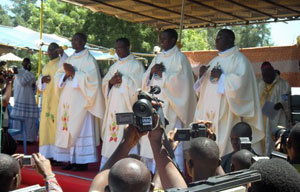
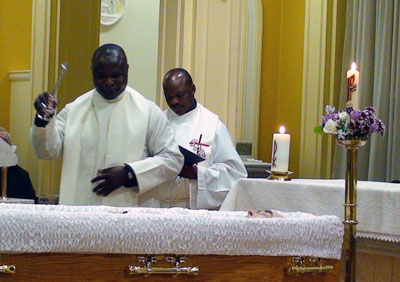
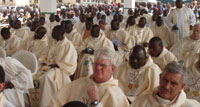
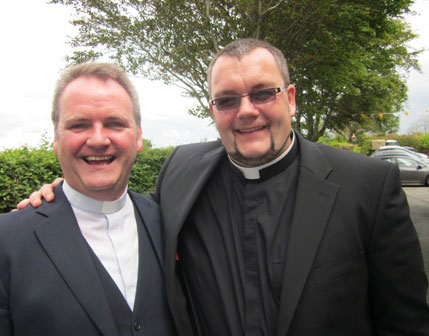
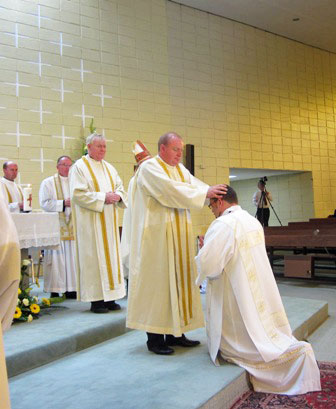
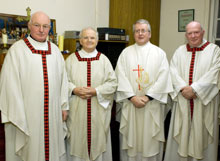
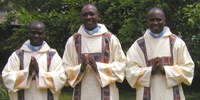
benin-newly-ordained-2010On Sunday 18 April 2010 the Catholic Church in Benin Republic began the 150th Anniversary celebrations of its birth. During the Mass we participated in the ordination of four young Beninois as SMA priests. They are Fathers Valentin Kobolou Fadegnon, Anselme Ishola Yonlonfoun, Bishop Ganye, Désiré Omotunde Salako and José Florent Kakpo.

Why was Agoué chosen as the place for our celebration? According to Fr Péloy, Agoué was founded in 1821 by several hundred Mina people who came from Petiti-Popo, now Aného, on the Benin / Togo border.

LET US RENEW THE FACE OF THE EARTH – Reflection for May 2010

LET US RENEW THE FACE OF TeyjafjllajokullHE EARTH Reflection for May 2010
In the last month we had the eruption of the Icelandic Volcano, which, even if it didn’t do any lasting damage, resulted in major disruption to people all over the world for an entire week. Have we learnt anything from this last event? When Nature decides to act, we humans have to learn to wait.  Perhaps we need to look at our technologically driven lifestyles. What is a week in a whole lifetime? Yet it seemed catastrophic to “lose” an entire week of work, travel and business.

Fr Paul D’Arcy SMA Funeral homily

darcy-p-family-wilton

Homily delivered by Rev Fr Fachtna O’Driscoll SMA, Provincial Leader of the Irish Province

29 April 2010

Readings:

Eccl 3: 1-8, 11 and 1 John 4: 7-11, read by Fr Paul’s nieces, Carol and Fiona

John 12: 44 -50, read by Fr O’Driscoll SMA  

There is an old wise saying that goes “map out your life, but do it in pencil”. When Paul D’Arcy took over the post of Provincial Secretary just over four years ago one of the tasks of that role was to organise the arrangements for all Irish SMA priests’ and brothers’ funerals. Little did we think then that within such a short space of time we would be celebrating Paul’s own funeral. This is part of the mystery of life. Our opening reading from the Book of Ecclesiastes puts it very clearly and succinctly: “there is a time to be born, and a time to die;…a time to mourn and a time to dance; …. a time to keep silence and a time to speak”. We are not the masters of time, God is. And God has now seen fit to call Paul into his full embrace.

darcy-p-family-wiltonAll of us got a shock on Tuesday morning on hearing the news that Paul had died. Not that we were unaware that his health condition was grave; it was just that in the previous days he had seemed to regain some strength and was looking towards some quality of life for a little time to come at least. It was not to be, and we know too that the medical prognosis was not comforting and perhaps Paul was spared a lot of suffering by his sudden death. Since he was diagnosed with cancer in the late summer 2008 Paul has really marked out his life in pencil. He lived from day to day and accepted whatever was given to him with commendable grace. Trying to figure out the whys and whynots of death is a useless activity; far better to accept the mystery and hand our loved one over to the Lord. Perhaps this Feastday of Catherine of Siena, mystic as well as savvy politician,  will inspire us to simply be with the mystery.

There is something special about being buried during the Easter season. All our readings at Masses this season speak of the resurrected Christ and the new meaning he brings to the lives of believers. And while the resurrection of Christ is not primarily about our own hope of resurrection to new life – it is primarily about the guarantee that the Kingdom of God is really among us – nevertheless it does offer hope to our faith that as St Paul puts it “if we have died with Christ, we shall also live with him”. Our Christian belief assures us that all the ties of friendship and affection which knit us together in this life do not unravel with death. That is why Paul’s natural family and his family of the SMA plus all his many friends are consoled today. We believe that his life is changed, not ended.  

Paul dedicated his life to proclaiming the message that the Kingdom of God is among us. Part of that message is that at death we begin to share in the Kingdom of God in a new way, a way that leads through purification to ultimately sharing in the fullness of God’s eternal kingdom. How many times did Paul share this consoling message of faith with grieving families as they tried to come to terms with the loss of a loved one? How well did he live the kingdom of God among us now by trying to make his own the passage from the letter of St John that we had in our second reading this afternoon: “let us love one another since love comes from God”…. and  anyone who fails to love can never have known God, because God is love”.  Paul had a very clear grasp of the fundamentals of that message which St John outlines a little further on in the reading: “this is the love I mean: not our love for God, but God’s love for us when he sent his Son to be the sacrifice that takes our sins away”. This is a key phrase for understanding the Christian mystery. We do not have to compete with God’s love. We do not have to try to ‘out love’ God. We simply respond to God’s love. And so it is that resurrection to new life in Jesus is gifted to us freely from God. We do not earn it; we receive it. Paul D’Arcy preached that message to others and today we are confident that he will enjoy new life with God, not because of his own efforts but through accepting the love offered by God. 

darcy-p-john--donalPaul was born in Castlebar, Co Mayo on 16th January 1945. The youngest of five children, he did his primary and secondary studies in Castlebar. He was an accomplished sportsman excelling in gaelic football where he was a tenacious corner back on the Mayo minor team; he excelled also as a basketball player. Fr Billy O’Sullivan recounted for us the other evening how Paul came to join the SMA after a vocation talk in St Gerard’s College. He did the usual route through SMA formation of Cloughballymore and Dromantine until he was ordained a priest in December 1968.

His first assignment after ordination was to the Tyrocinium at Kagoro, Northern Nigeria to study the language and culture of the people among whom he would live and work. He excelled in the Hausa language, so much so that he was called back some years later to initiate new recruits into the language. An assignment to the diocese of Jos found Paul in such parishes as Kwa, Shendam and Pankshin – great names in the history of SMA mission in Northern Nigeria.

Paul was called back, in 1980, by the Provincial administration to take up an appointment as Promotion Office Manager for the Irish Province. He did this job for six years and during this time his sporting interests came to the fore – particularly his love for golf which he had by now developed – by organising the first ever Provincial golf tournament. Thankfully that tournament is still flourishing and thanks will always be due to Paul for establishing such a fraternal gathering. Paul was to spend the next nine years in service to the British Province as secretary to the Provincial and his team. The British Province has always been loud in its appreciation of Paul’s service in that role.

A feature of Paul’s career as a missionary priest has been a moving back and forth between pastoral and administrative assignments. So, in 1995, having completed his assignment with the British Province Paul took up a pastoral appointment in the diocese of Arundel & Brighton. He loved the ten years he was to spend there in the parishes of Chichester, Leatherhead, Weybridge and Banstead and here too his service was much appreciated. Indeed, Bishop Kieran Conry phoned me yesterday morning to express his condolences to the family and to the SMA and spoke of the fine character of a man that Paul was.

In 2005, Paul again responded to the call of SMA and accepted my invitation to return to the Province as secretary. I have worked with him in close quarters for the past four years and have found him to be a man of principle, a man of honour, a man of loyalty, a man of utter discretion, a kind, gentle and pleasant man, and a good friend. I will miss him, not just for his work and service but especially for his kindness and decency.

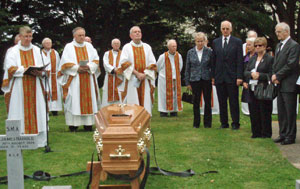
darcy-p-concelebrants-3(Our picture shows, from left, Fathers Denis Collins SMA, Paul’s cousin Tim Sullivan PP, Rob Morland SMA (British Province), Fachtna O’Driscoll SMA, Paddy Gilligan PP and Tom Fenlon SMA)


In the years that Paul and I worked together it was clear that like every priest Paul got his energy not from administrative work but from contact with people and from the few opportunities given to him to break the word of God with people. I chose the gospel of today – it was actually the gospel of yesterday’s liturgy – because it speaks of how we should approach the word of God, both as listener and speaker. Jesus tells us that he speaks not his own word but the word of the Father. So anyone who would dare preach the word must first be very attentive to that word so that what they preach is not just their own word but genuinely the word of the Father as mediated through Jesus. I would sometimes see Paul prepare his homilies over in the office. What struck me was the care he gave to the issue; he was meticulous about reading the word and usually some commentaries to bring the word more alive.

But Paul’s most powerful preaching was done not through word at all but through action. I’m reminded of the phrase of St Francis of Assisi: “Preach the gospel at all times. If necessary, use words.”  This was the preaching of life, how he faced his sickness. Quite a number of confreres have said the same thing to me over the last few days: “wasn’t Paul very brave in the way he approached his illness.” I can certainly testify for that being true, but he never indicated to me that anyone should regard him as brave. But brave he was. Since the day he was first diagnosed he has never wallowed in self-pity. He told me the other day of a morning in the cancer ward awaiting treatment when a woman patient said her first reaction when she was given the news was “why me” and Paul’s instant response was to say “well, why not me”. This was said without any sense of superiority or judgement but with total and simple honesty. That attitude has helped him to live through this illness with great dignity.

His illness did not dull his good sense of humour. It affected his singing but not his appreciation for music. Nor was his passion for sport dimmed in the slightest. His fondness for Man Utd grew, if that was possible. They say that in God’s time there is no yesterday or tomorrow, so I suspect that Paul already knows who’ll win the premiership this year – maybe he just couldn’t face a Chelsea victory!

His relationship to his family strengthened through his illness; his fondness for his nieces and nephews which was reciprocated; the frequent visits to and from family were treasured as precious gifts. His love for Leinster and Irish rugby flourished – I wonder why? Yes, he took a quiet but very genuine delight in the sporting achievements of nephew Gordon.

Paul will be missed; by family, colleagues in SMA, wide circle to friends. But these ties have not unravelled.

Ar dheis lamh De go raibh a anam dilis.

darcy-p-cemetery-2

Fr Paul D’Arcy SMA

paul-darcy-sma-2

Fr Paul D’Arcy SMA

paul-darcy-sma-2

The Irish Province of the Society of African Missions mourns the loss of Fr Paul D’Arcy SMA who died at 3.15am on Tuesday, 27 April 2010 in the Bon Secours Hospital, Cork.

Paul was born on 16 January 1945 in Castlebar, Co Mayo, the son of the late Donal and Margaret Helena D’Arcy (neé O’Sullivan, from Belmullet). The youngest of five children, he is survived by his brothers Donal and John, their wives Clare and Peggy, his sister-in-law Mary, nephews and nieces. His brother Pat and sister Mary (Corkery) and her husband predeceased him. Funeral homily here.

Benin Jubilee celebrations

benin-jubilee-logo

benin-jubilee-logo

Four SMA priests ordained as part of the celebrations to mark 150 years of the Catholic Church in Benin Republic

The Catholic Church in Benin Republic is celebrating 150 years of evangelization in this part of west Africa. To begin the Jubilee Year there was a Eucharist, on 25 April, to recall the arrival of the first SMA missionaries in Dahomey (as it was then called). During the Mass Bishop Antoine Ganye ordained four young men who have committed their lives to serve as priests in the Society of African Missions (SMA).

On 18 April 1861, the French ship ‘D’Estaing’ anchored off the port of Ouidah in the Republic of Benin. On board were the first missionaries to reach the Kingdom of Dahomey, as the Republic of Benin was then called.  They were Fr Francesco Borghero SMA, an Italian and Fr Francisco Fernandez SMA, a Spaniard. The town of Ouidah was well known for centuries to every slave trader in Europe.

Benin Jubilee celebrations 3

Address of Fr Michel L’Hostis at Benin Jubilee celebrations

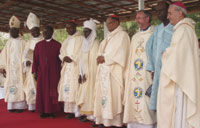
Fr Michel L’Hostis is the Superior for the SMA in Benin and Niger Republics. After the ordination of the four new SMA priests they received their Mission Crosses from the bishops of the dioceses from which they came. Fr L’Hostis spoke to the faithful who participated in the Ordination Mass :

Your Excellencies, Bishops, Fathers and my dear sisters and brothers in Christ,

Yes, 149 years on, the Church in Benin gives thanks to God for the arrival of the first two SMA missionaries at Ouidah and today ordains four of its sons to continue the work.

Our thanks to the Episcopal Conference for agreeing to integrate the priestly ordination of these four members of the Society of African Missions into this Solemn opening of the Jubilee Year.

Benin Jubilee celebrations 2

benin

Opening of the Jubilee to celebrate the Evangelization of Benin Republic

beninSunday, 18 April 2010 the Catholic Church in Benin launched a year of celebration to mark the 150th anniversary of its birth. During the celebration, 4 young Beninois were ordained priests for the Society of African Missions (SMA). Read an eyewitness report on this wonderful Jubilee Day.

Fourth Sunday of Easter 2010

25 April 2010

Acts 13.14, 43-52
Revelation 7.9, 14-17
John 10. 27- 30

A certain young man was studying at the university as he wanted to become a teacher. After he qualified he had great joy in working as a teacher. It gave him a lot of satisfaction. What saddened him was that he met some of the others who had been at university with him who were also teachers. But they told him they had no great love of teaching. They did it because it was a well paid job. Obviously their hearts were not in it.
2006themeToday is traditionally known as Good Shepherd Sunday when the Church asks us to pray especially for vocations to the priesthood. Perhaps the need to do this has never been greater. We need priests whose hearts are in it, who are truly good shepherds to the people God has entrusted to them. I feel that I am particularly blessed by God because I really enjoy being a priest and all that this involves.
As parents you are asked to be shepherds of the family God has given you. It is the same for teachers, farmers, fishermen, doctors, lawyers, etc. Is our primary concern to care for and help others to a better quality of life? If we are in it just for our own good then no matter what title one has one is not a shepherd with the heart of Jesus. Don’t we all have a great responsibility?
Sometimes it may cost a great amount if we try to listen to what we believe we are called to do and put it into practice. In the gospel today Jesus is speaking to the Jews and he says ‘the sheep that belong to me listen to my voice; I know them and they follow me’. This does not just apply to priests but to all who would like to be real disciples of Jesus. The theme of the Good Shepherd unfolds against a background of conflict and the threat of death as is more clear in the verses in John that follow today’s passage. 
Down through the ages up to our own time anyone trying to really listen to the voice of God and put it into practice will suffer in one way or another. It will make demands on us. We see people who try to be faithful in marriage despite difficult relationships, others who withstand the pressure to have an abortion, others again who refuse to give or take bribes etc. This is in no way a condemnation of anyone who may have given into temptation on any level. In fact, haven’t we all at some stage or other?
In our world today there are many voices calling out to be heard. Either on television or radio, by advertising, on the Internet, pressure from well meaning friends, peer pressure etc. There is also the voice of God calling us. Which voices will we listen to? ‘My sheep hear my voice’, says Jesus. Many religious leaders of his time refused to listen to Jesus. They thought they were honouring God by killing Jesus and that they were saving religion by multiplying sacrifices, commandments, prohibitions etc. Isn’t it much safer and more secure to follow the law and tradition slavishly instead of risking following Jesus, who spoke about love, service, forgiveness, compassion etc being the core of true religion? 
A friend of mine has a fish tank in which he has some small fish. He also keeps some canaries in a big cage. The fish and the birds belong to him. But in a sense he belongs to the fish and birds.  If he doesn’t care for them they die. But I know he takes great care to feed them daily and clean their tank and cage from time to time. So they live longer and he gets great pleasure from them as Jesus does from us. Jesus says in the gospel that the sheep that belong to him listen to his voice. So in belonging to Jesus, he belongs to us and we know from experience that our belonging to him means that he does all he can to care and love us if we allow him.  Very often we don’t. We stray away to follow other voices. Yet he keeps inviting us back to the true path that alone gives real peace and joy. This is the Good News.
To whom do we as Christians belong? It is not enough simply to say that we belong to Jesus. What we do and think will give us a good idea. Are we regular in going to Sunday Mass, to some daily prayer? Are we forgiving to those who may have hurt us or to those who think differently to us? Do we pray to put our trust in him and allow ourselves to be guided by his will?
He says also in this very short gospel: ‘I give them eternal life’, which for John the Evangelist does not just mean just life after death. Rather it involves the beginning of eternal life now – that is, a quality of life which gives peace, freedom, joy, but will also involve suffering and trial if we follow the Good Shepherd. It is especially about our relationship with God which begins here and continues into eternity.
In spite of your and my weaknesses Jesus gives us the great promise that as his brothers and sisters no one can steal us from him because the Father who is greater than anyone will not allow this.
Like any true shepherd Jesus will pull out all the stops to love and care for us. He does this especially through the friends and other disciples he gives us to care for us now. 
‘Lord Jesus, true Shepherd of your flock, thank you for sharing this vocation with each of us.  May your Spirit enable us to be true life givers and carers of your flock, those you have entrusted especially to us. Amen’.
Fr. Jim Kirstein, SMA

Third Sunday of Easter 2010

resurrection18 April 2010

Acts 5:27- 32, 40- 41
Revelation 5:11-14
John 21:1-19

Two men who were very good friends for a long time had a serious disagreement and stopped talking to each other. Three months later one of them phoned the other and admitted the major fault had been his and invited the other to a meal which was accepted. His friend forgave him totally and they had a great reunion.
Today we hear about the forgiveness of Jesus in relation to Peter and the other disciples despite their betrayal of him and their infidelity. In fact, he calls them ‘friends’.
The disciples had been out fishing all night and caught nothing. It was obviously dark. Now Jesus the Light of the world appears on the shore and having been told they had caught nothing suggested they cast their nets again and they catch a huge number of fish. Obviously he did not withhold his forgiveness and compassion from them despite their infidelity and betrayal of him. We see that Jesus was concerned to save them from the embarrassment of returning home to tell their families they had failed to catch anything. Also it was during their normal work that he appeared to them. This is important for us to know. Jesus does not try to embarrass us when we betray him by our sins and he is concerned and cares for us that our daily tasks would go well. He is with us if only we are aware of this. We also see the concern of Jesus in providing a meal for them. They had worked hard all night without success and were probably cold and tired so he calls to them and says ‘Come and have breakfast’. He invites us to the Eucharistic meal always too. 
When the disciples came ashore after the miraculous catch of fish they found a charcoal fire ready with fish cooking on it. You may remember that it was around a charcoal fire when Peter was warming himself that he betrayed Jesus 3 times. Now Jesus is telling Peter that he is fully forgiven for his betrayals but before Jesus can allow him to shepherd the flock he wants to hear directly from Peter if he loves him. 
Jesus asks Peter 3 times ‘Do you love me?’ This threefold question and answer do not imply that Jesus has doubts about Peter but that Peter’s love for Jesus is sincere and that he has the devoted love for Jesus, which is at the heart of all true discipleship. Jesus wants to hear the reply from Peter himself.  Jesus then tells Peter to feed his lambs (the weaker members of the community), to feed his sheep (the stronger ones) and to care for all of them.  This is the role of the shepherd.
This is a very important exchange because it reveals to us what the essence of Christianity is. Is it not true to say that Christianity is a person, Jesus Christ and so it is about our relationship with him and all that involves?  So why do I go to Mass on Sunday or why do I try and keep the commandments? Is it because I think I may go hell or that God will punish me, which is untrue?   Or is it because of my relationship with Jesus?  If so who is the Jesus I relate to? Who really is Jesus for me?  How well do I know him?  Can I have a deep relationship with someone if I do not know him/her very well? How do I deepen any relationship?  Is it not by spending time with the person and getting to know him/her?
That is why Jesus came – to offer us a deep personal relationship with him. He wants us to be his friends as he says in John’s gospel. Firstly he reveals himself to the 7 disciples. He is constantly trying to reveal himself to us in the ordinary events of each day, through our friends, in prayer etc
If we can see Jesus in this light as someone doing all he can to invite us into his friendship then we might want to be his disciples not because of any law but simply because we would like to.  Christianity was never meant to be a religion of fear and threats of punishment if we didn’t measure up. It was meant to be a relationship between Jesus and us and, between God whom Jesus revealed and us.  The Laws and Commandments were given to help us avoid trouble. So if I kill and get caught I may be hanged or electrocuted so God says – Don’t kill.  If I steal and am caught I may end up in prison, etc.
It is by living according to the value system of Jesus, attending Mass, by personal prayer, celebrating the sacraments and reading scripture that we deepen our relationship with Jesus. Jesus invited the disciples to a meal after the catch of fish.  If we could only understand and accept how passionately and unconditionally Jesus loves us then the more we would respond out of love and not fear. His death on the cross sums up this love. But it isn’t easy.  Peter was told by Jesus at the end of today’s gospel that he would suffer if he tried to be faithful to him.
‘Lord Jesus, thank you for your invitation to us to a deep, personal friendship with you. With the help of your Holy Spirit, help us to be more aware of this and to respond generously. Help us to forgive others as you forgive us always if we ask you. Amen’.

Fr. Jim Kirstein, SMA. 12th April, 2010

Topo Island revisited

topo-cemetery

Topo Island, Lagos State, Nigeria

topo-cemeterySituated off the south west coast of Nigeria, not far from the great megacity of Lagos, here – in 1862 – began the story of evanglization by the SMA in Nigeria with the arrival of an Italian SMA priest, Fr Francesco Borghero.
Our Regional Superior for southern Nigeria, Fr Tim Cullinane SMA, reports on the visit he, and 13 SMA colleagues, recently made to this ‘seedbed of the faith’ in Nigeria. On right of our picture is Fr Eddie Hartnett SMA and on left is Fr Cullinane. SMA priests from Ireland, India and five African countries made up the group – truly the “new face” of the SMA.

During Easter week 2010 fourteen SMA priests went on a two day visit to Badagry Slave Port and Topo Island, in the south west corner of Nigeria.

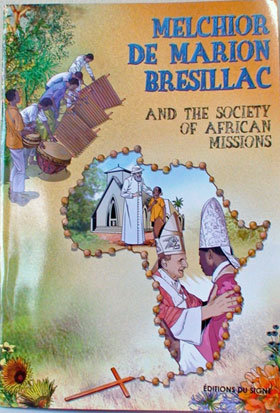
Melchior de Marion Bresillac & the SMA

de-bresillac-cartoons

de-bresillac-cartoons

The SMA General Council has produced a further book on the SMA Founder, Bishop Melchior de Marion Brésillac, in order to make this wonderful missionary better known today. 

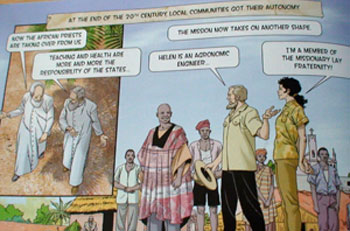
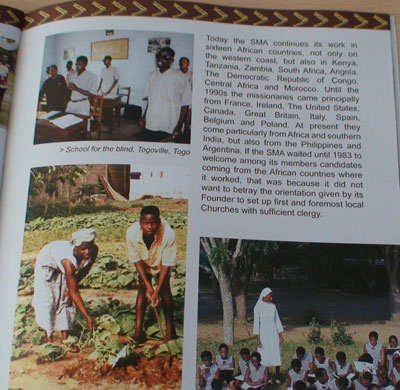
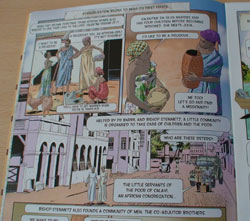
In a ‘Comic book’ format it also provides news of the work undertaken by his successors today. Its 55 pages give a colourful history of the SMA, yesterday and today!

The first part – 39 pages presents the story in cartoon form. The second section – entitled ‘The African Missions’ is for those who prefer a more ‘narrative type’ presentation.

Fr Jean-Marie Guillaume SMA, Vicar General of the Society, had overall responsibility for the production which will be distributed to all parts of the Society and to those who are interested in having a copy.

Some sample pages:

de-bresillac-cartoons-4de-bresillac-cartoons-3

If you would like to receive a copy of this very entertaining and enlightening production please contact the SMA at the following address: Rev AM Editor, African Missions, Blackrock Road, Cork City, Ireland.

de-bresillac-cartoons-2


WE MUST BE THE CHANGE WE WANT TO SEE – Reflection for April 2010

candle14

EASTER MESSAGE – Reflection for April 2010

Easter has come, and Christians all over the world celebrate the new life, and the new creation, that the Resurrection brings, not just personally, but as Pope Benedict said in his Easter Message, also “socially, in our surroundings, our neighbourhoods, our countries, and in our world.”

Gandhi once said; “we must be the change we want to see around us”. These words are an inspiration now, as we live in crisis times for the Church, the economy and for our entire society!  Easter shows what can happen when we are prepared to move beyond our self-imposed limitations!  The tomb is empty; there is no point in seeking the living among the dead! As new persons, we are challenged to accept the newness around us: new faces, new languages, new cultures, and to create a new society, becoming ourselves, “the change we want to see happening”. We can do this in the strength of our faith in the Resurrection, which alone overcomes death.  Here is hope for the world that the Pope has expressed, and it challenges us to make our prayers great ones:

In memory of Bishop John Moore SMA

bishop-john-moore-sma

Bauchi


a poem by Liam Caniffe, former Ambassador of Ireland to the Federal Republic of Nigeria

The heat of the torrid day
Lingers on through the nightbishop-john-moore-sma
As in bed uneasy I lay
Amid slumber unquiet.

Aeons of my kind have made
My skin a window that tries
To capture the rays in the shade
Of Northern sun-bereft skies.

Malarial mosquitoes buzzing
In my ears, unseen in the dark
En route I fear to causing
A diseased filled mark.

Here in Bishop’s House I rest
There basic wants are met
Where electricity is sporadic at best
And running water a dream as yet.

All around the dusty streets contain
Throngs of people everywhere
Eking out sufficient to maintain
Life from little in the putrid air.

Why does he endure so much
Forsaken all he could have had
To give to those whose needs are such
And do it with a heart so glad.

It takes a spirit most sublime
To reach far out to strong and weak
And give to those lost in time
The bread and life for which they seek.       [Nigeria Easter 2007 – for Bishop John Moore SMA]

Easter Sunday 2010

resurrection34th April, 2010

Acts 10:34, 37-43
Colossians 3:1-4
John 20:1-9

Not too long ago at the funeral Mass of a certain man, the priest in his homily said of him ‘he went around doing good. In fact he spent most of his life doing good’. 

These are the very words that Peter used in the first reading today about Jesus. And this was because God had anointed Jesus with the Holy Spirit. Whilst alive among us before his death Jesus preached the Good News that God was an incredibly, loving, forgiving and compassionate Father. Jesus healed many people and freed many from the power of what enslaved them-their fears, their sinful way of life etc. But despite going around doing good, the Jewish religious leaders eventually arranged the death of Jesus because the God they proclaimed was one who was a very demanding, judgemental God who was totally the opposite of the God Jesus proclaimed. Having got rid of Jesus these Jewish religious leaders thought it was the end of Jesus but we know otherwise and today we celebrate the great event of His Resurrection.

Perhaps Easter Sunday is something like that. Up to the moment of the Resurrection, after the terrible death of Jesus on Good Friday, the disciples were devastated. The One they had leaned on was gone. They never imagined Jesus would have been taken prisoner and crucified. In that instant their dreams evaporated. The disciples experienced a dreadful loss and were shattered Their hopes were gone. The Jesus they believed was crucified. For them at that terrible time, they never expected the sun to shine for them again in their lives.

Now in today’s gospel, a woman no less, Mary of Magdala reports to Peter and John that the tomb is empty. In many of the Resurrection accounts, it is the women who first experience the Risen Jesus. Women at that time, as in many places still today, were looked down upon. It seems that the proclamation of the Risen Jesus starts with the very people who were marginalised and who counted for little in society. In any case the curiosity of the 2 is awakened and they run to the tomb. Peter sees the linen cloths on the ground in the empty tomb. He did no more than see what was there. However, it is said of John that he ‘saw and he believed’ even though his own faith was not yet perfect because the full impact had not yet dawned on him. It took Thomas even some days to surrender and accept – very consoling for us. To discover fully how rich faith is takes time and growth and God is incredibly understanding and patient.

Like Mary Magdalene, Peter and John who all eventually came to believe, faith is a sheer gift from God that enables us to accept God’s revelation in Scripture and in the lives of the first witnesses to the resurrection that Jesus is alive, is out and about in our world today.

This is my experience of resurrection. Whilst the empty tomb has its importance I know that I have experienced much freedom because of the gift of faith in the resurrection of Jesus God gives me and the experience of Jesus working in my life now. Anywhere I see love in action in life I see the power of the Risen Jesus at work. Mary Magdalene went in the dark and found an empty tomb.  Since Jesus was not there it was indeed darkness, but later in meeting Jesus a new light dawned for her and all other believers.

The resurrection doesn’t mean that we gloss over pain, suffering and difficult daily life situations, but it does give us a new vision of life. It gives us the freedom to face the dark side of life, and even death with confidence knowing that Jesus broke the bonds of human limitation and death.

For Christians resurrection is now, not just after we die.

If we are faithful despite the great difficulty of these times, we believe Jesus is there with us then and he will surely help us experience the sun shining again. Not only that we will begin to develop talents and gifts we never knew we had because fear gives way to trust in Jesus. This empowers us to break free of former limitations.  With Jesus risen and gone from them the first apostles and disciples developed courageous leadership and other skills they never knew they possessed.

In the gospel today we heard that on approaching the tomb in the still darkness of pre-dawn, Mary Magdalene’s thoughts were centred on a stone to be rolled away as she was convinced that the dead body of Jesus was inside. It was all she had eyes for, as it were. Nor did she check on whether the tomb was empty or whether her beloved Lord was still there. Perhaps in reflecting on our own experience we might think about the many stones that need to be rolled away. What is it that keeps us unfree?  Where are we closed in from what or whomever?

I imagine that you are at Mass today because you are anointed with the Holy Spirit. You are empowered to go around doing good. The Lord invites us to continue this work which he did during his life on earth. He chooses to use us, human and failing at times as we do. We are that important to God and let us never forget that we are resurrection people, empowered to witness to a God who has raised Jesus from the dead and is by our side to strengthen us at all times.

“Thank you, Lord Jesus for the gift of our faith in your resurrection.  May we be witnesses of gospel joy and peace to others still searching and doubting.  Amen”. 

Fr. Jim Kirstein SMA – 2 April 2010

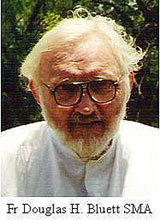
Fr Douglas Bluett SMA

douglas-bluett-sma

Fr Douglas H Bluett SMA dies in London

douglas-bluett-smaThe SMA British Province has lost its senior missionary with the death of Fr Douglas (Dougie) Bluett in a London hospital on Monday, 27 March 2010.

In recent years he had suffered from cancer though never allowed it to dim his missionary calling. He continually requested a return to front line service in Africa though his illness meant that his wish could not be granted.

Fr Bluett, born in Dublin in 1934 was raised in the Church of Ireland before converting to Catholicism and becoming a Catholic priest.

He was ordained in Keffi, diocese of Makurdi, by Archbishop Peter Y Jatau of Kaduna, Nigeria  in 1972. For 36 years Fr Bluett ministered in several parishes in the diocese of Makurdi, most notably Doma. He was a renowned teacher and for many years taught at St Thomas Aquinas Major Seminary in Makurdi. He had the great joy of seeing part the area where he worked made into a separate diocese, Lafia.

Fr Bluett is mourned by his sister, extended family, friends and his confreres in the British Province as well as in the wider Society.

Fr Rob Morland informs us that, in accordance with his wishes Fr Dougie will be buried alongside other SMA colleagues Manchester.

The funeral arrangements are as follows:

Monday, 5th April: Reception of his remains at the SMA House, 33 Lyonsdown Road, New Barnet at 5pm.

Tuesday, 6th April: A funeral Mass will be celebrated at 12 noon in the Church of Mary Immaculate & St Peter, New Barnet.

Wednesday, 7th April: Mass in the chapel at St Mary’s Catholic Cemetery, Manchester Road, Worsley, Wardley at 11am followed by interment.

May his gentle soul rest in peace.


Easter Reflection 2010

An Easter Reflection

resurrectionAll the major religions have their holy sites. The holiest Christian site is the Church of the Holy Sepulchre in Jerusalem. We can’t be certain but scholars are agreed that it is the site of the crucifixion and resurrection of Jesus. The original church was built by the emperor Constantine. His mother Helena is credited with finding the true Cross. The original building had a pagan shrine built over it and many churches were built and destroyed on the site. The present building is the result of major renovations that were undertaken in the 1950s. It is a major centre of pilgrimage for Christians. 

I was there for Easter Sunday 2005 and concelebrated Mass with priests of many different nationalities under Calvary and in front of the Tomb. The chants and prayers in different languages added solemnity and helped reflection on the enormity of the event we were remembering. 

The resurrection of Jesus changed everything. The Father called him out of the darkness of the tomb of death to a new triumphant risen life. He is alive. He is with us. He has risen from death. We now look on death in a different way. It is not a destructive end. It is an opening to new life. His death looked disgraceful and final. But Mary and the disciples were surprised and delighted to see him alive on that first Easter Sunday. 

He appeared to them a number of times before the Ascension and it completely changed their lives. They believed and they shared their faith with others. They witnessed, by their preaching and the way they lived, that Jesus had risen.

St. John says, ‘The night is over and the real light is already shining. Anyone who claims to be in the light but hates his brother or sister is still in the dark. (1 John 2:8-9). We can now live ‘in the light’. Life can be full of difficulties, we can be buffeted from all sides with bad news, everything can seem dark, but Jesus has risen, there is now hope and meaning to our moments of darkness and difficulty. Jesus went from the despair of death on the Cross to the triumph and joy of the resurrection. If we faithfully follow him we too can triumph over our weakness and difficulties and come to glory with him.

obrien-johnWe are challenged to change and live in a new way. ‘Since you have been brought back to true life with Christ you must look for the things that are in heaven where Christ is seated at God’s right hand. Let your thoughts be on heavenly things not on things that are on the earth because you have died and now the life you live is hidden with Christ in God. But when Christ is revealed, you too will be revealed in all your glory with him.’ (Colossians. 3:1-4).

The people who visit the Church of the Holy Sepulchre this Easter and every Christian who worships in their own church will be celebrating new life and pledging to live that life to the full in their community.

–  Fr John O’Brien SMA, SMA House, Ranelagh, Dublin 6

Inter Ministerial Council meeting

north-south-ministers-dc

North-South Ministerial Council meeting in Dromantine

Dromantine Retreat and Conference Centre  hosted a North-South Ministerial Council meeting on 3rd March 2010. These meetings, part of the Good Friday Agreement, are usually held twice a year and are hosted at different venues in the two jurisdictions.

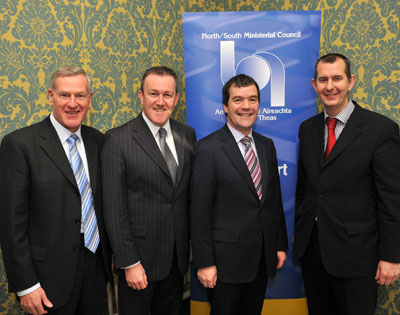
north-south-ministers-dcAs it concerned the Transport sector the attendance included Mr Conor Murphy MP MLA, Minister for Regional Development and Mr Edwin Poots MLA, Minister for the Environment (Northern Ireland Executive) and Mr Noel Dempsey TD, Minister for Transport, (Irish Government). They were accompanied by their officials and advisors. The meeting was chaired by Mr Murphy.  

Our picture shows, from left, Father Des Corrigan SMA, Conor Murphy MP and MLA, Noel Dempsey TD and Edwin Poots MLA.

Before the actual meeting, Ministers Dempsey and Murphy launched a new policy on cross-border data sharing arrangements. This will facilitate the exchange of information on vehicles and drivers, particularly relating to driving and parking offences as well as toll charges.

Further information on this very important development can be found at:

http://www.northernireland.gov.uk/news/news-drd/news-drd-030310-cross-border-co-operation.htm

Before the venue was decided on, officials from the North-South Joint Secretariat, which is based in Armagh, came to look at Dromantine and the facilities it could offer. After discussing their requirements etc it was agreed that Dromantine could host such a meeting.

The meeting and the launch attracted considerable media presence, including BBC, UTV and RTE. All of these covered the events on their evening news programmes as did many newspapers.

In a letter received from the Joint Secretaries, they wrote, “We received positive feedback from Ministers and officials who were impressed with the hospitality, facilities and professionalism of the staff.

Such a meeting taking place in Dromantine was a new development and an experience which was welcomed and appreciated by all concerned.

Fr Desmond Corrigan SMA, Director

Palm Sunday 2010

PALM SUNDAY – YEAR C

28th March, 2010

Isaiah 50.4-7
Philippians 2.6-11
Luke 22.14–23.56

One night a man went to a pub for a drink.  Later he saw two other men arguing seriously and it began to get worse.  Then one of them pulled a knife from his pocket and was about to stab the other.  Luckily he was disarmed.  Many TV films or movies today have a lot of violence in them.  Even the struggle between good and evil in them is very violent. Does ‘popular culture’ in East or West see no alternative to the use of force for asserting rights or overcoming malice?

The ancient time into which Jesus came was similar to our own time. Large armies carried out the will of emperors and kings over smaller armies and kingdoms.

palmsundayjerusAs we begin Passion Week today we will see the confrontation between Jesus and the Jewish religious leaders, the scribes and Pharisees coming to a climax. He was witnessing to the ways of God which were very different to the usual way of dominating others by violence and battles.  And he expected that his followers would do likewise.  Unfortunately some gospel texts can seem to say that violence is alright.  One such text is that of Luke 22.36 when Jesus says, in view of the oncoming confrontation with those determined to condemn and kill him, ‘if you have no sword sell your cloak and buy one’. The disciples take this literally but what Jesus is really saying according to scripture scholars is ‘prepare seriously for the coming events, especially by prayer’, as he did in the Garden of Gethsemene.  It certainly was not an incitement to violence or to armed force, but that their very lives would be at stake.

On Palm Sunday, Jesus riding on a donkey is proclaimed by the crowds as ‘the king who comes in the name of the Lord’. Certainly not a king who was coming with a powerful army. Yet five days later he is being mocked, scourged and crucified.  Probably some in the crowd on Palm Sunday were shouting for his death only a number of days later.  It raises the question for each of us – are we as faithful in following Jesus in time of trial, temptation and suffering as we are when life is going well for us?  Do we pray to thank God as much in good times as we do when we ask for help when life is difficult and painful? 

The focus of today’s celebration and indeed for all the readings of Holy Week is on Jesus, the faithful one. During all this week we are celebrating his fidelity not only when he was being praised and honoured by the crowd as a king but also during the terrible times of suffering and crucifixion. The first reading today is from the prophet Isaiah. He foretells the mysterious One who is to come whom we know now as Jesus, by saying ‘I gave my back to those who beat me, my cheeks to those who plucked at my beard, my face I did not shield from blows and spitting. The Lord God is my help, therefore I am not disgraced’. This was exactly what Jesus did.  He trusted that his Father would strengthen him to be faithful to the end especially when suffering. The Good News is that God our Father will strengthen us also.

In the accounts of the Passion of Jesus what the Gospel writers focus on is not the scourging, the whips, the nails, the physical pain but emphasize rather that, in all of this, Jesus is alone, misunderstood, lonely, isolated, without hardly any support.  What is emphasized is the agony of a heart that is extra sensitive, gentle, loving, understanding, warm, inviting, hungry to embrace everyone.donkey

On the surface it would seem that that the death of Jesus was a defeat for Jesus. But it really was a victory. It was the triumph of good over evil, of love over hate, of light over darkness and of life over death as the resurrection proved.

Recently a young woman was walking along with her 2-year-old son. He fell and started crying.  Immediately she picked him up and embraced him absorbing his pain and fright. She did not scold or condemn him for falling. Shortly afterwards he stopped crying and was fine again.  I feel that this is a good image of Jesus on the cross. He is there with his arms outstretched, absorbing the pain, the suffering, the hatred and violent intentions of others. He absorbs the pain into himself and returns it to us all as love, forgiveness, compassion and healing if we will but accept these. Jesus breaks the cycle of violence and instead of returning hatred for hatred as we see so often done in our world today, as with so many suicide bombings, murders, stabbings etc. he offers only total love in the hope we will imitate his incredible example. Jesus absorbed all the violence, transformed it and returned it as love and forgiveness.

So the liturgy of Holy Week is telling us of the incredible love of a God who will never give up on us no matter if having praised him in good times we will forget his love in hard times.  It is very important to note that nowhere in any of the gospel readings of this week does Jesus condemn anyone. Neither does he condemn you and me.  The ultimate proof of this is that whilst hanging, in terrible agony on the cross, Jesus prays: ‘Father, forgive them, they do not know what they are doing’. 

But Jesus is the totally disarmed one, as the Letter to the Philippians says.  He actually emptied himself and took on the condition of a slave, humbling himself even unto death, death on the cross.  Jesus did not act out of a power stance or with any superior force but met bitterness with gentleness, hatred with love, rejection by accepting the others in their anger.  How hard for us to imitate his example.

To follow Jesus faithfully is not easy. It is much easier to go to Mass, pray the rosary or say novenas.  All these are very good.  But Jesus asks us above all to follow his example by living daily with the same attitudes that he lived by.  This is the way that leads to real peace and joy. That is why prayer too is very important. We need it to strengthen us in times of trial.

“Lord Jesus, thank you for breaking the cycle of violence that you were confronted with. Give us the Holy Spirit to follow your example and to be always faithful in following you. Amen.”

                                     Fr. Jim Kirstein SMA, March 22, 2010

Bishops of Niger Ad Limina visit 2010

dsc05515

Ad Limina Visit of the Bishops of Niger and Burkina Faso to Pope Benedict XVI

The SMA founded the first Catholic Mission in Niger in 1931.

Since then the Church has had a slow steady growth though the Catholic population is only about 20,000 (i.e. less than a fifth of one percent). Despite this small number its role in Nigerien society is greatly appreciated by the entire population, especially for its education, health and social services. dsc05515Archbishop Michel Cartateguy SMA is the Archbishop of Niamey (on right of picture with Fr Fachtna O’Driscoll SMA, Irish Provincial Leader). The other diocese in the country, Maradi, is led by Bishop Ambroise Ouedraogo.

Pope tells Bishops of Burkina Faso and Niger on Ad Limina visit: “May a new missionary zeal enliven your community, so that the Gospel message is fully accepted and faithfully lived!”

Vatican City (Agenzia Fides) – “After more than a century, evangelization has already borne abundant fruit, visible through many signs of the vitality of the Church-God’s family in your countries. May a new missionary zeal enliven your community, so that the Gospel message is fully accepted and faithfully lived.” That is the appeal that was made by Pope Benedict XVI to the Bishops of Burkina Faso and Niger, whom he received in audience on March 20, during their visit ad Limina Apostolorum.
In his speech, the Pope said that “faith always needs to strengthen its roots,” and welcomed the commitment “to a healthy inculturation of faith,” and encouraged them to continue in the “missionary effort of solidarity” toward the sister Churches on the continent. Other signs of hope were shown in the efforts made by the Church to combat “the evils that prevent populations to achieve real development and the promotion of solidarity towards all and especially the most in need.”
Citing the context of the Year for Priests, the Holy Father expressed the wish that every priest be guaranteed a solid education, not only during his preparation for ordination, but for his entire ministry, “because it is essential” that the priest can devote time to deepening in his priestly life, to avoid falling into activism…May the example of John Mary Vianney awaken in the hearts of your priests, to whom I pay tribute for their brave missionary activity, a renewed awareness of their total gift to Christ and the Church, powered by a fervent prayer life and passionate love of the Lord Jesus!”
Particular expressions of thanks and encouragement were then addressed by the Pope to catechists, “necessary collaborators of the priests in proclaiming the Gospel,” who “have a key role not only in the first evangelization and the catechumenate, but also in the animation and in support of the community.” This is why the dioceses are making considerable efforts to ensure their human, intellectual, spiritual, and pastoral formation” and the Pope also encouraged them to meet their material needs, “so they can lead a dignified life.”

Also regarding formation, Benedict XVI urged the bishops of Burkina Faso and Niger to care for the formation of the laity, so that they can “take responsibility in the Church and society and be authentic witnesses of the Gospel in them” and “pay particular attention to the political and intellectual elite of your countries, who are often confronted with ideologies opposed to a Christian conception of man and society.” In particular, he mentioned the pastoral care of young people through the strengthening of the school and university chaplaincy.

The last topic touched by the Pope was on interreligious relations: the good stable climate established “can deepen the bonds of esteem and friendship, as well as cooperation among all segments of society… Thus, teaching the younger generation the fundamental values of respect and brotherhood will foster mutual understanding.” The Pope then expressed the hope that they continue to strengthen the bonds that unite Christians and Muslims in particular, “in order to advance in peace and justice and promote the common good, rejecting any temptation to violence or intolerance!” (Agenzia Fides 22/3/2010)

The complete text of the Holy Father’s address – in French – is available at the link below: 

http://www.fides.org/fra/documents/AdL_Burkina_F.Niger_20032010.doc


NIGER – Brief Overview of the Country

Rome (Agenzia Fides) – The Republic of Niger has an area of 1,287,000 km2 and a population of about 14 million inhabitants. It is bordered to the north by Libya and Algeria to the west by Mali and Burkina Faso, on the south by Benin and Nigeria, and east Chad.

The country’s main ethnic groups are the Hausa, the most numerous and involved in politics, followed by Zerma-Songhai, the Fulani, the Tuareg, and the Berberi.maradi - festival 2 Picture shows part of the Maradi Festival celebrations.

History
Niger has been since time immemorial a hub for economic exchanges between the inhabitants of the Maghreb and Chad. Virtually unknown to Europeans for a long time, in 1890 an agreement between France and Britain made the country enter French orbit. In 1922, Niger became a French colony in French West Africa. In 1960, independence was proclaimed.

Niger is a republic governed by a President elected every 5 years. Even the Legislative Assembly is renewed every 5 years. The history of independence is marked by a series of military coups. The last one took place on February 18, 2010 and overthrew President Mamadou Tandja, who had forced a change in the Constitution in order to obtain a third term.

Another recurring crises is related to the integration of the nomadic Tuareg, which triggered a series of rebellions in the last 20 years.

Economy
The country is rich in raw materials: uranium (Niger is home to 7.5% of global uranium production), iron, silver, platinum, and titanium. Niger, however, ranks 174 (out of 179) on the Human Development Index of the United Nations. 90% of the population is illiterate and lives on subsistence farming and pastoralism.

Religion
90% of Niger’s population is Muslim. Approximately 250,000 people belong to traditional religion. Catholics are about 20,000 (0.20% of the population).

The Catholic Church

The work of evangelization was begun by the Fathers of the Society of African Missions (SMA) who founded the first mission in Niamey in 1931. The mission was established as a Prefecture Apostolic on April 28, 1942 and elevated to a diocese on March 21, 1961. Working there are the Redemptorist Fathers, missionaries of SMA, the Missionaries of Africa (White Fathers), the Little Brothers of Jesus (of Blessed Charles de Foucauld), the Brothers of Christian Schools, and 7 female religious congregations.
On June 25, 2007, Pope Benedict XVI created the new Ecclesiastical Province of Niamey, which has as its suffragan the Diocese of Maradi.

Some data on the Catholic Church in the country: there are 2 dioceses with 19 parishes. There are 3 bishops, 22 diocesan priests, 24 religious priests, 4 professed brothers, 91 religious sisters, and 255 catechists. The Catholic Church runs 7 kindergartens with 1,482 students, 14 elementary schools with 6,161 pupils, 2 junior high and high schools with 2,550 students. The Catholic Church also operates 2 hospitals, 6 clinics, a leper colony, and an orphanage. (from the most recent Church Yearbook). (Agenzia Fides 20/3/2010)


The complete text of the Holy Father’s address – in French – is available at the link below:

http://www.fides.org/fra/documents/AdL_Burkina_F.Niger_20032010.doc

More information at: www.fides.org


Fifth Sunday of Lent 2010

FIFTH SUNDAY of  LENT – YEAR C

21st March 2010

Isaiah 43.16-21
Philippians 3.8-14
John 8.1-11

Recently one of the newspapers showed a photo of a young woman being buried up to her neck in the earth.  She had been caught committing adultery and was about to be stoned to death for it. What a horrific way to die. As in the gospel there was no sign of the man. The gospel scene could have ended up in a very ugly manner. If Jesus had gone along with the script of the Scribes and Pharisees the woman would have died a horrible death. Who would have benefited from that? Instead, thanks to the understanding and compassion of Jesus, she was able to put the past behind her and make a new start.

Today’s gospel is primarily about who God is and how he treats us. Jesus gives the woman caught in adultery another chance. Instead of allowing her to go to her death, Jesus gives her life. Jesus is clearly telling us who God is and how he acts towards each one of us. God is a life-giving God, not a death-giving One. What Jesus is saying is ‘If I look on you with God’s pure gaze of love, with God’s forgiving attitude then you are totally and freely loved and forgiven’. It is God who decides all this. We cannot make God’s love and forgiveness depend on our worthiness or goodness.  Unfortunately it is not our human experience.  Don’t we often want to exact revenge or punish those who hurt or wrong us?  Not so God – it is so far from the God Jesus is witnessing to. That does not mean if God loves me like that I can sin merrily.  In fact it is the very opposite – realising how very much God loves me so unconditionally I will do my best to please him in doing likewise to others. We should pray often for this gift. 

The first reading from Isaiah briefly recalls Israel’s past and tells them that ‘God is doing a new deed’. Our God is not a God who keeps reminding us of our past sins.  His focus is much more on what he can still accomplish in our lives from now on no matter what our past has been. God is the God of the second chance or however many chances we need.

In today’s gospel Jesus offers a new way of looking at life.  We notice that Jesus did not ask the woman to look back, to publicly account for her sins. He merely asks that she go on with her life and not sin again.  With Jesus what is past is past.  Others may condemn us but God never does.

This is what St. Paul the onetime Pharisee and a radical upholder of the Law discovered.  Because of his own experience of God’s passionate, forgiving love for him he can now say as we heard in today’s second reading – ‘I believe that nothing will happen that will outweigh the supreme advantage of knowing Christ Jesus my Lord’.

This was the experience of the woman caught in adultery. In meeting Jesus she heard; ‘Has no one condemned you, neither will I condemn you. Go away and don’t sin anymore’.  This is perhaps the greatest thing that ever happened to the woman – the experience of being accepted, of being heard, of being treated as a human person.  At this stage of the story Jesus is kneeling down and looking up at the woman.  The Pharisees who had departed full of shame had merely looked down on her with scorn and rejection.  How humiliated and fearful she must have felt before Jesus enters the situation.

Yet Jesus did not treat her sin lightly.  He didn’t deny she had sinned.  Sin carries its own punishment. It is not God who punishes us but sin.  He knew that if she did the same again he would not necessarily be around and she would indeed be stoned to death.

The Scribes and the Pharisees exposed the woman to the most humiliating kind of shaming – a public shaming. People have been known to commit suicide rather than face a public shaming.  They didn’t show the slightest concern for the woman as a person.  She was someone they thought they could use to entrap Jesus.  She was to them what bait is to a fisherman.

Jesus could see the double standards they applied to themselves.  He knew that they were sinners like everyone else, yet they were able very conveniently to forgive and be easy on themselves whilst condemning the woman. In fact, the only person in the scene who had a right to condemn her, Jesus, had not the slightest interest in doing so.  And when all had left Jesus is left alone with the woman.  As St. Augustine puts it, only misery and mercy remained.

Yet in regard to the Scribes and Pharisees there is something marvellously gentle and subtle in the way Jesus dealt with them. He had outwitted them but he did not condemn or humiliate them. He exposed them, but did not spell it out in public.  He didn’t even judge them.  Rather he invited them to judge themselves. Instead he simply tells them that those without sin should cast the first stone.  Immediately the accusers become excusers.

Jesus shows how God deals with sinful people, that is, with each of us. He is a God of incredible, unconditional compassion and loving forgiveness. He changes our view of God.  At the same time he asks us to change our view of sinful people.  Each one of us, no matter what our sins are, has the capacity to change. Our sins are not the sum total of who we are.  They are parts of who we are, for sure.  But God can do a new deed for and in all of us if we allow him.  We heard in the First Reading from Isaiah the words: ‘See I am doing a new deed’.  This is indeed very consoling for us.  It is God who will do in us it if we allow him.

But God from whom we receive total and absolute forgiveness expects us to do likewise for others.  Is that true of us?

“Lord Jesus, thank you for not condemning us. We do not deny that we sin and yet you constantly give us new opportunities to change. Help us to be ever ready to excuse others for their failings as you do ours. Amen”.

Fr. Jim Kirstein, SMA.March 15th, 2010

World Water Day 2010

World Water Day – 22nd March 2010  

Campaign to raise the profile of water quality at the political level so that water quality considerations are made alongside those of water quantity.`With World Water Day soon approaching on 22nd March, the simple yet much sought after substance of water is brought to the fore.

As well as having a sufficient supply of water for all people worldwide, water quality is also of paramount importance. Africa as a continent is frequently associated with a shortage of clean water, resulting in much human suffering. Perhaps the water shortage issue is sometimes too closely aligned with the simple idea that there isn’t enough rain in Africa, resulting in a type of inevitability, or acceptance, of the ongoing problem. However this analysis could be compared to the oversimplified idea, that the Great Famine in Ireland was the result of the potato blight. In both situations the root cause of the problem was and is social injustice and social inequality.

With one in five of the world’s people living without safe water[1], ill-health from drinking dirty water is one of the most serious threats to human life. The availability of clean drinking water also affects many more elements of people’s lives in Africa. When water and sanitation are provided to poor communities, they can begin to spend their insufficient incomes on other needs such as food, health care and education. This is in contrast to the present situation where many Africans, usually women, have to spend hours collecting water for their families. The water they collect is often taken from dirty and polluted sources, and the containers often hold up to 20 litres of water.[2]

The UN Water for Life Decade 2005-2015, which kick started the first World Water Day, is hoping to address the issues around water and to promote efforts to fulfill international commitments made on water and water related issues by 2015.

 It is hoped that this will put greater pressure on all stake holders involved, to fulfill the Millennium Development Goals on water and sanitation. It is also hoped, that it will inform the greater public of the devastating effects that lack of good quality water can have on human beings. Let’s hope that a concerted effort by all stakeholders and countries will mean more stories like those from Louisa in Mozambique. “Before we got sick quite often from drinking the lake water. We no longer get sick from drinking dirty water. The water from the pump is sweet and healthy.” [3]

For more read : www.worldwaterday.org


Jos: Causes of violence are not religious

Statement of 17 March: Another massacre in Nigeria; Archbishop of Jos tells Fides “this is just another retaliation over loss of livestock, not a religious conflict,” talk of interreligious violence ends up spreading it

Jos (Agenzia Fides) – “This is a retaliation against the Fulani herders against the villagers, for an alleged theft of livestock. This is not a clash between Christians and Muslims,” Fides was told by Archbishop Ignatius Ayau Kaigama of Jos, the capital of the Nigerian Plateau State, where this past night, March 16-17, 12 people were killed in an attack in the village of Byie.
“The Fulani herdsmen, considering the villagers responsible for the loss of part of their livestock, have carried out a retaliation attack. The fact that the Fulani are Muslim, and the villagers are mostly Christians, is an incidental fact. The real motivation for the massacre is the alleged theft of the livestock,” Bishop Kaigama strongly affirmed.
“I am concerned about the fact that the large international press continues to present the clashes that take place in Plateau State as a religious conflict between Christians and Muslims. This is not so. “This violence is of a social, economic, and political origin. Stating that there is a religious clash means endangering the lives of people, because, talking about it really presents a threat to igniting sectarian hatred. Why doesn’t the international press talk of the initiatives undertaken by everyone, including Christians and Muslims, to reduce tension in the area? It seems to me that they are just trying to throw fuel on the fire” concludes the Archbishop of Jos. (Agenzia Fides 17/3/2010)

Statement of 13 March: Archbishop of Jos tells Fides News Agency: “It is time that political leaders do their part and address the root causes of violence,” Archbishop of Jos tells Fides

Jos (Agenzia Fides) – “The politicians must take the bull by the horns and address the root causes of these cyclical episodes of violence. I will not tire of repeating: the real causes of violence are not religious, but ethnic, social, political, and economic” Fides was told by Archbishop Ignatius A. Kaigama of Jos, capital of the Plateau State.
“We religious leaders will continue to do our part, preaching nonviolence and mutual respect, but administrators and politicians also need to do their part,” said Archbishop Kaigama.
Among the causes of the crisis, Archbishop Kaigama mentions the distinction between “indigenous” and “non-indigenous,” which divides the population of the state.
According to various analysts, the root of the clashes in Plateau State dates back to British colonial times, between those who have the status of “indigenous” and “non-indigenous.” In the first case, you have access to a range of rights as original inhabitants of the state. The “non-natives,” however, suffer discrimination, for example, exclusion from various state posts, restrictions on access to universities for which they pay higher tuition fees, etc. …
In a note sent to Fides, Archbishop Kaigama explains the latest attacks.
“Less than two months after the January 17th 2010 Jos ethno-religious crisis in which hundreds of people lost their lives (see Fides 20/1/2010), in what seems to be a reprisal attack in which over one hundred persons have been reportedly killed in an early morning raid, occurred on March 7th in the villages of Dogon Nahawa, Ratsat, and Zot Foron, some 15 kilometers south of the city of Jos. The villagers of the Berom ethnic group (mainly Christians) alleged that their attackers were Fulani Muslim herdsmen who swooped on them while they slept. The attack which lasted more than two hours began at about 2:30 am and the victims were completely unprepared for the fury of the marauders. The free use of guns, cutlasses, and other lethal weapons left little chance for the victims, mainly children and women who were hacked down and burnt as they attempted to escape the massacre.”
The exact figures of casualties are normally difficult to ascertain in such circumstances. The electronic and print media have given divergent figures ranging from 150 to over 700. The parish priest of St. Thomas Parish in Shen who pastorally serves the affected areas, Fr. Philip Jamang, said he physically witnessed the mass burial of sixty four persons in Dogon Na Hawa village, thirty persons in Ratsat and twenty-four in Zot Foron, not including those still missing. A resident of the village, Peter Jang, described how the attackers went about their dastardly act by starting to shoot in the air in order to bring people from their houses and then when people came out, they started shooting at them and cutting them with machetes and other weapons while at the same time burning their houses.
As was the case in 2008 crisis, the Catholic Archdiocese of Jos is organizing a Mass of solidarity to pray with and for the victims of the affected persons. The Holy Mass will take place on the 19th of March 2010 at St. Jarlath’s Parish Church in Bukuru, an area which experienced most of the physical destruction to lives and properties…We have taken up collections of material items as well as made monetary contributions to help the affected. We got support from some dioceses in Nigeria, international church agencies and individuals. Our Justice, Peace and Caritas Department has already attempted to attend to some food, medical and clothing needs of the many thousands who were displaced (Muslims, Christians and others).” (Agenzia Fides 13/3/2010)

More information at www.fides.org


A miraculous spiritual adventure to Benin City

brian-mccormack-in-benin-ci

A miraculous spiritual adventure

In October 1953 Brian McCormack, a native of Castlebar, Co. Mayo, entered the Colonial Service and took up employment as an agricultural engineer in ‘Mid-West’ Nigeria.

Just five months into his contract on 20th March, 1954 he died from natural causes while inspecting a rice plantation project near Agenebode, a 2-hour drive from Benin City where he lived. His body was brought back to Agenebode where he received the Sacrament of Extreme Unction. Bishop Patrick J Kelly of Benin City was present at the mortuary for the removal of Brian’s remains to the Holy Cross Cathedral in Benin City.

The funeral Mass took place on 22nd March, 1954 at Holy Cross Cathedral. In attendance were Bishop Kelly SMA and Fathers Michael McFadden SMA, also a native of Castlebar, Joseph Stephens SMA, Joseph Hilliard SMA, Thomas Murray SMA, Joseph Conboy SMA, William Kennedy SMA and James Conlon SMA. All but the last two have gone to their eternal reward. Fathers Conlon and Kennedy now live at the SMA House, Wilton, Cork. After the Mass Bishop Kelly accompanied the funeral to the cemetery where he blessed the grave and led the prayers of Christian Burial.

Brian, Sr. was born in 1917 into a family of 9 boys and 5 girls. Two brothers, Joe and Ger, and a sister, Eileen Irwin, still reside in Castlebar. Brian’s sudden death was a huge blow to his wife, Patricia, who is still hale and hearty and living in her native Dublin, and the other members of his family. His two sons, Paul, born in December 1951 and his younger brother, Brian, born in November 1953, just after his father had gone to Nigeria, were not old enough to fully understand the circumstances surrounding their dad’s death at the age of 37. Their mother remarried in 1956 and had 5 more children, 3 girls and 2 boys. Her second husband, Frank Sweeney, died in 1987.

The subject of Brian’s sudden death so far from home was scarcely ever mentioned over the years. However, in recent years Brian Jr., who lives near Ennis, Co. Clare became friendly with Mr. Tajudeen Busari, a native of Nigeria, who has been living in Ireland for the past twelve years. They started to swop stories and mention of his dad’s death in Nigeria all those years ago nurtured in Brian’s mind the desire to locate his father’s grave. Brian began his quest for information about the whereabouts of the grave by contacting the Colonial Office in London. No solid information emerged.

A letter written by Fr Michael McFadden SMA who was working in Ibadan, Oyo State and had attended the funeral Mass in Benin City provided useful information about Brian’s death and the details about the funeral Mass and burial. In the letter Fr McFadden mentioned the names of the priests who attended the funeral Mass. In addition, Brian’s cousin, who had spent some time in Kenya, advised Brian to contact the Society of African Missions (SMA) in Cork City. He promptly rang Fr. Fachtna O’Driscoll, SMA, the Provincial of the Irish Province, who informed him that another Irish SMA, Fr. Peter McCawille, SMA, was working in Benin City.

Brian contacted Fr. McCawille with his request for information. There are three major public cemeteries in Benin City. Fr McCawille visited all three searching for any information about the whereabouts of the grave of the late Brian McCormack Snr. Progress was slow and largely unproductive.

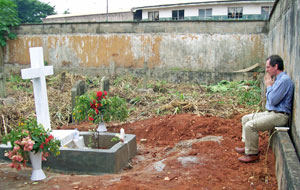
At one stage he was told by one of the local church members that he was engaged in ‘an impossible task’. However, just when it seemed unlikely that he would find the grave he wandered into Holy Cross Cathedral (where Brian’s Funeral Mass had taken place nearly 56 years before) compound to talk to some of the older members (parishioners), hoping that one of them might have some recollection of what cemetery was in use at the time. Incredibly, he met one man who felt sure that in those days Europeans were buried in a cemetery close to the former Police Station. That compound is now occupied by Edo State Hospitals Management Board.

Thanks to the kindness and co-operation of the Chief Executive of the Hospitals Management Board, Dr. M. A. Osumah, and the Secretary, Mr Ofure Oriafor, the grave was located.

On the initial visit the place was overgrown with tall grass and it was impossible to recognise any graves. However, Mr Oriafor graciously assured Fr McCawille that the grass would be cut the next day. True to his word, when Fr McCawille revisited the cemetery on the Tuesday morning the cemetery was cleared and with the help of some photos that had been taken of the grave shortly after the burial and a name plate which was sent by the extended family and on which were inscribed the words ‘In loving memory of Brian McCormack. Died at Auchi. 20th March 1954. R.I.P.’ the actual grave was located. It was a defining and joyous moment. Fr. McCawille immediately communicated the good news to Brian, Jr. who was about to leave Ireland on a wing and a prayer on his journey of discovery to Nigeria.

Brian McCormack and his friend Tajudeen Busari arrived in Benin City on Sunday, 7th March and visited the grave the next day. It was a hugely emotional moment for Brian, standing at the grave of the father whom he had never met and who had died almost 57 years ago to the day.

He immediately alerted his mother and the extended family by phone to his discovery. He spent the next two days with his friend, Tajudeen who is a Muslim, tidying up the grave and painting it. A Mass was celebrated by Fr. McCawille in the cemetery on Wednesday, 10th March, to which all those local people who had helped in finding the grave were invited. Brian served the Mass mindful of the fact that his father Brian, Sr. had also served Mass every day on board the ship, the Aureol, which had brought him to Nigeria in the company of many Irish missionaries.brian-mccormack-in-benin-ci

Before the Mass Brian placed a laminated photo of his father and a card from his mother on the grave. After the Mass he carried a memento from the grave and the candle used during the Mass back to Ireland with him.

For all of us gathered around the grave it was a rare moment of great celebration and intense joy. Almost exactly fifty-six years since his father was buried in Benin City, Nigeria, Brian McCormack, Jr. fulfilled a dream and stood at the grave and talked to the father that he never met. It was the crowning moment in a miraculous spiritual adventure.

Our picturee shows Brian Jnr praying at the grave of his late father. May Brian Senior rest in peace until the day of the Resurrection.

Edited from a report sent by Fr Peter McCawille SMA

WHAT DOES COIS TINE DO?

nasrudeen

WHAT DOES COIS TINE DO?

In the past Cois Tine provided the wide range of services listed below.  At present services have been cutrailed due to a number of reasons i.e.

  • the decline in demand for services due to the fact that very few new asylums seekers are arriving in Ireland.  As a result, over the past few years, the need for many of our services such as a drop-in centre, training and counselling reduced greatly.   

  • A decline in the availability of funding has also made providing services more difficult.

At present therefore Cois Tine’s services are limited to outreach visitation to Direct Accommodation Centres in the Cork City area.  This work is undertaken by a small group of volunteers and aims at befriending, providing information and emotional support.  To a lesser extent than before we support some training and multicultural events and also maintain our website.

We still have offices at St Mary’s Pope’s Quay and are delighted that we have been joinded in the same building by NASC- the Irish Immigrant Centre. In these difficult times this is a logical and practical development that will allow us to work more closely, to utilise scarce resources more effectively and also develop new services in response to client needs.

In the near future we will review our service provision and, if both human and financial resources are available would like to focus on pastoral outreach to Africans living in the community.  This work will be undertaken in cooperation with other local agencies and faith groups. 

___________________________


In the past Cois Tine provided a range of pastoral support services for Asylum Seekers and Refugees esepcially those of African origin.  For convenience these services are classified under the headings of Social, Psychological and Spiritual.


Socialnasrudeen
Drop-in Centre: Open Tue-Thur, 10.30am–4pm.
•  Meeting space/rooms: Open weekdays, Mon-Fri, some evenings and weekends.
•  Advocacy: On behalf of individuals – help in dealing with officialdom, agencies etc.  
•  Drumming Circle: With a multicultural membership, meets weekly.
•  Mna Cois Tine (Cois Tine Women’s Group). Meets every two weeks.
•  Events/Parties/Trips: At various times and to mark various occasions.
•  Cork African Women’s Group: Meets at least once a month an more often when necessary.  
•  Computers/Internet Access: Available for immigrants during Drop-in Hours.  


All the above have elements of recreation, practical/emotional support and assist in the process of integration.  We view them as an integral part of our ministry to welcome the stranger.

Training Courses: These take place throughout the year and cover topics such as:
Computer skills: Group Courses and individual tuition.
Personal development.
Women’s Health.
Organisational Development.
Pastoral care: (for volunteers working with Immigrants).

Training aims to increase skills, to help immigrants integrate into the local community and to provide asylum seekers with constructive activities while they await decisions on their asylum applications.

Awareness Raising/Promoting Integration: Through the following means – 
Web Site: Highlighting justice issues affecting Immigrants.
o Networking/Committees/Steering Groups: Providing a Christian perspective with the aim of ….promoting inclusion, integration and the welcoming of the stranger.
Public/Church Events:  Providing input and presentations on issues affecting immigrants.


We believe that these activities are important to making the inclusion of immigrants in our community and Church a normal and accepted part of life.

Support and facilitation of Immigrant Community Groups: By providing –
Meeting facilities/rooms: Allowing new community groups to organise and function.
Extended Opening hours: Evenings and weekends by arrangement.
o .Training:  Especially in organisational development.

 The overall aim of these activities was to empower immigrant groups and to increase their capacity to organise and to engage in active citizenship.  In 2009 twenty-three groups used Cois Tine for their meetings and activities.

Psychological
Counselling: Three trained Counsellors provide a service at Cois Tine.
Alternative therapy: Massage is provided especially for immigrants who cannot engage with the Counselling process.due to language.difficulties.
One-to-one contact with Immigrants: Giving people time and individual attention has always been at the centre of Cois.Tine’s work. This takes place during pastoral outreach care work or in our premises.  Over 5,000 visits were made to our premises in 2009. Contact was made with many more people during outreach visitation of.Accommodation Centres, Homes and Hospitals.
Befriending: Cois Tine is open to maintaining contact with clients for as long as they need.


These services are all about welcoming and caring for individuals by providing them with the emotional support and information they need to cope with the burdens they have brought from their homelands, the stresses of the asylum system and the problems of settling into a new culture and place.

Spiritualcandle14
Cois Tine provides spiritual support for Catholic immigrants and is respectful of the religious traditions of non-Christian immigrants.  Catholic immigrants are supported through:

•   Liturgies.
•   Home visitation/spiritual support.
•   Liaison with Parishes.
•   Spiritual Direction.

Through the Spiritual, Psychological and Social services outlined above Cois Tine provides pastoral support aimed at helping immigrants as they begin their lives in Ireland.
 

Fourth Sunday of Lent 2010

FOURTH SUNDAY of  LENT – YEAR C

14th March 2010

Joshua 5.9-12
2 Cor 5.17-21
Luke 15. 1-3, 11-32

A certain young woman Mary was the youngest of a family of 8. Her father had died when she was quite young. One day she visited her aunt Julie who had just found a bag of old photographs in her attic. A number of them were photos or portraits of her father whom Mary never got to know because of his early death. Aunt Julie was the brother of Mary’s dead father. She showed Mary the photos, some of which were portraits of her father. Julie explained that some portraits weren’t a good likeness of her father while others were. Then she came to one old portrait and said to Mary.  ‘Now that is as good a resemblance you’ll ever see of your late father’.

The readings today paint or reveal to us an excellent portrait or likeness of who our heavenly Father is. A clear theme runs through the three readings: God’s incredible mercy and forgiveness for sinners.

In the First Reading we have the beautiful words God spoke to his people – ‘I have taken the shame of Egypt away from you’. The shame of sin and slavery are behind them. Yahweh their faithful God had freed them and looked after them on their journey through the wilderness to the Promised Land.  This despite their often turning aside from worship of Yahweh.

Then in the marvellous Second Reading we heard how God has reconciled us to himself through Christ, not holding our faults against us. It is important to note that it was God who did the reconciling.  As the text says: ’It is all God’s work’. So it is not because we gained God’s favour by our good deeds. Rather it is God’s incredible love that reconciled us to himself. Our good deeds are always simply a ‘thank you’ to God for his wonderful compassion and love for us.

Now that we have been reconciled to God he actually wants us to be his ambassadors or witnesses to tell others that they too are reconciled or can be, simply by turning back to God no matter how badly we have sinned or how long we have stayed away from God. 

But what kind of God have we that he is inviting us to be reconciled to?  And Jesus who knows the Father intimately paints this incredible portrait of the Father to us.

Just as any ambassador is expected to know his country’s policies and priorities and how best to represent them, so too with us called as we are to be ambassadors for God

So who is the God we are expected to reveal to others? It is the God whose portrait Jesus paints in the gospel today. Jesus reveals this to us by means of a parable. Some people have called it the parable of the ‘Good Father and his two sons’ because it focuses more on the father than on the two sons. The parable which is probably the best known and loved of all Jesus’ parables tells us the story of two sons and how each acted and then the response of the father.

Isn’t it hard to believe fully the parable of Jesus? What human father would have acted in that way? We would call him a crazy father since he knew what type of character his younger son was and yet he gives him his share of his inheritance. Since people did not get the inheritance until the Father was dead the younger son is basically saying – ‘as far as I am concerned you are dead’. The son is true to form and spends his inheritance wastefully on a life of debauchery.  What is unexpected is not so much that the father welcomed him back but that he holds a great feast for him.

In the culture of the time to have accepted the son back, to begin things again as they were before would be most unusual. But to organise a feast, to kill the animal that was being kept for the big occasion, to give the son a cloak, a ring (a symbol of enormous trust) and sandals – these are almost impossible to imagine. The son is restored to his former position.

The parable does not speak in a way we human beings do things or are accustomed to act. The parable is speaking of God’s ways. It is God the Prodigal Father who runs towards the lost son, clasps him in his arms, not asking for any explanation, neither giving him a scolding nor criticising him. For a father of his time to have run to and embraced the son would have been very unusual.

To tell us who God really is, Jesus tells us this story and invites to be participants. God is so different from what we expect God to be. But we are not God and our ways are not God’s ways which is exactly what Jesus is trying to get us to accept.

God is extravagant. He is extravagant in his love and mercy towards us. He comes to meet us as we are, sinners, often so undeserving of his love. Jesus is trying to help us to have a different way of looking at God.

Yet some people maintain it is an unfair story. They feel sorry for the older son, convinced he got a raw deal. They believe that the younger son got away with doing terrible things. He should have been punished. He should have been taught a lesson. So it is not difficult to understand the reaction of the elder son who refused to participate in the feast for his younger brother. But others would say that he was too hardhearted and unforgiving towards his brother.

So the parable is really about hearts: selfish hearts and generous hearts, closed hearts and open hearts, cold hearts and warm hearts, unrepentant hearts and hard hearts.

Which of the two sons in the parable do I identify most with, the younger son or the older one?  Maybe there is part of each in me.

The most important question of all is this: Who is the God I believe in? Is it the Prodigal Father Jesus describes for us today? Will we be ambassadors/witnesses of this Good News or of a false God of fear and sanctions?

Lord Jesus, help us to accept fully the great Good News that God is our loving and compassionate Father who is as you describe him in the parable today. Help us to spread this message by the way we treat others and live our lives as Christians. Amen”.

Fr. Jim Kirstein, SMA. 8th March, 2010

Founder no 6 March 2010

OUR FOUNDER TODAY                                                                                                                               No. 6   March 2010

IN SEARCH OF JESUS BY TAKING UP ONE’S CROSS

In joining the SMA I believed, like all young people my age that I was simply going to offer all my being to God for the Evangelization of Africa. However, in the course of my formation and of my life as a missionary priest, I was obliged several times to come back, humbly, to the question asked, many years before, by Bishop de Bresillac:

What are you looking for? Quid quæritis ? Honor? Don’t come here. The joy of ministry? Don’t come here. For friendship, for recognition, consolations, in return for all that you do? Don’t come here. You will find all of that in Europe (…) But if, faithful to your vocation, you accept, in all its depth, a life of sacrifice; if you are looking for Jesus alone, the poor Jesus, the humble and humiliated Jesus, Jesus crucified, ah! Then come! Hasten to run after him, come! You will find here everything to fill your heart with bitterness and venom but with venom that becomes sweet by virtue of the cross. (Retreat to Missionaries, 2nd edition, pp. 72-73)

If I recall here this type of questioning by the Founder it is because I think that it merits being meditated on regularly, above all during this time of Lent, by all the members of the SMA from every époque, age and nationality.

Indeed, let us look at the following: what is the primary objective of our SMA missionary life? Primary Evangelization? Promotion of the local clergy? Justice, peace and protection of the environment? The setting up of parishes? Urban or rural Apostolates?

One could still cite other responses that are formulated as a result of our work, but let is listen to what our Founder proposes.

While approving all of the above priorities he shows us in his ‘Retreat to Missionaries’ the supreme objective, the objective that includes, conditions and brings to perfection all the others: seeking Jesus and him alone; and he shows us the best way to reach this end: take up one’s cross, which means taking up the mission received from Christ. Because the true lover of the cross finds himself there, where the Lord leads him. He would not wish to be elsewhere. (Ibid., p.196)

This, perhaps, may appear to us banal but let us ask ourselves candidly today: how many times in our lives have we refused to receive the mission proposed to us? How many times, after having accepted this mission, have we wished to change it for another that appears to us to be more worthy of our capabilities and of our devotion? How many times have we done our best to ensure that our Superiors accept to give to us the position that we have dreamt of?

Most probably our Founder asked himself all these questions when he was sharing his experience of being in a parish and the superior of the seminary and vicar apostolic, in the course of his ‘Retreat’ (Ibid., pp.193-194). No one is exempt from the temptation to be jealous of the cross-mission of the other person or to choose for himself a cross-mission that appears to be the most adapted to his own character and to his own capabilities, which may not be the case in reality.

So what are you looking for? Quid quæritis ?

                                                                                                                  Marian Szatkowski SMA

THANK GOD FOR THE STRANGER

st-patrick
THANK GOD FORst-patrick THE STRANGER Reflection for March
 

All over the world, wherever the Irish are found, St. Patrick’s Day is celebrated. But not everyone who celebrates knows what it’s all really about. The le gends can hide the reality. In fact St. Patrick is a great model for us all today. He was forced to come to Ireland, being abducted at the age of sixteen, to become a slave, minding pigs on a cold Antrim mountainside. But during those six years of hardship he discovered how God was looking after him, and developed a life of intense prayer. Then he escaped, and returned to the comfort and security of his family. But the suffering, loneliness and exile which he experienced changed his life and prepared him for an undreamed-of future later on. He describes how this came about in his famous “Confession”

THANK GOD FOR THE STRANGER

st-patrick
THANK GOD FOR THE STRANGER – Reflection for March
 st-patrick
All over the world, wherever the Irish are found, St. Patrick’s Day is celebrated. But not everyone who celebrates knows what it’s all really about. The legends can hide the reality. In fact St. Patrick is a great model for us all today. He was forced to come to Ireland, being abducted at the age of sixteen, to become a slave, minding pigs on a cold Antrim mountainside. But during those six years of hardship he discovered how God was looking after him, and developed a life of intense prayer. Then he escaped, and returned to the comfort and security of his family. But the suffering, loneliness and exile which he experienced changed his life and prepared him for an undreamed-of future later on. He describes how this came about in his famous “Confession” 

Second Sunday of Lent 2010

SECOND SUNDAY of LENT – YEAR  C – 28th February, 2010

 Genesis 15. 5-12, 17-18

Philippians 3.17 – 4.1

Luke 9.28-36


One day a poor man living in a hostel for homeless people was walking along the main street of a big city. At a certain point he found himself outside a church. Before he realised it, he was inside. He couldn’t recall whether or not he said any prayers. But his soul was flooded with light.  His depression lifted and a great peace descended on him.  He felt he belonged on the earth after all. He felt close to God and loved by God. The experience didn’t last very long. He said later he would give anything to have had a similar experience.  For one short moment he tasted glory.

However, when it was over he found himself on the street again going about as aimlessly as before. Several times he went back to the church in the hope of a similar experience but it never happened. The homeless man wanted to hold on to that experience. He wanted to go backwards to it instead of forwards. He might have used the experience to illuminate the darkness of his life and go forward more hopefully and courageously.

Was it not something similar for St. Peter in today’s gospel? He made the same mistake. Having seen the transfiguration of Jesus on the mountain he wanted to build some tents there and so hold on to the experience and not go back down the mountain to the struggles and trials of daily life. Not only that but Peter didn’t focus on the dialogue between Jesus, Moses and Elijah. Their topic of conversation was about the future passing of Jesus which he was to accomplish in Jerusalem. Peter, as usual was generous but misguided as he wishes to hold on to the experience.  He allows the uniqueness of Jesus to slide away and he blurs what Jesus had said – that the suffering of the cross had to be before the advent of Messianic glory. 

In all that will happen the disciples’ faith in him as the ‘Christ of God’ will be severely tested. But even then they must keep faith until the true nature of Jesus is again confirmed in the final conclusive glory of his resurrection on the third day. On the mountain Jesus’ loving Father says to the 3 disciples: ‘this is my beloved Son in whom I am well pleased. Listen to him’. That is, just don’t focus on his coming glory but remember the suffering he will have to undergo first. The mountaintop experience was given so as to strengthen them in time of trial

And how much they needed that strength. For there would come another day and another hill. This time the sky would be dark. The face of Jesus would be covered with sweat and blood. His clothes would not dazzle. They would be taken from him. For his companions he would have two criminals.  There would be no voice from heaven only the voices of mockers and scorners. The disciples would be shattered and would want no part of what was happening.

In a sense we all have somewhat similar experiences in our daily lives. People who are married remember the joy of their wedding day and their honeymoon. But they can’t hold on to that experience. They must move on to the life that follows. And during that time there may be tensions in the marriage, sicknesses, unemployment etc. That is the time when we are asked to be faithful. And of course there will be other ‘transfigurations’ like wedding and birthday anniversaries, the birth of their children and so on. 

For others it may be to hold their first newborn baby in their arms and see the smiling face of their own flesh and blood reflected back to them. Later, there may be difficulties with the children, the normal growing tensions but also very good times.

On this Sunday we read about the Transfiguration of Our Lord. It is important to realise that Jesus went up the mountain to pray. We need to remember the great importance of prayer especially in times of difficulty. Remember that Jesus prayed in the Garden of Gethsemene to strengthen himself for the coming ordeal of his Passion and death.

We who are followers of Jesus are reminded that we have a goal, a harbour where we are going. Our faith tells us this. This world is not the end of things. We too will be transfigured as the second reading today tells us. St. Paul reminds us that our homeland is in heaven, that here we have no lasting city. Since our homeland is in heaven, ‘it is from there will come the Saviour we are waiting for, Our Lord Jesus Christ, and he will transfigure these wretched bodies of ours into copies of his own glorious body’.

The Transfiguration was the harbour for Jesus, so that no matter how big the waves were or how violent the ocean might be, Jesus would have the confidence to face all that lay ahead of him. He knows that death will not be the end, a final defeat but the way that leads to glory.

The episode of the Transfiguration reminds us that our being Christians means living in the midst of the ups and downs of daily life. We all have our own personal experiences of how difficult life can be. We know that we may have to face sickness, unemployment, being misunderstood, the sudden death of a loved one etc. God is no less with us at these times though it is harder to see and be aware of this. However, even if we are promised the fullness of the kingdom after we die, it has already here if we respond to God’s call. Little by little as we try to do God’s will a deeper peace and joy invades our lives.

We must never forget that our God is a faithful God. In the first reading we heard about an ancient ritual whereby the parties bound themselves to fulfil the agreement between them. In the reading we hear about God’s making the covenant with Abraham, our father in the faith. God is saying that he will always be faithful to his promises even we fail, as we do from time to time,

“Lord Jesus, Let us never lose sight of You who were transfigured. You are our safe harbour.  Give us the courage to be faithful to the end especially in time of trials and difficulties. Amen.”

Fr. Jim Kirstein, SMA

First Sunday of Lent 2010

21st February, 2010 – Year C

Deuteronomy 26.4-10
Romans 10.8-13
Luke 4.1-13

In a certain African country a young woman went to see a priest. Her boyfriend belonged to another Christian Church. He told her that if they were to marry she would have to give up the practice of her Catholic faith that was of great importance to her. She came from a poor background whilst he was very rich. The priest asked her: ‘If your boyfriend loves you so much would he demand that you abandon your faith which you say is very precious to you? Would he give up his faith to become a Catholic?’ The priest never saw her again so never knew how she responded to the temptation to give up her faith in order to marry her boyfriend.

Lent is not so much about denying oneself as acknowledging God.

In the First Reading we heard that through the ceremony of offering the first fruits, the Israelites had recognised all that God had done for them in the past, especially in the Exodus. The writer exhorts the people to ‘remember’ and ‘not to forget the events of their history’. Even when they forgot God and strayed from him by idolatry God was always their faithful God (as he is ours).

During Lent the Church invites us to embark on a journey, the journey of Lent, a journey towards Easter. We are a baptised people but haven’t yet lived fully the life of a Christian. Lent calls us to a change of heart and a fuller living of the gospel. In today’s gospel we see Jesus struggling against temptation. He will help us in our own struggles with temptation.

All three readings today are about the faithfulness of God. All of us are weak and prone to evil. This may be a disturbing truth, but it is one which we ignore at our peril. One of the great problems of our times is our failure to know ourselves, to recognise evil and deal with it within ourselves. We are born with conflicting desires so that doing good is always possible but never easy. The hardest victory of all is over oneself.

Shortly before his temptations Jesus had been baptised in the river Jordan by John the Baptist. There he had shown his solidarity with us sinners. Now he is showing again his solidarity with us humans as he allows himself to be tempted.

Luke tells us that Jesus was a long time in the wilderness. There he experienced three types of temptations:

v           The first temptation is to put trust in material things. Here for example it is to change stones into bread as Jesus is hungry. The word ‘bread‘ can mean material things in general. In our world today riches, wealth, possessions can be great temptations.

v           The second temptation is to power that will be his if he worships the devil. Jesus is tempted to act as a political messiah. If Jesus had all the power and glory look how important he would become and what good he would do. Jesus dismisses the devil by saying ‘You must worship the Lord God and serve him alone’.

v           The third temptation is to popularity. It is a call to do something spectacular. If Jesus would just throw himself down from the top of the Temple, over 400 metres high, people would be amazed.  What popularity he would have and he could so much good! Yet he did work many miracles and look at what happened in the end. Popularity does not last long. Today they cry Hosanna! Tomorrow, Crucify him!!

Ultimately the devil is trying to make Jesus forget who he is as a human being (fully like us), with its limitations, totally dependent on his Father to care for him. He is tempted to act from a power stance and not from the will of God. The devil tries to tempt Jesus to cheat on his humanity and satisfy his hunger and to use his power to deny his Incarnation. Satan is tempting Jesus to deny his true humanity. Jesus will not call on his power as God when the going gets tough. He wants to be in total solidarity with us, allowing himself to be tempted just as we are and struggling to overcome the temptation. This was especially so in the Garden of Gethsemene when tempted not to go through with his Passion and death since he foresaw the terrible suffering and rejection it would involve.

The example of the gospel is clear: In his life Jesus proclaimed the primacy of God and his kingdom. We cannot use our gifts and talents for our own personal prestige or to dominate others politically, materially or spiritually. The attitude of Jesus must be ours and that of the Church. Its message and its power are not to serve itself but to serve God and his chosen ones, especially the poor and the marginalised.

In a remarkable phrase in today’s gospel we read that having failed to tempt Jesus, the devil left him to return later. So the temptations in the wilderness were not a once off trial for Jesus.

Like us temptation was an ongoing reality in his life. So he can understand us when we are tempted and what it means to struggle. It is important to note that Jesus is a human being, like us in everything. He did not overcome temptation because he was God but because he prayed and reflected on scripture.

One of the invitations during Lent is to spend more quiet time in prayer and to become more familiar with the Bible. It was this deep reflection on scripture that gave Jesus the strength in the wilderness.  Let us pray often to Jesus when tempted to overcome the temptation.

“Lord Jesus, it is never easy to overcome temptation. Help us not to rely on ourselves but to pray often for the gift of the Holy Spirit to be with us.  Amen”

Fr. Jim Kirstein, SMA – 16th February, 2010

Family Vocations Crusade at 50

fvc-celebration-1-february-

Family Vocations Crusade (FVC) @ 50

fvc-celebration-1-february-

The present FVC Directors and some of their dedicated Office staff pictured here with two of the founding members of the Family Vocations Crusade after a Thanksgiving Mass in SMA Dromantine. Also in attendance was the Provincial Councillor with responsibility for Promotion work, Rev Fr Damian Bresnahan SMA.
In the centre of the picture above is Mr Tommy McKenna and the first on the left, seated, is Miss Marie Bell. Along with Fr John Joe Conlan SMA (now Dom David OSB of the Benedictine Monastery, Murroe, Co Limerick) they were part of the FVC founding members in 1959. Several others have returned to their eternal home with the Lord. Also in the picture, seated right, is Mrs Barbara McKenna.
The SMA is ever mindful and grateful for their inspirational commitment and concern for the evangelization of Africa.
But the work would not be possible without our committed lay staff who keep the different offices throughout the country running smoothly. Thanks to those who have retired and to the present staff who are the ‘voice’ at the end of the phone line when FVC members phone in to ask for prayers or for other matters.
During the past 50 years the members of the FVC – thousands of families from all over Ireland -have played an essential role in the training of more than 300 SMA priests. This they have done by their prayers, their active concern for particular students and their financial contribution each year.
FVC members agree to give a certain amount each year for a period of eight years to help defray the expenses of training our seminarians. At present we have nearly 250 studying to be SMA priests in 14 seminaries throughout the world. What exactly is the FVC?
If you would like to get more information on how to become a member of the FVC contact the SMA community in your area. Details of SMA Houses here

Family Vocations Crusade Group

The story of the SMA and the Rocks family

Francie and Andrea Rocks are schoolteachers, from Cookstown in mid-Ulster. In May 2009, with their three young sons, family and friends around them, and under the guidance of the SMA Family Vocations Crusade (FVC) Director (Fr Lee Cahill SMA), they started a new FVC group. This took place in their own home, 50 years after the first such group was inaugurated by Father John J Conlon SMA (now Dom David OSB). Francie and Andrea are known as “Head Sponsors”.

That evening in May, this group linked with 480 similar groups in Ulster began their contribution to the huge groundswell of support (10,000 in Ulster) for young men being trained for SMA missionary priesthood in Africa…that huge and lovely continent. This group in Cookstown is now caught up in a current of amazing support for the apostolic adventure of the Society of African Missions.

That evening in May, they met, as did tens of thousands before them over the previous 50 years. Guided by their FVC Director, they looked at, engaged in, and developed a passion for the challenge being faced by young men in Africa (and other parts of the SMA world) in the 21st century. Eucharist climaxed the evening. This group, another dynamic strand in the FVC web, has SMA Dromantine as their point of reference, and the African Mission as their focus….10.000 people, young and old, lay and religious, committed to mission.  

Each year, like most of their 480 counterparts in the FVC, Francie and Andrea will call their group members together at their home. They will review, chat and pray over, and to celebrate the Eucharist for the African scene they are involved in. Their passion is directed towards the potential SMA missionary priests in Africa. These latter are sharpening their life-commitment to scattering the powerful seeds of Christ’s Gospel deeper and deeper in the hearts of their fellow-Africans, torn (by many circumstances, mostly through no fault of their own) between the enhancement and the destruction of their lives.

In September each year, Francie and Andrea will join their fellow Head Sponsors from their local region. In this “Area Head Sponsor” Meeting, they will get a sense of the bond with, and the stretch beyond, their own group, in the common mission of the SMA.

Dromantine, itself, will draw Francie and Andrea, and their 3 boys…. to the regular FVC weekend retreats (3/4 times a year); to the now-renowned “SMA Open Day”, on the first Sunday of June (when anything between 3 and 4,000 sponsors, friends and family enjoy a predominantly fun day); to the SMA Youth Camp (Dromanteens!), where 11-16 year old children of the Head Sponsors enjoy 5 weeks in the summer.

In 2017, Andrea and Francie’s group will join the other FVC groups, which began in 2009 (such groups are known as “8-Year Sponsor Groups”) in Dromantine. They will meet a young SMA priest, from Africa or India, Poland or the Philippines, who comes to these special groups, representing the class recently ordained, and who has been supported through their own seminary days by people such as Andrea and Francie. 

Over 8 years Francie and Andrea’s prayer; working with their own group members; experiencing – via Dromantine – something of the SMA pulse-beat; and their contributions (normally 15-20 Euro per person, annually). All this comes together on this special day, when ordinary, wonderful, Irish people become tangibly linked with real Africa, and the real African Mission.

By the law of averages, Francie and Andrea are likely to continue beyond 2017…continuing their own group…and, if the law of averages holds, they will see some of their own members branching out to form their own Head Sponsor groups.

If you would like to know more about the FVC and are interested in information on how to start your own group click here.


Food situation in Liberia

liberia_203map

Food situation in Liberia: Gbarnga and Monrovia

 liberia_203map

GBARNGA, 14 January 2010 (IRIN) – Every year Liberian farmers lose 60 percent of their harvest to birds and vermin or poor storage conditions, contributing to country-wide food insecurity, say UN officials, who are calling on donors to put more funding into pest management and storage.

The Ministry of Agriculture estimates 52,000 tons of rice out of 144,000 produced in 2007 was lost, while 44,027 tons of a 155,293 ton harvest was lost in 2008.

“Our interaction with farmers has shown they lack very basic knowledge of pest control,” said Augustus Flomo, a consultant with local NGO Agency for Economic Development and Empowerment (AEDE), which partners with the Food and Agriculture Organization (FAO) in Liberia.

Eight out of 10 rural Liberians are moderately or highly vulnerable to food insecurity, according to the latest government food security survey.

During the country’s 14 years of conflict, which ended in 2003, production plummeted, and Liberians went from importing 30 percent to 60 percent of their rice needs, said Ahmed Ag Aboubacrine, emergency FAO adviser.

Production has not recovered since, leading the Agriculture Ministry to try to reverse the trend by encouraging Liberians to return to their farms. But seeing over half of a harvest lost puts farmers off, said Daniel Lorbah, a farmer in Margbi County, 40km north of Monrovia.

Flash strips, rat traps

FAO is training farmers how to ward off rats and birds in field schools it has set up with AEDE and the Agriculture Ministry in all of Liberia’s 15 counties.

Lorbah returned to farming in 2005 when the conflict had ended but found most years he lost three-quarters of the rice he produced. He underwent training in 2008, learning how to attach flash tapes (metallic strips that reflect sunlight) to his crops to scare off birds, and how to make and set up vermin traps.

Rice fields in Bong County

“After going through how to deal with rats and birds, I am no longer facing problems of pests eating up my rice.” Buoyed by the gains, he told IRIN he hopes soon to expand his 2.4 hectare farm to four hectares.

Farmers who have undergone training are gaining confidence, Joshua Juah, head of a farmers’ cooperative in Kokoya District, Bong County, central Liberia, told IRIN – and are gradually increasing their plots. The cooperative’s core-harvest cassava losses have dropped from 50 percent to about 10 percent in the year since introducing pest control techniques.

Next steps

Now that pest management is improving, donors need to turn to post-harvest losses by increasing funding for crop storage and preservation facilities, said AEDE technician Joseph Kpagbala.

 “We cry day-by-day, because we do not have places to keep our rice, cassava, eddoes [a local tuber] and yams after harvesting them,” Martin Togba, leader of Bong Country’s Kpatakpai Farmers’ Cooperative, 135km north of Monrovia, told IRIN.

“We keep them in places where they get spoiled after several weeks,” he said.

Most farmers store their crops in makeshift bamboo huts roofed with thatch but without protection from the damp, according to AEDE.

James Korkollie, a member of the cooperative, told IRIN half of his 2009 plantain harvest rotted in storage just two weeks after harvesting, due to damp conditions.

“The roads are bad; no one wants to venture into this deep forest [to buy], and I am worried if this situation continues I will lose all of my crops by the end of January,” Korkollie told IRIN.

A 2009 Ministry of Agriculture study on harvest losses recommended the government boost loan schemes to farmers’ collectives so they can improve their storage facilities.

If they do not, government efforts to improve food security “will fail”, John Jukon, director of Liberia-based cooperative Farmers Against Hunger, told IRIN.

 yekeppa_liberia_1

Yekeppa, north Liberia

MONROVIA, 19 January 2010 (IRIN) – Farmers are turning to urban gardens as a way to boost food security in Liberia’s Montserrado County, where just one percent of residents grow their own produce today compared to 70 percent before the war.

Some 40 percent of Liberia’s population lives in the capital, Monrovia – located in Montserrado – after years of fighting sparked rural communities to move to the city. Many new arrivals had no access to land and have crowded into slums.

Over half of Monrovia’s residents live on less than US$1 a day, according to the World Bank.

The Food and Agriculture Organization (FAO) is targeting 5,000 urban residents of Montserrado, Bomi, Grand Bassa, Bong and Margibi counties, to encourage them to start market gardens or increase the amount of fruit and vegetables they grow on their farms. Participants had to have access to tools and some land.

The aim is to improve food security and nutritional status while boosting incomes, said project coordinator Albert Kpassawah.

Participants told IRIN they plant hot peppers, cabbage, calla, tomatoes, onions, beans and ground nuts.

Health and nutrition experts in Liberia say increasing fruit, vegetables and protein in people’s diets is vital to reducing chronic malnutrition, which currently affects 45 percent of under-fives nationwide.

Joseph Rogers has a half-acre market garden in Johnsonville on the outskirts of Monrovia, which he plans to expand. “I am planting cabbage… I used to [grow vegetables] before the war, but [my crops] were damaged in the crisis. It affected my family.”

When he lost his garden his family found it hard to eat, he said. Now he grows enough to sell part of his produce.

 “Sometimes people come here to purchase huge quantities. I pay for the school fees with the money I earn,” Rogers told IRIN.

Paul Tah, father of six, had never farmed before he got involved in the FAO project. “I got interested in this project because of the lack of jobs in this country,” he told IRIN. He now makes $200 each season from selling peppers.

 “My family is in fine health. This is my livelihood now. I don’t have to depend on a government job to survive.”

maternity 

Maternity ward, Yekeppa

Limitations

FAO assists primarily by providing seeds and training in techniques such as conserving rainwater and composting. The organization does not provide fertilizer, insecticides or tools – a concern to some participants. “You cannot grow cabbage without insecticide. It doesn’t work,” Anthony Nackers told IRIN.

Vermin, insects and poor storage destroy 60 percent of Liberia’s annual harvest, according to FAO.

And many of the most vulnerable city-dwellers – those with no access to land – cannot participate at all, FAO’s Kpassawah pointed out.

But he said he hopes the project’s benefits will spread beyond immediate participants, since all who take part are encouraged to pass on their training to relatives, neighbours and friends.

And there is ample scope to expand techniques learned from cities to rural areas, he pointed out. Just one-third of Liberia’s 660,000 fertile hectares are being cultivated, according to the Ministry of Agriculture.

————————

These two reports come to you via IRIN, the humanitarian news and analysis service of the UN Office for the Coordination of Humanitarian Affairs. The opinions expressed do not necessarily reflect those of the United Nations or its Member States. Reposting or reproduction, with attribution, for non-commercial purposes is permitted. Terms and conditions: http://www.irinnews.org/copyright.aspx

Map and photographs are from the SMA Communications Department, Blackrock Road, Cork, Ireland and are added to this article.

PRESIDENT’S ADDRESS

121366473.cyz2ujrf

ADDRESS OF PRESIDENT MARY MCALEESE Interfaith Event, Cork City Hall, 22 January, 2010

Ladies and Gentleman,121366473.cyz2ujrf

This morning I was here in this auditorium at another event celebrating a famous Irishman, a famous Cork man, who was born a 100 years ago this year. He hadn’t a drop of Irish blood in his body but you could start a very big row in Cork if you dared to suggest that he was anything other than a great Cork man. His name was Aloys Fleischmann’s and for almost fifty years he was a professor of music in this city. The son of German Immigrants, a child from a different place, a child from a different background, a great son of Cork, who loved Cork and was loved by Cork.

Through his life we begin to see the joys we have in the present and the future as more and more young Irish men and women draw from the wells of different countries and different faiths, different perspectives. Because, in this generation, so many have come from all around the world to make their lives here as Aloys Fleischmann’s family did all those generations ago. Many of them may not have a drop of Irish blood in their bodies although some of them will because one of the great joys will be intermarriage and one of the great joys of those marriages will be shared children – Irish, Lithuanian, Irish, Nigerian Irish, Chinese you name it. All those wonderful joys we have to look forward to as their genius puts itself at the service of our country and what do we want for them?

Well, I can tell you what we d121366447.ghdm4s0oon’t want, because I come from Belfast where Christians of two different Christian traditions did not trust each other, did not love each other enough and so were estranged. Out of that estrangement came such wasted opportunity and unfortunately some violence that’s what we don’t want. We know what we don’t want because we have the wisdom of bitter experience which teaches us that if we work together, if we love one another across differences, we have so so much to enrich our lives.

No two in this Hall are the same.  Not even identical twins, as the mother of identical twins will tell, are the same. No two have the same perspective, no two the same range of gifts, no two the same range of talents or mix of talents. Everybody utterly absolutely unique and in that uniqueness, in that very uniqueness, we bring range of skills that compliments the person next door or the person across the street. How terrible it would have been throughout all the floods and the snow, you had recently here In Cork, if every single person had only the one same talent and that talent did not include an aptitude for sweeping out water. If everybody said well “I don’t do sweeping out water” “It’s not my thing” or “I don’t do helping neighbours” can you imagine what would have happened. Instead everybody pooled their little bit of talent and created a community effort and helped each other as neighbors. And they did not first ask what you believe before they said “Can I help you.” No the help was given as neighbours.

interfaith

One of the great things we share is Faith, it infuses our lives. We have many different perspectives here. We have very different views on doctrines and dogma. We have many different views on these things. But none of those differences can stop us, or should stop us from loving one another, befriending one another, being good to one another, inviting each other into each other’s home, into each other’s embracing friendship. That is what enriches our lives the joy of friendship.

To all of you, I say a very big thank you. Every one of you for what you do to ensure that we live in an honourable community with each other where we do truly respect each other make space for each other, smile at each other and welcome each other.

I think of the many times that Irish Immigrants around the world and God knows there were plenty of them. I think of all the times they were not made welcome. They were our relations, our aunts, our uncles, our family and it broke our hearts to hear that they were made welcome. What a terrible thing that if we in turn did anything other than smile and hold our hand in welcome to those that come here. Because we know what it is like to be a stranger in strange lands. We know how wonderful it is when somebody makes space for us makes us welcome and smiles what a lift that is to the human heart. A human heart very often that has so much loneliness because you have left the homeland, left mother behind, father behind, relatives behind all that is familiar. Culture, language, faith, system infusing the atmosphere around us to come to a strange country and it is easy to feel strange and to feel lost.

What breaks that sense of strangeness, what breaks that lostness is the human person who smiles at you, who shakes your hand, who is interested in you, who wants to befriend you. In that moment of friendship you feel, you can cope with everything that is strange, you feel alive in a new way and alive in a new place that is why Cois Tine is so important and why even the words are lovely. Cois Tine is like the fire the hearth.

When I was wee and when visitors would come to the house, we would all be sitting around the cozy fire in the living room but visitors were bought to the parlour. Do you remember the parlour? The coldest most miserable room in the house but with all the good furniture stuffed into it. And you would bring the person into the cold parlour and turn on the two-bar electric heater and leave the gorgeous fire. Because the fire, in some 121366508.pwogmlwpways, was the place for the family, the really intimate family and so the choosing of those words Cois Tine are very important. The people are invited to the fireside, not to the parlour, not to the posh parlour, for the stranger you are trying to impress but to the fireside where you engage in deep, deep being with one another. Real friends to one another. Family to one another.

Tonight that was this service, this interdenominational, this shared service celebrates is that we are family to one another. We are friends to one another, we are community, we are Cork, we are Ireland. Whoever we are, whatever we are, whatever we believe, whatever differences there are, we share that very very powerful thing. We are Ireland, we are community, we are family.

Enjoy each other’s company this very blessed night.

Fifth Sunday in Ordinary Time 2010

kenya

Isaiah 6.1-2, 3-8

1 Cor 15.1-11

Luke 5.1-11

In today’s gospel passage Jesus meets people at their place of work. Seeing first the fishermen and then their boats he uses both to further his message. The boat becomes a pulpit, a place from where his word is proclaimed. The congregation is drawn from those who are close at hand and willing to journey to hear the word.  It is a reminder to us that God’s word is not reserved for church or cathedral.  Isn’t there a danger that we will do this and fail to experience the many ways in which our loving God comes to us in our daily experiences?  Where have you and I experienced God coming to us recently outside of church?

Isn’t there something reassuring in today’s readings insofar we are reminded that God is not looking for perfection but rather willingness to try to do better?

We could call this 5th Sunday, “Good Excuse” Sunday.  In each of the three readings – Isaiah, Paul and Peter feel they have very good excuses for not accepting God’s call. None of them feels worthy or capable enough:

  • ·Isaiah’s reply is “What a wretched state I am in, I am a man of unclean lips”.
  • ·Paul says that he hardly deserves the name of apostle, being the least of the apostles because of his persecution of Christians.
  • ·Peter tells Jesus after the miraculous catch of fish: “Leave me Lord, I am a sinful man”.

Each knows that he is in the presence of the Holy One and they believe that they are totally unworthy of God’s choice of them.

They experience what we might call ‘Spiritual Inferiority’.

This, of course, is whole point of today’s readings. God chooses us because he is good and not because we are worthy. Jesus does not deny what Peter says about being a sinful man but he calls him in the hope that Peter will realise that the work Jesus is entrusting to him could never be accomplished by man or woman without the powerful help of God’s Spirit.  It will take Peter, as it does all of us, a whole lifetime to realise how totally we need God’s help.  So here Simon as he was then called gets a new name, Peter, a new job and a new image. All three take time to complete their transformation.

This is indeed Good News for each of us this Sunday. In that we are baptised, we too like Peter, are called to witness to God in the world. We may immediately reply that we are not worthy and that we are sinners, maybe even great ones – another case of spiritual inferiority!!   But God considers us worthy and that is all that counts.

It is not Isaiah, Paul and Peter who choose God.  It is the very opposite.

Maybe we don’t want to be called. Perhaps we can see the demands involved. We might prefer to opt out. If that is our choice then God will leave us free to do so if we wish. But we will never have the deep peace and joy we seek if we search for it in other places apart from God.

We must remember that each of us share a common vocation: the vocation to be a Christian. Because we are born into Christian families, sometimes we fail to appreciate our Christian vocation sufficiently. Our faith is given to us personally by God. We have the responsibility to both cherish and nourish it. We are also responsible for the faith of others, particularly those who are near and dear to us. Christ has entrusted his mission not just to the Church, but also to us individually.  There is still work to be done. Let us never underestimate the difference we can make. It doesn’t have to be perfect but it does have to be real.  How will you and I respond to the challenge?

God sees the marvellous potential in each of us.  Some of the great saints like Teresa of Avila, Charles de Foucauld etc lived mediocre or in the case of the latter very sinful lives early on.  But God then touched them and they responded.

Do we not pray in the part of Eucharistic Prayer 2 after the consecration ‘we thank you Lord for counting us worthy to stand in your presence and serve you’. If God considers us worthy who are we to object? We each have different roles to play in God’s plan to bring about his kingdom of truth, justice and forgiveness here on earth, be it as parents, priests, religious, teachers, or farmers etc. 

Peter had worked hard all night and caught nothing.  Jesus asked him to try again.  He could have objected saying he was exhausted or that there were no fish where they had failed to catch any.  However, he responded to Jesus and tried again. Look at the result.

Sometimes we too may get tired of trying to be good Christians. We may get bored, disillusioned with what we sometimes see going on in the church.  We may want to give up on ourselves or on others who disappoint or even betray us. 

To all of us Jesus says, ‘try again’. I am with you. I count you worthy. You have great potential.  But we must like Isaiah, Paul and Peter realise deeply that we cannot succeed alone. Like Peter we may fish all night in darkness, but Jesus the Light invites us to call on his help. He will make our efforts fruitful in his own way and in his own time. When Jesus was not with them, they caught nothing.  But when he was with them, what a difference? Not only a catch of fish but a great abundance. Their obedience was rewarded.

“Lord Jesus, we thank you for counting us worthy to stand in your presence to serve you and others. Amen”.             

                                               Fr. Jim Kirstein, SMA


Jim Higgins makes a new record

higgins-j-at-86-with-eric-

Fr James Higgins makes a new SMA Irish Province record

higgins-j-at-86-with-eric-

On 8 February 2010 Fr James Higgins became the oldest Irish SMA to be still in active ministry in Africa. Ad Multos Annos! He is pictured here with Fr Eric Yapi-Yapi SMA (Ivory Coast) and Fr Noel Musa SMA (Nigeria) and two St Louis Sisters who came to wish him a Happy 86th Birthday after a Thanksgiving Mass in St Patrick’s SMA Church, Cable Point, Asaba

James Higgins was born in Collooney, Co Sligo, Ireland on 8 February 1924. His beloved mother died just six months after his birth. Jim was reared by a father whom he loved and admired and he credits him for his “placid, patient, kindly temperament“. Jim also credits his loving ‘Nanny’, Miss Coggins, for all her kindness and upbringing.

After his studies with the Society of African Missions he was ordained a priest on 14 June 1949 in St Colman’s Cathedral, Newry, Co Down.

After gaining his Higher Diploma in Education from the University College, Cork (UCC) he left Ireland on 25 November 1950. He was appointed to work in the diocese of Benin City, in the Mid Western Region of Nigeria. And there he has remained to date!

Jim Higgins’ name will always be associated with the education apostolate of the late Bishop P J Kelly SMA who saw that education was the key to evangelization and to human development. Fr Higgins was Tutor at St Thomas’s Teacher Training College, Ibusa which the SMA founded in 1928. For the next 30 years he taught in Assumption Teacher Training, Uzairue, St John Bosco Secondary School, Ubiaja and St Joseph’s Teacher Training College, Ozoro.

 higgins_bp-elue_60th_jubile

Bishop Elue of Issele-Uku diocese and Fr Higgins at his 60th Jubilee and 85th Birthday celebration in St Patrick’s Parish, Cable Point

In December 1981 he moved into fulltime pastoral ministry when he was appointed the Parish Priest of Sapele. The SMA Regional Superior in Nigeria South, Fr Tim Cullinane reminded all during the 50th Golden Jubilee celebrations: “Fr Higgins did not confine himself to the church in Sapele itself. He had even time to venture with canoe and speedboat into the creeks and mosquito-infested mangrove swamps and find communities there eager to hear about Jesus Christ. At last, after 33 years he says, “I was becoming a real missionary”, At SMA meetings today we often ask ourselves, what is the charism of the SMA? or to put it simply, what should the SMA be doing? Fr Higgins’ answer is that we should be opening outstations which in time will become parishes and in line with this he told once that his favourite Bible text is “as long as you did it to one of the least of these brothers of mine you did it to me”.

After 13 years he moved to St Patrick’s SMA Parish, Cable Point, Asaba. In 2000 he moved to the SMA House in Uromi, Edo State. After completing his assignment there, in 2004, he returned to Asaba and now forms part of the SMA team there, with the Parish Priest,  Fr Joseph Chege SMA (Kenya) and Fr Noel Musa SMA (Nigeria).

Fr Higgins has two books to his credit: Fifty Years a-growing (2000) and The Pilgrim Soul in me (2004). The title of his first work is due to his belief that he feels “even after fifty years in Nigeria, that I am still only learning what it means to be a missionary in this beloved land.” And now after ten more years in Nigeria to add to the first 50 there is no doubt that Fr Jim Higgins is still learning!

Copies of his work can be bought from the SMA Communications Department.

ADDRESS-Fr Angelo Lafferty SMA

angelo

INTERFAITH EVENT ADDRESS

Text of address made by Fr Angelo Lafferty SMA at the Interfaith Even held in Cork City Hall on theangelo 22nd of January 2010.

President McAleese, Dr. Martin McAleese, Deputy Lord Mayor, Councillor John Buttimer, members of the faith communities and to all of you, I wish to say formally Cead Mile Failte. As many of you will already be aware tonight’s interfaith celebration and prayer, is part of the Cork Integration strategy launched in 2008.  Cois Tine, a pastoral care programme for immigrants was asked to spearhead this event to bring together in prayer the various faith communities here in Cork as part of this strategy.

Earlier in the year President McAleese agreed to honour us with her presence here as we continue on a process of inclusiveness, integration and a unity in diversity.

• Tonight the presence of many diverse groups in our community is recognized and respected.
• The key to understanding this diversity is Respect.
• We must therefore find the proper balance between honouring our own faith and respecting each others.

Our faith is what gives life and meaning to our existence. It is what will bring us through the most difficult of times and circumstances if it is strong and clear enough. But it must provide for the well-being of all and not just ourselves if it is to help create a world that works for everyone.   One of the constants that we all work with in society is that while change is inevitable, growth is optional.

This is because we don’t always understand change, and therefore have a hard time accepting it. In our community of great diversity of race, culture and faith we, tonight, opt to grow.  To share what we have in common in our faiths. This helps us discover the unity that exists in our midst.  The Preamble to the Earth Charter summarises what we are about here this evening.

angelo3

“To move forward we must recognize that in the midst of a magnificent diversity of cultures and life forms we are one human family and one Earth community with a common destiny. We must join together to bring forth a sustainable global society founded on respect for nature, universal human rights, economic justice, and a culture of peace.  Towards this end, it is imperative that we, the peoples of Earth, declare our responsibility to one another, to the greater community of life, and to future generations.”

And so it is in this spirit that I invite President McAleese, President of our country to begin our Interfaith Prayer Service.

Dr Christy O’Sullivan

Dr Christy O’Sullivan
Homily at Funeral Mass on 3rd February 2010

Readings for the Mass
Isaiah 25: 6-9
Revelation 21: 1-7
John 14: 1-6,23-26

When the renowned scripture scholar, the late Raymond Brown, was once asked if he intended following the writing of The Death of the Messiah by a similar work on the Resurrection he replied, ‘I would prefer to research that topic face to face’. This sounds to me like an answer Dr Christy might give to a similar question. And, indeed, today Christy has the answer to the question. The Christian community gathered here in support of Mary, Liz and all the extended family believe that Christy will rise again and that we will all meet each other again in the final resurrection in the fullness of time.

One of the great consolations of our Christian faith is our belief that all the ties of friendship and affection which knit us together in life do not unravel at death. This is such a comforting statement of faith for all who lose a loved one. Christy’s family and many friends can take comfort in this faith today.

Thank God Christy was blessed with a long life. Just at the end of August last we had a nice birthday celebration when he attained the age of 90. While it is true that his physical and mental capacities had dimmed from their earlier acute brightness in the final years, he still retained his dignity and due in no small way to the loving care of the staff of St Theresa’s here in Blackrock Road he was able to live out his days in relative comfort.

We have an opportunity to celebrate his life today. Many wonderful stories have been told over past days. Christy was quite a character and there were many amusing incidents recalled with affection. It is right that we celebrate that good life today but we do so in a special context. We do so in the context of the celebration of Eucharist. Our gathering here today is special. This is no ordinary remembering. We remember Christy today at Mass which is the very special act of remembering. At Mass we gather around the table of the Lord to remember the life, death and resurrection of Jesus. And we believe that this action is not simply the mental recollection of a past event. We come hoping to be forgiven, to be nourished, to be challenged and sent forth; and we believe that our act of remembering is a means through which God enters into and transfigures our lives.

Faith, and the Mass in particular, was very important to Christy. The readings chosen for today’s Mass were ones admired and meditated on by Christy himself. They speak to us of death and afterlife, and, perhaps, more importantly, they speak to us of how we ought to live the invitation to be citizens of God’s kingdom. The first reading from Isaiah is a familiar one at funeral liturgies. An image often used by the writers of the Hebrew Scriptures – the Old Testament – when trying to picture a life beyond the present physical one was that of a banquet. They really hit the nail on the head because the image chosen was one very often used by Jesus himself to describe the same reality. The prophet Isaiah almost gets carried away when picturing what the banquet will be like – a banquet of rich food to be enjoyed by all; a space where tears will be wiped away and mourning will be no more; a space where shame will no longer burden us. Such an image is helpful to us all as we come today to bury Dr Christy. The sadness of his passing is real as we will miss his lively presence – his family of course will miss him more and will even miss their daily visit to St Theresa’s; but the sadness is tempered by our hope of eternal salvation and that we will meet again in the after-life. Isaiah’s banquet is the guarantee that our hope will not be in vain.

And the second reading from Revelations is equally full of hope. John speaks of the new heavens and the new earth replacing the old and finite one. ‘Here God lives among people. He will make his home among them; they shall be his people, and he will be their God; his name is God-with-them.’ I think it would be true to say – and this is not in an attempt to make Christy out to be overly pious but – that Christy lived his life from that perspective. He trusted and he believed that God was present to him in all the actions of every day.

Christy was born on 28 August 1919. He belonged to a family of six boys and three girls. No doubt living in such a family knocked the rough edges off him from an early age. He was a good student and also enjoyed all sports, in latter years enjoying fishing and hunting etc. In school he was a keen rugby player. I well recall a story the late Fr Sean O’Mahony SMA often told of the day Presentation College Cobh won their first and only Munster senior schools cup in 1937. Christy was on the opposing side and Sean always claims that Christy was responsible for a leg injury he sustained that day. In later years they were to become the best of friends. He qualified as a medical doctor in 1946 and served first in Ballineen, West Cork. He then spent some years specialising in Hammersmith Hospital in London under the supervision of the famous Dr Ian Aird. He was at the forefront of many developments taking place in Ireland during the 1950s and into the 1970s. He was the first airport doctor of Cork airport; he worked with Irish Shipping, Cork Shoe company, Irish Distillers, An Garda Siochana etc. Christy was known to be kind to anyone who was unwell, irrespective of whether they were his patient or not, and was kind to the poor and respected when they might not always be able to pay for his services. He had a roguish temperament and liked to play practical jokes on people. And he wasn’t adverse to sometimes trying his medical solutions on members of the animal kingdom!  I don’t know if he had any great speciality for throats but it is interesting that we bury him on the day of commemoration of St Blaise.

He was a mature man when he married Mary and the joy of both their lives was the birth of Liz. He was a devoted father and took special pride in his son-in-law and grand-children

For the SMA of course we know him best from his almost 40 years of noble service to us as our medical practitioner. He gave true and sterling service in these 40 years. He was always known as a very good diagnostician and it is interesting that Liz would say that many times travelling in the car with him she saw him take note of somebody on the street or in another car and diagnose some ailment they would have. His connection to the SMA also included his cousin, Fr Maurice Walsh SMA who later died in England.

In recognition of his long and faithful service to SMA Christy was received as an honorary member of the Society in June 1990. This was a special occasion for the SMA, an opportunity to say thanks to a loyal servant and friend. But I know too that it was an honour that Christy deeply appreciated. From that day onwards he often wore the SMA emblem on the lapel of his jacket. At his acceptance speech the day of the conferring of the honour by the Superior General he said that he would cherish the memory to the end of his days. He spoke of his boundless admiration for the men who toiled in Africa, especially those who did so at great cost to their personal health. Men of ‘vision and valour’ he called them. He admired their rugged individualism and the diversity of gifts. Many of them became life-long friends. In fact this is probably the outstanding characteristic of that honorary membership. Christy was in a real sense coming home.

And even more so was the wonderful privilege that we in the SMA received when we could receive Christy for the past three years to be a full member of our community. He now truly was in a very real sense ‘coming home’. It was a privilege for us to be able to ease him gently into the darkening days of his life. As I mentioned earlier, his health was frail but his presence, and the visits from his family, were important and significant. Indeed, he may have lost much of his intellectual powers but had lost little of his roguish temperament, sharpness and directness. I recall a funny incident one afternoon while walking through St Theresa’s. I encountered Christy walking the corridor seeming lost. I encouraged him to take my hand to return to his bedroom and he duly did. On his bedside locker was a beautiful picture of Mary and himself. I simply asked him who was in the photograph. That’s Mary my wife, he said. And then sharply he said to me “are you married?” And on receiving my answer he asked another question, “is there something wrong with you?”.   

All these nice things we say of Christy are true. But today we put all this goodness in its proper perspective. Our trust in his resurrection is not on account of his deeds but rather on account of the wonderful love and unconditional mercy of God. The gospel that was special to Christy’s heart brings this out very well. ‘Do not let your hearts be troubled… because I am going to prepare a place for you’. That is the position that all of us rely on; God’s fidelity, not ours. ‘If anyone loves me he will keep my word’. Christy like the rest of us did his best to respond to the love of God. We have mentioned some of those ways here during this homily. Our goodness should always be seen as a response to God’s love and not as an insurance to salvation. Christy, like the rest of us, will be saved by the unconditional love of God.

On the occasion of his honorary membership Christy quoted from the poet Longfellow and perhaps it is appropriate to finish with those lines:

      “for age is opportunity, no less than youth, though in another dress.

        And as the evening twilight fades away, the sky is filled with stars invisible by day”

Ar dheis lamh De go raibh a anam dilis.    

Dr Christy O’Sullivan

dr_osullivan-2

Dr Christopher (Christy) O’Sullivan
MB, BCh, BOA, LM, LIGCP

dr_osullivan-2

On the day of his admission as an Honorary member of the Society of African Missions


Christopher O’Sullivan was born in ‘Glenmalure’, Blackrock Road, Cork on 28 August 1919.

After qualifying as a Doctor from UCC he had practices in the Grand Parade in the city centre and in Glanmire. It has often been said of him that he was available at all times to his patients and had a wonderful gift for diagnosis. Dr Christy was the official Doctor for Cork Airport.

For nearly 40 years Dr Christy was the GP for the SMA priests and brothers in Cork, attending our sick members on a weekly basis. One SMA described him as “a faith-filled man”. His kindness and dedication was recognized by the Irish Province when he was admitted as an Honorary member of the Society in 1990 by the Superior General, Fr Patrick Harrington SMA. The conferring, in the SMA Community Chapel, Blackrock Road, was presided over by the Irish Provincial Superior, Fr John Quinlan SMA.

Dr O’Sullivan was for many years associated with the Medical team that accompanied the annual Cork & Ross Diocesan Pilgrimage to Lourdes. He also visited Rome on occasions and was a welcome visitor, along with his wife Mary, at the SMA Generalate there.

In recent years, due to ill health, Dr Christy came to live with many of the SMA he had cared for during those 40 years. He was a welcome resident of St Theresa’s Nursing Unit, SMA Blackrock Road where he died peacefully, with his family and some of the SMA community around him, on 1 February 2010.

He is survived by his wife Mary, their daughter Elizabeth and her husband Sean and their two children, Jack and Grace. His sisters Breda and Eileen survive him. He was predeceased by his brothers, Fr Patrick, a priest in the diocese of Cork & Ross and Fr Seamus who ministered in the USA.

His remains were removed to the St Joseph’s SMA Parish Church, Blackrock Road at 7pm on Tuesday, 2nd February from O’Connor’s Funeral Home, Temple Hill. His funeral Mass will take place at 2.30pm on Wednesday after which his remains will be brought to the SMA Wilton cemetery for burial.

May St Luke, the Physician, be among those to welcome him to his eternal rest. Homily here


Bishop Christopher Abba Memorial Mass

bishop-abba-memorial-mass-2

Memorial Masses for the late
Bishop Christopher Shaman Abba, Bishop of Yola, Nigeria

Bishop Christopher Shaman Abba was born in Mabushi, Kaduna State in 1938.

Between 1946 and 1954, he attended the following Primary Schools: Catholic Primary School Mazuga, St. Thomas Primary School Kano, St. Peter Claver Primary School Kafanchan and St. Theresa’s Primary School Guni – Minna.  

He attended St. Theresa’s Minor Seminary, Oke-Are, Ibadan where he completed his Secondary School education in 1959. The following year he entered the Ss. Peter & Paul Major Seminary, Bodija, Ibadan for his philosophical and Theological Studies which he completed in 1966.

On 18 December 1966 he was ordained at his hometown Mabushi Kataf by the first Archbishop of Kaduna, Most Rev John McCarthy SMA. He was the first indigene of Kaduna State to be ordained for the Archdiocese of Kaduna.

From 1967 – 1972 he was appointed to St. Joseph’s Minor Seminary Zaria, Kaduna State. As well  as Archdiocesan Vocations’ Director he also served as Chaplain to the Advanced Teacher’s College and the Kongo Campus of Ahmadu Bello University in Zaria.

In 1972 he went to the USA for Further Studies. The then Fr Christopher was still studying in Maryland when he was appointed to head the newly-erected Diocese of Minna. He was installed as the first Bishop of Minna on 30 Decem­ber 1973. From a start of eight parishes in the new diocese Bishop Abba left behind 23 parishes on his translation to Yola diocese in 1996.

As the third bishop of Yola (replacing Bishop Sheehan OSA) he carried a cross of ill health but continued to serve to the best of his ability until his death.

Two Memorial Masses were arrangede by the Society of African Missions (SMA) to celebrate his life and to pray for the eternal rest of his soul. They were celebrated in Dublin and Cork.

The following is a brief report of the Mass in Dublin.

You couldn’t but like Christopher Abba.
He was Bishop of Minna for twenty three years and Bishop of Yola for fourteen years. He never lost his simplicity, and Christopher was always Christopher. Hew died in his sleep, but had not been well for some years. He was 73 years old, too young to die.

28 January 2010
Bishop Abba’s funeral took place in Yola on the 28th and on that day, and at the same time, Fr Sean Hayes SMA (who knew Christopher since 1958, in Mabushi, when the latter was a seminarian) arranged a Memorial Mass in Dublin.
There was a nice representative turn out in Dublin, and a shared homily gave several an opportunity to share their memories of the Christopher Abba they knew.

Sr Nuala SSL who knew Christopher longer than anyone else came from Dundalk and shared. She had baptised Christopher’s father before he died (he had sent for the Sister). She had also baptised Christopher’s mother who died of a snake bite, having reached the Louis Hospital in Zonkwa too late to be saved.
When Christopher was diagnosed with TB he spent eight months in Zonkwa Hospital and the Sisters made sure he got good and well, with plenty of food and TLC.

The African priests (diocesan and SMA) brought the Nigerial flavour to the celebration, singing the Our Father and the Lamb of God in Hausa as well as some hymns after Holy Communion.

Bishop Abba was fondly remembered. May he enjoy his eternal reward. He was 73 years old, too young to die. 

Bishop Christopher Abba was laid to rest in Yola. May his gentle soul rest in peace.

Those who attended the Mass in Dublin included:
Sisters Josephine Henry, Nora Hurley, Maura Blair, Hannah Boylan, Bernadette Smyth, Sheila Finnegan, Maura Flynn, Marie Byrne and Mary Clerkin (all from the St Louis Sisters). The OLA Sisters were represented by Sister Eileen Cummins (former Superior General) and Julie Doran.

bishop-abba-memorial-mass-2

Fathers William Greene, Billy Fulton and Dennis O’Rourke attended from the Kiltegan Missionaries, all three having worked with Bishop Abba in Minna.
Among the Nigerian priests in attendance were Fr Paul Gokok (who was preparing to leave Ireland after the funeral of the late Bishop John Moore SMA), Fr Andrew Batare, Fr Basil Kassam, Fr Stephen Dami and Fr Joseph Apust.
Also present were Jim & Susan McHugh, former missionaries in Minna, as well as Helen Doyle, a staff member at the SMA House in Dublin. Apologies were received from many others who could not attend.
The SMA was represented by Fathers Eddie O’Connor, Fionbarra O’Cuilleanain, Edward Muge, Sean Hayes, John Haverty and John Dunne (Vice Provincial).

Memorial Mass in Cork
On Saturday, 30 January, a Mass was celebrated in the African Missions, Blackrock Road for the late Bishop. It was attended by more than 30 SMA priests, many of whom had worked with Bishop Abba when he was a priest in Kaduna Archdiocese. The Principal Celebrant was Bishop Tim Carroll, Vicar Apostolic of Kontagora. The homily was given by Fr Eddie O’Connor, who knew Bishop Abba for nearly 40 years and who served as the Parish Priest of Bishop Abba’s home town, Mabushi, for nearly ten years. In his homily Fr Eddie reminded us that Bishop Abba always emphasised his closeness to the SMA and his enduring gratitude to its priests. He had a great loyalty to the Society for what it had done for him personally and as co-workers with him.
Fr O’Connor recently published a History of the Archdiocese of Kaduna. An earlier work of Fr O’Connors recounts the lives of SMA Missionaries in Northern Nigeria (1907-1934).


Fourth Sunday in Ordinary Time 2010

4th Sunday in Ordinary Time 2010

come_to_me

Jeremiah 1:4-5; 17-19   –   1 Corinthians 12:31 – 13:13   –   Luke 4:21-30

Each of the readings given for today are sufficient for several reflections. I will just share a thought that comes from Jeremiah and 1 Corinthians.

Jeremiah 1:4-5: How amazing it is to think that BEFORE I was born, before even my parents knew each other, God KNEW ME! And not only did God know me but God consecrated me. And the consequences of that are that God loves me, no matter how I think I am in the sight of God.

1 Cor 13:4 and 6: Replace the word ‘love’ with ‘God’ and how does it read: God is patient, God is kind … God does not rejoice in wrongdoing but rejoices in the truth – or as Jesus put it to the woman accused of adultery: Woman, neither do I condemn you, go, and do not sin again. God always loves the sinner but never the sin.

So God has chosen and consecrated me; and even if I have sinned God will not give up on me. He is patient, kind and will always welcome me back.

God only sees the possibilities for good in me. Shortly before his death one old SMA missionary put it beautifully: God has confidence in me.

May you may feel the loving presence of God within you.
No matter what troubles you may have at this time
may God’s loving embrace give you warmth and strength.
 
May you have that same confidence that God has in you.


INTERFAITH EVENT

interfaith4
 
INTERFAITH EVENT: On Friday 22nd of January the President of Ireland, Mary McAleese, attended the Interfaith Event organised by Cois Tine at Cork City Hall.
.
 

Bishop Moore SMA (RIP)

bishop-john-moore-sma

bishop-john-moore-smaThe Society of African Missions mourns the unexpected death of Bishop John Moore SMA (Bishop of Bauchi, Nigeria) .
At the same time as his funeral Mass and burial was taking place in Wilton, Cork the faithful in Bauchi were also attending Mass. Fr John Keane SMA emailed this brief report from Bauchi:

“Yesterday at the same time as the funeral Mass was said in Ireland the Cathedral and compound in St John’s, Bauchi was full to capacity. Though it was not the official requiem Mass for him in the Diocese, people came from all over Bauchi Diocese, Jos Archdiocese, Shendam Diocese, Yola Diocese to be in solidairty with his funeral in Ireland. The Leaders of other Christian Churches from Bauchi were present.
Bishop James Daman  from Shendam Diocese was the chief celebrant at the Mass. He was an old and dear friend of John Moore. The Church though full was quiet as people were still coming to terms with the news of his death.”

Funeral rites for Bishop Moore  – Funeral Mass & burial –  Homily at the funeral Mass  –  Biography of Bishop Moore

Violence in Jos, Nigeria

Violence in Plateau State, Nigeria – from FIDES News Agency

AFRICA / NIGERIA – “We denounce all perpetrators of this shameful conspiracy,” say Bishops of the Ecclesiastical Province of Ibadan

Abuja (Agenzia Fides) – The Bishops of the Ecclesiastical Province of Ibadan completely denounce the recent incidents in Jos in a statement sent to Fides, published at the close of their meeting held January 18-19, 2010.

“Our country, in the last few months has spent a huge amount of time and resources on a purported rebranding campaign,” the Bishops write. “Of late, government, groups and individuals have berated the United States of America over its reaction to the unfortunate case of Farouk Abdulmutallab, a young Nigerian, accused of attempting to commit a terrible terrorist act,” the statement continues. “We shouted ourselves hoarse to convince the whole world that we are no terrorist nation. Yet, unfortunately, the most recent religious crisis in Jos, Plateau State, has badly exposed our hypocrisy and ineptitude. Some extremists claiming to be Muslims suddenly set upon Christians in their Churches and homes, killing and burning. We as a nation have yet again been caught napping, and as a consequence, precious lives and property have been lost.”

“It is sad that such occurrences in the recent past have not been convincingly investigated and addressed and are not found preventable. This persistent situation does not augur well for a nation claiming to be on the path of development and national integration,” the Bishops continue.

“We are compelled, yet again, therefore to sympathize with the innocent victims of the current crisis and pray for the repose of the souls of the dead. We denounce all perpetrators of this shameful conspiracy against a particular segment of our nation and we call on the competent authorities to act decisively before things get out of hand. We also call on all religious leaders to speak up with courage to denounce and oppose religious extremism and fanaticism wherever they are found…May Mary, Mother of Good Counsel, intercede for us before God’s throne that Nigeria may rediscover her unity, prosperity, strength and progress in the forthcoming years,” the statement concludes. (LM) (Agenzia Fides 20/1/2010)

Links:
Complete version of Bishops’ statement (in English)

http://www.fides.org/eng/documents/A_Communique_issued_at_the_end_of_a_two_day_meeting_held_at_the_Pastoral_Institute.rtf


AFRICA/NIGERIA – “The spread of false information increases the violence,” Archbishop of Jos tells Fides

Jos (Agenzia Fides) – “The spread of false information incites the people and increases the violence. There should be attention placed so as not to spread news that has not been verified,” Agenzia Fides was told by Archbishop Ignatius Ayau Kaigama of Jos, the capital of Plateau State (central Nigeria), where in recent days there have been serious clashes that have claimed hundreds of lives. “The situation has returned to calm. Police and army are patrolling the streets of the city and have imposed a curfew. I cannot give figures on the number of victims, how many houses, churches, or mosques have been burned, in part because of the curfew that does not allow me to move about freely. I fear that both Christians and Muslims will inflate figures regarding their victims. The authorities should be impartial and honest in presenting data on casualties and damage to structures,” says the Archbishop of Jos.

Archbishop Kaigama clarifies the Fides news report from yesterday (see Fides 20/1/2010): “It was affirmed that the spark that had caused the violence was from an attack and fire started at a Catholic Church. This has not happened. It is true that a Protestant church was burned. From what I have so far managed to find out, several churches have been burned, but most are not Catholic. I repeat: there are too many rumors, including one on the destruction of the Cathedral, which is absolutely not true.”

To calm the people, yesterday (January 20) several Christian leaders (including Archbishop Kaigama) and Muslim leaders held a meeting. “Next Monday (January 25), the Islamic-Christian Joint Committee will meet to assess the situation and take measures to avoid similar incidents from happening again,” concluded Bishop Kaigama. (L.M.) (Agenzia Fides 21/1/2010)


AFRICA/NIGERIA – “Human life is sacred,” say Christian and Islamic leaders of Nigeria, condemning violence in Jos

Abuja (Agenzia Fides) – “Human life is sacred and belongs to God alone to give and to take away. It must therefore be respected, protected and preserved by all men and women who claim to believe in God under any name,” affirms a joint statement signed by Archbishop John Olorunfemi Onaiyekan of Abuja, President of the Christians Association of Nigeria (CAN), and Alhaji Muhammad Sa’ad Abubakar III, Sultan of Sokoto and President, Nigeria Supreme Council for Islamic Affairs (NSCIA).

In the statement, the leaders of the two most important associations, Christian and Islamic, express their strong denunciation of violence in the city of Jos, capital of the Plateau State (see Fides 20 and 21/1/2010) and invite all to work for peace and reconciliation.

The two leaders met in the Nigerian capital of Abuja, along with other religious representatives, under the auspices of the Nigerian Inter-religious Council (NIREC) which is a council of Christians and Muslims who seek to promote interreligious dialogue.

“Settling any kind of grievances through violence and bloodshed is ungodly. Rather than solve problems of misunderstanding in any society, violence and bloodshed only compounds them,” the document affirms. “In the name of the religious communities that we represent, we vigorously condemn the new wave of violence that has once again erupted in and around the city of Jos in recent days.”

“We commit all those who have been killed to the mercy of God. We offer our sincere condolences to all the bereaved. At the same time, we fully support and reinforce the passionate appeal of the Inter-religious Committee of Plateau State, issued in the very heat of the events, calling on all to eschew violence, seek peace and work for it.”

The statement says: “NIREC observed that the primary responsibility of ensuring the security of life and property rests squarely with government and commended the efforts so far made by government at all levels to contain the crisis. It however appealed to government and the various security agencies to remain vigilant not only to prevent a spread of the crisis to other parts of the country, but to also fish out and deal with not only the material perpetrators of violence but those who recruit, arm and support them.”

“If Nigeria must pull itself out of this problem of civil disturbances and violent communal clashes, security agencies must not treat perpetrators of these acts like ‘untouchables’ or ‘sacred cows’ any longer,” the statement concluded. (LM) (Agenzia Fides 22/1/2010)


More information at: www.fides.org

All the published material is licensed under Creative Commons and can be used at your disposal. We only ask that Fides Service be clearly cited as the source. Contact for e-mail subscribers: [email protected]


Funeral Mass & burial of Bishop John Moore SMA

bp-j-moore-funeral-mass-1

Funeral Mass for Bishop John Moore at 12 noon, Saturday, 23 January


A large number of priests concelebrated the funeral Mass with Fr Fachtna O’Driscoll SMA (Provincial Leader), Rt Rev Tim Carroll SMA (Vicar Apostolic of Kontagora, Nigeria), Fr Tom Ryan SMA (Vice Provincial, British Province), Fr Paul Gokok and Fr Andrew Batare, priests of the diocese of Bauchi.

In his opening remarks Fr O’Driscoll welcomed the Nigerian Ambassador to Ireland, H E Dr Kemafo Chikwe, Mr John Kennedy from the Office of the Executive President of the Federal Republic of Nigeria, the Irish Ambassador to Nigeria, My Kyle O’Sullivan. Fr O’Driscoll also welcomed the many priests, brothers and Sisters from many Congregations who knew Bishop John, had worked with him in Jos and latterly in Bauchi. The wider Moore family attended with many coming from all over the country to say Goodbye to a beloved brother, brother-in-law, uncle, cousin and friend.

Among the Congregations represented were OLA Sisters, Infant Jesus Sisters, OLF Sisters, Sisters of St Louis, Ursulines of Jesus, Franciscan Sisters of St Joseph and Mercy Sisters. The Presentation and De La Salle Brothers were also in attendance.

Fr O’Driscoll read out letters received from the Apostolic Nuncio to Ireland, Most Rev De Giuseppe Leanza, transmitted through the Bishop of Cork & Ross, Rt Rev John Buckley and a letter from the Chargé d’Affaires at the Apostolic Nunciature in Abuja, Nigeria conveying the sympathy of His Holiness Pope Benedict XVI.

SMA, Augustinian and Kiltegan priests as well as eleven Nigerian priests concelebrated. The presence of the latter added to the liturgy with their singing in Hausa at various times during the Mass.

bp-j-moore-funeral-mass-1

Fr Paul Gokok (Administrator, St John’s Cathedral, Bauchi), Fr Fachtna
O’Driscoll SMA (Provincial Leader, Ireland) & Fr Andrew Butare (Bauchi
diocese) concelebrating the Funeral Mass.

In his homily Fr O’Driscoll recalled the opening lines in the first reading (Isaiah 52) “How beautiful on the mountains are the feet of one who brings good news, who heralds peace, brings happiness, proclaims salvation, and tells Zion, ‘Your God is king!.  These are almost word pictures of John the missionary. One can almost see him bounding over land in his typical exuberant style to preach the gospel in season and out of season.  …  He had a great grasp of the Hausa language and could engage in sustained banter with people in Fulani and  other languages of the lowlands. Nelson Mandela once said “if you speak to a man in a language he understands you get through to his head; but if you speak to him in his own language you get through to his heart”. John understood this instinctively because he had such a big heart himself and it is because of this heart connection that the people among whom he lived and worked in Nigeria are devastated at his untimely death.” Read the full homily here.

Brother Jim Redmond SMA played the Organ for the Mass and the singing was led by Fr Angelo Lafferty SMA.

fr-fergus-tuohyAt the end of the Mass Father Fergus Tuohy SMA spoke of the shock in Bauchi diocese at the death of Bishop John. He and Fr Paul Gokok represented the grieving faithful there.

The Episcopal Cross given to Bishop John at the time of his appointment as Bishop of Bauchi, along with a photograph of his Installation were placed on the coffin by Fr Gokok. They were later presented to the family as a memento of a dearly beloved pastor.

In a moving moment during the Mass the request of Bishop Moore’s Cook in Bauchi, Emmanuel, that a rose be placed on the coffin was carried out by Fr Gokok. It symbolised the deep love which all his staff had for ‘our bishop’.

a-rose-from-his-cook-emman

Mr John Kennedy also addressed the congregation reminding them of the fatherly love he and his family experienced during their lives. At the time of family illness they were supported by the prayers of the bishop and for that they will always be grateful. Mr Kennedy arrived from Nigeria last night and was returning this evening.

Bishop John Moore SMA was laid to rest alongside his brothers SMA’s – brothers, priests and bishops in the adjoining SMA community cemetery to await the Day of the Resurrection. Fr Andrew Batare led the large congregation in reciting the First Glorious Mystery of the Rosary, the Resurrection, for the happy repose of the soul of John Moore SMA

Reception of Bishop John Moore SMA in Wilton

Homily of Fr Dan Cashman at the Reception of the remains of the late Bishop John Moore SMA at St Joseph’s (SMA) Church, Wilton, Cork on 22 January.

Bishop John Moore was my classmate and friend.

I feel that one of his characteristics that all of us can confirm was his great sense of humour. Wherever he was, Ireland, Kwande, Jos, Bauchi .. that place was a ‘laughing place’ because John could squeeze humour out of most situations.

We are also aware that ecclesiastical honours sat very lightly on his shoulders, for this down to earth, practical human being was able to cut through the pomp, grandeur and the ‘episcopal speak’ and grasp the basics. He was a pastor first and last and for him the diocese of Bauchi was just a larger than usual parish.

His faith and courage was tested in dangerous times as he kept the Christian community united and strong, while inter-religious riots and killings rocked Bauchi State. He stayed at his post and with his people when he was needed, unconcerned for his own safety and security. He never wavered in his commitment to his people and to his mission to build up a self-sufficient and viable diocese.

For the laughter and happiness he brought into our lvies, for the example of his faith, courage and ministry we thank God and say ‘Well done, John Moore’.

For this man of fallible faults and 44 years of priestly ministry I believe that God the Father will affirm our judgement of Bishop John and say “Come you good, honest and hardworking servant, join me in my eternal laughing place!”

May the soul of Bishop John Moore and all the faithful departed through the mercy of God rest in peace.


Homily for Bishop John Moore SMA

Homily delivered by Rev Fr Fachtna O’Driscoll SMA, Provincial Leader of the Irish Province
23 January 2010

Readings:    
Isaiah 52: 7-10, read by Mrs Joan Moore, sister-in-law of Bishop Moore
Romans 14: 7-12, read by Mr Michael Mahony, brother-in-law of Bishop Moore
John 11: 19-27, proclaimed by Fr Fachtna O’Driscoll SMA


The Christian life is a journey to godliness, not godliness attained.

Bishop John Moore SMA epitomised this saying. As a bishop of the church he never gave the impression that he had attained godliness. He was basically a humble, modest and self-effacing man. By the end of these days of remembering and the various funeral liturgies many fine things will have been said about the character of this special man. But John himself would be horrified if we were already to canonise him. The idea of sainthood would not sit comfortably on his shoulders. Perhaps, like Dorothy Day, he would retort “don’t ever call me a saint, I don’t want to be dismissed so lightly”.

Dismissing John would not be an easy task. Through his humanity John witnessed to the fact that the journey to godliness was worth making. He also showed that this journey could be an enjoyable one, that it was full of fun, and through his deep faith he invited and encouraged others to make this journey to godliness too. John touched the lives of so many people; in Nigeria he touched the lives of the wealthy and the powerful but also the lives of the poor and those on the very margins of society. In Ireland he touched the lives of his family and friends and his colleagues in the SMA in very deep ways. In the short few weeks of receiving medical care at Blackrock Road he made a deep impression on all members of staff. A ‘lovely man’ was the refrain of all. He touched the lives of everyone who had the good fortune to come into his presence whether for business, for a social gathering or for prayer. He inspired the young priests of his own diocese and the young SMA priests who worked in his region to become better missionaries. Through a wholesome generosity of spirit he left a deep positive impression wherever he went.

Perhaps it was because of this that we were all stunned when the news came through on Wednesday morning that John had died. Whatever he knew himself, whatever the doctors had told him, he had not communicated that his condition was quite as critical as it turned out to be. The announcement of his death was a real shock to the system, like a kick into the guts. It’s true that we had been warned for some days that the sickness was very severe and that death could indeed be close. But this warning itself was a shock. How could this big man who gushed with life be now on the verge of leaving us? It seemed and was unbelievable. He was only 68 years of age, seemingly the picture of good health.

Only time allowed us to move from the suspension of belief to accept the reality of what is. John Moore has died and we gather today to pray him home to the God he tried to serve faithfully all his life. We gather too to remember and give thanks for this good man, as we have been doing these past few days. I’m sure everybody here will have a special memory. Many of these were shared through tears but also through much laughter over these past days. But our gathering today is special. This is no ordinary remembering. We remember John today at Mass which is the very special act of remembering. At Mass we gather around the table of the Lord to remember the life, death and resurrection of Jesus. And we believe that this action is not simply the mental recollection of a past event. We come hoping to be forgiven, to be nourished, to be challenged and sent forth; and we believe that our act of remembering is a means through which God enters into and transfigures our lives. How often did John participate in this great act of remembering? How often did he break the word of God and break the body of Christ for others to share in this great act of remembering? For over 44 years as an SMA missionary he did so on a daily basis as he celebrated Eucharist. It is fitting, then, that it is by this same Eucharistic celebration that we say our last farewells.

The opening lines of the first reading this afternoon are very appropriate for this man. “How beautiful on the mountains are the feet of one who brings good news, who heralds peace, brings happiness, proclaims salvation, and tells Zion, ‘Your God is king!’”.  These are almost word pictures of John the missionary. One can almost see him bounding over land in his typical exuberant style to preach the gospel in season and out of season.

John brought good news wherever he went. Sometimes it was the formal good news of the gospel of Jesus Christ. More often perhaps it was in the simple and informal settings of daily life where his booming voice and booming laughter brought tears of joy and laughter and happiness to others. John was blessed with a voice that could be projected great distances. He really did not need amplification to proclaim salvation, as his towering presence seemed to provide that extra dimension to the vocal sound. Again, we can picture John inserted into the words of Isaiah as he proclaims “your watchmen raise their voices, they shout for joy together, for they see the Lord face to face, as he returns to Zion”.

Bishop John Moore was a big man in so many ways. He was large in stature and larger still in personality. He was blessed with a great sense of humour and jovial personality. He always seemed to be in good form and could see the humour in any situation. In the toughest of situations he could see the bright side of things. He was a man of very deep compassion. He was thus from his earliest days. Coming from Harold’s Cross parish in Dublin he did his primary and secondary schooling in the famous Synge Street CBS. From there he moved on to the SMA at Cloughballymore and then Dromantine. Here he excelled in dramatic acting – by all accounts was a wonderful mimic too – and I’m told he was no mean philosopher, gifted with the ability to explain difficult concepts in very simple language.

After ordination John was appointed to the diocese of Jos in Nigeria and in that area he has laboured for the past 44 years. It is not insignificant, then, surely that he died on the feast of Blessed Tansi, the famous Nigerian monk. Blessed Tansi once wrote home to friends from his monastery in Leicester, England, “I have seen the gospels lived here”. I have no doubt that John will have echoed those same sentiments many times during his 44 years ministry in Nigeria.  He had appointments in some of the most historic mission stations in all of Northern Nigeria such as Akwanga, Kwa, Shendam, Kafanchan, Kwande, Pankshin and Jos itself. John was well appreciated by his confreres in the SMA who voted him to represent them as their delegate to Provincial Assemblies and twice voted him to be their Society superior. Indeed, as has been remarked to me more than once over these days, John always remained a true and loyal SMA.

In all of his mission stations John was a real ‘man of the people’. I know it is something of a cliché to say this, but cliché or not, it is still true. He had a great grasp of the Hausa language and could engage in sustained banter with people in Fulani and  other languages of the lowlands. Nelson Mandela once said “if you speak to a man in a language he understands you get through to his head; but if you speak to him in his own language you get through to his heart”. John understood this instinctively because he had such a big heart himself and it is because of this heart connection that the people among whom he lived and worked in Nigeria are devastated at his untimely death. The people of Bauchi would dearly love to be here to pray with their much loved bishop. In a phone call with Archbishop Kiagama on Wednesday night, the metropolitan bishop of the Bauchi area, he spoke of the pain of the Bauchi people and their desire to share in the funeral liturgy for John. No doubt there will be a fitting celebration back in Bauchi at a later stage. Fr Fergus Tuohy will share a word with us on behalf of the Bauchi diocese after communion.  

Today we come as a people who trust that God will raise John on the last day. The drama unfolded in our gospel story of Martha and Jesus is a powerful one. “I know he will rise again at the resurrection on the last day” says Martha of her brother to Jesus. And Jesus’ reply is ingrained into our minds and hearts: “I am the resurrection and the life. If anyone believes in me, even though he dies he will live, and whoever lives and believes in me will never die. Do you believe this?”. Martha proclaimed her belief. We are challenged today to proclaim our belief that John will rise from the dead and that we in our own turn will rise with Jesus. So it is with great Christian hope that we pray for the repose of John’s soul.  

We are told in our second reading that the life and death of each of us has its influence on others. I know that John’s life and the courage with which he approached death will have influenced his family and friends and all his colleagues in SMA. But it is the people of Nigeria that will have been influenced the most. He has left many a wonderful legacy and I have no doubt that the Christian community of Bauchi will long treasure this legacy. A sister phoned me on Wednesday afternoon to share her sympathy. Her description of John will echo in the heart of so many here today “he has left a wonderful legacy of kindness”. She went on to relate a story of how that kindness was manifested in her life on more than one occasion. But each person will have their own story to relate. By modern standards John did not live a very long life. But again he epitomised the saying of Abraham Lincoln that it is not the days in your life that matter so much as the life in your days. John packed a catalogue of sustained effort and achievement into the length of days that were given him.

John showed great courage and faith in taking on leadership for the Vicariate of Bauchi in 1996. He was taking on an area of 64,000 sq km. He has worked since the beginning with great perseverance, courage and no little faith to make it a fruitful and exuberant church, somehow reflecting his very own personality. Whatever failings he may have had they were certainly not due to timidity. There are now twelve developing parishes served by 23 priests, 6 sisters and over 50 catechists. Establishing the church in Bauchi has not always been an easy task. There have been difficult times – especially of religious tension – and we acknowledge that those tensions and difficulties remain and are current as we speak. So we pray and ask John now to intercede for a restoration of calm and peace among the peoples and religious traditions of that part of Nigeria.

Those who worked alongside John in that area have many wonderful stories to tell. To recount them here would take all day. But the one guarantee is that they would invariably be full of fun. Such stories revolve around activities connected to the building of Christian community, small and larger buildings for worship, clinics to help the poor and sick, schools to aid the educational advancement of the entire community, not just the Christian community, catechetical centres to outreach to the remotest parts. John was particularly keen to make the church as self-sustaining as possible in both personnel and finance. To that end he used his grants wisely to support priests, religious, seminarians and catechists. When I met with him late last summer to discuss his situation he was very hopeful that things were falling nicely into place so that in a few years the diocese could be fully indigenised. Little did we think then that the Lord had his own plans!

At the national level of the Episcopal conference in Nigeria John was once Chaplain to Youth; later Chaplain to the Marian Movement and later Chaplain to the Laity Council of Nigeria.      

Having said all this, perhaps I should make the point that I frequently make in funeral homilies and I believe it bears repeating, perhaps especially so at the funeral of a bishop, that is, that we don’t earn salvation. All the goodness of John’s life, some of which we have spoken of here, did not earn him salvation. Salvation is a free gift from God which cannot be earned. John’s goodness, his uprightness is a response to being loved by God. All of us are challenged to live upright and holy lives in response to the unconditional love we’ve received from God. In a sense it is a statement of belief that we will indeed be saved in the blood of Christ. Christians act uprightly because that is how Christians ought to behave. This is not to downplay the importance of Christian response; it is simply to place it in its proper Christian context.

We are ready now to bury the body of this good man, this good bishop. Many funny stories will yet be told. John is and will be sorely missed by those who knew and loved him and those who were loved by him. I’m conscious of his loyal staff, people such as Emmanuel, Albert and his drivers, who befriended him since his early days in Nigeria. The whole of the church in Bauchi will need time to recover from this wound. But recover they will because that is ultimately what the gospel is all about: after death comes resurrection. It would be a denial of all that John stood for and achieved in Bauchi if the church there were to crumble in his absence. I have no doubt that after taking the time to grieve the church there will flourish like nothing seen before. And that will be John’s truly abiding legacy.

Ar dheis lamh De go raibh a anam dilis.

SMA Retreats 2010

SMA Retreats / Summer School 2010

The annual Retreats for SMA members are taking place in the SMA Dromantine Conference & Retreat Centre as follows:

Directed Retreat: 26 June – 2 July

Preached Retreat: 28 June – 2 July

SMA Summer School: 5 – 8 July

Contact Fr John Dunne SMA or the Dromantine Superior for further details and bookings. Participants are expected to arrive on the evening before the particular Retreat begins.

Lay people who wish to attend one of the many Retreats held at Dromantine should contact the Conference Centre directly for full details of the different Retreats and Courses. Click here for further information.

Biography of Bishop John Moore SMA

john_moore5

john_moore5

Rt Rev Dr John Moore SMA
Bishop of Bauchi, Nigeria
20 January 2010

Rt Rev Bishop John Moore SMA passed away at 1.30am on the morning of 20 January 2010 in St Vincent’s Hospital, Elm Park, Dublin. Bishop Moore had been undergoing medical tests in recent months and his death was unexpected. He was aged 68 years.

Bishop Moore was born on 12 January 1942 in the parish of Harold’s Cross, Dublin, in the Archdiocese of Dublin, the second son of John and Mary Moore (née Broughal). He is survived by his brother Gerard and younger sister Mary.

He attended the Christian Brothers Secondary School, Synge Street, Dublin from 1955 to 1959. In that year he entered the Spiritual Year programme of the Society of African Missions (SMA) at Cloughballymore, Kilcolgan, Co Galway. In 1960 he became a member of the SMA. From 1960 to 1966 he studied Philosophy and Theology at the SMA Major seminary at Dromantine, Newry, Co Down. John was admitted as a permanent member of the SMA on 15 June 1965. Right Reverend Eugene Doherty, Bishop of Dromore, ordained him to the priesthood on 20 December 1965 in St Colman’s Cathedral, Newry.

He was appointed to the north of Nigeria, arriving there in October 1966. After completing his Language learning programme in Kagoro, Kaduna State, John was appointed to the then diocese of Jos. Among the parishes where John ministerd are Akwanga, Kwa, Shendam, Kafanchan, Kwande, Pankshin and Jos.

john moore

The then Father Moore visiting a village in Shendam parish

Though a Dub and a lover of all things to do with the city John was a great man for ‘bush work’ – going into the countryside and establishing parishes. That meant he had to be a ‘jack of all trades’ and during his 44 years in Nigeria John was responsible for the digging of wells, building schools, clinics and churches. Many of these projects were funded from money collected in Ireland by John and the SMA as well as several funding agencies. When he came home in December 2009 he brought with him his Report on the latest school project he was working on – funded by Irish Aid (the Irish government agency that funds many development projects all over Africa).

From 1983-1984 he was chosen to serve as SMA Society Superior in Jos. During his 44 years as a priest and bishop in Nigeria he rejoiced in seeing the creation of three new dioceses from the original diocese of Jos: Kafanchan, Shendam and Bauchi. He continued to minister in Nigeria until his return to Ireland recently for medical treatment. 

The Vicariate Apostolic of Bauchi was created on 5 July 1996 with territory taken from the Archdiocese of Jos. It covers 64,605 square kilometers in Bauchi State. John was appointed as the Vicar Apostolic. He was ordained titular bishop of Gigthi on 7 November 1996 by Archbishop Gabriel Gonsum Ganaka, Archbishop of Jos. 

bishop-moore-and-parishione

Bishop Moore with parishioners in Bauchi

Bauchi is a predominately Muslim area and the new Bishop quickly set about creating good relationships with the local Muslim leaders. His fluency in Hausa and several other Nigerian languages was of great assistance to him as it demonstrated his respect for the people among whom he served.

On 31 December 2003 Bauchi was raised to the status of a diocese with John as its first Bishop. He was installed as Bishop on 11 March 2004 at the Cathedral of St John the Evangelist, Bauchi.

With its population of 5.5 million and an area of 64,000 sq kilometres Bauchi diocese is 80% the size of Ireland and a greater population. At the time he had 12 parishes with 23 priests and 10 religious (sisters and brothers) to assist him in caring for the 68,000 Catholic spread over this huge area. Throughout his missionary life John realised the great need to train lay people in order for the church to grow. During his 14 years in Bauchi he ensured the training of Catechists who went into the most rural of areas to lead Church services and look after development projects. Today there are 80 women and men Catechists in the diocese of Bauchi.

The progress since 1996 is impressive: from twelve parishes we now have twenty; the number of priests has gone from 23 to 42 (including 29 diocesan clergy); there are 9 Sisters (OLA, Holy Child and St Louis Congregations) and 4 Presentation Brothers. There are 22 seminarians training for the priesthood.

He is sadly mourned by his brother Gerard, his sister Mary, his sister-in-law Joan and his brother-in-law Michael, nieces, nephews, the clergy, religious and people of the Diocese of Bauchi, his brother bishops in the Nigerian Episcopal Conference and by his confreres in the Society of African Missions.

Funeral arrangements

Thursday, 21 January: Prayers were said at 12.30pm in the Mortuary Chapel at St Vincent’s Hospital, Dublin followed by removal to Cork.
The remains of Bishop Moore arrive at the SMA House, Blackrock Road, Cork at 5pm. Solemn Evening Prayer for the Dead was celebrated by the SMA community and friends.
Friday, 22 January: Removal at 7pm from Blackrock Road to St Joseph’s SMA Church, Wilton.
Saturday, 23 January: The funeral Mass will be celebrated at 12 noon followed by burial in the adjoining SMA cemetery.

Ar Dheis Dé go raibh a anam dílis.


African Missionary Newsletter

The African Missionary Newsletter is published twice a year and sent to our supporters free of charge. It is also available online. To read the latest issue click here.

Second Sunday in Ordinary Time 2010

wedding_feast

John 2: 1 – 11

We have moved from the joy of the Christmas season into the ‘ordinary’ time of the year, though there is nothing ordinary about the miracle Jesus worked at Cana.

Imagine the embarassment of the young couple when they learn that the wine has run out. We must remember that a wedding feast in the Jewish tradition took place over a number of days. It’s not the one day event we are used to in Ireland or most parts.

People won’t remember this wedding for the beautiful bride or the wonderful food. No! It will be remembered as the wedding where the wine ran out!

The Church views marriage as a Holy Sacrament that invites a man and a woman to mirror the love of Christ for his Church. The prophet Isaiah in the First Reading saw it all when he wrote: ’As the bridegroom rejoices in his bride, so will God rejoice in you’. ACCORD, the Irish Catholic marriage care service, calls their marriage preparation programme: ‘Marriage: a journey not a destination’. And the sacrament of marriage reminds us that this journey is best walked in the presence of the Lord, who as St. John says, is love itself. God has a special interest in the couple’s happiness.

In taking up the theme of a wedding in the gospel today, John the evangelist presents not only Jesus’ first miracle but he calls it a ‘sign’, as he does all the other miracles in his gospel. For John the miracle of Cana is a sign that points beyond itself to a much deeper meaning. This is the new creation and we share it. Jesus is replacing the old Jewish religious rites with the new wine which is himself. It is the best wine that is saved until now.

What Jesus did at Cana was not a once-off thing. It pointed to what would happen all through his ministry. The changing of water into wine is a symbol of what he was about. Everywhere he went the old is made new. For the widow at Nain whose son had died and whom Jesus raised up again to life, he changed tears into joy. For the thief on Calvary he changed despair into hope. And on Easter morning he changed death into life.

Like the multiplication of the loaves and fishes, there was at Cana a superabundance of wine. Not a stingy or small amount as some humans might give out but God’s lavish generosity. It is saying that our God is a God of life, life that is abundant, and still more and more abundant life that we call eternal. It begins now, according to St. John, but will reach its fulness in eternity.

If Jesus can change something like water into wine as a sign of his love for the young couple, can he not change us too into the kind of people that we are called to be?
Do you believe this? 
Do you offer yourself to him for this transformation or change? 
After all, isn’t this what we celebrate each time at the Transformation or Consecration of the Mass?

We believe that God through his Holy Spirit changes parts of creation like bread and wine into the Body and Blood of Jesus. 

Pray that God can do the same with other parts of creation, you and me, to be better persons, better members of his family

He can use us, working together in the community of disciples, to make our world a better place.

Lord God, filled with the grace of the Holy Spirit, may I become more and more in the image of Jesus your Son. And may I help make this world more in the image in which you created it. Amen.


SMA Nigeria meets as one

m-henry-and-f-mcgrath


66 SMA priests and deacons have just concluded a two day meeting in Abuja to assess their missionary work and to make plans for the future. The setting for their gathering was the DRACC Centre in Abuja. The meeting, due to begin on Tuesday, did not begin until the following morning as many travelling from Lagos experienced flight delays. Fr Emmanuel Andoh SMA was the Facilitator for the meeting.

m-henry-and-f-mcgrath

Fr Maurice Henry and Fr Frank McGrath in earnest conversation.

There are SMA members from 6 different parts of the Society attending: the three Districts-in-formation (DF) based in Africa (Bight of Benin, Gulf of Guinea, Great Lakes), the Indian District-in-formation and the British and Irish Provinces.

Of particular interest to all was the progress of the Bight of Benin DF as it encompasses Nigeria as well as Benin, Central African Republic and Niger. Fr Basil Soyoye is the Superior of this unit.

After an Opening Mass led by Fr Donald Mulenga SMA (ordained in Zambia in 2009 and now on mission in Nigeria) the Charge d’Affaires at the Vatican Nunciature, Msgr Jean Sylvain Emien, addressed the meeting and expressed his joy to the SMA members present as he traces the inspiration for his priestly vocation to the SMA missionaries he knew in his home country, Ivory Coast. Msgr Emien recalled that Bishop de Bresillac opted to go to Africa after reading the signs of his times. He invited the SMA today to continue to read the signs of the times and adapt our missionary work to meet them.
The proposed uniting of the two SMA Regions in Nigeria shows that, as regards our administrative structures, we are indeed responding to that challenge.
Fr Tom Hayden SPS was invited to address the gathering on Intercultural Dialogue. Fr Hayden reminded all that, with regard to our living together as SMA members, we must continually work at this, despite 150 years of experience.

Other matters which the participants discussed

1) Vocations & Mission animation work going on in Nigeria;

2) Developments in the Bight of Benin District-in-formation.

3) The different missionary apostolates of the SMA in Nigeria were evaluated and some plans for the future decided on.

In October 2010 the two SMA Regions (presently based in Abuja and Ibadan) will be merged into one Region for Nigeria. Sr Rita Schwartzenburger OP spoke on the implications and challenges etc of this development. 
The Headquarters for the new Region (to be erected in October 2010) will be Abuja where a new SMA House is under construction with Father Maurice Henry SMA supervising the work.

(Thanks to Fr Basil Soyoye for assistance in the compiling of this article)

New Help

You Help Us Live Our Call to Mission
We are grateful to those who support our work.  We believe that every prayer said on our behalf, every gift made, and every friend who has made sacrifices to keep our mission alive are the lifeblood of SMA Fathers and Brothers.

…………………

Become a Member

Become a mamber of the SMA family with any gift you make.

…………………

Support a Project
Make a donation to any of our 100-plus projects in Africa.
…………………

Become a Sponsor
Sponsors are crucial to our success in changing people’s lives for the better.

…………………..

Projects
December Appeal

Spreading God’s Mission and Love Through The Classroom.  
More »

Projects
A Gift of Hope

Every day, we receive urgent requests from our more than 440 SMA Fathers & Brothers in 17  countries across the globe who want to do even more.
More »

Ways to Help
SMA  Legacy Society
Enrollment is open to our friends who have included SMA in their gift planning.
More »


IF YOU WANT TO CULTIVATE PEACE -Jan 2010

flower
CULTIVATE PEACE, PROTECT CREATION – Reflection for Januaryflower 2010

Can we disregard the growing phenomenon of “environmental refugees”, people who are forced by the degradation of their natural habitat to forsake it — and often their possessions as well — in order to face the dangers and uncertainties of forced displacement?
Can we remain impassive in the face of actual and potential conflicts involving access to natural resources? All these are issues with a profound impact on the exercise of human rights, such as the right to life, food, health and development. [Par 4]
.
If you want to cultivate peace, protect creation. The quest for peace by people of good will surely become easier if all acknowledge the indivisible relationship between God, human beings and the whole of creation.. .

Diocese_of_Bauchi

Bauchi Diocese

Bishop Malachy John Goltok
Diocese of Bauchi
P O Box 17
Bauchi
Bauchi State
Tel: (+234)-77-541 475

SMA personnel in Bauchi diocese

Irish Province
Fr Alberto Olivoni – Medical Doctor at Tafewa Balewa

British Province
Fr John Keane, Vicar General and Parish Priest, Gombe

Indian District-in-formation
Fr Premraju Kasapogu – Assistant Priest of St Mary’s, Tafawa Balewa

Great Lakes District-in-Formation
Fr Peter Makasa (Zambia) – Parish Priest of St Mary’s, Tafawa Balewa

REFLECTION FOR DECEMBER 2009

starofbethlehem
starofbethlehemREFLECTION FOR DECEMBER 2009

Starting on December 7th, crucial UN sponsored Climate Change talks will begin in Copenhagen.  While we are experiencing the worst flooding on record, other countries especially in Africa suffer from drought and crop failure. People are having to make lifestyle choices to cope with increasing heat and decreasing water, many have to migrate and find themselves unwelcome and without a home.

Traditionally this is a season of giving and generosity, and thoughtfulness of neighbours. Can we draw some inspiration from some of our Christian forebearers to deal with the effects of global warming that is having such dire effects already on so many people and places everywhere? One of the great legacies of Francis of Assisi is that he expanded the concept of ‘neighbour’ to include not only the human race but the whole of creation and all its creatures. Many of the Celtic saints also showed special love for God’s creatures. St. Columban wrote, ‘if you wish to know about God, learn about his creatures’.

May we walk gently on the earth during Advent and Christmas in solidarity with all who are suffering from extremes of climate related situations.  May the  birth of the Christ-child inspire us to a new beginning of care, concern and love for all that God has created.  May we extend a hand of welcome to the Stranger who comes to live among us.

Tanzania Mwanza Archdiocese

Archdiocese of Mwanza

History

  • 10 April 1929: Vicariate Apostolic of Mwanza Erected
  • 25 March 1953: Elevated as Diocese of Mwanza
  • 18 November 1987: Elevated as Archdiocese of Mwanza

Statistics

The estimated Catholic population of the Archdiocese in 2004 was 875,000 out of a total population of 2,942,148. (About 29.7%)

Bishops in Mwanza

  • Anton Oomen MAfr was Vicar Apostolic 19 March 1929 to 13 June 1948
  • Joseph Blomjous, MAfr became Vicar Apostolic of Mwanza on 25 June 1950 and was Bishop of Mwanza from 25 March 1953 to 15 October 1965.
  • Renatus Lwamosa Butibubage was Bishop of Mwanza from 15 January 1966 to 18 November 1987.
  • Anthony Mayala was Archbishop of Mwanza from 18 November 1987 until his death on 19 August 2009.

SMA in Mwanza
Dutch Lay Missionary, Marga v Barschot, leads a Street Children project called Upendo Daima (means “unconditional love” ). She has been a missionary for eight years.

American Lay Missionary, Suzette, works with orphans and in the AIDS ministry

Fr Patrick O’Rourke (Co Cavan) is the Regional Superior, based at the SMA Regional House, Mwanza.
Fr  Joseph Marwa SMA, (Shinyanga, Tanzania) is the SMA Vocations Director at SMA Regional House, Mwanza.
Fr Robert Wolff SMA (Strasbourg, France) is the Guestmaster at the SMA Regional House, Mwanza.

Fr Patrick Agbodi SMA, (Warri, Nigeria) and Julius Chelanga, (Eldoret, Kenya) manage a large parish, Pasiansi, in Mwanza City.

Fr Michael McKee SMA (Co Tyrone) runs the rural parish of Ngudu with Fr Bembolio de los Santos SMA (Phillippines)

Tanzania Shinyanga Diocese

SMA in Shinyanga

Fr P J Kelly (Lawrencetown, Co Galway) is Parish Priest of Kilulu, a large rural parish located on the borders of the Serengeti National Park. It is an area of primary evangelisation. He is assisted by Fr Julius Chelanga (Kenya);

– Frs Raulyn Estalane (Philippines), Josaphat Nzioka (Kenya) and Emmanuel Mafumba (DR Congo) work in Mwandoya parish.

OLA sisters run a vocational school and a clinic in Bugisi Parish. The sisters also have a clinic in Mwamapalala Parish.

Tanzania Arusha

Archdiocese of Arusha

Archbishop Josaphat Louis Lebulu

The diocese was erected on 1 March 1963 with territory taken from the diocese of Moshi. The diocese was elevated to Archdiocese on 16 March 1999. 

The Catholic population in 2006 was  estimated as 193,446 from a total population of 1,705,687 (11.3%).

Previous Bishops: 

Dennis Vincent Durning CSSp from 1 March 1963 to 6 March 1989
Fortunatus M. Lukanima from 6 March 1989 to 20 July 1998
Josaphat Louis Lebulu was appointed on 28 November 1998

SMA presence: two parishes of primary evangelization among the Maasai people

Frs John Gallagher (Co Mayo) and Arkadiusz Nowak (Poland) work in Moita Bwawani parish;
Frs Cyril Imohiosen (Ibadan, Nigeria) and C J Antony (India) minister in Moshonh parish, on the edge of Arusha City.

St Theresa Novena 08

novena2008

novena2008

PRAYERS OF THE NOVENA 
(To be recited each day of the Novena September 23rd to October 1st 2008, preferably with the family joining together)

Prayer for Missionaries

0, St Thérèse of the Child Jesus, who merited to be proclaimed Patroness of the Catholic Missions of the whole world, remember the very ardent desire you manifested here on earth “to plant the Cross of Jesus Christ in every land and to announce the Gospel even to the end of time”. We beseech you, according to your desire, to help priests, missionaries and the whole Church.

Obtain for us all an increase of missionary zeal and generosity. Protect our missionaries; help them in their labours, support them in their sufferings and poverty; teach them to love Jesus more ardently and to place all their confidence in the Tabernacle and in the intercession of our Immaculate Mother, Mary.  

Prayer for Personal Intentions

0, Little Flower of Jesus, remember your promise to do good on earth. Shower down your roses on all who invoke you and obtain for us from God the graces we seek from His infinite goodness.
(Here mention your intentions)
Our Father…
Hail Mary …
Glory be to the Father …

St. Thérèse,
Patroness of the Missions,
Pray for us.

ST THÉRÈSE’S NOVENA 2008

81 years ago, on December 14, 1927, Pope Pius XI declared St Thérèse of the Child Jesus “patroness of the missions and missionaries all around the world”.  Through this act the Pope waned to stress the tow essential traits of a missionary: action and contemplation.  In fact, a real missionary is always active in comtemplation and comtemplative in action.

St Thérèse herself said  “I would like to travel all over the earth… I would like to proclaim the Gospel even in the most remote islands.  I would go to those who have never heard about the Lord… In the heart of the Church, my Mother, I would be Love”.

Thérèse of course never left her convent not to mind travelling to far off places.  Most of you who participate in this Novena cannot leave your home for foreign shores.  But you live out your missionary commitment through the various acts of love you perform for family and neighbours every day.  And your prayer and finacial support for missionaries active in the field is another important way of living out your baptismal commitment.

Please join us again in our Novena to St Thérèse.  Please send your prayers and petitions in the envelope provided.

Through the intercession of St Thérèse, may God continue to bless and protect you.

Fr. Fachtna O’Driscoll SMA
Provincial Superior

Preachers and Music for the Novena 2008

Tuesday 23 September Fr A J Butler SMA Fr F Diamond SMA
Wednesday 24 September Fr A J Butler SMA SMA Parish Choir Wilton
Thursday 25 September Sr Patricia McMenamin OLA SMA Parish Choir Blackrock Road
Friday 26 September Sr Patricia McMenamin OLA Fr F Diamond SMA
Saturday 27 September Sr Patricia McMenamin OLA Frankfield Parish Choir
Sunday 28 September Fr Tomas Walsh SMA Fr F Diamond SMA
Monday 29 September Fr German Patiga SMA OLA Sisters Ardfoyle
Tuesday 30 September Fr Desmond Smith SMA Fr F Diamond SMA
Wednesday 1 October Fr Fachtna O’Driscoll SMA Fr F Diamond SMA

Ireland’s National Shrine – SMA Blackrock Rd., Cork
The National Shrine of St Thérèse in Ireland is located in the SMA Parish Church at Blackrock Road, Cork.


National Novena
The National Novena to St Thérèse is celebrated at the Shrine every year from 23 September to 1 October, her Feastday.  Supporters of our Missionary Work throughout Ireland and, indeed, elsewhere join in the Novena by reciting the Prayers on each of the nine days.

The Prayers of the Novena are given above .  People who join in the Prayers might like to make an offering for our SMA missions and can do so on line here or post directly to:

    The SMA Provincial
    Blackrock Road
    Cork, Ireland.

The Life of St Thérèse
October 1 is the Feast of the “Little Flower” another name for St Thérèse of the Child Jesus (1873-1897). St Thérèse is a favourite saint for many people and she is especially held dear by missionaries everywhere. Her life was short, just 24 years old when she died. She is renowned for the simplicity of her life – she never did anything extraordinary, did not found a religious order, never went on the missions. Her life was a hidden life in the Carmelite convent in Liseaux. But all her yearning was to live in God’s service and everything she did was for love of God, to advance his Kingdom.

For all of her short life the work of the missions was special for her. So she has been proclaimed Patroness of the Missions.

St Theresa Novena 10

shrinesttherese2

National Novena in honour of Saint Thérèse
Patroness of the Missions

shrinesttherese2

The National Shrine of St Thérèse in Ireland is located in
St Joseph’s SMA Parish, Blackrock Road, Cork

St Thérèse of Lisieux deepened her missionary commitment through her life of contemplative prayer. Most of us are called to live our commitment in the world through witnessing to Christian values in all that we do. But we can call on the intercessions of Thérèse to help us in this task. We do that once agin this year through our Novena in honour of St Thérèse. Through the intercession of St Thérèse, may God continue to bless and protect you.

Please join us in prayer, and send your prayers and petitions to

Fr Fachtna O’Driscoll SMA, Provincial Leader, African Missions, Blackrock Road, Cork
.

If you want to make an offering for our SMA missions please click on line here.

1 October is the Feast of the “Little Flower” another name for St Thérèse of the Child Jesus (1873-1897). The Little Flower is a favourite saint for many people and she is especially held dear by missionaries everywhere. Her life was short, just 24 years old when she died. She is renowned for the simplicity of her life – she never did anything extraordinary, did not found a religious order, never went on the missions. Her life was a hidden life in the Carmelite convent in Liseaux. But all her yearning was to live in God’s service and everything she did was for love of God, to advance his Kingdom.

For all of her short life the work of the missions was special for her. So she has been proclaimed Patroness of the Missions.

Preachers for the 2010 Novena

Thursday – 23 September : Fr Damian Bresnahan SMA
Friday – 24 September : Fr Malachy Flanagan SMA
Saturday – 25 September : Fr Tommy Faherty SMA
Sunday – 26 September : Sr Assumpta Cahill SMA
Monday – 27 September : Fr Des Smith SMA
Tuesday – 28 September : Fr A J Butler SMA
Wednesday – 29 September : Fr A J Butler SMA
Thursday – 30 September : Fr Eddie O’Connor SMA
Friday – 1 October : Fr Fachtna O’Driscoll SMA

You are invited to join with us – SMA priests, brothers, seminarians and our supporters throughout Ireland and beyond – in reciting the prayers on each of the nine days of the Novena. And remember: prayer does not change God, it changes us.


Spirituality and Lifestyle

sma – our objectives

spirituality & lifestyle


at the heart of our approach to our sma spirituality and lifestyle is that:

  • a spiritual life that is rooted in christ is the basis for our missionary apostolate.
  • this spiritual life is nourished by
    -the sacramental life of the church,
    -by the word of god,
    -by the spiritual traditions of our society,
    -by personal and community prayer.
  • this spiritual life manifests the link between faith and justice.
  • the sma lifestyle is marked
    -by the spirit of the beatitudes,
    -by joyful prophetic witness to the gospel
    -by an active presence among the marginalized.
  • the sma is open to internationality in a spirit of mutual respect, dialogue, listening and through the sharing of material, cultural and spiritual resources.

these core values drive us to aspire to the following in our spirituality and lifestyle:

  • spirituality
    • inspired by the life and writings of our founder, reflection on the missionary apostolic spirituality of the society continues to unite us. this reflection, promoted through sma publications, seeks to clarify and deepen our missionary apostolic spirituality in the light of our lived missionary experiences.
    • our missionary spirituality energizes our missionary activity. it is enriched through sharing on our lived missionary experiences, and through the spiritual riches both of the cultures we come from and the cultures we live and work with.
  • lifestyle
    • each sma member is either part of a community of life or of an apostolic community. these sma communities support all their members, including those in positions of responsibility. they are characterized by openness, hospitality, and sharing. they show particular concern for new members.
    • these communities are actively involved in promoting jpic issues and continue or initiate a concrete project of sharing with the marginalized.
    • these communities maintain links, as close as possible, with sma members who, for one reason or another, are unable to take part in the life of the community.

Special Project in Liberia

Provision of carpenters tools and materials
for 60 qualified carpenters

Project Background: The Diocese of Gbarnga in Liberia is involved in the training of war affected young people, many of them former combatants.

As people there are slowly getting back to some normality after 14 years of civil war, people’s needs are changing dramatically. The new emphasis is on:-

  1. Rebuilding – housing, schools, churches, clinics;
  2. Farming – tools, machinery, seeds, fertilisers;
  3. Teaching – schoolbooks, classroom materials, games equipment…

Every sector of the community is in need of help.
Fr Chris Brennan SMA, has set up a Diocesan Education Office and together with its Skills Training Officer, he is focussing on the following.

Current Programme:
Moving from skills development to employment.
The current programme here is aimed at assisting those who have little or no formal education. Now that peace and stability have returned to Liberia there is a great demand for carpenters to assist in the reconstruction of the country. With the provision of a proper carpentry tool kit and some essential materials, each carpenter will be in a position to generate an income for himself and become independent in a short time.

Achievements to date:
In the past ten years more than 200 carpenters have been trained.

Recent developments in Liberia… click here.


Project Details:
Equipment for 60 Carpenters to work in three cities in Nimba County – Sanniquelle, Ganta and Tappita – and the neighbouring villages.

Each carpenter to be supplied with


Tool Box

€80

Full Tool Set

€480

Carpentry materials

€160

Protective Clothing

€80

Total Cost per carpenter

€800

Total cost of the Project: €48,000.

WHAT TO DO?
Send your Donation for this Project to:

The Development Office,
African Missions,
Blackrock Road,
Cork, Ireland.

SMA Parishes

SMA PARISHES

SMA Irish Province is responsible for the pastoral care of 4 Parishes:

Ireland:

Diocese of Cork & Ross
SMA Parish of St Joseph, Blackrock Road, Cork
SMA Parish of St Joseph, Wilton, Cork

England:

Diocese of Brentwood
Our Lady of the Rosary and St Patrick Parish, Walthamstow, London

Australia:

Archdiocese of Perth
Parish of Christ the King, Beaconsfield, West Australia

SMA Mission

SMA Mission Statement

 The Society of African Missions (SMA) is committed to preaching the Good News of Jesus Christ chiefly in Africa and to people of African origin.

We regard

  • solidarity with the poor and the powerless,
  • commitment to reading the signs of the times,
  • activities for justice and peace,
  • dedication to building a better world, including care for the environment,

as constitutive dimensions of witnessing to the Good News. We do this through education, health care, development projects and conscientisation for justice. We also help in caring for African immigrants in Europe and the USA and draw attention to those structures that oppress them and other people of the Third World.

Though the obstacles are many, the Society of African Missions is filled with hope, a hope that is rooted in the Gospel of Jesus Christ. in the service of this Gospel, whose power we have witnessed in the birth of new Christian communities throughout Africa, we seek to give prophetic witness to the

  • word that is truth,
  • word that illumines and gives life,
  • word that liberates and transforms

in fundamental continuity with the traditions of the Society and in imitation of the life and example of the Founder, the Society will continue to give joyful witness to the Gospel, chiefly among Africans and people of African origin. That witness springs from a vibrant missionary apostolic spirituality, which is grounded in a deep relationship with Jesus Christ. on this basis, the missionary apostolates of SMAs are undertaken in a spirit of collaboration and dialogue, continually highlight the link between faith and justice, and aim to promote the integrity of creation in all its aspects. Open to the Spirit of Christ, the Society remains open to undertake “new and bold initiatives” in obedience to the command of Christ, who has commissioned us to “go out to the whole world and proclaim the Good News to all creation”(mk 16:15).

The apostolate of the Society of African Missions is of its nature specifically missionary. We are not “extra clergy” but missionaries engaged in the Church’s mission ad gentes. Called “to bear witness to the Risen Christ among the nations” (Redemptoris Missio, no 66), we reach out, not only across geographical barriers, but across social and cultural barriers, to those who are most abandoned and marginalised, to the victims of war and violence, to refugees in Africa and outside it, to women and children, and to all those who await the Gospel of hope.

SMA missionaries live and work in solidarity with our African brothers and sisters struggling for justice and peace in the midst of political turmoil and social disintegration: members are prepared to dedicate ourselves with courage to stand by the people in places like Liberia, Ivory Coast, Congo and other troubled regions of the continent of Africa.


SMA Jubilee 2006


homepage title
The Society of African Missions [SMA]
Jubilee 1856 – 2006


PA2001
SMA Irish Provincial Team

Planned Events:

  • The official Public Programme of our Jubilee was formally launched on 19th March 2006 at SMA Church, Wilton, Cork.
  • March 30-31: Symposium on Issues affecting Africa and Europe at UCC
    April 28-29: Lay Graduates Reunion – Dromantine
  • May 27: National SMA Pilgrimage to Knock
  • June 1-4: International Flower Show – Dromantine, Newry
    June 4: Family Open Day – Claregalway
  • June 10: Remembrance Day for all deceased SMA members – Wilton, Cork
  • June 24-25: International Pilgrimage to Lyon, France
  • Pilgrimage to Croagh Patrick
  • September 23-October 1: Mission and Novena to St Theresa – Blackrock Road, Cork
  • October 6-8: Ballinafad Old Boys Association – Dromantine, Newry
  • November: Special Commemorations of deceased SMA members at local level – Dromantine, Claregalway and Dublin
  • December 8: Foundation Day: Closing of Jubilee

Other Features

  • Souvenir Album
  • DVD on our Missionary work was launched on 7 February at Wilton
  • Biography of the Late Bishop Patrick Kelly SMA, Bishop of Benin City in Nigeria to be launched on 25 August

In 2006 the Society of African Missions (SMA) will reach an historic milestone in its existence as a Missionary Society. Founded on December 8th 1856 in Lyons in France, the SMA has a unique opportunity in our lifetime to both look back with gratitude for the 150 years of solidarity with Africa and to look forward with renewed hope and dedication to continue its work of mission.

Looking back on the life of the Founder, Bishop de Marion Bréssilac (1813-1859), one could easily conclude that the Society’s coming into existence was a chance or accidental happening. At first a diocesan priest in France, the Founder had very early in his priesthood volunteered to work as a missionary in the East and was assigned to India. This he did for 12 years. Had he not run into a variety of difficulties there, it is conceivable that he would not have resigned as he did in 1854, and in all likelihood would have spent all his active days there. That events transpired as they did was instrumental in his founding a new Society, with the approval of Rome, for the evangelisation of Africa. Thus 2006 gives all in the SMA, and all connected with it, the opportunity to give thanks to God:

  • For what has been achieved in Africa, under His grace, in the course of 150 years;
  • For the dedication of generations of SMA’s and loyal bands of lay co-workers in partnership;
  • For where the Society is today with an ageing membership in the older Provinces but with emerging new Units in Africa itself, in Asia and in Poland.

Indeed the focus of our celebration will be very much towards the future. Undoubtedly it will be a moment of opportunity and grace from God for all connected with the SMA – members and lay supporters – to renew our commitment to nurture the growth of the reign of God, especially in Africa.

It will be an occasion for more people not only to learn of the SMA and its work, but also to become active participants as an expression of their baptismal call. We invite you to take a look at the various events planned for 2006, and to take part where possible (keeping in mind especially the national celebration in Knock on May 27th). Let us pray for God’s blessing and guidance for the Jubilee year and beyond.

SMA in Action

The Members of the Irish Province are engaged in various activities:

Members in Africa

  • in SMA Parishes
  • in Administration
  • in Formation
  • in Education
  • in Diocesan Pastoral Action

Members outside Africa

  • in Adminsitration
  • in Promotion of Mission
  • in Society Parishes in Ireland and Britain
  • in Pastoral Ministry not directly realted to SMA

Work of the SMA
A large number of SMA members work in urban and rural areas, utilising new pastoral and missionary approaches, both within Africa and outside it. They are engaged in

  • primary evangelisation
  • running SMA and non-SMA parishes
  • chaplaincies
  • different ecclesial movements
  • inculturation
  • development projects for Justice, Peace and Environmental Care.

Some SMA members are engaged in other Apostolic Activities including

  • socio-economic projects (with prisonres, street children, etc)
  • projects of solidarity with the marginalised, with those infected by HIV-AIDS
  • health projects
  • agricultural development
  • providing material and spiritual assistance to refugees and displaced persons
  • promoting reconcilaition among people of different ethnic groups
  • the media: audiovisuals, press, radio, television
  • the encounter with followers of other religions (Islam, African Traditional Religions), or just being present to them
  • welcoming and accompanying Africans in our countries of origin in Europe and America

Some SMA members are called upon to serve in Administration

  • in the service of the Generalate, the Provinces, the Districts and the Regions of the Society
  • in the promotion of Justice, Peace and Environmental Care at various levels
  • in the service of Church Organisations at Diocesan and International levels

SMA members are involved in different kinds of Formation work

  • parishes (among the laity, in ecclesial movements)
  • seminaries and schools of theology
  • secondary schools, colleges and univeristies
  • centres of research and promotion
  • the new Districts of the SMA

SMA members are involved in areas of Animation and Promotion within and outside Africa

  • missionary animation
  • vocations ministry
  • gathering financial reources for SMA activities and for the needs of Africa

There is a considerable number of elderly SMA members who are retired or if more active are engaged in promotion work and in chaplaincy service.

SMA House Dublin

SMA House, Ranelagh Road, Dublin

The SMA House in Dublin is located at No 82 Ranelagh Road, Dublin 6.


SMA House Ranelagh Road Dublin

Use of SMA House

  • Residence for the House Administration, SMA Promotion staff, SMA lecturers at various institutions, SMA and other priests studying at nearby institutions.
  • Promotion and Mission Animation Offices: the Family Vocations Crusade for Dublin and Leinster, Missionary Association Cards distribution.


Dublin:
African Missions, 82 Ranelagh Road, Dublin 6.
Tel: 01 4968162 / 01 4968163
Fax: 01 4968164
e-Mail: [email protected]

SMA History Extra

PROVINCIALS OF THE IRISH PROVINCE

  • Stephen Kyne (1912-1913)
  • Maurice Slattery (1913-1918, 1925-1931)
  • William Butler (1918-1925)
  • Stephen Harrington (1931-1946)
  • Patrick Kelly (1946-1952)
  • John Creaven (1952-1968)
  • Laurence Carr (1968-1976)
  • Joseph Donnelly (1976-1978)
  • Cornelius Murphy (1978-1989)
  • John Quinlan (1989-2001)
  • Fachtna O’Driscoll (2001-2013)
  • Michael McCabe (2013-2019)
  • Malachy Flanagan (2019-  )

SUPERIORS GENERAL OF THE SMA FROM THE IRISH PROVINCE

  • Maurice Slattery (1937-1947)
  • Stephen Harrington (1947-1958)
  • Patrick Harrington (1983-1995)
  • Kieran O’Reilly (2001- 2010)
  • Fachtna O’Driscoll (2013-2019) 

Irish Province SMA Bishops, Vicars Apostolic and Prefects Apostolic included

Prefect Apostolic (PA), Vicar Apostolic (VA), Bishop (Bp)

  • Thomas Broderick, VA of Western Nigeria (1918-1933), +1933
  • Francis O’Rourke, VA of the Coast of Benin, Nigeria (1930-1938), +1938
  • Stephen Kyne, PA of Liberia +1947
  • Leo H Taylor, VA of the Coast of Benin (1939-1950), Archbishop of Lagos (1950-1965) Nigeria, +1965
  • Patrick J Kelly, VA of Western Nigeria (1939-1943), VA of Asaba-Benin (1943-1950) and Bp of Benin City (1950-1973) Nigeria, +1995
  • John M Collins, PA (1932-1934) and VA of Liberia (1934-1950), VA of Monrovia (1950-1960), Liberia, +1961
  • William Lumley, PA of Jos, Nigeria (1934-1953), +1962
  • Joseph G Holland, VA of Lower Volta (1946-1950) and Bp of Keta (1950-1953), Ghana, +1972
  • John McCarthy, PA (1943-1954), Bp (1954-1959) and Archbishop of Kaduna (1959-1975), Nigeria, +1975
  • Thomas P Hughes, PA of Kaduna (1934-1943), VA of Ondo-Ilorin (1943-1950), Bp of Ondo (1950-1957), Nigeria, +1957
  • William Porter, PA of Northern Nigeria (1930-1933), VA of the Gold Coast (1933-1950) and Archbishop of Cape Coast (1950-1959), Ghana +1966
  • Francis Carroll, PA of Cape Palmas (1950-1960), VA of Monrovia (1960-1976), Liberia, also Apostolic Internunco and Pro-Nuncio to Liberia (1961-1976), +1980
  • William R Field, Bp of Ondo (1958-1976), Nigeria, +1988
  • John Reddington, Bp of Jos, (1954-1974), Nigeria, +1994
  • Richard Finn, PA (1953-1958) and Bp of Ibadan (1958-1974) Nigeria, +1989
  • William Mahony, PA (1960-1969) and Bp of Ilorin (1969-1984), Nigeria, +1994
  • John Moore, VA (1996-2003) and Bp of Bauchi (2003-2010), Nigeria  +2010
  • Noel O’Regan, Bp of Solwezi, Zambia 1995-2004
  •                             Bp of Ndola, Zambia 2004-2010
  • Timothy Carroll, PA (1995-2002) and VA of Kontagora (2002-2010), Nigeria
  • Patrick J Harrington, Bishop of Lodwar, Kenya (2000-2011)
  • Kieran O’Reilly, Bishop of Killaloe, Ireland (2010 – ) 

SMA History Irish Province

SMA – History – the Irish Province

1856: The SMA was founded by Bishop Melchior de Marion Bresillac on
8 December 1856.

1858: Less than two years later, on 4 November 1858 the first SMA missionaries embarked in Marseille for Gorée and later Freetown in the Vicariate of Sierra Leone, the territory entrusted to the SMA. They were Louis Reymond, Jean-Baptiste Bresson and Brother Eugene.

1859: On 14 May, the Founder himself arrived accompanied by Louis Riocreux and Brother Gratien. Yellow fever, a deadly tropical disease, had broken out.

1859: June: On 2 June Fr Riocreux died aged 27. On 5 June Fr Bresson died aged 47. On 13 June Br Gratien died aged 29. On 25 June Bishop de Bressilac himself died aged 46. To complete the sacrifice, on 28 June Fr Reymond died aged 36. The ill Br Eugene was taken back to France by ship.

Back in France the devastating news reached the small group of SMA members led by Father Augustine Planque who succeeded de Bresillac as co-Founder and First Superior General.

During his years as Superior General (1859-1907) Mission territories were opened in Benin (1861), Nigeria (1863), Algeria (1865), Ghana (1879), Egypt (1874), South Africa (1874), Liberia (1906), Ivory Coast (1895).

He founded the Missionary Sisters of our Lady of Apostles, OLA, in 1876.

1877: Fr Francois Devoucoux came to Ireland and established the SMA in 1878.

1882:Fr Joseph Zimmermannsucceeded him as Superior of the SMA development in Ireland.

1912: The Irish Province was founded in 1912. There have been 11 Provincial Superiors leading the Province.

4 Members of the Irish Province of the SMA have been Superiors General of the Society.

21 Members of the Irish Province have been called to serve the Church in Africa as Bishops, Vicars Apostolic and Prefects Apostolic.

Currently there are 206 members of the Irish Province.

The Father Kevin Carroll Collection of African Photographs is an important record of the life of the people and the work of the SMA in Nigeria … see here.

“Sons of Mgr.de Bresillac, go forward! Africa has great need of you”.
John Paul II, 1983.

Shendam Centenary Day

Baptism of 35 infants at Shendam Centenary
SHENDAM 100
Baptism of 35 infants at Shendam Centenary
35 babies are baptised by
SMA Superior General
Fr Kieran O'Reilly baptising infant at Shendam
Fr Kieran O’Reilly SMA baptising one of the infants


Procession of Bishops at the Centenary Mass
 
Some of the congregation at Shendam Mass
Section of the Congregation at the Mass
 
Priests concelebrating Mass in Shendam
Some of the priest concelebrants
Cardinal Diaz with local and religious leaders at the Mass
Cardinal Diaz meets local and
religious leaders at the Mass

The Centenary of the arrival of the first SMA Missionaries in Northern Nigeria was celebrated at Shendam on 10 February 2007.

The town of Shendam was en fate for the occasion. Adjacent to the present parish church an outdoor altar was erected covered by a large canopy as protection from the intense 40 degree heat and sun.

An estimated 30,000 Catholics from all the parishes of the Archdiocese of Jos and the neighbouring Dioceses gathered at Shendam for the celebrations.

His Eminence Ivan Cardinal Diaz, the Prefect of the Congregation for the Evangelisation of Peoples, was first among a host of dignataries who attended. He was accompanied by His Eminence Anthony Cardinal Okogie, Archbishop of Lagos. The Apostolic Nuncio to Nigeria, Archbishop Renzo Fratini attended along with thirty-one of the Archbishops and Bishops of Nigeria. Several SMA missionaries and assoicates who had worked in northern Nigeria travelled from Ireland, Scotland, England, France, Holland and USA to attend. Archbishop Ignatius Kaigama, Archbishop of Jos, hosted the great occasion.

The Plateau State Governor, His Excellency Michael Bot-Mang, led the civic delegation present. which included ministers of the State Govenment and members of the State and National parliaments. His Royal Highness, Miskoom Hubert Shaldas II, the Long Gomai of Shendam, who is the grandson of the Long Gomai who received the first missionaries in 1907, led the local attendance. religious leaders present included the Emir of Wase and the Anglican bishop of Jos.

The ceremonies began with the baptism of thirty-five infants by Fr Kieran O’Reilly SMA, Superior General who travelled from Rome for the occasion.

Memorial Cross to deceased missionariesAfterwards, a monument to “all missionaries who gave their lives in the service of of the Gospel in northern Nigeria” was blessed and unveiled by Cardinal Diaz.

The Centenary Mass followed and was concelebrated by the two cardinals, thirty-one bishops and over 300 priests who were present. The Mass was introduced by an enactment of the arrival of the first missionaries – Fathers Waller, Belin and Mouren SMA. Among the priests concelebrating was Fr Frank Meehan SMA who was parish priest of Shendam in 1957 when the Golden Jubilee of the arrival was celebrated and at which the surviving member of the first trio, Fr Mouren, was present.

The great host of people at the Centenary celebration was a sufficient testimony to their work and the work of missionary priests, brothers, sisters and laity over the past century. Much was said by the speakers at the Mass in paying tribute to that work.

Cardinal Diaz read a message of congratulations from Pope Benedict XVI and concluded by imparting the Apostolic Benediction on behalf of the Holy Father.

AEFJN Study Day

Irish Antenna Africa-Europe Faith and Justice Network Study Day

Took place on March 9th 2004 at Marino Institute of Education, Griffith Avenue, D9.

Keynote speaker: Michael McCabe SMA, President of AEFJN Executive, Rome
Theme: The Mission of Justice – Leadership and Justice in a globalized world

Other speakers:
Jim Loughran, Amnesty spoke on the Arms Trade –
Conall O’Caoimh, Comhlámh/Dóchas spoke on the topic: Trade not Aid –
Anne Reilly, Debt and Development Coalition: The African Debt Issue

For the text of Fr Michael McCabe’s lecture: … here

Reinterment at Kagoro

INTERMENT AT KAGORO…

To a moving rendition of the Irish hymn “Ag Críost an Síol” a group of Irish missionaries gathered at the SMA cemetery in St. Joseph’s Parish, Kagoro in Nigeria on 08 March 2005. With them was a huge gathering of local Catholics. The occasion was the re-interment of the remains of seven valiant Irish missionaries, three sisters and four priests. All of them had lain buried for periods of between seventy and twenty years at St Piran’s cemetery, Jos located in that city in an area likely to be redeveloped for secular purposes in the near future.

  • Fr Florrie O’Driscoll SMA, from Aughadown, Skibereen, Co Cork, was only six years in Jos and was already appointed as Regional Superior when he died in 1935 aged 30 years.
  • Fr Anthony O’Dwyer SMA, from Clonlee, Co Galway, was 27 years old when he died in 1937. He attended two SMA priests who were suffering from yellow fever – his classmate, Fr John Marren from Co Sligo who died in his presence and Fr Pat McAnally from Belfast who survived— contracted the disease himself and died a week later.
  • Fr Andrew Geraghty SMA, from Rochfordbridge, Co Westmeath, died in 1940 as a result of a fall from a horse, the normal mode of transport for priests at the time in the Jos area. He was aged 29 and was only thirty months on mission.
  • Sister Fidelma Reynolds OLA, from Ballykilcline, Co Roscommon, was about to return to Ireland on her first leave after eight years in Nigeria working in healthcare and maternity when typhoid claimed her in 1947. She was aged 37 years.
  • Fr Michael Harrison SMA, from Athlone, died in 1974 aged 70 years. He was SMA Regional Superior for a period and also served as Vicar-General of Jos. A renowned builder, many fine churches in Jos city are the fruit of his labours.
  • Sr Maura O’Leary OLA, from Inchigeela, Co Cork died in 1975 within six hours of contracting typhoid. She was 57 years of age. She had been Principal Tutor in the Jos School of Midwifery.
  • Sr Ita McGuane SSL, from Tubber in Co. Clare was killed in a car crash in August 1978 when she was moving to her new appointment in kano having served for ten years as Principal in St Louis Secondary School, Jos.

The transfer of their remains to the newly-prepared cemetery in Kagoro was celebrated in a Mass presided over by Bishop John Moore SMA of Bauchi Diocese, assisted by Fr. Maurice Henry, SMA Regional Superior, who preached the homily.

In his letter to mark the re-interment, the Apostolic Nuncio to Nigeria, Archbishop Renzo Fratini, wrote: “ I pray that this may be an edifying occasion, and that it may serve to highlight the achievements of the mission to Northern Nigeria, entrusted to the SMA, and to enkindle the spirit of evangelisation in the region in our own day”.

The story of the success of the seed planted by these early Irish missionaries is seen in the twenty-million strong Catholic Church led by fifty mostly indigenous bishops and Archbishops. Also a quarter of the seventy SMA missionaries still in Nigeria at the start of the twenty-first century are Africans, drawn from seven different countries on the continent. The hope of all was adequately prayed for by the Nigerian Provincial Superior of the St Louis Sisters, Sr Patricia Ojo, at the Mass: “May the young African members of the SSL, OLA, and SMA congregations remain steadfast and faithful in their continuing efforts to bring Christ to the peoples of Africa, and the peoples of Africa to Christ”.

Refugee Day Prayers

Suggestions for Prayers of the Faithful for World Refugee Day 

Some or all of the following could be used:

Introduction:
God our Father on our pilgrimage of life we turn to you in hope and confidence

For the leadership of the Church; that we may continue to be at the service of human mobility and pursue the globalisation of solidarity, caring for those who fall by the way side.
Lord Hear Us.

For those who gave generously in service our Irish Emigrants over the years. As we mark 50 years of service of the Irish Chaplaincy in Britain let us remember the many priests, brothers, sisters and lay people who cared for those who were forced seek a new life in Britain.
Lord Hear Us.

For those who come to our land, may they find a welcome, may they not be exploited and may they find a place to celebrate their unique culture. May the life of Saint Patrick remind us of the blessing and graces that a migrant can bring to our shores.
Lord Hear Us

We give thanks or those who continue to remember and look after elderly relations abroad. May distance not inhibit our duty to care for those we love. We give thanks for the benefits of new technologies that allow us to communicate more effectively and that give us the freedom to travel more frequently to spend time with those we love.
Lord Hear Us.

We remember those who die away from home. We remember those that have died without family or friend to accompany them in their last hours.
Lord Hear Us

We ask that our church communicates the gospel  by recognising and celebrating the rich diversity and giftedness of peoples and cultures among us.
Lord Hear Us

We ask for the courage of the Spirit to speak out on behalf of our brothers and sisters who are exploited and oppressed by unjust structures, violence and warfare, so that their human dignity will be respected and their human rights are protected.
Lord hear us

We pray that those seeking a new life and safety in our country, that they may find welcoming hearts and support among us, as they adapt to the challenges of a new environment and new way of life.
Lord hear us

We pray for our political leaders and legislators, that the transforming power of the Spirit will help them make decisions that create an inclusive and just society for all people.
Lord, hear us

We thank God for the gift of communication and pray that we use this gift to help us embrace diversity and so build bridges of friendship, love and service in our local community.
Lord, hear us

Conclusion:
Spirit of God
Through the witness of our lives,
standing in solidarity with all peoples,
may we spread the warmth of your love,
the light of your wisdom,
and the fire of your justice,
so that all may live I peace and security.  We make these and all our prayers through Jesus Christ our Lord,
Amen

Provincial Assembly 2007

SMA Provincial Assembly 2007

See pictures >>> here

Profile John Dunne

Fr John Dunne SMA

Profile:

1944: Born in Knockaneavan, in north Co Cork, Ireland

1963-1971: Studies with SMA at Cloughballymore, Wilton & Dromantine

1970: Permanent member of SMA.

1970: Ordination

1971-1980: Jos Diocese, Nigeria

1980-1982: Boston, USA – further studies

1982-1989: Formation staff SMA House, Maynooth

1989-1995: Cork – SMA Vice-Provincial, Irish Province

1995-2002: Lome, Togo – Superior, SMA African Foundation

2003-2005: Rome – Director Mid-Life Programme for missionaries

2005-2007: Superior SMA House of Formation, Nairobi

2007- Vice Provincial Leader, African Missions, Cork

Contact:
Fr John Dunne SMA
African Missions
Blackrock Road
Cork


e-mail: [email protected]

Africa needs YOU…

Fr John (Sean) Dunne’s interest in SMA started from a visit by Fr Liam O’Sullivan SMA to the CBS in Mitchelstown where John was a student. Liam was then the Vocations Director and “spoke about Africa and the importance of Africa and the needs of Africa and he kept saying ‘maybe somebody would like to go“. That was in 1961. Later, in 1963, when finishing his schooling, John wrote to Liam seeking information about SMA and expressed interest in joining the Society. And that year he began his studies at the SMA House, Cloughballymore, Kilcolgan, Co Galway.

Following ordination in 1970, John was sent to the north of Nigeria. “First I joined a group of SMA to learn the local language, Hausa… then I was hoping to be appointed to pastoral work, but I got the shock of my life when I was sent to teach in school… Mary Immaculate Teacher Training College at Kafanchan in Jos Diocese”. For the next ten years John was involved in education, holding various appointments in Katsina, Pankshin and Vom.

In 1980-82 he was at Boston, USA and attained a MA in counselling. In 1982-89 he was on the Formation team at SMA House, Maynooth, where SMA students studying at St Patrick’s College, Maynooth were based.

At the SMA Provincial Assembly of 1989 John was elected Vice-Provincial Superior and served the Province in administration work until 1995. Next he was appointed to spearhead the developing SMA African Foundation and was based in Lome, Togo. “I found this a very interesting experience, watching and living with a Fr John with SMA aspirantsgrowing and developing membership of SMA in Africa“. This gave him the opportunity to know many African countries where SMA members work. Having completed six years in Lome, he is moved to Rome with a team running an ongoing-formation programme for missionaries. Then in August 2005 he took up a new appointment as leader of the Formation Team at SMA House of Studies, Nairobi where over twenty SMA students are preparing to become missionary priests.
In 2007 John was elected as the Vice Provincial of the Irish Province. He is now based in Ireland.

What motivates him? What attracts him to the missionary task?
“I suppose it is that I believe one’s life is important and that we are part of something that is bigger than ourselves. I look at what that means for me from time to time and feel part of the overall struggle to fulfil the mission of the Church and in particular the SMA part of that mission”.

Would you consider joining in the struggle?

Would you like to join John in the Church’s missionary task?

Contact the SMA Vocations Director, African Missions, Blackrock Road, Cork

Profile Jim Lee

Fr James G (Jim) Lee SMA

THROUGH WAR… AND PEACE….

Fr Jim Lee SMAJim Lee was ordained 53 years ago and has been in Africa for most of the time since. Now 81 years old he is one of the longest serving SMA missionaries in Africa.

He spent his early missionary career in Nigeria where he spent many years at St Leo’s Teacher Training College, Abeokuta . Since 1976 he has been on assignment in the Archdiocese of Monrovia, Liberia.

“I was strongly influenced by my early contacts with Canon Cahill, the Parish Priest of Dromaroad and a brother of Fr Thomas Sexton Cahill SMA who died in 1942. He encouraged me to become a missionary priest when I expressed interest in priesthood. So I came to SMA”.

Armed with a theology degree from Maryknoll, NY, and a catechetics diploma from Lumen Vitae, Belgium, much of his missionary life was spent teaching. More recently he has been involved in the pastoral and social development areas and for many years he has been Administative Assistant to the Archbishop of Monrovia. This involves being largely responsible for the finances of the Archdiocese though nowadays he has able lay assistance. He continues in that role with the current Apostolic Administator of Monrovia, Fr Andrew Karnley. Every week-end he travels the nine-mile journey to Holy Family Parish, Colwell, as pastor to a community for many years without a priest.

Jim has worked in Liberia under the civilian government of President Tolbert and the military rule of Samuel Doe, Prince Johnson and Charles Taylor. He is now happy to see civilian rule restored under the current Acting President Bryant and is looking forward to full democracy being implemented after the forthcoming elections.

He has been in Liberia throughout the 15 years of civil war. “This was a terrible time for the country and people… For me it was difficult and frightening, but somehow I accepted it and struggled to be of help to the suffering people. I am grateful for lots of help I received from Ireland and from the Irish SMA Province”. He experienced the war conditions at first hand and saw it “having a devastataing effect on the country… Thankfully things are now moving towards normality but the scars of war will take a long time to heal”. He is full of praise for the work of the 15,000-strong UN Peacekeeping Force and especially for the Irish Army contingent who “have been simply wonderful and very kind to the people.

Insignia of Knight Grand Band of the Humane Order of African RedemptionThe long years of service to Liberia has not gone without recognition. In 2004, Jim was admitted to the Humane Order of African Redemption by the Government of Liberia with a grade of Knight Grand Band in recognition of his efforts in humanitarian assistance.

What of retirement? “I want to work until I am unable… and I want to die out there”, he says unwilling to whittle down any of the commitment he made to pursue his missionary vocation.

Would you like to join Fr Jim?
Would you like to hear more of the life stories of peoples in Africa?

Why not contact the SMA Vocations Director?


Profile:

1924: Born in Belfast, native of Dunturk near Dromaroad, Co Down

1946-1952: Studies with SMA: Galway and Dromantine

1951: Permanent member of SMA

1952: Ordination

1952: Archdiocese of Lagos, Nigeria.

1976 to date: Archdiocese of Monrovia, Liberia

Contact:
Fr James Lee SMA
Archdiocese of Monrovia
P O Box 2078
MONROVIA
Liberia

Cell Phone: +231 6 515 372

e-mail: [email protected]

Profile Dan McCauley

Fr Daniel M (Dan) McCauley SMA

Fr Dan McCauley SMAA FULL AND CHALLENGING LIFE….

Dan McCauley is from near Strabane Co Tyrone. A big influence on his decision to join SMA was his uncle, the late Fr Dan McCauley SMA who ministered for many years in Ondo Diocese, Nigeria and who died in 1990.

Dan is a product of Ballinafad College, formerly a minor seminary of the SMA located in Co Mayo, where aspirants to the Society received their secondary education. He studied philosophy and theology at Dromantine, Co Down, and was ordained in 1970 in St Colman’s Cathedral, Newry, by the late Bishop Eugene O’Doherty.

Following ordination, Dan was appointed to Nigeria in 1971 and began his time there by learning the Yoruba language and customs of the people before undertaking work in the Diocese of Ilorin where he spent 23 years. In 1995 the new Vicariate Apostolic of Kontagora was created from part of the Diocese of Ilorin. Dan transferred to the Vicariate and is currently the Vicar General under the Vicar Apostolic, Bishop Tim Carroll SMA. He is resposible for the pastoral administration of the Cathedral and St Michael’s Parish, Kontagora.

After 34 years in Nigeria, Dan is still drawn to the work there. What is the attraction? “One thing is being part of a team that is involved in the development of a new territory as it moves towards the day when it will become a fully-fledged diocese”, he says. “But also, the people… the people are joyful, generous and welcoming despite economic harshness, insecurity and the many other problems they have to face”.

Dan’s busy daily schedule in the cathedral parish “is varied and unpredictable”. The needs of parishioners – prayer, blessings, visiting the sick, wedding preparations, marital problems – take priority. Much time is devoted to meeting catechists and scheduling baptism classes. Development work too is demanding – well-digging projects, transportation, etc. Being at the central parish means frequent visits from diocesan personnel needing accommodation and hospitality. Other activities include the Parish Council, meetings of Small Christian Communities and hosting and attending the Vicariate’s Pastoral Council, Catechetical Committee and Health Committee.

“All in all, a pretty full life… a life that is busy and challenging” he says.

Would you like to join Fr Dan?
Would you like to hear more of the life stories of peoples in Africa?

Why not contact the SMA Vocations Director?


Profile:

1948: Born in Clady near Strabane, Co Tyrone, Ireland

1959-1971: Studies with SMA: Ballinafad, Cloughballymore and Dromantine

1965: Member of SMA

1970: Ordination

1971-1999: Diocese of Ilorin, Nigeria.

1995 to date: Vicariate of Kontagora, Nigeria

Contact:
Fr Dan McCauley SMA VG
St Michael’s Catholic Cathedral
P O Box 56
KONTAGORA
Nigeria

Cell Phone:
+234 80 3827 3327

e-mail: [email protected]

Profile Tomás Walsh

Fr Tomás Walsh SMA

THE URBAN APOSTOLATE…

“My SMA career began when every Friday I passed around the SMA Mission Box to my fellow workers at Carroll’s Cigarette depot in Cork. I was working there at the time… I always got nice letters back from the SMA Fathers… and I remember getting very nice calendars at Christmas… So when I wanted to become a priest I thought the SMA should be the first I should write to and they had the awful misfortune to take me!”

Tomás has spent all his missionary life in Nigeria. After ordination he was assigned to the Archdiocese of Lagos involved in the urban apostolate.

While in the seminary Tomás became actively involved in issues of social injustice and he has maintained that interest throughout his missionary life. He has always been interested in medicine too. From the combination of these two interests he was able to campaign for improved healthcare for women and an end to some of the medical malpractice in areas where he worked.

When he began work in Abuja, the new Federal Capital of Nigeria was just developing. He got involved in pastoral work, developing a parish which has since been subdivided into three parishes. He also helped the Archbishop in setting up the diocesan structures. He is currently the financial administrator for the diocese.

Fr Tomas Walsh with some of his young chargesHis typical day involves spending the morning either in the Diocesan Chancery or in a clinic. He visits a private secondary school in the parish for which he is responsible. He is also constructing a 2000-seater church in the parish. In the evenings he celebrates Mass for the parishioners and the average attendance is about 500 people. Then he finds time to organise co-operatives and credit unions in his area.

“I think being a missionary allows me to be a boy scout for ever. The diversity of the work… no two days are ever the same… I also have a great love for the Nigerian people and I get more from them in many areas than I have ever given. This is the magnetic pull that brings me back each time”.

Interested in giving a hand?
Interested in getting involved in the work being done by Fr Tomás?

Contact the SMA Vocations Director.


Profile:

1953: Born in Cork, Ireland

1973-1982: Studies with SMA Wilton & Maynooth

1981: Permanent member of SMA.

1982: Ordination

1982-1992: Lagos Archdiocese, Nigeria

1993-date: Abuja Archdiocese, Nigeria

Contact:
Fr Tomas Walsh SMA

Profile Michael O’Shea

Fr Michael O’Shea SMA

WRITING AND TEACHING…

Fr Mick O’Shea, theologian, writer and missionary, has worked for SMA in Zambia and Benin (Africa) and India and The Philippines (Asia) as well as undertaking studies in Italy and Ireland (Europe).

In 1962 the SMA Vocations Director wouldn’t take no for an answer (when Mick told him he wasn’t interested in becoming a missionary) – so Mick came to SMA that same year!

Immediately after ordination he was sent to Maynooth for further studies in theology. He was later to undertake studies in Spirituality in Rome. There he began research into the life of the Founder of SMA, Bishop de Marion Bresillac. He wrote a study on the Spirituality of the Founder – Mission or Martyrdom?

Mick has undertaken pastoral work in Zambia. Later he taught in the Major Seminary at Mpima where he is currently professor of Church History and also teaches English.

He was also involved in Formation work for SMA in Calavi (Benin) at the International Spiritual Year programme there and in both the Philippines and India he spent some time as Director of Studies.

Formerly a keen canoeist, he likes to keep fit by cycling, jogging and he also loves walking in the forest near his present location in Zambia.

He is currently engaged in writing a biography of Bishop P J Kelly SMA (1895-1991), the former Bishop of Benin City in Nigeria.

“I suppose the ‘African adventure’ appeals to me”, he says.

Interested in giving a hand?
Interested in continuing the work being done by Fr Mick?

Contact the SMA Vocations Director.


Profile:

1944: Born at Cork, Ireland

1962-1970: Studies with SMA Galway, Wilton & Dromantine

1969: Permanent member of SMA.

1969: Ordination

1970-1973 : Studies at Maynooth

1973-1983: Zambia

1983-1988: Further Studies, Rome

1988-1992: Calavi, Benin

1992-1994: India & Philippines

1995 to date: Zambia

19-date: Zambia

Contact:
Fr Michael O’Shea SMA
St Augustine’s Seminary
Mpima
P O Box 81011
KABWE
Zambia

Profile Owen Maginn

Fr Owen Maginn, SMA

STILL GOING STRONG AT 84…

“I didn’t know a lot about SMA when I felt I wanted to be a priest. So I applied to a number of places before deciding on SMA”

“The call to the missions was there at the beginning. I keep going to Africa because there is a sort of a pull there. I like it. I like the people and I get on well with them. And I am happy in the work that I’m doing”.

Fr Owen celebrated his Diamond Jubilee, 60 years, as a priest in 2003. The main celebration was in Zambia. He works in the Diocese of Ndola and for many years was the confidential secretary to the bishop until the bishop’s death early 2004.

At 84 years he still manages to teach the nearby Franciscan Brothers Scripture and Catechetics. He celebrates Mass and preaches in the local Bimba language every Sunday. He even finds time to be with the young people of his parish who hold him in high esteem.

“I begin my day with prayer and Mass on five days and I have Mass in the evenings on the other two days… Because of my age I have slowed down a lot… I work in a very rural area… with the youth on Saturdays and adults on Sundays… It’s a contribution to the local church”.

“There are things that I do that would not be done unless I was there becasue of the shortage of priests. On Saturdays I do the shopping…there is always need for food in the bishop’s house where I live… I also help by doing any other small things I would be called upon to do. There are always little jobs to be done… Then in the evenings I would meet the people, talk to them”.

Interested in giving a hand?
Interested in continuing the work being done by Fr Owen?

Contact the SMA Vocations Director.


Profile:

1920: Born at Seaforde, Downpatrick, Co Down.

1938-1943: Studies with SMA Galway & Dromantine

1943: Permanent member of SMA.

1943: Ordination

1944-1950
Studies at Cambridge
Recovering from TB

1951-73:
Egypt
Formation work Dromantine & Galway

1974-date: Zambia


Fr Owen with Fr John Horgan SMA, Vice Provincial

Contact:
Fr Owen Maginn SMA
SMA House
P O Box 70356
NDOLA
Zambia

Profile Michael McGrath

Fr Michael McGrath SMA

PROCLAIMING GOOD NEWS

For most of his 40 years as a missionary Michael has been on assignment in Kaduna, Nigeria. His primary interest has been in catechetics: teaching and training catechists and writing books suitable for teaching catechetics in Africa.

He first made contact with SMA when in Secondary School he listened to the vocations director, Fr Michael Cummins SMA but expressed no interest. However, “Fr Cummins sent me greetings every Christmas and Easter and this persistence resulted in my making contact with him after I finished school when I did consider becoming a priest.”

Michael’s involvement in catechetics has brought him all over Africa and he has visited and worked in Ghana, Zambia, Tanzania, Uganda and Kenya besides Nigeria.

“I feel drawn to tell people about Jesus Christ through teaching and preaching the Gospel. Since I always felt Ireland had more than enough priests to do this, I wanted to be elsewhere. When I arrived in Nigeria I became passionately convinced that catechists and lay leaders are key in the work of evangelisation. The more one helps them to pass on the message, the better is Christ known and loved”, he says.

For many years Michael was responsible for the catechetical training centre at Malumfashi in Katsina, Nigeria. Here catechists and lay leaders have been trained for all the dioceses in the north of Nigeria.

Together with Sr Nicole Gregoire SA, Michael has published more than twenty books in a series known as Africa: Our Way, dealing with such issues as catechetics, counselling, marriage, homiletics. The series is widely-used in English-speaking countries of Africa and some have been translated into Hausa and Kiswahili.

“There is no such thing as a typical day in my life”, says Fr Michael. “Each day brings different ‘bits and pieces’, overseeing and running the bookshop, sending out orders, answering queries about the books. I often meet with groups of catechists and am available to the diocesan priests with queries about the RCIA”. Michael also conducts occasional seminars.

On the pastoral front he is chaplain to the Borstal Institute in Kaduna which caters for 300 delinquent youth. It is the only borstal in Nigeria. Every Sunday Michael spends 3-4 hours with the young people

Would you like to join Fr Michael in preaching the Good News?
Would you like to reach out to the young people of Africa?

Why not contact the SMA Vocations Director?


Profile:

1940 Born: Abbeyshrule, Co Longford

1957-1964: Studies at Galway & Dromantine

1964: Permanent member of SMA

1964: Ordination

1965-71: Archdiocese of Kaduna, Nigeria – teaching, pastoral and catechetical work

1972: Catechetical studies at Gaba, Uganda

1973-93: Catechist Training programme at Malumfashi, Katsina State and writing the Africa: Our Way series

1994-date: Kaduna Archdiocese, writing and chaplaincy work

Contact:
St. John’s House
P.O. Box 1444
KADUNA
Kaduna State
Nigeria
Tel:
062-247 689
e-mail: [email protected]

Profile Malachy Flanagan

Fr Malachy Flanagan SMA

USES ORGANISATIONAL SKILLS…

“I came to know of SMA from Fr Peter Devine SMA who comes from my parish. When I felt I wanted to be a priest he encouraged me to become a missionary with SMA”

“I am drawn to missionary work… I feel attracted to reach out to the most abandoned… to be a messenger and instrument of hope… to build up a local indigenous church… to help people in their struggle against illiteracy and injustice and lack of basic health facilities”.

Fr Malachy has spent most of his missionary life in areas of Primary Evangelisation in the Borgu area of Ilorin Diocese and now in the Vicariate of Kontagora where the bishop is Bishop Tim Carroll SMA. He has therefore been working at the frontline of the missionary apostolate, in areas where the Gospel is yet unknown, telling people for the first time about the love of Jesus Christ.

At present he is engaged in administratve work as the Secretary/Chancellor of the Vicariate. This is mainly routine office work and the day-to-day running of the Vicariate, including the adminsitration of its finances. ” I get very few opportunities for direct pastoral action. However, at week-ends I help with parish work. I am responsible for diocesan building projects and for many water development projects which I supervise regularaly. In the dry, desert conditions around Kontagora the provision of clean drinking water is a necessity. The Vicariate makes a huge contribution to well-digging and water purification systems”. Malachy also finds time as advisor to the diocesan Laity Council.

Interested in giving a hand?
Interested in getting involved in the work being done by Fr Malachy?

Contact the SMA Vocations Director.


Profile:

1962: Born at Old Mellifont, Co Louth

1980-1989: Studies with SMA Wilton & Maynooth with one year on Stage in Ibadan, Nigeria

1988: Permanent member of SMA.

1989: Ordination

1989-1995 Ilorin Diocese, Nigeria

1996-date: Kontagora Vicariate, Nigeria


Fr Malachy with his mother and Fr Nelson SMA (Ghana)

Contact:
Fr Malachy Flanagan SMA
P O Box 178
KONTAGORA
Niger State
Nigeria
Tel: (+) 234-67-220776
e-mail: [email protected]

Profile Jim Kirstein

kirstein-fr-jim

Fr Jim Kirstein SMA

It’s never too late to start

Fr Jim Kirstein SMA comes from Cork City and was brought up very close to the SMA House at Blackrock Road. From a very early age he served Mass in St Joseph’s SMA Church.kirstein-fr-jim

“After my secondary schooling I worked for 8 years but I always had it in my mind to join the SMA. The late Fr Jack Collins SMA invited me to come and see and to test my vocation… but even then I had not realised who or what SMA was… but they were the only priests I knew.” He was 26 years old when he began his studies for the missionary priesthood.


Following his ordination he was assigned to the Diocese of Jos in Northern Nigeria. He spent eight years teaching on the staff of St Murumba’s College, Jos. Then in 1977 he became directly involved in seminary formation of future priests. He has spent nearly 30 years in this ministry – in Nigeria, Ireland, Benin Republic and the Philippines.

He was Spiritual Director at St Augustine’s Major Seminary, Jos until 1983. Later in that year he was recalled to Ireland to become Director of Students at SMA House of Studies in Maynooth. He was there until 1991 when he took a sabbatical break to study French.

Having achieved a fluency in French it was natural that, in 1992, he was assigned to the SMA International Spiritual Year (ISY) Programme at Calavi in the Benin Republic. The ISY caters for SMA seminarians from all over the world and they live and study through the mediums of both French and English. Six years later, Fr Jim was asked to move across the world to work with our Filipino seminarians at the SMA House of Studies, New Manila.

Fr Jim feels deeply committed to the work of mission. “I never once wanted to be or considered becoming a diocesan priest… I feel, as a member of SMA, that I should do whatever the Society wants me to do. I am very happy doing that… The missionary must be a person of intense faith… Zechariah in the Gospel was struck dumb because he did not believe. Unless we really have deep faith in our hearts we will not be able to preach the Good News. I am absolutely convinced of and believe in Jesus Chrsit and what he came to bring us.”

In the SMA House of Studies in Quezon City, Metro Manila he was often the only member of the formation staff. This gave him much to do – in charge of the house, bursar, formator. He was also chaplain to a Christian Family Movement group and to a parents group. “And in case I get too idle I give some retreats and provide spiritual direction”. When he handed over to Fr Roy Marana SMA in February 2006 he returned to Ireland and was appointed as the Main Office Manager at Blackrock Road. Despite some bouts of ill health Fr Jim continued in that post until 2010 when he officially retired. He now resides at the SMA Motherhouse in Cork. But he is not idle! He has published a book of Sunday homilies – often used on this website for busy priests who need some help with their Sunday sermon – and is available to celebrate Mass / lead Recollections for the SMA community and other groups who ask.

I never regretted for a moment becoming an SMA. I am very happy being a missionary priest and I wouldn’t want anything else“, he says.

Interested in giving a hand?
Interested in getting involved in the work being done by Fr Jim?

Contact the SMA Vocations Director.


Profile:

1935: Born in Cork, Ireland

1961 – 1969: Studies with SMA at Clouhgballymore Co Galway, Wilton Cork & Dromantine Newry.

1968: Permanent member of SMA.

1968: Ordination

1969 – 1983: Jos Diocese, Nigeria – teaching in secondary school and spiritual director in Major Seminary

1983 – 1991: Director of Studies, SMA House Maynooth

1992 – 1998: Calavi, Benin – SMA International Spiritual Year

1999 – 2006: Philippines – SMA House of Studies

2006 – 2010: Main Office Manager, SMA Blackrock Road

2010 Retired in Blackrock Road 

Contact:
Fr James Kirstein SMA
African Missions
Blackrock Road
Cork

Profile John Haverty

Fr John Haverty SMA

WORKING BY MOTOR-BIKE…

For 42 years Johnny Haverty has been on assignment in Kaduna, Nigeria and has become one of the longest serving SMA missionaries in that territory.

His missionary vocation was largely influenced by the prayer-life of his family where a prayer for the missions was one of the trimmings to the family Rosary. This helped to create inside me an abiding desire to do something for the Third World, he says. He came to join the SMA through contact with Fr Michael Cummins SMA who made a deep impression with his austere, bronze looks and penetrating words.

What sustains John in his missionary work is the nagging feeling that there is something wrong with our world regarding the uneven distribution of hardship and luxury between the developing and the western world.

Spreading the Good News of salvation and contributing to human development helps to level the playing field, he says.

In his missionary work, Johnny ministers in quite an extensive area in the southern part of Kaduna and covers much of his parish by motorbike because of the poor condition of the rural roads. A typical day would involve an early morning one-hour ride to an outstation to visit a small village congregation where he would celebrate Mass, administer baptism and perform marriage ceremonies when necessary. Back in the main station of the parish by mid-morning he would pay a routine visit to the central Primary School and the Secondary School. Contacts with the head-teachers and other staff is important. In the evening time he finds time to visit the homes of the parishioners and to spend time listening to their stories and absorbing the folklore of the local community.

Would you like to join Fr John?
Would you like to hear more of the life stories of peoples in Africa?

Why not contact the SMA Vocations Director?


Profile:

1936: Born at Craughwell, Co Galway

1954-1961: Studies with SMA: Galway, Wilton and Dromantine

1961: Permanent member of SMA

1961: Ordination

1962 to date: Archdiocese of Kaduna, Nigeria.

Contact:
Fr John Haverty SMA
St John’s Catholic Church
P O Box 116
KACHIA
Kaduna State
Nigeria

e-mail: [email protected]

Profile Don Burke

Fr Don (Daniel) Burke SMA


MULTI-NATIONAL CAREER…

Don comes from Waterford City but his subsequent career would make him a citizen of the world. After his schooling there he started his career as a clerk working in Cork City where he also took up studies at the School of Commerce and qulaified as a Chartered Secretary. A chance riverine outing with the Legion of Mary brought him into contact with Fr Moran OP a Dominican priest who invited him to consider being a priest. Later he came in contact with Fr Tom Hurst SMA, a jovial retired missionary who impressed Don considerably. These contacts were instrumental in his decision to come to SMA to test his vocation. “The homefront did not appeal to me, I wanted the experience of mission that Fr Hurst had”. In joining the Society Don followed in the footsteps of his older brother, Maurice who was already a member of SMA.

Assigned to Lagos he quickly got involved in the slums of the city working with street children. This led him to set up the Boys Town in Lagos to cater for the youngsters he constantly met on the streets.

Subsequently he was sent to Poland where he was instrumental in setting up the Polish Foundation of SMA. He experienced Poland at first as behind the “Iron Curtain” of the communist regime and saw it emerge as a capitalist country.

He is now back in Africa, in Zambia, where he provides much-needed chaplaincy work in four institutions.

Don has always had a keen interest in the local culture and wherever he has been assigned he has spent time studying the local language.

Interested in giving a hand?
Interested in getting involved in the work being done by Fr Don?

Contact the SMA Vocations Director.


Profile:

1933: Born in Waterford, Ireland

1955-1962: Studies with SMA at Coughballymore, Co Galway and Dromantine

1961: Permanent member of SMA.

1961: Ordination

1962-1984: Archdiocese of Lagos, Nigeria

1984-1993: Formation work in Poland

1994-date: Ndola Diocese, Zambia

Contact:
Fr Daniel P Burke SMA
SMA House
P O Box 70356
NDOLA
Zambia

Installation of Bishop O’Regan SMA

jhorganbpnoel

Bishop Noel O’Regan SMA installed as bishop of Ndola, Zambia.

Bishop Noel O’Regan was installed as the fourth bishop of the Catholic diocese of Ndola on Saturday 13 November 2004. The installation followed from his appointment of the 1st October 2004.jhorganbpnoel

The attendance was very large with the result that a big number of people were unable to gain entry into the cathedral.

Archbishop Orlando Antonini, the Pro-Nuncio to Zambia, conducted the installation of Bishop Noel during a prayerful liturgy attended by many dignitaries of Church and State.

The Church dignitaries included Cardinal Adam Kozlowiecki, former archbishop of Lusaka, and the present archbishop of Lusaka, Medardo Mazombwe along with five diocesan bishops. Priests, religious and numerous laity from the dioceses of Ndola and Solwezi also attended. Many leaders of the different Christian churches were also in attendance. The Catholic diocese of Limburg, in Germany, which has a long association with the diocese of Ndola, was also represented. Fr John Horgan SMA, Vice-Provincial, represented the SMA Irish Province.

presidentzambiaThe President of the Republic of Zambia, Levy Mwanawasa, led the dignitaries of State who attended. Others prsent included Senior Chief Mushili, Chief Chiwala and several leading Zambia politicians.

It was an occasion of joy and celebration. In the speeches bishop Noel was warmly welcomed by all. He was commended for his work as bishop of Solwezi and he was pledged good wishes and support for his future work in the diocese of Ndola. In reply bishop Noel pledged to carry on the work of the late bishop De Jong.
All then enjoyed a celebratory meal at the Lowenthal Theatre and the Annex to the Cathedral house.

On 14 November Bishop Noel began a busy week of familiarisation with the personnel, institutions and offices of his new diocese.

We wish him God’s blessing in his ministry of leadership in this new and important assignment.

Ndola Diocese is about 32,000 km2 in area and it has a population of about 2 million of which Catholics number about 750,000. There are 98 priests (of which 9 are SMA) and 302 religious working in the Diocese.

Bishop O’Regan was born in Bishopstown, Cork in 1941. Having graduated from UCC in 1964 he became a permanent member of SMA in 1967. He was ordained to the priesthood in December 1967 at Newry, Co Down. He worked as a missionary in Zambia. He was appointed Bishop of Solwezi in 1995 and ordained bishop. He is to continue on as Apostolic Administrator of Solwezi diocese until a successor is named.


Zimbabwe_Appeal

Zimbabwe – a growing humanitarian and governmental crisis

There has been a renewed appeal for prayer and a call to act in solidarity from Catholic bishops in Zimbabwe and the Southern African Catholic Bishops Conference for the suffering people of Zimbabwe. Pervasive corruption of the regime led by President Robert Mugabe and the flagrant violations of human rights continue to intensify. According to the Bishops, “the suffering population becomes more insistent, generating more and more pressure through boycotts, strikes, demonstrations and uprisings, the State responds with ever harsher oppression through arrests, detentions, banning orders, beatings and torture. …the situation is extremely volatile.”

As Zimbabwe confronts this growing humanitarian and governmental crisis the Bishops ask for ‘concrete action’ to inspire hope and prayers on behalf of the people of Zimbabwe. They insist that a peaceful resolution of the country’s problems can be worked out through national dialogue, respectful negotiation, and the preparation of a new constitution that would safeguard the rights of the country’s people.

As part of their recent Pastoral Letter the Bishops offered a prayer for their country:

God Our Father,
You have given all peoples one common origin,
And your will is to gather them as one family in yourself.
Give compassion to our leaders, integrity to our citizens, and repentance to us all.
Fill the hearts of all women and men with your love
And the desire to ensure justice for all their brothers and sisters.
By sharing the good things you give us
May we ensure justice and equality for every human being,
An end to all division, and a human society built on love,
Lasting prosperity and peace for all.
We ask this through Jesus Christ, our Lord. Amen
.


Archdiocese of Lusaka, Zambia

The Archdiocese of Lusaka, Zambia
 

Erected 25 April 1959
Area 64,000 sq kilometers
Population 3,225,098
Catholics 729,896
Priests 208
Permanent deacons  1
Religious 892

History:
The territory was erected as the Prefecture Apostolic of Broken Hill on 14 July 1927
The name was changed to the Prefecture Apostolic of Lusaka on 13 June 1946
It was elevated to be the Vicariate Apostolic of Lusaka on 14 July 1950

Most Rev Telesphore George Mpundu

Archbishop Mpundu was born at Kopeka on 21 May 1947
He was ordained priest on 17 Dec 1972
He was appointed Bishop of Mbala on 7 Mar 1987 and ordained bishop on 21 Jun 1987.
On 1 Oct 2004 he was appointed Coadjutor Archbishop of Lusaka, Zambia and succeeded on 28 October 2006

lusaka-cathedral

Cathedral of the Child Jesus, Lusaka

P O Box 32754, 41 Wamulwa Road, 10101 Lusaka

Telephone: +260-211-239 257   or   +260-211-291 625
Fax:              +260-211-290631


Former Archbishops:
Emmanuel Milingo was appointed on 29 May 1969 and resigned on 6 Aug 1983
Medardo Joseph Mazombwe was appointed 30 Nov 1996 and retired 28 October 2006


lusaka-cathedral-interior

Interior of the Cathedral


SMA in the Archdiocese

5 SMA’s work are working in the Archdiocese.

Fr Patrick Barry (Cork) and Fr James O’Kane (Tyrone) work in the Parish of Chainda-Ibex Hill.

SMA Transit House
PO Box 320311
Woodlands P O
Lusaka
Street address: 33 Great East Road, Chelston, Lusaka

Tel: +260-211-281633
@    [email protected]

Fr Paraic Kelly (Galway) and Fr Michael O’Shea (Cork) work in St Augustine’s Major seminary, Mpima

St Augustine’s Major Seminary
P O Box 81011
Mpima
Kabwe

Tel +260-976 647052
@    [email protected]

Fr Joseph Marwa (Tanzania) is the Superior of the SMA Formation House, Kabwe

SMA Fathers
P O Box 80692
Kabwe

Tel +260-215-221170
@    [email protected]


The Archdiocese of Lusaka has six Suffragen Dioceses: Chipata, Livingstone, Mongu, Monze, Ndola and Solwezi.

Diocese of Ndola, Zambia 2011

Erected

25 April 1959

Area

32,000 sq kilometers

Population

2,000,000

Catholics

850,000

Priests

98

Permanent deacons

 1

Religious

322

History:
The territory was erected as the Prefecture Apostolic Ndola, territory taken from the Prefecture Apostolic of Broken Hill on 8 January 1938
It was elevated to be the Vicariate Apostolic of Ndola on 13 January 1949
Part of the territory became the Prefecture Apostolic of Solwezi on 9 April 1959


Ordinary: Bishop Alick Banda

Bishop Banda was born in Mufulira, Ndola diocese, Zambia on 15 November 1963.
He was ordained priest on 7 August 1994.
He was appointed Bishop of Solwezi on 30 June 2007 and ordained bishop on 29 July 2007.
On 13 November he was appointed Coadjutor Bishop of Ndola.
He succeeded as Bishop of Ndola on 16 January 2010.

P.O. Box 70244
Ndola, Zambia, Telephone: +260-212-614013 or +260-212-681307
Fax: +260-212-620630


Former Bishops:
Francis Constantin Mazzieri OFM Conv: Appointed on 4 February 1938 and retired 26 November 1965
Nicola Agnozzi, OFM Conv. Appointed 1 February 1966 and resigned 10 July 1975
Dennis Harold De Jong. Appointed 10 July 1975 and died 17 September 2003
Noel Charles O’Regan SMA. Translated from Solwezi on 1 October 2004 and resigned on 16 January 2010.


SMA in the Diocese of Ndola

SMA work in seven parishes and various chaplaincies.

Regional House:
Fr Anthony Kelly
(Galway), Regional Superior and responsible for The Martyrs of Uganda Parish, Chikumbi

SMA Regional House
P O Box 70356
Ndola
Street address: 16 Koumboka Drive, Ndola
Tel: +260-212-681222
Fax: +260-212-680580
@   anthony.kelly at sma.ie

Fr Cathal McKenna (Guestmaster)

Luwanga, Kitwe:
Fr Pascal Emong ‘Ekisa (Kenya)
Fr Martin O’Farrell (Cork)

Mulenga Kitwe:
Fr P J Gormley (Augher, Tyrone)

St Maximillian Kolbe Parish
P O Box 20578
Kitwe
Tel: +260-212-251005

New SMA Parish:
Fr Brian O’Kane
(Tyrone)

131 Petuake Crescent
Ndola
Tel: +260-212-681113

Mufulira:
Fr Thomas Casey 
(Tipperary)
Fr Hope Klutsey (Ghana)
Fr Gustave Mukosha (Zambia) – also serves as Deputy Regional Superior

P O Box 40940
Mufilira

Responsible for
St Mary’s, Kamuchanga
St Peter’s, Kansuswa
St Francis, Kawama
St Michael, Chibolia

Chaplaincy Service: (various institutions):
Fr Daniel Burke
(Waterford)

P O Box 70356
Ndola
Tel: +260-977-277647


Popes_Missionary_Intention_for_December 2008

Reflections

Pope’s Missionary Intention for December 2008

For Previous
Missionary Intentions see:

    January 2008
February 2008
March 2008
April 2008
May 2008
June 2008
July 2008
August 2008 September 2008 October 2008
November 2008

“That especially in mission countries Christians may show with acts of fraternal love that the Child born in the stable at Bethlehem is the luminous Hope of the world. “


Each Month the Pope also has a General Intention that he commends to the faithful for prayers.  For December the Intention is:

That in the face of a spreading of a culture of violence the Church through her apostolic and missionary activity may promote with courage the culture of life.

Popes_Missionary_Intention_for_June_2008

Reflections

Pope’s Missionary Intention for June 2008

For Previous
Missionary Intentions see:

June 2007
July 2007
August 2007 September 2007 October 2007 November 2007 December 2007 January 2008
February 2008
March 2008
April 2008
May 2008


“That the International Eucharistic Congress in Quebec, Canada, may lead to ever deeper understanding of the Eucharist, the heart of the Church and source of evangelisation.”

Pilgrimage_To_Lyon_2006

Basilica of Fourviere

2006 SMA Jubilee Celebrations | Lyon Pilgrimage

Pilgrimage to Fourviere and the Shrines of France

Shrines to be visited

  • Fourviere
  • Ars
  • Nevers
  • Paray le Monial
  • Sacre Coeur
  • Rue du Bac
  • Lisieux

7-13 December 2006

Basilica of FourviereLyon for the exact date of the 150th Anniversary of SMA
France’s famous Shrines and for Christmas shopping

The Founder of SMA, Bishop Melchior de Marion Bresillac, and his companions consecrated the Society of African Missions to Our Lady of Fourviere on 8 December 1856, 150 years ago. That was the beginning of the SMA.

A Pilgrimage to Fourviere (in Lyon) is being organised, leaving Dublin with Aer Lingus on 7 December at 09.45 am and flying directly to Lyon, France.

  • Apparition of Sacred Heart at paray le Monial7-8 December: Lyon: Attend the re-consecration and dedication of SMA at Fourviere. (2 nights at Lyon)
  • 9 December: Visit Ars and Paray le Monial (overnight)
  • 10-13 December: Visit Nevers and move on to Paris. In Paris visit Sacre Coeur Basilica and Rue de Bac. And plenty of time for shopping in Paris. On 12 December there will a day-trip (optional, extra) to Lisieux. The flight back to Dublin on 13 December will arrive at 16.05 pm. (3 nights Paris)

Cost: €690 per person sharing for Half-board (Dinner, B & B) (single supplement €160).

Fr Sean Hayes SMA will lead the Pilgrimage.

Organised by Pilgrimages Abroad, 64 Middle Abbey Street, Dublin – Tel: 01-873 1444 (Contact: Michael Kennedy). Bookings before end October 2006.

Pilgrimage_to_Lyon

LINks

Pilgrimage to Lyon and Castelnaudary

Lyon: 24-25 June 2006


Founder of SMA in 1856
– Bishop Melchior de Marion Brésillac –
died on 25 June 1859.

This year the Founder’s Day of the Jubilee Year was a special occasion. SMA members and associates came together at the place where the Society was founded 150 years ago – Lyon, France – at The Basilica of Our Lady of Fourviere.

A Vigil was held on the evening of 24 June at the Basilica. Young people from Lyon using pageantry, poetry, music and scripture, demonstrated the life and history of the SMA before a captive audience in the crypt of the Basilica.

On Sunday 25 June the Mass for the SMA Jubilee was concelebrated in the Basilica and televised all over France. The main celebrant was Cardinal Philippe Barberin, Archbishop of Lyon, who was joined by Cardinal Turkson, Archbishop of Cape Coast (Ghana) and SMA Bishops Jean Bonfils and Patrick Harrington and several other bishops. Archbishop Sarah, Secretary of the Congregation for the Evangelisation of Peoples, preached the homily. More than 200 priests concelebrated the Mass.

Following the Mass there was a gathering at the SMA House, Chapanost for a meal and entertainment of a truly international flavour. All the various SMA units worldwide participated.

For details of the Founder’s life… see here.

27-29 June

These days were spent on pilgrimage to the birthplace of Mgr de Marion Bresillac. On Tuesday 27 June, some 40 SMA members travelled by coach to Castelnaudary in South-West France. En route they called at the SMA retirement residence at Montferrier, near Montpellier, where Mass was celebrated with the local community.

Castelnadaudary was reached in the evening. A stroll along the southern bank of the Canal du Midi was followed by a meeting with some parishioners at the Parish Hall. An exchange about the Founder, his life, his town and the progress of the process of beatification took place.

On Wednesday, Morning Prayer was celebrated in the Church of St John where the Founder was baptised. Cardinal Berberin presided. Then followed a procession to the home of Melchior de Marion Bresillac and his family. The Cardinal, the Superior General and the Mayor of Castelnaudary unveiled a commemorative plaque. Mass was then celebrated in the parish Church and was followed by a reception at the parish hall at which speeches were made honouring the pilgrims.

After lunch there was an opportunity to visit in the local cemetery where the parents of the Founder are buried. This was followed by a walk to areas associated with the Founder including a visit to the Canal du Midi where his father had worked.

Then there was the short journey to Carcassonne where the pilgrims stayed at the Abbaye Seminary. There the Founder had undergtaken his studies in preparation for his ordination. A tour of the ancient walled-city by night was made.

On Thursday the long journey back to Lyon brought the pilgrims to Clermont-Ferrand where there is a small SMA House. There the local SMA community and some SMA supporters joined the pilgrims for Mass before the pilgrimage returned to Lyon.


Pilgrimage_To_Knock

SMA Mission | SMA News

SMA Pilgrimage to Knock – 24th Annual Pilgrimage


On SATURDAY, 22nd MAY, 2004 our 24th Annual Pilgrimage to the Shrine of Our Lady of Knock was held. About 2,500 pilgrims from all parts of Ireland were joined by a group from Stopsley, Luton and a small group from the USA.

The Pilgrimage was led by the Provincial Superior, Fr Fachtna O’Driscoll SMA. He was the main celebrant of the concelebrated Mass and was joined at the altar by Fr Tom Wright SMA, Provincial Superior of the American Province of SMA, Fr John Brown SMA who led the group from the SMA Parish in Luton, Fr Jude MSP (a Nigerian Missionary of St Paul who is currently studying in Ireland) and Fr Seamus Nohilly SMA who preached the homily. More than 50 priests concelebrated. Most were SMA but were joined by priests from Dublin (Esker), Tipperary, Ardagh & Clonmacnoise and the USA.

The weather was glorious and that enabled the Procession and Way of the Cross to be held outdoors. Fr Sean Hayes SMA and Sr Margaret Cummins OLA led the prayers for the Procession. Brother Jim Redmond SMA was at the organ and Fr Angelo Lafferty SMA led the singing for the Procession and the Mass.

The Pilgrimage also marked the closing of the Annual Novena of Prayer to Our Blessed Lady.

Procession in progress

Some of the priests concelebrating the Mass

Annointing of the Sick

Way of the Cross

Procession begins


Rosaleen OBrien and daughters Breda and Aileen

Fr Sean Lynch with his brother and sister-in-law Patrick and Margaret


OLA Sisters Catherine, Eileen and Loreto

Sr Mary OLA, Frs T Kearney, M Costello, T Wade, F ODriscoll, Sr Lucy OLF


Procession in progress

Pilgrims leaving the Basilica


Philippines_Diaconate

SMA in Philippines

Celebration in the Philippines 

Good Shepherd Parish, Manila, in the Philippines is run by SMA missionaries. Mission Sunday – 21 October – was a special day for the Parish when Bembolio De Los Santos SMA was ordained to the Diaconate.

He was ordained by Bishop Jesse Eugenio Mercado, Bishop of Paranaque, in a colourful ceremony that was witnessed by his family, SMA members and a host of parishioners.

  deacon-elect prostrates in prayer  Bishop Meercado with new deacon
 ordination mass  sign of peace


Bembolio comes from the island of Negros where he was born on 9 February 1974.  He came to SMA and undertook his philosphical and theological studies including a Spiritual Year at SMA House in Silang. He joined the Society in 2003 as a temporary member and took his permanent Oath of membership of SMA on 19 October 2007.  He spent one year on pastoral assignment in Ghana where he had the opportunity to experience SMA missionary work.  He hopes to be ordained to the priesthood in May 2008.

 fr roy marana

new deacon with reverend sisters 

Blackrock_Road_Community_Centre

Blackrock Road Parish | Organisations | School | SMA Parishes


Blackrock/Ballintemple Community Centre
St Joseph’s SMA Parish, Blackrock Road, Cork

Blackrock/Ballintemple Community Centre

Following a meeting of the SMA Trustees, Fr Fachtna O’Driscoll, the SMA Provincial Superior, is pleased to formally announce that the SMA is making available circa 2.0 acres of land to facilitate the development of a new Parish Community Centre to serve the Ballintemple/Blackrock area.

This land, located at rear of SMA Parish Church, Blackrock Road, is the second parcel of land to be made available for the local parish community by the SMA. Some months ago, in 2003, a portion of the land was leased to the Ballintemple National School (Crab Lane) for the erection of some badly needed prefabricated classrooms.

“This is a great use of SMA land to put it at the service of the community, because the mission of the SMA is about community-building, not only in Africa but elsewhere,” says Fr O’Driscoll. “Moreover, the Community Centre will be a good resource for the SMA’s evangelising outreach in Ireland.”

Building on the experience gained through developing the community centre at SMA Wilton, the proposed Blackrock/Ballintemple, Community Centre is being designed to cater for the needs of all age groups in the parish. It will include many features and supports for the following activities including –

  • Sporting Clubs – Bowls, Badminton, Karate, etc
  • Leisure Pursuits – Bridge, Bingo, Aerobics, Keep fit
  • Youth Clubs, cubs and scouts
  • Active retirement facilities
  • Cafe
  • Meeting Rooms
  • Creche facility … and much more.

There will be a formal handing over of the property, by the Trustees, when the Parish Trustees are in a position to proceed with the construction and development of the site.

Major Fund
Raising Underway

More information:
Call: 021-4916129
021-4293325

OLA_launch_Centenary

OLA Sisters celebrate their founder

The SMA and OLA

The Congregation of Sisters of Our Lady of Apostles (OLA) was founded by Fr Augustin Planque SMA. Fr Planque was the successor of the SMA founder, Bishop de Marion-Brésillac. As Co-Founder of SMA he made a major contribution to the Society which he led for almost 50 years, 1859-1907.


Left to right: Mgr Andrew V Thanya-anan (Apostolic
Nunciature), Sr Nuala Harty OLA, Sr Eileen Cummins
OLA (Superior General), Sr Mary Crowley OLA (Provincial),
Cllr Catherine Clancy (Deputy Lord Mayor of Cork), Sr
Joan Murray OLA, Fr Fachtna O’Driscoll SMA (Provincial)

“If there aren’t Sisters to train the girls there will be no Christian families” he said. Realising the great need there was for sisters to work alongside the SMA missionaries and to bring their own particular charism to the work of mission in 1876 he founded the OLA.

Augustin Planque SMA died on 21 August 1907. OLA Sisters are commemorating the centenary of his death and launched the celebrations on 20 August.

Ardfoyle Convent was en fête for the opening of this special year of prayer and celebration. Flags of the various countries where Irish OLA Sisters work were displayed. Bishop John Buckley (Cork & Ross) was the main celebrant at the Mass. Irish SMA Provincial, Fr Fachtna O’Driscoll, preached the homily. OLA Superior General, Sr Eileen Cummins was present. The Apostolic Nuncio to Ireland and the Lord Mayor of Cork were represented in the gathering of more than 250 OLA well-wishers.

Nigeria_Unrest_News

AFRICA/NIGERIA

13/5/04
Calm charged with tension in Kano northern Nigeria after recent clashes. Fides sources say hundreds were killed in the violence
Kano (Fides Service)- “The situation is still tense although at the moment there is no fighting and the city lives in relative calm” say local Church sources in Kano, northern Nigeria, where Muslim extremists recently attacked Christians (see Fides 12 May 2004). “The police appears to have public order in hand. There were small skirmishes last night, but nothing very serious”.
According to Fides sources at least two Catholic churches were torched including the cathedral and compound and churches of other Christian confessions. Many homes and shops belonging to Christians were sacked and looted. Our sources say that hundreds of people were killed. But Nigerian authorities say 25 persons were killed.
The clashes in Kano follow violence which exploded earlier this month in Plateau state central Nigeria where at least 200 were killed in clashes between Muslim Fulani herdsmen and Christian Tarok farmers (see Fides 6 and 11 May 2004). Christian extremists are said to have massacred many Muslim herdsmen.
In this climate of violence radical Muslims in Kano warned they would take justice in their own hands if the government did not do everything possible to identify and punish those responsible for the crimes in Plateau state. With regard to this new outbreak of violence one Christian leader in Kano said if the situation continues, Christians will move elsewhere to safer areas rather than live in fear. – (Agenzia Fides 13/5/2004)

12/05/04
Clashes in northern Nigeria. “At least one Catholic church has been destroyed by Muslim extremists” Fides receives dramatic report
Kano (Fides Service)-“The situation in Kanu is tense. The curfew in fo! rce until yesterday was lifted this morning but people are still afraid to leave their homes although police and army troop patrol the streets” local church sources in Kano told Fides. Over the last few days Kanu, in northern Nigeria, has been the scene of episodes of violence and Muslims have attacked Christians and Christian places of worship. According to Fides sources at least one Catholic church and adjoining parish centre has been torched by Muslim extremists and “very probably other churches and homes”.
“We know that many people were injured but not the exact number. It is difficult to have a clear picture of what is happening since it is not safe to leave the house. Groups of armed extremists have been seen in three other districts of the city. Yesterday, 11 May, rioters attacked the university destroying several campus buildings ” the local sources told Fides.
Violence in Kano follows on violence in Plateau state central Nigeria earlier this month in which at least 200 were killed in clashes between Muslim Fulani herdsmen and Christian Tarok farmers (see Fides 6 and 11 May 2004). Christian extremists are said to have slaughtered Muslim herdsmen. “ Attacking the Christian community in Kanu Muslims claim they are taking revenge for the violence against Muslims in Plateau” the sources told Fides. Armed with machetes and knives the aggressors stopped cars looking for Christians and made people recite Muslim prayers to prove their identity.
Nigerian President Olusegun Obasanjo has called on all Nigerians to remain calm and urged Muslim leaders to calm their people. “I ask you to stop our Muslim brothers because an eye for an eye will and a tooth for a tooth only cause our country drown in blood ” the President told Muslim leaders.
About 10,000 Nigerians have perished in tribal and religious clashes since 1999. – (Agenzia Fides 12/5/2004)

06/5/04
“This is not a war about religion” local Church sources in Nigeria tell Fides with regard to violence in central Nigeria
Lagos (Fides Service)- “We will never tire of repeating that this is not a battle between Christians and Muslims it is a question of ethnic identity and politics ” a local Church source in Nigeria told Fides with regard to reports of fighting in Plateau state, central Nigeria. “We must be prudent with our speech: we must be wary of speaking of genocide, as some people have called it” the sources told Fides.
Abdulkadir Orire Nigerian Minister of Justice has said that at least 200 people were killed in clashes Yelwa. The attackers used automatic weapons and many in Nigeria are wondering where they came from. “Peopel talk of fighting between Muslims and Christians when in fact the reasons for the conflict are political, social and ethnic” the sources told Fides. The fighting is among Muslim Fulani herdsmen who want to take better land occupied by Christian Tarok tribesmen
On 26 February this year at least 48 people including women and children were massacred in a community of the Church of Christ of Nigeria at Yelwa. Plateau State was the scene of violence in 2001 when more than a thousand people perished in clashes between Christian and Muslim tribesmen. In 2002 about a hundred people were killed in ethnic clashes. – (Agenzia Fides 6/5/2004)

27/05/04
Clashes in Plateau state, Nigeria
Reports have been received in Rome of Clashes in Plateau state, Nigeria, in which at least 48 protestant Church of Christ worshippers killed in church:
Jos, Plateau State, Nigeria: 48 worshippers, including women and children, were slaughtered on 26 February at Yelwa, when a church belonging to the Church of Christ of Nigeria was attacked by a gang of armed men who opened fire indiscriminately. This was the most violent in a series of episodes of violence in the past two weeks in Plateau state, central Nigeria. At least 100 people have been killed and thousands have fled their homes. Local sources told Fides that a gang equipped with modern arms has been attacking villages over a vast area, involving at least four districts and that according to eyewitnesses “the gang was not local and the operations appeared to be carefully planned. The attackers all wore the same black overalls and the attacks were obviously co-ordinated”. The army sent reinforcements and set up road blocks in Yelwa.
Plateau State has been the scene of violent clashes in the past. More than 1,000 people were killed in violence between Christians and Muslims in 2001. In 2002 the victims were counted in the hundreds. Rather than religious or ethnic disputes the clashes were over land claims and episodes of cattle stealing. – (Agenzia Fides 27/2/2004)

Nigeria South Personnel

NIGERIA SOUTH REGION – in 2010 the two Regions in Nigeria were amalgamated into one Region. We give the details here for the former Nigeria South Region.

Regional Superior for Nigeria
Fr Maurice Henry – Phone: 08035606501

Vice-Regional Superior:
Fr Narcisse Ogou Seka SMA – Phone: 08

Society of African Missions, P O Box 9152, Wuse, Abuja, Nigeria

@ [email protected]


SMA involvement in western and midwestern Nigeria

27 SMA missionaries work there:

16 from Ireland
  1 from India
10 from Africa

The Headquarters of SMA Bight of Benin District-in-Formation is in Ibadan… See here

Archdiocese of Ibadan

Archbishop Felix Alaba Job
Archbishop’s House
8 Bale Latosa
Onireke
P M B 5057
Ibadan, Oyo State
Tel: 02-2414996
Fax: 02-2414855
@
[email protected]
[email protected]

Eleven SMA priests work in the Archdiocese of Ibadan

BIGHT OF BENIN District-in-formation HOUSE

Basil Soyoye (Nigeria) – Superior
Francis Barka-Nado (Central African Republic) – Vice-Superior
Patrick Dossoumou (Benin) – Secretary

The following also reside at the above address
Fintan Daly (Ireland) – Parish Priest of St Leo’s Parish, Challenge
Alphonsus Kelly (Ireland) – Resource Person

SMA FORMATION HOUSE – BODIJA

Paul Amegashie (Togo) – Superior
Francis Rozarion (India) – Dean of Students
Patrick Agbodi (Nigeria) – Bursar
Colm Nilan (Ireland) – Spiritual Director

CHALLENGE – St Leo’s Parish

Fintan Daly (Ireland) Parish Priest

OKE-ADO

John O’Hea (Ireland) – Catechetics

Diocese of Ondo

Bishop Francis Folorunso Alonge
Bishop’s Secretariat
Ondo By-Pass
P O Box 46
Akure, Ondo State
Tel: 034-241263
Fax: 034-241393

One SMA Missionary is working in the Diocese of Ondo

AKURE – St Therese of the Child Jesus SMA Parish

Matthew O’Connell (Ireland)

Diocese of Ilorin

Bishop Ayo-Maria Atoyebi OP
Bishop’s House
16 Umar Audi Road, GRA
P O Box 686
Ilorin, Kwara State
Tel: 031-222292
Fax: 031-222572
@ [email protected]
[email protected]

One SMA member works in the diocese of Ilorin

ILORIN – Holy Family Parish

Alphonsus Flatley (Ireland)

Archdiocese of Lagos

His Eminence Anthony Olubunmi Cardinal Okogie
Archbishop of Lagos
19 Catholic Mission Street
P O Box 8
Lagos, Lagos State
Tel: 01-2633841 (Office)
01-2635729 (Residence)
Fax: 01-2633841
@ [email protected]

Nine SMA missionaries are working in the Archdiocese of Lagos

GOWON ESTATE – St Joseph’s SMA Parish

Daniel Monaghan (Ireland) – Parish Priest
Bernard Asuka (Kenya)

1004 – St Charles Borromeo Parish

Trinkson Debres (India)

AJAH – Our Lady Mother of Perpetual Help Parish

Eamonn Finnegan (Ireland)

APAPA – Sacred Heart Parish

Andy O’Sullivan (Ireland)

AJARA

Eddie Hartnett (Ireland)

BADORE – Our Lady, Mother & Queen

Noel O’Leary (Ireland)

OBANIKORO – SMA House

Valentine Hynes (Ireland)

Diocese of Issele-Uku

Bishop Michael Odogwu Elue
Bishop’s House
P O Box 63
Issele-Uku, Delta State
Tel: 048-888089
0803-7142369
TeleFax: 090-501520

@ [email protected]

Four SMA missionaries are working in the diocese of Issele-Uku

ASABA – St Patrick’s SMA Parish Cable Point

Joseph Chege (Kenya) – Parish Priest
Noel Musa (Nigeria)

Diocese of Uromi

– Vacant –

Bishop’s House
P O Box 160
Uromi, Edo State
Tel: 055-94340

One SMA missionary is working in the diocese of Uromi

UROMI

Richard Wall (Ireland)

Archdiocese of Benin

Archbishop-elect Augustine Obiora Akubeze
Archbishop’s Residence
P O Box 35
Airport Road
Benin City, Edo State
Tel: 052-253787
Fax: 052-255763
@ [email protected]

Two SMA work in the Archdiocese

BENIN – St Andrew’s Parish

Augustine Onwuzurike (Nigeria) – Parish Priest
Peter McCawille (Ireland) – responsible for the Family Vocations Movement in Benin City and surrounding dioceses.

Mission_Alive

Justice and Peace | Cois Tine

“Proclaim the Message”
Festival Programme 3rd – 6th October 2004
Organised by the Irish Missionary Union

The Festival was held at Baile An Easpaig Beag- Bishopstown GAA Club, CORK.

September 28th
L
aunch of “Mission Alive” took place at Shandon Boatclub Marina, Cork in collaboration with Meitheal Mara. For more… here

October 3rd at 11.00 am.
Opening Mass was clelebratede at Holy Spirit Parish Church, Dennehy’s Cross, Cork.
Principal Celebrant: Archbishop Pius Ncube, Archbishop of Bulawayo, Zimbabwe.
This Mass was broadcast live by RTE 1.

Issues addressed included…

  • World Religions and inter faith dialogue
  • Racism and Multiculturalism
  • Welcome the stranger
  • Herbal Medicine
  • World Debt
  • Our response to HIV/AIDS
  • Asia, its way of life, culture, challenges and languages
  • Africa, its way of life, culture, challenges and languages
  • Latin America, its way of life, culture, challenges and languages
  • Eastern Europe, its way of life, challenges!, culture and languages


Mission Alive,
Irish Missionary Union,
Orwell Park,
Rathgar,
Dublin 6.
Tel: 01 4965433 / 01 4911904

“A call for a fair transparent and prompt Asylum Process”

Cois Tine in Cork, is an outreach programme of the SMA Justice & Peace Desk, supported by other religious. It responds to the pastoral needs of refugees and asylum seekers.

During the Festival, Cois Tine launched a campaign calling on the Irish Government to

  • Ensure a fair and prompt Asylum process.
  • Give the right to work to Asylum Seekers whose applications have not been processed within six months of arrival in Ireland.
  • Grant residency rights to non-Irish parents with children born in Ireland who had applied for residency prior to the Supreme Court decision of January 2003.
  • Regularise the status of people who have been waiting more than two years for a decision on their asylum application.
  • Grant Asylum Seekers, who do not qualify for recognition as refuges but who are in need of protection, leave to remain on humanitarian grounds.


Fr Angelo Lafferty SMA
Justice & Peace Co-ordinator

Contact Address:
“Cois Tine”,
21 Victoria Avenue,
Cork.
021 – 4316593
email: [email protected]


Ministry_in_SMA

about sma | mission statement | sma objectives | sma life | contact us

sma – our objectives

ministry – core values

motivated by the gospel of christ and faithful to the charism of our founder in the mission entrusted to us, we will give prophetic witness to the compassionate love of god for the world (cf. john 3:16). attentive to the ever-changing signs of the times, and in a spirit of openness and dialogue, we will cooperate with local churches, and with all who share our objectives. we will exercise, chiefly among africans and peoples of african origin (cf. sma constitutions and laws, art. 2), a ministry of service and empowerment.

objectives

1 primary evangelisation and inculturation

  • the sma will review its apostolic commitments in the light of the gospel, the sma charism, and the missionary priorities of the local churches.
  • in fidelity to our charism, sma members and associates will be willing to proclaim the gospel and establish christian communities in places where the need for missionaries is most urgent. priority will be given to areas of primary evangelisation in all appointments of sma members.
  • the sma is ready to cooperate with local churches, especially in africa, in their programmes of inculturation.

2 other apostolic activities

  • the sma will continue to be involved in diocesan pastoral programmes in a missionary spirit.
  • the sma will propose to members, who are returning to their countries of origin, apostolic activities in line with the sma charism and priorities, both within and outside sma structures.
  • the sma will continue to coordinate all efforts to promote the use of the media in the service of its apostolate at every level of the society.

3 the promotion of human values

  • in cooperation with other organisations, public and voluntary, notably the african networks (aefjn and afjn ), the sma will continue to involve its members and associates in initiatives on behalf of africans, especially refugees, street children, aids victims and other marginalized groups, both within and outside africa.
  • the sma will support the peoples of africa in their efforts to change unjust structures and to create structures in keeping with the dignity and rights of all men and women. in cooperation with other groups, the sma will seek to remedy injustices, which arise within the church or from church practices.

4 inter-religious and ecumenical dialogue

  • in spite of the difficulties involved, the sma will strive to promote a better understanding of islam and to cooperate with muslims.
  • sma members and associates will acquire a thorough knowledge of the languages, cultures, and traditional religions of the peoples among whom they work, especially in africa, in order to facilitate a better understanding of them and more effective communication with them.
  • the sma will strive to promote ecumenical dialogue and cooperation with the various christian churches.

5 collaboration

  • in their various ministries, sma members will continue to cooperate at all levels with the local church, other missionary institutes, the laity, and sma lay associates.
  • in cooperation with diocesan programmes, the sma will intensify its involvement in the empowerment and training of laypersons for leadership roles in africa.
  • the sma will develop general criteria for lay associate members.
  • the sma is open to the various forms of lay association (juridical and non-juridical) in all its units.

6 missionary and vocations animation


Ministers_Visit

CONOR LENIHAN TD Minister of State visits SMA, Blackrock Road, Cork

Conor Lenihan TD (Minister of State) with Fr Martin O Farrell SMA and Fr Damian Bresnahan SMA On Tuesday, 11 May 2005, the Society of African Missions was host to a representative gathering of Sisters of Our Lady of Apostles, Franciscan Missionary Sisters of St Joseph, Mercy Sisters, Little Sisters of the Assumption, Holy Rosary Sisters, Bon Secours Sisters, Presentation Sisters and Brothers, Christian Brothers, Good Shepherd Sisters, St Louis Sisters, Augustinian Community, Sacred Heart Missionaries, Society of St Patrick and the Society of St Columban.

The occasion was the visit to SMA House, Blackrock Road, Cork of the Minister of State for Development Cooperation and Human Rights, Mr Conor Lenihan TD. The Minister had come to Cork for a public meeting. He took the opportunity to meet missionaries because of their long-standing commitment to the spiritual, material, medical and educational development of peoples in Africa and elsewhere.

Minister’s Talk
The Minister told the meeting that “the Government has decided to prepare a White Paper on Ireland’s official programme of Overseas Development Assistance (ODA). The White Paper will set out clearly the Government’s policy for the future direction of its official programme of ODA which is managed by Development Cooperation Ireland, a Division of the Department of Foreign Affairs”.

“The record of the Irish Church and Irish clergy of all denominations shows the enormous contribution and the footprints that you have left in Africa and other places around the world”, he said. “If one has to look for an area of moral leadership in Ireland where the Church and churches and churchmen and churchwomen have shown huge leadership, it is in the area of development, particularly in relation to Africa. I was absolutely astounded and perhaps I shouldn’t have been. But everywhere I went in Africa, I found a footprint left by Irish missionaries, priests and nuns and brothers… there is a footprint there that preceded the creation of our own aid programme which stands at €545m this year.

“I’m been my job since September. But in this room there is several hundred years of experience of development, individually and collectively.

Minister Conor Lenihan with Sister Agnes FMJ from Kenya“I am here in Cork to speak on Overseas Development Assistance, but it is you missionaries who have led this whole issue in Ireland… The truth of the matter is this. There has been a lot of social commentary about our most recent ascent to affluence. A lot of people have said that in moving from that relatively poor, high emigration, high unemployment society to a society of full employment that there has been some loss in the value system and that we have become individualistic and materialistic. And I have to say that this is outright rubbish. An example I use to show and make this point clear is that, when this country was affected by high emigration and high unemployment and by a culture of failure in the 1980s and when Bob Geldorf led an appeal even in those stressed times in Ireland to give generously to express solidarity, there was a huge response. And when you flick down the years and see the tsunami response from a much different society, of inward migration as distinct from emigration, of full employment, a society of affluence and plenty, yet the value system of generosity hasn’t changed at all in those twenty years. And that is a tribute to yourselves because you have led the way in this regard, you are the people who preached and talked about this issue about world poverty and poverty at home as well… You have led the way in this area and that is why I am here tonight to acknowledge that contribution and to listen to what you have to say.

“Ireland now is in a position of affluence… and we are leaders in development. We are the ninth largest per capita contributor to overseas aid. That is only the contribution that the State makes, not to talk of what you and Irish NGOs do on the world scene. So we are leaders in this area. There are only five countries who have achieved the 0.7% of GNP and we are in the chasing pack of four or five countries which can actually attain it before the 2015 deadline set by Kofi Amin and the UN. And we will achieve that. It is my view that we can not only achieve it, but we can exceed it, as countries, for instance, like Norway have done. We can do it and we will do it because we are building on a very strong foundation built by yourselves and your ‘fore-fathers’ so to speak… There is also another issue… Ireland has a tradition of giving. The memory and legacy of famine still lives on in our minds and in our culture… And we were conquered and we were colonised… But because we did liberate ourselves from oppression we can also give something that other counties simply cannot give who have not had these experiences… We do also receive kudos in return for what we do… we get respect on the international front for the role that we play in development and for what we have achieved we gain an influence beyond our weight… For what you have contributed to this I say thank you.”

Questions and Issues
After his contribution the Minister answered questions from the audience covering such issues as:

  • G8 and Third World Debt and the necessity for Ireland, which is committed to 100% release from debt, to lobby G8 members to help developing countries overwhelmed by their incapacity to ever meet these debts many of which would seem to be unjust
  • The need to have an immigration policy that would be fair and efficient for asylum seekers
  • Concern about the delays in the present process that impact negatively on the mental health of applicants
  • A recent situation when an immigrant had been in Ireland for three years and had permission to work; but when he applied for a work permit the fourth year to the Department of Labour he received a message “on information received from the Department of Justice your work permit cannot be renewed”
  • The lack of trust or the apparent reluctance of the Department in the past in funding projects through missionaries, indeed Irish missionaries, already working in areas of grave need, a situation which some would argue still prevails today

IMRS
In introducing the Minister, Fr Martin O’Farrell SMA, Director of the SMA Development Office, spoke of the cordial relations that have existed for many years now between the Department of Foreign Affairs and missionaries, especially in Africa. The cooperation and encouragement that was received was appreciated.

He then explained the new company recently set up by the Irish Missionary Union called the IMRS. The primary role of the company is to support the development work of Irish missionary organisations and their partners in the development world. The initial emphasis of the company is on the sourcing and allocation of funds for missionary development personnel and projects. One such source is the Ireland Aid under the auspices of the Department of Foreign Affairs. This year Ireland Aid provided €12 million to IMRS and there is a draft proposal to raise the amount to €20 million over the next three years.


Welcome_Message_from_Provincial_Superior

fachtna

Welcome to the Website
of the Irish Province of the Society of African Missions.

Last year we introduced a new way of contacting our many friends and supporters through the distribution of our African Missionary newsletter to replace our magazine. Now we are launching the SMA Irish Province Website.

The world has become a very small place through the introduction of new technologies in the field of communications. With the growth of the Internet and the World Wide Web, we now have many opportunities to communicate more effectively the mission of SMA. It has taken us time to get to where we are, but we feel that we are now ready to launch our website.

We hope that those who visit will find items that will interest them. But if they remain only interested then the website will not have done an adequate job. What we need is for people to be inspired. There is so much in our story that is inspirational and that people will want to know about. Being touched by the story that is SMA, we hope that you will want to hear more and become more active as players in that story yourself.

There will be links to the past in order to tell what the SMA is and where it has come. We have so much to be grateful for in our mission history. But our mission is being lived in and out of African today. That living of our mission will determine and shape our future success.

Each of us can make a difference by the way in which we live our mission. We need to be courageous enough to let that story be told. “No one lights a lamp and then hides it or puts it under a bowl; instead, he puts it on the lampstand, so that people may see the light as they come in”. [Lk 11:33].

In the months ahead, we will continue to develop our website and our ability to interact online with you our colleagues, friends and supporters. We invite you to become part of this new enterprise.

We are striving to tell our story, humbly, but without fear or trepidation.

Fr Fachtna O’Driscoll SMA
Provincial Superior
2 February 2004

message_from_provincial_superior

fachtna

MESSAGE FROM THE PROVINCIAL SUPERIOR

“Blessed is the womb that bore you and the breasts that nursed you!” .Such was the cry of a pious woman as she followed Jesus.

How often do we hear such a comment in our own time. “Your mother must be very proud of you”. It is peoples’ way of acknowledging that human goodness does not suddenly appear from nowhere. It is almost always nurtured in a solid family environment where prayer and Christian values are promoted. Mothers frequently play a crucial role in this.

It should not surprise us then, to learn that Jesus himself regularly drew peoples attention to the uniqueness of his mother. Mary’s specialness, her unique postion in the story of faith, comes not so much from her biological relationship to Jesus but from her faith relationship. Jesus points to the real link between them, namely, among all the people in the gospels, Mary is the pre-eminent example of teh one who hears the word of God and keeps it.

That is something we too are asked to do. How can we manage it? For sure we cannot manage it on
our own. Family is crucial.

The SMA Novena to Our Lady is an opportunity for families to pray together in thanksgiving and in
petition. Thanksgiving for so many blessings received; petition for so many needs – health, exams, peace, safety, etc. It is also a wonderful opportunity to join with the large SMA family throughout Ireland and abroad who come together to pray in this Novena.

I invite you to join us once again over these nine days. And I look forward to meeting you at our
annual pilgrimage to Knock shrine on Saturday, May 22nd.

Fr Fachtna O’Driscoll sma
Provincial Superior

logo_resultsIP

SMA Logo | Full List of Rules

SMA International Logo Competition
June 1, 2004 – January 31, 2005

Irish Province Results

In compliance with the Rules of the Competition each SMA Unit is to select three semi-finalists from the designs submitted to the Unit. These are to be forwarded to Rome for the final adjudication.

The Irish Province received 12 designs from nine contributors – one contributor submitted three designs, another two designs. The Irish Jury assessed these submissions and selected the following

Three of the designs were selected as the winners of the Irish Province section and have been forwarded to the International jury in Rome for the final selection.

The three logos adjudged the best for the Irish Province section were:

Irish Unit Prize:
Each of the chosen three semi-finalists from the Irish Unit will receive a copy of Architectures of Nigeria by the renowned Fr Kevin Carroll SMA.

logo_competition_rules_1

International Design Competition
to design a new Logo for the
Society of African Missions (SMA) – Worldwide
(Celebrating 150 Years of Service in Africa 1856 – 2006)


OFFICIAL RULES & GUIDELINES


  1. Open Competition:
    The SMA International Logo Competition is open to individual artists of all ages whether professional or amateur and to interested persons, of any age. (Entrants under 18 years of age must have the authorisation and agreement of parent/guardian).
  2. The winning design shall reflect the internationality, image and Christian mission of SMA.
  3. Irish Entries:
    The Competition is being conducted simultaneously in the various units of the Society of African Missions. The following rules are for applicants from Ireland (including Northern Ireland), the Irish Province Unit of SMA.
  4. Web-site:
    Preliminary information about SMA can be found on our website: www.sma.ie.
  5. One-design per person:
    The first design submitted by each individual shall be the only design considered by the SMA in respect of that individual.
  6. Your submission must be accompanied with your full name and contact details (mailing address, telephone number, e-mail address and, in the event that you are a minor, the written consent of your parent/guardian).
  7. Closing Date:
    Closing date for entries is 31 January, 2005 and only designs which are received on or prior to 31 January, 2005, will be considered by the SMA.
  8. Where to send entries:
    In order to enter in the competition all designs must be submitted either by post to:
    SMA Logo Competition
    African Missions
    Blackrock Road
    Cork
    OR by email to [email protected] [preferred format for e-mail entry: jpeg].
  9. The SMA is not responsible for any lost, late, misdirected, damaged, illegible or undelivered mail for whatever reason or for any delayed, illegible, incomplete or garbled email transmissions. The SMA will not return any submissions made to it in connection with this competition.
  10. By entering this competition, you acknowledge and agree that the SMA may use the submission made by you for whatever purpose it deems necessary or desirable. Accordingly, you irrevocably and unconditionally grant to the SMA and to its successors, assignees and licensees a license to use in whatever manner the SMA considers appropriate (which shall include, without limitation, publishing, broadcasting, performance, display, exhibition, making available to the public) your submission in any and all media, by any manner or means the SMA deem necessary or desirable. Further, you irrevocably and unconditionally waive any and all moral rights in respect of the use of your submission in the foregoing manner.
    You represent, warrant and undertake to the SMA that you own the necessary rights to all copyright in relation to the submissions made in order to give effect to the foregoing.
  11. Judging the Irish winners:
    On or about 28 February, 2005 three semi-finalists will be selected by each SMA unit throughout the world. Each of the semi-finalists shall be entered into the international competition representing their unit.

    Judging the finalists:
    On or about 31 March, 2005 the SMA jury shall select their top ten (10) finalists. Each of the finalist’s and semi-finalist’s submissions may be published on the SMA website, in the SMA publications or by any other means available to the SMA.

    Judging the overall winner:
    The winning design shall be chosen by the jury on or about 1 May, 2005 and shall reflect the internationality, image and Christian mission of the SMA taking into account the originality, creativity and ability of the design to reflect of the image of the SMA.

  12. The jury’s decision is final and the SMA shall not entertain any representations made on behalf of any participating individual.
  13. The winner will be notified by the SMA by means of mail or email and shall, if required (for no additional consideration) execute such documentation as is required by the SMA to transfer all the rights in the design to the SMA. In the event that the additional documentation is not returned within the timeframe stipulated by the notification, the SMA shall be entitled, without giving notice, to award one of the other finalist’s designs the prize. In the event that an alternate winner is chosen, the requirements placed on the initial winner shall also apply to the alternate winner.
  14. In the event that the winner is a minor, (s)he must provide such written consent/agreement of his/her parent/guardian as may be required by the SMA. Notwithstanding this, the winner, and his/her parent/guardian as the case may be, agrees that by entering this competition the SMA and any authorised third parties may use the winner’s name, photograph or any other likeness, biographical information and statements concerning the competition for the purpose of advertising or promotion.
  15. SMA shall record, process and hold personal information submitted to us in accordance with applicable privacy laws. By making a submission you hereby consent to our recording, processing and holding of your personal data for the purpose of this competition.
  16. Prize:
    The winning designer will receive a return trip to Lyon (France), birthplace of the SMA in 1856, during the SMA 150th Anniversary celebrations in 2006. The prize will include return transport (economy class) to Lyon and accommodation and meals at an SMA location for one week for the winner (and his/her parent/guardian where relevant). All taxes and other expenses are solely the responsibility of the prize-winner.
    The Irish Province Unit will present a prize to each of the three semi-finalists from Ireland.
  17. The prizes are not cash redeemable and have a value of €0.01.

logo_competition_rules

International Design Competition
to design a new Logo for the
Society of African Missions (SMA) – Worldwide
(Celebrating 150 Years of Service in Africa 1856 – 2006)


OFFICIAL RULES & GUIDELINES
Irish Unit


  1. Open Competition:
    The SMA International Logo Competition is open to individual artists of all ages whether professional or amateur and to interested persons, of any age. (Entrants under 18 years of age must have the authorisation and agreement of parent/guardian).
  2. The winning design shall reflect the internationality, image and Christian mission of SMA.
  3. Irish Entries:
    The Competition is being conducted simultaneously in the various units of the Society of African Missions. The following rules are for applicants from Ireland (including Northern Ireland), the Irish Province Unit of SMA.
  4. Web-site:
    Preliminary information about SMA can be found on our website: www.sma.ie.
  5. One-design per person:
    The first design submitted by each individual shall be the only design considered by the SMA in respect of that individual.
  6. Your submission must be accompanied with your full name and contact details (mailing address, telephone number, e-mail address and, in the event that you are a minor, the written consent of your parent/guardian).
  7. Closing Date:
    Closing date for entries is 31 January, 2005 and only designs which are received on or prior to 31 January, 2005, will be considered by the SMA.
  8. Where to send entries:
    In order to enter in the competition all designs must be submitted either by post to:
    SMA Logo Competition
    African Missions
    Blackrock Road
    Cork
    OR by email to [email protected] [preferred format for e-mail entry: jpeg].
  9. The SMA is not responsible for any lost, late, misdirected, damaged, illegible or undelivered mail for whatever reason or for any delayed, illegible, incomplete or garbled email transmissions. The SMA will not return any submissions made to it in connection with this competition.
  10. By entering this competition, you acknowledge and agree that the SMA may use the submission made by you for whatever purpose it deems necessary or desirable. Accordingly, you irrevocably and unconditionally grant to the SMA and to its successors, assignees and licensees a license to use in whatever manner the SMA considers appropriate (which shall include, without limitation, publishing, broadcasting, performance, display, exhibition, making available to the public) your submission in any and all media, by any manner or means the SMA deem necessary or desirable. Further, you irrevocably and unconditionally waive any and all moral rights in respect of the use of your submission in the foregoing manner.
    You represent, warrant and undertake to the SMA that you own the necessary rights to all copyright in relation to the submissions made in order to give effect to the foregoing.
  11. Judging the Irish winners:
    On or about 28 February, 2005 three semi-finalists will be selected by each SMA unit throughout the world. Each of the semi-finalists shall be entered into the international competition representing their unit.

    Judging the finalists:
    On or about 31 March, 2005 the SMA jury shall select their top ten (10) finalists. Each of the finalist’s and semi-finalist’s submissions may be published on the SMA website, in the SMA publications or by any other means available to the SMA.

    Judging the overall winner:
    The winning design shall be chosen by the jury on or about 1 May, 2005 and shall reflect the internationality, image and Christian mission of the SMA taking into account the originality, creativity and ability of the design to reflect of the image of the SMA.

  12. The jury’s decision is final and the SMA shall not entertain any representations made on behalf of any participating individual.
  13. The winner will be notified by the SMA by means of mail or email and shall, if required (for no additional consideration) execute such documentation as is required by the SMA to transfer all the rights in the design to the SMA. In the event that the additional documentation is not returned within the timeframe stipulated by the notification, the SMA shall be entitled, without giving notice, to award one of the other finalist’s designs the prize. In the event that an alternate winner is chosen, the requirements placed on the initial winner shall also apply to the alternate winner.
  14. In the event that the winner is a minor, (s)he must provide such written consent/agreement of his/her parent/guardian as may be required by the SMA. Notwithstanding this, the winner, and his/her parent/guardian as the case may be, agrees that by entering this competition the SMA and any authorised third parties may use the winner’s name, photograph or any other likeness, biographical information and statements concerning the competition for the purpose of advertising or promotion.
  15. SMA shall record, process and hold personal information submitted to us in accordance with applicable privacy laws. By making a submission you hereby consent to our recording, processing and holding of your personal data for the purpose of this competition.
  16. Prize:
    The winning designer will receive a return trip to Lyon (France), birthplace of the SMA in 1856, during the SMA 150th Anniversary celebrations in 2006. The prize will include return transport (economy class) to Lyon and accommodation and meals at an SMA location for one week for the winner (and his/her parent/guardian where relevant). All taxes and other expenses are solely the responsibility of the prize-winner.
    The Irish Province Unit will present a prize to each of the three semi-finalists from Ireland.
  17. The prizes are not cash redeemable and have a value of €0.01.

logo_competition_results


SMA International Logo Competition
June 1, 2004 – January 31, 2005

Irish Province Results

In compliance with the Rules of the Competition each SMA Unit is to select three semi-finalists from the designs submitted to the Unit. These are to be forwarded to Rome for the final adjudication.

The Irish Province received 12 designs from nine contributors – one contributor submitted three designs, another two designs. The Irish Jury assessed these submissions. Three of the designs were selected as the winners of the Irish Province section and have been forwarded to the International jury in Rome for the final selection.

The three logos adjudged the best for the Irish Province section were:

Irish Unit Prize:
Each of the chosen three semi-finalists from the Irish Unit will receive a copy of Architectures of Nigeria by the renowned Fr Kevin Carroll SMA.

The ten finalists selected by the international jury in Rome may now be viewed at:

http://perso.wanadoo.fr/missions.africaines/nouveaute/concours_logo/concours.htm

The winning entry will be selected in May 2005.

logo_competition

SMA Logo | Full List of Rules | Result

SMA International Logo Competition
June 1, 2004 – January 31, 2005

The Society of African Missions (SMA), an international Catholic missionary organization, celebrates more than a century of service in Africa. As part of our celebrations for our (upcoming) 150th Anniversary in 2006, and in keeping with our tradition of respect for the arts, SMA announces a worldwide competition to select a new LOGO. We invite artists and all interested persons to submit original designs that communicate in vibrant visual imagery, the unique identity and exciting mission of SMA today!

Entries must be submitted through the SMA Unit nearest to you.
SMA Units are: all locations where SMA have Provinces, Districts or Foundation

Ireland (including NI) France-Lyon France-Strasbourg The Netherlands
Italy Britain Spain Poland
USA Canada Argentina The Philippines
India Africa

Closing Date for Entries:
31 January 2005.

Stage 1:
End of February 2005: From all the Irish entries three semi-finalists will be chosen. These designs will be posted on our website.

To see these designs… here

Stage 2:
End of March 2005: The Irish semi-finalists, along with the semi-finalists from the other SMA units, will be sent to a jury of SMA judges at our international headquarters in Rome.

Prizes
Overall Prize:

The grand-prize winning design will be chosen by the jury in May 2005. The new logo will be introduced officially at SMA’s 150th anniversary ceremonies in June 2006 in Lyon, France, the place where SMA was founded in 1856. The winning artist will be invited to attend those ceremonies as a guest of honour.

Irish Unit Prize:
Each of the chosen three semi-finalists from the Irish Unit will receive a copy of Architectures of Nigeria by the renowned Fr Kevin Carroll SMA.

Get to know us! Learn about our faith-filled history, our commitment to African arts and culture, and our exciting work as missionaries in Africa and around the globe. Let our story inspire you to tell it to the world through a dynamic new logo that captures the essence of SMA.

For complete contest rules, click HERE. For samples of existing LOGOs, click HERE.

Submit inquiries and designs to: [email protected]
or by mail to: LOGO Competition, African Missions, Blackrock Road, Cork.

Liberia’s Troubled History

  • People have lived in the region for centuries.
  • From 1820, the shape of modern Liberia began when freed slaves from America (to become known as Americo-Liberians) settled in this part of West Africa’s coast.
  • Liberia was declared an independent republic in 1847.
  • 1880-1980 the country experienced ebb and flow of conflict and quiet, as the settler government met more or less opposition from the indigenes.
  • 1980: the growing tensions and animosities between the Americo-Liberian ruling dynasty and the Liberian indigenous peoples, exploded in a coup d’etat, led by a relatively uneducated army sergeant, Samuel Doe. The elected prersident (William Tolbert) and nearly all his cabinet were killed in public execution. The seeds for the present decimation and horror had been sown.
  • 1985: Samuel Doe was “elected” in an overly sham election. But opposition forces were determined to topple him.
  • Late 1989: Liberia was overrun by Charles Taylor who initiated a campaign of unspeakable atrocity. Civilian casualties were enormous; refugees poured into Ivory Coast, Guinea and Sierra Leone. Liberia was beginning to be devsated and reduced to ruins.
  • October 1992: Taylor was in control of more than 90% of the country when he launched an infamous 4-month artillery barrage of the capital, Monrovia.
  • Mid-1994: The protagonists were hammering out one of the now legendary-many-but-short-lived-peace accords. This led to Taylor becoming President in 1995.
  • Monrovia was razed again in April 1996. In late 1996, the Economic Union of West African States sent a peacekeeping force (known as ECOMOG) to initiate another peace.
  • In 1997, after a campaign of overt intimidation, Taylor won a landslide vistory in the elections for Presidency.
  • From 1999 Guinea and Ivory Coast, supporting respective rebel groups, became embroiled in the efforts to topple Taylor, who was supporting the destablisation of these countries ( as well as Sierra Leone). Another round of vicious fighting, with innocent civilians caught everywhere in the midst of it, was in motion.
  • 2001: the UN imposed trade, arms, and travel restrictions on Taylor and his government (springing mainly from the trading of arms and diamonds). Through 2002 and into 2003, the fighting continued whilst the UN continuously extended the sanctions imposed.
  • June 2003: Taylor was indicted by the UN-backed war crimes tribunal in Sierra Leone. By August, his position as president was untenable. He resigned, and sought, and was granted, asylum in Nigeria.
  • September 2003: Thousands of UN peace-keeping troops began to arrive.
  • October 14th. 2003: Charles Gyude Bryant was sworn in as Liberia’s Head of State using the title “Chairman” with a promise of a fresh start and an end to 14 years of conflict.

lesotho_ambassador_visit


Visit of Lesotho Ambassador to SMA, Blackrock Road, Cork


Provincial Superior, Fr Fachtna O’Driscoll SMA,
with Ambassador Ramaila
H E ‘Mannete ‘Malethole Ramaili
Ambassador of the Kingdom of Lesotho
to Ireland speaking to the SMA

(From Left): Fr Fachtna O’Driscoll SMA, Ms Claire Corcoran
(Tourism Attache, Lesotho Embassy), H E Ambassador ‘Mannete ‘Malethole
and Fr Martin O’Farrell SMA (Development Officer)

launch_of_book

maginnbook_1

New Book Launched

maginnbook_1 

Owen Maginn: A Missionary’s Story

by Michael O’Shea SMA

 was launched in Castlewellan, Co Down on Thursday 20 August.

Owen Maginn: A Missionary’s Story

is available from SMA House, African Missions, Blackrock Road, Cork.  Price €12.00. P&P €2.00 extra (Ireland), €4.50 extra (rest of World).

The Launch was performed by Fr John Dunne SMA, Vice-Provincial.  The book describes the life and times of veteran SMA Missionary Fr Owen Maginn who died in 2006.  It is published by the Society of African Missions and printed by Shanway Press, Belfast.

The author, Fr Michael O’Shea SMA, teaches Church History and English at St Augustine’s Seminary, Mpima which is the national Seminary of Zambia.  Previous publications include: Missionaries and Miners, Mission or Martyrdom and Bishop Kelly of Western Nigeria.

PREVIEW OF THE BOOK

“Owen Maginn, A Missionary’s Story’

by Michael O’Shea.

With ancestral kin ranging from substantial landowners to notable clerics, the Maginns of Kilcoo, though dispossessed of their lands, can claim to be a family which has left its mark at home and abroad. More recent forebears, can count among their ranks important business people, millers, numerous parish priests, and owners of a fifteenth century castle.

Owen Maginn was born to Mark and Annie, farmer and school teacher, in Drumaroad, Co Down, in 1920.  In 1923, in straitened circumstances owing to the fall in sales of flax and potatoes after World War I, Mark took Annie and Owen across the Atlantic to seek their fortune in America.  Owen spent his childhood until the age of nine in the booming automobile making city of Detroit where Mark was an employee of Henry Ford, and Annie ran a boarding house.  There, Owen’s brother Tom was born.  All went well until the Wall Street crash of 1929, which was followed by world wide recession and terrible poverty.  Out of work, Mark sent his little family home to Ireland while he hung on in the hope that things would improve.

Having begun primary schooling in Detroit, Owen completed it in Drumaroad and, in 1934, became one of the first pupils in the new secondary school opened by the De la Salle Brothers in Downpatrick.  In 1938, he entered the African Missions novitiate in Galway, studied theology in Dromantine, Co Down and was ordained in Newry in
December 1943.  The following year he and a classmate were sent to Cambridge University, the first SMA priests to be sent there.

The background of the earlier part of his life was composed of two major world-shaking events: the Recession of the Thirties and World War II.  While these did not greatly interfere with his personal development, a personal tragedy in 1946 did.  After his second year in Cambridge, he contracted the dreaded disease of tuberculosis which laid him low for the next four years.  Surviving this and, later, a major operation which removed two thirds of his stomach, he returned to Cambridge to finish his degree – an MA in history.  His lung and stomach problems continued to trouble him sporadically throughout his life but, never giving in to them, he lived a life of hard-work and loving service especially in Africa.

In 1951 he received his first mission appointment, Egypt. Teacher and dean in St George’s College,Heliopolis, he lived through the Nasser era, the Suez War, Islamisation, and the Yom Kippur war of 1973.

The last of the Irish SMA Fathers in St George’s, it fell to him to negotiate transfer of ownership of the school to the Coptic Patriarch.  He remained on a voluntary basis to teach English and help the new Coptic Fathers run the school.   In between his two major tours in Egypt, he worked for seven years at home in Dromantine seminary as professor of Church History, dean of students and spiritual director and for short time as acting  superior of the Society’s novitiate in Galway.

From 1971, he was the only Irish SMA Father in Egypt and, especially after the Yom Kippur War of 1973, felt increasing dissatisfaction with his isolation and lack of  missionary or priestly ministerial possibilities.  In 1974, he thought of doing a ‘sabbatical’ in a new SMA mission in East Africa, Zambia. The ‘sabbatical’ in Zambia lasted over 30 years until a stroke forced him to retire in 2005.

Owen died at eighty-six years of age, a year after leaving Zambia.  He was not a bishop, founder, ‘major superior’, martyr, notorious villain or saint — the kind of people who are more often the subjects of biographies.  He was an ‘ordinary’ African Missionary, one who was ‘extraordinary’ in his ordinariness.  His ‘human-ness’, sense of humour, modest achievements, and the fascinating times he lived through, make his story worth telling.  His story is also the story of Drumaroad, of Detroit in the Twenties, of SMA formation in an age gone by, and the story of the Irish mission in Egypt and its mission in Zambia.

Michael O’Shea sma
Mpima Major Seminary,
Box 81011, Kabwe, Zambia
[email protected]

25 June 2009
[the 150th anniversary of the death of the Founder of the African Missions Society, Mgr Melchior de Marion Bresillac]


Kontagora McCauley Report

kontagora_mission_house

Kontagora Vicariate | Nigeria South Personnel

Crisis in Kontagora
23rd – 24th February 2006

fachtna


Provincial’s Appeal for peace and
non-retaliation 


Fr Fachtna O’Driscoll SMA, Provincial Superior, issued the following statement:

“On behalf of the SMA of the Irish Province, I want to express our sympathy to the family of Joseph Ibrahim who lost his life in the church fire. I want also to sympathise with Bishop Tim Carroll SMA and the priests and people of Kontagora. I thank God that our SMA members, the sisters and others are safe. In such extremely trying conditions, I admire the courage of our missionaries who could so quickly get on with their missionary work despite their terrible ordeal.

“I appeal to all for calm and peace and for a restoration of the harmonious relations that had existed among all sections of the community in Kontagora.

“I want to promise Bishop Carroll that the SMA will play its part to help restore the destroyed buildings, vehicles and other property.

“Finally I appeal for help from people of good will to enable that restoration to be done.”

Note: Anyone wishing to help could send donations to:
The Kontagora Fund
c/o SMA
Blackrock Road,
Cork, Ireland.

A personal account of the experience by Fr Dan McCauley SMA (Strabane, Co Tyrone)

It was Thursday 23rd February. The main thing on my mind that day was the arrival of the Service Leaders from the outlying 

adventwreath
Fr Dan McCauley SMA views the destruction

communities of the parish, coming for a mini workshop that evening and staying until midday on Friday. The day was spent making the preparations: arranging the collection of money from the bank, the purchase of foodstuff and firewood, getting local women to cook. By 7 o’clock in the evening some of the participants had gathered and the cooks were already hard at work with their cooking pots. By 8 o’clock Catechist John Bato had begun the workshop with his own input. At 8.30 I visited the group, agreed on a programme for that evening and the following morning. The plan was for John to continue his input after which they would have their meal and then come to the Mission House for a video.

It was nearly 10 o’clock and I had already wheeled out my television to the veranda and had all set up in readiness to show the video. I decided to make one further trip to the far end of the compound where I found John Bato answering questions from the floor. Without entering I left them and headed back to the house. On the way I noticed that the main gate to the compound was still open and had an uneasy feeling about that. I went directly to the gateman who was already asleep and asked him to close the gate. He said that he hadn’t closed it because two of the mission staff had gone out and were yet to return.

On entering my house there was a call from one of the Notre-Dame sisters (SND) across the road telling me to close that gate and the words she spoke shook me: ‘may God help us through this night’. I tried to reassure her that nothing was going to happen. After all in worst periods of rioting in other cities nothing ever happened in Kontagora. I went back out again to make sure the gate was closed.

By now it was about 10.10 pm. It was then that I heard the ominous din of shouting coming from the direction of the town. I became alarmed. But I was still refusing to accept that anything could happen in Kontagora. By now the Leaders were gathering for their video show. The schoolchildren boarding in the compound had also gathered. Everyone was listening in silence and fear was palpable as we heard the mob come nearer to the compound. A group chanting passed by the gate after hitting it a few times. The sequence of events from then on are blurred in my memory.

I remember being told that the children’s hostel was on fire. When I went to investigate I found that the gang outside on the road had thrown a burning tyre over the wall. It was burning and had set alight the dried grass all around. My fear was that the fire might get near to the store where there might have been some petrol kept. I grabbed a piece of firewood that had been brought earlier in the day and began beating the fire with it calling on others to come and help. Immediately rocks began to rain down on us from over the wall and we abandoned that fire. Going back to the house the banging on the gate became louder and more determined. I directed everyone to leave for the next compound, pushed the television cupboard inside the house and locked the door. Fr Frank McGrath said: “they will burn the house… get your passport”. I hurried to my room and almost left without it. The passport was not in the place where I usually keep it and after a panic-stricken search in the dark I discovered it and fled out the door. At this juncture the rioters had burst through the gate and were already setting fire to the church. The last of us passed through to the second compound probably at about 10.30 pm.

At the far wall of that compound, in which there are a number of buildings belonging to the Vicariate, we, Fr Frank, Sr Josephine Enemo OLA and myself squatted down behind a heap of cement blocks and listened to the activity going on in the compound we had just left. We knew the church had been set alight and later could see fire starting in the mission house. After some time I suddenly noticed some figures running towards us in the semi-darkness. One alighted the blocks behind which we were hiding, paused to stare down at us and then continued on his way over the wall. Some of his mates pulled themselves over the wall further along. “That was close”, I thought to myself. The next while was spent watching the fire gain momentum in the mission house. There was a dramatic moment when a large gas cylinder exploded with a loud bang and huge ball of fire rising up from the house. The time came eventually when Benjamin, the security man came to tell us the coast was clear and we should go and see what could be saved.

The first thing to be rescued was my pick-up which was parked in the lean-to car shelter alongside two other vehicles which were already ablaze. The shelter itself was also on fire. Attention was then focussed on the rooms of the mission house that the fire had not yet reached. With the help of those who had remained on in the compound during the attack we salvaged as much as possible of the contents of those rooms. My own room was the nearest to the fire and due to the density of the smoke there it was difficult to see and to endure it for more than a matter of seconds thereby enabling us to retrieve only a minimum of property from the room. Having salvaged all we could from the house we then entered the church to find a few isolated fires burning but most of the benches were still intact. We did what we could to isolate the fires making a space between the good benches and the burning ones. The church was going to be only minor damage. Standing out side it looked as if we were standing in the middle of a ‘ring of fire’. As we stood facing the blazing house there were two vehicles ablaze to the right and two to the left. Behind us there was the church . Further back there was the three school buses of St Michael’s Nursery/Primary School already gutted.

By now it was after 2.00 am and with some mattresses we had saved we decided to lie down on the verandah of a house in the second compound where we had hidden. After a short while we noticed a fire beginning to spread through the neighbouring Living Faith Church just over the wall. It soon developed into a spectacular inferno that both fascinated and filled us onlookers with apprehension. As the flames were subsiding we heard agitated voices indicating that the arsonists were still around close by. We did not feel safe in this spot. So, at 3.00 am, Frank, Sr Josephine, John Bato and myself dragged our mattresses back into the burning compound, past the fires to the very lower end of it. There we rested and spent the next four sleepless hours waiting for daybreak to come. With the arrival of daybreak we were able to see more clearly the extent of the destruction. People began coming to sympathise and view the spectacle.

Later in the day the sad news emerged that that one of our Leaders, Joseph Ibrahim, who had come for the workshop lost his life in the fire in the neighbouring church which we watched at 3.00 am. I buried his charred remains at about 3.00 pm on Friday 24th in the town cemetery. May his soul rest in peace.


kenya_personnel

Presence in Kenya | Projects

Irish Province SMA Members in Kenya
Fr James Clesham – Nairobi (Hospital Chaplain)
Fr Patrick Devine – Nairobi (Shalom)
Fr Oliver Noonan – Nairobi (Shalom)
Fr Aodhán McCrystal – Regional House, Nairobi
Br Patrick Dowd – Lodwar (Sabbatical leave)
Rt Rev Patrick Harrington – Kitale
Fr Cornelius Murphy – Ngong
Fr Michael McCabe – Nairobi FH
Fr Tom McNamara – Nairobi FH

Other SMA Members working in Kenya

Dutch Province
Fr Ludwig van Bussel – Lodwar

Bight of Benin District-in-formation
Fr Reginald Nwachukwu (Nigeria) – Ngong

Gulf of Guinea District-in-formation
Fr Fabian Hevi (Regional Superior), from Ghana
Fr Emmanuel Andoh (Ghana) – Nairobi FH
Fr Fabian Gbortsu (Ghana) – Nairobi FH 

Great Lakes District-in-formation
Fr Isutsi Alex (Kenya) – DF Administration
Fr David Bakamana (DR Congo) – Ngong
Fr Moses Chileshe (Zambia) – Nairobi FH
Fr Emmanuel Mafumba (DR Congo) – Nairobi
Fr Edwin Mmasi – Lodwar
Fr Charles Mpundu (Zambia) – DF Administration
Fr Edouard Musiba (DR Congo) – DF Administration
Fr Thaddeus Ogato (Kenya) – DF Administration

Indian District-in-formation
Fr Ambu Kumar – Nairobi
Fr Adam Fernandez – Ngong
Fr Peter Pandi – Kitale
Fr Ashok Saminathan – Kitale

FH indicates he is on the SMA Formation House staff

SMA in Kenya

SMA REGION OF KENYA

There are 26 SMA missionaries in Kenya.

SMA members are in the following dioceses:

Archdiocese of Nairobi:
His Eminence John Cardinal Njue, Archbishop of Nairobi, PO Box 1423, Nairobi.

Diocese of Lodwar:
Rt Rev Patrick J Harrington SMA, Bishop of Lodwar, PO Box 101, Lodwar [email protected]
More about Lodwar here…

Diocese of Ngong:
PO Box 24801, Karen, Nairobi

Racial Discrimination

International Day for the Elimination of Racial Discrimination
– March 21st 2009 –

Background to Anti-Racism Day

In 1760, a regulation was passed in the the Cape Colony of South Africa (which is now known as Western South Africa). This regulation permitted slaves to move between town and country as long as they presented the pass to the relevant authorities. The pass was authorised and signed by the slave’s owner which allowed, albeit contrained, movement throughout the colony. In 1814, the British government purchased the colony from the Dutch settlers and the system of ‘passes’ remained in force for colureds (i.e, a designation of  non-whites other than persons of negroid ethnicity) and blacks. In 1809, pass laws had begun to permeate the various regions in South Africa, where they were frequently amended to suit the needs of the local white population. By 1923, they were designed to regulate movement of black Africans in the growing urban areas throughout South Africa.

As part of the policy of apartheid (meaning ‘segregation’ in Afrikaans), which was a system of legalized racial segregation enforced by the National Party (NP) South African government between 1948 and 1994, designated territory was set aside for black inhabitants, called bantustan or homeland. The black South Africans were forced to carry passbooks called “dom pas”, meaning stupid pass, at all times, under pain of sanction. This documentation proved they were authorised to live or move in “White” South Africa”. These laws caused outrage amongst the non white communities and consequently under the orchestration of the African National Congress ( ANC), an organised system of grievance resolution was initiated called the Defiance Campaign to oppose the ‘pass laws’.

In a sign of  peaceful opposition to the ‘pass laws’, on 21 March 1960, in the township of Sharpeville, South Africa, protesters gathered to demonstrate against the imposition of the oppressive regulations. In retaliation the police used excessive force to combat the peaceful congregation and opened fire killing 69 innocent protesters. The global community were appalled and consequently the United Nations General Assembly subsequently declared that day, March 21st, International Day for the Elimination of Racial Discrimination. This was an attempt to remind the world of the Sharpeville massacre but also top act as a vehicle to combat racism and discrimination wherever they might exist.

The day is now a symbol of the fight against ignorance and racism and provides a platform to both publicly and privately denounce discrimination along racial lines.  

Unfair Trade

Facing a global trading system that is unfair and disadvantageous to so many, we have a right and responsibility to make our voices heard by those who represent us on the global level.  The SMA joins in the struggle against the injustice done to Africa in the area of trade.

1) Trade union leaders from African countries recently criticised the direction the European Commission (EC) took with regards to the negotiation of Economic Partnership Agreements (EPAs). Read more.

2) Report of the Study on African Ecumenical Engagement with the Consultation Process Towards a Joint EU-Africa Strategy. Read more.

Fair Trade

FAIR TRADE


Who does it help?

Two types of generic producer standards exist; one for small farmers and one for worker/employees on plantations and in factories. The former refers to smallholders organised into co-operatives or other organisations with a democratic, participative framework or structure. The latter concerns organised workers/employees and the related labour issues of fair pay, right to union membership, health and safety concerns, work related grievance procedures, terms of work and the advocacy of non-child labour etc.

The Fair Trade movement is intimately connected to development. Fair trade encourages producer organisations to continuously ameliorate working conditions and produce quality merchandise whilst also creating and facilitating environmental stability by way of environmentally friendly agricultural methods and to invest in the development of their organisations and welfare of their producers and workers.

When and by whom did it originate?
In 1989, the Netherlands became the first country to establish a Fair trade consumer label. The first Irish product to bear the FAIRTRADE Mark, ‘Bewley’s Direct Coffee’, was launched in 1996. In 1998 the Fair trade Mark Ireland as well as Fair trade organisations from 16 other countries (mainly throughout Europe and North America) established Fair trade Labelling Organizations International (FLO). FLO is the umbrella entity for all 20 national initiatives. It provides global international cooperation and common Fair trade standards. In 2001, FLO and its affiliate organisations adopted a new common FAIRTRADE Mark to replace the seven labels that were previously in usage.

How does it work?
Trading standards or Fairtrade certification is a product certification system that was designed to allow people to identify products that meet agreed standards in areas such as the environment, employment and development. This certification system is overseen by a standard-setting body, ‘FLO International’ and a certification body, ‘FLO-CERT’. The system ensures the maintenance of aforementioned standards by insisting on independent auditing of producers commitments to same.  Those companies that do provide products that meet the Fairtrade standards may apply for licences and consequently are permitted to use the Fairtrade Certification Mark for such products.
The licensing system that operates stipulates that traders must pay a price to producers that will in turn fund the costs of sustainable production. The premium that is paid allows the producers to invest in development and to sign contracts that cater and allow for long-term planning and sustainable production practices.

What kind of impact does it hope to achieve?
For many years small producers from the developing nations were unable to sustain a livelihood let alone prosper from their labours. With the advent of fair trade, as opposed to the acknowledged unworkable concept of free trade, (e.g. a concept maligned by many influential commentators such as Nobel prize winning economist Joseph Stiglitz) a new equality was nascent and with it a new global vision of equity and justice.  Although, exploitation of indigent workers and indigenous producers persists, the concept and movement of fair trade acts as an alternative to the highly subsidised products which originate in the West or at least offer an informed choice to a more educated and discerning consumer to invoke an individualised conscience based on the ideals of fairness, transparency and social justice.

African Migrants

The SMA actively engages in the care, solidarity and evangelisation of African migrants together with issues that threaten their well-being by:

  1. Promoting awareness and legislation to prevent, suppress and punish trafficking in persons

Stop the Traffic by Stopping the Traffik!
Add your name to the thousands of others who are supporting the STOP THE TRAFFIK campaign. Stop The Traffik aims to create awareness and understanding of the worldwide problem of people trafficking and call for change. More >>> http://stopthetraffik.org.au/help/declaration.asp


Medicine

The Society of African Missions supports the right to medicines for all, particularly the availability of affordable good quality medicines for African countries.

In line with the social teaching of the Church SMA Missionaries promote and support the provision of good health care. In the Parishes and Dioceses where they work SMA’s witness first-hand the negative effect created by the lack of affordable and good quality medicines for HIV/Aids, Tuberculosis, Malaria and other treatable diseases.

Essential Medicines
as defined by the World Health Organization are “those drugs that satisfy the health care needs of the majority of the population. They should therefore be available at all times in adequate amounts and in appropriate dosage forms, at a price the community can afford.”
Intellectual Property Rights
Are the rights that creators have to prevent others from using their inventions.  They can be in the form of copyrights, trademarks or patents.
Generic Drugs
A generic drug is a legitimately produced medicine that is the same as the original brand name product – it contains the same active ingredients but is not made by the company that first developed, marketed and often patented the drug. Because generics are in general a lot cheaper than patented products, they have played a huge role in making sure people actually have access to essential medicines in the developing world.
(- Medicines Sans Frontiers)
The SMA
supporting the view of the Africa Faith and Justice Network (AEFJN), believes that:
The Human Right to Health takes precedence over Intellectual Property Rights.The freedom of less developed countries to care for the health of their populations should not be limited by adherence to international agreements like TRIPS when their provisions, such as the universal adoption of patents, are detrimental to the realization of the right to health.
Prayer
God of Love lay your healing hand on all who are sick and most abandoned.
Touch the hearts of those in positions of power so that they may use their power to ensure a fairer sharing of quality medicines that can bring healing.
 Bless the efforts made in advocacy on behalf of people in poorer countries who cannot afford to buy medicines they need.
We ask this in Jesus, Our Healer and Saviour.  Amen.

THE RIGHT TO HEALTH
is recognised in international law and in the Universal Declaration of Human Rights.  Implicit in this is the right to have access to Essential Medicines.  Millions of people do not enjoy this right.   About 33% of the world’s population does not have access to basic drugs, a proportion that rises above 50% in the some regions of Africa and Asia.  For more in dept Background information on the issue of Medicines click here (link to  “background to the issue of medicine

ACCESS TO MEDICINES
One of the main reasons for the lack of access to medicines is the high cost charged by producers. This in turn is the result of Patents used by Pharmaceutical Companies to protect their “Intellectual Property Rights” (IPR’s) over the drugs they develop.  These patents, which can last for up to twenty years prevent the production of affordable generic versions of essential drugs.  This in affect gives the pharmaceutical company concerned a monopoly on the drug and the ability to maintain high retail costs.

TRIPS
In 1995, the World Trade Organisation (WTO) established the Agreement on Trade-Related Aspects of Intellectual Property Rights (TRIPS) – read more here 

This defined the minimum standards for a set of Intellectual Property Rights including those affecting pharmaceuticals which WTO members must incorporate into their national legislation.  In effect TRIPS would mean that all WTO member states would have to recognise patents on medicines and not manufacture or import cheaper generic drugs.

In theory the TRIPS agreement did allow some flexibility for governments of poorer countries to use cheaper drugs in spite of patents.  However in practice this was not the case.  In an effort to address this situation a WTO meeting held in Doha in 2001 declared and affirmed a country’s “sovereign right to take measures to protect public health.”  In other words this statement reaffirmed the ability of TRIPS member states to circumvent patent rights in order to access essential medicines.

Since Doha however, some Western members of the WTO have attacked both the spirit and the intent of this Declaration, putting the interests of the pharmaceutical industry before the health of the world’s poor.  Even though a subsequent measure in 2003 does, in theory, allow producer countries to export medicines under license to countries not able to manufacture them, the regulations and requirements around this are so complicated as to make it almost unworkable. Overall efforts to reach collaboration with pharmaceutical companies to provide access to affordable essential medicines in developing countries have to a large extent failed.  The TRIPS agreement has also had the effect of spreading patent protection to countries that produce generic versions of drugs e.g. India – thus reducing even further the availability of affordable drugs.

Summary
The TRIPS Agreement established by the World Trade Organisation in 1995 has, in spite of efforts to make it more flexible in practice, protected the monopolies and profits of pharmaceutical corporations.  At the same time it has, in effect, prevented the availability of affordable medicines in African and Asian countries.

Climate Change

Climate Change – Overviewcollage2

“Climate” is a very general term that has a variety of closely related meanings. Usually, “climate” refers to the average, or typical, weather conditions observed over a long period of time for a given area. Climate change is effectively the debate that states that human beings have already or potentially adversely affected the Earth’s environment due to the mismanagement and misuse of its natural resources leading to detrimental short and long-term consequences for the planet and its inhabitants. In essence the interaction between the Earths environment and the custodians of the planet have become desynchronised leading to catastrophic and unnatural changes in the Earths eco system.  The voices of those who deny climate change and its human causality are becoming fewer as scientific evidence mounts.

Carbon dioxide is the chemical by-product emitted when fossils fuels, such as oil and coal etc, are burnt.  The aggregation of carbon dioxide in the atmosphere prevents energy from 

HOW GREENHOUSE GASSES WORK

The physics of increased percentages of greenhouse gases in the atmosphere causing climate change on earth are simple: blanket and heat effect. In the past nature kept atmospheric gases stable as it balanced out gases expelled from and absorbed by the earth. It was delicate. When a single asteroid struck the earth and changed the atmosphere, it wiped out most life on earth and took millions of years for nature to restore a balanced atmosphere. In our times when a single volcano erupts it takes the earth years to restore atmospheric balance. But such emissions are minor compared with the fossil fuel gases expelled by the 200-year-old industrial revolution. The mathematical gap between the gases expelled and earth’s ability to absorb them is the problem. The extra gases hold in the rays of the sun, heat the earth and cause its climate trajectory to change. It is simple physics. 

the suns rays from escaping back into space. This process in effect traps the heat in the same manner heat is trapped in a green house thus providing the term ‘the greenhouse effect’.

Factual causes of Climate Change

  • CO2 emissions from Traffic and Industry
  • Deforestation 
  • Burning Trees and Litter
  • Large Power Plants that use Fossil Fuels
  • Intensive Livestock rearing

Climate change can make a dramatic impact upon the equilibrium and subtle balances that must exist in order for the continued survivals of earths’ delicate flora and fauna. Even the most insignificant imbalance in the Earths’ environment can adversely and appreciably affect both the eco system at large and the corresponding food chain of the planet.  Climate change can cause; flooding, stormy, unpredictable and highly destructive weather patterns, higher water levels due to the melting of the polar ice caps, invasion of foreign insects and related diseases, further deforestation leading to infertile and in-arable land.

The effects of climate change
Apart from some eccentric dissenters, the majority of the scientific community acknowledge there have been dramatic changes in the Earths environment. Scientists are more than 90% confident that human industrial activity is driving global temperature rises.

  1. Carbon dioxide levels today are nearly 30 percent higher than they were prior to the start of the Industrial Revolution, based on records extending back almost 650, 000 years ago.
  2. According to NASA, the polar ice cap is now melting at the rate of 9 percent per decade. Arctic ice thickness has decreased 40 percent since the 1960s. 
  3. The current pace of sea-level rise is three times the historical rate and appears to be accelerating.
  4. The number of Category 4 and 5 hurricanes has almost doubled in the last 30 years. The IPCC 4th Assessment Report said that this trend would likely continue.
  5. Poverty and food insecurity has also been tied to climate variability.

The Players
The West (Europe and North America) and more developed nations like China and India create the biggest impact. in the form of carbon dioxide emissions, on climate change. The great need to meet the insatiable appetite of consumerism in the West has been the driving force behind the growth in global emissions. The developing countries such as those in Africa, Latin America and Asia are now endeavouring to develop structures to ape the avariciousness of their Western cousins and therefore placing an extra strain and aggravating the already perilous and delicate environmental balance. These developing nations argue that the West has had the opportunity to source and supply the unquenchable consumerism of their citizens over many decades and cries hypocrisy at the attempts by the latter to call for a reduction in manufacturing by the new players in the global market, i.e. the developing nations and their growing economies.

overview – years of consultations and Conferences – culminate with Paris agreement – depends on implementation

Deadlock – while time is running out.
While the world has faced an unprecidented economic downturn that has paralysed efforts to  promote climate chage mitigation measures severe weather events and prolonged changes in weather patterns are continuing.  Flooding, tornados, drought, shorter growing seasons are being experienced.  Denial of climate change is all but a thing of the past and everyone is aware that the cost of mitigation measures will increase the longer we wait to implement them.  Even so no coordinated  measures are being taken to tackle climate change.


Read More  Environment:  Justice Briefing 1     Environment II: Justice Briefing 2     Global Warming: Justice Briefing 4   

Africa – Climate Change:  Briefing 22


Jubilee Launched

Homily of Superior General | Address of Archbishop Brady

LAUNCH OF SMA JUBILEE YEAR

The Society of African Missions in Ireland officially began celebrations to mark the 150th anniversary of its foundation on 19 March 2006. A special Mass at St Joseph’s SMA Parish Church, Wilton, Cork was celebrated to mark the launch of the Jubilee. The Lord Mayor of Cork, Councillor Deirdre Clune, and the Minister of Enterprise, Employment and Trade, Mícheál Martin, were among the attendance.

Archbishop Seán Brady, Primate of All Ireland, was the principal celebrant and the concelebrants included the Apostolic Nuncio, Most Rev Dr Giuseppe Lazzarotto; Most Rev Lewis Ziegler, Bishop of Gbarnga, Liberia; Most Rev John Magee, Bishop of Cloyne;Father Kieran O’Reilly SMA, Superior General of the Society; and the Provincial Superior, Father Fachtna O’Driscoll SMA. Most Rev John Buckley, Bishop of Cork & Ross, presided at the Mass.

The homily was preached by Fr O’Reilly who spoke about the marvellous history of the growth and development of the Irish Province of SMA and its contribution to the wider Society and its mission to Africa. He said “there are many challenges that face missionaries today, especially in a rapidly changing Africa, challenges to live out and give witness to Christ’s call to peace and love… the challenge of the Founder’s vision of living in solidarity with the most abandoned people of Africa… of being promoters of justice and peace and the integrity of creation which is at the centre of the mission agenda today”. He called on young people to rise to meet this challenge and to be open to the call of the Lord in the service of the mission of the church in our time. The full text of the homily here.

mmmmmmmmmmmmmmmmmmmmAt the reception that followed the Mass, the Lord Mayor of Cork, Councillor Clune, spoke of the special place the SMA has in the history of the city where it established its first roots in Ireland. From Cork many missionaries began their missionary journeys and to Cork they returned for rest or retirement when their tasks were done.

Archbishop Brady spoke of the powerful contribution of the Ireland to the mission of the church and great service Irish missionaries had provided in the areas of evangelisation, education and medicine in Africa and elsewhere. Full text of speech here.

The Papal Nuncio spoke of the importance of missionary work for the advancement of the Christian message throughout the world and paid tribute to the work of the SMA and all Irish missionaries who give their lives in the service of the people of God everywhere.

Speaking on behalf of the churches in Africa, Bishop Zeigler of Liberia, thanked the SMA for introducing the church to his own country and to so many other parts of Africa. He thanked the people of Ireland who had sent the priests and brothers and sisters to bring a new hope to their peoples.

A souvenir album about the life and mission of SMA called “SMA – Celebrating 150 Years” was published and presented to the attendance.

A series of other events are planned to mark the Jubilee. Among them:
A conference will be held at UCC on 30-31 March dealing with various aspects of Development, including the role of Missionaries, the impact of HIV-AIDS and Human Rights.
The SMA National Pilgrimage to Knock will be on 27 May.
There will be an International Flower Show at SMA House Dromantine, Newry, Co Down from 1-4 June.

jubilee_homily_fr_oreilly

Homily preached by Fr Kieran O’Reilly SMA, Superior General,
at the Mass to launch the 150th Celebration of the
Founding of the Society of African Missions,
at St. Joseph’s Parish, Wilton
Sunday, March 19th 2006

FAITHFUL TO OUR MISSIONARY CALLING

Your Grace, Archbishop Sean Brady, Archbishop of Armagh, Primate of All Ireland
Your Excellency, Archbishop Lazzarotto, Apostolic Nuncio to Ireland,
Bishop John Buckley, Bishop of Cork and Ross,
Bishop John Magee, Bishop of Cloyne
Bishop Lewis Ziegler, Bishop of Gbarnga, Liberia.

Lord Mayor, Alderman Deirdre Clune
Minister Mícheál Martin
Members of the Civil Authorities.

Members of the Society of African Missions,
Members of other Mission Societies and Congregations,
Sisters of our Lady of Apostles.
Sisters of other Mission Institutes.
Families, Friends and supporters of the Society of African Missions.

I am very happy to be here in St Joseph’s Parish Church, Wilton, to celebrate this special occasion with you. Today, the Irish Province of the Society of African Missions opens its celebrations to mark the 150th anniversary of the Founding of the Society.

Origins
The Society has its origins in France, at Lyons, in the middle of the 19th century. It was founded by a Missionary Bishop, Bishop Melchior de Marion Bresillac who had been the first Bishop of the Diocese of Coimbatore in South India. He had worked in India for thirteen years and on returning to Europe he had, at the request of the Roman authorities, founded a Missionary Society dedicated to work among the most abandoned in Africa.

His place of missionary endeavour was to be along the West Coast of Africa – in today’s terms a territory that stretched from Sierra Leone to the Niger River in Nigeria. He was made Vicar Apostolic of this territory that fronted the Bight of Benin.

Four guiding principles for his work
Before leaving for India, in 1842, at the age of 28 he made a retreat and wrote down the following resolutions in his diary, setting out in four short sentences the future direction of his life and the inspirational ideals that have played a significant part in the life of our Society.

  1. To be a missionary with all my heart
  2. To neglect nothing that will advance the work of God
  3. To seize every opportunity of preaching the word of God
  4. Lastly, and it is for this above all that I implore Your blessing, to use every available means, all my strength, all my mind, towards the training of a native clergy.

These remained his missionary objectives throughout his life… and are part of the identity of the Society of African Missions to this day.

Early years of the SMA
The first years of the Society’s life were marked by tragedy and set backs. Not least of these, was the death of Bishop de Bresillac, at Freetown, a short time after his arrival there, in 1859. This tragic event was to be repeated on many occasions over the following years. Young missionaries, not long arrived on the West Coast of Africa, succumbed to the difficult climatic conditions and the diseases prevalent at that time.

The young Society without its energetic and dynamic Founder survived, through God’s grace, and under the guidance of Fr Augustin Planque, successor to Bishop de Bresillac, who courageously carried the work forward. It was Fr. Planque who recognised the importance of the need of Sisters to work also in that difficult and demanding environment to assist with the women in the area of evangelisation. It was he who founded the Congregation of our Lady of Apostles who have worked in West Africa for over 120 years. I would like to pay special tribute to them for their work and commitment to the work of Evangelisation and for their generous support and collaboration with our Society. I am happy to see many of them here to day as we celebrate together the missionary life of our Society.

When the Society began its life, it was a fact that all missionaries travelled, one might say on the “coat tails” of the different colonial powers of the day. The two colonial powers that exercised the greatest influence in West Africa, at this time, were the French and British Empires. As the work of the first missionaries expanded and spread along the West Coast it was imperative to have English speaking missionaries to evangelise the territories under British colonial rule. With this in mind, the Society first came to Ireland in the 1870’s.

Ireland in the mid to late 18th Century.
It is well to recall that the situation in Ireland in the late 1870’s early 1880’s was very unsettled, agrarian unrest was widespread. In 1879, Michael Davit founded the Land League the political situation remained uncertain. Under Parnell, the struggle for Home Rule was entering a new phase. The main task for the Catholic Church was to rebuild after the granting of Catholic Emancipation and the end of the Penal Laws and to plan for the pastoral care of the millions who had been forced to leave Ireland following the Great Famine.

First Contacts
The first contacts between Ireland and the SMA took place in South Africa and were made through Fr James O’Haire, who was acquainted with some of the early SMA missionaries in South Africa. Through Fr O’Haire’s contacts with Bishop Delaney, the first SMA presence in Ireland was here in Cork on the north side of the city, in Mayfield. After a brief stay there the Society moved in the early 1880’s to Blackrock Road and opened there an Apostolic school and a Church. Moving here to Wilton in the late 1880’s when the Society purchased this property. From these two houses – hundreds of missionaries have passed through having prepared themselves for work in Africa.

Many of those whose memory we hold dear are from your families, they were your friends and neighbours, they are buried here and in the many cemeteries dotted throughout Africa. Many are buried in the adjoining cemetery but many are also buried in the small cemeteries along the West Coast of Africa, in Asaba, Ekpoma, Oke Are, Ibadan Lagos – Nigeria: Ouidah in the Benin Republic, Kumasi in Ghana, Monrovia in Liberia, In East Africa in Francisdale in Zambia, Nairobi in Kenya, and also in North Africa in Egypt.

Builders of the Irish Province
While this day focuses on the celebration of the work of the Society over 150 years it is good to recall the lives of those who have built the Irish Province of the SMA, in particular, men like Fr. Joseph Zimmermann, from Switzerland, who was instrumental in building up the Irish Province, over a twenty eight year period. He also contributed in no small way to a better understanding, in the Irish Church of the time, on the need for missionaries to the lands where the Gospel had not yet been preached.

The early benefactors like Count Blake and Mr Himsworth – one of the first to respond to appeals for financial help, and who contributed generously to the building of our house in Blackrock Road. Their support and the generous support of our many benefactors has enabled the Irish Province to grow and to contribute significantly to the growth of the wider Society of African Missions, the Church in Africa and the spread of the Kingdom of God. The early efforts culminated in the establishment of the Irish Province of SMA on 15th May 1912.

Africa
Africa, at the turn of the 20th century was still a mysterious continent. The coast had been explored but much of the interior was unknown. The coming of explorers, adventurers and the colonial powers was beginning to have a significant effect on the peoples and cultures of Africa that had remained largely isolated for centuries.

This was the world to which the young Irish Missionaries of the late 1890’s and early 1900’s left family and friends here in Ireland, knowing that they, more than likely, would not return again. The early years of the Society saw a continual flow of young men from Ireland willing to accept the missionary calling and follow in the footsteps of our Founder and the early missionaries.

Members of the Society Priests and Brothers
Ordinations to the Missionary Priesthood

Phase 1. Ordained Lyons, Egypt and Cork there were 123 – 1878-1926

Phase 2. From Dromantine – 587 Members – 1926-1971

Phase 3. From Maynooth – 73 Members – 1971 – 1999

Brothers
Over these years, the number of Brothers who served in our Province numbered up to 35, among them the first two members of the Society in Ireland to die in Africa. Brother Alphonsus Nolan who died in 17th October 1880, of tuberculosis aggravated by dysentery and Brother Jerome Killen who died in Lagos on 5th December 1880.

(In the Society’s house of formation in Dromantine, in County Down over 587 priests were ordained for the missionary priesthood in a period or 45 years (1926-1971). In all, Seven Hundred and eighty priests have been ordained for the missionary priesthood in the Irish Province.)

Phase 4. Our own time.
The Society has entered into a new phase of presence in Ireland. In the Irish Province today the number of candidates coming forward has diminished and all but dried up. This is not just a phenomenon experienced by our Mission Institute but also by other Mission Institutes. The Society still invites young men to come and join us but many factors in our present cultural climate do not facilitate and encourage young people to respond to the call to Mission. However, we will continue to invite and trust that the Spirit will still lead young men to join the Society. We must listen and discern what the Spirit is saying to us through this reality. It is a time of soul searching in the light of the great missionary tradition that we have known in Ireland.

Growth of the International Society
As the Society grew in Ireland there was a corresponding growth in France and Holland. Territories were assigned to the different Provinces: the Irish Province was assigned Western and Northern Nigeria and in 1906 Liberia. This year we celebrate the centenary of our Society’s missionary involvement in Liberia and I am indeed very happy to have Bishop Lewis Ziegler from the Diocese of Gbarnga, in Liberia here with us.

The Nature and Purpose of our Society
From the beginning, the focus and direction of our Society has concentrated on Africa. This has been our central interest over the past 150 years. This focus is the basis for our planning and organisation for the future. We remain faithful and committed to the vision of our Founder, to work among the most abandoned in Africa. Our focus on Africa at this time is important as the challenges and needs of mission in Africa are more demanding than ever. Solidarity with Africa in Africa and outside Africa is our engagement now.

In our work of mission, as evangelisers, we do not only engage in proclaiming the Gospel, or converting individuals to Christ but also, in the words of Evangelii Nuntiandi, The missionary Encyclical of Pope Paul VI

“bringing the Good News into all the strata of humanity, and through its influence transforming humanity from within and making it new” – (EN, 24).

It is a process which embraces, again in the words of Evangelii Nuntiandi,

“both the personal and collective consciences of people, the activities in which they engage, and the lives and concrete milieux which are theirs” – (EN, 19).

This is a dramatic development in the understanding of Mission.

The Missionary Encyclical of John Paul II, Redemptoris Missio expresses it in this way

“The Kingdom of God is all embrasive, bringing the good news into all the strata of humanity, and through its influence transforming humanity from within and making it new.” – RM, 13.

This is a significant development in understanding what missionaries are about in our time and it is very different from when our Society was founded and the early missionaries departed from our shores to preach the Gospel.

The context of mission is more challenging and demanding than it has ever been. Issues of Justice, Peace and the Integrity of the created world in which we live are now at the centre of the Mission agenda. It is a difficult and often unrewarding task in our times to uphold such issues, but to do so is firmly rooted in the conviction that Jesus Christ, in his saving mission, has given dignity and worth to each and every human being. This is the fundamental cornerstone on which we engage in mission today.

As a missionary Society we have been part of that movement in the Church that specifically oriented its identity and work to going to the Nations following the injunction of Jesus at the end of Matthew’s Gospel:

“Go, therefore make disciples of all Nations” – Matthew 28.19

An important task in our time is, I believe, that of building communities that are “salt and light” to the world (Matt 5:13-16). The disciple is to witness to the Gospel with the aim of transforming the world, a witnessing based on the experience of their encounter with the Risen Lord. They are to be “the fragrance of Jesus Christ” 11 Cor 2:14

Builders of a better world after the vision of the Prophet Isaiah from the first reading in today’s liturgy of the Word:

“Building a better world where war and destruction will be no more:
He will wield authority over the nations
And adjudicate between many peoples
These will hammer their swords into ploughshares
Their spears into sickles
Nation will not lift sword against nation
There will be no more training for war”.
– Isaiah 2:4

Africa Today
Africa continues to experience rapid change leading, to among other consequences, a great rich/poor divide, a rapid movement into large conurbations where millions are now in search of a life for themselves and their families. These are the “new frontiers” of mission as defined by John Paul II in his missionary encyclical, “Redemptoris Missio”. This is the world of mission in Africa today. There remains also the geographical locations of mission, remote areas of Primary Evangelisation, where our missionaries’ presence is valued and welcomed…. where they work with the local people to guarantee education facilities for the future generations through establishing schools etc.

I believe that Our Missionary commitment calls us to stretch to the limit our charism of missionary service, after the example of our courageous missionaries – drawing strength from their labours and inspiration from their courage. The pastoral challenges include serious medical and health issues, the need to engage with the serious deficiencies of the education system in many of the countries where we work and to plan and collaborate with the local Church on all issues effecting the life of our people and communities.

Who are the Agents of the Missionary Enterprise of the Society today?
I have spoken about the number of Priests and Brothers from Ireland who have contributed significantly to the SMA. Today, our Society is engaged in a great journey with the Churches, who though us, received the gift of faith, where we have served as missionaries, over the last one hundred and fifty years. We now invite young men from Africa to join us for Mission to other parts of Africa.

We also have members coming from India, Poland, the Philippines, and Argentina and they now live in international missionary communities, in Africa. My recent visits to the Central African Republic, Tanzania and Kenya highlighted for me the new “identity” of our young missionaries. The greater percentage of our young missionaries, let us say those under 40 years of age, numbering nearly 90% of missionaries under 40 in the Society, now come from these new Units of the Society. It is an exciting time for our Society and other mission Institutes like ourselves.

Core of our Work
The challenges facing those engaged in mission are many but the centre of Mission remains for all generations of missionaries and that is the person of Jesus Christ, as the one who has come from the Father to bring a unique message of love to the world. Witnessing to the person of Jesus and establishing communities based on his vision of harmony and respect communities that are “light and salt”.

The world of the early church was divided on many levels, Paul in the Letter to the Galatians describes religious divisions and states that for those who are “in Christ” there is another reality:

Since all of you are in Christ, there can be neither Jew nor Greek, there can be neither slave nor freeman, there can be neither male nor female.” – Galatians 3:28

This is the reality that Missionaries are called to live in a dramatic way in the world in which they witness to Christ. They are confronted in their life and ministry by many of the divisions that exist in our world: The differences between ethnic identities, the social divisions that create all kinds of tensions that lead to dissension and discord.

The witnessing communities established by the Missionaries of tomorrow are called to cross boundaries and cross over to the “other person” to establish the values of the Kingdom. It is not an easy task. Many factors cultural, historical and social, challenge the vision of a world that can live in harmony.

Paul insists upon the unity of the Christian community (the body of Christ). We have been given a new identity in Christ, an identity that supersedes all others. That is one of the great challenges for Christian mission to bear witness to that reality. Any form of segregation in the community, ethnic, racial or social, is, for Paul, a denial of the Gospel, it is a counter witness to the Gospel.

One of the main tasks of Mission in our time is about creating witnessing communities as presented in the Gospel of Matthew that will be seen as radically witnessing to what the Gospel means : “as light on a hilltop and as salt that savours food” in a world that is broken and divided. Showing that in Christ a new world is possible, a Kingdom of Truth and love is possible.

That is the great missionary task, then, is about creating communities marked by a radical unity, flowing from their new identity in Christ.

I ask you to pray at this celebration today that this missionary challenge will become a reality in our time.

Conclusion
Looking to the future

The Society, from her foundation has endeavoured to live the vision of our Founder to go to the “most abandoned” with the good News of Salvation. The work of our Society continues in Africa and also here in Ireland where the vision and the passion for Mission of our Founder is still our guiding light.

The words from the Book of Proverbs comes to mind as we take stock of these past years:

Many are the plans of the human heart
But the purpose of Yahweh – that stands firm.” –
Proverbs 19:21

From the very beginning, the Society faced many challenges in discerning how best to communicate the message brought by Jesus Christ, we are still engaged in that search – I believe it never ends. The mystery of how to present the reality of Christ is not exhausted.

The “purpose of Yahweh” is still being fulfilled with the missionaries of our time. Today, the missionaries of our Society come from 24 countries, committed to Africa and the Spread of the Gospel. Quiet a change from the early days when three countries provided the candidates.

The presence of our SMA African missionaries to other Africans is the fruit of that fateful journey undertaken by our Founder when he set out from Europe in March 1859.) It is a journey that continues and is truly fulfilling the “purpose of Yahweh”.

To you, our friends gathered here today, I thank you for your faithful participation in our Missionary task over these years. The generosity and support of the Irish people has been, and continues to be, extraordinary. Without your support it is not possible, not only for the Irish Province, but also the entire Society of African Missions to carry out the task it has in spreading the Good News of Salvation.

It is a day of thanksgiving for all but also a special day of rededication to the future and participating in what the Book of Proverbs calls, the “Purpose of Yahweh”, we – missionaries, family, friends and supporters of the Society are humbled that we have been called to participate in this “purpose”.

Mission continues, for our Society we remain committed to acting in Solidarity with Africa.

I commend to you today our missionaries working in sixteen countries in Africa and in different places on the other continents.

Remembering the words of St. John’s Gospel, as Jesus prayed for his disciples, so at this Eucharist we pray for them:

“Consecrate them in the truth;
Your word is truth.
As you sent me into the world,
And for their sake I consecrate myself,
So that they too may be consecrated in truth”
– John 17:17-19

Kieran O’Reilly SMA
SMA, Rome

jubilee_cemetery_day2


Remembrance of Deceased SMA Missionaries


Another phase in the 150th Jubilee Celebration of SMA was a day of prayer for deceased SMA missionaries. All deceased members of the Society were honoured and remembered.

Mass was concelebrated at St Joseph’s SMA Parish Church, Wilton, Cork on Saturday, 10 June 2006 and was followed by a special commemorative ceremony in the adjoining SMA Community Cemetery.

More than 600 relatives and friends of deceased SMA missionaries from all over Ireland attended.

Bishop Patrick Harrington SMA, Bishop of Lodwar (Kenya) and former Superior General of the Society was the main celebrant and he was assisted in the sanctuary by Bishop Noel O’Regan SMA of Ndola Diocese(Zambia), Fr Fachtna O’Driscoll SMA, Provincial Superior, and former Provincial Superiors, Fathers Con Murphy SMA and John Quinlan SMA. Numerous SMA priests joined in the concelebration as did Fr McGuinness OFMCap who was home from Papua New Guinea.

Fr Fachtna O’Driscoll preached the homily. The text of the homily can be seen here…

In a preliminary to the Mass representative objects were presented – African cloth by Fr Andy O’Sullivan SMA, African carved crucifix by Fr Fionnbarra O Cuilleanain SMA, picture of the SMA Founder by Fr Joe Maguire SMA and mission box by Fr Tomas Walsh SMA.

Readings at the Mass were read by Sexton Cahill and Breda Keyes. The Prayers of the Faithful were recited by Sr Deanna Donohoe OLA and Sr Mairead Hickey OLA.
__________________________________

jubilee_cemetery_day

Jubilee Celebrations | Helping SMA

Remembrance of Deceased SMA Missionaries


Another phase in the 150th Jubilee Celebration of SMA was a day of prayer for deceased SMA missionaries. All deceased members of the Society were honoured and remembered. Mass was concelebrated at St Joseph’s SMA Parish Church, Wilton, Cork on Saturday, 10 June 2006 and was followed by a special commemorative ceremony in the adjoining SMA Community Cemetery.

More than 600 relatives and friends of deceased SMA missionaries from all over Ireland attended.

Bishop Patrick Harrington SMA, Bishop of Lodwar (Kenya) and former Superior General of the Society was the main celebrant and he was assisted in the sanctuary by Bishop Noel O’Regan SMA of Ndola Diocese(Zambia), Fr Fachtna O’Driscoll SMA, Provincial Superior, and former Provincial Superiors, Fathers Con Murphy SMA and John Quinlan SMA. Numerous SMA priests joined in the concelebration as did Fr McGuinness OFMCap who was home from Papua New Guinea.

Fr Fachtna O’Driscoll preached the homily. The text of the homily can be seen here…

In a preliminary to the Mass representative objects were presented – African cloth by Fr Andy O’Sullivan SMA, African carved crucifix by Fr Fionnbarra O Cuilleanain SMA, picture of the SMA Founder by Fr Joe Maguire SMA and mission box by Fr Tomas Walsh SMA.

Readings at the Mass were read by Sexton Cahill and Breda Keyes. The Prayers of the Faithful were recited by Sr Deanna Donohoe OLA and Sr Mairead Hickey OLA.

jubilee_address_sean_brady

150th JUBILEE CELEBRATION OF THE SMA
at WILTON, CORK CITY

ADDRESS GIVEN BY ARCHBISHOP SEAN BRADY
SUNDAY 19 MARCH 2006

I feel very honoured to have been invited by Father Fachtna O’Driscoll and the SMA Irish Provincial Team to come to Cork today to be Principal Celebrant at the special con-celebrated Mass today. I thank you for that honour. Today’s Mass marked the formal launch of your Jubilee celebrations, a jubilee to commemorate the 150th anniversary of the foundation of the Society at Lyon in France. I congratulate you on reaching this historic milestone. It is a milestone that provides an excellent opportunity to pause and reflect and give thanks –
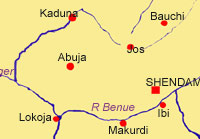
  • To give thanks to God for what has been achieved over the last 150 years.
  • To recognise and applaud and salute the noble generosity and heroic enthusiasm of generations of SMA missionaries, who left all not for profit or for gain but to tell people in Africa that God is love.
  • To acknowledge the outstanding loyalty of very dedicated cohorts of lay co-workers.

The Jubilee also provides an occasion to assess the prospects for the future, and to see the potential for consolidation, giving careful attention to the signs of the times and the inspirations of the Holy Spirit.

I also congratulate you on the really impressive Programme of Events which you have planned for the year. I wish it great success. I know it will bring many blessings as you study and pray and go on pilgrimage to the various shrines and sanctuaries that are precious to SMA history. I am quite sure that the year will bring many fruits and graces.

Personally I have nothing but the very best of memories of my associations with the SMA. Your Vocations Promotions people came to St. Patrick’s College, Cavan during my time there in the fifties. In very spirited and enthusiastic presentations, they put before us a clear and attractive picture of the missionary, reminding us of how Patrick himself had come as a missionary to Ireland. Later, as a young priest, I had the good fortune to go to Dromantine on various short courses e.g, Parish Renewal; Marriage Encounter type weekends; and also, of course, courses for young priests. I remember being there in the midst of a mighty frost and snow with temperatures way below zero but the warm welcome which the SMA gave made up for it all. Another thing that has always struck me is the very strong desire, on the part of the SMA, to help the local church in any way they could here in Ireland.

Later on, during my time on the staff of the Irish College in Rome I had occasion to renew once again my acquaintances with many SMA people and it was always very pleasant and happy. Father Pat Harrington was your Superior General then and Father Kieran, the present Superior General, was immersed in his post-graduate studies then. I then came to know Father Michael McCabe from my own native county of Cavan.

Since coming to Armagh eleven years ago, I have come to know Dromantine and appreciate the treasure that it is. I call it the ante camera of paradise. I thank you for the decision taken some years ago to invest substantial resources in Dromantine and I salute how well that has been achieved. I salute also the efforts of Father Eamonn Finnegan in that matter and all those who helped him.

I heard recently a proposal that the Catholic Church in Ireland should designate the next decade as the decade dedicated to the new evangelisation of adult formation and were that to happen, I am sure Dromantine would have an invaluable role to play. In agriculture, farmers often talk of re-seeding fields that have become tired and yield less than their true potential. The Church in Ireland is in need of a certain amount of re-seeding at the moment and we need all the help we can to achieve that.

Last Friday we welcomed to Armagh a group of pilgrims from a town in northern Italy called San Colombano al Lambro. The town is named after St Columbanus of course who stopped there on his way to Bobbio. Isn’t it marvellous to think that, 1,500 years later, there are people willing and able to make a pilgrimage of gratitude to Ireland for the gift that the great Irish missionary brought to them so long ago.

I am delighted to learn that the small seeds sown by Bishop Marion de Brésillac 150 years ago have grown into a huge tree with so many branches with roots in Africa and America, Asia and Europe. Today we thank God for the 944 members working mainly in Africa of course, but also in the Americas, Asia and Oceania. We salute the courageous decision taken some years ago to accept members from Africa and Asia and we rejoice in the people who have joined the Society from the eleven African countries as well as from India and the Philippines.

I am delighted to know that there are currently 236 members of the Irish Province. We are proud that the Province has given four (4) Superior Generals to the Society and that twenty-one (21) have been called to serve the Church in Africa as successors to the apostles. We all take pride in this contribution to the marvellous story of the SMA.

Sons of Mgr Bresillac go forward – Africa has great need of you“. Those stirring words of the late Pope John Paul II to you in 1983 are still relevant and inspiring today.

Prospere Procedite indeed. May the SMA celebrations here in Ireland this year remind all of us of Ireland’s proud missionary record. May the glorious example of countless SMA missionaries, the real heroes, dedicating their lives to the glory of God, inspire Irish people to appreciate the faith that motivated such self-sacrifice and may we all live that faith to the full.

Thank you.

History of the Church in Northern Nigeria

History of the Development of the Church in Northern Nigeria

SHENDAM 100!

 Shendam is one of the many thousands of towns of Northern Nigeria. Situated in the Lowlands of Plateau State it has no major industry and has few outstanding physical or historical features that would attract the visitor. The Chief of Shendam is known as the Long Goemai, a title that has been in existence far back into the shadows of past centuries.
But Shendam has a special place in the history of the Church in Nigeria: it is the very first Roman Catholic mission station established north of the Rivers Niger and Benue. This happened on 12th February 1907 and so 12th February 2007 will be a wonderful day for all the Catholics of Northern Nigeria. They will celebrate 100 years of the foundation of the Catholic Church north of these great rivers, years that have witnessed an almost unbelievable growth in members, parishes, dioceses and church institutions.

The First Missionaries

Fr Oswald Waller SMAThe first three missionaries, Oswald Waller (French), Ernest Belin (French) and Joseph Mouren (Dutch), were members of the Society of African Missions (SMA) which was based in Lyons (France). After a sea journey of more than a month they landed at Burutu at the mouth of the Niger (Lagos had no harbour to take ships at that time) on December 4th 1906. They went from Burutu up the Niger to Asaba where Monsignor Carlo Zappa lived. He was responsible for the Catholic Church in the territory of the Upper Niger. He was on a tour of his missions when they arrived, so they had to wait almost two weeks before he returned and could give them some information as to their possible destination.
It may seem strange to us but when Waller and his companions left France on 26th October 1906 they had only a vague idea as to where they would work. The appointment given to them in France was quite vague: “found a mission somewhere between the right bank of the Benue and the left bank of the Niger”. Zappa gave them the name of the British colonial administrator for Muri Province, Captain Ruxton who lived at Ibi on the river Benue. Ruxton had told Zappa some months previously that he would welcome missionaries. They went to Lokoja from Asaba in two days in a comfortable steam Fr Joseph Mouren SMAlaunch and it was from here that difficulties seemed to mount daily. It was the dry season and, since the water level of the river was low they had to look for local canoes to carry them and. their belonging. They got the canoes but nothing seemed to go right: leaks in the boats, canoes that broke away from the bank, stubborn boat-men. Eventually they left Lokoja and finally met Ruxton, not at Ibi but at Amar, 4 days further up the Benue. He suggested Shendam as a site for a mission to them and, having thought deeply about it overnight, they decided to go there; Next day they returned to Ibi. Their journey from Lokoja to Ibi, then to Amar and back again to Ibi took 28 days in narrow canoes at a speed of three miles an hour! Mouren said:
“Over our own canoe we had, with mats and palm leaves, built a hood, under which we could find shelter against the heat of the sun. Our deck chairs were placed in single file behind one another and in them we had to keep quiet for four-weeks. “

Arrival at Shendam
So on February 7th 1907, having crossed over from Ibi, Waller and Mouren set off on a narrow path with carriers for some of their loads leaving Belin to guard the remainder of their belongings at Ibi until more carriers could be found. On February 12th, after six days of struggle through elephant grass, rough bush, swamps and having crossed the Shemanker River six times, they had their first look at Shendam, built on a slope on the other side of the river. It was a small walled town of one street to which they were welcomed by the Long Goemai and his people – poor people who gave a great welcome to the strangers, including some of their huts until the missionaries could have their own accommodation.

Fr Ernest Belin SMA outside his house in ShendamThey had to struggle with the language since they had neither Hausa nor Goemai. They had to be farmers, shepherds, carpenters and well-diggers, in establishing their mission but they never forgot that they were missionary priests who came to preach the Gospel of Jesus Christ. By 1909 six SMA missionaries had come to Shendam: Belin, the youngest, died of black-water fever within six months, Schumacher, who came a month after his death, was himself dead of the same sickness in 18 months and Mouren, who had reached death’s door six times, was on his way back to Europe. In that much time: the only baptisms they had (Christmas 1908) were two, treed slave boys who were given to the mission to rear. It would be 1914 before the first marriage received a church blessing.

Even though progress was terribly slow and sickness and death took such a heavy toll on this infant mission yet a second mission was opened when two more priests, Adolphe Roussellet and Theophile Boulanger, came from France. Then two others, Alphonse Schahl and Georges Fischer, came before the end of 1909; Charles Monpoint came in 1912 and Eugene Sirlinger and Donat Scheicher in 1913. Sirlinger was to become well known for his work in translating catechisms and Bible stories in a number of languages, including Goemai. He also set up the first school in Shendam. Schelcher who died from black-water fever at Demshin in 1919 was the third priest to die in those early years.

Growth
In 1911 Shendam was cut off from Asaba and became the headquarters of the new Prefecture (mission territory) of Eastern Nigeria. The name was given in error because it was not east of the Niger but the area between 8° East and 12° longitude and north of the river Benue. Oswald Waller, the only survivor of the founding group, was appointed Prefect Apostolic (superior) by Rome. His prefecture covered an area of 200,000 sq km approximately with just two mission stations: Shendam and Demshin! Waller and his missionaries were men of deep faith and determination as they had shown in the face of all the setbacks that came their way from the time they had landed at Burutu. Every journey begins with a single step and Shendam and Demshin were just the first steps in the journey of evangelising the entire North of Nigeria. In July 1911 Waller went to Bauchi and was optimistic about establishing a mission in that area. However, as was the case with the people of Pankshin who had invited them there shortage of men hindered development. It was 1918 before Waller visited Jos and Kano where he was asked to open a chapel. Travel to Jos whenever one of the priests visited it was on horseback since there was no railway and no road transport. It was until 1921 before the first simple church was opened in Jos and 1922 before work began on the church in Kano. Waller also visited Zinder (in the present Niger Republic) which was to become an outstation of Kano.

Almost all of North Eastern Nigeria was under the care of the Shendam Mission even though little work could be done in the early days because of shortage of missionaries. At one time there were only 4 priests in that vast territory. The building of the railway was a big boost to their work because it helped travel. However, it added a lot of work since there was a small Christian community at every railway station and construction yard and these people too needed the services of a priest. Places such as Jos, Ropp, Makurdi, Lafia, Mada, Gudi, Jagindi and Kafanchan, were regularly visited by priests from Shendam who sometimes spent up to two months in this work – saying Mass, hearing Confessions, celebrating marriages and baptisms.
Mgr Waller left Kano after the opening of the new church in 1925 and for health reasons could not return. By that time the headquarters between 1910-1925: men like Berengario Cermenati who celebrated the first Masses in Minna, Zungeru, Kaduna and Zaria in 1911, Patrick 0’Connell who was to become the earliest resident priest in Zaria in 1921 and Paul Emecete, ordained for the Vicariate of Western Nigeria in 1920 and the first Nigerian priest of the 20th century. Cermenati had visited the Shendam men in 1907 and also in 1911.

The Harvest
In 1929 the part of the Prefecture of Western Nigeria (headquarters at Asaba) north of the Niger was added to Waller’s prefecture and the unified territory was called the Prefecture of Northern Nigeria with a new Prefect Apostolic, this time an Irishman, Mgr. Francis O’Rourke. There were three missions with resident Fathers: Shendam, Kano and Zaria with 6 priests altogether. In 1934 this huge region was divided into the prefectures of Jos and Kaduna with Monsignors William Lumley and Thomas Hughes respectively heading them. In Jos there were now 4 main stations: Jos, Shendam, Udei and Kwande with 9 priests. They had a total of 24 secondary stations. Whereas Kaduna had Kaduna, Kano, Zaria, and Minna with 8 priests and 16 secondary stations. Both Jos and Kaduna became dioceses in 1953, Jos with Bishop John Reddington and Bishop John MacCarthy at Kaduna. By 1960 Jos had 11 central missions, a minor seminary, 2 teacher training colleges, 3 secondary schools and 2 hospitals whereas Kaduna had 15 central missions, 4 teacher training colleges, 5 secondary schools and 2 hospitals. Jos was elevated to an Archdiocese in 1994, and Bishop Gabriel Ganaka who succeeded Bishop Reddington became the first Archbishop. Peter Jatau, ordained in 1963, (present Archbishop of Kaduna) was the first indigenous priest of Jos diocese, followed by Gabriel Ganaka who was ordained in 1965. Today there are more than 100 Nigerian priests and many Sisters working with Archbishop Ignatius Kaigama.

Those humble beginnings in Shendam in 1907 were the seeds sown that, directly or indirectly, gave birth to the dioceses of Kano, Bauchi, Yola, Maiduguri, Jalingo, Kafanchan, Lafia and the Archdiocese of Jos. The Archdiocese of Kaduna, the dioceses of Sokoto, Zaria, Minna and the Vicariate of Kontagora had their initial impetus from a different direction, from Lokoja along the Niger to Baro and from Minna on the railway line to Kaduna and Zaria.

We remember all those who gave their lives, their talents and their health from the first days at Shendam to the present time: the missionaries, the indigenous priests and Sisters, the catechists and teachers, church leaders and all the faithful who received the Gospel message with such faith and who passed it on from generation to generation.

In the history of the Catholic Church in Northern Nigeria Shendam can be seen as the mustard seed of the Scriptures which is the smallest seed of all seeds when sown but grows into the biggest shrub of all (Mark 4:30-31). That the harvest has been great is due entirely to God’s blessing.

– Thanks to Fr Edward O’Connor SMA for this History

History of the Church in Mid-West Nigeria

ORIGIN AND DEVELOPMENT OF THE CATHOLIC CHURCH

IN THE PRESENT ECCLESIASTICAL PROVINCE OF BENIN CITY

l. LOKOJA (1884-1893)

It was in 1882 that Monsignor Jean-Baptiste Chausse SMA, the Prefect-Apostolic of the Catholic Church in Lagos, and Father Theodore Holley SMA, of Abeokuta fame, sailed up the River Niger to assess the possibility of bringing knowledge of Christ to the people who lived east and north of Yoruba land. The report they sent to their Superior General, Fr Augustin Planque SMA, in Lyon, must have impressed him because just two years later Rome setup the Prefecture of the Upper Niger, covering all that territory in modern Nigeria, north of Lokoja, an important trading centre at the confluence of the two biggest rivers in West Africa, the Niger and the Benue. The Evangelisation of that vast territory was assigned to the Society of African Missions (SMA).

In November 1884 SMA Fathers Jules Poirier, Filippo Fiorentini and Pierre Piolat arrived by boat in Lokoja, where they set up their temporary headquarters from which they hoped to evangelise the towns and villages north of the two rivers. Father Poirier was the first Prefect-Apostolic. He had some missionary experience in Topo in the Lagos area and he had hoped to develop Lokoja in the same way as he had done in Topo by establishing a Christian community and then establishing a farm to solve the food problems, before spreading out to the neighbouring villages.

But things did not work out that way. In Lokoja the people were mainly Moslems and in no way disposed to the Christian faith. Besides, their resources were very limited both in money and personnel. The missionaries were few and the few that did come were struck down by ill-health and even death. Fathers Fiorentini and Piolat died in 1885 and 1886, respectively. Three others were assigned to the prefecture in 1885 – Carlo Zappa, Johann Baptist Voit and Andrew Dornan. Fr Dornan died in less than a year at the tender age of twenty-eight. By the end of 1886 only three of the first six of the missionaries survived. Fr Poirier had succeeded in getting four OLA (Our Lady of Apostles) Sisters to come to Lokoja but two of these also became victims of the fevers that swept West Africa at that time. So in 1891, just seven years after the SMA arrived there, two Rev Fathers, two Rev Sisters and twelve redeemed slaves left Lokoja for Asaba, where Carlo Zappa had established St Joseph’s Catholic Mission in 1888.

II. ASABA (1888-1938)

It was largely in response to the insistent entreaties of one Sir James Marshall, an official of the Royal Niger Company with its Headquarters at Asaba, that Fr Poirier decided to send Fr Zappa to Asaba in 1888. On Pentecost Sunday James Marshall and his equally devout assistant, Judge O’Kane, returned from Mass at Onitsha on the eastern bank of the Niger. They were pleasantly surprised to meet Fr. Zappa waiting for them. Sir James immediately led Father to the site which he had purchased for them – the site which has remained the Head-quarters of the Catholic Church in Asaba to this present day.

Even in Asaba the early missionaries did not find it easy. The response was slow. Because of the high-handed activities of the Royal Niger Company, white men were unpopular and in many minds the missionaries were associated with them. However, the Fathers and the OLA Sisters impressed the barriers. The care for the sick shown by the teaching of catechism, were established but were not well attended. Then there was the physical factor. Sickness among the missionaries was widespread. Mosquitoes were everywhere. At that time there was no quinine or medicine to treat malaria. By 1898, just 10 years after their arrival in Asaba, of the 21 SMAs who arrived there, 7 had died, 7 had to return home and only 7 survived. Despite the problems, Fr Zappa was determined to press on and young priests and sisters continued to come from Europe. By 1900 there were fifteen priests in the Prefecture and Fr Zappa made maximum use of them. Since the departure of Fr Poirier for Europe in 1893 he was now in charge of the Prefecture. He set off, on foot, to the nearby towns, west and north of Asaba, and soon he had mission stations in Issele-Uku, Ibusa, Illah, Ogwuashi-Uku, Okpanam and Onicha-Olona. By 1896 he had established a mission in Agenebode, in the Afenmai District. And in 1897 there were three OLA Sisters in that same Agenebode. This town, on the banks of the Niger, was to become the centre from which the faith would spread throughout Afenmai. In 1904 Fr Eugene Strub, of Asaba fame, wrote home stating that “little by little, obstacles that were thought to be insurmountable were overcome. Progress once started never halted. “

In 1906 Msgr Zappa re-opened Lokoja and from there many outstations were established – Okene, Kabba, Oka and even Zaria. Zappa had his sights set on Ishan country for some time and Fr Clement Bannwarth opened a residential station in Ubiaja in 1908 while Fr Joseph Corbeau of immortal Ishan fame opened Okoni, close to Uromi, in l912.

It was later that he turned his attention to the southern banks of the Niger – this time on the creeks of the Niger Delta. Forcados was opened as a centre by Fr Georges Oilier in 1913 and Fr Luigi Cavagnera established the mission in Warri in 1917. Msgr Zappa died in Asaba in 1917. By his extraordinary zeal and tireless energy, by his diplomacy in dealing with the Royal Niger Company, the local chiefs and the people he loved so well, he was able to leave behind him a well-established, vibrant Church in at least three-quarters of the vast area entrusted to him.

Bishop Thomas Roderick, SMA. (1918-1933)

Bishop Thomas Broderick, SMA continued the policies of his predecessor. He ordained the first Nigerian priest in the person of Fr Paul Emechete in Asaba on 6th January, 1920. Later in 1926 he transferred the Seminary, established by Msgr Zappa in Ivianokpodi in the Agenebode area in 1907, to Asaba. Among the young seminarians were Pedro Martins, Anselm Ojefua, Stephen Umurie, Anthony Sanusi and Joseph Erameh. Bishop Broderick established a Training Centre for catechists in Ibusa in 1927 and in the adjoining compound

he established St Thomas’ Teacher’s Training College in 1928. This was a very significant move because it meant the Catholic Church was fully committed to education and the establishment of schools throughout Mid-West Nigeria, as it was then known. It was the first Secondary school throughout the Region and the rapid but solid expansion of the Catholic Faith was due in no small measure to the products of St Thomas’ that were soon to be found in schools in every town and village. So, when Bishop Broderick died in 1933, the Church had a well established form of evangelisation in the training of catechists and teachers.

Bishop Leo H. Taylor, SMA. (1934-1939)

In comparison with his predecessors (Msgr Zappa and Bishop Broderick) and his successor (Bishop P J Kelly), the Episcopacy of Bishop Taylor in the Vicariate of Western Nigeria, as it was officially called since 1911, was comparatively short. He returned to Lagos in 1939 as he had been appointed Archbishop of the Lagos jurisdiction. During his tenure of office in Asaba Bishop Taylor continued with the proven policies of his predecessors. However, greater emphasis was now being laid on the schools as tools of evangelisation. During his Episcopacy the numbers attending the Catholic primary schools increased from 6,300 in 1932 to 12,375 in 1939. The increase in the number of primary schools necessitated an increase in the number of trained teachers. So the enrolment in St Thomas’s, Ibusa increased from 16 in 1928 to 60 in 1939.

However, the increased attention given to education did not diminish the attention to normal pastoral care and the Bishop could be seen going along on his bicycle, travelling from station to station to administer the Sacrament of Confirmation. The most significant feature of his Episcopacy was the transfer of the Head-quarters of the Vicariate from Asaba to Benin City in 1938. Bishop Taylor did this because he felt that it was more appropriate and more convenient for administrative purposes to have the headquarters of the Vicariate close to the civil headquarters which was Benin City at that time.

III. BENIN CITY (1940-1973)

The first resident priest in Benin was Fr. William Lumley, SMA, later Msgr Lumley of Jos fame. He took up residence in 1928, Previous to that Benin was an outstation of Sapele. Bishop Patrick Joseph Kelly SMA was appointed Bishop as the successor to Bishop Taylor in 1940. His Episcopacy was a long one of thirty-three years, and a very fruitful one. There was progress on all fronts. Catechists were his top priority. He trained the catechists personally in his own compound. During the Confirmation visits he insisted on examining the candidates – hundreds of them – himself. He built up the indigenous Church. In 1940 there were three indigenous priests; in 1973 there were 50 and hundreds of seminarians and Sisters. Likewise the number of Catholic Schools continued to multiply throughout the Diocese. (The Vicariate of Asaba-Benin became the Diocese of Benin City in 1950). He established the first Secondary School, Immaculate Conception College, Benin and St Patrick’s, Asaba in the mid-Forties and he was the Proprietor of up to 40 secondary schools in 1972. But Bishop Kelly was above all a man of prayer. He was an SMA to the core and it was fitting that he should spend the later years of his long life at our Provincial Mother House in Cork City, Ireland. He died there on 18th August, 1991, at the age of 97.

MODERN TIMES

When Bishop Kelly retired in 1973 the Vicariate of Asaba-Benin which he inherited in 1940 had become the Diocese of Benin City (1950). Subsequently, Lokoja (1955), Warri (1964), Issele-Uku (1973), the Prefecture of Bomadi (1973), Auchi (2002) and Uromi (2006) were created. In 1994 the Ecclesiastical Province of Benin City was created with Archbishop Patrick E Ekpu as its Metropolitan. On the installation of His Grace, Bishop Anthony Gbuji preached the homily. Among other things he said: “We owe immense gratitude to the missionaries of the Society of African Missions and to the Sisters of Our Lady of Apostles. They planted and watered with untold sacrifices and courage the seed abundantly blessed by God which we now reap with great joy. To those of them now in our midst we express deep gratitude and may God grant eternal rest to those who have slept in the Lord.”

Today the SMA presence in the Province is confined to the SMA parish, Cable Point, Asaba and SMA House, Uromi, the former Tyrocinium, opened in 1957, with Fr. Matthew Walsh as Regional Superior.

Fr James Higgins SMA
St Patrick’s Parish
Cable Point, Asaba.
15th August, 2006

General Assembly 2007

General Assembly 2007

A Wet Day for Papal Audience in Rome

St Peter's Square in the rain
A wet St Peter’s Square

Derek, John, John and Daniel
Conventional sheltering

improvisation
Fr Thaddeus Ogato improvising

improvisation
More improvisation

has the rain stopped
I wonder if its still raining?

Jean-Marie and Joseph and others sheltering
Frs J MGuillaume and C Cuenin keep dry

Big umbrella for the Pope
The Pope takes shelter too
blessing in the rain

Papal blessing in the rain

Superior General Re-election 2007

Re-election of Fr Kieran O’Reilly SMA
as Superior General of SMA on 28 April 2007

Newly re-elected Superior General, Fr Kieran O'Reilly

Pre-election discernment by delegates to GA
Delegates meet in chapel for period of
discernment prior to the election of
Superior General

Pre-election discernment by delegates to GA
Delegates meet in chapel for period of
discernment prior to the election of
Superior General

voting during election

Votes are cast during the election of
Superior General

white smoke

White Smoke rises – the election has been
successful

thanksgiving mass
Mass in thanksgiving for the election –
the Superior General is main concelebrant

celebratory meal
Time for sharing a celebratory meal
and for speeches

General Assembly 2007 More Pictures

General Assembly 2007… More Pictures


working group in session A working group in session during the General Assembly
prayer time Time to pray is essential during the General Assembly
recreation Time for much needed recreation brings some delegates to the tennis court
francis at computer Reporting and writing and computers are elements of the General Assembly as Fr François is discovering
Tea-break fro Patrikson, John and Mike Fathers Francis Patrikson, John Dunne and Mike Adrie exchange ideas during the tea-break

General Assembly 2007 Pictures

19th SMA General Assembly
in Pictures

16 April – 12 May 2007

opening mass of assembly
Fr Kieran O’Reilly SMA Superior General flanked by Fr Francis Gnonhossou SMA (left) and Fr Patrikson F at the Opening Mass of GA2007

General Assembly in session
Delegates to General Assembly 2007 present for the first formal session of the Assembly being held at SMA Generalate in Rome

flags of the nations linked to SMA
Flags of the Nations where SMA
members work or originate


delegates at GA07
Frs Jean-Pierre Frey (Strasbourg) and
Damian Bresnahan (Ireland) at GA07

delgates to General Assembly
Delegates Frs CJ Antony (India), Daniel
Cardot (France) & Michael Adrie (Ghana)

Delegates to GA07
Delegate Fr John Kilcoyne (Ireland) and General Councillor Fr Michael McCabe exchange views

Secretaries
Secretaries Frs Martin Kavanagh (Ireland) and Henri Blin (France) fulfil an important role at GA07

Family Vocations Crusade

doers


doers

Between 2009 and 2013 the Society of African Missions has added 87 more priests to their ranks.

Included among the 2011 class is Fr Kevin Conway SMA who was ordained in his home parish – Dunamanagh, Co Tyrone – by Bishop Patrick J Harrington SMA, bishop emeritus of Lodwar, Kenya. For the last three years Kevin has been living and studying at the SMA House of Studies in Nairobi, Kenya.

bresnahan-d--kcHis training would not have been possible without the help of a wider SMA family – our Family Vocations Crusade Sponsors. Coming from every county in Ireland, they are the spiritual and financial backbone of the SMA training programme.

Fr Kevin (on right) is pictured here with Fr Damian Bresnahan SMA (Omagh) after the Ordination ceremony.

How it all began…
Since 1929 the SMA Major seminary was based in a property near Newry, Co Down. Dromantine College served its purpose as a training centre for SMA priests for more than 40 years. In 1959, some people from around the North who knew of Dromantine expressed an interest in becoming more involved in the Mission of the Church. And this was BEFORE the opening of the Second Vatican Council (1963) which speaks of the essential vocation of the laity in the mission of the Church. From that interest a support group for SMA seminarians started. We know it as the Family Vocations Crusade or FVC.

In recent years the SMA has seen considerable expansion and vocations for Africa, Asia and Poland. This has necessitated opening new Houses of Formation in these continents and countries. At present we have 270 SMA students studying in our Formation Houses. It costs more than €1.5m (One and a half million Euro) per year for their maintenence and college fees. Many African and Asian countries are materially less well off so SMA relies almost totally on outside support for the training of our missionaries.

We need generous supporters to finance the education and training of our SMA students for the missionary priesthood.

The mission is still the same. The responsiblity for the evangelisation of people is the responsiblity of the whole church. “The whole church is missionary” said Pope John Paul II.

kc-j-bowe-handsJoining the FVC can give YOU the opportunity to contribute directly to advance the mission of the Church.

Our picture shows FVC Director for Leinster, Fr John Bowe SMA, laying hands on the head of Fr Kevin during the most solemn part of the Ordination ceremony.

Will you help us in our work?

Would you consider becoming a sponsor?

There are two ways of getting involved in the FVC.

Group Membership: A Leader, known as the Head Sponsor, invites a number of others – family, relatives, friends – to form an FVC Group. Members of the Group are called Sponsors. The Head Sponsor is the contact person with the FVC Director attached to the nearest SMA House. The Head Sponsor organises the Group, arranges for the collection of contributions, keeps in touch with all the Sponsors and communicates special requests and needs for prayer to the Director.

Individual Membership:  For Sponsors who are unable to join a Group who may send an annual contribution directly to the nearest FVC Director.

FVC Members do three things:

  • Pray for vocations daily
  • Encourage vocations in their homes through a positive attitude to the Christian faith
  • Make a financial contribution annually to the SMA

How to start a Group?
Contact the FVC office at one of the following: 

SMA House, Blackrock Road, Cork
Telephone 021 – 4616316 or [email protected]

SMA House, Dromantine, Newry, Co Down, BT34 1RH
Telephone (+44) 028 30821224 or [email protected]

SMA House, Claregalway, Co Galway
Telephone 091 798880 or [email protected]

SMA House, 82 Ranelagh Road, Dublin 6
Telephone 01-4968162 or [email protected] 

Funeral Homily of Thomas Higgins

Fr Tom Higgins SMA


Funeral Homily – 3 February 2005


(Preached by Fr Fachtna O’Driscoll SMA, Provincial Superior)

Readings:
Wisdom 3: 1-9
Romans 12: 3-13
John 12: 23-28

1st February ushers in the Season of Spring. We notice a lengthening of the light at both ends of the day. That theme of light is carried on into the second day of the month, when we celebrate a mini-festival with lighted candles as we contemplate the Presentation of the child Jesus in the temple. 1st February is also the Feastday of St Brigid, secondary patron of Ireland. Tom Higgins’ theology and spirituality would have little truck with modern day, feminist inspired connections being made between a pagan goddess and a Christian saint, but that he should die on this particular day is not without some significance. Brigid consecrated her whole life to God, as a virgin; so did Tom. Brigid is renowned for her hospitality, almsgiving and care of the sick. These are themes running through the life of Fr Tom; at one point, as giver; at another, as receiver. He died peacefully early on Tuesday morning, in Blackrock Road, after a protracted illness.

Our first reading this afternoon is that reading from the Book of Wisdom that is regularly chosen for funeral liturgies. The souls of the virtuous are in the hands of God. It is appropriate for Tom’s funeral liturgy. In the reading, the afflictions of this life are seen as slight in contrast to the blessings that will surely follow in the life to come. God has put the virtuous to the test, like gold in the furnace, and they have not been found wanting. They who trust in him will understand the truth, those who are faithful will live with him in love; for grace and mercy await those he has chosen. Tom lived his life with great fidelity to the Lord; our faith convinces us that he has moved into new life and there has met mercy itself.

In the gospel, we are reminded that the grain of wheat must die if it is to lead to a rich harvest. New life is possible only when the old has died. Nature itself is a brilliant teacher in this regard. For the Christian, of course, we are not talking of just any kind of new life. We are talking about nothing less than new life in God’s very being. Jesus’ resurrection from the dead is the guarantee of the hope we claim as Christians that one day we too will rise with him into everlasting life. This was the faith that inspired Tom Higgins to dedicate his life for over 60 years in missionary priesthood with the SMA. How lovely it was that we were able to celebrate with him the Diamond Jubilee of his ordination to priesthood, just six weeks ago. Tom’s was a life rich in blessing, but not without its pain also.

A native of Sligo town, Tom was born on July 8th, 1918 into a family of three boys and three girls. He completed his Primary education with the Marist Brothers in Sligo before going on to secondary school in Ballinafad and Wilton. From here he moved on to Cloughballymore, where he cherished the spiritual atmosphere and the great family spirit existing between the Staff and the students. He graduated from University College, Galway in 1941. His first mission appointment after ordination in 1944 was to Monrovia, Liberia. It is fitting that the present Archbishop of Monrovia, Michael Francis, who would have been ten years of age when Tom first reached those shores, had just arrived in our house for convalescence just a matter of days before Tom died.

Tom had a very significant missionary career in Liberia. He began as a teacher, was later a pastor, and later still an administrator. Tom seemed to possess many of the gifts outlined by St Paul in his letter to Romans in that passage we read here this afternoon – teacher, preacher, administrator. In each ministry he gave of his gifts freely; and he was never less than a thorough gentleman. He was very highly regarded by all his colleagues as he served as Regional Superior from 1953-64. In this particular ministry he became noted for the quality of his hospitality, something which St Paul reminds us we need to make our special care. He also had huge compassion for his confreres. During these years in Liberia, finances were never too plentiful and the church was finding it extremely difficult to make ends meet from the ordinary resources of the mission. Tom worked with the creative spirit of another confrere to establish a rubber plantation at Kakata to raise funds for the mission. The pioneering work in this regard was to survive up to the recent tragic war.

Unfortunately, ill-health, in the form of a very debilitating disease of both his eyes, was to force him to leave his beloved Liberia in 1970. There is no doubt that this experience was a defining one in Tom’s life. I am reminded of the comment of Thoreau – “as a young person we dream of building a bridge to the moon and sometime in mid-life we pick up the materials we’ve gathered and build a woodshed.”

Tom was to work for another nineteen years in pastoral ministry in the diocese of Hexham and Newcastle in Northern England. Poor eye-sight was to continue to plague him, and he was to develop other health complications including cancer. So he returned to work in this parish of Wilton for five years, before moving into full retirement in the Wilton community in 1994, where he lived contentedly until requiring a higher level of nursing care at the Blackrock Road community since 2002.

At the beginning of this homily reflection I focussed on the image of light. Light and sight are inextricably linked. Tom’s seeing of the physical world changed around 1970. I think it would be true to say that the way he viewed faith and the Church also changed around that time. Tom would say, of course, that it was the church that had changed; his view had remained constant throughout. However one judges that debate it is very true that Tom found it painfully difficult to come to terms with many of the changes, liturgical and otherwise, brought about by the Vatican Council and subsequently. He was never afraid to argue his point with great conviction. He did more than argue; he aligned himself with some of the traditional movements within the church, such as the movement for the restoration of the Latin Mass, and was a devoted supporter and participant until increasing frailty made it simply impossible for him to continue.

Throughout this period Tom always maintained his dignity. He did not cede his point easily but he always tried to dialogue with courtesy and respect. He remained, as always, a real gentleman. That’s why the second reading this afternoon, taken from the Mass for the feastday of St Brigid, rings true. St Paul tells us, “Do not let your love be a pretence, but sincerely prefer good to evil. Love each other as much as brothers should, and have a profound respect for each other.” Tom showed his love for his brothers by trying to get us to move back from what he regarded as the wrong way, and he did so with profound respect. He certainly worked for the Lord with untiring effort and great earnestness of spirit. And he certainly did not give up when trials came.

In the same reading each of us is urged not to exaggerate our real importance and to judge ourselves soberly by the standard of faith that has been given to us. Tom had no doubt that his cause was an important one: but he never exaggerated his personal importance and had a sober judgement of himself.

Our faith asserts that Tom is now participating in the heavenly liturgy, where arguments of style and language are no longer relevant. He is at peace in body, mind and spirit. Our prayer is that he will enjoy the fullness of God’s eternal peace.

Ar dheis lamh De go raibh a anam dilis.

Funeral Homily of Thomas Egan

Fr Tom Egan SMA

Funeral Homily – 5 May 2006

(Preached by Fr Fachtna O’Driscoll SMA, Provincial Superior at SMA Parish Church, Wilton, Cork)

Readings: Macc 12: 43-45
2 Peter 3: 8-14
Mt 11: 25-30

In his heyday, Fr Tom Egan was renowned for the eloquence of his after-dinner speeches or his words of gratitude at an SMA Promoters’ meeting. It was a pleasure to be treated to Tom’s choice of complimentary and affirmative phrases that were rarely understated. However, in his latter years, particularly since he joined the community at Blackrock Road, his was a quiet but contented presence. It is perhaps fitting then that he died on the Feast of two of Jesus’ less prominent apostles, Saints Philip and James. Tom died on Wednesday morning last at the South Infirmary Hospital after a relatively short illness. We gather here this afternoon to celebrate this funeral liturgy and pray for the repose of his soul.

This is the fifth occasion already this year that the Irish Province of the SMA is celebrating a funeral liturgy for one of our colleagues. Each funeral has its own individual stamp but all are reminders to us that life is not of our choosing and is outside our control. Our task is to accept the life that is given to us and at the end surrender it back to the God from where it all began. For Tom that life breath was first breathed over 80 years ago. We are truly thankful to God today for the richness of his 80 years. Our sadness at parting is no less real for the fact that Tom enjoyed a long life. His sisters and brother, nieces and nephews and extended family will miss his presence as will the members of the SMA. It was touching, over these last weeks particularly, to see the affection in which he was held by his extended family. But we are blessed that our Christian faith allows us to place his passing in a context that looks beyond this life. Jesus’ promise that we will enjoy life in God into eternity enables us to acknowledge the human loss but to recognise that our brother has now simply moved into a new phase of existence.

In our first reading this afternoon we read about the Maccabbeen clan. If there was one characteristic above all others that marked them out it was their total dedication to Yahweh, total dedication to Yahweh’s people and unswerving perseverance right to the end, in spite of suffering or danger. In the Book of Maccabees we find the first thought-through Old Testament theology of resurrection. Judas Maccabeus, by his collection for the sacrificial sin offering, attested to his belief in the resurrection. This was some years before Jesus came to confirm that those who die in the Lord are indeed raised to life with him. As the reading puts it, “for if he had not expected the fallen to rise again it would have been superfluous and foolish to pray for the dead”. Our faith guarantees that it is far from superfluous and foolish to pray for the dead. We do so in the sure faith knowledge that as Tom died with Christ in baptism, he will also imitate him in his resurrection.

It seems to me, from knowing a little of the life and character of Tom Egan, that our 2nd reading today, taken from the second letter of St Peter summarises the spirituality on which Tom based his whole life. In the Lord’s time-scale one day is equal to a thousand years and a thousand years as one day. In terms of Tom’s life, one day is equal to 80 years and 80 years is just like one day. Operating out of that perspective, then, it becomes incumbent on us to “live holy and saintly lives while we await the Day of God to come”. As St Peter puts it, “do your best to live lives without spot or stain so that he will find you at peace”. There is no doubt that Tom tried to do exactly this throughout his life, sometimes, perhaps, to a fault.

Our gospel passage reminds us that we have no claim on divine revelation. Whatever is revealed of the mystery of God is pure gift. “I bless you, Father, Lord of heaven and of earth, for hiding these things from the learned and the clever and revealing them to mere children”. Human intelligence – intellectual knowledge – is no gateway to understanding the mystery of the divine. Only the stance of solid faith opens us to the possibility of receiving whatever is gifted to us of the mystery of God. And this mystery reveals the extraordinary promise that when we come to the Lord with our burdens he will give us rest. How often must Tom have come with his worldly burdens before the gentle and humble heart of the Lord and found there that the burden shared had then become light.

Tom Egan was born in 1925 in Cloonacool, Tubbercurry, Co Sligo, under the shadow of the Ox mountains. He was the eldest in a family of two boys and three girls. He did his early secondary school studies at the diocesan minor seminary of St Nathy’s, Ballaghdereen. He completed these studies here in St Joseph’s, Wilton. From 1944 –’47 he completed a Bachelor’s Degree in philosophy and education between the universities of Cork and Galway. After four years of theology studies in Dromantine he was ordained priest in June 1951 at the Dominican church in Newry and then assigned to the missionary posting of Monrovia Vicariate, Liberia where he was to spend the next 13 years.

Tom did not always enjoy robust health so he must have found the harsh tropical climate of West Africa severe on his constitution. Nevertheless he persevered at the task and became a well established member of the team. The greater part of the thirteen years was spent as a teacher in St Patrick’s High School in the city of Monrovia. His good organisational and secretarial skills were also put to good use. Bishop Collins was glad to avail of these skills and he also recognised Tom’s gift for diplomacy. He sent him for some basic training to sharpen his diplomatic skills and Tom was to put such skills to excellent use not only in Liberia but very much so later in the promotion of SMA mission among our supporters here in Ireland.

It is this aspect of his career as a missionary that is best known. From 1964 to 1998, apart from a short stint at the Spiritual Year programme at Kilcolgan in Galway, Tom dedicated his life totally to the promotion of the Society among our benefactors. He spent three years of this programme attached to the house in Blackrock Road, where among his duties was preaching in churches throughout the West, a precursor to the Mission Awareness ministry of today. But it was his attachment and relationship to the SMA house in Wellington Road, Dublin that was to leave the major mark on his life. Here he gave almost thirty years establishing and cementing the Family Vocations Movement in the Leinster region. In fact, he became so identified with this house that one can scarcely think of the building without connecting it to Tom’s presence therein. It is a mark of how he was regarded in Dublin that a special memorial Mass will be celebrated in Rathmines church next week to enable his many friends to gather to pray for the repose of his soul. No doubt there will be great stories told and memories shared after that Mass.

The address ‘Wellington Road, Ballsbridge, Dublin’ conjures up images of opulence. But Tom’s living quarters in the SMA house were spartan in the extreme. Certainly no one could lay a charge against him of ostentatious living and expect that it would stick. His bedroom could barely fit a bed and table and from here Tom carried out much of his secretarial work. A colleague from those years recalled for me yesterday how even in times of sickness Tom would lie on the bed with his portable typewriter on his chest and type letters of esteem, condolence or comfort to whomsoever had a need at that time.

The key to his ability to generate so much support for SMA and esteem for its work includes the following salad of ingredients: sheer repetitive hard work; meticulous attention to detail; regular and sustained contact with benefactors; unashamed use of his wonderful innate gift of charm; interest shown in all happenings within the wider family, especially around exam times; attendance at hospitals and funerals; judicious and lengthy use of the technology invented by Mr Alexander Graham Bell. Holding all these ingredients together was an unfailing courtesy and respect shown at all times. We often speak of our benefactors being part of the extended family of SMA. There is no doubt that the members of the Family Vocations Movement in Leinster became a real extended family to Tom. Alexander Graham Bell is quoted as saying “the most successful men in the end are those whose success is the result of steady accretion”. Fr Tom Egan was certainly a living proof of the truth of that statement.

For many years Tom was the dean of the promotion team within the Province. He was respected and admired by his colleagues. This is where his eloquence and diplomacy were shown to good effect also. He had a quaint mannerism of beginning every statement with the preface ‘the point about it is’. Nothing seemed to give him more pleasure than to construct an ode of praise to a colleague or benefactor. A small word would never be employed where a big one could supply. They say that good ideas need landing gear as well as wings. It is probably true to say that Tom’s ‘landing gear’ was not quite as highly developed as his ‘wings’.

Tom has now landed very firmly in closer union with the Father. Many of those to whom he ministered here on earth will surely have been there to welcome him. Our prayer is that whatever purification may still be necessary will be quickly attended to. His life’s work has been accomplished and he can now rest in peace.

Ar dheis De go raibh a anam.

Funeral Homily of Thomas Lindon

Fr Thomas Lindon SMA

Funeral Homily 28/12/2004

(Preached by Fr Fachtna O’Driscoll SMA, Provincial Superior)

Readings:
Isaiah 52: 7-10
1 John 1: 1-4
Matt 11: 25-30

There is something very poignant and sad about dying on Christmas Day. And, yet, there is something very uplifting in it also. To die in the hope of eternal life on the very day when we celebrate the coming down to earth as man of the very Son of God, the one in whom all our hopes of eternal life rest, the one who himself incarnated hope, is somehow a beautiful rounding off to a life lived in this unquenchable hope, and dedicated to spreading this same message of hope to the very ends of the earth. Fr Tommy Lindon passed away very peacefully at about 7pm on Christmas Day. His death concludes one stage of his existence. His death also brings to a closure a time of suffering and unease when the quality of his life was far from what one would wish. For a man of brilliant intellect these last few years must have been shockingly disfigured. And, yet, not least because of the loving care he received in St Theresa’s, he was gently released to meet his God when the time was right.

At death our Christian faith is a great solace. For Tommy’s family, his confreres in the SMA, and his many friends there is the assurance of faith that his life is changed, not ended. We have the assurance in our Gospel passage today, that Jesus provides rest, a rest that is eternal, for those who labour and are overburdened. There is no doubt that Tommy’s life has been laboured and overburdened these last few years. We give God thanks today that his labour is finally ended and he rests in peace. I particularly chose this gospel passage for Tommy’s funeral for that reason but for another reason too. We are told, “I bless you, Father, Lord of heaven and of earth, for hiding these things from the learned and the clever and revealing them to mere children”. Tommy was a very clever man, a man of vast learning; but I do not disparage his learning in any way when I suggest that it was not his learning that revealed to him this message of hope. In fact, it was because he refused to allow his learning to present a barrier to accepting this simple message of faith and hope that allowed him to live this reality in his own life and dedicate his life to communicating it to others. This gospel passage affirms that salvation is never earned, it is pure gift. The donor, not the recipient, is the focus here. A child can accept the message more readily than an adult because there are fewer walls of incredulity and scepticism to penetrate.

Tommy Lindon was born on 22nd June 1933 and from an early age discerned a call to missionary priesthood. Our second reading today, from the Prophet Isaiah, tells us “how beautiful on the mountains are the feet of one who brings good news, who heralds peace, brings happiness, proclaims salvation…….. for the Lord is consoling his people”. Tommy must have been impressed with such a vision because he chose to study for missionary priesthood in the SMA schools of Ballinafad and Wilton. Marked out as a bright student from the beginning it was no surprise that he was chosen to pursue further studies in Rome, after ordination in 1957. Because of young age he and some colleagues had their ordination to priesthood postponed for some months, which meant that unfortunately they were not ordained with their classmates to celebrate the centenary of the SMA in 1956.

Even a quick glance at his CV in the booklet lets us see that he had an enormous variety of ministries throughout his life. Tommy spent eight very enjoyable years in pastoral ministry in the diocese of Ibadan, Nigeria from 1980-’88, but much of his life was given over to teaching and academic pursuits. It would, however, be a mistake to think that Tommy’s knowledge of the Lord remained on the intellectual level. He proclaimed a God who had intimately touched his own life. As that beautiful passage from St John that we read here puts it, something which has existed since the beginning, that we have heard, and we have seen with our own eyes; that we have watched and touched with our hands; the Word, who is life – this is our subject. That life was made visible; we saw it and we are giving testimony, telling you of the eternal life which was with the Father and has been made visible to us”. Tommy strove throughout his life to convey something of the experience of meeting that God, not just an intellectual knowledge of a God out there.

Tommy had a very unique and individual sense of humour, a sharp wit that saw fun in events where others might be slower to see it quite in the same way. [I think Billy was very accurate last night when he described his sense of humour as whimsical. In fact, just this morning in my office I was led to make an interesting connection. I have on my desk one of these diaries that you tear away a page for each day with a little gem of wisdom printed for each day. For today, the gem of wisdom says: The greatest lesson in life is to know that even fools are right sometimes. Somehow or other I think Tommy learned that lesson very early in life and never took anything or anybody for granted.]

And humour is one of the three H’s that links Holiness to Humility. This humour manifested itself in that crackling smile when his face opened in glee and his body shook with a sustained chuckle. Whether he was in Rome, in Ibadan, in Dromantine, in Cambridge, on the Provincial Council, in London, in Liberia, in Sierra Leone, in Zambia or back here in St Theresa’s that same humour shone forth, bringing life and mirth to others. Tommy enjoyed a sing-song and a party get-together, and could always be relied on for a humorous party piece. In fact, it is nice to remember that his wit was one of the last faculties to leave him. Sr Rosalie recounts how some years ago when she was accompanying Tommy to hospital, being driven by Fr Paddy Barry, Tommy’s wit expressed itself out of the blue. Passing along the opposite quay to the Opera House Sr Rosalie wondered aloud what might be on at the theatre at that particular time; quick as a flash a hitherto silent Tommy replied from the back-seat, “the roof”. Tommy also enjoyed a game of tennis and during his years in Ibadan he was a very faithful participant in the weekly tennis game at the Regional house.

Tommy’s career was both various and interesting. He had the opportunity to watch the scene at the very heart of the church when he was a priest student in Paris, and gained a Doctorate in Theology in Rome; as a teacher of theology during the changes brought about by the Vatican Council he witnessed and participated in many of these changes; he served in Nigeria at a time when that country was establishing itself as an independent country just emerging from decades of colonial control; he served in Liberia during its darkest days of civil war, and was forced to move with the seminary students and staff into the neighbouring country of Sierra Leone in order to continue the programme of training; he served on the Provincial Council of this Province during a period when the beginnings of the decline of vocations to the priesthood was becoming perceptible, and I think he was the initiator of the programmes of on-going formation by organising the early summer-schools at our Maynooth house for those on holiday from Africa. He followed up his stint on the Provincial Council by taking a Masters Degree in African studies. This, allied to his Doctorate, prepared him well to focus his future teaching career on Mission Studies. So, a wide and rich experience was his and he gave of his best in the different ministries.

In these latter years when ill-health decreed that he could no longer serve on mission he returned to Ireland, first to care for his own sick sister, and then to be cared for himself at Blackrock Road. Here, while it is true that he received much, he never ceased being a giver either. Tommy was always a gentleman right to the end. He was easy to care about and to care for. He gifted others by allowing them to care for him without demur.

They say the mind grows rich from what it receives, the heart from what it gives. Tommy’s mind undoubtedly received a vast amount in all those years of reading and study. But his heart also grew significantly because he was a generous giver.

So now it is time to pray him home to the God who is the ultimate giver. We can be assured that God will not be found wanting to provide a place at the heavenly banquet for this gentle missionary priest, confrere, brother, uncle, relative and friend.

Ar dheis lamh De go raibh a anam dilis.

Funeral Homily of Fr Seán Kelly

Fr Seán Kelly SMA

Funeral Homily – 28 April 2005

(Preached by Fr John Horgan SMA, Vice-Provincial Superior)

The unexpected death of Fr Seán last Sunday evening at his house in Lecarrow, Co Roscommon was a shock to his family, especially to his sister Theresa who was visiting with him for the weekend. It was a shock to his SMA family; to his parish family; to his large circle friends and acquaintances. It left us stunned, in complete darkness with all the lights gone out. We depended on our faith and God’s word to help us in our struggle with the trauma.

In today’s gospel Jesus asks to remain in his love; he assures us we will remain in his love by keeping his commandments. The love of Jesus for us is so great that he was willing to die for us. A missionary vocation is a life long commitment to helping others to be aware of that love; bringing to them the God News that God loves them.

As a young man Fr Seán committed himself to witness to that love of God for us by joining the African Missions the SMA. After completing his secular education to third level, his theological and spiritual formation he was ordained a priest of the Society of African Missions on the 21st December 1960 to go and preach the good news in Africa. When he died last Sunday he was in the 45th year of his priesthood.

Most of the first third of Fr Seán’s life as a missionary priest was spent in the archdiocese of Jos in Nigeria in education and pastoral work first as a teacher and later as a secondary school principal. He was immersed in the many and varied activities of a young vibrant, expanding church. The situation was very similar to the early Church of the first reading. Growth and expansion bring their own problems; problems demand meetings to find solutions.

So in the first reading we find the Church leaders at such a meeting, the Council of Jerusalem. They listen to Barnabas and Paul describing all the signs and wonders God had worked through them among the pagans as the young church expanded to embrace new converts not only from among the Jews but from among pagans as well.

On holidays many were enthralled as Fr Seán told of the wonders of life on the missions because he witnessed in his mission work the blessings and marvels of God.

Because Fr Seán’s health was a not robust he was given an appointment in Ireland in 1976. Indeed the next section of his life totalling 11 years was devoted to different assignments in the Promotion of the SMA in Ireland. Here again he used his talent for story telling as he recruited young men to be future SMAs, as he promoted the SMA magazine, the African Missionary or as he collected mission boxes, preaching in parishes, giving people an awareness of mission.

In 1987 he was assigned to the SMA Community here at Wilton to be the bursar and a member of the formation team. Our SMA students spent their first year in Wilton in those days. During this period he also assisted in the parish here in Wilton. I have been told that the Cork comedian, Billa Connell never missed the 6pm Saturday evening Mass when Fr Seán was the celebrant.

In 2000 after 13 years of work in Wilton, Fr Seán undertook ministry in his native diocese of Elphin. There, in the parish of Knockcroghery, he ministered happily for the past five years.

This brief summary of his life does not do justice to the colour and quality of the man. He related naturally to people and made lasting friendships easily. He always made a point of knowing the personal names of people; he never forgot them. He was loyal to his family, to the SMA and to his friends. He loved company, had a good sense of humour; was a great entertainer; he could tell stories with the best and his tales were tall but never tedious.

These social gifts helped him in the different appointments he held during his life. They helped him in his dealings with young people whether in the classroom, in vocations groups or parish groups; they helped him in promoting the SMA mission; they help him in parish work. He had qualities, which endeared him to people.

Fr Seán was a man of faith, a prayerful person, and a priest committed to his vocation. He was a man of courage and integrity in everything he did and said. He made no show of his holiness or closeness to God. But he was holy and close to God.

For me closeness to God is often visible in the way people accept the sufferings and crosses of life. Fr Seán had his share of these crosses. He had to forego his preference for a life of mission in Africa and accept a life of mission in Ireland because of his health.

In the last months of 2003 two of his sisters and a brother-in-law died within a period of six weeks. This was an emotionally tough time for Fr Seán as he coped with such family losses. Last year 2004 was a year of physical suffering and loss for Fr Seán. He spent three periods in Galway University Hospital. In February 2004 he had treatment for gallstones. In May 2004 he had treatment for stones in the kidney and in October he had prostate surgery. He bore all of this suffering without a murmur of complaint. And after a very short period of recuperation at our SMA house in Claregalway he resumed work in his parish.

In the second reading St Paul says his life is being poured out as a libation or offering. And as that life nears its end Paul feels gratitude and joy that he has run the good race; that he has kept the faith and that a great award awaits him. During the last two years as Fr Seán coped with his own health problems and the deaths of his sisters and brother-in-law he must have felt like St Paul that his own life was being poured out as a libation. God was asking him to sacrifice more and more.

Fr Seán has run the good race; he has kept the faith.
We pray Lord, that Fr Seán will meet with his deceased parents, brothers, sisters and all he ministered to in the kingdom where your missionaries receive the hundred-fold you promised to those who would leave everything even their very selves so that they might be your witnesses in Jerusalem, Judea, Samaria and even to the farthest bounds of the earth

Ar dheis Dé go raibh do anim dílis, a Sheáin.

Funeral Homily of Robert Molloy

Fr Robert Molloy SMA

Funeral Homily – 11 April 2005

(Preached by Fr Fachtna O’Driscoll SMA, Provincial Superior)

Readings:
Wisdom 7: 7-11
2 Peter 3: 8-14
John 6: 35-40

The beautifully solemn and dignified funeral ceremony of the late Pope John Paul II on Friday last was a reminder to all of us of the dignity of life, the dignity of death and the hope that Christians carry that death is not the end of dignity but the beginning of a new stage of greater dignity where life is lived in the greater fullness of God’s presence. Bob Molloy lived 92 years of life with great dignity. He died, as he lived, peacefully and quietly on the very morning that the leader of his church was buried, a church he served faithfully, diligently and with an admirable dignity all his life.

Mircea Eliade, the anthropologist, once said: “No community should botch its deaths!” What he means is that those who die should not be left go from our midst without us recognising what they have done for us. If so, the loss is ours. In the SMA we try to take care not to botch our deaths. Our elders carry the story of the community. Few have carried the story of the Irish Province of the Society of African Missions as well as Fr Bob Molloy. In a letter of congratulations for his Golden Jubilee in 1986, the then Superior General, Patrick Harrington, described Bob as “probably the best known, most respected and loved SMA among the Irish confreres”. Few would argue with that assessment. Tom Humphries wrote an article some time ago on the great Dublin player and manager, Kevin Heffernan, where he said: character is fate: all the rest is scenery. I believe that would apply equally well to Bob Molloy. He was a character, almost an institution, who impacted and influenced the lives of hundreds of SMAs in his almost 70 years of priesthood.

Our opening reading this afternoon esteems the value of Wisdom. Few in our Society had that gift of wisdom to the level of Bob Molloy. He was bright, intelligent, well read. But he was more than knowledgeable, he was wise. He carried his knowledge with a deep humility and modesty, almost to the point of self-abnegation. He never tried to impress his vast learning on others. One is reminded of the old Eskimo woman who when asked why the songs of her tribe were so short responded, “because we know so much”. Bob’s knowledge was not any ordinary knowledge. It was knowledge about God and the things of God. It was, ultimately, knowledge of God which cannot be learned in any book but only on one’s knees. Bob was a theologian: Faith seeking understanding. He sought first for his own sake. And then he sought to impart it to others. He did so in a very gentle manner.

In our second reading St Peter reminds us that God’s time is chronicled according to a different standard to ours. All we know is that he is patient with us. The Lord’s call may come suddenly, something like a thief in the night. Bob’s call was sudden but hardly like a thief because this day has been awaited now for some time. What is required of us is to live holy and saintly lives until the Lord does come. “Do your best to live lives without spot or stain so that he will find you at peace”. I think most people would characterise Bob’s life as holy and saintly. But we need to remind ourselves again that a holy and saintly life does not earn salvation. Salvation is never earned; it is God’s free gift. Bob too will receive it as free gift.

This is borne out again in our gospel today from John’s famous teaching on the Eucharist. “All that the Father gives me will come to me, and whoever comes to me I shall not turn him away.” This text would have been very familiar to Bob. He would most likely have taught it in scripture class and dogma class. But he learned it also through his own prayer and life experience. “It is my Father’s will that whoever sees the Son and believes in him shall have eternal life, and that I shall raise him up on the last day”. That was Bob’s personal belief and as an African missionary priest he must have longed to carry this belief to the peoples of Africa. Perhaps he did an even greater thing by dedicating his life to teaching those who would bring this message to Africa.

Born in Ballinrobe, Co Mayo in 1913, Bob was the last born of six boys and three girls. He schooled first at the local Christian Brothers. Witnessing a horrific accident to a young man impressed on Bob the uncertainty of life and so he decided to dedicate his life to priesthood. A happy congruence of economic hardship and positive impressions of a local SMA missionary, George McCormack, launched him in the direction of SMA. He began his studies in Wilton, which he found difficult as the staff was not always very congenial and his own shy manner made it difficult for him to mix easily with the many city students present there. He moved on to Clough and Dromantine, where he integrated more easily. His own reflections on these times, indeed on his entire career with the SMA, make for fascinating reading. They are candid and, as one might expect, extremely insightful. One interesting point he made was that he considered the formation was too focussed on formal prayer and routine to the detriment of enabling student priests to form an intimate, affective relationship with Christ that might sustain them through life. “Too little pondering of Christ in the heart” was his assessment of that formation culture.

After ordination in 1937 he was assigned to take further studies in Canon Law in Rome. This surprised him as he did not consider himself to be an exceptional student in Dromantine days. Cardinal Ratzinger spoke eloquently on Friday last of John Paul’s self-sacrifice in accepting the post of auxiliary bishop of Krakow at a time when he was most happy in the academic environment of the university. Bob’s self-sacrifice was in the other direction. He had been looking forward in 1937 to an appointment on mission to West Africa. He had even purchased a trunk for the travel. But when the appointment to Rome came he accepted it with immediate obedience. As he said, “nothing left now but to drink deep the canonical spring”. His ready acceptance of this appointment was to mean that he never did experience a missionary appointment to Africa. This must have been a huge disappointment but he accepted it with commendable resignation. Two short trips to Africa in the 1960s, where he was hugely impressed by the welcome he received from all the men, compensated somewhat for this loss.


His time in Rome was not an easy period. Studies were demanding and then the onset of war meant food etc became scarce. The entry of Mussolini into the war further compounded problems. Though gaining a Doctorate in Canon Law in 1940 he was asked, because of the restrictions on movement during the war, to remain on in Rome where he gained a second Doctorate, this time in Divinity, in 1942. The account of his train trip through war torn Europe up into Lisbon from where he subsequently took a seaplane to Ireland is another fascinating episode in his life. He arrived home in 1942, in poor health and generally strained. He was next appointed to the teaching staff in Dromantine.

Bob was to spend the next 27 years as a professor of various subjects in Dromantine. His health never recovered sufficiently to recommend a career in the tropics. But he was to impact the lives of more than 300 SMA priests plus countless others who left the seminary through his ever nimble and alert mind, infectious laughter and gentle humour. A piece to mark his Silver Jubilee of Ordination has this to say of his teaching style: “Though learned, he is not pedantic; and he enlivens the weightiest material by his powers of apt illustration, explosive wit and humour, and rare felicity of expression”. During this period, also, Bob was to make a huge contribution to the local church in Northern Ireland, as he acted as consultant to local bishops on theological and especially canonical matters.


In 1969, with the gradual closure of Dromantine as the seminary and the movement of the students to Maynooth, Bob was appointment to Blackrock Road as part of the secretariat in the Provincial’s department, with special responsibility to edit the Bulletin. This was the brainchild of the 1968 Assembly, which saw the need for renewal and updating of missionaries who had little chance to read the literature on the new theological currents consequent on the renewal of the 2nd Vatican Council. Over 13 years Bob was to produce 36 volumes of this Bulletin. He was unambiguous in his commitment to God’s Word and Mission, with a passion for truth and integrity. It was hugely appreciated by the men on the field – and by the students of the time too, I can assure you! Bob was a true wordsmith, producing up-to-date, relevant material in the most readable and easily digestible manner.

In 1983 he began his retirement. He was to enjoy another 20 years of contented living among his confreres until increasing fragility necessitated his move to St Teresa’s for more regular nursing care. His presence here too was appreciated and he was held in great affection.

Bob was humble, modest and self-effacing, at a great cost to himself. He was never overly self-assertive and his sensitive nature could be pained by domineering personalities with strong opinions who had little patience with those of a more tender temperament. But he will long live in the memory of all those who learned from his lectures and his writings. He was something special.

Ni bheidh a leithead aris ann.

Ar dheis lamh De go raibh a anam dilis.

Funeral Homily of Richard Devine

Fr Richard [Rickie] Devine SMA

Funeral Homily – Keash – 14/6/2005

(Preached by Fr Fachtna O’Driscoll SMA, Provincial Superior)

Readings:
Wisdom 11:22 – 12:1
Titus 3:4-7
John 11: 19-27

Dietrich Bonhoeffer has been quoted as saying “we must learn to regard people less in the light of what they do or omit to do, and more in the light of what they suffer.” Fr Rickie Devine’s life was blessed with many deeds. We will reflect on some of them in the course of this homily. But we remember also that the final years of his life were marked with the sign of suffering. He bore his suffering nobly and well. For a big powerful man the gradual weakening of his body and mind cannot have been easy to accept. His suffering is now finally over. He died peacefully, surrounded by the loving care of his own family and his family in the SMA, on Saturday afternoon last, at Blackrock Road, Cork.

So, we gather here this morning to celebrate a life well lived. Our opening reading from the Book of Wisdom sets the proper tone for our celebration. “For you love all things that exist, and detest none of the things that you have made. For you would not have made anything if you had hated it”. Rickie Devine, like all of us, was loved into existence by God. Whatever his achievements may have been they would not have endured had God not willed it. So, our first task is to give thanks to God for Rickie’s faith and fidelity to priesthood. And we now pray him home into the God he tried to serve faithfully all his life. And we do so with great confidence. Because our Christian faith assures us that at death life is changed, not ended. We will reaffirm this faith in the Preface for this Mass that we will pray in a short while. Our confidence is based not on an idle hope but on the very word of Jesus himself as we hear it this morning from his own lips.

Our gospel passage today gives us that wonderful encounter between Jesus and Martha. On the human level, I believe, each of us can identify with Martha’s disappointment. She had put her hope in Jesus but his late arrival had now meant that her brother, Lazarus, was already dead. But Jesus says to her in his gentle but reassuring way “it is not too late. In Christ it is never too late because I am the resurrection and the life. If anyone believes in me, even though he dies he will live, and whoever lives and believes in me will never die”. He then goes on to ask a very simple but very crucial question “Do you believe this?” That same question is being asked of each one of us present in this church this morning. Do you believe this?

Rickie Devine gave his own very clear and unambiguous answer to that question. His answer was, yes, I do believe. And not only did he believe that himself but he devoted his entire life to sharing that belief with others in his almost fifty years of priesthood with the SMA, thirty-seven of those years spent in Nigeria, West Africa.

Rickie Devine was born on August 14th, 1931, the eldest of a family of seven children, here in this parish of Keash, which he always spoke of with such great affection. He did his secondary school studies in Summerhill College, Sligo before beginning his journey to priesthood in the SMA by attending St Joseph’s SMA College, Wilton, Cork. He then went on to Kilcolgan in Galway before finally completing his studies at Dromantine College, Newry, Co Down from where he was ordained to the priesthood in 1957. The guts of the next thirty-seven years were spent in various dioceses in Nigeria before ill-health necessitated his return to Ireland where he was to serve in the diocese of Elphin for two years before coming to reside at the SMA houses of Claregalway and Blackrock Road, Cork.

But before I begin to discuss his priestly service in the SMA I think it is very important that I set it in its proper context. There is a danger in any funeral homily, and, perhaps, especially at the homily for a priest when one records their contribution to furthering God’s kingdom, that one might give the impression that it was this work, on behalf of God if you like, that earned them salvation. Nothing could be further from the truth. This needs to be stated forcefully.

That’s why I chose today for our second reading that beautiful passage from St Paul’s letter to Titus. Paul states it very boldly, “it was not because of any good deeds that we ourselves had done, but because of his own mercy that he saved us… and he goes on to say “God poured out the Holy Spirit abundantly on us through Jesus Christ our Saviour, so that by his grace we might be put right with God and come into possession of the eternal life we hope for.” In other words, salvation cannot be bought, it cannot be earned. It is an entirely free gift, given out of God’s infinite mercy. Rickie was not saved through anything he did, no matter how many Masses he celebrated throughout his life. He, like every woman and man on the face of the globe, is saved only through the gift of God brought about in the life, death and resurrection of Jesus.

So, given that understanding as background, it is now appropriate to reflect a little on Rickie’s life. The first thing to be said is that he had a great affection for his home parish of Keash. Many is the time I heard him myself in Nigeria telling with pride the various doings of the characters around this place. I suppose, then, it is appropriate that he be buried here among his own people. I understand that the Devine name goes back here for a number of centuries, and that there is quite a collection of priests and religious coming from this place. Rickie developed his love of sports here. As a student in the SMA he was a noted athlete and footballer. Tom told me the other day that he would often cycle with Rickie perhaps thirty miles to a Connaught sports meeting where Rickie would promptly win all the four sprint races of the day, 110yds, 220, 440 and 880. Rickie developed his love of boxing here, a love he was to transfer to his time in Nigeria. He was a good servant too of the local football club. I gather that even as a priest, while home at one time on a short stint on promotion work down in Tipperary, he would regularly return here to Keash to play for the footballers. Tom also shared with me a story of a memorable occasion during those days when in a rather heated match against the neighbours of Gurteen when some of the Gurteen players were the worst for wear Rickie consoled their mentors by assuring them that he would anoint all the injured players immediately after the match.

That incident reveals a man of great wit. His wit and quick repartee came through on so many occasions. For such a big man he always had a warm handshake and a rather impish smile as if to suggest that there was always some fun lurking in the background. When I myself was first assigned to the diocese of Ekiti in Nigeria in 1979 Rickie Devine was already an established institution in that place. He was a powerfully big man, with a big physique, big heart and big character. He was renowned as a builder. He built churches, schools, at least four hospitals, clinics etc. And he always built big. One of his proudest achievements was a church he built in a parish outstation that was two foot longer than the cathedral church of the neighbouring diocese. He developed a very effective rapport with the African people who loved him dearly. Some times he might raise his voice but at the end of the day they always knew that he was totally on their side. His ready wit came to the fore there too. I remember one memorable occasion we were gathered with Bishop Fagun as the Senate of priests of Ekiti diocese. At the time the bishop was attempting to establish some guidelines for the priests as regards our lifestyle, how much food and drink we should take and so on. Rickie was known for the fact that he had a certain capacity to drink beer. When the discussion turned to this issue one of the local priests said “I think two beers a day is sufficient for a priest, my Lord” and Rickie retorted immediately, “he means before breakfast, my Lord”. You can imagine that not much more work was achieved at that particular meeting.

Rickie’s service to the people was much appreciated. He was honoured in two towns with chieftancy titles. He founded football teams and boxing clubs in many of his parishes. He contributed to a multi-cultural Ireland long before the advent of the Celtic Tiger or such topics were being discussed when he brought over a Nigerian player by name of Ojo to play for Sligo Rovers. After twenty-five years service in Ekiti he transferred up to the new capital at Abuja. Here he was to work in close cooperation with Cardinal Ekandem in supervising the construction of a Pastoral Centre and a whole new missionary seminary for the Society of St Paul, an indigenous Nigerian missionary congregation. All in all, his contribution to the growth of the church in Nigeria was truly immense.

Rickie has now gone from us, gone to that home constructed not with cement or mud block but with love. We will certainly miss him: his wit, his humour, his favourite phrases such as “that terrible fellow” or “that super jack” or “to speak the fact”, his characteristic sitting style from where he would pontificate on many topics. He has gone home to the Lord he tried to serve through the gifts given him. Our prayer is that we too will join him one day in the full fellowship of God’s kingdom.

Ar dheis lamh De go raibh a anam dilis.

Funeral Homily of Peter Devine

Fr Peter Devine SMA
Funeral Homily – March 26th 2007 at Tullyallen Parish Church
(Preached by Fr Fachtna O’Driscoll SMA, Provincial Superior)

Readings: Macc 12: 43-45
Hebrews 4: 12-16
Matt 25: 31-46

Fr Peter DevineWhen the renowned scripture scholar, the late Raymond Brown, was once asked if he intended following the writing of The Death of the Messiah by a similar work on the Resurrection he replied, ‘I would prefer to research that topic face to face’. Fr Peter ‘Doc’ Devine SMA is now face to face with the topic of resurrection and it is the belief of the Christian community gathered here this afternoon that the Lord has invited him home to begin the process of full sharing in the very being of God.

One could say that Peter’s health has been in decline since the early 80s when developing cancer necessitated the loss of one kidney. But he battled bravely, honestly and fearlessly for many years to enjoy a very fine quality of life. If it is true that success is measured by how high you rise again after reaching rock bottom, then Peter was very successful indeed. Never was that battle more bravely fought that in the last four to five years when the renewed onset of cancer demanded radical steps to keep it at bay, from the best of alternative medicine to dialysis to whatever would give a glimpse or a window of opportunity. Peter treasured life and he was not going to let go easily. Even the last month was marked by enormous courage until eventually his tired and frail body could fight no more. Then on Friday night last he surrendered gracefully and very gently and calmly passed over from this life to the next.

It is at a time such as this that the quality of our faith is tested. For Peter’s family, confreres in the SMA, parishioners and very special and dear friends it is a time of great loss. ‘Doc’ was a genuine character, in ways a larger than life figure. He will be missed and it is important that his passing is mourned and grieved. He had a good life but was not an old man by present day reckoning. However, we do have the consolation that our grieving and mourning is done in the context of a religious faith that solidly holds that Peter’s life has only changed, not ended. We are people of the resurrection.

Our opening reading from the Old Testament takes the example of Judas Maccabeus taking full account of the resurrection. As the text puts it: “for if he had not expected the fallen to rise again it would have been superfluous and foolish to pray for the dead”. We know that it is far from foolish to pray for the dead. And that is why we gather here this afternoon – just as Peter himself gathered and celebrated so many funeral liturgies in his 46 plus years of priesthood – to pray Peter home into the God he tried to serve faithfully and well.

Peter was born here in Molleek, Tullyallen in September 1933. He attended the local primary school, a short period in the CBS Drogheda and then the SMA secondary school at Ballinfad, Co Mayo. It was here he earned the nickname ‘Doc’, a name that was to stick to him through his missionary career in Africa and subsequent years in Cork and Dromantine. I’m told it may have originated in the fact that he was the first in the class to wear glasses and so was referred to as ‘doctor’. In any case, whatever the genesis of the name it stuck like glue so much so that all SMAs knew ‘Doc’ Devine but I bet many would not have known that his Christian name was Peter. After Ballinafad Peter moved into the full SMA formation system through Clough Ballymore, Wilton – where he took an Arts degree in University College Cork – and Dromantine, from where he was ordained in the largest class ever ordained in the Irish Province on 21st December 1960. During his student days ‘Doc’ was a character. A keen interest in motor mechanics, carpentry etc set him apart as a man of action. He was never too academically inclined yet achieved the required standard to serve much of his missionary career in the teaching profession. During his student days he was also known as a keen sportsman, being a particularly tigerish opponent on the football field.

His family circumstances were not easy during his student days. His dad died rather prematurely from some type of blood poisoning and then his senior brother was tragically electrocuted. Enormous credit is due to his mother for the way she reared the family in such circumstances. Undoubtedly her faith strengthened her and Peter as the second in the family was as supportive as he could possibly be.

Peter was assigned after ordination to the diocese of Kaduna in Northern Nigeria. He was to commit the next 23 years of his life to the teaching profession. He served many years as principal. He worked in such schools as St Mary’s Secondary School, Fadan Kaje and Father in charge of Kankada – the first station opened in southern Zaria in 1937 by Fr Malachy Gately; St Patrick’s Secondary School, Zaria; Government Secondary School, Birnin Gwari; Government Secondary School, Kachia and finally in administration at the Zonal Office, Zaria.


I think it would be true to say that while ‘Doc’ left an imprint in the field of education he left an even broader imprint through his extracurricular activities. His interest in cars was legendary, whether as to the mechanics of the engine or pursuing the hobby of rally driving. Many indeed associated the name ‘Doc’ with doctor of mechanics. He used to tell wonderful stories of his different exploits in the rallying world. They were always colourful and one suspected that a little licence with the truth was employed towards embellishment.

Peter began to be troubled by various health issues from 1974 onwards but he bravely staved off the need to return to Ireland until it was absolutely necessary. He had to have an operation to repair damage to his vocal cords – an operation that was undoubtedly successful – but kidney failure forced the issue beyond discussion. When he returned to Ireland he was to spend some short time as a chaplain to the Vincent de Paul summer hostel at Mornington where he earned the respect and huge gratitude of the participants.

He was then to spend three years as Bursar of the SMA community house in Wilton, Cork. He continued to enjoy his interest in mechanics and flowers and plants etc but it was here that he especially developed and matured his interest and love affair with dogs, especially greyhounds. He became known far and wide the whole country, from coursing meetings at Clounnanna or Clonmel or track meetings at any corner of the country. His dog Tomahawk was his pride and joy for so many years. But this interest in dogs also had a pastoral dimension to it. He was a boisterous, flamboyant, transparent character who was easily liked and for many was non-threatening. He did much good in a very unpretentious and certainly not in any pious way.

And he exercised a similar type of ministry here in his home parish of Tullyallen. He was always a man of the soil and nothing gave him greater pride than his neighbours in the wee county. He would visit the sick in their homes or in hospital, bring communion to the house bound and generally be available wherever the need was greatest. Our gospel reading this afternoon would certainly have been an inspiration for Peter. ‘Doc’ was not into using words if they could not be backed up by action. “I was hungry and you gave me food; I was thirsty and you gave me drink; I was a stranger and you made me welcome; naked and you clothed me, sick and you visited me, in prison and you came to see me”. These were not mere words for Peter; they were commands that had to be concretely fulfilled. For this reason it is fitting that he be buried here in his home church yard graveyard, alongside the other priests who have served this people well.

Peter was to spend the last 20 years of his life in this part of the country, attached to the community of Dromantine. Here he continued his interest in dogs, developed also an interest in Shetland Ponies and was general groundsman and maintenance coordinator for the plant at Dromantine. He became a much loved figure in the locality and continued to cement his relationship to his people at home.

Having said all of the above about Peter it would be a most incomplete picture not to acknowledge that Peter, just like the rest of humanity, had a shadow side as well. And because of his flamboyant and transparent personality his shadow too left its imprint. Peter was known to be quick tempered and impetuous. He was not a man for dialogue or for accessing the grey areas of argument or issue. As the saying goes he tended to shoot first and ask questions afterwards. This naturally got him into some spots of bother from time to time and required of his superiors some deft negotiating to get things back on track. He would not always have enjoyed a smooth and harmonious relationship with superiors. Confrontations were not infrequent and a prolonged period of stony silence could often ensue. However, thank God he was willing to accept the hand held out in reconciliation. Peter’s life was a good example of how the Christian life is a journey to godliness, not godliness attained.

And whatever can be said about the shadow side, undoubtedly it was well outshone by the side that drew forth from others love, esteem and affection. He wore his heart on his sleeve and indeed it was a heart of gold. He formed deep and abiding friendships, none more so than with his loving, caring and devoted friend, Kathleen Byrne. Kathleen took wonderful care of Peter especially as his health deteriorated. She attended to his every need and made what could have been a most painful journey over these past months a journey into peace and tranquillity.

As Peter passes on we pray that he enjoys the fullness of peace.

Ar dheis lámh Dé go raibh a anam dilis.

Funeral Homily of Owen Maginn

Fr Owen Maginn SMA

Funeral Homily – 05 December 2006

(Preached by Fr Fachtna O’Driscoll SMA, Provincial Superior at SMA Parish Church, Wilton, Cork)

Readings: Ecclesiastes 3:1-8,11
Romans 14:7-12
John 17:24-26

 When the Father laughs at the Son and the Son laughs back at the Father, that laughter gives pleasure, that pleasure gives joy, that joy gives love, and that love is the Holy Spirit”. When Meister Eckhart spoke those words back in the 14th century he may well have been motivated by having encountered someone like Fr Owen Maginn. I think for most of us the abiding memory we will carry of Owen is his laughter. Even when he was being most serious, or trying to be most serious, even in the latter days of his sickness when describing a condition that was obviously painful and critical, he could hardly conclude his remarks without breaking into his trademark giggle. That mischievous sparkle in the eye [as someone noted in our website guestbook], that giggle and laughter, were manifestations of something very wholesome inside the spirit and body of this extraordinary missionary.

Born into farming stock in Co Down in 1920, Owen was to spend just a few weeks short of 63 years as an SMA missionary priest. Never one of Nature’s athletes, always frail, he looked often a little the worse for wear. Yet he was to survive into his 87th year and hung on tenaciously to life, never more so than in these final eleven days when it seemed utterly futile to do so. His heart was obviously very strong, a heart that beat with love and compassion for all those he encountered in those 86 years. In the light of these long days of holding on his dying on Sunday morning was in a strange way almost sudden. In the space of about three minutes the still strong breath grew more and more shallow until eventually he was breathing no more. It was a beautiful, peaceful death, the mirror image of a life well lived. His going is well captured by our first reading this afternoon. “For everything there is a season,…. A time to be born, and a time to die”. Owen died not when any of us thought he was ready but when God was ready. As the reading puts is: “God has made everything suitable for its time; but although he has given us an awareness of the passage of time, we can grasp neither the beginning nor the end of what God does”.

All of us here present will have many memories of Owen. What is beautiful about our Catholic faith is that we exercise these memories now in this funeral liturgy in the context of a much bigger remembering. As Christians we believe that it is precisely in our remembering that we come to wisdom and new life. At Mass we gather around the table of the Lord to remember the life, death and resurrection of Jesus. And we believe that this action is not simply the mental recollection of a past event. We come hoping to be forgiven, to be nourished, to be challenged and sent forth; and we believe that our act of remembering is a means through which God enters into and transfigures our lives.

Our offering of Mass today is a prayer for the repose of the soul of Fr Owen. And we believe that just as the Father raised Jesus from death so too at the last day he will raise Owen. Owen himself held such faith with a passion. He dedicated his life to sharing this faith with others. How often he must have reflected on the prayer of Jesus in today’s Gospel: “Father, I want those you have given me to be with me where I am, so that they may always see the glory you have given me because you loved me before the foundation of the world”. And the final verse of this Jesus prayer could indeed be a prayer that Owen himself would make: “I have made your name known to them and will continue to make it known so that the love with which you loved me may be in them”.

Perhaps a little known fact about Owen’s early life was that he spent from about the age of three to eight in the city of Detroit in the State of Michigan, USA. At that stage his only brother Tom had been born and the family was to move back to Drumaroad. Owen took his secondary education at St Patrick’s De La Salle, Downpatrick from 1934 to ’38. Along with other SMAs, then and later, he seems to have benefited greatly from the fine education received from the Brothers. His decision to join the SMA in 1938 was influenced by Fr Sexton Cahill SMA, a native of Crossgar, Co Down, whose brother, Fr Denis, was the P.P. in Drumaroad and whose nephew, Fr Sexton Doran still works in Zambia.

After ordination in December 1943 he was assigned, along with his class-mate Fr Jim McCarthy, to further studies in Cambridge. He secured a Masters Degree in History but his time there was bedevilled by ill-health. His humour was evident in an early letter back to the Provincial where he wrote: “we feel a lot more confident of a 1st in heaven than we do in Cambridge”. He did not find the environment in Cambridge conducive to faith growth but one must keep in mind that the time was not particularly marked by a strong ecumenical spirit. He was troubled by bronchial difficulties and eventually pulmonary tuberculosis was diagnosed. This necessitated the collapse of his left lung and its subsequent re-expansion.

Believing that his health might not be able to withstand a severe tropical climate, his superiors appointed him to Egypt in 1951. He was appointed to St Georges College, Heliopolis. He once described this college as an effort to be a second Eton. He had to return to Dublin in 1953 where he was operated on for duodenal ulcer and the removal of a significant portion of his stomach. A lesser man, in the context of such a medical history, might have decided enough of travelling. But not Owen. He returned to Egypt for another three years during a very turbulent if exciting period in Egypt’s history.

In 1957 he was called back to the seminary staff of Dromantine. Many SMAs, including many present here this afternoon, have very warm memories of his time in both Dromantine and Cloughballymore. He moved to Clough as Superior for a number of months in 1963 due to the illness of the late Fr James Byrne SMA. He was professor of ecclesiastical history in Dromantine as well as being Dean and subsequently Spiritual Director. It is some testimony that I can say for sure that I never heard a single negative comment about his time as a student formator. Having spent altogether seven years at this task it is no mean feat to come away with one’s reputation unscarred. He had a strong positive influence on many future missionaries.

In 1964 his request to return to Africa was granted and he returned for the next ten years to St Georges in Heliopolis. One could spend many a pleasant hour with Owen being regaled with stories of that period of his life. During his recent illness he was telling me, with many interjections of laughter, of events in Cairo during the six day war with Israel. His later years in Cairo were marked by some dissatisfaction with what the college was achieving and his own desire to work as a missionary in a more pastoral setting. This wish was fulfilled when he was assigned to the Diocese of Ndola, Zambia in 1974.

What was characteristic of Owen’s life was his tremendous ability to form friendships. This gift he maximised to the full. It stood to him all his life. When people moved away he maintained friendships through a phenomenal regularity of correspondence. The friendships were as likely if not more likely to be with young people, often female, as with older folk. It is probably true to say that this gift and indeed his whole life truly blossomed during the last 30 plus years lived in Ndola.

“The life and death of each of us has its influence on others; if we live, we live for the Lord; and if we die, we die for the Lord, so that alive or dead we belong to the Lord”. Thus we heard in our second reading this afternoon. How appropriate to mark Owen’s life and death. His influence was first of all manifested through his family. Being the elder of a two sibling family unit his attachment to the family of his brother Tom was perhaps even stronger than the norm. He had a huge interest in all that went on for his brother Tom, Sadie and the children. And he was intensely proud of them. Even to the point of insisting that the children sing or perform for all SMA visitors to the house, something not always appreciated by the performers themselves. But his love and care for them was very much reciprocated. Throughout his life he was held in great devotion. This has been witnessed to telling effect these last days of waiting on Owen’s return to the Lord. This has been a difficult time for all you his family but I know that you also regard it as a time of rich blessing. Your witness of love and care has been inspiring and I know it will bear fruit in your own lives.
During Owen’s year or so sojourn in Blackrock Road we often teased him that nobody had more girl-friends visiting than he. His was an easy and comforting presence and it was no surprise that he could draw into that presence people young and old, male and female. His ministry in Zambia had a profound effect. Damian reminded us the other day of the outpouring of support from parishioners on his journey home last winter. He had a lovely ministry to those living with HIV/Aids – Sr Dr Eileen Keane, the pioneer of so much of the response to the Aids crisis in Zambia, has a fund of humorous stories from that field that would be too much to relay here; he acted as Spiritual Director and Chaplain to many Sisters communities; and he looked after his little parish each weekend with great consistency. His presence in Bishop’s house as companion and confidential secretary was much appreciated. He was a wise counsellor to young and old. The members of the Friends of Africa found in him a father who was non-threatening and non-judgmental but someone who could put before them a challenge to become the life-giving and wholesome human beings God was calling them to be.

Owen’s ability to befriend was aided in no small way be a voracious desire for news. He never tired of hearing the latest from any direction and he was not beyond engaging in the occasional bit of gossip. His curiosity revealed a genuine sincerity. He was at his best when debating or arguing a point in theology or the SMA or the Diocese. He was extremely well read and while never becoming offensive, he held his views with a real tenacity, though his views could change in a short space of time and they certainly changed significantly over the years. He developed over time into quite a progressive thinker and had little patience with the minutiae of church discipline if it did not seem to serve the broader gospel imperative. He was genuinely interested in people and nothing gave him greater pleasure than sharing good news.

Fr Owen Maginn will be hugely missed by those to whom he ministered and by those who ministered to him. Many fond stories have been shared during these days of mourning. His family and community of origin, the wider SMA family, the Church in different parts of Africa are all parting with a unique and gracious character. If one were to write a one line epitaph it might go something like this: he was one nice, decent, wholesome human being.

Ar dheis lámh Dé go raibh a anam dí­lis.

Funeral Homily of Oliver Smith

Fr Oliver Smith SMA

Funeral Homily – April 9th, 2005

(Preached by Fr Fachtna O’Driscoll SMA, Provincial Superior)

Readings:
Ezekiel 37: 12-14
Romans 8: 8-11
Luke 12: 35-40

I imagine, if we were given a choice about when to die, many of us would choose to die during the season of Easter. This is the season of alleluia and new life. The season when we are reminded again and again that death is truly swallowed up in victory. For Oliver Smith it was a lovely blessing to die during this season. And to have died in the very week that the Pope himself died, a man who seniored Oliver by only 20 days, must be regarded as a special privilege indeed.

Oliver had the blessing recently of celebrating the Diamond Jubilee of ordination to Priesthood, 60 years of service in the Lord’s vineyard. We had that quiet but dignified celebration here in this very oratory less than four months ago. Indeed, it is sobering for all of us to realise that both of the men we celebrated that day, Tom Higgins and Oliver, are now celebrating life in greater fullness.

So, Oliver has much to be grateful for, especially in these latter months. And we can be grateful too that the Lord spared him a long period of suffering. Who would have expected that Oliver would have that fall last Monday afternoon, necessitating his removal to hospital and the onset of death. But given that his injuries suggested that his recovery was going to be partial it was indeed a blessing that his death came quickly.

Our gospel reading today is that familiar passage where the Lord reminds his disciples that they must be dressed and ready for action. This referred most probably to the necessity to be always ready to advance the kingdom; but it can equally be interpreted, as the church has done so down the ages, as a reminder that we are not in control of life. It is in God’s hands to give and to receive. And, so, it is necessary to be prepared when the Lord sends that invitation. My sense is that Oliver was ready for that call. Not in any morbid or compulsive sense but rather as something that would happen without fanfare in the Lord’s good time. In fact, he lived life to his fullest capacity right to the end, in spite of severe restrictions to mobility. In fact, he did so to a degree that many of us would have wished he did not. He reminded me sometimes of the old grandmother in her late 80s who said, “I don’t suppose I shall live for ever, but while I do live I don’t see why I shouldn’t live as if I expected to”.

Our first reading this morning from the prophet Ezekiel is the great promise spoken to the people of Israel to give them hope of rescue from bondage, slavery and captivity in Babylon. It comes after that famous passage of the vision of the dry bones. The bones, being representative of the people of Israel, were dry because the people had no spirit in them. They had reneged on the promises through their sinfulness. But God never reneges on a promise. And so the bones will once again come to life and they will be resettled in their own soil. This will happen when God’s spirit dwells among his faithful people. The promise of this reading can also be interpreted on an individual level. God’s promise to us, in Jesus Christ, is that he will dwell eternally in spirit among his faithful people. This is a tremendous reassurance at the time of any funeral.

That reassurance is strengthened in the passage from Paul to the Romans. Once we have moved our interest over from the unspiritual [that is a life of selfishness and tendency to sin – or living in the flesh, as Paul so graphically puts it] to the spiritual we are assured that God’s own spirit has made his home in us. When we step back and reflect on that statement we recognise what an awesome statement it is to make – God’s own spirit has made his home in us. And then Paul goes on to say “and if the Spirit of him who raised Jesus from the dead is living in you, then he who raised Jesus from the dead will give life to your own mortal bodies through his Spirit living in you” Again, this passage refers primarily to living a spirit-filled life while on this earth. It means the Spirit of God permeates Christians and prompts them to live for God. But it also signifies a continuing life in the Spirit beyond the grave; a life that is possible when this earthly life has been lived in this spiritual way.

It was this same spirit that prompted Oliver Smith to offer himself for missionary priesthood in the SMA way back before the beginning of the 2nd World War in 1939. Mobility, and in the end lack of mobility, became a feature of Oliver’s life. He had been born in Tralee, Co Kerry in 1920. He had two sisters Marie and Rose with whom he shared a deep bond of affection right to their deaths. Some members of his extended family had entered religious life before him. In his early years he moved to Carlow and was entered as a student in the diocesan seminary, Knockbeg College. I believe I am right in saying that he was a contemporary of Fr Tom Gorman there. He was also a contemporary of the late bishop Patrick Lennon, brother of Fr Tommy Lennon SMA. These must have been good years for Oliver as he often spoke with some affection of those years. It was at Knockbeg that he first had any encounter with SMA. A photograph in the 1939 SMA calendar of a darkhaired priest wearing a white soutane and a sun helmet attracted his attention. The priest was Fr Michael Carolan SMA [Offaly] who later became Oliver’s first PP in Shendam, Nigeria. Oliver was ordained to the priesthood in December 1944; said his first Mass in the Pro-Cathedral in Dublin and received his first missionary appointment to the prefecture of Jos in Nigeria.

His missionary career was dominated by ministry in the fields of education and administration. He was both supervisor of schools and Education Secretary for Jos at different occasions. Later he was assigned as Staff Inspector for Christian Education in the Ministry of Education in Kaduna State. He served as bishop’s Secretary in both Jos and Kaduna dioceses. Archbishop Jatau of Kaduna, who was once his houseboy, later became his bishop. In fact, at the jubilee celebration here four months ago I made a smiling reference to his bravery in moving from one territory to another within the Region of Northern Nigeria. This was not something done very frequently.

In all, Oliver was to give 42 years of active service to mission in Nigeria. This was a remarkable achievement given that he did not always enjoy robust health. Perhaps more than most, he enjoyed the colonial era in Nigeria. He had good memories of that time too, memories that he later committed to paper when, in his retirement years, he began writing short stories. Thankfully, he was to have these published some years ago so they now stand as a tribute to his writing ability but more importantly as an important memoir of a particular era of missionary endeavour.

In 1989 Oliver returned to Ireland and retired to Kells, Co Meath where he lived in retirement with his sister Marie for the next eleven years. In 2001 he came down here to Blackrock Road and has been a member of this community ever since. Many people here will have memories of Oliver, some from his early years in seminary and mission, others from later years. He was certainly his own man, a true “fearr ann fein” He had an independent mind and would not be easily swayed from a path of action once his mind was made up. One would have to say he had a steak of stubbornness and could be somewhat awkward at times. His was a quiet presence, but a presence not easy to ignore even if that was not always reciprocal. His choice of funeral arrangements reflects a facet of his character that was intensely private. A spirit of generosity and kindness was also present: this was evident in his desire to leave his bodily organs after his death to anyone to whom the medical profession would deem them to be of benefit. His age counselled against actually using these organs. He is also known to have formed bonds of warm attachment and affection with staff members in this house. And he always marked his gratitude when a good deed was done to him or for him.

Our faith assures us that all the bonds of friendship and affection that knit us together in this life do not unravel with death. So, it is with this assurance that we now say our final farewell to our colleague.

Ar dheis De go raibh a anam dilis.

Funeral Homily of Micheal McGlinchey

Michael McGlinchey SMA


Funeral Homily – 14/12/2004

(Preached by Fr Fachtna O’Driscoll SMA, Provincial Superior)


Readings:
Eccles: 3: 1-8, 11
Titus 3: 4-7
John 11: 19-27

John Ayscough is quoted as saying, “Death is but a sharp corner near the beginning of life’s procession down eternity”.

These words seem appropriate in attempting to preach the word at the funeral of Fr Michael McGlinchey. In the last few years Mick’s walking style was considerably slower making sharp corners difficult to negotiate. As was observed of a famous man in his declining years, frail step following frail step – going nowhere with elegance.

Death is always sobering. But there is something very appropriate about dying just at the time when the year itself is dying. For the Christian, of course, death is not the end but the beginning of a new stage of life. And, so, it is equally appropriate that Mick should die during the season of Advent. Advent is the great season of expectation and hope. Hope for the Christian is a special concept. People speak of hoping that they will win the lottery. They know that their chances of doing so are statistically remote. This kind of hope is as far removed from Christian hope as it is possible to be. Christian hope is a confident hope; it is the hope of the little child on Christmas morning, that Santa will surely come. The child has not yet seen Santa but the possibility of Santa not coming is beyond the child’s capacity to imagine. As Christians we carry this quality of hope of resurrection and new life in our hearts throughout our lives.

When we interpret a life’s journey in the light of the resurrection it means that all of life’s events are not just significant in themselves but are significant in terms of the whole. That is brought out very clearly today in our first reading from the Book of Ecclesiastes. There is a time for every purpose under heaven, a time to be born, a time to die. Ultimately, then, our time is only a particular participation in God’s time. Mick’s passing came very quickly last Saturday evening. In a sense he died as he had lived, smoothly, calmly, without fuss or fanfare. As the reading puts it: God has made everything suitable for its time  and we can grasp neither the beginning nor the end of what God does.

Mick McGlinchey was born here at Doorat, Donemana on 20 November 1929. He did his schooling at the CBS in Derry, to which he cycled each day. Mick often spoke with pride about these cycling journeys to school. He then followed the SMA programme of studies through Ballinafad, Wilton, Kilcolgan and Dromantine. He was ordained a missionary priest on 13 June 1956 and was to spend the next 30 years as a dedicated missionary in the diocese of Benin City, Nigeria. He was to serve here with great distinction and great compassion.


I will return to that topic in a little while but I want first of all to set it all in its proper context. I think there is a danger in any funeral homily, and, perhaps, especially at the homily of a priest when one records their contribution to furthering God’s kingdom, that one might give the impression that it was this work, on behalf of God if you like, that earned them salvation. Nothing could be further from the truth. This needs to be stated forcefully.

That’s why I chose today for our second reading that beautiful passage from St Paul’s letter to Titus. Paul states it very boldly, “it was not because of any good deeds that we ourselves had done, but because of his own mercy that he saved us and he goes on to say “God poured out the Holy Spirit abundantly on us through Jesus Christ our Saviour, so that by his grace we might be put right with God and come into possession of the eternal life we hope for.” In other words, salvation cannot be bought, it cannot be earned. It is an entirely free gift, given out of God’s infinite mercy. Mick was not saved through anything he did, no matter how many Masses he celebrated throughout his life. He, like every woman and man on the face of the globe, is saved only through the gift of God brought about in the life, death and resurrection of Jesus.

Mick’s story, like all our stories, is only a partial story. The real, complete story is that of Jesus. Because, through Jesus we know that we are people of the resurrection. As we see in our Gospel passage today that powerful response of Jesus to the grieving Martha on the death of her brother, I am the resurrection and the life. If anyone believes in me, even though he dies he will live, and whoever lives and believes in me will never die.” Resurrection means that death is not the end anymore. It means that our destiny is life. So when we die we do not pass from life to death but from life to life. Death is that extraordinary moment when the Christ who is life can finally take me to himself for ever, when God and I can never, ever, be separated from one another. That is what it means for a Christian to die. That’s what it meant for Mick.

Mick not only lived that faith but he shared that faith for almost 50 years as an SMA missionary. He had a great loyalty to his call as priest, missionary and SMA. The first 30 years of his missionary life was spent, as I said, in the diocese of Benin City, Nigeria. He became renowned for his prowess as a builder. It was once said that common sense is genius dressed up in working clothes. Mick’s genius was revealed in the practical and the concrete. He built many fine structures of concrete and iron. But, perhaps more importantly, he built up also peoples self-esteem, and he built community. He built up peoples’ spiritual lives through celebrating the sacraments for them and offering solid catechetical programmes; he catered to their health needs by establishing health clinics; he catered to their educational needs by providing them with both school fees and, where necessary, school buildings. He was, then, far from being a one-dimensional missionary.

He was noted particularly for his kindness and compassion towards the people. The beautiful, warm smile that radiated from his open face right to the time of his death was evident from the very beginning. He loved and cared for his people, they knew it, and they reciprocated. He became director of the lay apostolate of the diocese, a job that meant he had to accompany the late, Bishop P.J. Kelly on his marathon C onfirmation tours. His placid, good humoured temperament made such tours tolerable.

In 1986 he was asked to take up a home appointment as Bursar of the SMA formation house at Maynooth. He very much enjoyed the cycles around the plains of County Kildare but his heart was still in Africa. On a personal note, there is one thing I am grateful for from that period. I succeeded Mick as bursar of SMA house. Not being blessed with manual skills such as Mick himself had I was anxious as to how I would attempt the various bits and pieces of ongoing maintenance. Mick gave me the soundest advice I have ever received – call an expert ! That simple but wise advice was to get me out of many a tight corner. The two years in Maynooth were followed by a year or so in the SMA parish of Wilton, Cork. But Mick was not really at peace until he returned to his beloved Nigeria. He was to spend another eight years there, this time in the diocese of Warri and a short time in the Ibadan Regional house.

Ill health forced Michael’s return to Ireland and he has been living in contented retirement in Dromantine since. Mick simply radiated contentment. The question “how are you Mick?” always elicited the response “never better”.. sure how could you not be good in a beautiful place like Dromantine”. As in his working life he had built up peoples’ self-esteem so now in his retirement through his God given gift of placid temperament and infectious optimism he built up peoples’ hearts.

Michael will shortly be laid in his final resting place among his closest family kith and kin. He will be missed by his family and friends, his confreres within the SMA and the people he served so loyally in Africa. A memory of him will long remain in their psyche as they contemplate the various concrete buildings that will continue to stand to his credit.

Michael McGlinchey has lived and died well. Ar dheis lamh De go raibh a h-anam dilis.

Funeral Homily of Micheal Kennedy

Fr Mícheál Kennedy SMA
Funeral Homily – March 28th 2007 at SMA Parish Church, Wilton Cork
(Preached by Fr Fachtna O’Driscoll SMA, Provincial Superior)

Readings: Isaiah 52: 7-10
Romans 6: 3-9
John 14: 1-6

Fr Micheal Kennedy “There is a destiny that makes us brothers None of us goes our way alone
All that we put into the lives of others Comes back into our own”.

I do not know the exact origin of these words but they impacted Halai Kennedy to the extent that he used them in a speech prepared for the celebration of the Golden Jubilee of ordination to priesthood in Blackrock Road in June, 2001. I think they express eloquently sentiments he lived his life by. He knew he was not alone. For the past number of years debilitating sickness necessitated his being aided in most things. Perhaps it was merely payback time for the goodness he brought to others’ lives during 55 plus years of missionary priesthood.

The most significant announcement made in the history of the universe was that made by the angel Gabriel to Mary that she was chosen to be the mother of God. This year the Church transferred the celebration of the Feast to Monday last. It was a nice privilege for Halai to finally surrender his body and spirit home to the Lord, surrounded by his beloved sister, Sr Brenda and Lee Cahill, on such a special day. We gather here this afternoon as family, confreres or friends to pay our final respects and pray for the repose of his soul. Halai has now begun the process of sharing in the fullness of life in God.

Our opening reading this afternoon is a splendid reflection of a people who are so convinced of God’s abiding love that their joy at this good news cannot be contained. One can almost picture a people dancing for joy as they proclaim that God is king. The Lord is consoling his people, redeeming the city. And we as Christians are the inheritors of this vision. We too can dance in our heart today that God is consoling his people. This is not in any way to deny the reality of loss. We must grieve and mourn the loss. For Halai’s family especially it is a poignant moment. He was the eldest of eleven children and my sense is that he became, especially in latter years, very much the focal point around which much of the family life revolved. So his loss has a special impact.

But our grieving is done as a faith-filled people. A people who proclaim with conviction that at death life is changed, not ended. “Do not let your hearts be troubled. Trust in God still, and trust in me” our Gospel assures us this afternoon. We reflect along with St Paul that we have been baptised into Christ’s death “so that as Christ was raised from the dead by the Father’s glory, we too might live a new life”. We believe that Halai having died with Christ will return to life with him. This is our own conviction but it was also the conviction that inspired Halai to dedicate his life as a missionary priest.

“How beautiful on the mountain are the feet of him who brings good news”. Halai carried the good news to the people of Nigeria and to the people of Ireland. He did that effectively and efficiently when his health was robust. But perhaps he did it in a more authentic way when he was most vulnerable. Perhaps we minister to others best when we allow them to minister to us. In such a vulnerable space our ego loses the ability to obstruct the workings of God’s Spirit. How beautiful too are the feet of the one who welcomes and receives good news.

Halai celebrated his 80th birthday last August. He was always proud of his Kerry roots and the town of Tralee always held a special place in his heart. He did his initial studies in CBS Tralee and was part of a group of four lads from the same class – including his own brother, Tom, to join and go on to ordination with the SMA. Halai was ordained at St Catherine’s Dominican Church, Newry in 1951. Being academically bright and a systematic student it was no surprise that he was immediately assigned to study science at U.C.C. He took an honours primary degree and followed this up with a Masters Degree in Chemistry. Such a course of studies would of course mark him out as a man who would give his life to the education profession and this is what he did.

In 1955 he was appointed to the Prefecture [later diocese] of Ibadan and was to serve all his African missionary career attached to the college of Loyola in Ibadan. Twenty one years were spent as Principal of this highly respected school. He was competent, efficient, a good teacher and a good organiser and administrator. He was a man of prudence and many relied on his sound judgement, a man of drive and determination tempered by moderation and self-restraint. He believed that education was a better safeguard of liberty than any police force or army. And he believed in a well-rounded and balanced education rather than a simple attention to academic subjects. Theodore Roosevelt has said, “to educate a man in mind, and not in morals, is to educate a menace to society”. Certainly Halai’s philosophy of education was not geared to adding to the menace in society. He was acknowledged as a man of rare stature. He was loyal to his colleagues on staff. This was much appreciated by younger members who may not have received the same respect from other older confreres. “He was the one man you could call on whenever there was a problem” was how one sister described him to me last night. And his organising abilities were legendary: he had constructed a comprehensive evacuation plan for the missionaries in Ibadan during the Nigerian civil war – based on a plan worked out by the British embassy; thank God it did not need to be put into use.

But life was not all work and no play because he enjoyed a healthy social life. He had a particular fondness for the card game of Bridge and he became a very accomplished player. In fact this interest deepened when he returned to Ireland and he is the author of some books on the game. Apart from being recognised as a competent teacher and administrator he was also highly regarded by his confreres in the SMA. He was elected as a delegate to a number of Assemblies, attending both the Provincial and General Assemblies of 1973. He was a member of the Preparatory Commission for Provincial Assembly 1973 and was also on the short-list panel for election as Provincial Superior that year.

From the mid to late 70s ill-health became his almost constant companion. Cardiac problems of various kinds were to shadow his days from then on. Visits to hospital are too many to enumerate here but a heart pace-maker installed in 1978 and renewed a number of times afterwards was to allow him a decent quality of life for a number of years. It would appear that the later degeneration of his mental capacity was also connected to his cardiac condition. This whole ill-health saga required his dying to much of what had gone before. But here too for the Christian there is solace, for the law of Christian spirituality in the scriptures tells us that nothing that we have not died to in this life can ever be resurrected in the life to come.

Having been forced to retire from Africa due to this health condition he was assigned to Wilton as a tutor and confessor in the Preparatory year programme and helped out also in this public church. He was much admired and respected both by his colleagues on staff and the students. He prepared excellent notes on the bible and these were appreciated by the students when they went on to study theology in Maynooth. He also shared his love of the scriptures with the prayer group in Wilton parish and many attribute their love of scripture to his promptings. He enjoyed ten good years in the college ministry and then after a short period of service in the parish as assistant priest he eventually retired from active ministry in 1993. The unexpected death of his brother, Fr Tom Kennedy SMA, that same year, took a serious toll on his overall health condition. In 1995 he came to live in the Blackrock Road community where he has been lovingly cared for ever since by the staff of the house and by his attentive family, none more so than Sr Brenda Mary who has surrounded him with love and meticulous attention all these years.

The above listing of the various places to which Halai has been assigned reminds us again of our gospel text this afternoon. “I am going now to prepare a place for you”. In a sense the Lord has been preparing a place for Halai all his life. But now the promise is more compelling: “I shall return to take you with me; so that where I am you may be too”. The next lines of the gospel evoke for me memories of Halai in his most vulnerable state. The dialogue between Jesus and Thomas as to where he is going and how the road there is to be discerned is most apt. Halai struggled with the insecurity of not being sure how he might get back into his bedroom to rest. Repeated verbal assurances that this would be taken care of seemed to offer little respite. But now at his death he has the assurance from the Son of God himself that Jesus is the Way, the Truth and the Life. No one can come to the Father except through him”. Halai no longer has to struggle with insecurities about the way forward. Jesus has assured him that he is the way to the Father and he has come to claim Halai as a companion on the journey. His troubled heart and spirit can finally rest in peace.

Ar dheis lámh Dé go raibh a anam dilis.

Funeral Homily of Larry Skelly

Fr Larry Skelly SMA


Funeral Homily – 22 January 2005

(Preached by Fr Fachtna O’Driscoll SMA, Provincial Superior)


Readings:
Macc 12: 43-45
Heb 7:25-8:6
Matt 11: 25-30

The Tsunami tragedy in S.E. Asia over the holiday period has given rise to lively debate as to where was God during this tragedy. How could a good God allow such a tragedy to happen, many asked. This is not a new question. The problem of suffering has been debated since the beginning of time, since humanity has become aware that suffering is part of the human condition. Some valiant attempts at explanation have been offered, running something like the following: God’s is a creation in freedom where the marvellous processes of nature have the capacity to produce wonderful development and growth but can also bring utter destruction and devastation. For God to intervene to stop disasters occurring would necessarily involve the cessation of freedom. In such a state we would all be responding in a programmed fashion like robots. God’s gift was to create the world with its own laws, and human beings with freedom and the ability to make choices.

However, no rational attempt to explain God’s mode of acting is sufficient. All fall short because the miracle of nature is greater than the human mind can grasp. But that does not mean that we flounder in a sea of meaninglessness and despair. Far from it, in fact. Because Christian faith asserts that God did make a decisive intervention in human history by coming among us as a man, a full and complete human person, and took on himself, in the person of Jesus Christ, the suffering of all humanity. For those of us who claim Jesus Christ as Lord, we do not recognise a God who stands aloof and witnesses disinterestedly a human tragedy but rather we recognise a God who suffers along with us in our suffering. But not only is he a God who co-suffers with us: he is also the God who, in the resurrection of Jesus Christ and his victory over suffering and death, holds out to us the promise and hope that in him we too pass through death into new and everlasting life. This is the hope of the Christian, this gives a meaning and fuller context to human death. At death life is changed, not ended.

Even in the centuries before the birth of Jesus, as is testified for us today in our opening reading from the Book of Maccabees, it was recognised that it was a sensible thing to pray for the dead. It says, “For if he had not expected the fallen to rise again it would have been superfluous and foolish to pray for the dead.”

That introductory reflection on the Tsunami disaster is prompted by another reflection. Why are some people taken suddenly in the full blossom of youth, however the circumstances of their death, while others, like Larry, seem to linger on and cling to life when human wisdom would seem to dictate that life has no more to offer them? This too is mystery. Mystery that is intolerant of rational explanation. But mystery that opens us to wonder and praise when better regarded through the prism of Christian revelation. This point is brought out very cogently in our Gospel passage. Jesus says, “I bless you, Father, Lord of heaven and of earth, for hiding these things from the learned and the clever and revealing them to mere children.”

Larry Skelly died last Thursday morning, just eight days short of his 79th birthday, in the loving care of the nursing staff of St Theresa’s and his confreres in the SMA. His last days were, thank God, devoid of pain due to the care and affection in which he was held.

Larry had a rich and varied career in the SMA. He was a true Dub, doing his early schooling in the O’Connell School of the Christian Brothers, where he had a brilliant academic record. In fact, I was told some years ago by the late Fr Gerry Crowe SMA, a classmate of Larry’s both in secondary school and the SMA, that Larry gained first place in Ireland in the Leaving Cert examination in the subject of history. [Although I have not been able to have this independently verified. Gerry remembered this because he himself got third place!] Larry continued all his life to read widely in history. His library is a veritable treasure-throve of history books of the highest quality.

It seemed fitting, then, that Larry was assigned to take history for his degree subject at Cambridge University, after ordination in 1950. Larry was to give the next 54 years of his life sharing in the priesthood of Jesus Christ through the Society of African Missions. It is fitting that our second reading today, taken from the Mass of the morning on which Larry died, from the letter to the Hebrews, presents a fine theological reflection on the priesthood of Jesus Christ. Jesus’ priesthood is contrasted with that of the cultic priesthood, which needed to present a new sacrifice day after day. Christ’s sacrifice of himself was made only once, is redemptive for all time and is not a new sacrifice presented afresh day after day. However, it is renewed every time we celebrate Mass. It is the privilege of the priest to stand in persona christi and day after day offer again to the Father this one saving sacrifice of Jesus Christ. It was Larry’s privilege to do this thousands of times in the course of his 54+ years of priesthood.

Larry’s first African appointment was to Cape Coast in Ghana where he was to spend the next eleven years as a teacher in St Augustine’s College. From there, in 1965, he transferred to Nigeria, where he spent the following eight years teaching in St Gregory’s College, Lagos. His African career, then, was given over entirely to the educational apostolate. As well as basic teaching, he was a Housemaster, and produced some plays such as Oscar Wilde’s, The Importance of being Earnest. Ill health took its toll in the early 70s, particularly a liver problem, that necessitated his staying out of the tropics for the remainder of his career. This ill health was to remain with him until the end but it did not prevent him from a productive career outside of Africa. He spent one year in Rome as anglophone secretary to SEDOS. A combination of factors intervened to cut his stay there rather short. He was then to spend twelve years in parochial ministry in the Archdiocese of Dublin, in the parish of Rathmines. This was followed up by a year’s sabbatical in our Maynooth house and another year as assistant in this very parish of St Joseph’s here in Wilton, from 1991-’92. In these years of ministry he is particularly remembered for the high quality of his preaching. I can testify to that myself because I was a colleague of his during his year in Maynooth. His sermons were short, sharp and always to the point. Even the students rated his homilies very highly! During this period he had to undergo very major surgery. But, thank God, he recovered well and went on to enjoy a further fourteen fulfilling years of life.

His interest in reading was to stand him in good stead in his next appointment as editor of the SMA Bulletin, a task he performed efficiently and effectively. But, once again, progressive ill health forced him to move into retirement here in Wilton in 1998, until finally moving over to Blackrock Road in the middle of 2003.

That outline of his career presents a man who was obviously gifted with a very keen intellect. As with every gift, it did have its shadow side. He was a keen debater and he liked being correct. At times he presented as irascible and, indeed, grumpy. No doubt ill health contributed significantly to this aspect of his character. And it was redeemed by a beautiful smile that was generally ready to surface behind the sometimes rather forbidding exterior countenance. Larry was a man who maintained long and faithful friendships through his life. Many of his friendships were formed in his early school years and survived right to the end. I suspect that he did not have a plethora of friends; he was careful in his choice, but those who befriended him were loyal and true.

Larry has now gone home to the God he tried to serve faithfully and well throughout life. He had, and we have, much to be grateful for.

Ar dheis lamh De go raibh a anam dilis.

Funeral Homily of John McCreanor

Fr John McCreanor SMA

Funeral Homily – 01 March 2007

(Preached by Fr Fachtna O’Driscoll SMA, Provincial Superior at the Parish Church, Ballinahinch, Co Dwon)

Readings:
Isaiah 25:6-9
1 Cor 15:51-57
Luke 23:44-46,50,52-53; 24:1-6

Dietrich Bonhoeffer has been quoted as saying “we must learn to regard people less in the light of what they do or omit to do, and more in the light of what they suffer.” The last decade or so of Fr John McCreanor’s 87 years of life was lived with the sign of suffering. Now his suffering is finally over. In the early hours of last Tuesday morning John yielded up his spirit and breathed his last.

We gather to give thanks; to celebrate a life lived well, even in the latter years of infirmity and dementia, and to renew our faith and our hope. John has been released from the prison of body infirmity and will reclaim that body, then a glorious resurrected body, on the last day. John’s death, no more than any death, is not the conclusion of a life well lived. Rather it is the beginning of a new state of life. In the gospel passage this afternoon the terrified women are told “why look among the dead for someone who is alive? He is not here, he has risen”. We believe that through the resurrection of Jesus John continues to be alive in the presence of God.

We Christians have been graced with a priceless knowledge, the knowledge of faith. We believe that God raised Jesus from the dead. Jesus passed from death to new life. The resurrection of Jesus means the death of death. We heard how St Paul put it when writing to the Corinthians, “death is swallowed up in victory” He challenges death “where is your victory? where is your sting?”. Resurrection means that death is not the end any more. It means that our destiny is life. So when we die we do not pass from life to death. Rather we pass from life to life. Death is that extraordinary moment when the Christ who is life can finally take me to himself for ever, when God and I can never, ever, be separated from one another. That is what it means for a Christian to die. That is what it meant for John.

The fact that John reached the good age of 87 years does not mean that there is any less mourning for his death. Sure it is not the tragedy of a young person dying. And there is a real sense that he has completed his earthly journey. But to his friends in family, in the SMA and in a wider circle his passing is tinged with tears. It was very touching how the care staff of our house in Blackrock in Cork reacted when they got word that John had died. The young carers particularly wept copiously. It was remarkable how deep an impact John had made in their lives over the course of the last 30 months or so. Though to all external measurements his powers of communication seemed limited in the extreme they had known in him a warmth of character and a genuineness of spirit that was hugely attractive.

His nieces and nephews too will feel this acute loss. That is why our opening reading this afternoon is pertinent. “The Lord will remove the mourning veil covering all peoples; he will wipe away the tears from every cheek; for the Lord has said so; this is our God, this is the one in whom we hoped for salvation” It is important at this time to rely on this faith. John himself believed this with utter conviction and he dedicated his life to sharing this belief with others.

John was born here in this parish at Magheratimpany, Ballynahinch on 13 February 1920. He was the eighth of nine children and was the last survivor of his immediate family. John received his primary education at Drumaness, Ballyhinch and his secondary schooling at the local Commercial Technical School. He was what was termed a ‘late vocation’ and at the age of 23 he attended SMA College, Ballinafad, Co Mayo. He was much influenced by his sister, Kathleen, who entered religious life and served as a missionary in South Africa all of her life. As a young boy John got his first copy of the African Missionary magazine from his local curate Fr Brannigan and was much impressed by the life story of Fr Eamonn Murphy within. Fr Bill Fegan SMA was a friend of the family and used to visit them when he was on holidays from Africa. After Ballinfad he continued in the SMA Colleges of Cloughballymore, Co Galway and Dromantine College, Newry. From there he was ordained to the priesthood in June 1950.

John’s first missionary assignment was to Lagos, Nigeria in December 1950. He learned the Yoruba language of the local people of that area while understudying in the parish of Lafiagi. The first Mass he celebrated in Lagos was served by a young boy called Anthony Okogie. One day in 1998 at the SMA house in Crosby, Liverpool, John had the privilege of serving the Mass of the same Anthony Okogie who by then had already served for over twenty-five years as Archbishop of Lagos. He has since been made a Cardinal of the Church.

In 1951 he was posted up to the city of Ibadan where he was to minister in the parishes of Ogumpa, Oke-Offa and Oke Ado. Here he was also involved in a school building programme and wrote a type of Newsletter for the diocese under the instruction of the Bishop. His time in Ibadan was interrupted by a short spell in Ghana on a Community Development Course sponsored by UNESCO.

Bishop Finn sent him home for a rest in 1959 and it was while he was at home that he received an assignment to help the new British arm of the SMA by joining the staff of the newly opened seminary at Dutton Manor. Initially this appointment was to be for a two year period with the possibility of more permanence should it meet his own and others expectations. The fact that over forty years later John was still working conscientiously and with extraordinary dedication in support of the British unit is testimony that it was indeed a win-win situation for all.

Indeed, for a huge number of supporters of the SMA in Britain John became for many years the ‘face’ of the SMA. Not just through a promotion of the missions but through a pastoral outreach to literally thousands of supporters through the length and breath of the Province. He knew them personally and his little valise was better than any computer. We spend hours these days discussing and constructing databases. John had a database in that little valise and, indeed, much of it was contained in his very brain. He was meticulous in attention to detail, contacting promoters, all of whom in a sense had become friends, at the most acute and sensitive moments of their lives. Such pastoral attention and devotion was hugely appreciated. And the mission of SMA was more than repaid through the generosity of these supporters who responded in kind.

John spent little of the resources he gathered for SMA on himself. He lived a frugal lifestyle, very abstemious himself but yet a great host. He combined a natural aptitude for horticulture and husbandry with a desire to be as self-sufficient as he could be. He was a man truly in touch and in tune with nature. His training in horticulture before joining SMA was to serve him in good stead when he lived at Moor Lane, Liverpool where his garden became a wonderful source of fresh vegetables nurtured by his very own ‘green fingers’.

If he was frugal in life-style he was certainly not frugal in laughter or interests. He enjoyed a good joke, had a kind of dry wit and had a ‘drop dead’ gorgeous smile. He must have been quite a hit with the ladies in his younger days. The smile remained to the end. Even as increasing dementia dulled the reflexes of body and mind he continued to show on occasion a glimpse of that wonderful smile, a true expression of the John that was. John was also something of a wordsmith. This is what enabled him to publish a regular newsletter for his supporters but it also manifested itself in a keen interest in crossword puzzles. He enjoyed nothing better than the challenge of the most difficult crossword puzzle.

When one rehearses these different qualities of John McCreanor and the generous response to the call of the Lord to ministerial priesthood, there is a danger that one could fall into the trap of believing it was such a response that earned him salvation. Nothing could be further from the truth. Salvation is never earned; it can only be received. John’s generosity was a response to God’s fidelity. But just like you and me and the whole of humanity he too is saved only through the free gift of God in the passion, death and resurrection of his son, Jesus Christ. John’s response should serve as an inspiration to us to try to respond with the same level of generosity as we grow deeper and deeper in our appreciation of God’s incredible fidelity to us.

So, we bid farewell to an uncle, a confrere, a neighbour, a friend. He has done well; he has fought the good fight and run the race.

Ar dheis lámh Dé go raibh a anam dílis.

Funeral Homily of John Burke

Fr John Burke SMA

Funeral Homily – 21 November 2006

(Preached by Fr Fachtna O’Driscoll SMA, Provincial Superior at SMA Parish Church, Wilton, Cork)

Readings: Isaiah 25:6-9
2 Thessalonians 3:7-12
John 6:35-40

 One sometimes has to wonder at the planning of God! To take a man at a relatively young age, a man who is seemingly at the height of his powers and energy, a man who is devoting enormous amounts of time to good works, to the advancement of God’s reign on earth though pastoral action and writing, to take such a man appears to our way of planning as strange. Yet, this is all part of the mystery that is God and the mystery that is life. We do not know the mind of God. All we can do is live with the mystery and surrender ourselves to its unfolding meaning.

John Burke died in the early hours of last Sunday morning at St James Hospital, Dublin. It is important to record here our appreciation of the extraordinary care given by the staff of St James’ throughout John’s illness. Everything possible was tried to effect a healing. The care extended beyond attention to John’s physical condition to an all embracing attention to his person and to his family members and other friends who visited. At a time when it is commonplace to criticise the Health Service it is imperative that we state that in this case for sure the quality of care extended to John was second to none.

John died just a few months short of his 65th birthday. By today’s standards he was still a young man. But he was a man who had packed into this space of time a truly magnificent output. Maybe his early death makes sense when measured against the volume of that output. Our task today is to pray him home into the arms of the God he loved and tried to serve faithfully all his life.

We can make such a prayer in confidence and hope because our faith assures us that it will indeed be so. John believed this himself and dedicated himself to spreading this message through forty years of missionary priesthood in the Society of African Missions. Our gospel today tells us “he who comes to me will never be hungry: he who believes in me will never thirst”. It goes on to assure us that the one who comes to God shall not be turned away. And the final stanza says “Yes, it is my Father’s will that whoever sees the Son and believes in him shall have eternal life, and that I shall raise him up on the last day”. These are words of enormous comfort to those who mourn for John. We have God’s own assurance that he will raise him up on the last day. This means that John lives on in a new way; that at his death life has changed, not ended. And it means that we too will one day die and hopefully share with John the beatific vision.

John was born in the parish of Donoghmore in Limerick in 1942. He schooled locally, taking his secondary school studies at Sexton Street CBS. This school was renowed at that time as a hurling nursery but John was never very keen on sport. He preferred to study and read, behaviour that characterised his whole life. After ordination from Dromantine in 1966, John was assigned to the Diocese of Ibadan in Nigeria. Due to the Nigerian Civil War raging at the time his departure was delayed. This period was spent at short courses in UCC and at the Catholic Communications Centre in Dublin. His first posting in Ibadan was to Oke Ado in the city and this was followed by a posting to Ikire, a more rural setting though still a substantial town. In 1978 he was granted sabbatical leave and took a Masters Degree in Theology in Rome. His return to Nigeria saw a new assignment to the Archdiocese of Lagos. This posting seemed to give John greater scope to exercise his considerable skills. He served in such places as Festac, a developing town in Lagos suburbs dedicated to arts and culture, Surulere, Agege-Ipaja, Apapa.

John Burke was a missionary deeply appreciated by his people. I understand there is to be a vigil at the parish in Apapa next Friday night. John would not be described as a one dimensional or two dimensional pastor. His range of interest was vast and varied. However, two dimensions do stand out: as a builder and as a writer and practitioner of Canon Law. As a builder, John was at his best in finding sites in developing suburbs to establish churches and schools. He could indeed be described as an expansionist. He opened up new parishes and extended the boundaries of the church into areas previously untouched. And he used an innate cunning to draw down the best from his people. His policy was never to produce a finished product at first but rather to allow for some improvements so that the people themselves would gradually come round to demanding and providing for such improvements. And he was noted for the quality of his work. His attention to detail and the quality of the finished product was legendary. Nowhere was this more effectively seen than in the recently constructed SMA house at Obanikoro, Lagos.

This attention to detail of course simply reflected a quality in the man himself. He was always tidy and neat in personal deportment and his dwelling place was always marked by tidiness. In fact, it was the cause of some merriment to his confreres to be asked to take off ones shoes on entering his sitting room in order to preserve the pristine quality of the flooring. However, such apparent obsession with tidiness should not mask the fact that he was also a tremendous host. He always had an excellent table and he could regale a group for hours on end with his company.

His interest in Canon Law developed through frustration at the slow pace at which marriage issues were being dealt with at the Tribunal. He applied for study leave to attend a university in Ottawa, Canada where in the course of two years he attained first a Baccalaureate and then a Licentiate or Masters in Canon Law. He returned to Lagos and was appointed Judicial Vicar of the marriage tribunal of the archdiocese. For the rest of his life he was to devote much time to issues of marriage and Canon Law in general. He has written several books and pamphlets on the topic, and his Dictionary of Canon Law, first produced in 1994 and recently updated, is well respected in the field.

John seemed to have boundless energy. I often wondered how he got time to deal with all that he seemed to manage. The number of books, pamphlets, articles on diverse topics of theology and sociology, and letters written would fill a fair sized bookcase. Perhaps he found the time to do so because he refused to fritter away his time on frivolous pursuits. There could hardly be a more apt reading for his character than the one chosen today for our second reading. “we were not idle when we were with you…..we worked night and day slaving and straining…. now we hear that there are some of you who are living in idleness, doing no work themselves but interfering with everyone else’s”. Something that could never be said of John Burke was that he was an idle man.

During his time in Lagos John was responsible for introducing the Redemptorist Congregation to Nigeria. Appreciation for his support in this venture was expressed when he was made a Redemptorist Oblate, a type of honorary membership, in 1997.

His way of working, though often effective, also had its shadow side. His zeal was perhaps akin to the zeal of the convert. And just like many a convert this zeal was sometimes attended by an intolerance for what went before. In his younger mission days John enjoyed a smoke and a drink. Latterly he frowned on such things. John was a man of action. His style was to look at an issue or a problem, evaluate how it might be improved, plan the improvement and execute it. This style resulted in the type of output I spoke of earlier. He did not like to waste time on too much discussion. Patience would not have been his strongest or most conspicuous virtue; nor would he have always been the greatest admirer of another person’s efforts or output. He was never a great man for meetings. He found the process of consensus decision making for too slow for his liking. He held his own very strong convictions and opinions and could be somewhat dictatorial at times. He held strong views on interfaith issues and inter-religious dialogue was not a theological position he espoused.

As with the SMA so he was with his own family. As a driving instructor, I gather that he could be a bit demanding. But he was a brother held in deep affection. Indeed, I found it inspiring over these last weeks of his illness to see John’s family’s devotion to his care. Tales were told of fun and laughter, disputes and reconciliations, the nuts and bolts of ordinary but treasured family friendship. Hours were spent at his bedside by all family members but I know nobody will be offended when I pay particular attention to Mary’s extraordinary devotion. Having spent countless hours at his bedside in recent months, weeks and most especially days it was fitting that you were by his side when he breathed his last. You will miss him more than anyone. But you will receive comfort and consolation and, in time, come to appreciate that you have been the recipient of a very special gift. I hope our opening reading this afternoon will bring you words of comfort. “.. [the Lord] will remove the mourning veil covering all peoples, …. he will destroy death for ever …. he will wipe away the tears from every cheek”. In time, Mary, your tears, too, will be wiped away.

John has fought the good fight, he has run the race. He accepted his recent illness with commendable serenity. He battled for life, indeed battled long after a less tenacious person might have thrown in the towel. When at last his tortured body could fight no longer he surrendered with great dignity.

Ar dheis lámh Dé go raibh a anam dílis.

Funeral Homily of John Breheny

Fr John Breheny SMA

Funeral Homily – 25 April 2006

(Preached by Fr Fachtna O’Driscoll SMA, Provincial Superior at St Kevin’s Church, Keash, Co Sligo)

Readings: Isaiah 25: 6-9
1 John 4: 7-11
John 6: 35-40

If there is any such thing as a good time to die, then to die within the octave of Easter is not such a bad deal. These weeks the liturgy bombards us with resurrection imagery: the appearances of the post-resurrection Jesus the Christ testify that when he said while on earth “destroy this temple and in three days I will raise it up again” he was not joking. The confidence with which Peter and companions go about healing in the name of Jesus and accounting for their actions with boldness before the Sanhedrin proves the truth of that extraordinary and eternal paradox of Christianity, namely, that new life can only come through death. During this Eastertide the Paschal or Easter candle is lit throughout, as it is lit at all funeral Masses. It is intended to be a symbol of the risen Lord among his people. His presence is light, shedding this light on the meaning of life. The candle is an invitation to those who seek this light in their lives to search the Scriptures if they wish to embrace the teaching of Jesus found there.

John Breheny has now embraced death, after a debilitating sickness that just sapped away at his powerful physique in a slow and relentless march towards decay. Our faith assures us that beyond this death he has begun a new life. John spent a great deal of his life searching the Scriptures; from there he embraced the teaching of Jesus. The teaching on the resurrection was one of the most profound truths that John embraced. With this faith he consoled the bereaved throughout forty-five years of missionary priesthood. It is with this faith too that we console the bereaved today as with confidence we pray John home into the God he tried to serve faithfully and well all his life.

Our opening reading this afternoon reminds us that in God’s plan the mourning vale would only be a temporary thing. Our Christian faith assures us that at death life is changed, not ended. We will reaffirm this faith in our Preface prayer of this Mass shortly. But even long before the coming of Jesus, God was assuring his people through the Prophet Isaiah that he was preparing for all peoples a banquet of rich food, that he was going to remove the mourning veil and the shroud of death enwrapping all nations because he would destroy death for ever. We know that he did this completely in the Resurrection of Jesus from the dead. We know that God never reneges on his promises so we can be assured that our present mourning will pass into celebration and rejoicing.

Our gospel reading today contains a powerful reflection on eucharist and resurrection. “I am the bread of life”, Jesus tells us, “whoever comes to me will never be hungry”, and “the will of the one who sent me is that I should lose nothing of all that he has given to me, and that I should raise it up on the last day”.

John Breheny was born into a family of two boys and two girls in the townland of Knockoconnor in this parish of Keash over seventy-four years ago. He did his primary studies locally and some years then passed before the vocation to missionary priesthood took hold. Faith and religion were obviously revered in the Breheny household. Three of the four children joined religious life: Sr Assumpta joined the Mercy Sisters and Kevin was ordained with St Patrick’s Missionaries, Kiltegan, and gave many years as a missionary in Kenya.

At the age of seventeen John began secondary school studies at the SMA college, Ballinafad. This must have taken great courage, particularly for a man who was basically shy, to join a group of boys four and five years his junior. But he persevered with quiet resilience and this quality of perseverance in difficulty was to characterise his life right up to his death. Even in his sickest days John still refused to give up the fight.

There is a saying that goes“He does not believe who does not live according to his belief”. I said earlier that John searched the Scriptures and embraced the teaching he learned there. Another of these teachings is that we should “love one another since love comes from God and everyone who loves is begotten by God and knows God”, as we read this afternoon in the second reading from the first letter of St John. John Breheny had a great love for people. For such a big, strong, physically powerful man he had an equally big heart. He had enormous kindness. In his quiet, gentle, self-effacing and at times even self-deprecating way he witnessed to the love of Jesus as he went about his pastoral duties. And nowhere was this love more evident that with the members of his own family. He had the facility to be equally at home with young or old. I’ve learned that during his holidays he would frequently go off for the day with his nieces and nephew either to the beach or some other place where they could enjoy a day of fun together.

After ordination in 1960, John was assigned to the diocese of Monrovia in Liberia. He was to spend the next fifteen years in various parishes in this diocese. He is still held in fond memory by the old folk in such parishes as Kakata, Sanniquelle, Gbarnga and Yekepa. On Saturday last, I talked to Fr Chris Bennan SMA as he was driving along the road from Monrovia to Yekepa. He told me he would relay to his people the news that John had died and was sure that the news would be greeted with sadness and mourning. But it would also be greeted, he was sure, by recounting stories of the missionary who with his own hands had physically established the infrastructure of churches, clinics, hospitals and schools. There must be something about this parish of Keash that produces missionary builders. Just last year at the funeral Mass here for Fr Rickie Devine SMA I spoke about Rickie prowess as a builder. John too was gifted with these skills. John was very gifted with his hands and so not only did he organise building teams to construct church plants but he frequently used his own strong hands to construct the buildings.

In 1975 ill-health was to force John to return from the tropics. The esteem in which he was held by all is well attested by the correspondence between the various superiors in organising his coming home. In fact, John’s file is one of the smallest in the Provincial’s office; a sign of a quiet presence, a ‘no palaver’ man. He was seen as a solid missionary who simply needed time to rest and recuperate. So, after a short time at home and a very short stint on mite-box collection here in the West of Ireland, in 1976 John was assigned to the parish of the Sacred Heart in Stopsley, Luton, England. That he was well loved by the people there is surely evident from the large numbers who have come from Luton for this funeral liturgy.
John was to spend the next thirty years in Luton. He enjoyed the place and the people; he was content and fulfilled in his priesthood; but the desire to return to Africa never left him. He made a number of requests to the Provincial to return. Apart from a short visit in 1986 his wish was never to be granted. John accepted the reasons given without protest, in his customary disposition of recognising that in life things don’t always go your way and at such times the proper response is acceptance because there may be very good reasons why one’s plans did not work out.

John had a huge knowledge of the parish and people of Sacred Heart. He spent the vast bulk of his time there as the co-worker of Fr Eugene Connolly. They made a good team; hard to replicate, and their service to the people was unstinting. One sensed that they had a rapport and a bond that was unarticulated and I’m pretty sure never discussed. It was not always rosy in the garden but there was a huge trust one of the other. In fact, one might even speak of a type of telepathic connection as when in the early hours of Saturday morning last Fr Damian was called for the second time to attend at John’s bedside he met on the corridor at 3.00am Fr Eugene making his way to John room. No one had called Eugene. It was as if he knew in some pre-conscious way that John was about to die.

When Fr John Brown took over from Fr Connolly as parish priest in July 2000, he found John Breheny to be an invaluable assistant. His knowledge of the parish and all things connected to the parish was remarkable. His meticulous attention to detail was legendary, whether it be filling financial returns for diocese or taxman or attending to the Board of Governors of the school. He devoted enormous attention to the schools. He was loved by both staff and pupils. It was very heart-warming to see the volume of hand-made get-well cards he received from the pupils of Sacred Heart schools in the last few weeks. Every pupil must have sent their own personal card. John’s interests ranged widely from affairs of church to the Vauxhall motor plant to Luton Town soccer club. I’m sure the people of the parish could talk for days of the different contributions John made to their parish. My memories are happy ones of visiting the parish to see how the deacons of the day were doing or later checking how the parish was fulfilling the criteria of an SMA parish. At every visit John was the essence of courtesy and hospitality. One could sit for hours in the kitchen just listening to his fond stories or opinions on this, that or the other.

In a real sense there is something profoundly timely in the fact that in June of this year SMA will hand back to the diocese of Northampton responsibility for the parish of Sacred Heart. John greeted this decision, as did we all, with sadness but resignation. What SMA has done in that parish will live long in the memory of its people. John Breheny’s contribution to that story was immense. The Father will not be short changed in gratitude.

John’s earthly journey has now reached its end; so, after his faithful and eventful life we are now ready to speed him home to God.

Ar dheis De go raibh a anam dilis.

Funeral Homily of Joe Brennan

Fr Joe Brennan SMA


Funeral Homily – 3 March 2006


(Preached by Fr Fachtna O’Driscoll SMA, Provincial Superior)

Readings: Ezekiel 37: 12-14
1 Peter 1: 3-9
Luke 12: 35-40

“Remember, man, that you are dust and to dust you will return”.

These words of the Ash Wednesday liturgy were prayed in St Teresa’s Oratory just two hours before Joe Brennan died, peacefully in his bed just two doors down the corridor from the Oratory. The words are a stark reminder of the inevitability of death. Ash Wednesday, perhaps more than any other day with the possible exception of Good Friday, is a reality-check day. On that day one cannot avoid the reality of one’s own mortality. We will all eventually decay as our bodies return to the state of dust. Joe Brennan had the fortune to die on Ash Wednesday. Even though in the end his passing was sudden, he had really been preparing to die for quite some time now. Given his general state of health when he came over to Blackrock Road from Wilton some four years ago, one could say that these years have been a real bonus. It is also, of course, testimony to the wonderful care provided by our staff in Blackrock Road, lay and cleric. Joe appreciated this care very much. It is only right today to acknowledge it.

A funeral ceremony would be a very morose affair if our focus remained on dust. A key ingredient that our Christian faith provides takes our mood from one of being morose to one of thanksgiving and celebration. Because our Christian faith asserts that for God’s faithful people life is simply changed, not ended. The state of dust to which our body returns is itself but a temporary state. We believe in the resurrection of the Body and Life Everlasting.

Even in the time of the Hebrew Scriptures the Prophet Ezekiel, some six hundred years before the coming of Jesus, was forceful in his declaration that God’s plan for his people was one of restoration. As our first reading this afternoon puts it, “you will know that I am the Lord, when I open your graves and raise you from your graves…and I shall put my spirit in you, and you will live”. The focus here is primarily on the in-spiriting of the people and the restoration of the nation after the time of exile but it also evokes belief in a personal afterlife. This passage comes after that famous passage of the vision of the dry bones. The bones, being representative of the people of Israel, were dry because the people had no spirit in them. They had reneged on the promises through their sinfulness. But God never reneges on a promise. And so the bones will once again come to life and they will be resettled in their own soil. This will happen when God’s spirit dwells among his faithful people. The promise of this reading can also be interpreted on an individual level. God’s promise to us, in Jesus Christ, is that he will dwell eternally in spirit among his faithful people. This is a tremendous reassurance at the time of any funeral.

Our second reading from the First Letter of St Peter focuses on this theme in a much more direct way. St Peter tells us that “God the Father of our Lord Jesus Christ has, in his great mercy, given us new birth as his children, by raising Jesus Christ from the dead, so that we have a sure hope and the promise of an inheritance that can never be spoilt or soiled and never fade away”. St Peter is in no way tentative about the proclamation of this faith position. We have a sure hope and the promise of an inheritance that will never fade away. This is a powerful expression of the Christian position. At death, then, we are not faced with doubt as to the future but rather with a conviction that through the resurrection of Jesus Christ we too will rise from the dead. That is the faith we profess. That was the faith that Joe Brennan lived and taught all his priestly life. We take comfort in that faith today as we come to bury his mortal remains.

Joe Brennan was born over eighty years ago in Newcastle-on-Tyne in England. His early years were difficult. His father died three months before Joe was born. Some nine years later his mother died and Joe was then brought back to Co Kilkenny to be reared as a member of one of his cousin’s families. Ever since, he has been, as it were, adopted as a true member of that family. That there was a close bond among the members of the family is obvious from the fact that he spent long periods of time with different cousins throughout his life and from the frequent visits by various cousins during his years of illness. Attested to also by the fact that members of his family have come from very long distances and at very short notice to attend his funeral.

Economic hardship necessitated his going out to work at a young age. At fourteen years of age he was apprenticed to the coalmines near Castlecomer, Co Kilkenny. This was difficult work and it undoubtedly took a toll on his health for the rest of his life. He suffered from respiratory ailments for much of his life, probably caused by exposure to so much coal dust from an early age. After his time in the mines he worked for three years in the Irish Army, two years spent as a clerk in the Army Depot of Engineers and one in the Ordnance Survey unit. This was followed by some time working as a Postman and even a short period spent as a Bus Conductor with C.I.E.

Joe was accepted as a student for the SMA in 1951. Because he did not have a formal Secondary School education he came first for some months to the College here in Wilton. From there he went on to Clough-Ballymore and Dromantine. Throughout his student days he was regarded as a steady, generous, obliging, reliable and responsible student. The fact that he was eight to ten years older than his classmates did not deter him from participating fully in student life. He was a keen sportsman, being especially noted for his soccer prowess but had also through his Kilkenny rearing developed a keen interest in hurling, an interest he enjoyed right up to the time of his death.

After ordination in 1958, Joe was assigned to the Diocese of Jos in Nigeria. Here he worked in a variety of missions such as Akwanga, Pankshin, St Theresa’s in Jos city and Shendam. The tropical climate did not always agree with him but he soldiered on bravely until 1977 when he transferred out of Nigeria and eventually worked in pastoral assignments in the Diocese of Leeds in England. These next fifteen years or so allowed him to re-connect with family, whether back home in Castlecomer or in Leeds or Newcastle. In 1992, ill-health forced him into retirement to our community at Dromantine. He was to enjoy reasonable good health over the next six years, despite undergoing heart by-pass surgery in 1993. In 1998 it was thought best that he come South and so he moved to the Community here in Wilton. Further ill-health was to plague him with the development of the disease of Leukaemia. This necessitated frequent visits to hospital for blood transfusions. Initially such transfusions gave him remarkably renewed energy. Over time, however, they were to become less and less effective.

Throughout his sickness Joe continued to enjoy and exude a very placid and serene character. The question “how are you, Joe” often elicited the answer “terrible, Thank God”. He never lost his sense of fun or the ability to tell a good story [he shared his life story more than once with those who cared for him in St Teresa’s] and he could enjoy a good joke right up to the end. Perhaps more than most he was conscious of mortality but this did not deter him from living life to the fullest as long as it was physically possible. I don’t believe he had any great fear of death. This was because in the words of today’s gospel “he was dressed for action and had his lamp lit”. He may not have anticipated death to call quite so suddenly on Wednesday morning but my impression is that the master would have found him awake when he called.

Our gospel reading today is that familiar passage where the Lord reminds his disciples that they must be dressed and ready for action. This referred most probably to the necessity to be always ready to advance the kingdom; but it can equally be interpreted, as the Church has done so down the ages, as a reminder that we are not in control of life. It is in God’s hands to give and to receive. And, so, it is necessary to be prepared when the Lord sends that invitation. My sense is that Joe was ready for that call. Not in any morbid or compulsive sense but rather as something that would happen without fanfare in the Lord’s good time.

So, Joe will be missed. From listening to his family these days it is clear that you will miss his vibrancy and sense of fun. In the SMA we will miss his happy demeanour and his powerful voice as he attempted to state his viewpoint with some force at the Sunday Gaudeamus. And we will miss his refrain, yea yea yea. He will be greatly missed too by the staff of St Teresa’s who cared for him well and loved him dearly.

May his gentle soul now rest in Peace.

Funeral Homily of Jim Lee

Fr James Gerard Lee SMA
Funeral Homily – February 22nd 2006
(Preached by Fr Fachtna O’Driscoll SMA, Provincial Superior)

Readings: Isaiah 61: 1-3.6.8-9
James 3: 13-18
John 6: 35-40

When Archbishop Michael Francis of Monrovia returned to Liberia on Tuesday of last week, after more than a year of medical care in the Blackrock Road community, and word came through that he had travelled comfortably and well and was now positively blooming and blossoming back in his native environment, it was almost as if Jim Lee gave himself permission to die. Though Jim would shy away from any comparison to the holy man Simeon in the temple there was a Simeon like quality to his passing, as if he were saying ‘now your servant is ready to go in peace’. It was as if the knowledge that the bishop whom he had faithfully companioned for the guts of thirty years, sometimes in days of extraordinary danger, was safely home was all that he needed to let go that fragile grasp of life.

Jim’s impending death had been signalled since last October. When word came through from Monrovia that Jim needed to be accompanied home for some intensive medical treatment we knew things did not look good. However, thank God, he was to enjoy a few months of relative good health which allowed him to make re-connections with his blood family and spend some quality time among his confreres in the SMA. Since the middle of last week the deterioration in his health condition dramatically accelerated until he finally answered the call home to the Lord some few minutes after 9am on Monday morning last. Jim had lived a good and full life for almost 82 years, 53 of these spent as an SMA missionary priest.

So, we gather this morning as a hoped-filled Christian community. Our natural human sadness at departure is real and must be honoured, but it is a sadness expressed in the context of belief that, after a long life here on earth, Jim now continues to live in the resurrected life promised by Jesus and guaranteed by him through his own victory over death. For Jim life has changed, not ended. When the body of our earthly dwelling lies in death we gain an everlasting dwelling place in heaven. This is our belief. This too was Jim’s belief. A belief he lived and preached as a missionary for 53 years. Our task this afternoon is to pray for Jim that whatever in his character remains to be purified in order to be ready for the full embrace of the Father’s presence might quickly take place. And we support his sisters, Lucy and Margaret, in their time of grief.

The Letter of St James selected this afternoon was the reading at Monday morning’s Mass. There is a certain appropriateness about the fact or coincidence that these words of his patron saint should be proclaimed on the morning of Jim’s death. St James instructs his community that they should express their intelligence through humility and wisdom. Their hearts should carry no bitterness, jealousy or self-seeking ambition. They should be people of honesty and integrity. They should be peacemakers, being kindly and considerate to others. They should be full of compassion and express their goodness through a lack of partiality or hypocrisy in all that they do. C ertainly a tough ideal. None of us ever reaches that ideal. From my knowledge of Jim Lee I think he made a better than average stab at it.

In our first reading the prophet Isaiah foretells the mission that Jesus would later claim as his very own mission. To receive the anointing of God’s Spirit in order to “bring good news to the poor, to bind up hearts that are broken; to proclaim liberty to captives; to comfort those who mourn”. This became Jim’s mission too as he sought to fulfil that mandate throughout his life, never more so than in the last fifteen years of dreadful civil war in his beloved Liberia. I know that much of Jim’s personal money was given to the poorest of the poor and he has even mandated this beyond his death. And surely his recent ministry has been nothing else than binding up hearts that were broken by war; nothing else than continuing to proclaim liberty to a truly captive people, a liberty that they might not enjoy in this life but a true liberty promised by Jesus Christ. And how often must he have comforted those who mourned, not just those who mourned in the normal process of life and death but particularly those who mourned through the senseless death of a savage war. Yes, his people would certainly have recognised in Jim a ‘priest of the Lord and minister of God’, as Isaiah puts it.

Our gospel reading today contains a powerful theme of eucharist and resurrection. “I am the bread of life”, Jesus tells us, “whoever comes to me will never be hungry”, and “the will of the one who sent me is that I should lose nothing of all that he has given to me, and that I should raise it up on the last day”. St Irenaeus puts it very beautifully: “When the mixed chalice and the baked loaf receive the word of God, and when the eucharistic elements become the body and blood of Christ, which bring growth and sustenance to our bodily frame, how can it be maintained that our flesh is incapable of receiving God’s gift of eternal life?”.

James Gerard Lee was born on 29 May 1924 at Drumaroad, Castlewellan, Co Down, the eldest in a family of two boys and three girls. Though the vocation to priesthood was there from an early age, he delayed somewhat his pursuit of it. He matriculated from Garvey College, Belfast in 1946 and proceeded to Cloughballymore and Dromantine. His first posting after ordination in 1952 was to Lagos archdiocese, in the parish of Lafiagi. At the end of this tour he was called home to take up an appointment as Provincial Secretary and Archivist. Jim was none too pleased to be offered this appointment. He had major misgivings about it and found it not to his liking. On a yearly basis he asked the Provincial to review the situation and allow him return to Africa. His persistence eventually paid off and he was allowed to pursue a course in catechetics in Brussels. At this time the discipline of catechetics was taking a more prominent role in missionary practice.

His next missionary stint was lived at St Leo’s College, Abeokuta. He was to spend ten years at this post where he put his catechetical training to good use. The end of this period saw a stage of personal unsettlement which he was to eventually work through with great faith and perseverance. To aid his working through these issues he was assigned to the diocese of Northampton in England, first working in the parish of Kettering and, later, becoming part of the first team in the newly opened SMA parish in Luton. He was to give two years here before again accepting an African assignment. His next African venture was to Liberia, beginning in 1976 to head up the diocesan catechetical programme for the archdiocese of Monrovia. There is little doubt that the next 30 years were momentous, for the country of Liberia and for Jim personally, but they were also perhaps the happiest and most fulfilling years of his priesthood. During this thirty-year period he was to have a sabbatical break in Maryknoll, New York where he was to gain a Master of Arts in theology and also to give helpful assistance to the American Province’s formation programme.

Jim was not the only missionary to give sterling service during the war in Liberia. There are many other heroes in both the local church and among the missionaries. But Jim’s contribution was a telling one. His courageous gesture to stay on in the war zone so as to help in the evacuation of other expatriate civilians did not go unnoticed by the press in Northern Ireland. He was given banner front-page headlines in the Irish News and, perhaps more surprisingly in the Belfast Telegraph. It was nice too that his services to humanity were recognised by the Liberian government when, in 2004, they admitted him to the Human Order of African Redemption with the grade of Knight Great Band.

My memories of Jim only span the years of the war. His enthusiasm was infectious, his work ethic inspirational. To see him rushing about in the autumn of his life, rolling up the sleeves of the white cassock in his characteristic and individual manner, was something to behold and admire. Last summer, at the tender age of 81 years, he sat in my office. We were discussing the financial affairs of the archdiocese and looking at possible systems that could be put in place to guard against a recurrence of the chaos that had inflicted them. The system he described to me was a complex one, one that would tax the mind and energy levels of a much younger man, but Jim was taking it in his stride. He left the room with a bounce to his step and a level of excitement that one might expect more from a missionary about to set out on his first tour than one who had already celebrated his golden jubilee. I thought to myself, ‘there is Mission Alive personified’. Oh that one could harness such enthusiasm.

This hectic life has now ceased. But Jim’s legacy lives on. Especially in the hearts of his nephews and nieces who held him in deep affection. And in the hearts of all those, especially the poor, to whom he dedicated his heart and his life.

Ar dheis De go raibh a anam dilis.

Funeral Homily of Frank McCabe

Fr Frank McCabe SMA
Funeral Homily – September 6th 2007 at SMA Parish Church, Wilton Cork
(Preached by Fr Fachtna O’Driscoll SMA, Provincial Superior)

Readings: Isaiah 55: 1-11
               1 Thess 5:1-6.9-11
               John 6: 35-4

Fr Francis McCabe“But it is not as if you live in the dark, my brothers, for that Day to overtake you like a thief”. These words from St Paul’s first letter to the disciples at Thessalonica were heard in today’s second reading.  This in fact was the first reading at Mass on the morning that Frank died. Few people were as well prepared to meet the Lord as Fr Frank McCabe. His whole life was dedicated to the Lord: the greater part in active ministry; the latter years in full-scale prayer and adoration. It is a consolation to his family and friends that he went to meet the Lord not in the dark but very much in the light.

Frank was blessed to live a long and fruitful life to 89 years of age. As Abraham Lincoln is quoted as saying “… in the end, it’s not the years in your life that count. It’s the life in your years”. Certainly Frank packed a huge amount of experience into those 89 years. I will speak of some of this experience shortly but I first want to set his passing in its proper context. We gather not just as any happenchance grouping of people. We gather as a Christian community praying our brother disciple home into the arms of the God he tried to serve all his life. And we pray with firm conviction that the promise made by the Lord will be fulfilled.

That promise is beautifully outlined for us in our Gospel passage this afternoon. Jesus says “Now the will of him who sent me is that I should lose nothing of all that he has given to me, and that I should raise it up on the last day. Yes, it is my Father’s will that whoever sees the Son and believes in him shall have eternal life, and that I shall raise him up on the last day”. Those who knew Frank well know of his tremendous dedication to the Holy Eucharist. I know that at different periods of his life he would spend many hours in private adoration before the Blessed Sacrament. “He who comes to me will never be thirsty: he who believes in me will never thirst”. Such words ring through for Frank.

As, indeed, do the words of our opening reading from the Prophet Isaiah. These words come from a time well before the coming of Jesus but the message is similar to that of the gospel text. We are told that the ways of the Lord are very different to our ways. “my thoughts are not your thoughts, my ways not your ways”. God’s ways are so totally above our ways that we cannot really ever grasp the awesome generosity of God. He provides all the things we need without our having to make any payment. This is so alien to our human way of thinking that we find it difficult to grasp. I believe that Frank McCabe did grasp it. He did not, as the reading puts it “spend his wages on what fails to satisfy” , and he continued throughout his life to “seek the Lord while he is still to be found, and called to him while he was still near”.

And these words provide us with a very good reflection for a funeral Mass, particularly, I believe at the funeral of a priest. When one recounts the good deeds done by a priest – as I will shortly do for Frank – there is the temptation to think that it was somehow these good deeds that earned him salvation. Nothing could be further from the truth. Because the simple but very profound truth is that salvation cannot be earned. It is a freely given gift of God. To our way of thinking of course that is preposterous. But God’s ways are not our ways; God’s thoughts are not our thoughts.  It is important to understand, then, that Frank, like every other human on the face of the planet, will be saved not through anything he did in this life but simply through the free gift of God. Frank’s task, like our task on the last day, will be simply to accept that gift. But accepting such a gift is not quite as simple as it seems. It can take a lifetime to really prepare oneself to accept such an awesome gift.

Frank spent 89 years preparing. Born into a family of seven children at Derrinasoo in the parish of Ardcarne on the Leitrim/Roscommon border [I understand that Frank was given to altering county affiliation depending on the fortunes of the county football team!], he spent his opening years in the local primary school. It was here that he first learned of the SMA and applied for admission to Ballinafad secondary school. He moved from there to the school here at Wilton to complete his secondary education and then went on to Clough and Dromantine. He completed his BA degree in philosophy and education between UCC and UCG and completed his H.Dip in Education post ordination, in 1948.
During his student days he was a keen footballer. One of his more pleasant memories was the day he played for the Fenagh club in the Leitrim county final on the year of his ordination.

After ordination Frank was appointed to the diocese of Lagos, Nigeria which at that time included Ibadan. In all he spent the next 42 years in ministry in the Ibadan area.  He spent the first 20 years in the education apostolate, founding many schools and being principal of many others. He served in Oke-are Minor Seminary where he taught many of the present day priests and bishops of Nigeria; he taught in Teacher Training Colleges and secondary schools in such places as Ile-Ife, Ikire, Maryhill etc.

After twenty years of school apostolate he was delighted to get the opportunity for pastoral experience. First assigned to Eleta and later to Moor Plantation, he is perhaps best known from his assignment to the parish of Igbo-ora. Along with the usual catechetical and sacramental ministry he became renowned here for his Family Unit Farming Project. This was a project to enable local farmers to learn new skills and provide mechanised machinery such as tractors which he was able to provide through funding from different international agencies. Frank was in his element in this environment, exercising all his farming knowledge and empowering the locals to cultivate to levels hitherto unknown. In a truly literal sense Frank was maintaining his hand on the plough. Every spare bit of land in the area was taken up with a vegetable garden of one kind or another. At this time he had yet to develop an interest in growing flowers, perhaps feeling they were an unwarranted luxury. Later he was to develop a wonderful taste for flower growing.

In all these years a number of characteristics were readily observable. He lived an austere and frugal lifestyle. Any donation to the mission was certainly not spent frivolously on himself. He had a great devotion to the Eucharist and Our Blessed Lady. He promoted devotion to the Family Rosary and supported the establishment of the Legion of Mary. But it was not a case of “all work and no play”.  Frank was a very keen tennis player and I had the privilege of playing against him more than once. Though thirty-five years my senior he was still a formidable opponent and gave away no easy points! In fact, one of the few lighter moments in an otherwise questionable sojourn in Australia some years later was the morning he told me over the phone that at 81 years of age he had begun taking up tennis again!

In 1989, the pressure and stress of work on the African continent forced him to reluctantly agree to return to Ireland. But he was in no mood for retiring so he spent the next six years in the diocese of Clonfert, staying at the parochial house in Attymon in the parish of Kiltulla in the famed hurling territory of Killimordaly. Here he continued to promote adoration of the Blessed Sacrament, devotion to our Lady and the Family Rosary. Pilgrimages to Knock were also a regular feature during these years. He retired officially in 1995 and was to spend the next three years between Claregalway and here in Wilton.

But even in retirement he was indefatigable in his evangelising outreach. Devotion to Mary became ever more central to his spirituality and it was this that led him to join the Magnificat Meal Movement in Toowomba, Queensland, Australia. His going, however unwise, was undoubtedly motivated by a faith perspective. He was to spend the next six years or so here in what can best be described as quasi seclusion. Repeated requests from superiors and family to return to Ireland were refused. Then one fine day in 2004 he mysteriously appeared in Galway. His health condition did not allow for a rigorous investigation of what had transpired over the previous years or how he had suddenly appeared back among us. But perhaps that was not really important as the greatest feeling shared was one of relief that he was home.

He has been a valued and much loved member of the Blackrock Road community ever since where he has received top class care and affection from all members of staff. It was a great blessing that on June 18th last, though frail of mind and body, he was able to join his classmate Joe Maguire to celebrate 60 years of priestly ministry. All that remains for us now is to surrender him into the arms of Jesus.

Ar dheis lámh Dé go raibh a anam dílis.

Funeral Homily of Fergus Conlan

Fr Fergus Conlan SMA

Funeral Homily – Janurary 23rd, 2006

(Preached by Fr Fachtna O’Driscoll SMA, Provincial Superior)

Readings: Isaiah 25: 6-9
1 John 4: 7-11
John 11: 19-27

First of all, I want to extend to you from Ireland profound condolence on the very unexpected death of Fr Fergus Conlan SMA. On behalf of the entire membership of the Irish Province of the SMA I extend to Fr Fergus’ family, the church here in Ndola our sincerest sympathy. To Bishop Noel O’Regan SMA, to the priests, sisters, catechists, laity leaders, youth leaders, and the full membership of the church I give an assurance of prayerful remembrance at this sad time. It is always sad to lose a colleague; it is even tougher to lose a leader; to lose both a colleague and leader in such unexpected circumstances is a significant trauma. To those of you who were present last Tuesday morning at Kuomboka to realise that Fergus was no longer with us I offer a special word of comfort and sympathy. When I heard the news in Ireland it was with profound shock. How much more shocking must it have been for you to realise that the one you greeted ‘good night’ to in seeming good health only a few hours before was now dead. My prayer is that this celebration of Fergus’ life and entry into new life will be for you a moment of great consolation and serenity. May you find in this celebration the strength to continue your ministry of service to the church in Zambia and find in the memory of Fergus empowerment for yourself and your people in the days and years ahead.

It is at moments such as this that we value our faith. If it were not for our faith in Jesus’ promise of new life events such as that which took place last Tuesday morning would leave us full of despair. Because of our faith despair is replaced by hope. We believe with sure conviction that the God who called Fergus into earthy life sixty-six years ago in Ireland has now called him home to his own side to enjoy the fullness of life in his very presence.

What is important to realise is that our belief that Fergus has entered new life is not due to the fact that he was a priest. Being a priest does not entitle him to any favours in the sight of God. He has been a servant, and a good servant, but in the words of scripture he has merely done his duty. There is a danger that we may think that a priest, because he deals each day in the things of God, because through a regular prayer life he ought to have a deep relationship with God, he somehow has a shortcut to new life. But this is not the case. The priest, just like any Christian, just like any human on the face of the planet, is redeemed and saved only by Jesus Christ. New life, fullness of life, resurrected life is not something we can earn by dent of hard work. Rather it is a free gift that God bestows on those he loves. Our job in life is to somehow put ourselves in the right frame to receive that new life when it is offered. Whether you are a catechumen setting out on the road to Christian living or the Pope in Rome you will have to receive from our loving Father in heaven this gift of new life. It is not a prize for anything we have done on this earth. Our task today then is to pray for Fergus. To pay him our final respects. To give gratitude to God for the life he gave him and the way he used him to better the lives of countless thousands, both in Africa, Europe and America. And to pray him home into the arms of the God he tried to love and serve all his days.

Fergus has been tremendously influential in the lives of so many people in this church today. The outpouring of grief and the sense of solidarity over these last days is fitting testament to that. He has been influential in the lives of many people thousands of miles from here. It is only natural then that we should over these last days be full of sadness and grief. This is a normal, solid human response. But while we acknowledge our grief and give it sufficient time to be articulated in word and deed, we cannot stay in our grief. Fergus himself would have little patience with us if we were to wallow in grief to such an extent that we were unable to function effectively. Fergus did not live in the past; his focus was always on present and future. So now we must continue the struggle to advance God’s reign in our daily lives.

Our opening reading this morning reminds us that in God’s plan the mourning vale would only be a temporary thing. Our Christian faith assures us that at death life is changed, not ended. We will reaffirm this faith in our Preface prayer of this Mass shortly. But even long before the coming of Jesus, God was assuring his people through the Prophet Isaiah that he was preparing for all peoples a banquet of rich food, that he was going to remove the mourning veil and the shroud of death enwrapping all nations because he would destroy death for ever. We know that he did this completely in the Resurrection of Jesus from the dead. We know that God never reneges on his promises so we can be assured that our present mourning will pass into celebration and rejoicing. I already detect that the church here in Ndola has moved into that stage of celebration. Your faith is your assurance. Long may it live and be strengthened.

Our gospel passage today gives us that wonderful encounter between Jesus and Martha. On the human level, I believe, each of us can identify with Martha’s disappointment. She had put her hope in Jesus but his late arrival had now meant that her brother, Lazarus, was already dead. I’m sure any one of us would have been annoyed at Jesus for his delay in answering their summons. Jesus does not take offence at Martha’s reprimand but he says to her in his gentle but reassuring way “it is not too late. In Christ it is never too late because I am the resurrection and the life. If anyone believes in me, even though he dies he will live, and whoever lives and believes in me will never die”. He then goes on to ask a very simple but very crucial question “Do you believe this?” That same question is being asked of each one of us present in this church this morning. Do you believe this? If Fr Fergus’ death does nothing else than force us to address that question, it will have achieved much.

Fr Fergus gave a very clear and unambiguous answer to that question. Yes, he said, I do believe. He proclaimed this faith every time he entered the church to pray. Every time he vested for the celebration of Mass. He proclaimed it in every act of kindness and love he did for his family. Every act of kindness and care for the people of his parish was a statement of belief. He proclaimed it in every selfless deed he did to make this community a living and caring community. He had no doubt that with Jesus he too would rise again. And with Jesus he believed that his spirit would never die. That too is our faith today. Fergus’ spirit lives on through his extended family, his colleagues in the SMA, through the communities he has served, and through all those he blessed in this life through his natural goodness.

Fergus lived as a man who at a very deep level knew he was loved by God. He did not always have to articulate this in flowery language. He simply lived it. In his uncomplicated way he grasped the essence of today’s second reading. Here we are admonished to love one another “since love comes from God and everyone who loves is begotten by God and knows God. Anyone who fails to love can never have known God, because God is love. This is the love I mean: not our love for God but God’s love for us when he sent his Son to be the sacrifice that takes our sins away”. Fergus had a very positive attitude towards people. He believed they could achieve the best if they were given the freedom to exercise their own natural gifts. He did not like to impose but rather sought to draw out from people the goodness that was within them. Sometimes his style was laid back. At other times he could be enormously challenging. But whatever style he adopted at any particular moment his entire attitude was formed by this conviction that we are deeply loved by God. As St John puts it, our concern is God’s love for us, not our love for God. Why does St John focus so much on this? Simply because he knew that to focus on our love for God would eventually leave us profoundly shamed. As the song puts it, “my love for you my Lord is only a shadow of your love for me”. Our love is limited and conditional. God’s love is enduring, it is lavish, it is eternal, it is not even dependant on our response. God is not going to love me less because my response is inadequate. Sure, my inadequate response may mean that I am not in a good space to receive God’s love but that never stops God seeking me out to be the recipient of his love. This is beautifully put by the prophet Isaiah when he says “God is waiting to be gracious to you”. This is a beautiful image: one can picture God waiting with a broad smile for our return to him.

Fergus Conlan was born in Newry, Co Down, Northern Ireland in 1939. He had three brothers and one sister. His brother, Finbarr, has predeceased him. He did his primary studies in his local school and then graduated to the Christian Brothers school in Newry. He joined the Society of African Missions and during the course of his studies took a degree in zoology and bio-chemistry. During his student days he was a noted athlete. He was particularly adept at the game of Gaelic Football and achieved the highest honours with his native county when Co Down won the All-Ireland championship in 1961. After ordination to the priesthood in 1964 he was first appointed to the Diocese of Ondo in Nigeria. After four years he was called home to serve as dean in the SMA juniorate College of Ballinafad. He found the atmosphere in the school too restricting so he sought and was given permission to take further studies in youth guidance. This course was to have a profound influence on his subsequent career. He returned to Nigeria for another ten years. For the rest of his life he was to become the champion of youth everywhere he went. He even earned the title ‘Professor’ in this ‘University for Youth’ here in Francisdale. He had little sympathy with those who found young people indisciplined and untrustworthy. He believed that youth should be challenged but they should also be allowed to take risks because to risk is to jump off the cliff and build your wings on the way down. I know that there are many youths in this church this morning who owe a great deal to Fergus’ insistence on youth being given their rightful place in society. He put many a student through school be seeing to their school fees and sponsored others for different arts and crafts. In fact, something remarkable about Fergus was his ability to relate across the generations. In order to relate to youth he had to consciously get younger each year. When many others who were chronologically younger than Fergus began to tire of the patience youth work required he never lost his passion for this ministry.

Because of his interest in youth it was only natural that the SMA would ask him to take up the ministry of vocations recruitment. This he did for three years in Northern Ireland. He followed this up with two years of a Masters in Psychology programme in Boston, USA. The skills he was to pick up here were to stand to him in his next assignment which was here in Zambia. He came to Zambia in 1986 and for the last twenty years he has been a stalwart champion of the church of the laity. He was obviously impressed by the church he found here and did all he could to continue in that tradition. At every international meeting he would talk with pride of the laity-led church of Zambia. He never espoused the clerical model of church. I read recently of the rather humorous happening at the time of his Silver Jubilee of priesthood. If there was to be a celebration, Fergus insisted that the laity should also be celebrated. Organising the jubilee of wedding ceremonies turned out to be a bit more complicated than was first envisaged. Fergus served in Cimwemwe, Francisdale and in Kuomboka. All of you here will knows these towns and parishes far better than I do so I will not attempt to describe the quality of his ministry there. However, I do know that it was mainly characterised by his love and care for those on the margins of society; the poor, women, widows, youth. He lived in a very practical way the vision of the founder of the SMA, Bishop Melchior deBresillac, who dedicated himself and called on all his followers to serve the most abandoned. I am told that Cimwemwe means ‘joy’. Very fitting because I know Fergus brought much joy to many during his earthly ministry.

Fergus was a very gifted singer and guitar player. Yet, he was rarely the life of the party in that he was a shy man in many ways. Quietly spoken, sometimes almost taciturn, and yet a good mixer. A good listener, he always gave space to people to find their own strength and if they faced problems he did not simply solve them but rather empowered people to be the agents of their own problem solving. He was generous, innovative and creative and always keen to push the boat out beyond the safe harbours of the status-quo. He was his own man and never gave in to playing the party line just for his own comfort. The German poet and philosopher, Goethe, once said, The dangers of life are many, and safety is one of them. Fergus never allowed himself to fall into that danger.
He was passionate and forceful, and had a huge hunger for justice. Nowhere was this more obvious than in church issues. This sometimes made him a difficult interlocutor. Those in authority positions could always be assured of a vigorous challenge if Fergus perceived them being too afraid to move in the direction that he felt the Spirit was moving the church. He could even sometimes be sharp but one always knew that his purpose was not to offend or to cause personal hurt but rather to shift the model to a more innovative and liberating style of leadership.

Because of his competence it was only natural that he was frequently voted by his confreres in the SMA to positions of leadership. He did not seek such positions but when they were thrust upon him he did not shirk for the task. At the last General Assembly of the Society in 2001 he constantly challenged the leadership and the other delegates to move beyond the zones of comfort, to seek to move the global church to recognise new forms of ministry and priesthood. Not everyone agreed with him and not all his ideas carried the day, but his enthusiasm was enough to effect change that has continued to challenge in the intervening years.

Obviously Fergus’ health was not as strong as it appeared. In fact, going back many years he has had a catalogue of surgical procedures on his body. Almost twelve years ago he underwent by-pass surgery of the heart. Two years ago in Ireland he took a turn and was actually clinically dead for a few moments. Thank God he then recovered and was able to continue his ministry here. But all together must undoubtedly have taken their toll on his physical wellbeing.

Fergus’ death creates a huge loss for his family and for the church here in Zambia. For the Diocese of Ndola, and particularly for the SMA here in Zambia. As Superior of this Region he was responsible for the continuation of our mission here and the growth of the Society. He carried these responsibilities lightly but he will be difficult to replace. Our prayers must now be with Fr Anthony Kelly and the team as they take over the mantle of leadership. I have no doubt that they will do so with great effectiveness, but I do ask all of you here to support them through your prayers and every kind of assistance.

Fergus has now begun the procession down the road to eternity. He will be hugely missed: his strength, his handshake, his smile, his devilment, his music, his determination, his tenacity, his honesty, his courage, his conviction, his faith, his charity, his companionship.

Ar dheis lamh De go raibh a anam dilis.

Funeral Homily of David Hughes

Fr David Hughes SMA

Funeral Homily – 15 January 2007

(Preached by Fr Fachtna O’Driscoll SMA, Provincial Superior at SMA Parish Church, Wilton, Cork)

Readings: Ecclesiasticus 2:7-13
Hebrews 4:12-16
John 14:1-6

 The coming of the hour of dawn seems to be a significant time when people accept the invitation to journey from this life to the next. Our last two confreres buried from this church died at almost the exact same time of morning, soon after 8am. That final turn in the bed after a somewhat protracted illness seemed to allow them move gently into God. These two men’s lives warrant comparison: both lived to a ripe old age; both were ordained during the course of the 2nd World War; both served their early missionary career in Egypt, a mission to which not a large number were ever assigned; and both enjoyed healthy mental functioning until shortly before they died. David Hughes can now connect again with Owen Maginn and rehearse stories of Choubra and St George’s, Heliopolis. One thing we can be sure of: there will be much laughter.

“Do not let your hearts be troubled”, Jesus assures us in our gospel passage today. There is no indication that Davie was ever troubled by the prospect of death. Since his heart attack in 1988 he had been almost twenty years preparing for this eventuality. “Trust in God still, and trust in me…. for there are many rooms in my Father’s house… and I am going to prepare a place for you…. and I shall return to take you with me, so that where I am you may be too”. David had a firm conviction in the resurrection on the last day. He believed it himself and he devoted his life to sharing this belief with others. These words of the gospel are consoling words for David’s family of birth and his SMA family with whom he lived for the guts of seventy years. Today we pray for the repose of his gentle soul, that his time of purification before enjoying the fullness of the beatific vision will be short.

David Hughes was born in Cabinteely, Co Dublin on 7th April 1917. Less than three months would have seen him enjoying his 90th birthday. He came from a family of three girls [one of whom was a Presentation Sister serving in Manchester, England] and two boys. After his early Primary schooling with the Irish Sisters of Charity in Milltown he moved on to the famous Christian Brothers in Synge Street. Having read about missionary life in a CTS pamphlet he almost stumbled upon the SMA and pursued his studies in Clough and Dromantine. Ordained in 1940 [by virtue of dispensation for not having yet attained the canonical age] in a class of twenty, he was first assigned to Egypt. Due to the 2nd World War his passage there was delayed some months. When he did eventually travel by sea it was quite an eventful journey, one that Davie used to tell with some relish. Suffice it to say there was more than good fortune in their reaching the shores of Africa at all.

But the sentiments of our opening reading this afternoon would surely have been nourishing his heart, even if it is highly unlikely that the words of Ecclesiasticus were on his lips. “You who fear the Lord, wait for his mercy: do not turn aside in case you fall. You who fear the Lord, trust him, and you will not be baulked of your reward”. Fear of the Lord in the best sense of respect and awe before God’s presence was ingrained in Davie’s psyche. He would have relied on “the Lord who is compassionate and merciful” to bring him through the acutest danger.

His early period in Egypt was spent in Choubra in Cairo. Here he taught in two different schools and in fact he was to devote the first twenty-five years of his priesthood to the teaching profession. These first years were difficult as provisions were in short supply. For a man who became renowned for hospitality and the quality of his table it must have been difficult to accept such poor fare; oftentimes the only meat available was camel meat, and the house had no fridge to preserve food or cool the water. The last twelve of the seventeen years he was to spend in Egypt were spent in St George’s College, Heliopolis. Many of these years were spent as Superior and it was through his efforts that the school attained the very high renown that it achieved. Davie was very precise and supremely efficient. Indeed, even in retirement, he could wither you with a damning look if you were to be any bit off the mark in the celebration of the Liturgy of the Hours.

Davie enjoyed good relations with the majority Moslem population in Egypt but it was his relations with the Oriental Coptic Christians that he specially treasured. He greatly admired the quality of their liturgies, the diversity of their rites, and the precision of their icons. He visited Coptic monasteries in the desert and was a frequent visitor to St Catherine’s at the foot of Mt Sinai.

Notwithstanding his enjoyment of life in Egypt, Davie’s soul stirred with thoughts of a different experience of Africa. “The word of God is something alive and active: it cuts more finely than any doubled-edged sword: it can slip through the place where the soul is divided from the spirit; and it can judge the secret emotions and thoughts”. This we are told in our second reading today from Hebrews, the actual reading of the Mass on Saturday morning when Davie died. The word of God was alive and active in Davie and he responded to its promptings. On request, he was assigned to the mission in Northern Nigeria to the Diocese of Kaduna. For the next twenty years or so he laboured in this vineyard. He taught at St John’s College, Kaduna; at the Minor Seminary in Zaria and the Teacher Training College. Eventually he left the teaching ministry and joined in parish ministry in such places as Our Lady of Fatima, Kano, Mabushi, Kaduna town itself and perhaps other places. He felt most at home in the ‘bush’ ministry to remote villages.

Davie’s efficiency, his decency, his ability was well respected by his colleagues in the SMA as by the people among whom he lived and served. This was testified to by the fact that he was on three separate occasions elected by his colleagues to be their representative to the Provincial Assembly, once by the men in Egypt in 1952 and twice by the men in Kaduna in 1968 and ’73. He was generally easy to get on with, was kind and always hospitable. These qualities remained with him as he moved into a different location of ministry after thirty six years in Africa.

In 1977 Davie took a sabbatical in Scotland doing parish ministry in the Diocese of Aberdeen. He was assigned to the Highland district around the town of Inverness. He especially enjoyed serving these isolated communities. When his sabbatical year came to a close he was asked by the bishop and agreed to continue on in this ministry. He was to do so for another ten years and who knows how much longer it would have continued had a heart attack in 1988 not intervened. This forced him to abandon his isolated communities and seek a job that would be less taxing. He was much appreciated by the bishop, clergy and people of Aberdeen as is noted in these words I quote from a letter written to him by Bishop Conti: “you were a tremendous help, a marvelous colleague, and an exemplary pastor”.

From the Highlands of Scotland he moved to the lowlands of Nottingham where he spent five happy years as chaplain to a group of elderly nuns in a convent in Cleethorps. An amusing angle to this apostolate was that the Sisters resided in St Hugh’s convent.

Ill health gradually became more pronounced so in 1993 he moved into retirement. First of all he spent four happy years in Dromantine and this was followed by almost a decade in Wilton and finally joining the community at Blackrock Road just about three months ago.

Recounting his life in this manner should not be interpreted to mean that Davie had no weaknesses. He did, just like every single one of the rest of us. But he did, as we can, take comfort in the second half of that beautiful passage from Hebrews. “For it is not as if we had a high priest who was incapable of feeling our weaknesses with us”. Yes, Jesus too experienced weakness; he was tempted in every way that we are, though without sin. With such a one as this on our side, what do we really have to fear? Davie has now conquered fear; we pray that we too will one day join him in that victory.

Ar dheis lámh Dé go raibh a anam dílis.

Funeral Homily of Dan Daly

Fr DANIEL J DALY SMA

Funeral Homily – 14 July 2005

(Preached by Fr Fachtna O’Driscoll SMA, Provincial Superior)

Readings: Ecclesiastes 3: 1-8,11
Hebrews 12:18-19.21-24
Matthew 11: 25-30

The date 12th of July is associated by one community in Ireland with joy, by the other community with sadness: by one community with victory, by the other with loss. For Fr Dan Daly SMA this was the day he finally heard the invitation to accept victory over death and cross over into new life. For some time now he had enjoyed the status of being the oldest member of our Province. For someone who lived 95 and a half years – and indeed would sometimes claim that his recorded date of birth denied him another year – it was perhaps fitting that he should die on such an historic date. He was born at the very tail-end of the first decade of the last century and last millennium at Caherhayes, Abbeyfeale, Co Limerick. And he was to spend almost an entire century devoting his life to the promotion of God’s reign. Almost seventy years of this life was lived as an SMA missionary priest. So, we gather in thanksgiving this afternoon to pray that like Jesus Dan too will be resurrected into new life.

Many of you will recognise that this afternoon’s Gospel passage was the passage read at yesterday’s Mass, the Wednesday of the 15th week of the year. This passage speaks directly to Dan Daly’s lived faith experience. I would describe his faith as simple but solid. It was built on the twin towers of devotion to the Eucharist and devotion to Mary. This Gospel passage reminds us that we have no claim on divine revelation. Whatever is revealed of the mystery of God is pure gift. “I bless you, Father, Lord of heaven and of earth, for hiding these things from the learned and the clever and revealing them to mere children”. Human intelligence – intellectual knowledge – is no gateway to understanding the mystery of the divine. Only the stance of solid faith opens us to the possibility of receiving whatever is gifted to us of the mystery of God.

Our opening reading from Ecclesiastes shows us that there is a time proper to everything. “A time to be born, and a time to die; …. God has made everything suitable for its time; but although he has given us an awareness of the passage of time, we can grasp neither the beginning nor the end of what God does”. Over the course of a century Dan must have had a keen awareness of the passage of time. Just imagine the enormous changes that he witnessed throughout his 95 years, changes becoming ever more accelerated in latter years. But he was even more keenly aware that we can truly grasp neither the beginning or the end of this incredible process. And he devoted his life helping people come to an awareness of this mystery, both in Africa and in Ireland, as missionary priest.

Our Hebrews reading speaks of fear before the mystery of God. A scene so terrible that even Moses himself was struck with trembling and fright. But what else would one expect to be struck by when introduced into the very presence of God himself. Our belief is that today Dan is experiencing God’s presence in greater fullness than heretofore. And before that mystery the only right response and attitude is one of wonder, of not knowing, of serenity before the mystery. The fear we speak of here is no ordinary fear. This is biblical fear. A fear not sourced in threat to one’s very being but rather sourced in awe before the presence of God, fear sourced in wonder, in amazement, in acceptance of not knowing and yet believing. Dan Daly knew this kind of fear. And he learned over the course of a long and sometimes difficult life to accept it with serenity.

For Dan Daly, vocation to priesthood was not the first call. His first desire was to work as an agricultural instructor. And so he spent some years at agricultural school with the Salesian Order. But a vocation to missionary priesthood was being discerned and so he gradually made his way to secondary school in Wilton. He was to spend three difficult years here but such difficulties might be understandable given that this period coincided with the great Depression of the late 1920s and early 30s. He moved on through Kilcolgan and Dromantine before ordination on 19th December, 1937. As a priest, his first assignment was to Lagos, Nigeria. In fact, he arrived in Lagos on 28th October, 1938 on the very day that the Bishop of the Vicariate, Bishop O’Rourke, died.

Lagos at that time was still a Vicariate, and it was huge, stretching from Lagos to Ilorin. Dan’s first appointment was to Ado-Ekiti where he was to spend 18 months in pastoral work. In fact, a run through his early appointments is to receive a geography lesson on Western Nigeria. From Ado he moved to Oke Padi in Ibadan, from there to Ile-Ife, from there to Iperu in Ijebu Province where he was to teach and be principal of a Teacher’s Training College, from there to Suru-Lere in Lagos itself and other appointments besides. It was a time of physical hardship – compounded for a period by the 2nd World War when resources were as scarce in Nigeria as they probably were here in Ireland – but a time also of contentment and spiritual fulfilment. In all, Dan was to spend the guts of thirty years on mission in Nigeria.

The severe climate, causing regular bouts of dysentery and malaria, was to wreak a severe price on his health. His latter years in Nigeria were plagued by illness and this illness was to dog his life for most of the remainder. He once thought a transfer to the American Province might be the solution to his problems but this process was never completed. A desire to work in pastoral ministry in America also had to be shelved. His struggle with illness meant that any significant pastoral appointment anywhere was afterwards precluded. Yet he was to give valuable service to the Society through office duty and valuable service in the wider pastoral scene here in the city of Cork through his promotion of devotion to Our Blessed Lady. He became somewhat of a leader to the Marian Priests Movement here in Cork and various lay Marian Prayer Groups which resulted in a profound devotion to the Immaculate Heart of Mary and Eucharistic Heart of Jesus.

Unfortunately, the illness meant that for many years relationships with his family, his confreres in the SMA, especially with Superiors of Diocese and Society, became strained. Thankfully, however, his latter years, through the blessing of very good and kind medical care, were lived out in great serenity. He became a much loved member of the community at Blackrock Road, to those he lived among and to those blessed to care for him. Throughout all his illness – his hearing too becoming more progressively impaired – he remained faithful to prayer. One would almost never see him without the Rosary beads entwined in his hands. This was always his first request of the caring staff. He spent many hours too in quiet contemplation of the Blessed Sacrament.

But his interests were not so heavenly minded that he lost all interest in the world here below. He remained lucid to the very end. His hearing may have almost completely gone but his interests and mind were razor sharp. I was often amazed in recent times by the questions he asked about subjects that I would have assumed had completely passed him by. He was always keen to know how his beloved Limerick had done in hurling or football. And he took great delight in simple things such as the success he recently enjoyed in the house lottery on the Grand National. He also had a great appreciation for flowers: he insisted that every week fresh flowers would be placed at Our Lady’s altar. He paid for such flowers but also insisted on getting value for money! In fact, his use of money in latter years reflected his faith. Much of it was given away to the Vincent de Paul or the Samaritans or to one or other of the Marian movements.

Dan was to make a few attempts at dying. I well remember that about six or seven years ago we remained at his bedside through several nights believing that the end was surely near. And his recoveries were always dramatic; not a slow recovery but a dramatic one as if to suggest the previous days were but an aberration to the norm. In some ways such recoveries reflected his strong and forceful personality style.

Two days ago his timing and the Lord’s timing finally coincided. We can indeed be grateful for his long life, a life of struggle and yet a life that, in the end particularly, became an inspiration that illness can also, given the right care, lead to serenity. As the elder statesman, he will be missed by us all.

Ar dheis lamh De go raibh a anam dilis.

Funeral Homily of Con O’Driscoll

Fr Con O’Driscoll SMA

Funeral Homily – November 23rd, 2005

(Preached by Fr Fachtna O’Driscoll SMA, Provincial Superior)

Readings: Wisdom 6: 12-16
1 Cor 15: 20-28
John 14: 1-6

Con O’Driscoll was vested in alb and stole ready to celebrate Mass with his beloved Knights of St Columbanus when he was taken suddenly ill and died just after 3pm on Sunday last, the Feast of Christ the King. For all of fifty-six years Con had lived his missionary priesthood with a passion that was both exemplary and inspiring. I have no doubt were one to ask Con for his choice of dress at death he would have chosen none other than what he was wearing. He may not have dared to hope for this. But it looks awfully like God’s way of saying “well done my good and faithful servant”. This is surely but a part of that hundredfold that the Lord promises in this life to those who serve faithfully and well. And few could have been as prepared as Con to enter effortlessly into the Father’s embrace when the final call came so suddenly. Sunday was also the eve of the Feast of the Presentation of Our Lady. For a man who had such a strong devotion to Our Lady there was surely a symbolism in this timing also.

Con’s passing came so suddenly and unexpectedly that even four days later we still find it hard to take in. Only on Sunday morning he seemed just as keen as ever to enter into a hectic day of pastoral and evangelical outreach, just as he had done on countless Sundays before. But he has gone from our sight, to accompany us no more on this earthly plane. He will be sorely missed by his wide extended family, spanning four generations. He will be sorely missed by his friends and colleagues in so many kingdom-building endeavours in this city and well beyond. And he is and will continue to be a huge loss to us his brothers in the SMA.

While Con would recognise and affirm the natural human sense of grief and loss that accompanies his death, he would want us quickly to move beyond the tears to a consideration of the deeper questions. Con’s was a life absorbed by these deeper questions. And he was vehement in his response to such questions. For him there were no doubts, buts or maybes. It was all a seamless Yes. Not for Con the questioning of Thomas, “how can we know the way?”. Jesus is the Way, the Truth and the Life. Jesus is Lord and in him we find the fullness of life. Death on the earthly plane is but a stage, a transition point, on the greater journey back to God. At death life is changed, not ended.

“Do not let your hearts be troubled. Trust in God still, and trust in me. There are many rooms in my Father’s house”. How often Con must have repeated those words of Jesus to console grieving relatives of the dead. One can almost hear him speaking them right now. He had no doubt that Jesus had gone and prepared a place for him and that he would return to take him with him. Jesus has now returned and our faith assures us that he has brought Con with him into one of those rooms in the Father’s house.

Many of you will recognise our second reading this afternoon as being the second reading of last Sunday’s Mass. St Paul theologises for the people of Corinth on the significance of Christ’s death on the cross. “Just as death came through one man in the same way the resurrection of the dead has come through one man. Just as all people die in Adam, so all will be brought to life in Christ”. We see here that death and life are at the heart of God’s plan for the world, with life always winning out. While death is part and parcel of the life of each human person, so too is life beyond death. But these are mysteries not so easy to grapple with. In an age when our various cultural expressions seem to be moving us towards the denial of death it is imperative that we do not concede ground to such illusions. Con O’Driscoll had no truck with such illusions. During the last fifteen years, when such illusions were gaining greater popularity, Con devoted his life to countering them. Whether in the parish of West Green in London, or through Legion of Mary, Knights of St Columbanus, Simon community, various Marian prayer groups or other outreaches Con never failed to preach in season and out of season the eternal values and creeds of the Christian gospel.

Con was a genuine seeker after Wisdom. For this reason I think the opening reading today is quite appropriate. It is true that he did seek news, sometimes even gossip. And his range of interest was wide. But the search went much deeper; not for things at the superficial level only but for the wisdom of God. In fact, you could say that wisdom befriended him. As the reading puts it, “wisdom is found by those who look for her”. One of Con’s innocent quirks was to begin a conversation with a query about some person or something. One quickly learned that this was Con’s none too subtle way of telling you that he was privy to information that you did not have yourself. This was an innocent enough trait that hid no malice but it could be a little irritating at times, especially if it carried the further tone that somehow you were failing in your duty by not knowing what he knew. Sometimes, just for a tease, it was interesting to bat back with a point that was slightly revolutionary and vaguely heretical. Con would chase such a point to the end like a greyhound after a hare.

Con was born in the parish of Aughadown in the heart of West Cork – a great SMA stronghold – almost 83 years ago. He did his secondary schooling in St Fachtna’s, Skibbereen and always spoke warmly of his years there. As a young man he had a keen interest in sports, especially athletics. He was once presented with a pocket-watch for being the best all-round athlete in the school. He also played Gaelic Football with some distinction at the local level. Towards the end of his life I would not have considered him to be sports minded but perhaps it was these early endeavours that sparked the enduring interest in how his grand and great-grandnephews and nieces were performing in their chosen sports. And I understand that he was not slow either to deliver some tactical advice and propose physical exercise programs.

Con never lost his love for his native place. He went back frequently to West Cork, in more recent times probably mostly for the funerals of his contemporaries. Regularly during these trips he would wander back to the place of his birth and gaze out to sea. He must have derived great spiritual sustenance from the contemplation of his roots. He had a tremendous sense of pride in his native place and in the O’Drisceoil clan.

After ordination in 1949 Con was appointed to the Mid-West of Nigeria and served in Asaba-Benin Vicariate, Benin City Diocese and Warri Diocese. He was known to have a facility as a builder; one of his proudest feats was to have the old marble altar from Drimoleague church transported to Nigeria and set in the new church he had built in Ashaka, and it is still in use to this day. But Con will perhaps be best remembered as an administrator. He served as Vicar-General of the diocese of Warri during a turbulent time in the State of Nigeria and the Church in Warri. [Fr Dan Cashman gave a very moving testimony to that period of Con’s life last night] He coped admirably during the Civil War years that affected the missionaries in Warri closely. The absence of the Bishop during much of this time meant that the weight of responsibility fell on Con’s shoulders. This took a severe toll on his psyche and physique. Simultaneously with the Civil War a climate of mistrust was also to develop in the Church at Warri. This was to add to the burden of office resulting in Con’s needing to return to Europe for some needed recuperation. He spent two years in Ballinafad and over four years in the Diocese of Clifton. This was followed by twenty wonderful years in secondment to the British Province working in their parish of West Green, North London. Con really flourished in this environment; the spirit that seemed to have been sapped and sucked out of him through the difficulties in Nigeria returned with gusto and he was to enjoy a very rewarding pastoral experience in West Green parish. Many parishioners there hold him in very fond memory and it is good to see some of them with us today.

When Con retired from West Green in 2001 we all assumed he came home to rest. It is dangerous to assume anything. Con’s talent and skill to befriend people meant that it was all but impossible for him to sit and rest. He needed to be active. In the last two days I have found the following little gems of wisdom in my daily calendar, almost as if written with Con in mind. The first says, As you grow older, you’ll find the only things you regret are the things you didn’t do. It seems to me Con was intent on proving there would be few things he would regret. The second says, When one has a great deal to put into it, a day has a hundred pockets. On that calculation Con must have had about a thousand pockets.

An impairment to his sight meant that he had to forego driving a car. But this he could see as gift as it meant that others now were drawn into his missionary endeavours. And I don’t think any of his numerous chauffeurs really objected to being co-opted in this way. He had extraordinary energy for a man of his years. And, of course, he proved the rule that the only one to ask to do a task was a busy person. Con was never to be found wanting when some chore was required by the community. He loved working in the garden; this, I understand, was a relatively late interest for him, an interest deepened by his relatives’ regular gifts of books on gardening matters. His apostolate to the Legion of Mary – whether to Praesidium, Curia, Comitium, Concilium – was persevering. Within the last month he hosted a group of young people on Legion of Mary outreach to the natives of Cork. He was especially proud of the part in played in the work of the Knights of St Columbanus, and the wonderful new structure of Bru Columbanus just here beside us was a genuine source of pride to him. He led several pilgrimages to Knock or Medugorge, and he was already planning to return there this coming June; he took part in numerous prayer groups, especially those with a Marian flavour; he promoted devotion to Divine Mercy and was a devoted rosary man. Each evening he prayed the rosary with the men in St Theresa’s before his own silent Holy Hour for the missions.

Con’s missionary career has now closed. But his spirit will remain with his family, Society and colleagues as we work to bring about God’s reign in our world. His inspiration is a fond legacy.

Ar dheis lamh De go raibh a anam dilis.

Funeral Homily of Connie Griffin

Fr Connie Griffin SMA
Funeral Homily – November 26th 2007 at St Peter’s Church, Sabon Tasha, Kaduna, Nigeria
(Preached by Fr John Haverty SMA)

Fr Connie Griffin SMAYour Grace, Archbishop Jatau, My Lord Bishops, Fellow Priests, Rev Sisters, Brothers & Sisters in Christ:

On behalf of Fr Connie Griffin lying here, l wish to express our sincere gratitude to all of you gathered here this morning to pay our final respect to the Late Fr Griffin SMA.  He has indeed touched the lives of many people: he has  touched my life to the very depth of its core: not only because we have been close friends and near neighbours and because we have spent many hours sitting in the moonlight at Kurmin Sara, sharing experiences and expectations, but mainly because he was a deeply spiritual priest.

On Monday last, November 19th on my way from Abuja, where I had witnessed the last days of Fr Griffin on earth, I called in to Kurmin Sara, his parish, to tell them the shocking news that ‘Griffin, Your Parish Priest, is dead’ one of his faithful friends shouted  BA GRIFFIN YA MUTU BA, MU NE MUN MUTU : MU DUKAN MUTANEN K / SARA MUN MUTU. SHI YANA A NAN DA RAI AMA MU MATTATU NE.  As he uttered these words I had a vision of Griffin being escorted by the Angels to his seat of glory in heaven and “l John heard a voice from Heaven say to me ‘Happy are those who die in the Lord. Now they can rest for ever, after their work, since their good deeds go with them. Then the One sitting on the Throne spoke: I will give them water from the well of life, free for anybody who is thirsty. It is the rightful inheritance of the one who proves victorious… he will never hunger or thirst again: neither the sun nor the scorching wind will ever plague him for the Lamb on His throne will be his Shepherd.”  I was happy for Griffin but sorry for ourselves.  MU NE MATTATU.

That Griffin of that vision was a different Griffin to the one of the past 4 days. On Tuesday I had called to him to pick up some letters for Abuja: he said he had ‘a bit of a fever’ but it was not serious. I tried to persuade him to come with me to Hospital in Abuja but he refused saying he was busy and he’d be OK. The following evening on my return I noticed that he had deteriorated but still insisted he’d be fine.  I told him that in the morning he must come to hospital: next morning I came at 9.45 and he had to be carried unconscious from his room and when we reached the Hospital in Abuja he was almost gone. The Staff at the National Hospital all tried their best for the next four days but all in vain.

There is no inherent dignity in death except what the person brings to it by his patience and endurance.  He never complained.  While conscious he signed himself with the cross regularly. On the last morning he said to Sam “Zan mutu”. This suffering Griffin was a different Griffin to the victorious later Griffin of the Apocalyptic vision.

Fr Griffin was born on September 1st 1947 in the beautiful seaside resort of Schull in Cork, Ireland, the youngest of four, two boys and two girls. In due time he attended the Minor Seminary but to fulfil his Missionary ambition he later joined the SMA .  After ordination to the priesthood in 1974 he came to Nigeria.  At the initial stages one might have doubted ‘if he were built for the Nigerian roads’ as the ad says. He had a rather frail appearance and a sensitive and timid personality. He had his first few short appointments in urban areas of Zaria and Kano and then launched out into the rural areas where he would spend the remaining 28 years of his pastoral life.

He endeared himself to the people of Ikululand during his appointment there 1980 to 1984.  The following 4 years were spent at Sabon Sarki and then to the vast parish of Dan Ladi (1989 – 96 where the familiar sight of Griffin shrouded like a Sheik on the back of a motor bike was certainly rather amusing.  Back in Kagoro 1996 – 2004 he made a lasting impression: his buildings and decoration are adequate testimony.  Kurmin Sara welcomed him with open arms in 2005: he was the answer to their prayers.

Fr Griffin was a man of many talents: the builder and decorator, the well digger, a social developer, etc. I will not dwell on any of these, worthy as they are: rather I will try to find the secret that gave him that charism to touch the lives of so many people. Many heartfelt tears have been shed by adult men and w omen on hearing of his death. He sure touched many hearts.                                      

The key to his energy and inner strength was his personal relationship with God. I say that because I’ve had the privilege of sharing many relaxed hours of mutual visits and conversations and sometimes arguments.  He was a man of God and his love for humanity sprang from his strong personal love of God.  God was always p resent to him.  God was in him and he was in God. He reminds me of Anthony de Mello’s story.  He always had one of De Mello’s books at his bedside.  He has one story about the Grandfather Fish who was swimming around very relaxed in the sea. A young fish swam up to him in a great hurry, so impatient: I am looking for the Sea: where is it?  Relax, my boy, said Grandfather: you are right in it, swimming in it.  But this is water, said the young fish impatiently, and swam away annoyed. Griffin knew God is here, all around him, always. Many of us are too busy like the young fish. De Mello said read a passage of Scripture, carry it around in your heart and let it light up your experiences of the day. The Hub of your life will be God.

During our sitting down together conversing he will sometimes break off and make the sign of the cross; equally when travelling there must be the occasional sign of the cross. I was expecting him to visit one evening at Kachia: I saw the headlights of his car turning in off the main road: I recognised his pick up: I waited, waited. No sign. I took a short stroll to see what was wrong: I was astonished: there I saw him kneeling by his car on the road….l retreated.

Most of us don’t even know where to look for God.  Another little favourite story of Griffin from Tony de Mello: Nasruddin was on his hands and knees on the street busy looking for something. “What are you looking for asked his neighbour?  My key, I lost it yesterday. They both searched for a while but in vain. Where do you think you lost it. I lost it in the forest. Then why are you looking for it here? Because it is easier to search here. Like Nasruddin we are looking for God sometimes in the wrong place and that’s why we don’t find him. Whether in Kurmin Sara or Danladi, Kagoro, Gidan Bako or Sabon Sarki or wherever Griffin knew God was there.

De Mello tells us to look into the eyes of the sick and the suffering and the needy and there we will see and meet God, the God of compassion. It was touching t a mass in K/Sara during the week to hear a poor disabled person giving testimony weeping and recounting all that Griffin had done for her. Another parishioner there confided in me that Griffin had told him that wherever he died(and whenever) he wouldn’t wish for an expensive coffin and an elaborate funeral: he thought such expenses should better be spent to assist the needy. When he realized that he was in that wonderful but rather expensive National Hospital he was quite concerned about such matters. And later on sorting through his personal items in his inner room at Kurmin Sara was a lesson on the right use of Mission money.

His little sense of humour and fun was well known to all.  At any sitting with Griffin you must expect something funny from him.  And so to end up on a lighter note I just recall a recent local party which we both attended.  When it was time for “Riddles and Jokes” he was first to raise his hand and go to the centre: ‘The teacher in the classroom said: Who can make a sentence with the word ” INCOME “? One bright boy raised his hand: Yes, what is it?  Sir, I opened the door and INCOME THE CAT.
AT 3.15 P.M. ON NOV 19TH 2OO7 ST PETER OPENED THE DOOR OF HEAVEN AND “INCOME GRIFFIN”. MAY HE REST IN PERFECT PEACE. AMEN.

Ar dheis lámh Dé go raibh a anam dílis.

Funeral Homily of Chris Murphy

Fr Christopher Murphy SMA

Funeral Homily – 02 February 2007

(Preached by Fr Fachtna O’Driscoll SMA, Provincial Superior at SMA Parish Church, Wilton, Cork)

Readings: Job 19:1.23-25
Hebrews 4: 1-5.11
Matt 7: 21.24-27

All things are born and die in time, but only in the case of human beings is an awareness of temporality constitutive of their identity. Without remembrance, we know not who we are, can make no plans and have no hope. We learn, or fail to learn, to live and speak the truth – and truthfulness takes time. This quotation from the theologian, Nicholas Lash, reminds us of the importance of remembering. It is through remembering we know who we are. In the life of Chris Murphy there is much to remember. In fact, eighty-eight full years of remembering. Sixty-two years of that as a missionary priest in the Society of African Missions.

And there is something appropriate about presenting his body back to the dust from which it came, as his spirit continues on in God, on the day we commemorate the Presentation of the Child Jesus in the Temple. This feast challenges us to walk as children of the Lord in our entire way of life. Chris was a man who did that to great effect. Our prayer is that Chris will be resurrected again on the last day and that we too will one day join him in paradise. This is the promise held out to us in our readings today. In the Book of Job we read: “after my awaking, he will set me close to him, and from my flesh I shall look on God”. The figure of Job in the Scriptures may well have been referring to mortal existence but with the development of faith we believe that promise is held out into eternity.

The Hebrews reading is unequivocal in its testimony of faith. “The promise of reaching the place of rest God [has prepared] still holds good, and none [should] think they have come too late for it…. We who have faith shall find a place of rest“. Chris Murphy believed that with utter conviction. He imbibed such faith from his parents and in the loving home environment around Moynalty, Co Meath where he grew up as the youngest of nine children. That faith and religion was an important feature of Chris’ background can be seen from the fact that two of his sisters became nuns. The family was steeped in questions of God and manifestations of faith. Little wonder, then, that the youngest child should dedicate his life as a missionary priest.

Chris had the unique distinction of being born on Christmas Day – hence the name. It gives some chronological context to his life to realise he was born at the conclusion of World War I and ordained a priest towards the end of World War II. Born in Mullagh, Co Cavan where he took some of his primary schooling, the family moved to Moynalty which Chris always considered home. Then he schooled in CBS, Kells, in Ballinafad, Wilton, Clough and Dromantine. His attraction to the missions was ignited by the sight of a photograph of a white bearded missionary sailing up the river in a riverboat. Chris did not do anything extraordinary at school to set him apart from others but even at this age he was seen by his superiors as a man of sound judgment and prudence. And even then was noted his faithfulness to his spiritual exercises, something that would truly mark the remainder of his life.

After ordination in December 1944, Chris was appointed to the Prefecture – later Diocese and archdiocese – of Kaduna in Northern Nigeria. The territory of the Prefecture at that time measured 125,000 sq km. Next week the Church in Northern Nigeria will celebrate 100 years of its existence. It’s fascinating to realise that Chris Murphy was a key player in the growth of that Church for half its lifetime. He served in many different stations, mainly in the Southern Zaria region. Here he built up vibrant Christian communities in his typical quiet, unassuming way. He was loved by the people who knew him affectionately as Fr C. Murphy. He was an efficient administrator and was untiring in his zeal and devotion. His early days in Kaduna were not easy. Times were tough and the comforts of life sparse. Though always frugal in life and habits, Chris lost patience with the long delays waiting for public transport and so was delighted when allowed by his bishop to purchase a bicycle. However, his enjoyment was short lived because when his Parish Priest returned from home leave he commandeered the bicycle for himself.

Jesus says in the gospel passage of today: “It is not those who say to me, “Lord, Lord”, who will enter the kingdom of heaven, but the person who does the will of my Father in heaven”. For Chris Murphy doing the will of God was intimately bound up with doing the will of his superiors, i.e. true obedience best understood as deep listening. Many of the tasks given to Chris were ones he would not have chosen for himself. His call home to be the Superior of the house of studies here in Wilton from 1958 to ’61 was not a job he would have chosen for himself. Having stated his own preference for a different assignment he graciously undertook the role when it was offered to him a second time. Students of his from that time in Wilton, many of them here today, speak only in the highest manner of his carrying out of his duties in this role, eventhough I gather that sometimes he gave off the impression that he was not ever quite sure what he was supposed to be doing.

He was released back to his beloved Nigeria in 1961. He continued his steady work in parish ministry up to his election as Regional Superior of the members there in 1974. This was a clear sign of the deep esteem and respect he enjoyed from his colleagues. It was during these years that a Superior from another congregation described him as the wisest man he had ever met. Evidently this priest had participated at a meeting with Chris over a three-day period and Chris never once opened his mouth to offer an opinion. This really was characteristic of Chris – don’t speak unless you can improve on the silence and of those who say nothing, few are silent. They say that wisdom is the reward you get for a lifetime of listening when you’d have preferred to talk. Yes, Chris was very wise.

Ill health was to determine the future course of his missionary career. In 1987 he moved into the Regional house at Kagoro as Guestmaster. Here his availability, welcoming manner and wise counsel was appreciated by all. Eventually, continuing ill-health necessitated his return to Ireland where he was to spend the next fourteen contented years between Blackrock Road and Wilton. He exuded unflappability and contentment. He could be described as a man who knew how to belong to himself. If, perhaps at first, his exterior countenance suggested a somewhat forbidding presence, one very quickly realised that nothing could be further from the truth. Within this broad frame lay a sensitive soul and a tranquil and serene spirit.

Such a lifestyle of course did not happen by sheer accident. It was built on a very obvious devotion to a life of prayer. Chris was a deeply prayerful person. He had a special gra for the breviary and the rosary. Both had to be in a key position beside his bed right up to the time of his death. He did not need to convince people of the importance of prayer by any vocal sermons. His lifestyle itself was the sermon. Prayer was the rock on which this sensible man built his house. Over the years rains came, floods rose and gales blew, but his house was never in fear of collapsing. It was too firmly founded on the rock of prayer. In his prayer, too, he knew that well timed silence was more eloquent than speech.

Chris’ quietness did not entirely hide a very delightful, wry sense of humour. His self-deprecating comments were usually offered with a chuckle. One always suspected there was a deeper laughter going on inside the big frame but his gentle nature was a stranger to uproar of any kind. His was a dead-pan, understated kind of humour, typified by this oft heard comment in latter years as he would be heading off to siesta: “Let’s cut some slack this afternoon”. I gather that even in his days as a clerical student when home on vacation from seminary he would visit with the old folks around Moynalty and read the paper to them. However, what Chris was reading bore little relationship to what was actually written in the paper. Many fruitless visits to the newsagent could not unearth such a wonderful story in any newspaper.

There is one danger in all of this, of course, that one might get the impression that it was his goodness than won him salvation. Nothing could be further from the truth. Chris, like all people, will be saved by the free gift of God. He has not earned it; he has simply responded to it. Today we celebrate in thanksgiving that his response was faithful.

His quiet, unobtrusive presence will be sorely missed. His rosaries, his breviary, his wise counsel. The Hebrews text told us: “God’s work was undoubtedly all finished at the beginning of the world”. Chris’ participation in God’s work in this life is now finished. It may be finished but its effects will be long-lasting. He has fought the good fight, he has run the race. May he now enjoy the rewards of his labours.

Ar dheis lámh Dé go raibh a anam dílis.

Funeral Homily of Brian Horan

Fr Brian Horan SMA
Funeral Homily – April 16th 2007 at SMA Parish Church, Wilton Cork
(Preached by Fr Seamus Nohilly SMA, Provincial Councillor)

Readings: Ecclesiastes 3:1-7,14
Ephesians 6:13-17
John 20:4-17

There is a piece of wisdom that goes something like this:

Those who go looking for happiness for itself rarely find it.
But if you pursue being a good person; be motivated to be dedicated in one’s calling
and conscientious in one’s work – then happiness will find you.

Fr Brian Horan SMAThese are the words that come to my mind as I try to sum up the life of Fr Brian. Happiness found Brian. The transition to the fullness of that happiness found him most unexpectedly when he died in his sleep some time on Wednesday night or early Thursday morning last. Unexpected for sure; unprepared I don’t think so.

There is a time for every human experience and emotion. This is the wisdom we heard in our First Reading. From a human point of view, there is never a good time to die for those near and dear to the deceased. This is especially so in the case of a sudden death. There is deep shock and sadness that the earthly life of a loved one has been terminated so abruptly.

This is where our Christian faith and hope come to our aid in providing the full context to our lives and in providing the assurance that when our existence on this earth reaches its end, we don’t find ourselves facing nothingness and abandonment. On the contrary our faith and hope assures us that we end up facing the merciful hands of our living God who welcomes us and transforms our death into the beginning of our Resurrection.

The basis for this belief and trust is in what we have just celebrated in Holy Week and continue to do so in this Easter Season, viz. Jesus’ own passage through death onto Resurrection and Ascension – and that this Passover of Jesus is the guarantee of ours. This is the real Good News – none better for the believer. So much so that we can say, from a faith point of view, any time is a good time to die. For it to take place in Easter Week, as in Brian’s case, is extra consoling for all of us who are still a bit numbed at being in no way mentally or psychologically prepared for this farewell celebration today.

One of the key conclusions, among others, that we can draw from Jesus’ various appearances after his Resurrection, like the one to Mary Magdalene in the Gospel we have just heard, is that there is continuity between the way Jesus was before he died and the way he is now after his Resurrection. He wanted to show that it will be the same pattern for us. The person we have grown to be in this life – in my uniqueness; in my inner self, my spirit, my soul – is what I bring with me and what continues into the next life

So one’s person and life in the hereafter may be compared to a shrub or fruit tree, the seed of which God has given us to put roots to and bring forth over-ground while we are on earth, and Heaven then is the full flowering or blossoming or harvesting of that same shrub or tree.

And in so far as one can humanly judge the earthly shrub or flower, that was Brian’s human life, was indeed a very wholesome and healthy one. By way of tribute I will attempt to summarise those 72 years.

He was born on May 3rd 1935 in the Parish of Keash, Co. Sligo, with a Ballinafad Postal address. Of farming background, on completion of primary School he had his Secondary Education from 1949 to 1954 in the SMA College in Co. Mayo – another Ballinafad. In the final year of his formation for missionary priesthood in the SMA Seminary of Dromantine he was ordained a Priest on December 21st 1960. From 1961 until 2002 he worked in the Archdiocese of Kaduna, Nigeria, in a number of rural and urban parishes – apart from six months in 1965 when he was called upon to fill an unexpected vacancy as Director of students in the Society’s then Novitiate in Co Galway. That unbroken service of over 40 years to Kaduna A’ diocese typified the man – solid, consistent, persevering.

In 2002 he came back to Ireland and after a nine-month Sabbatical he took up a pastoral Appointment in the Kilteevan section of Roscommon Parish in Elphin Diocese in July 2003. At the same time he was Chaplain to the Roscommon Co. Hospital and Home – almost 4 years of the same quality service as before.

When I reflect on Brian and his life three umbrella qualities come to mind that would be inclusive of those mentioned in our Second Reading from St. Paul – truth, justice and zeal to spread the gospel of peace

Loyalty was certainly one: He was loyal to his priesthood and mission – there was no wavering or doubting with Brian once he had put “his hand to the plough”. He was loyal to his brother Paddy. A big part in his decision to come home from Nigeria, and as to where he would work in Ireland was to be near to him. He was loyal, and extremely kind let me add, to the people he ministered to in Nigeria and Kilteevan – something that people sensed and drew forth from them tremendous respect and esteem for him. And he was loyal to the SMA. He has served our Society very well. For a lot of his time in Kaduna, Brian was the one that his colleagues in the diocese turned to to represent them at various Meetings and Provincial Assemblies. He was for a 6 year term their Society Superior and served for many years on the Regional Council. While none too comfortable with leadership, he was a true team player.

Brian was nowhere more at home than in the company of fellow SMA’s. With those that he knew well he was most pleasant and easy company. He had a wry sense of humour. His famous party piece was ‘Tangmalangmalu’ – a rendering of which he gave for the last time at the last SMA Meeting he attended in Dromantine just a month ago. Any visit to Brian was good for at least one quotable quote and one or two of those have acquired legendary status that will surely be repeated as long as his name and memory are recalled.

Brian was a home bird. Furthermore in latter years, because his eyesight was not the best, he kept driving to a minimum. But he loved people to call to him and appreciated each and every visit. I know that from my own experience. By sheer luck I had such a chance to call on him last Wednesday and we spent a very pleasant hour before he set off to see Paddy his brother, and cousin Imelda and her husband Jim. That Brian was given the opportunity to be with a fellow SMA for a time and spend a good few hours with his brother and closest cousins within just hours of his death was altogether fitting and providential. And that all three of us have since said that “he was never in better form” is indeed sobering and salutary.

A second quality for me was his integrity. He was an honourable gentleman. There were no two sides to Brian, nor could anyone ever say of him that he had double standards. . He was a simple man in the best sense of that word. His life style was extremely so – he travelled very light through life He was utterly reliable and dependable – the one you could be sure was “always there” and available. For a good 12 years up to 2002 as well as being the Parish Priest of St. John’s parish he was the Procurator for the Archdiocese – a task that was quite demanding. One thing is for sure. Archbishop Jatau never had to worry that the finances were not being carefully, prudently and fairly managed. He would have had a lot of dealings with the growing number of young priests in the Archdiocese and would have been a powerful example to them especially in the areas of conscientiousness and accountability.

The third part of his armoury was his wisdom. His unassuming and self-effacing manner belied for those who did not know him well a brightness of intellect and a sharpness of mind. While he would always err on the side of caution and was one who did not embrace change too enthusiastically, he nevertheless possessed a great wisdom and insight into life and was a good reader of character.

This wisdom was not purely a human one. It was imbued with a wisdom that comes only from God and that Brian garnered through a life time of nourishment of his faith and fidelity to a regular prayer life. He possessed calmness of temperament and great composure. I never once saw him in a fit of anger or ever to lose his cool. This placidness and calm that he exuded, even in the face of annoyances, irritations or ‘palavers’, could only have come from an inner peace that God alone can give.

Paddy Horan has lost a noble brother. Imelda and Jim you have lost a noble cousin. The numerous people Brian ministered to have lost a noble pastor and we in the SMA have lost a noble colleague and friend.

But again we do not dwell on the ‘loss’ too much against what most assuredly has now been ‘gain’ for Brian himself – a gain which is nicely contained in another piece of comforting wisdom to conclude with:

Think of stepping on the shore and finding it heaven;
Of taking hold of a hand and finding it God’s hand;
Of breathing a new air and finding it celestial air;
Of passing from storm and tempest to an unknown calm;
Of waking and finding you are HOME.

Funeral Homilies

Funeral Homilies – SMA Irish Province

2009

Fr James Harrold SMA – Funeral Homily – 1st September 2009 at St Joseph’s SMA Parish Church, Wilton

Jesus wanted to be remembered by us. On that night before he died at the last supper, with his Apostles around him, he set aside his cloak, filled a basin with water, grabbed a towel, got down on his knees and washed their feet. This was the same Jesus who on another occasion at another meal changed water into wine. This was the same Jesus who had raised people from the dead, gave sight to the blind cured the lepers healed the sick. This was the Son of God and yet it was in the context of this simple gesture and what would immediately follow it, that he specifically wished to be remembered… Homily here

Fr Jimmy O’Connell SMA – Funeral Homily – August 6th 2009 at St Joseph’s SMA Parish Church, Wilton
Fr Jimmy O'Connell SMAAs we gather to mourn at the death Fr James O’Connell, together with his family and friends, we come also to celebrate the life of our brother and fellow missionary. His life can be viewed as having two major chapters: the active missionary and the retired man who suffered from Parkinson’s disease for many years. While it is easier to focus on the active part of his life we acknowledge that the latter years are an integral part of the story of this good man. Our life is like a weaving or tapestry woven through the relationships we form and events that overtake us in the life time given to us by the God who created us. Death offers a time to remember and retell our stories. We turn to the wisdom and insights of Sacred Scripture to help us relate to the mystery of Jimmy’s life and death… Homily here

Fr Harry Casey SMA – Funeral Homily – February 9th 2009 at St Nicholas’ Parish Church, Ardglas, Co Down
Our readings from scripture are important today as they provide us with windows of hope and so they become avenues through which we grapple with death and gradually come to terms with the loss of Fr Harry Casey, our brother priest. These readings also invite us to be more conscious of our own life as it unfolds each day and our future death which will come eventually in God’s time… Homily here


Fr Paddy Carroll SMA – Funeral Homily – January 31st 2009 at St Joseph’s SMA Parish Church Wilton
Fr Paddy Carroll SMAA monk asks: ‘Is there anything more miraculous than the wonders of nature?’ The Master answers: ‘Yes, your awareness of the wonders of nature.’ Over the last several months Paddy Carroll had turned his always enquiring mind to the issue of Creation. Some would say, perhaps, that his wonder was primed by the many happy hours he spent on the green sod in different continents. But his wonder was a deeply spiritual quest. He sought out again the spiritual poems of George Herbert to cast light on the magnificence of creation. This was a spiritual quest… Homily here

2008

Fr John A Creaven SMA – Funeral Homily – December 5th 2008 at St Joseph’s SMA Parish Church, Blackrcok Road, Cork
“As I approve of a youth that has something of the old man in him, so I am no less pleased with an old man that has something of the youth. He that follows this rule may be old in body, but can never be so in mind”. I believe those who knew John A. Creaven will agree that this short quotation from Cicero captures the essence of this extraordinary missionary priest.  Homily here…

Fr John O’Mahony SMA – Funeral Homily – November 14th 2008 at St Joseph’s SMA Parish Church, Blackrock Road, Cork
Fr John O'Mahony SMAI had to send a text message on Wednesday evening last to Bishop John Moore SMA in Bauchi, Nigeria. I took the opportunity to also tell him of John O’Mahony’s death, in case he had not heard it. His reply text offered sympathy to all and then said “John was a giant in every way”. John’s physical frame had increased somewhat over the last months especially; but it is not his physical stature that merits him the title of giant but rather his pioneering and unique contribution to the spread of the gospel through the use of modern means of communication. His establishment and management of the Catholic media centre in the archdiocese of Kaduna, Nigeria will stand the test of time. Here he trained more than 2000 Nigerians in the craft of radio and TV production and made more than 200 religious radio programmes and 30 TV programmes per year. Of John it can be truly said: “he was a legend in his own life time”.  Homily here…

Fr James McCarthy SMA – Funeral Homily – October 15th 2008 at St Joseph’s SMA Parish Church, Blackrock Road, Cork
Fr Jim McCarthyMany of you will recognise that two of the readings chosen for this Mass were the assigned readings for last Sunday’s liturgy. Jim died within a few hours of those readings being proclaimed in Catholic churches throughout the world, just a few minutes into the first hour of Monday morning. He was a few months shy of attaining 88 years of life; two months shy of celebrating 65 years as an SMA priest. Today we gather as a Christian community to celebrate his life and to pray him home to the God he strove to serve faithfully all his life. Homily here...

Fr Jeremiah Dwyer SMA – Funeral Homily – August 7th 2008 at St Joseph’s SMA Parish Church, Blackrock Road, Cork
Fr Jerry Dwyer SMATuesday 5th August was a difficult day for Fr Jerry Dwyer’s family. It was a difficult day but also a very special day because Fr Jerry’s sister Ann and her son Denis and brother Dan and his wife Brenda knew that when they were called by Fr O’Shea before breakfast that it was to come and say goodbye to their older brother who was such a part of their life. The family sat with Jerry from breakfast until supper when he took his last breath just before 6.00pm. Homily here…

Fr Dominic Kearns SMA – Funeral Homily – April 9th 2008 at St Joseph’s SMA Parish Church, Blackrock Road, Cork
Fr Dominic Kearns SMAFor the last few weeks of this Easter Season we have been celebrating the life and death and New Life of Jesus Christ.  As we continue that celebration we gather here today to celebrate also the life and death of Fr. Dominic Kearns SMA and to pray with great trust and hope that our friend and missionary is sharing also the New Life of Easter Resurrection with his God. Homily here…

2007

Fr Connie Griffin SMA – Funeral Homily – November 26th 2007 at St Peter’s Church, Sabon Tasha, Kaduna, Nigeria
Fr Connie Griffin smaYour Grace, Archbishop Jatau, My Lord Bishops, Fellow Priests, Rev Sisters, Brothers & Sisters in Christ: On behalf of Fr Connie Griffin lying here, l wish to express our sincere gratitude to all of you gathered here this morning to pay our final respect to the Late Fr Griffin SMA.  He has indeed touched the lives of many people: he has  touched my life to the very depth of its core: not only because we have been close friends and near neighbours and because we have spent many hours sitting in the moonlight at Kurmin Sara, sharing experiences and expectations, but mainly because he was a deeply spiritual priest. Full text here…

Fr Frank McCabe SMA – Funeral Homily – September 6th 2007 at SMA Parish Church, Wilton
“But it is not as if you live in the dark, my brothers, for that Day to overtake you like a thief”. These words from St Paul’s first letter to the disciples at Thessalonica were heard in today’s second reading.  This in fact was the first reading at Mass on the morning that Frank died. Few people were as well prepared to meet the Lord as Fr Frank McCabe. His whole life was dedicated to the Lord: the greater part in active ministry; the latter years in full-scale prayer and adoration. It is a consolation to his family and friends that he went to meet the Lord not in the dark but very much in the light. Full text here…

Fr Brian Horan SMA – Funeral Homily – April 16th 2007 at SMA Parish Church, Wilton
There is a piece of wisdom that goes something like this:
Those who go looking for happiness for itself rarely find it.
But if you pursue being a good person; be motivated to be dedicated in ones calling
and conscientious in ones work – then happiness will find you.
These are the words that come to my mind as I try to sum up the life of Fr Brian. Happiness found Brian. The transition to the fullness of that happiness found him most unexpectedly when he died in his sleep some time on Wednesday night or early Thursday morning last. Unexpected for sure; unprepared I don’t think so. Full text here…

Fr Micheál Kennedy SMA – Funeral Homily – March 28th 2007 at SMA Parish Church, Wilton
“There is a destiny that makes us brothers None of us goes our way alone
All that we put into the lives of others Comes back into our own”.

I do not know the exact origin of these words but they impacted Halai Kennedy to the extent that he used them in a speech prepared for the celebration of the Golden Jubilee of ordination to priesthood in Blackrock Road in June, 2001. I think they express eloquently sentiments he lived his life by. He knew he was not alone. For the past number of years debilitating sickness necessitated his being aided in most things. Perhaps it was merely payback time for the goodness he brought to others’ lives during 55 plus years of missionary priesthood. Full text here…

Fr Peter Devine SMA – Funeral Homily – March 26th 2007 at Tullyallen Parish Church
When the renowned scripture scholar, the late Raymond Brown, was once asked if he intended following the writing of The Death of the Messiah by a similar work on the Resurrection he replied, ‘I would prefer to research that topic face to face’. Fr Peter ‘Doc’ Devine SMA is now face to face with the topic of resurrection and it is the belief of the Christian community gathered here this afternoon that the Lord has invited him home to begin the process of full sharing in the very being of God. Full text here…

Fr John McCreanor SMA – Funeral Homily – 01 March 2007 at The Parish Church, Ballinahinch, Co Down
Dietrich Bonhoeffer has been quoted as saying “we must learn to regard people less in the light of what they do or omit to do, and more in the light of what they suffer.” The last decade or so of Fr John McCreanor’s 87 years of life was lived with the sign of suffering. Now his suffering is finally over. In the early hours of last Tuesday morning John yielded up his spirit and breathed his last. Full text here…

Fr Christopher Murphy SMA – Funeral Homily – 02 February 2007 at SMA Parish Church, Wilton, Cork
All things are born and die in time, but only in the case of human beings is an awareness of temporality constitutive of their identity. Without remembrance, we know not who we are, can make no plans and have no hope. We learn, or fail to learn, to live and speak the truth – and truthfulness takes time. This quotation from the theologian, Nicholas Lash, reminds us of the importance of remembering. It is through remembering we know who we are. In the life of Chris Murphy there is much to remember. In fact, eighty-eight full years of remembering. Sixty-two years of that as a missionary priest in the Society of African Missions. Full text here …

Fr David Hughes SMA – Funeral Homily – 15 January 2007 at SMA Parish Church, Wilton, Cork
The coming of the hour of dawn seems to be a significant time when people accept the invitation to journey from this life to the next. Our last two confreres buried from this church died at almost the exact same time of morning, soon after 8am. That final turn in the bed after a somewhat protracted illness seemed to allow them move gently into God. These two men’s lives warrant comparison: both lived to a ripe old age; both were ordained during the course of the 2nd World War; both served their early missionary career in Egypt, a mission to which not a large number were ever assigned; and both enjoyed healthy mental functioning until shortly before they died. David Hughes can now connect again with Owen Maginn and rehearse stories of Choubra and St George’s, Heliopolis. One thing we can be sure of: there will be much laughter. Full text here …

2006

Fr Owen Maginn SMA – Funeral Homily – 05 December 2006 at SMA Parish Church, Wilton, Cork
 “When the Father laughs at the Son and the Son laughs back at the Father, that laughter gives pleasure, that pleasure gives joy, that joy gives love, and that love is the Holy Spirit”. When Meister Eckhart spoke those words back in the 14th century he may well have been motivated by having encountered someone like Fr Owen Maginn. I think for most of us the abiding memory we will carry of Owen is his laughter. Even when he was being most serious, or trying to be most serious, even in the latter days of his sickness when describing a condition that was obviously painful and critical, he could hardly conclude his remarks without breaking into his trademark giggle. That mischievous sparkle in the eye [as someone noted in our website guestbook], that giggle and laughter, were manifestations of something very wholesome inside the spirit and body of this extraordinary missionary. Full text here …

Fr John Burke SMA – Funeral Homily – 21 November 2006 at SMA Parish Church, Wilton, Cork
 One sometimes has to wonder at the planning of God! To take a man at a relatively young age, a man who is seemingly at the height of his powers and energy, a man who is devoting enormous amounts of time to good works, to the advancement of God’s reign on earth though pastoral action and writing, to take such a man appears to our way of planning as strange. Yet, this is all part of the mystery that is God and the mystery that is life. We do not know the mind of God. All we can do is live with the mystery and surrender ourselves to its unfolding meaning. Full text here…

Fr Tom Egan SMA – Funeral Homily – 5 May 2006 at SMA Parish Church, Wilton, Cork
In his heyday, Fr Tom Egan was renowned for the eloquence of his after-dinner speeches or his words of gratitude at an SMA Promoters’ meeting. It was a pleasure to be treated to Tom’s choice of complimentary and affirmative phrases that were rarely understated. However, in his latter years, particularly since he joined the community at Blackrock Road, his was a quiet but contented presence. It is perhaps fitting then that he died on the Feast of two of Jesus’ less prominent apostles, Saints Philip and James. Tom died on Wednesday morning last at the South Infirmary Hospital after a relatively short illness. We gather here this afternoon to celebrate this funeral liturgy and pray for the repose of his soul… Full text here…

Fr John Breheny SMA – Funeral Homily – 25 April 2006 at St Kevin’s Church, Keash, Co Sligo
If there is any such thing as a good time to die, then to die within the octave of Easter is not such a bad deal. These weeks the liturgy bombards us with resurrection imagery: the appearances of the post-resurrection Jesus the Christ testify that when he said while on earth “destroy this temple and in three days I will raise it up again” he was not joking. The confidence with which Peter and companions go about healing in the name of Jesus and accounting for their actions with boldness before the Sanhedrin proves the truth of that extraordinary and eternal paradox of Christianity, namely, that new life can only come through death. During this Eastertide the Paschal or Easter candle is lit throughout, as it is lit at all funeral Masses. It is intended to be a symbol of the risen Lord among his people. His presence is light, shedding this light on the meaning of life. The candle is an invitation to those who seek this light in their lives to search the Scriptures if they wish to embrace the teaching of Jesus found there…. Full text here…

Fr Joseph Brennan SMA – Funeral Homily – 3 March 2006
“Remember, man, that you are dust and to dust you will return”.

These words of the Ash Wednesday liturgy were prayed in St Teresa’s Oratory just two hours before Joe Brennan died, peacefully in his bed just two doors down the corridor from the Oratory. The words are a stark reminder of the inevitability of death. Ash Wednesday, perhaps more than any other day with the possible exception of Good Friday, is a reality-check day. On that day one cannot avoid the reality of one’s own mortality. We will all eventually decay as our bodies return to the state of dust. Joe Brennan had the fortune to die on Ash Wednesday. Even though in the end his passing was sudden, he had really been preparing to die for quite some time now. Given his general state of health when he came over to Blackrock Road from Wilton some four years ago, one could say that these years have been a real bonus. It is also, of course, testimony to the wonderful care provided by our staff in Blackrock Road, lay and cleric. Joe appreciated this care very much. It is only right today to acknowledge it. … full text here

Fr James Gerard Lee SMA – Funeral Homily – 22 February 2006
Fr Jim LeeWhen Archbishop Michael Francis of Monrovia returned to Liberia on Tuesday of last week, after more than a year of medical care in the Blackrock Road community, and word came through that he had travelled comfortably and well and was now positively blooming and blossoming back in his native environment, it was almost as if Jim Lee gave himself permission to die. Though Jim would shy away from any comparison to the holy man Simeon in the temple there was a Simeon like quality to his passing, as if he were saying ‘now your servant is ready to go in peace’. It was as if the knowledge that the bishop whom he had faithfully companioned for the guts of thirty years, sometimes in days of extraordinary danger, was safely home was all that he needed to let go that fragile grasp of life … full text here

Fr Fergus Conlan SMA – Funeral Homily – 23 January 2006 (in Zambia)
First of all, I want to extend to you from Ireland profound condolence on the very unexpected death of Fr Fergus Conlan SMA. On behalf of the entire membership of the Irish Province of the SMA I extend to Fr Fergus’ family, the church here in Ndola our sincerest sympathy. To Bishop Noel O’Regan SMA, to the priests, sisters, catechists, laity leaders, youth leaders, and the full membership of the church I give an assurance of prayerful remembrance at this sad time. It is always sad to lose a colleague; it is even tougher to lose a leader; to lose both a colleague and leader in such unexpected circumstances is a significant trauma. To those of you who were present last Tuesday morning at Kuomboka to realise that Fergus was no longer with us I offer a special word of comfort and sympathy. When I heard the news in Ireland it was with profound shock. How much more shocking must it have been for you to realise that the one you greeted ‘good night’ to in seeming good health only a few hours before was now dead. My prayer is that this celebration of Fergus’ life and entry into new life will be for you a moment of great consolation and serenity. May you find in this celebration the strength to continue your ministry of service to the church in Zambia and find in the memory of Fergus empowerment for yourself and your people in the days and years ahead. Full text here…

2005

Fr Con O’Driscoll SMA – Funeral Homily – 23 November 2005
Con O’Driscoll was vested in alb and stole ready to celebrate Mass with his beloved Knights of St Columbanus when he was taken suddenly ill and died just after 3pm on Sunday last, the Feast of Christ the King. For all of fifty-six years Con had lived his missionary priesthood with a passion that was both exemplary and inspiring. I have no doubt were one to ask Con for his choice of dress at death he would have chosen none other than what he was wearing. He may not have dared to hope for this. But it looks awfully like God’s way of saying “well done my good and faithful servant”. This is surely but a part of that hundredfold that the Lord promises in this life to those who serve faithfully and well. And few could have been as prepared as Con to enter effortlessly into the Father’s embrace when the final call came so suddenly. Sunday was also the eve of the Feast of the Presentation of Our Lady. For a man who had such a strong devotion to Our Lady there was surely a symbolism in this timing also. … full text here

Fr Daniel (Dan) Daly SMA – Funeral Homily – 14 July 2005
Fr Dan Daly SMAThe date 12th of July is associated by one community in Ireland with joy, by the other community with sadness: by one community with victory, by the other with loss. For Fr Dan Daly SMA this was the day he finally heard the invitation to accept victory over death and cross over into new life. For some time now he had enjoyed the status of being the oldest member of our Province. For someone who lived 95 and a half years – and indeed would sometimes claim that his recorded date of birth denied him another year – it was perhaps fitting that he should die on such an historic date. He was born at the very tail-end of the first decade of the last century and last millennium at Caherhayes, Abbeyfeale, Co Limerick. And he was to spend almost an entire century devoting his life to the promotion of God’s reign. Almost seventy years of this life was lived as an SMA missionary priest. So, we gather in thanksgiving this afternoon to pray that like Jesus Dan too will be resurrected into new life. … full text here

Fr Richard (Rickie) Devine SMA – Funeral Homily – 14 June 2005
Fr Richard Devine SMADietrich Bonhoeffer has been quoted as saying “we must learn to regard people less in the light of what they do or omit to do, and more in the light of what they suffer.” Fr Rickie Devine’s life was blessed with many deeds. We will reflect on some of them in the course of this homily. But we remember also that the final years of his life were marked with the sign of suffering. He bore his suffering nobly and well. For a big powerful man the gradual weakening of his body and mind cannot have been easy to accept. His suffering is now finally over. He died peacefully, surrounded by the loving care of his own family and his family in the SMA, on Saturday afternoon last, at Blackrock Road, Cork. … full text here.

Fr John J (Seán) Kelly SMA – Funeral Homily – 28 April 2005
Fr Sean Kelly SMAThe unexpected death of Fr Seán last Sunday evening at his house in Lecarrow, Co Roscommon was a shock to his family, especially to his sister Theresa who was visiting with him for the weekend. It was a shock to his SMA family; to his parish family; to his large circle friends and acquaintances. It left us stunned, in complete darkness with all the lights gone out. We depended on our faith and God’s word to help us in our struggle with the trauma. … full text here

Fr Robert Molloy SMA – Funeral Homily – 11 April 2005
Fr Robert Molloy SMAThe beautifully solemn and dignified funeral ceremony of the late Pope John Paul II on Friday last was a reminder to all of us of the dignity of life, the dignity of death and the hope that Christians carry that death is not the end of dignity but the beginning of a new stage of greater dignity where life is lived in the greater fullness of God’s presence. Bob Molloy lived 92 years of life with great dignity. He died, as he lived, peacefully and quietly on the very morning that the leader of his church was buried, a church he served faithfully, diligently and with an admirable dignity all his life. … full text here

Fr Oliver Smith SMA 9 April 2005
Fr Oliver Smith SMAI imagine, if we were given a choice about when to die, many of us would choose to die during the season of Easter. This is the season of alleluia and new life. The season when we are reminded again and again that death is truly swallowed up in victory. For Oliver Smith it was a lovely blessing to die during this season. And to have died in the very week that the Pope himself died, a man who seniored Oliver by only 20 days, must be regarded as a special privilege indeed. … full text here.

Fr Thomas Higgins SMA – Funeral Homily – … February 2005
1st February ushers in the Season of Spring. We notice a lengthening of the light at both ends of the day. That theme of light is carried on into the second day of the month, when we celebrate a mini-festival with lighted candles as we contemplate the Presentation of the child Jesus in the temple. 1st February is also the Feastday of St Brigid, secondary patron of Ireland. Tom Higgins’ theology and spirituality would have little truck with modern day, feminist inspired connections being made between a pagan goddess and a Christian saint, but that he should die on this particular day is not without some significance. Brigid consecrated her whole life to God, as a virgin; so did Tom. Brigid is renowned for her hospitality, almsgiving and care of the sick. These are themes running through the life of Fr Tom; at one point, as giver; at another, as receiver. He died peacefully early on Tuesday morning, in Blackrock Road, after a protracted illness. … full text here.

Fr Laurence Skelly SMA – Funeral Homily – … January 2005
The Tsunami tragedy in S.E. Asia over the holiday period has given rise to lively debate as to where was God during this tragedy. How could a good God allow such a tragedy to happen, many asked. This is not a new question. The problem of suffering has been debated since the beginning of time, since humanity has become aware that suffering is part of the human condition. Some valiant attempts at explanation have been offered, running something like the following: God’s is a creation in freedom where the marvellous processes of nature have the capacity to produce wonderful development and growth but can also bring utter destruction and devastation. For God to intervene to stop disasters occurring would necessarily involve the cessation of freedom. In such a state we would all be responding in a programmed fashion like robots. God’s gift was to create the world with its own laws, and human beings with freedom and the ability to make choices. … full text here.

2004

Fr Thomas (Tommy) Lindon SMA – Funeral Homily – 28 December 2004
There is something very poignant and sad about dying on Christmas Day. And, yet, there is something very uplifting in it also. To die in the hope of eternal life on the very day when we celebrate the coming down to earth as man of the very Son of God, the one in whom all our hopes of eternal life rest, the one who himself incarnated hope, is somehow a beautiful rounding off to a life lived in this unquenchable hope, and dedicated to spreading this same message of hope to the very ends of the earth. Fr Tommy Lindon passed away very peacefully at about 7pm on Christmas Day. His death concludes one stage of his existence. His death also brings to a closure a time of suffering and unease when the quality of his life was far from what one would wish. For a man of brilliant intellect these last few years must have been shockingly disfigured. And, yet, not least because of the loving care he received in St Theresa’s, he was gently released to meet his God when the time was right. … full text here.

Fr Michael (Mick) McGlinchey SMA – Funeral Homily – 14 December 2004
John Ayscough is quoted as saying, “Death is but a sharp corner near the beginning of life’s procession down eternity”.
These words seem appropriate in attempting to preach the word at the funeral of Fr Michael McGlinchey. In the last few years Mick’s walking style was considerably slower making sharp corners difficult to negotiate. As was observed of a famous man in his declining years, frail step following frail step – going nowhere with elegance. … full text here.

Fr Maurice Slattery

Maurice Slattery

Born: 22 September l874 at Laccamore, Abbeydorney, Co Kerry, in the diocese of Kerry
Died: 11 May l957, of heart failure, while holidaying in Tralee, Co Kerry

In his family there were eight boys and two girls.

l893-l896: secondary studies at St. Joseph’s College, Wilton, Cork
l896: joined the Society’s seminary at Lyon, France and the Society’s seminary at Choubra, Egypt
21 December l897: admitted to membership of the Society .
Ordained: 9 June l900 in the seminary chapel at Choubra along with James O’Rafferty and Thomas Gibbons by Bishop Roveggio.
1900 Teacher in the seminary at Choubra, director in the SMAs school at Zeitoun and then teacher in St. Louis college, Tantah. l904-l905: Director of students at Mahalla, Egypt
l905-l9l2: Professor at Tantah The qualities displayed during these years were such as to make him a likely choice for an important role in the launching of an Irish Province of the Society.
1912: appointed vice-Provincial of the new Province
10 September 1913: succeeded Stephen Kyne as Provincial Superior.

Maurice took charge at a time when the Province was facing a crisis of confidence. The ground work for creating the Province had been laid by Joseph Zimmermann who had been resident in Ireland since 1883. The erection of the Province coincided with a decision by Society superiors in Lyon to withdraw Fr Zimmermann from Ireland because of long standing differences. The membership of the new Province (scarcely 20 priests and brothers) was divided on the question of Fr Zimmermann’s removal, while many of the bishops, clergy and laity who had supported him over the years, now withdrew their support from the new Province. This was the situation which Maurice faced when he assumed office in 1913. By the time his term came to an end, in July 1918, he had succeeded in restoring the confidence of the members, regaining much of the lost support and placing the Province on a sound financial footing. His sure touch reflected itself in the growing confidence of the Province’s increasing number of missionaries in Liberia, Nigeria and Egypt, and in its flourishing training institutions in Ireland.

On 15 October 1913 Maurice had the joy of sending off to Liberia the first contingent of young priests ordained for the Province. They were John M Collins (later bishop of Liberia), Peter Harrington (later American Provincial), Eugene O’Hea and William Shine (who was to die a year later). Each subsequent year he presided over a new ‘departure ceremony’, held in St. Joseph’s Church, Blackrock Road, on the feast of St. Therese, patroness of the missions. One far-seeing decision which he took early in his term was the foundation of the African Missionary, the Province’s magazine which brought the missionary message into Irish homes. He himself was to contribute regularly to this journal throughout his long life. It’s first edition appeared in January 1914. Scarcely less important was the establishment of the ‘Missionary Shilling’ promotion scheme, which brought large numbers of people into contact with the Society and raised badly needed revenue. The most obvious acknowledgement of his work between 1913-1918, was the decision by Propaganda Fide to confide the vicariate of Western Nigeria to the Province in 1918, two months after Maurice’s Provincialship ended.

1918-1925: maurice was vice-Provincial and also superior of the new novitiate and house of philosophy at Kilcolgan, Co Galway. During these years he made important additions to the house to cater for the growing number of students, acting often as his own architect and clerk of works. His approach to the training of students was liberal and open minded.
1925: Maurice was once again elected Provincial by the Provincial Assembly. One of the pressing needs for the Province at this time was the provision of a suitable theological seminary, since the existing seminary at Blackrock Road was too small. Maurice acquired and adapted for this purpose a fine house and estate at Dromantine, Co Down. He remained Provincial until the Assembly of
l931: Stephen Harrington succeeded him as Provincial Superior and appointed Maurice as Provincial procurator, entrusting to him the day to day financial management of the Province.

1937: The 8th General Assembly of the Society held at Lyon elected Maurice as Superior General. It was under his supervision that the Assembly’s decision to move the Generalate from Lyon to Rome was successfully implemented. Maurice found a suitable house within a short distance of the Vatican – at 324 via dei Gracchi. The outbreak of war in 1939 made it difficult for him to administer the Society as he would have wished, but he did manage to keep in contact with the members through circular letters. The war also interfered with his plans for an international house of studies that would group around the Superior General a chosen body of students from all the Provinces. His ten-year term as Superior General (prolonged because of the war) came to an end in 1947, leaving him still in good health in spite of the privations and anxieties which he had endured and in spite of his 73 well filled years.
1947-1953: After the General Assembly of that year (he was again succeeded by Stephen Harrington), Maurice returned to Cork where he was appointed first superior of a university hostel for African students attending U.C.C. (St. Francis Xavier’s) founded at Doughcloyne outside the city limits.
1953 (October): at seventy nine years of age he retired from active duty. He spent his last years living at Doughcloyne.

Maurice’s life spanned almost three generations. Born in the relative peace of the Victorian era, he lived to see the turbulent birth of the atomic age. A fine figure of a man, well over six feet, he made an impression wherever he went not only by his appearance but also through the force of his strong personality. Highly regarded on all levels within the Irish Church and in Vatican circles, he won for the Province respect and esteem, so necessary for the accomplishment of its work in Ireland and in Africa. Maurice’s strong features belied a sensitive and creative nature, which expressed itself in a number of small volumes of poetry and prose works. Maurice took a keen interest in social, economic and political questions and frequently wrote in newspapers and journals on the great issues of the day. Two of Maurice’s brothers became priests: William and Tom, both who served in New South Wales, Australia and died in the 1930’s.

He is buried in Wilton cemetery.

Messages from Father Zimmermann

Message from Father Zimmermann

“I can say that throughout the year I was unable, even on Saturdays, to take supper with the others because from 5 or 6 pm until 10 pm I was in the Confessional and sometimes up to midnight […]. I must say that we are well respected. Last week, for example, the City Council had one of their regular meetings. I presented myself to the Public Works Department […] and when I did this the Mayor came towards me, hand outstretched, and in front of the entire City Council called me by name, and many greeted me by name also; I was surprised and nearly ashamed seeing that they knew me by name but I did not know them”.
                  (Letter to Fr Planque, Cork, 1 November 1886, in AMA 14/1 14.453)

“I saw Mgr O’Callaghan, the new bishop of Cork. As this was my first visit, I did not intend to make any request of him. But he began by saying that he had heard that I had faculties at one time, but that they had been removed this year; he also said that he’s heard that you had demanded explanations […]; he said that his response to that demand was to now restore the faculties I had before, i.e. the same as that which all the diocesan priests have: thus my faculties were renewed without my having to request it. In addition, he informed me that he knew everything relating to our Chapel, that he considers it to be a public chapel and that there is no need to close it anymore on Sundays”. 
                   (Letter to Fr Planque, Cork, 28 November 1886, in AMA 14/1 14.454)

“I’ve had a rough year; how many times I went to bed without eating and how many nights I passed without going to a bed at all except on a railway station bench, without mentioning the other annoyances that were, for me, ten times harder than these deprivations, annoyances that often caused me to cry bitter tears”. 
                  (Letter to Fr Planque, New York, 12 June 1890, in AMA 14/1 14.531)

“Your kind letter and enclosed cheque […] reached me safely yesterday. I was so overpowered by this renewed charity of yours, I had to go out of my room into the open air and could scarcely bear the strain of the joy and consolation. […] Oh dear Mr Blake, my heart is not attached to money, but I know by experience its value and how hard it is to obtain material means so indispensable to forward any work”. 
                  (Letter to Mr Blake, 25 October 1900, in SMA Cork Archives)

“I paid the intended visit to His Grace the Archbishop of Tuam. It was a good interview. Though I am naturally timid, the great goodness of His Grace set me however at once quite at ease. I was enabled to lay before him the work, aim and end of our Society. He took great interest in it, and gave me clearly to understand that our work has his entire sympathy, [and] consequently his favour and powerful support. I saw he is greatly in favour of the noble project you have in view, respective Ballinafad. […] You see, my dear Mr Blake, I am like an open book before you. And I feel less restraint because your goodness has identified you with our work, so that my difficulties are like your difficulties and our success your success”.
                  (Letter to Mr Blake, 5 February 1905, in SMA Cork Archives)

“Africa is so vast, with such an immense number of Pagans, and the conversion [so] comparatively slow, that it will take as yet centuries to bring all Africa into the Holy Church of Christ. Never can there be too many missionaries. It is therefore of the utmost importance to create permanent nurseries of missionaries, and means of their support”. 
                  (Letter to Mr Blake, 15 November 1904, in SMA Cork Archives)

Fr Jim Higgins Celebrations

Jubilee celebrations in St. Patrick’s parish, Cable Point, Asaba

Fr Jim at 85
There was a great spirit of celebration around St. Patrick’s SMA Parish, Cable Point, Asaba on Sunday, 15th March, 2009 when a huge crowd joined Fr. James Higgins SMA to celebrate his 85th birthday and the Diamond Jubilee of his ordination to the priesthood. Presiding at the Mass was Most Rev Emmanuel Otteh, the Bishop Emeritus of Issele-Uku diocese.

Fr Tim Cullinane, Bishop Otteh and Fr Jim

The chief celebrant was Fr Higgins and the concelebrants were Fr Tim Cullinane, SMA (Regional Superior, Nigeria South), Fr Basil Soyoye, SMA (Superior of the Bight of Benin District-in-Formation), Fr Joseph Chege, SMA, Parish Priest, St. Patrick’s), Fr Noel Musa, SMA, (Assistant priest, St Patrick’s), Fr Mattie O’Connell (St Thérèse parish, Akure), Fr James Owosu-Yeboah, SMA (St Joseph’s, Gowon Estate), Fr. Richard Wall (SMA House, Uromi), Fr Colum Nilan, SMA (SMA House of Formation, Ibadan), Fr Bernard (Holy Cross Cistercian Monastery, Illah), Fr Eric Yapi Yapi, SMA (Assistant priest, St Patrick’s) and Fr Peter McCawille, SMA (St Andrew’s, Benin City). Sunday obligations prevented Bishop Michael Elue (Issele-Uku) and many local priests from attending the Mass but they all came later to pay their respects to Fr Higgins. The sermon was preached by Fr Timothy Cullinane.

Tributes to Missionaries: Holy Ghost Fathers and SMA
At the end of the Mass Bishop Otteh paid glowing tributes to both the SMA and the Holy Ghost Fathers for the great sacrifices they made in bringing the faith to that part of Nigeria and he prayed that successive generations of priests would endeavour to emulate their example in the years ahead.

Fr Jim Gives Thanks
In his valedictory address at the end of Mass Fr Higgins asserted that all the thanks for his having reached this milestone in his life were due primarily to almighty God who blessed him with good health throughout every day of his nearly 60 years in Nigeria. So good was his health that he had never once spent a day in hospital. He continued to acknowledge his gratitude for the many people who had helped him along the way: his SMA family, Archbishop Patrick Ekpu, Bishops P J Kelly, Anthony O Gbuji, Emmanuel N Otteh and Michael O Elue who all inspired him to greater heights, a whole host of local priests who had been such a source of encouragement to him, teachers and pupils in the various schools in which he worked; the different congregations that he had served in parishes even when he was teaching. He made special mention of the wonderful work done by the various catechists in the parishes throughout the country, calling them the unsung heroes of evangelization.

Reception
After the Mass a grand open air reception was laid on with a great display of cultural dancing and other events all designed to mark this special day. Special mention should be made of the little children, popularly referred to as the de Brésillac Babes, who moved delightfully throughout the Mass and gave a special dancing display during the reception.

Bishop Elue, Fr Jim and Parish Priest, Fr Joseph Chege SMA

Blessing of Rain
The day was brought to a premature end by a huge shower of rain which sent everybody scurrying in all directions and which was interpreted as a clear sign of further divine intervention in the life of Fr. Higgins, leaving the people convinced that this unexpected downpour was in itself a promise that continued blessings would be showered not only on Fr. Higgins in the years ahead but on all those with whom he had come in contact throughout the length and breadth of the mid-west over the past 60 years and hopefully for many years to come.

Fr Jim and Bishop with Sisters present

Peter McCawille, SMA.
St. Andrew’s Church,
Benin City.

French Invasion

The French Invasion


This editor is specifically sized to the size of the content area on your website

From here you can create new pages to display on your site.

If you are importing Microsoft Word Documents, don’t forget to use the ‘Paste From Word’ button above to remove any non web related characters.

Founder of SMA

Bishop Melchior de Marion Brésillac

The founder of the SMA, Melchior de Marion Brésillac was born in Castelnaudary in the south of France, on 2 December 1813, into a family of social position and prestige which had suffered setbacks during the French Revolution. He was the eldest of five children. His father was an engineer and inspector on the Canal du Midi.

Early Life and Ordination
He received his early education from his father. Then in 1832 he went to the minor seminary to complete his secondary education and to realise his vocation to the priesthood.. Melchior was ordained a diocesan priest on 22 December 1838. After his ordination, he was appointed curate in the Church of St Michel in his native town of Castelnaudary. This was a comfortable position that many others would have enjoyed. However the young priest felt dissatisfied and began to discern his calling to Mission. This was not easy as both his bishop and his father were opposed to his desire to become a missionary. But de Brésillac was determined and eventually his bishop consented, but his father remained opposed. In 1841 he left his parish to follow a missionary vocation in the Missions Etrangeres de Paris (MEP), the Paris Foreign Mission Society, without farewell to his fatherand. After nine months he was appointed to India and arrived in Pondicherry on 24 July 1842.

Before leaving he made a retreat and wrote down the following resolutions:

  • to be a missionary from the bottom of my heart
  • to neglect nothing that will advance the work of God
  • to seize every opportunity of preaching the Word of God
  • lastly, and it is for this above all that I implore Your blessing, to use every available means, all my strength, all my mind, towards the training of a native clergy.

Life in India
He spent 12 years in India from 1842 to 1854. Having spent some months learning the Tamil language in Pondicherry, he was appointed curate of Salem, and then afterwards was put in charge of the minor seminary of Pondicherry (now in Bangalore).

From the beginning, the caste system was of major concern to him. Preaching a Gospel, which championed the equality of everyone before God, he was shocked and angered by a system where a person’s worth was determined by birth. He was even more shocked and angered to see the Church condoning it. His attempts to question the system met with bitter opposition. His ability, both as a pastor and seminary rector, was widely recognised and within four years of arriving in India he was appointed Pro-Vicar, and later Vicar Apostolic of Coimbatore. One of his first initiatives was the opening of a diocesan seminary. He gave much of his attention to this, visiting it regularly, giving talks and retreats to the seminarians. At this time there was discussion on using some customary practices in the liturgy regarding the Malabar Rites and the caste system but there was no agreement as to which customs were acceptable and which were not. De Bresillac wanted the whole question studied thoroughly and clear directives issued by the Holy See on which customs were acceptable and which were not. He insisted upon the need to form a native clergy and hierarchy so that the missionaries could move on and engage in primary evangelization elsewhere. But these ideas ran counter to those of many of his priests. These thought that the native Indians were not yet capable of the intellectual and moral standards required.

Resignation
Eventually in 1854 he arrived in Rome to make his case in person and to offer his resignation if there was no movement on the issue. Both the Pope and the secretary for the Congregation for the Missions listened attentively to what he had to say but in the end wanted to leave things as they were rather than stir up a hornet’s nest. De Bresillac asked to be allowed to resign as bishop. This was painful for him. Right through his life the one thing he wanted above all else was to do the will of God. Even after a lot of soul searching and prayer he could not be sure:
‘Have I been exact in listening to your voice, O God? Have I been faithful in obeying you? Is it in obedience to you that, after long years spent in India, I am now furling my sails.. or have I listened to myself?’

After spending some time with his family, he visited the headquarters of the Paris Foreign Mission Society and soon after received word from Rome that his resignation as bishop of Coimbatore had been accepted. The restlessness for mission was still with him. He wrote to the secretary of the Congregation for the Missions, asking that he might become an active missionary again. God, he believed, was calling him to be a missionary and he wanted to remain one to the end of his life. He again offered himself for mission, suggesting the interior of the West Coast of Africa.

Founding the Society of African Missions
His proposal was accepted in principle but Rome did not want him to go alone; they wanted him to found a society of missionaries for this work. On 29 February 1856, Rome gave him permission to found a society of missionaries but stressed that the road ahead would not be an easy one. With this permission in his hand he left Rome to begin the next part of his journey recruiting candidates and funds. His community gradually grew. On 8 December 1856, the feast of the Immaculate Conception, he led this small group of 6 to the shrine of Our Lady of Fourviere in Lyon. There he consecrated the Society to Our Lady and together this small group dedicated themselves to the work of the African Missions. Ever since the Society has celebrated the Feast of the Immaculate Conception, 8 December as its Foundation Day. The first group of three priests set sail for Sierra Leone on 4 November 1858.

West Africa and Death
Bishop de Brésillac then prepared for his own departure. He arrived in Freetown Sierra Leone on 14 May 1859 with one priest and one brother. A cloud of gloom hung over the place as smallpox was devastating the African population and yellow fever the Europeans. On 2 June one of the first group who, had been ill for a number of days, died. Three days later a second priest died suddenly and unexpectedly. Twelve days later one of the brothers died and a second one returned to France, leaving de Brésillac and just one priest.
On 25 June 1859 Bishop de Brésillac died leaving only a critically ill Fr Reymond behind. There was no priest to offer a funeral Mass for the bishop or bless his grave. A Protestant Minister read the prayers over his grave.

Founders Day at SMA Blackrock Road

FOUNDER’S DAY AT SMA HOUSE BLACKROCK ROAD

Bishop de Marion BresillacSMA celebrated Founder’s Day on 25 June 2005. On this day in 1859 the Founder of SMA died in Freetown, Sierra Leone. The occasion was marked at SMA House, Blackrock Road, Cork with a special Mass concelebrated by the community. Two of the concelebrants of the Mass were Archbishop Michael Francis, Archbishop of Monrovia and Bishop Boniface Dalieh of Cape Palmas, both from Liberia which in 1859 was part of the Apostolic Vicariate of Sierra Leone, territory entrusted to the SMA and Bishop de Marion Bresillac.
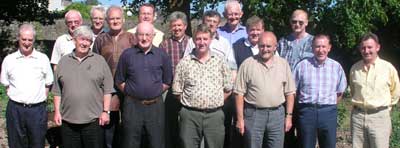
The principal celebrant was Fr Tom Curran SMA, the Communications Director of the Irish Province. The following is the text of the homily he preached at the Mass.

FOUNDER’S DAY HOMILY: 25/06/05

This day, June 25 2005, marks the 146th anniversary of the death of the Founder of SMA. We have come together for this Eucharistic celebration to commemorate the death of the Bishop, Melchior Marie-Joseph de Marion Bresillac. His death coming just 2½ years after he founded the Society was an event of immense significance.

This day is a challenge to us:
– It raises the question about who we are as members of the SMA
– it challenges us to examine the significance of Freetown and its impact on SMA.

December 8 1856, as Brésillac and his companions came together at the shrine of Our Lady at Fourvieres in Lyon, was a profound moment for the history of the missionary movement in modern times. What was inaugurated there was to make an immense contribution to the development “spiritual and material” of Africa and her peoples. This is because, and we should have no doubt about it, the SMA has had a deep impact on Africa and has and is continuing to set its mark on the continent to which Bresillac and his followers were to dedicate their lives, their energies and their service.

Just two years after the Society was launched the first SMA missionaries arrived in Africa, at Freetown, Sierra Leone, at the heart of the Apostolic Vicariate entrusted to Bishop de Marion Bresillac. These two years had been spent publicising the new Society, setting up the seminary, fund-raising and making preparations for taking on the missionary work in Africa. Within two months of the arrival of Frs Louis Reymond and Jean-Baptiste Bresson and Brother Eugene, Bresillac himself set off to join them on mission in the company of Fr Louis Riocreux and Br Gratien Monnoyeur. On 14 May they reached Freetown. It was the fulfilment of his deep felt longing to continue the missionary apostolate he had had to abandon in India.

The town of Freetown was engulfed by an epidemic of yellow-fever. Despite the urging of the ship’s captain not to, Bresillac went ashore to meet his confreres.
Why wasn’t he more sensible?
Why did he have to go ashore into the disease-ridden land?
Why did he take what, in hindsight, many would see as the foolish option?

To attempt to answer these questions might prove futile. But he must have been motivated by his missionary commitment and his desire to go amongst his abandoned people in their hour of need. He most certainly may have been motivated by the pledges he himself had made on retreat earlier. These would be the guiding principles of his missionary life.

  • “To be a missionary from the depths of my heart”.
  • “To neglect nothing that might advance the work of God”.
  • “To seize every opportunity to preach the Gospel”.
  • “Finally, and it is for this that I especially implore Your blessing, O my God, to use all my strength, all my study and make every possible effort to contribute to the formation of an indigenous clergy”.

His earlier experience in India would have enriched the Founder in the missionary apostolate but would also have sharpened his own ideas about what the missionary ought to be engaged in. Of particular significance is his own reflection on the method of Jesus in coming first to the locals, the children of Israel. So Brésillac became deeply committed to the establishment of the indigenous clergy, first of all in India and then, later, this was to become a major part of his vision for the new society he founded.

If the formation of the indigenous clergy was to be a fundamental aspect of mission policy, the second aspect was his own commitment to reach out to the most abandoned giving rise to the SMA prioritising Primary Evangelisation as one of its principal targets.

These two aspects of the missionary apostolate were what shaped his attitude and determined his vision. They also were to determine the vision of SMA up to this very day.

  • The commitment to be involved in the local church ensuring it would be developed and managed by its own people
  • And the commitment to the most abandoned peoples of Africa

were to be enshrined in our policy-making and to be the basis for our SMA mission location and apostolate.

Today’s Gospel account describes Jesus commissioning his disciples – “Go out to the whole world, proclaim the Good News to all creation”

Melchior de Marion Bresillac’s love for the continent to which he was to dedicate the work of the Society was to inspire and compel him to go ashore to be with the people he had come to serve” even if around him the advice he was given would have suggested staying safely on board ship.

It was the culmination of all his work over the previous decade’s for resources, for recruitment, for animation about mission. Now at last he had come to Africa, to his people, to his territorial see” And go ashore he must and he did. He was going to proclaim the Good News to the people entrusted to him.

And we know the rest. Fr Riocreux became ill and after a few days of fever he died on 2 June, aged 27. Meanwhile Fr Bresson too became ill and died on 5 June, aged 47. When Br Gratien became ill, Brésillac was already beginning to see the tragic end to his mission in Sierra Leone and even spoke about moving the mission further along the coast to Dahomey. When Gratien died on 13 June at the age of 29, Brother Eugene was sent back to France. By then Bresillac himself had become ill and though he seemed to respond to some medical treatment and to hold out hope of recovery, his condition deteriorated a few days later and by then Fr Reymond too was ill. Bishop Brésillac died on 25 June at the age of 46, and Fr Reymond three days later aged 36. A French trader was present as the bishop died and he recorded the final moments including the spoken words of the Founder “Faith, hope” and the uncompleted word “Charity” and finally his very last words – and not insignificant – “Thank you”.

The sacrifice that was to be so much a part of the SMA for the next fifty years had begun. That sacrifice at Freetown was to motivate and inspire men and later women to continue to come to Africa to fulfil the mission command of Jesus. What ended tragically in Freetown was to mark the beginning of a new phase of evangelisation that brought the message of Jesus Christ to the notorious West Coast of Africa and in time over the next 150 years to many other parts of that vast continent.

Today we look back and recall and remember. We remember the price that has been paid, we remember the generosity of so many of our confreres who have gone before us showing us an example and inspiring us not to spare ourselves in the service of God and in the bringing of the Good News to people who have not yet heard it. That work, that vision continues today. We ought to take pride in being part of it. And, for the privilege it is for us to be part of it, we too could make as our own message to God the very last words of Bishop Melchior de Marion Brésillac: “Thank You”.

[Fr Tom Curran sma]

Foundation and Early History

The Beginnings of the Society of African Missions

Invitation to Found a Missionary Society

In February 1856, Cardinal Alessandro Barnabo, the Secretary of the Sacred Congregation of Propaganda Fide asked Mgr de Marion Brésillac to found a missionary congregation to assist him in his new work in West Africa and to ensure stability and continuity.

On 8 December 1856, on the hill of Fourviere – at the shrine dedicated to Our Lady in Lyons, France, Bishop de Brésillac and six companions established the Society of African Missions. The special aim of the new Society was the evangelization of the most abandoned people in Africa and the formation of an indigenous clergy to care for the newly-established communities – thus enabling the missionaries to move on to evangelize others who were still in need.

Missionary Assignment in Africa

In 1858 Rome entrusted the mission of Sierra Leone to the SMA and in the same year, the first three missionaries departed for their new mission.

In 1859 Mgr de Bresillac entrusted the SMA in Europe to Fr Augustine Planque and set out with two others to join his three confreres in Sierra Leone.

Deaths in Freetown

On arriving off Freetown they were advised not to go on shore as an epidemic of Yellow Fever was raging in the town, but wanting to be with his missionaries and flock, the bishop and the others disembarked. Twenty-six days later, all the missionaries were dead with the exception of one Brother who returned to France to deliver the sad news.

Despite such a harrowing loss, the work was destined to continue, and, with the blessing of Pope Pius IX (“God be praised! The work will live. Yes, it will live!”) and the direction of Fr Planque, a new beginning was made. Another group left for Africa in 1861 and a foundation was made in Dahomey (now Benin Republic).

Numerous deaths of young priests marked these early years of the Society, yet still it spread quickly throughout the West Coast of Africa. “The first missionaries sent to the people of Africa will not be able to achieve their ends, but thanks to their sacrifice, they will sow an abundant harvest which their successors will reap”, wrote one of those early missionaries. By the time of Fr Planque’s death in 1907, there were 296 members, 205 of whom were on the missions in 8 African countries: Dahomey (Benin), Nigeria, Algeria, South Africa, Egypt, Gold Coast (Ghana), Ivory Coast and Liberia. At this stage more than 130 others had given their lives within a few short years of reaching African soil, then known as the “white man’s grave”.

Expansion of SMA (up to 1992)

From the beginning, the SMA drew its membership from several countries from which, after the death of Fr Planque, the following Provinces were gradually formed in Ireland (1912), Holland (1923), two in France: Lyons and Est (1927), USA (1941), Great Britain (1968), Italy (1982), and the Districts of Canada (1968) and Spain (1992).

Between 1918 and 1992 the Society had also spread to Togo, Niger, DR Congo, Zambia, Central African Republic, Tanzania, South Africa, Kenya and Angola. It also opened houses in Australia and Argentina.

New Developments

Since 1983 new foundations have been made to ensure that the missionary work of the SMA to Africa and African peoples will continue. These have been in many counties in Africa, in Poland and in Asia both in India and the Philippines.

Down through the years the SMA has sought to remain faithful to the spirit of its Founder, constantly adapting itself to new situations, and “always ready to respond to the needs of the times”. At the same time we remain a community of Christ’s disciples bonded together by our common response to the command He has given us:

Go therefore, make disciples of all nations;
baptise them in the name of the Father,
and of the Son and of the Holy Spirit
– (Mt. 28:19)

Extraordinary Provincial Council 2004

EXTRAORDINARY PROVINCIAL COUNCIL (EPC) 2004

15 Members of the Irish Province have completed their meeting in Cork. They included the Provincial Council, Irish Regional Superiors from Africa, representatives of the other countries in Africa where Irish SMA members work and delegates from Britain and Ireland. They were members of what is called the Extraordinary Provincial Council (EPC). The EPC is usually held twice during the six years between Provincial Assemblies.

The 2004 EPC was significant because it marked the half way stage between Assemblies and therefore provided an opportunity to review what has been happening to the various decisions and targets set by the Provincial Assembly in all the areas where members are working.

Opening the EPC 2004 on 16 June, the Provincial Superior referred to it as “another milestone in the history of the Province and an opportunity for renewal and rededication to the apostolate of the SMA”.

For the second week the Superior General, Fr Kieran O’Reilly, attended the meeting.

The EPC concluded on 23 June.


Front (left to right): Fathers Hugh Harkin (Secretary), Gerry Murray (Ireland), John Brown (Britain), Fachtna O’Driscoll (Provincial Superior), John Horgan (Vice-Provincial), Seamus Nohilly (Provincial Councillor), Padraic Devine (Kenya).
Back: Fathers Fergus Conlon (Zambia), Joe Egan (Ireland), Maurice Henry (Nigeria North), Paddy O’Rourke (Tanzania), Eamonn Finnegan (Provincial Councillor), Martin O’Farrell (Ireland), Tim Cullinane (Nigeria South), John Kilcoyne (South Africa),
Colman Nilan (Ghana).


Fr John Kilcoyne reads Gospel


Fr Fachtna O’Driscoll preaches
at Opening Mass

Embulbul Parish Projects in Kenya

SMA PARISH – EMBULBUL, DIOCESE OF NGONG, KENYA

The SMA parish of Embulbul, where Fr Con Murphy SMA is working, we have received appeals for two different projects. Your contribution is sure to help us.

The Vincent de Paul Society

A Conference of the St. Vincent de Paul Society was established in 2006 by Fr. C. Murphy SMA, assisted by Sr. Alice Daly, Daughters of Charity of St. Vincent de Paul.

The aim of this rather small conference is to respond to situations of extreme poverty that exist locally. This involves visiting the poor and the sick in their homes and in hospitals; praying with them and for them; communicating interest in and concern for their situation and giving whatever material help that is possible within the Conference’s limited resources.

The principal needs of those seeking help are food, medicine and clothing as well as school fees and house rent.

The local community is by no means rich but the people are quite generous with donations of clothes and food. For financial assistance, however, the Conference is largely dependent on overseas donors.
During the month of December ’08 the Conference spent 25,000.00 Kenya shillings (£ 250) on food, medicine and some essential household furnishings. Christmas food was supplied to 30 families and roughly 70 people were given clothing donated by parishioners.
In the village many people are unemployed and many earn less than 200 Kenya shillings per day (£ 2)

Any assistance for their project will be greatly appreciated.

Fr. Con Murphy – Assistant Priest
——————————————————————————–

                                
THE GOOD SAMARITAN PROJECT

This project is under the direction of the Parish priest of Embulbul and its aim is to provide practical assistance for those in the locality who are HIV positive and practically for children who are affected by the AIDS pandemic. Some of these children who are affected by the disease and many others have lost one or both parents.

Help for the children are provided especially through meeting their educational needs. The project attempts to:

a)    Pay school fees
b)    Provide school uniforms and text books
c)    Pay medical expenses.

A special feeding programme provides food for 140 children for three times weekly.

Also, a small group of adults about 123 – are given opportunity to participate in a self help programme which involves the working and the selling of articles of clothing as well as the manufacture of African ornaments and articles of jewelry for sale to tourists.

The annual budget for the project is roughly $ 25,000.00.

Any contribution will be deeply appreciated.

Fr. Fabian Hevi SMA – Parish Priest
Fr. Con Murphy SMA – Assistant

Democratic Republic of the Congo

SMA involvement in DRC:

There are 6 SMA priests working in the DRC.

Regional Superior: Fr Séraphin Kiosi SMA (Great Lakes DF – DR Congo)
Vice Regional Superior: Fr Jean-Marie Lamotte SMA (Lyons Province)

Area: 2,345,000 sq km
Population: 56.6 million.
Population Growth Rate: 2.9%
Capital: Kinshasa
Head of State: President Joseph Kabila
Independence: 30 June 1960
Ethnic Groups: More than 200 groups – Mongo, Luba, Kongo (all Bantu) and Mangbetu-Azande (Hamitic) make up about 45% of the population.
Religions: Catholic 50%, Protestant 20%, Kimbanguist 10%, Muslim 10%, indigenous beliefs 10%


SilverJubilee Fergus Tuohy

Silver Jubilee celebrated

Dromantine was the location for the Silver Jubilee Celebration of Fr Fergus Tuohy SMA which was held on 7 July 2006.

Fr Fergus was ordained to the priesthood on 13 June 1981 in Cork. He was first assigned to the Docese of Jos (Nigeria) and when the Vicariate of Bauchi was created in 1996, Fergus moved there. His missionary career has been divided between educatain and pastoral activities.

About 50 SMA members joined in the celebration of the Jubilee Mass. The homily was preached by Fr Aodh¡n McCrystal SMA. The Provincial Superior, Fr Fachtna O’Driscoll SMA, paid tribute to Fergus and his work at a function that followed the Mass and made a suitable presentation to him.

Lodwar Diocese

Lodwar Diocese

The Prefecture Apostolic of Lodwar was erected on 11 January 1968 with territory taken from the Diocese of Eldoret. The Prefecture was elevated to a Diocese on 30 January 1978. The Diocese is a suffragen diocese of the Archdiocese of Kisumu. The Diocese of Lodwar is located in the North-Western part of Kenya and is bordered on the north by Sudan, to the west by Uganda, to the east by Lake Turkana.

Area: 77,000km2

The First bishop was: John Christopher Mahon SPS who was appointed on 16 Jan 1968 and retired on 17 February 2000. His successor is the current Bishop, Patrick Joseph Harrington SMA appointed on 17 Febuary 2000.

Bishop

Rt Rev Patrick Harrington SMA
PO Box 101
30500 LODWAR
Kenya.

Tel: (054) 21.05.5
Fax: (054) 21.41.7
E-Mail: [email protected]

Links:
Bethany House

Diamond Jubilee Celebrations

SMA Diamond Jubilee Celebrations – 1943-2003

On 19 December 1943 twelve SMA missionary priests were ordained in St Colman’s Cathedal, Newry. Over the past sixty years, ten of these men passed to their heavenly reward: Fathers Hugh Conlon (Cork), Michael J Conway (Tuam), John Moorhead (Meath), Thomas Lennon (Kildare & Leighlin), Martin Whyte (Achonry), Gerard Scanlon (Killaloe), John Browne (Kerry), Michael Maughan (Tuam), Patrick Fitzsimmons (Dublin) and Patrick J Clancy (Limerick).

James McCarthy cuts cake with Sr ColumbaTwo of the class of 1943, Fathers James McCarthy (Cork) and Owen Maginn (Down & Connor) celebrated the Diamond Jubilee of their ordination on Friday, 19 December 2003.

Celebration in Cork
Fr James McCarthy served for most of his missionary career in the Archdiocese of Lagos, Nigeria where he was highly regarded for his work in the field of education before assuming the pastoral care of the people in the parishes of Falomo and Lafiagi in the great metropolis of Lagos. His contribution to education in Nigeria saw him give service in Oyo, Abeokuta and finally in St Gregory’s College in Lagos. For a number of years between his time in education and his time in parish work he served the Irish Province of the SMA as Vice-Provincial and as Provincial Councillor. He is now in retirement in Blackrock Road where the Jubilee was fittingly celebrated with Mass and a reception on 19 December.

Fr Owen McGinn with Vice-Provincial Fr John HorganCelebration in Zambia
Fr Owen Maginn’s sixty years as a missionary priest saw him give service in Egypt and Zambia. Having just returned to Zambia after a brief visit to Ireland, he celebrated his Jubilee in Ndola, Zambia amongst the SMA members working in the mission.

Fr Fergus Conlon SMA, Regional Superior in Zambia writes: “We had a beautiful celebration of Owens Diamond anniversary on Friday 19th December here in SMA Regional House. At first he wanted SMA’s only – something small. But after gentle persuasion he gave us names of those who he was close to. About 50 turned up – as one Sister remarked at the mixture “they were old and young, of many different nationalities, lay and various congregations of religious, sisters and priests and diocesan … a very representative turn out and a tribute to the high esteem in which Owen is held in the diocese. The Chief celebrant was Fr Owen himself … he was at his brilliant best. Flanked by Fr Patrick Chilambwe, Diocesan Administrator of Ndola Diocese, and Fr Secky Doran SMA who was celebrating 40 years of missionary priesthood … between these two East Down stalwarts Owen and Secky, 100 years of Missionary priestly service. The Mass was followed by speeches … from anybody that wanted to … some were very humourous but all ended in an appreciation of how Owen had helped them and was there for them at some important time in their life and family … followed by drinks and dinner … A recurring theme was the witness of Owen’s spirituality, acceptance, fidelity and good humour.”

Ad Multos Annos

Cois Tine 2012

Cois Tine 2012


Mission statement

Rooted in the call of the Gospel to welcome the stranger, Cois Tine addresses the pastoral, spiritual and social needs of the immigrant community.


Cois Tine is an outreach project of the Society of African Missions [with the support of other religious congregations and the local Church] towards the pastoral care of immigrants, mainly in Cork city and county. but a major focus will be on the members of the African community. Cois Tine’s remit is purely a pastoral / religious one. It does not address the political, legal or physical health dimensions of immigrant life, and deals with the social, cultural and mental health dimensions only in so far as they pertain to the pastoral / religious.

This outreach to immigrants has a broad ecumenical orientation but a primary Roman Catholic focus. All immigrants will be catered for.

Management Structure:
Cois Tine is one segment of the outreach programme of the SMA JPIC Desk. It is answerable to the Director of the JPIC Desk and ultimately accountable to the SMA Provincial Council.


Cois Tine,
St Mary’s Pope’s Quay
Cork.
Tel: 021-4557760
Email: [email protected].

Cois Tine staff:
SMA Justice & Peace Director: Fr Angelo Lafferty SMA
(087-6898159)

Administration: Gerry Forde, SMA Justice Office, African Missions, Wilton, Cork
(021 4933475)

Committee member: Fr Kevin Kiernan OFMCap


Directions:
Cois Tine is situated behind St Mary’s Church. Access is via Ferry Hill on the left of the Church… go to the top of Ferry Hill and the entrance to Cois Tine is on the right hand side.

For more information go to this link  www.coistine.ie

A POLICY FOR COIS TINE

COIS TINE –
Acknowledges the validity of cultural differences
Honours the uniqueness and dignity of each person
Welcomes the stranger in an environment that is safe and inclusive
Fosters the growth of an environment of hope, safety and mutuality
Accepts, appreciates and respects diverse spiritualities
Encourages and enables the contribution of the stranger within an inclusive and cultural context
Celebrates unity and diversity

Cause of the Founder

SMA Founder

Melchior De Marion Brésillac (1813-1859)
– Founder of the SMA

SMA FounderA life totally consecrated to the Missions
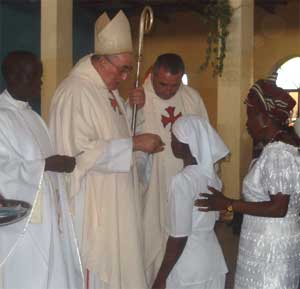
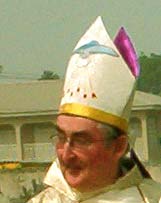
  • 2 December 1813: Born in Castelnaudary, Carcassonne, France.
  • December 1838: Ordained priest.
  • 1838-1841: Curate in Castelnaudary.
  • 1841: Joined Paris Foreign Mission Society.
  • 1842: Pondicherry, India; Curate at Salem;
    Superior, Minor Seminary of Pondicherry.
  • 1846: Ordained Bishop (Pro-Vicar and, later, Vicar Apostolic of Coimbatore, with the title of Bishop of Pruse).
  • 1855: Resignation and return to Rome.
  • January 1856: Volunteered to work in Dahomey: On 15 January Mgr de Brésillac wrote: “The Sacred Congregation would be pleased to see me opening this new mission; but it does not want me to go alone; they want me to found a Society of missionaries for this work.” From that moment he set out with all his energy to achieve that purpose.
  • 8 December 1856:
    The Society of African Missions was officially founded in Lyons, France.
  • 1858: SMA given responsiblity for the new Vicariate Apostolic of Sierra Leone. Two priests and a brother sent out for that mission.
  • 14 May 1859: Accompanied by two more missionaries, Mgr de Brésillac arrived in Freetown to join them. Yellow Fever epidemic was raging in Freetown.
  • 25 June 1859: He died as a result of that fever – six weeks after his arrival in Africa.

Since January 1928, his mortal remains are interred in the chapel of the Society of African Missions [SMA] in Lyons. The Cause for his Canonisation has been introduced and investigations are underway as well as the writing of a comprehensive account of his life, virtues and vocation.

Prayer for the Canonisation of
Bishop Melchior de Marion Brésillac

Lord God, you called Melchior de Marion Brésillac to serve you.
To make you known and loved you sent him to India and then to Africa.
For you, he gave everything, even his very life.
So that his life and teaching may inspire a missionary commitment in Christians today, we trust that the Church will recognize the holiness of this great servant of mission and that by his intercession we will receive the graces of which we have need (namely…)
We ask this through Jesus Christ our Lord. Amen.
[with Ecclesiastical approval]

Those persons who wish to make known graces or favours received through the intercession of the Servant of God are asked to write directly to the following address:
Rev Fr Postulator SMA
Missioni Africane
Via della Nocetta 111
00164 ROMA
ITALY
Fax number: +39-06-66 16 84 90

Email: postulator @ smaroma.org

Biography of Bishop Kelly

BISHOP KELLY OF WESTERN NIGERIAby Michael O’Shea SMA

LAUNCH OF BIOGRAPHY

A Co Galway-born bishop, who spent 70 years as a priest of the Society of African Missions, has been honoured in a new book on his life and work that was launched in his home-town of Ballinsloe on Friday 25 August 2006.

The Book, entitled Bishop Kelly of Western Nigeria, was launched by Archbishop Joseph Cassidy (retired Archbishop of Tuam) at a special function at Gullane’s Hotel, Ballinasloe. The attendance included many church leaders from Ireland and Nigeria.

Mgr Patrick Joseph Kelly, a member of the Society of African Missions (SMA), made a huge contribution to Nigerian society in terms of evangelization, education, and medical services.

Born in Craugh in 1894, he went to primary school in Aughrim and then to “The Pines”, now St Joseph’s, Garbally. The eldest son, he shelved a priestly vocation for some years to help on the family’s new farm acquired from the Land Commission at Tristaun.

When his younger brothers were old enough to take over, he went to the African Missions College in Cork. Beginning his studies in 1915, he was ordained a priest of the Society in 1921 and sailed for Africa.

His mission lay in the Irish Province’s new Vicariate of ‘Western Nigeria’. With the help of a French missionary he quickly learned to survive and, after some time, in his first mission of Eku, where he was alone, he proved to be an excellent pastor with a particular concern for the sick and dying.

A fluent Irish speaker he made great progress in learning the local African languages and spoke all of the major ones of his district. Though quiet and even shy, he was well liked by the Urhobos and others, who quickly discerned that he was a man out of the ordinary, a true man of God, who had their interests at heart.

Appreciated by his fellow missionaries, he was appointed their Religious Superior in 1931 and, in 1939, nominated Vicar Apostolic of Western Nigeria. Home on leave the following year, he was ordained bishop in St Michael’s, Ballinasloe, by Msgr Dignan, the bishop of Clonfert.

Bishop Kelly put God first in everything, but did not leave everything to Him. He was particularly committed to education and, building on his predecessors’ achievements, developed a network of some 700 primary schools and over 90 secondary schools, as well as teacher training colleges and seminaries.

Under him Church membership grew from about 30,000 in 1940 to over 180,000. He retired from his diocese, “Benin City”, in 1973, and died in Cork just two weeks short of his ninety-seventh birthday in August 1991.

The author, Fr Michael O’Shea SMA, is a missionary in Zambia and has already published two books on mission: Missionaries and Miners, The beginnings of the Church in Zambia, and Mission or Martyrdom, the Spirituality of Melchior de Marion Brésillac and the Society of African Missions.

The book is available at a cost of euro 10 or euro 12 (including p&p). For further information, please contact Fr John Horgan SMA, African Missions, Blackrock Road, Cork. Telephone: 021-4292871.

Diocese of Bauchi

bishop-john-moore-sma

Bishop John Moore SMA

bishop-john-moore-smaBorn 12 January 1942
Ordained priest in the Society of African Missions on 20 December 1965
Appointed Vicar Apostolic of Bauchi, Nigeria and Titular Bishop of Gigthi on 5 July 1996
Ordained as Titular Bishop of Gigthi on 7 November 1996
Appointed First Bishop of Diocese of Bauchi on 31 December 2003
Installed as First Bishop of Bauchi on 11 March 2004


Died in Dublin, Ireland on 20 January 2010, aged 68 years.

The Diocese of Bauchi was established on 31 December 2003 and formally inaugurated on 11 March 2004 in a ceremony that included the installation of Bishop John Moore as Bishop of the new Diocese. The Archdiocese of St Andrew’s and Edinburgh, which had association with Bauchi for many years, was represented at the ceremony. The Irish Province of SMA, of which Bishop Moore was a member, was also represented.

The new Diocese was formerly the Vicariate Apostolic of Bauchi, erected in 1996, created from territory of the Archdiocese of Jos, an area in excess of 64,000 square kilometres (the island of Ireland is 70,273 sq kms).

Bishop Moore administers confirmation at St Joseph the Worker Church, Yelwa assisted by Parish Priest, Fr Fergus Tuohy SMA, (right) and assistant Pastor, Fr Benedict Dogo.

The initial evangelisation of the Bauchi area was by SMA missionaries in the 1950s. However, from late 1963 the further development of the church there was the responsibilty of volunteer priests of the Archdiocese of St Andrew’s and Edinburgh, Scotland, as a response to the earlier plea of the Pope for churches to help in missionary work. Scottish priests continued to minister in Bauchi until 1986.

Some facts about the Diocese of Bauchi:

  • 22 parishes.
  • 29 indigenous diocesan priests, 3 diocesan priests on loan from neighbouring dioceses, 4 SPS missionaries and 5 SMA missionaries.
  • Three religious congregations provide 9 sisters – Holy Child Sisters (4), Sisters of Our Lady of Apostles (4) and St Louis Sisters (1).
  • There are 4 Presentation Brothers teaching in Tafawa Balewa.
  • 22 seminarians training for the priesthood.
  • About 68,000 Catholics in a total population of about 5.5 million.

Medical
Three Primary Health clinics: Gambar and Billiri both managed by the Diocese and Tafawa Balewa managed by OLA Sisters.

Education
Immaculate Conception Secondary School, Bauchi – Fr Fergus Tuohy SMA is the Director.  There is a Remedial School attached that prepares weaker students from the rural areas for entrance to secondary school.
Presentation Brothers Secondary School, Tafawa Balewa is run by the Presentation Brothers.
St James’ Secondary School, Gombe

There are 2 Nursery and 10 Primary schools throughout the diocese.

Bauchi Youth Centre trains Youth leaders etc. It is administered by the Kiltegan missionaries and their lay staff.

Catechetics
Gambar Catechetical Institute trains catechists for Bauchi and other dioceses in the country.  There are 80 trained catechists working throughout the diocese.

Diocesan Structures
There are Communications, Education, Health, Justice & Peace, Pastoral Commissions functioning in the diocese. These link to and work in conjuction with the Commissions set up by the Hierarchy in the Jos Ecclesiastical Province.

Seminarians
22 Seminarians are at various stages of their studies for the priesthood, providing great hope for the future development of the Church there.
20 attend St Augustine’s Major Seminary, Jos.
2 attend the Spiritual Year programme in Yola diocese.

SMA Missionaries in Bauchi (March 2011)
Fr John Keane – British Province – Vicar General and pastoral
Fr Peter Makasa – Great Lakes District-in-formation – pastoral
Fr (Dr) Alberto Olivoni – Irish Province – pastoral and medical apostolate
Fr Premraju Kasapogu – Indian District-in-formation – pastoral

Bauchi becomes a diocese

Bauchi Vicariate elevated to rank of Diocese: Dubliner, Bishop John Moore SMA, First Bishop

Vatican City (Fides Service) – The Holy Father, Pope John Paul II, on 12th December 2003, elevated the Apostolic Vicariate of Bauchi (Nigeria) to the rank of Diocese making it suffragan of the Metropolitan Archdiocese of Jos.

The Holy Father appointed Mgr John Moore SMA, titular Bishop of Gigti and until then Apostolic Vicar of Bauchi, as first Bishop of Bauchi.
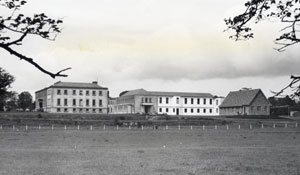
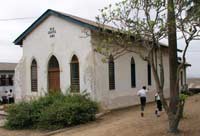
“The new diocese of Bauchi comprises the territory of the former Apostolic Vicariate. It will have an area of 64,605 sq km, a population of 5,550,000 of whom 68,000 are Catholics gathered in 12 parishes assisted by 23 priests (15 diocesan and fidei donum and 8 Religious); 6 women religious, about 50 full time catechists and 31 major seminarians. The new bishop will have his See at the house in Yandoka Road in the outskirts of Bauchi and St John the Evangelist Church will be the cathedral.” – (Fides Service 7/1/2004)

Bishop Moore, from Dublin, studied at the SMA Seminary in Dromantine and was ordained in Newry, Co Down in 1965. He has been involved in pastoral work in Nigeria ever since.

The new Diocese of Bauchi was formally inaugurated on 11 March 2004 when Bishop Moore was installed as the First Bishop of Bauchi.

Ballinafad Centenary

Ballinafad College

SACRED HEART COLLEGE, BALLINAFAD – CENTENARY

Ballinafad College

Ballinafad House in the heart of Co Mayo was given to the SMA by Llewellyn Count Blake in May 1908.  In September 1908 the Society of African Missions opened the house to accomodate students preparing for the missionary priesthood as a Secondary school or Minor Seminary.  It was named Sacred Heart College. 

Centenary Celebrations Photographs here

September 2008 marked 100 years since the opening of the College.

The Centenary was celebrated on Friday, 26 September, at Mayo Abbey, Co Mayo. The celebration included Mass in Mayo Abbey Parish Church. The main celebrant was Fr John Dunne SMA, Vice Provincial, who was joined by the Parish Priest of Mayo Abbey, Fr Austin Fergus, and a number of SMA missionaries. The large congregation included former teachers, students and workers of the College.

The homily was preached by Fr John Horgan SMA, a former teacher at the College. Full text of the homily here…

Refreshments and a Social Night in Mayo Abbey Parish Hall followed providing an opportunity to renew friendships from the past.  It was a Great Night of memories and meeting old friends and of music and dance. 

Ibadan Archdiocese

History
The little mud church built on the commanding site of Oke-Are in 1900 by the early Catholic Missionaries still remains. For more than eighty years it has stood sentinel over the ever growing city of Ibadan. It has witnessed the city’s progress through the years of colonial rule to the new era of independence and modernisation, to become first a regional and then a state capital. From humble beginnings in Oke-Are the Catholic Church has grown with the city to become one of its prominent religious institutions. The little church on Oke-Are is rightly regarded as the cradle of the Catholic faith in Ibadan area and the foundation stone of the Catholic Diocese of Ibadan. In 1907, wishing to be closer to the masses of the people, the SMA Fathers came down from Oke-Are and acquired a second site at Ogunpa where they built the second Catholic Church. The place soon became known as Oke-Padre, the Hill of the Fathers. Under the zealous leadership of Rev Fr Louis Friess, who was in charge from 1907 until his death in 1927, Oke-Padre became the centre of missionary activity for the whole of Ibadan and its environs.

At the middle of the 19th century, Ibadan Catholic Mission was still part of the vast Diocese of Lagos. In 1952, however, it was considered strong enough to exist on its own as a Prefecture Apostolic or “pre-diocese”. The one chosen to head the new jurisdiction was Monsignor Richard Finn SMA. Six years later, in 1958, the Catholic Church in Ibadan reached the final stage of its formation when it was raised to the status of a Diocese with Mgr Finn as its first Bishop. By then a number of parishes had been established alongside that of Oke-Padre. They included St Cyprian’s, Oke-Ofa, St Joseph’s, Oke-Ado and Holy Cross, Ikire.

On the July 4, 1971, Msgr Felix Alaba Job was consecrated Auxilliary Bishop of Ibadan. On December 12, 1974, he took over from Bishop Finn as the new Bishop of Ibadan.

In 1994, Pope John Paul II raised Ibadan Diocese to the status of an Archdiocese with Most Rev Dr Alaba Job as the first Archbishop of Ibadan. Ibadan cecame the seat of Ibadan Ecclesiastical Province with the Dioceses of Oyo, Ekiti, Ondo and Osogbo as suffragans.

African Synod 2009


What is a SYNOD?

[From Greek synodus, an assembly].  Generally, a Synod is an ecclesiastical gathering for discussion of matters relating to faith, morals or discipline. It can be held at local diocesan level under the bishop of the diocese or at international level when all the bishops of the Church assemble together for a General Council of the Church.  The Pope may also convene a Synod of bishops and other advisors from a particular region or to discuss the situation in a particular region.  The African Synod is such.

Has there been an African Synod before?

The 1994 Special Assembly for Africa of the Synod of Bishops took place from 10 April until 8 May, with the theme: “The Church in Africa towards the Third Millennium”. That Synod addressed the many and varied issues affecting the Church in Africa – Evangelisation, Inculturation, Dialogue with traditional religion, with Islam and with other Christians, the Christian Family, Jutice and Peace, Refugees, AIDS, Development, Social Communications, Seminary and Religious Formation, Education, Priests, Religious, Catechists, Lay Missionaries, Women and Youth.  The Synod was made up of Holy Father with 35 Cardinals, one Patriarch, 39 Archbishops, 146 Bishops and 90 Priests.  The full message of the 1994 Synod here…

Who attends the Synod?

All the Episcopal Conferences in Africa send delegates.  The Pope appoints some cardinals, bishops, priests, religious and lay people with particular interests or who may have a particular contribution to make as delegates, experts, auditors and advisors.

The African Synod (2009)

The Second Special Assembly for Africa, popularly known as the Second African Synod of Bishops, took place in Rome from 4 – 25 October 2009. The theme of the Synod was “The Church in Africa in service to reconciliation, justice, and peace:  You are the salt of the earth… you are the light of the world.”

Official Opening: The Homily of Pope Benedict XVI can be viewed here and sets the tone for the Synod.

Some Resources:

The AFJN (Africa Faith and Justice Network)
presents some material on the preparations for the Synod here….

The Launching of the Synod Preparation Paper:
by Pope Benedict XVI at Yaounde, Cameroon: Report here…

SMA Presence at the 2009 Synod of Bishops:

Fr Kieran O’Reilly SMA, Superior General represented the Superiors General of Societies of Apostolic Life. Fr O’Reilly’s intervention is here…

Archbishop Michel Cartateguy SMA, Archbishop of Niamey, Niger

AEFJN Justice and Peace

Justice and Peace Issues

AEFJN – the Africa-Europe Faith and Justice Network

The AEFJN is a faith-based international network mandated by 48 Catholic Religious and Missionary Institutes working in Europe and Africa. Founded in 1988 it promotes fair economic relations between Africa and Europe.

AEFJN is directed by an Executive Committee, elected among the member Institutes of the network. An international secretariat, based in Brussels (Belgium), co-ordinates the activities of the network, does advocacy work and lobbies the European Institutions on issues affecting Africa.

Groups of Religious in African and European Countries, known as AEFJN antennae, represent its concerns on national level, while a contact person in each of the member Institutes’ administrations, integrates its objectives in the JPIC programmes of the Institutes.

The AEFJN ANTENNAE (national groups) create awareness among Christians and religious, do advocacy and lobby towards the national governments, on issues relevant to Africa.

more… click on Logo or http://www.aefjn.org

Irish Antenna of AEFJN: >>>here

Active Apostolate

SMA Active Apostolate

Fr Eddie Hartnett off to his outstation on the Lagoon in Badagry, Nigeria

The 150 year-old apostolate of SMA continues. 400 SMA members work in various apotolates in Africa today.
They work in sixteen countries and come from various countries reflecting the internationality of the Society. 85 of them are Irish.

Their work is in primary evangelisation and in development.

Their work is in the rapidly expanding urban apostolate of the big cities as well as in the traditional rural areas.

They care for the spiritual as well as the material needs of our less well-off brothers and sisters in Africa.

They live among

  • people in need of education, health and medical facilities;
  • people living in slums and overcrowded conditions;
  • people suffering from effects of drought and water shortage, famine, poverty;
  • people with HIV-AIDS and other diseases.

They need support for maintenence and transport, to build churches, schools, clinics, bridges and wells, to care for refugees, street-children, the homeless,


Founder’s Cause

This is a place holder for the Founder’s Cause page. Please edit this page.

Our Lady of the Rosary & St Patrick

Priests in the Parish
Fr Kevin Conway SMA PP
Fr Freddy Warner SMA CC

61 Blackhorse Road, Walthamstow, London E17 7AS

Parish Phone: (+44) 0208 520 3647


‘Handing on the baton’

A special celebratory Mass to say Goodbye to Fr Donal M O’Connor & Fr Tom McNamara and to welcome Fr John Browne & Fr Eddie Deeney to the parish was celebrated in Our Lady of the Rosary & St. Patrick Church, Walthamstow, London on Saturday, 27 January 2007.
Tributes were paid to the outgoing Parish Priest and the Assistant Pastor.
Warm words of welcome were extended to the new Parish Priest and the Assistant. The handing on of the baton was symbolised in the exchange of candles between the priests and the people. 


Fr Donie O’Connor SMA passes the light
to Fr John Brown SMA (left)


Concelebrants from left: Frs Brown,
O’Connor, McNamara and Deeney


Fr Brown (right) and Fr Deeney pass
on the light to parishioners present


Fr Brown (right) and Fr Deeney distribute
Holy Communion

In 2009 Fr Deeney was replaced by Fr Mariusz Rarak, a diocesan priest working in Association with the Polish branch of the SMA. Fr Mariusz was a missionary with the SMA working with the Pygmy peoples of Berberati, Central African Republic from 2003 to 2008.

Visit to Angola

A visit to the Italian SMA group in Angola

The SMA has just under 1,000 members, of which we Italians are about 40. Despite our small number we are to be found in six African countries and the island of Guadalupe. My visit to Angola was to strengthen the ‘family’ ties among us, to see the situation our five Italian SMA priests and to share information and ideas for the future strategic choices of the Province.

I arrived in Luanda on 21 January 2010 to meet with our priests there: Fathers Renzo Adorni, Luigino Frattin, Angelo Besenzoni, Walter Maccali and Ceferino Cainelli. We all know each other well down the years. It was a joy to meet friends and brothers. Of the 30kg in my luggage, apart from the specific things that had been requested, there were good Italian salami and a few bottles of grappa.

Experience has taught me that during such visits it is important to stay with every confrere in his place of work and spend time to speak individually with them. But this time, I had to stay in Kikolo, except for 3 days when I went with Fr Walter to visit his new parish in Nambuangongo, 200 kms north of Luanda.

Working with the most abandoned

Driven by the inspiration of our founder Bishop de Brésillac “to go to the most abandoned people” we Italian SMAs chose to begin mission work in Angola. Circumstances have brought us to the outskirts of Luanda, to the Kikolo district. This area is part of the ‘belt’ around Luanda in a semicircle from north to south: a collection of neighbourhoods that ‘grew up’ as hundreds of thousands of people fled the countryside for the city during the Angolan civil war.

More than half of Luanda’s estimated population of five million live in this ‘belt’. As in most major African cities, this suburb has significant social and economic difficulties. Kikolo lacks roads, sewers, clean drinking water, electricity, schools, hospitals and other health services. The population is a mix of people from all over the country. They are mostly young and almost all speak Portuguese.

The new communities

Frs Renzo, Luigino, Angelo and Ceferino live together in the Good Shepherd Parish in Kikolo. Also there is Fr Mario Cherchi, a ‘Fidei Donum’ priest from Sardinia. Soon, Fr Mario will move to a new parish in the neighbourhood. Fr Luigino is the veteran. He arrived when there was only a chapel here. He is also the Vicar General of the Diocese. But he is also an expert in cement, iron and construction projects. In ten years many Christian communities were born. Today they form three separate parishes with twelve chapels and many basic Christian communities. This urban ministry, for some, is more important than evangelisation in rural areas.

This ministry needs a lot of creativity, organizational skills and demands a lot of patience. The statistics are huge: hundreds of catechumens, thousands of school children in the parish, around 400 catechists and pastoral assistants. Yet practising Catholics represent about 3% of the population! Fr Angelo told me: “even if our chapels are full, we are still small in number. This morning I went to the market on foot, of the thousands who saw me only two people recognized me as “Father” and greeted me. If the objective of the SMA is to bring the gospel to the most neglected, Kikolo is the perfect place to do it.

Local Clergy

Fr Renzo Adorni spoke to me about the diocesan seminarians and how he is encouraging our parishioners to take care of the seminary needs. He feels a certain satisfaction and pride that, with God’s blessings and the commitment of the faithful in recent years, a local clergy is being born. The diocese has a Bishop and 18 priests, all either religious or missionaries. In April the first diocesan priest will be ordained. There are eight other seminarians studying theology. Our SMA confreres are very aware of the SMA charism to train the youth and develop a local clergy.

Where is your brother?

Our confreres try to make ‘neighbours’ of the most disadvantaged, especially in a spiritual sense. I was very impressed by the decision of Fr Walter, which the rest of the SMA group agreed with, to live in the parish of Nambuangongo. This village parish was ‘closed’ for 50 years after two wars: one against the Portuguese from 1960 to 1974 and the second between UNITA and the MPLA from 1976 to 2002.

I stayed with Walter in his very simple house. An annex serves as a hall and church. There is neither electricity nor drinking water, no telephone network, no mobile phones. To get there from Caxito you must travel 150 Kms, over trails, streams and cross rivers. But Walter is happy to live there sharing the simple life of the farmers, who for many years saw no priest. He spends a lot of time visiting the sick, especially the elderly, who are often stay shut away in their rooms without treatment. A Benin proverb says: “it’s the legs that create friendship.” I believe it from the days I spent with Fr Walter at Nambuangongo.

What particularly struck me during this visit? I arrived at Kikolo on 21 January and the day before it had rained. Although I was accustomed to see the unpleasant effects of rain on the outskirts of African cities, in Kikolo for the first time in many years in Africa, I experienced a real sense of deprivation, finding myself immersed in mud, dirt and garbage. And I admired the adaptability of Angelo, Ceferino, Luigino and Renzo who continue to visit this area.

The Youth

I also saw what Fr Ceferino is doing with the youth. He has managed to engage with and motivate a good number of them who, in turn, will be animators themselves. They have started writing and producing a beautifully illustrated journal entitled ‘Aldeia Juvenil’, Youth Village, with very interesting articles written by them. Hoping to get an interview, they organized a feast for the boys with Alice Berenguel, one of the most famous Angolan TV presenters. The mission courtyard was full with thousands of boys. The most interesting thing is that Ceferino has managed to bring both rural and urban youths together. This work is developing well. There are also many street children living in Kikolo. Ceferino has plans to launch a craft workshop where they will learn welding, carpentry and electrical works.

I was very impressed by the lifestyle of our SMA family; certainly we can still improve, but they are faithful to community prayer, friendship and brotherhood. Each SMA priest takes responsibility, on a weekly basis, to cook for the community. In this area I enjoyed their creativity and expertise!

Who will come to give a hand?

I extend a sincere thanks to all those who have worked and are working in Kikolo and the many people who support them. The work achieved over ten years is impressive. It will continue to be so, as there still remains a lot to be done. The needs are immense and the environment is favourable: there are people, many young people, full of energy available and eager to know the gospel. One must learn Portuguese to be able to work here. Our Italian SMA’s are hoping to get African or Indian SMA’s to join them. There is a great need for people who are interested and willing to work fulltime here. Integrating pastoral work and human development in Kikolo would be a beneficial experience for families and laity. Priests are willing to collaborate and share their life with them. Who will give a helping hand?

Fr Toni Porcellato SMA, Vice Provincial, SMA Feriole

SMA Formation – theory

SMA Formation has as its point of departure the life and experience of the individual

SMA Constitutions & Laws


At the heart of the SMA formation process is Jesus Christ.

Formation is a life-long process of conversion and growth, of attuning ourselves to the mind and heart of Jesus in our missionary commitment.

We seek

  • to respond to the Lord’s call…
  • to be true witnesses of Jesus…
  • to be Apostles…
  • and to be guided by the Spirit of God to be zealous and effective instruments of the mission entrusted to us as individuals and communities.

This means that our formation process must be centred on Christ and his Kingdom and make us ready to give our lives and commit ourselves to the objectives of Jesus: he lived, died and rose again for the transformation of human existence and to reveal in himself the limitless love of God.

The formation to become a true apostle is primarily the responsiblitly of the individual, each student, member of the SMA.

The goal is “forming missionaries to be dedicated Apostles of Christ“. This determines the shape of the entire formation process – personal and communitarian, spiritual, intellectual, and pastoral.

 Diaconate is the final step before ordination to priesthood

If you want to know more about becoming part of our SMA missionary family and please contact  the SMA House nearest you:

SMA Houses in Ireland

or email the SMA Communications Director: 
communications @ sma.ie

He will forwardHThis e-mail address is being protected from spambots. You need JavaScript enabled to view it Please provide some basic information about yourself – name, address, age, education, religious denomination, work experience etc. so that you can be put in contact with the correct person.


Feast of Dedication of Lateran Basilica 2008

Reflection for Feast of Dedication of the Lateran Basilica…


Readings for
Feast of Dedication of Basilica of St John Lareran
9 November 2008

Ezekiel 47:1-2,8-9,12 Psalm 45
1 Corinthians 3:9-11,16-17
John 2:13-22

A Temple not built by human hands…

The Basilica of St John Lateran is the cathedral of Rome and the official ecclesiastical seat of the Bishop of Rome who is the Pope.  It is the oldest and ranks first among the major basilicas in Rome.  It is named as “the Mother and the Head of all the churches of the City and of the World”.

It is built on the site previously occupied by two monasteries – one dedicated to St John the Evangelist and the other to St John the Baptist.  In ancient Rome the Laterani family had a palace there.  Hence the name.  The Basilica is in fact dedicated to The Most Holy Redeemer. Today’s feast honours that dedication.

This feast is rich in symbolic meaning for it seeks to express the unity of catholics throughout the world with their spiritual leader, the Vicar of Christ, the Pope.

Churches today, just like the Temple for the Israelites, are an expression of God’s presence among his people.  Of course the church in this sense is the people of God.  But the actual buildings help us to visualise God’s presence and express that presence among us.  In the Old Testament this was expressed in the time of Moses by the “tent of meeting” and later by the great Temple of Solomon in Jerusalem.  But always these temples and churches made by human hands are at the service of the temple not made by hands – God’s people.

– Fr Tom Curran sma
SMA Communications

Blackrock Road, Cork


Page created : Saturday, November 8th, 2008

Last modified: Saturday, November 8th, 2008

Mission Sunday Year 2008

Reflection for Mission Sunday Year (A)…

Readings for
Mission Sunday of Year (A)
19 October 2008

Isaiah 45:1, 4-6
Psalm 95
Thessalonians 1: 1-5
Matthew 28: 16-20

Being a Missionary… Giving with Love

“Go and Tell” is the Theme of Mission Sunday this year.

St Teresa, Patroness of the Missions, once said: “Love is the vocation which includes all others” and she went on to say: “his Love is the true motive force that enables other members of  the Church to act.“  As one who has been blessed to be on the missions I am happy to tell you that as a missionary I have experienced tremendous love and support from my family, friends and local community in Ireland over the years. Many have made tremendous sacrifices to share in mission with me; others are missionaries through their prayers and financial support. 

It is a great privilege being a missionary… to be bringing the Good News of Jesus Christ to Africa.  We members of the SMA have been missionaries for over 150 years in various parts of Africa sharing the Faith that we received through our families and from our own local Church.   But there are others who have been a tremendous support to our Society through their prayers.  My friend Bernie runs a prayer group which gathers for prayer every Tuesday night and I am one of the beneficiaries of that prayer. They too are missionaries.

Others offer their suffering in mind and body for us on the Missions. I often felt the sacrifices I made in leaving home are accompanied by the sacrifices others make for me. I remember the first time I left for Africa being met by two friends, Chrissie and Mary, at Heathrow.  They travelled over two hours by train just to offer their support for my long lonely journey to the Missions.

Another kind of support is the very generous financial support we get from Parish and friends and family.  Mary and Noel, for example, when their old car passed the MOT,  instead of buying a new car they sent me €1,000 for the Mission from the money saved through passing the test.

Mission Sunday is a special day to remind us that we can all be Missionaries either like we are in the SMA or through prayer, sacrifices or financial support. Whatever opportunity we meet today to be missionary let us be involved generously in the Spread of the Gospel.

– Fr Anthony Kelly SMA
Regional Superior, Zambia


27th Sunday of the Year 2008

Reflection for 27th Sunday of the Year (A)…

Prodigal Son 

Readings for
27th Sunday of Year (A)
5 October 2008

Isaiah 5:1-7
Psalm 79
Philippians 4:6-9
Matthew 21:33-43

What more can I do?…

In the bible the Jewish people looked on themselves as the Vineyard of the Lord.

In the first  Reading today God speaks through the prophet Isaiah. It is a cry of pain. A pain caused by the ingratitude of his chosen people.

Many a parent today might utter the same cry as they experience ingratitude from one of their children
“What could I have done for my vineyard
 that I have not done ?
 I expected it to yield grapes.
 Why did it yield sour grapes instead.”

In the Gospel Jesus directs his parable on the Vineyard to the scribes and Pharisees. They were the ones who rejected  the Son.

Overall the readings speak of the rejection that our Heavenly Father experienced from his chosen people.

Today we are the chosen people – we are the tenants in the vineyard. A day will come when we too will have to give an account of our stewardship.  So, it is fitting that we should ask ourselves what kind of fruit we are producing?
Does God and the things of God come first in our lives?
Are we aware of God’s constant love and kindness towards us?
Do we  return that  love by the love we have for our brothers and sisters?
Especially do we show them the same kind of love, forgiveness and compassion that God reaches out to us.

– Fr Eddie Deeney SMA
Walthamstow, London


Twenty Sixth Sunday of the Year 2008

Reflection for 26th Sunday of the Year (A)…

st paul falls from horse on road to damascus

Readings for
26th Sunday of Year (A)
28 September 2008

Ezechiel 18:25-28
Psalm 24
Phillipians 2:1-11
Matthew 21:28-32

THE RIGHT TO CHANGE OUR MINDS…

There is a whole series of them in the Gospel accounts, all of whom changed their minds:  from Joseph who had decided to divorce Mary informally, to Mary Magdalene; from the woman caught in adultery to Peter the anointed leader who denied Jesus three times;  from the doubting Thomas who declared he would not believe unless… to the notorious Judas Iscariot, one of the chosen twelve.  Then in today’s Gospel we find the two sons, each doing the opposite to what they declare; while Jesus tells us that tax collectors and prostitutes paid attention to John the Baptist and they changed too.

There is plenty of common ground between those bible figures and our own fickle behaviour.  One day we can be full of fervour and keen to profess our Christian faith, come what may.   The next we can’t pray.  We ask where is the God of yesterday?  Does he exist at all?  Is all our time wasted?  Those who reject belief, faith, Church, religion and moral responsibility continue life as contented, apparently, as everyone else.  Many of them were our classmates with whom we received our First Holy Communion and Confirmation.  They don’t darken the door of the Church anymore.  They changed their minds!

Of all the gifts given to us by God, the freedom of choice is perhaps the greatest.  We’re not pre-determined beings;  our choices are sacred and are literally our making, our doing and un-doing.

When we respond positively to God’s grace as also reflected in the best and noblest inspirations and aspirations of our environment, we’re shaping ourselves more firmly in the image and likeness of God our Creator.

Part of the challenge of our day is to ignore the choices made by others and content ourselves with our own good choices which uplift, and determine a better tomorrow for  ourselves and society.


– Fr Maurice Henry sma
Abuja, Nigeria


Twenty Fifth Sunday of the Year 2008

Reflection for 25th Sunday of the Year (A)…

flags of the nations

Readings for
25th Sunday of Year (A)
21 September 2008

Isaiah 55:6-9
Psalm 145
Phillipians 1:20c-24,27a Matthew 20:1-16a

WORK IS MORE THAN A PAID JOB!…

Who are you?
Where do you come from?
What do you do?

These three questions have started many a conversation. All three are important but it’s the third one that is of special interest in the context of today’s Gospel reading. What do you do? How do we answer that question today? Most people respond by telling the questioner the job they have. Jobs are important and the work done in them is real work. But a great deal of work is done that is not paid employment. Work done by a parent in the home, for example, is real work even if it’s unpaid. So too is work done when people help their neighbours or take an active part in local community organisations.

The footballers of Kerry and Tyrone have worked very hard for many years to get themselves into today’s All-Ireland Senior Football Final. There are many other examples of real work that are not paid employment that could be cited here.

In today’s Gospel reading Jesus tells the story of the workers in the vineyard. In this story we can see how people’s attitude towards payment for their work changed as people who worked shorter hours received the same remuneration. This story challenges us to reflect on our attitudes towards paid employment.

But at a more fundamental level it challenges us to reflect on our understanding of what work really is. Meaningful work is very important for everyone. It plays a huge role in defining how people engage in shaping the world in which they live. People need meaningful work. It contributes to developing one’s skills, one’s sense of self-worth and so much more. Work is anything that contributes to one’s own development, the development of community or the wider society. Society ignores the value of such work at its peril.

– Fr Sean Healy sma
CORI Justice Desk,Dublin


Feast of the Triumph of the Holy Cross 2008

Reflection for the Feast of the Triumph of the Holy Cross…

Readings for
Triumph of the Holy Cross
14 September 2008

Numbers 21:4-9
Psalm 77
Philippians 2:6-11
John 3:13-17

TheCross Cross… Symbol of Love and Hope…

The Cross is an object of devotion throughout the world and nowhere more so that in Ireland where we have many fine examples of crosses – among them St Patrick’s Cross in Carndonagh, Co Donegal dating to 650 AD, and from the tenth century the West Cross and St Muireach’s Cross at Monasterboice and the High Cross at Clones and the Ardboe Cross on the shores of Lough Neagh.

Today’s Feast of the The Triumph of the Cross by tradition recalls the discovery of the true Cross in Jerusalem around 320 AD.

But more especially for Christians, we celebrate the Cross as the symbol of  Christ’s victory over sin, evil and death.   Jesus was crucified by nailing to the cross on Good Friday.  Why? Because those responsible for it felt threatened by Jesus, by what he said and by what he did.  Jesus suffered this terrible death because he remained faithful to proclaiming the Good News that everyone should love God and love all people.  We know his death was not the end for on Easter morning Jesus rose, glorious and triumphant, to a new kind of existence.  As Risen Lord he is with us always.

The cross is the great symbol of God’s love for the world. Today’s Gospel reading tells us that “God loved the world so much that he gave his only begotten Son… so that everyone who believes in him may have eternal life”. The extent of that love is measured by Jesus’ outstretched arms on the cross.  That embrace gathers each and everyone and is an assurance of the extent of his love.  “This much I love you”, he is saying.

The cross is also a symbol of hope. Our faith is about Good News, the Good News of Jesus Christ, the source of life and hope.  To be without hope is to be without a reason for living. This is what marks our Christian faith from all others. Christ’s death and resurrection are the foundation of Christian hope. It is the only Christian way of facing the future, it is the only Christian way of life.


– Fr Hugh B Harkin SM


Twenty Third Sunday of the year 2008

Reflection for 23rd Sunday of the Year (A)…


Readings for
23rd Sunday of Year (A)
7 September 2008

Ezechial 33:7-9
Psalm 94
Romans 13:8-10
Matthew 18:15-20

Brotherly correction….

In Tanzania we are celebrating the Year of the Basic Christian Community.  We are trying to make the WORD of God come more alive for our people by getting them to reflect on the Sunday readings prior to gathering for mass on the Sunday morning.  When people have reflected on the readings beforehand, they are more attentive to it when proclaimed in the bigger community gathering!

It is said that the word of God wants to speak to us every time it is proclaimed.  Yet how often we hear it said “I got nothing from Mass today!”  Perhaps we take away nothing because we have not prepared ourselves to hear God speaking.

There is a valuable message in what Jesus says in the Gospel today…
“If your brother does something wrong, go and have it out with him alone, between your two selves.”

Jesus wants issues resolved in a way that both parties respect preserve the dignty of each other.

He goes on…
“If he does not listen, take one or two others along with you: the evidence of two or three witnesses is required to sustain any charge.”

The voice of two or three may bring more weight and help the parties to realise that there is a better way forward.  But again there must be respect and concern.

Finally he tells us…
“If he refuses to listen to the community, treat him like a pagan or a tax collector.”

Harsh!!! Yes, but treating the brother as an outcast may help him see the error of his ways and bring about conversion, much like the Prodigal Son came to his senses and sought forgiveness when he realised the wrong he had chosen.

While alone with our brokenness, Gods light can shine and enable us to hear his voice say “Come back to me even in your brokenness, and I will make you whole.”

In treating with others we must see them as brothers and sisters, children of God like each of us, and, just like each of us, needing direction in our life’s journey.


– Fr John Gallagher SMA
Arusha, Tanzania


22nd Sunday of the year 2008

Reflection for 22nd Sunday of the Year (A)…

graphic of Jesus walking on water

Readings for
22nd Sunday of Year (A)
31 August 2008

Jeremiah 20:7-9
Psalm 62
Romans 12:1-2
Matthew 16:21-27

A better life… a better world….

South Africa has just come through a difficult period of xenophobia with the ensuing  violence which caused 62 deaths among them 21 South Africans, countless injuries, shacks burnt, thousands displaced and terrorized and seeking security.  Another tragic aspect of life here.  And we wander Why?

Various groups and agencies have opinions – political leaders both national and local, commercial enterprises, the relief agencies like the UN and Amnesty, Churches, the Media, experts on community life, and so on.  Each has its own angle and self-interest.  One wanders where all these were before things got out of hand? 

In today’s gospel, Jesus speaks about suffering – ‘If anyone wants to be a follower of mine, let him renounce himself and take up his cross and follow me’… and adds ‘What, then, will a man gain if he wins the whole world and ruins his life?’

This raises questions for us.  How dependent we have become in our life-style – junk food, multi-channeled television, car, travel, good social life, relaxation of nights out with friends, weekends away and holidays in the sun… Yes, the good times. But at what cost? As we face a life battling cholesterol, over-weight, lack of fitness, boredom, few reliable sober friends and mixed up family life.

To get life back into shape takes suffering and effort… taking control of the diet, using the gym, changing the life régime, awareness of the environment, concern for  people, restoring family and family values….  There is more to life. We need to change our life style to that of wholeness and well-being.  We need healthy body, sound mind, good heart and love. Jesus’ words ring true… Take up the challenge of being a follower of Jesus… a challenge for all of us rich, poor or not sure.

The message of Jesus is for everyone.  The poor already have their troubles.  But the rich must seek to carry their cross too in a meaningful way in the world:

feed the hungry,
welcome the stranger,
shelter the homeless,
relieve sickness and
share with those less well off.  


That oppression, injustice, migration, unemployment, sickness, hunger, homelessness and xenophobia erupt into violence may be that some people are not carrying their cross to make this a better world.  Jesus overcame the world and sin by his death on the cross.  With our cross we can make this a better life and a better world. 


– Fr Michael Flattery sma
Pretoria, South Africa


Page created : Tuesday, November 30th, 1999

Last modified: Thursday, August 28th, 2008


Twenty First Sunday of the Year 2008

Reflection for 21st Sunday of the Year (A)…

graphic of Jesus walking on water

Readings for
21st Sunday of Year (A)
24 August 2008

Isaiah 22:19-23
Psalm 137
Romans 11:33-36
Matthew 16:13-20

“Who do you say I am ?”…

We know Peter’s inspirational response –
        ‘You are the Son of the living God’.
We know the varied opinions of those who met the historical Jesus from Nazareth –  
        ‘John the Baptist, Elijah, Jeremiah or one of the prophets’.

But you!  Who do you say He is?

We too have varied opinions about Him and may even relate only to a historical Jesus of Nazareth who died 2000 years ago.  Or like St. Paul, do you recognise and believe in a Risen Christ.   If not, then ‘your faith is useless and my preaching is in vain’.

The risen Christ enables us to reach into the very depths of God which St. Paul refers to in his letter to the Romans. In seeing the person of the Christ we see the nature of God.  Christ told his followers ‘if you have seen Me you have seen the Father.  The Father and I are one’.

Knowing Christ enables us to plummet the depths of God’s wisdom and knowledge.  To come to an understanding of God’s motives and methods. All this while still recognising our dependency on Him.  Knowing our place in relation to Him.  As St. Paul reminds us today – “who could ever be His counsellor?  Who could ever give Him anything or lend Him anything?  All that exists comes from Him, all is by Him and for Him.  To Him be glory for ever!  Amen.”


– Fr Tom Fenlon sma
UK


20th Sunday in Ordinary Time 2008 – Year A

Reflection for 20th Sunday of the Year (A)…


sunrise mombasa kenya

Readings for
20th Sunday of Year (A)
17 August 2008

Isaiah 56:1,6-7
Psalm 66
Romans 11:13-15,29-32
Matthew 15:21-28

An Invitation…
           … to strangers…
                     … can do marvels…

This Gospel story can make us ask, why did Jesus respond to the Canaanite woman in this way?

But perhaps rather than wondering if Jesus did the right thing or not in his response to the woman we will benefit more if use this story to focus on our own life, our relationships and reactions to people who come across our path unexpectedly.


Jesus was in this area – a foreign environment – at the time because of the strong opposition of the Pharisees – he was rejected by the religious leaders.

  • How often have you found yourself in a strange environment?
  • When last did you feel like a stranger?
  • Do you meet people who are not part of your circle of friends or work group?
  • When last did you feel rejected?
  • Have you said or done something to cause others to feel rejected?

In our changing world new horizons open up daily as more and more people move from their own home base to new environments. The new horizons may come about through personal choice or they may be forced on us by circumstances. No matter which way they come they present a challenge.

The new environment, our personal “region of Tyre and Sidon” can be the place of new beginning just as it was for Jesus when he met the woman who kept asking for healing for her daughter. The new beginning happens when we get over the initial resistance to what comes at us or when we find ourselves challenged by new demands, new places, new cultures and new needs. While we may not be able to meet all the ways we or others would wish, we know that our choices do make a difference – we grow and others grow by creating a new beginning.

  • What new beginnings can you name in your life?
  • How has your life been enriched by new beginnings?
  • When last did you welcome a ‘stranger’, a rejected or self-rejecting person?
  • When did you say to someone, “you have great faith”?
  • How is your faith today?

– Fr John Dunne sma
Blackrock Road, Cork