
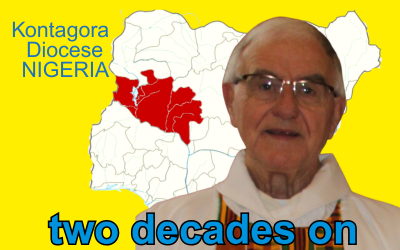
On the night of 23rd February 2006, in Kontagora, Niger State, Nigeria, a mob attacked the Churches and private premises of many Christian denominations including our own St. Michael’s Catholic Church and Presbytery (Mission House). I was one of three priests and a German lay worker living in the house at the time. The house was completely gutted and a number of vehicles belonging to the church personnel and workers plus a set of three school busses were all torched. The mob had been mobilised as a protest by a section of the Muslim population in response to the publication of cartoons of the Prophet Mohammed in a Danish newspaper. For a fuller account of the events of that evening, I refer you to an article titled ‘Kontagora McCauley Report’ (click on this link to view) written in the immediate aftermath of the attack on our website. You will also find a second article titled ‘Ten Years Ago in Kontagora’ (click on this link to view) which is a reflection on these events written ten years after the riot in Feb. 2016.

2006-2016 I write these lines as the 20th anniversary of the incident approaches (23rd Feb.) i.e. two decades later. For most of the first decade I continued working in the Vicariate until I departed Nigeria finally for Ireland, my homeland, in May 2015. I had already handed over the ‘keys’ of the Apostolic Vicariate of Kontagora to the newly appointed leader, Bishop Bulus Yohanna, after his episcopal ordination on 3rd May 2012. I had been the acting leader of the jurisdiction for two years as Apostolic Administrator (2010-2012). This came about due to Bishop Tim Carroll SMA having had to retire back to Ireland for health reasons in 2010. The youthful Bishop Bulus wholeheartedly set about the task of continuing the growth and development of the Catholic Church in the Vicariate of Kontagora, begun by the missionaries of the SMA and SPS (St. Patrick’s Missionary Society).
2016-2026 Looking back over this decade, I observe that one of its main features is the continued development and growth of the Vicariate of Kontagora with the steady increase in the number of priests, religious sisters and number of parishes. The outcome of this growth led to the announcement by the Vatican of the promotion of the jurisdiction from the rank of Vicariate to that of a Diocese on 2nd April 2020 with Bishop Bulus Dauwa Yohanna continuing as its leader. However, the official Inauguration Mass could not take place until 16th June 2022 due to the restrictions of the Covid 19 pandemic. The journey since the first announcement of the creation of Kontagora as a new jurisdiction, in the care of the Society of African Missions, by the Vatican in December 1995 was now complete. I, together with my SMA colleagues, OLA Sisters and members of other Congregations are proud to have been a part of that journey.
However, a sad feature of the recent decade is that the Diocese of Kontagora and its people have had to face the challenge of increasing lawlessness and insecurity. The scourge of banditry and kidnapping has led to a climate of fear and the disruption of economic, agricultural, educational and family life. For me, a painful example of this was the kidnapping of over three hundred schoolchildren and teachers from St. Mary’s Catholic Primary and Secondary School in Papiri village on 21st Nov. 2025. This school is in the parish I served from 1995 till 2001. Fr. Donal O’Cathain SMA, the Cork priest who spearheaded the growth and development of this school over the past twenty years is now residing for safety in the Bishop’s House in Kontagora town as, for now, it is too risky for him to return to his remote parish of Kigbera. Thankfully all the kidnapped children and staff were eventually released but the ‘bandits’ continue to wreak havoc among the villagers that remote area at the time of writing.
Looking back over the past two decades since the attack on Kontagora mission, I have mixed emotions. I rejoice that the Diocese has grown from its first announcement in December 1995 to its current position as one of the fifty-five Catholic Dioceses of Nigeria. Then, 1995, it was solely in the hands of missionaries (mainly Irish) i.e. SMA and SPS. Nowadays, it is led by a native of the Diocese, Bishop Bulus Yohanna assisted by around sixty priests (Nigerian) and a few missionaries, only one of whom is Irish, Fr. Donall O’Cathain SMA. I also enjoyed working at close quarters with the Missionary Sisters of Our Lady of Apostles (Papiri and Kwimo communities), the Sisters of Notre Dame de Namur (Kontagora community). In addition, I also worked with the Dominican Sisters of St. Catherine of Siena (Zuru and Yauri communities), the Sisters of Charity (Tungan Gero community).

On the other hand, it is with a heavy heart that I receive news of the increasing tension and insecurity in the Diocese of Kontagora. Stories abound of ‘bandit’ attacks, kidnapping and destruction in the villages A mixture of religious, economic, ethnic and demographic expansion factors contribute to this climate. But I have confidence in the strong faith of the Christian community of Kontagora Diocese and its leader, Bishop Bulus that they will withstand and overcome these challenges to their way of life and worship. I hope and trust that the current wave of unrest will end and that the villagers will be able to go with confidence to their churches, schools, markets and farms. May God bless and protect the People of God in the Diocese of Kontagora.
Dan McCauley SMA 22nd Feb 2026.