

(Readings: Col 1:21-23; Ps 53; Luke 6:1-5)
If Saul had listened to Jesus speaking in today’s Gospel he would have been annoyed at what he heard and associated himself with the question asked by ‘some of the Pharisees, Why are you doing something that is forbidden on the sabbath day?’ Saul, the supremely zealous promoter and even prosecutor of the Law, would have had great difficulty deciding what to do after Jesus’ self-declaration – ‘The Son of Man is master of the sabbath’. There could have been only one ‘master of the sabbath’, the Messiah.
However, as Paul, we hear in today’s first reading from Colossians a very different take on Jesus and on Paul himself, now a herald of the Gospel to the Gentiles. In that role he reminds those who were outside the Law that ‘God has reconciled [them] by Christ’s death’. He exhorts them to remain firmly rooted in the faith, ‘never letting themselves drift away from the hope…which you have heard which has been preached to the whole human race’, of which Paul himself is a servant. This shows how far Paul himself has travelled, and as Pope Benedict XVI stated, why ‘He uses the term “servant”… to indicate a relationship of total and unconditional belonging to the Lord Jesus’[1]. As herald of the Gospel he encountered those who ‘not long ago were foreigners and enemies’, experiencing hostility and hassle, harm and even hatred.
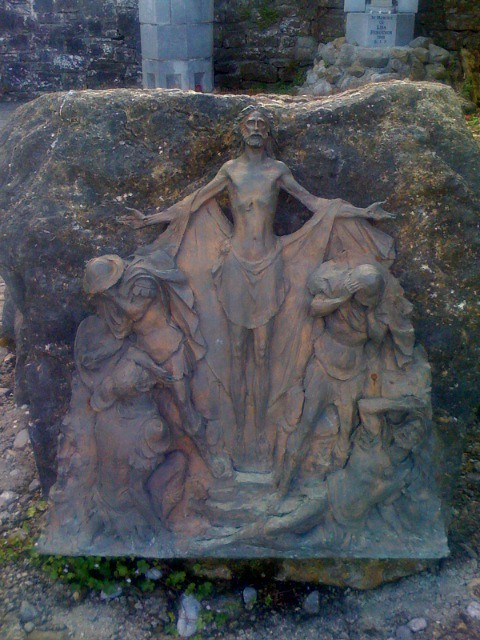
Reference to ‘Christ’s death in his mortal body’ in today’s first reading is a reminder of how often Paul refers to the cross and crucifixion of Jesus. This event is salvific, not sadistic, the supreme sign of the humility of God which hollows out human hubris. This is proclaimed in Paul half-line to the Corinthians, ‘so that the cross of Christ may not be emptied of its power’ (1:17). The master of paradox, Paul perceives the futility and fatality of Christ’s death on the cross from a purely human and historical perspective and presents it as revealing the way, working and wisdom of God’s eternal plan.

‘Ut crux Christi non evacuetur’, Latin for ‘so that the cross of Christ may not be emptied of its power’, is inscribed on the inside of the Altar in Holy Cross Abbey, (County Tipperary). Its annual Novena begins on Monday 8th (September) and includes the Feast of the Exaltation of the Holy Cross (Sunday 14th this year). With a Relic of the True Cross and its three Stations of the Cross in the Abbey, cloister and grounds, Holy Cross continues to be a place of pilgrimage and prayer.
Fr Kevin O’Gorman SMA
[1] Homily at Vespers for Promulgation of “Pauline Year”, June 2008-June 2009 (available at Vatican.co.za).