
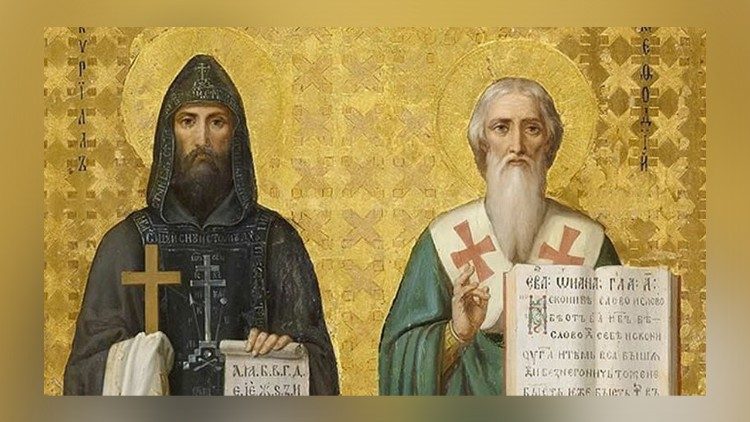
Reflection for the Feast of Saints Cyril and Methodius
Readings: Acts of the Apostles 13:46-49; Psalm 116; Gospel of Luke 10:1-9
Two themes stand out from today’s readings and they both turn on the word ‘light’. The Opening Prayer of Mass (in the Roman Missal) begins ‘O God, who enlightened the Slavic peoples through the brothers Saints Cyril and Methodius’ and in The Weekday Missal (1998) ‘Father, you brought the light of the Gospel’. Rooted often in the scriptural readings, the ‘light of faith’ is regularly referenced in the prayers of the liturgy.
The image of light – and its opposite – are also often used to symbolize secular situations and state(s) of affairs. President Catherine Connolly, in the course of her recent visit to Queen’s University, Belfast, ‘told staff and students’ that ‘Northern Ireland, without exaggeration, now represents a beacon of light to a world in how decades-long conflict can be resolved and reconciliation fostered and continued’.[1] In his America Letter Keith Duggan, writing about recent cutbacks in staff numbers at The Washington Post (newspaper), stated ‘that doggedness and fearlessness entitled the Post to its gallant motto: “Democracy Dies in Darkness”.[2] Adopting the method of distinguishing between what Pope Saint John Paul II described as ‘bright spots and shadows’ calls for ethical and evangelical discernment.
Apart from the identification and invitation of Jesus in the Gospel of John – ‘I am the light of the world. Whoever follows me will never walk in darkness but will have the light of life’ (8:12), the half line from today’s first reading – ‘a light for the nations’ – reveals a very rich scriptural and salvific seam from the Old Testament prophet Isaiah (42:6) which runs through to the sacramental and spiritual significance of the opening line of Vatican II on the church (known by its Latin title Lumen gentium): ‘Christ is the light of the nations and consequently this holy synod, gathered together in the Holy Spirit, ardently desires to bring to all humanity that light of Christ which is resplendent on the face of the church, by proclaiming his Gospel to every creature’.[3]
 The second sense of ‘light’ is reflected in the reading Gospel text and, put simply, it is about ‘travelling light’. Are the words ‘Carry no purse, no haversack, no sandals’ a recommendation or an obligation? Are they to be taken absolutely? The experience of, for example, taking up a post teaching theology in a country where there is little or no access to books and periodicals calls for the prudence of a portable basic reference and required reading library! Luke Timothy Johnson called ‘the connection between being a Christian and the way we own and use things one of the knottiest questions imaginable’.[4] If material possessions, (including publications) get in the way of freely proclaiming the Gospel, they are not optional but obstructive. Therefore, if wealth gets in the way of witnessing to the Gospel it should be given away, preferably to the poor, otherwise it ends up like, ‘But when the young man heard these words he went away sad, for he had many possessions’(Matthew 19:22).
Pope John Paul II dedicated his fourth encyclical to today’s saints, Slavorum Apostoli – The Apostles of the Slavs. This extolled their efforts in evangelizing ‘the Slav nations’, enriching the ‘Church, the Continent of Europe and the whole world’, expanding the spiritual and cultural treasure of the church and expressing its communion, ending on a deeply personal note, ‘The Pope of Slav origin in a special way thanks you for this’.[5]
Kevin O’Gorman SMA
[1] The Irish Times, 5th February 2026.
[2] The Irish Times, 7th February 2026.
[3] ‘Dogmatic Constitution on the Church’, in ed. Austin Flannery O.P., Vatican Council II – Constitutions, Decrees, Declarations, Dublin, Dominican Publications, 1996, par. 1.
[4] Sharing Possessions – What Faith Demands, Eerdmans, Cambridge, U.K., 2011, 1.
[5] Slavorum Apostoli, 1985, par. 32. (Available at Vatican.co.za)