
Readings: Acts 10:34, 37-43; Col 3:1-4; John 20:1-9
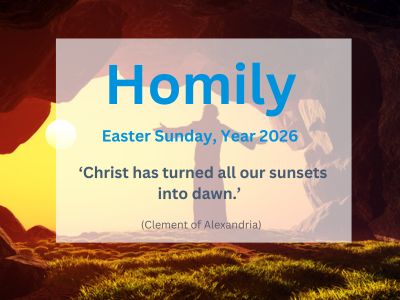
Theme: Christ has turned all our sunsets into dawn (Clement of Alexandria)
By Michael McCabe, SMA
In the early 19th century, gas lighting was installed in the dark foggy streets of London and other cities, mainly as a safety measure. Someone had to light the gas lamps at night and extinguish them before morning. Thus the job of the Lamplighter was born. The story is told about one of these lamplighters who was interviewed by a newspaper reporter about his job. The reporter asked him if he ever grew weary of his work on the cold, lonely winter nights. ‘Never’’ replied the Lamplighter ‘for there is always a light ahead of me to lead me on. But, added the reporter, ‘what about when you have put out the last light?’ ‘Then’, replied the lamplighter, ‘comes the dawn’. Today, Easter Sunday, we celebrate the coming of a dawn that has transformed our world forever. In the words of St Clement of Alexandria, the resurrection of Christ has turned all our sunsets into dawns’.
Today’s gospel reading from John recounts the dramatic story of Mary of Magdala’s discovery of the empty tomb. This is the same Mary mentioned as one of those standing at the foot of the cross as Jesus lay dying (cf. Jn 19:25). Very early – it was still dark – on the first day of the week (Sunday), Mary goes alone to the tomb of Jesus. Surprised to find that the large stone sealing the entrance to the tomb has been moved away, and presuming that the body of Jesus has also been removed, she rushes off to inform Peter and John (‘the other disciple’). They, in turn, run to the tomb as fast as they can. John, younger and fitter, reaches the tomb first, where he waits for Peter, who enters the tomb ahead of him. Both of them see the burial cloths of Jesus on the ground, indicating that the body had not been stolen, and come to believe in his resurrection. The account ends with the statement: ‘Until that moment they had failed to understand the teaching of scripture, that he must rise from the dead’ (Jn 20:9)
In our first reading Peter declares that Jesus’ resurrection from the dead was the direct action of God: ‘God raised him to life and allowed him to be seen’ (Acts 10:40. The resurrection of Jesus is God’s response to the Cross, the divine affirmation of everything that Jesus preached and did, everything for which he lived and died. It is the definitive answer of God the Father to a world that sought to silence Jesus forever; the final word between God and humanity in the great dialogue of salvation – the Father’s great ‘Amen’ to his beloved Son, and, through him, to humanity and all creation.
On this Easter Sunday morning, let us rejoice and be glad because Christ our Lord is Risen. Death, and all that is negative within ourselves and in our world, has no longer any power over him. And, with him, we too are victorious, for now nothing can come between us and the love of God made manifest in Christ (cf Rom 8:39). With the resurrection of Jesus, earth has been for evermore joined to heaven, and the ‘new creation’ has begun. This means, not just that there is life after death, but that, here and now, the old creation, where the power of death held sway, has been dethroned, and a new power loosed upon the world – the power to remake what is broken, to heal what has been diseased, and to restore what has been lost.
Our second reading from St Paul’s Letter to the Colossians draws out the implications of Christ’s resurrection for us, his disciples. In baptism we died with Christ and came to share in his new, risen life. So, ‘we must look for the things that are in heaven, where Christ is, sitting at God’s right hand (Col 3:2). In saying this, Paul is not suggesting that we become so heavenly-minded as to be of no earthly use. To the contrary, he is challenging us to live, here and now, in the light of the new creation. This means, as St Paul reminds us, casting off the outworn garments of our former selves, and clothing ourselves in the heavenly garments of compassion, kindness, humility, meekness, patience and love (cf. Col 3:12-15). It means turning away from the language of hate and resentment and speaking a new language – the heavenly language of forgiveness. It means courageously resisting the forces of darkness that use bombs and bullets as instruments of power, and letting the peace of Christ rule in our hearts (cf. Col 3:15). It means striving to manifest, in every relationship, in every word and deed, the name – the power – of Christ Jesus, our Lord (cf. Col 3:17).
I will end with a few lines from A Villanelle for Easter Day by the contemporary English poet, Malcolm Guite:
As though some heavy stone were rolled away,
You find an open door where all was closed,
Wide as an empty tomb on Easter Day….
The way is open, death has been deposed,
As though some heavy stone were rolled away,
And you are free at last on Easter Day.
I wish you all a blessed, peaceful and joy-filled Easter!
Listen to an alternative audio Homily by Tom Casey, SMA: