
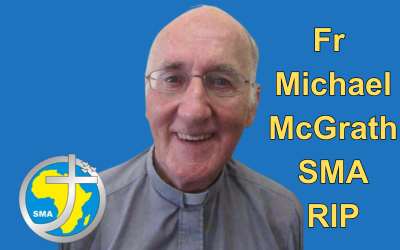
Below is the homily preached by Fr Michael McGrath CC, Saint Mel’s Cathedral, Longford during Funeral Mass of his uncle, Fr Michael McGrath SMA, at the Church of Our Lady of Lourdes, Abbeyshrule, Co Longford on Saturday, January 31st 2026.
I have a vivid memory of Uncle Mick standing on this very spot thirty-nine years ago preaching at his own father’s funeral—my grandfather, also Michael McGrath. Uncle Mick spoke of his memory of being brought as a young boy by his father to the Odeon cinema in Longford. How they’d sit there, waiting with craned necks in anticipation, until at last the curtains were drawn back. And then—suddenly—the magic of the silver screen would open up a whole new world. Mystery, story, beauty, drama. What had been hidden was now revealed.
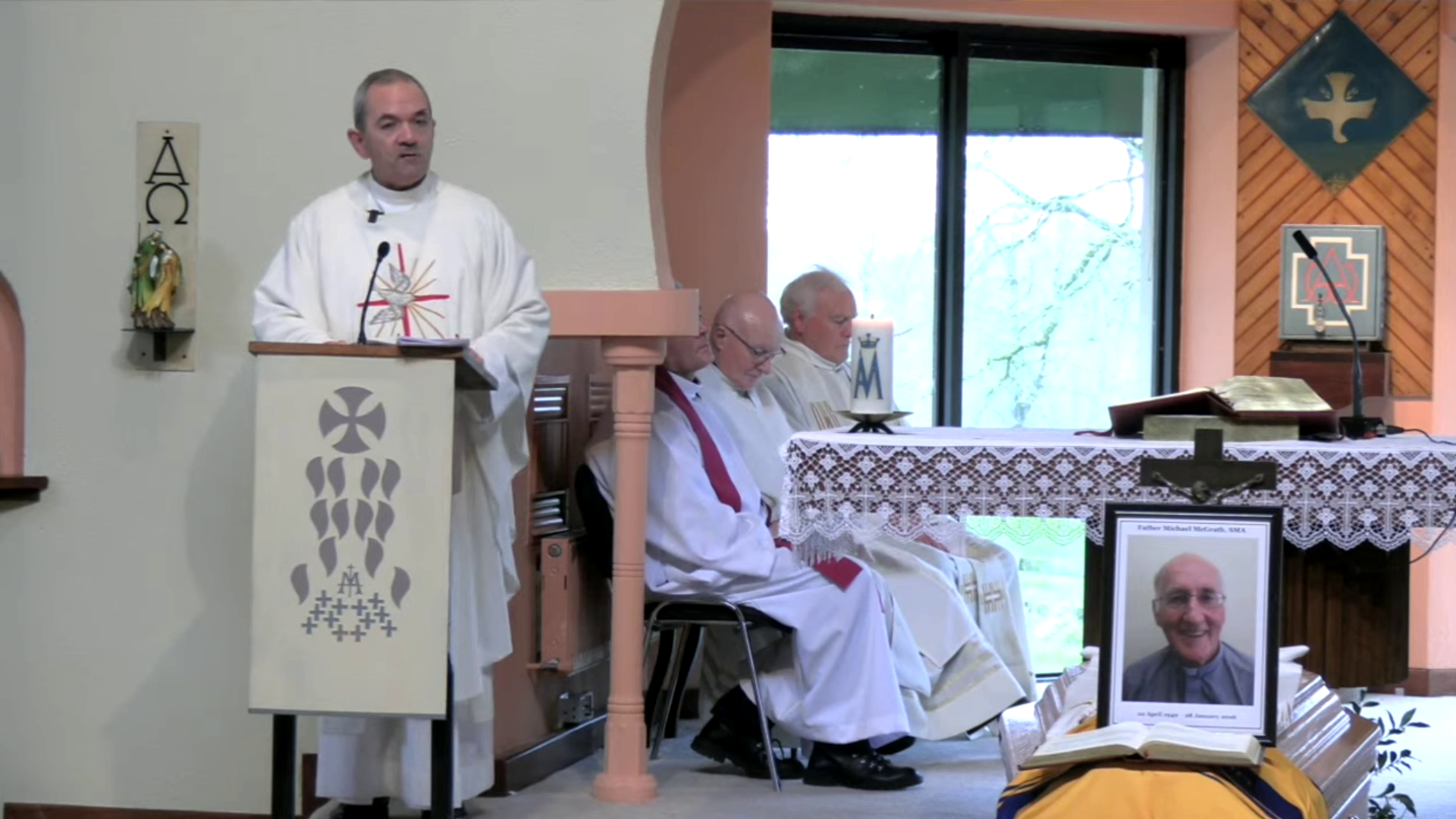 What Uncle Mick spoke that day for his father, he now lives for himself.
That simple image brings us very close to the vision of Isaiah whose poetry imagines heaven as the party of abundance, the table set for everybody—‘all the nations.’ The Prophet imagines the veil being lifted, the curtain drawn back, so that people can finally see what God has been preparing for them all along. It is a powerful image for death—but it is also a beautiful image for priesthood. Because at its deepest level, the awesome vocation of the priest is not to bring meaning so much as to unveil it; not to impose, but to reveal the mystery—unveil it, open the curtains on the deepest beauty, the sparkling nuggets of gold in the dust and earth of the everyday.
And that is how Uncle Mick lived his priesthood. For fifty-five years, most of them spent in Kaduna and across northern Nigeria, he gave his life to helping others see: to see the Gospel, to see Christ, to see their own dignity as sons and daughters of God. His life’s work in catechetics was not simply about passing on information. It was about unveiling the mystery—patiently, respectfully, beautifully—so that ordinary women and men, catechists and lay leaders, could recognise the light they carried within them.
A favourite writer of Uncle Mick, Daniel O’Leary describes the priest as a “midwife of mystery.” The midwife is not one who creates life, but one who helps it come to birth. Uncle Mick understood this deeply. When he arrived in Nigeria as a young priest in 1965, he quickly realised that the future of the Church did not rest primarily on missionaries, but on local catechists—women and men who could speak the language, understand the culture, and carry the faith into their own communities. His genius was to see them—to see their capacity, their wisdom, their calling—and then to equip them so that others, in turn, could see. He had a deep appreciation of their way to God and so, unsurprisingly the catechetical series that he and his dear friend Sister Nicole devised was Africa: Our Way. Desiring to lead others in the path of discipleship following the footsteps of Him who says, ‘I am the Way,’ Mick and Nicole stepped inside African skin and so did not impose a European or American Way, much less ‘his, her or my way.’ Through their books, posters, and videos that travelled far beyond Nigeria—Mick was quietly lifting the veil for countless people across Africa. In English, in Hausa, in Kiswahili, and in many other languages, he helped people encounter a God who was already close, already present, already at work in their lives.
That theme of seeing runs gently through today’s Gospel, specially chosen by Uncle Mick. He reminded Joe and me that this text said it all. In the Catechist’s material for this scripture passage, Uncle Mick points out that in the text there is no suggestion that the widow of Nain ever saw Jesus coming towards her. She is locked in grief, walking behind the body of her only son. What matters in the story is not that she sees Jesus—but that Jesus sees her.
“He saw her,” Luke tells us, “and was moved with compassion.” Jesus sees her fully: her loss, her vulnerability, her future. And because he sees her with compassion, he acts. Life and Hope interrupt death and despair.
Mick’s priesthood echoed that same way of seeing. Whether with catechists in Malumfashi, students in seminaries, young men in the Borstal Institute in Kaduna, or ordinary parishioners seeking understanding of the faith, Mick learned to see people not as problems to be solved, but as mysteries to be reverenced. And in helping them see God more clearly, he helped them see themselves more truthfully.
Daniel O’Leary wrote that the priest is called “to be a prophet of beauty, to remind people of the light within them; to reassure them that they are shining like the sun; to tell them that they can almost touch a rainbow.” What a privileged task that is, to draw back the curtain and enable another’s light to shine, and to see them smile in wide-eyed wonder at their own beauty. And Mick enabled all of that—faithfully and patiently, respecting the mystery unfolding in other people’s lives.
Uncle Mick was so ready for this day. The last page of his well-thumbed dog-eared breviary that he prayed every night remembers the prayer of Simeon in the Temple who had lived to see the day of the Messiah: “At last all powerful mater, you can let your servant go in peace.” Paul felt the same way as he wrote words to Timothy that are most surely in Uncle Mick’s heart as he takes leave of us: “I have fought the good fight. I have finished the race. I have kept the faith.”
Mick’s was not a race for recognition. It was a long obedience in the same direction; of teaching and writing, of training, of answering questions and asking too, of running a bookshop, accompanying catechists, helping brother priests, and standing patiently at the threshold moments of other people’s lives—putting, as O’Leary says, “glass around fragile hearts.” And Uncle Mick did that for us all. And now we send him home.
We always looked forward to Uncle Mick’s coming home—from Africa every two years, Olympics Year and World Cup Year. No prizes for guessing who had the remote control, when we became sophisticated enough not to have to move in order to switch the channel! Anyway those biennial visits began with the excitement of the trip to Dublin Airport. What a magical place that was for a child, and we weren’t even boarding a flight. We’d be standing behind the barrier at arrivals, scanning every face, waiting for first glimpse of the deeply tanned missionary to come through. Seconds would feel like hours as our anticipation would heighten. And then—suddenly—we’d recognise him. And the joy would erupt. And, sure we’d be gobsmacked, and we wouldn’t know how to talk to him at first and with the days and weeks we’d grow familiar again and there’d be family gatherings and outings to Croke Park and other Holy places, and then in his own time Mick would be packing the bags again.
And such is the mystery of death and dying too. As we bid farewell at departures to send a pilgrim home to God, there are saints and angels gathered at the Arrivals—and among that blessed communion there all standing to welcome Mick, are his parents Mike and Mary, his sisters Rose and Maureen, brothers in law John and Tom and sister in law Mary, my mother, and there’s Deirdre his niece and there are infant nieces and nephews too, and brother and sister missionaries and countless people whose faith he helped shape—they’re all waiting. And the Lord Himself is waiting.
The curtain is drawn back. The veil is lifted.
And the one who spent his life unveiling the mystery now steps fully into it. And the Lord says to him: “Well done, good and faithful servant. Come, share the joy of your Master.”
Amen.