
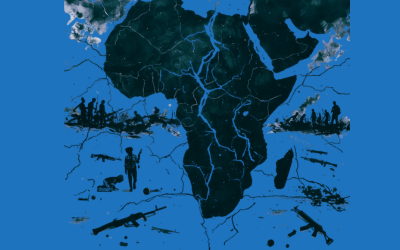
Using information provided by the International Crisis Group (ICG) on ten conflicts likely to continue in 2026, Netzwewrek Afrika Deutschland, the German antenna of the African Faith and Justice Network published the information below. This provides a summarized overview of these conflicts located in Africa, i.e. conflicts affecting Sudan, Ethiopia and Eritrea, as well as Mali and Burkina Faso.
SUDAN
- April 2023 – Civil war – triggered by a power struggle within the junta.
On the one hand: the Sudanese army together with a number of Islamist militias and former rebels. On the other hand: the RSF (Rapid Support Forces) under Mohammed Hamdan Daglo (‘Hemedti’), which is allied with other former insurgents and supported by foreign mercenaries.
- The RSF captured most of Khartoum and, with the support of the United Arab Emirates, advanced into the river basin of Sudan.
Abu Dhabi is close to the RSF and believes that supporting the RSF will strengthen its position in Africa. - By the end of 2024, Egypt, Turkey and Iran had increased their arms sales to the military. Saudi Arabia provided greater support to the army.
- March 2025 – Recapture of Khartoum and pushing back the RSF to Darfur and the Kordofan region. However, the RSF attacks as far as Port Sudan in the east. RSF sets up a parallel government in Nyala in southern Darfur.
The idea of peace negotiations is meeting with fierce resistance within the army leadership and among its allies. Powerful Islamists from the Bashir regime and former rebels from Darfur fear that a ceasefire would consolidate the RSF’s power in western Sudan. Hemedti is more willing to negotiate but continues to fight even after the official acceptance of the ceasefire. The tense relations between Saudi Arabia and the United Arab Emirates pose another obstacle: in early December 2025, forces supported by the Emirates captured territory in Yemen from their Saudi-backed rivals, further exacerbating tensions between the two countries over Sudan.
MALI AND BURKINA FASO
2012 – Rebellion against the central government: Ag Ghaly, leader of the Islamist group Ansar Dine, formed a coalition with Tuareg associations and other groups affiliated with Al-Qaeda. He succeeded in driving the Malian army out of the north of the country.
- It is the birth of the jihadist militia jama’at Nusrat al-Islam wa-l-Muslimin (JNIM). In March 2017, Ag Ghaly announced that JNIM had allied itself with al-Qaeda.
- Today, Ag Ghaly is at the helm of one of the most successful jihadist offshoots of al-Qaeda. Between 6,000 and 7,000 fighters are said to belong to JNIM, who are mainly active in Mali, Burkina Faso and Niger. In Burkina Faso, JNIM is now said to control 50% of the country. JNIM has also gained a foothold in Benin, Togo, Ivory Coast and Nigeria.
- Since September 2025, jihadists have partially blockaded Mali’s capital, Bamako, ushering in a new phase of the war in the Sahel. But in both Mali and neighbouring Burkina Faso, the risk of regime collapse and further chaos is growing.
- Attacks on key infrastructure, army bases and checkpoints, and most importantly, supply lines.
- Disruption of connections with Senegal and Côte d’Ivoire, whose ports handle most of the trade of the landlocked country of Mali.
- The Malian army and Russian forces are trying to protect the main roads.
- Goal of the JNIM – seizure of power
ETHIOPIA AND ERITREA
- 1993 – Eritrea becomes independent from Ethiopia after 30 years of war This will make Ethiopia a landlocked country with no direct access to the sea.
- 1998 – 2000 Eritrean-Ethiopian War 12. Dec. 2000 Signing of the ‘Algiers Peace Agreement’ – remains a meaningless document.
- 2018: Peace Treaty 2.0 War from 1998 to 2000 formally ended.
- Autumn 2020 – Outbreak of war between the regional government in Tigray and the Ethiopian central government.
- More than 600,000 people are killed, more than 120,000 women are raped and almost two million people are displaced.
- 2022 – „Pretoria Agreement” – Peace treaty between the Ethiopian government and the Tigray People’s Liberation Front.
- Agreement: to cease hostilities.
- Since this agreement, Addis Ababa has been waging a shadow war against both Eritrea’s capital Asmara and the Amhara region in Ethiopia.
- On 1 September 2025, President Abiy declares that Ethiopia’s ‘mistake’ of giving up access to the sea will be ‘corrected’.
Hope and Options:
“Kenya, Nigeria and South Africa, which were all pivotal in securing the Pretoria agreement, should shuttle between the two capitals, emphasizing the dangers if they should come to blows. Others with influence in Addis Ababa and Asmara – the U.S. especially but also China, the European Union, Gulf Arab countries, Türkiye and the UN – should reinforce that message. A new confrontation, this time between two states and their powerful armies, would be ruinous for a region already devastated by the Tigray conflict and now Sudan’s war.” Quelle: International Crisis Group
Network Africa Germany (NAD) [email protected] www.netzwerkafrika.de