
28th December 2025
Readings: Ecclesiasticus 3:2-6, 12-14; Colossians 3:12-21; Matthew 2:13-15, 19-23
Theme: Family Life in the Lord
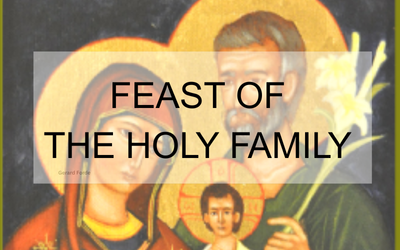
Today we celebrate the Feast of the Holy Family. Coming within the octave of Christmas, this feast invites us to reflect on the importance of family in our lives as God’s children, and on the values that underpin and sustain it. Created in the image of a God who is Love, the meaning of our lives is to be found in relationships. Our identity as human beings is inseparable from that network of relationships we call ‘family’ – not just the family into which we are born and in which we grow up, but the wider family of friends and relations, of county and country, of Church, and of all humanity. And our final destiny is to belong to the family of the blessed in heaven. We might say then that family is inscribed in our DNA. It is part of who and what we are. All this is all beautifully captured in the Africa philosophy of Ubuntu, which is best translated as ‘I am because we are’.
Today’s scripture readings highlight important family values. The focus of our first reading from Ecclesiasticus is on the respect, love and practical care children should show for their parents, particularly when they get old and feeble. ‘He who sets his mother at ease is showing obedience to the Lord. My son, support your father in his old age, do not grieve him during his life. Even if his mind should fail, show him sympathy, do not despise him in your health and strength’ (Ecc 3:11-12). These dictates are no more than the precepts of common decency.
In our second reading, St Paul sets a higher standard for us and highlights the virtues that should inform our relationships with one another. As God’s beloved children we ‘should be clothed in sincere compassion, in kindness and humility, gentleness and patience.’ And ‘over all these clothes, to keep them together and complete them, put on love’ (Col 3:12,14). Paul is, of course, well aware that tensions and disagreements arise even in the best families. So, we need to ‘bear with one another’ and ‘forgive each other as soon as a quarrel begins’ (Col 3:13). Paul also offers practical advice to wives, husbands and children. While we might not agree that wives should ‘give way’ to their husbands, we would surely agree that husbands should ‘love their wives and treat them with gentleness’, that children should obey their parents, and that parents should not ‘drive their children to resentment’ (cf. Col 3: 18-21). Paul’s teaching certainly deserves a hearing at a time when family violence is perhaps more prevalent than ever, especially violence towards women and children.
Matthew’s gospel draws our attention to the significant role that Joseph plays in God’s plan of salvation. He is called to accept Mary as his wife and to become, in the words of the Polish novelist, Jan Dobraczyńsk, the ‘shadow father’ of Jesus. Today’s reading highlights one aspect on his calling: the protection of baby Jesus from imminent danger to his life. It describes how an angel warns Joseph in a dream to take Mary and Jesus to Egypt, to escape the clutches of King Herod, seeking to eliminate the possibility of a rival to his kingship. In response to the angel’s warning, Joseph flees to Egypt with Mary and the baby Jesus, where they remain until the death of Herod (cf. Mt 2:13-15).
After Herod’s death, Joseph is again instructed by an angel to return with the child and his mother to the land of Israel. Even then danger awaits them in the figure of Archelaus, son of Herod, the ruler of Judah. So, instead of going back to his home in Bethlehem, he settles down with Mary and Jesus in the town of Nazareth in Galilee (not under the rule of Archelaus). We can only imagine what a difficult and stressful time that must have been for the ‘holy family’. With good reason, then, Joseph is regarded as the special patron of all those forced to leave their native lands because of war, hatred, persecution and poverty. And we surely need his patronage in the turbulent and war-torn world of our time.
Joseph is rightly presented to us as a model of fatherhood. While not the biological father of Jesus, in every other respect he is a true father to Jesus. His life embodies and reflects the tender love of God the Father for his beloved Son. In today’s world, where so many biological fathers fail to take responsibility for the children they bring into the world, the example of Joseph is as relevant as ever. In the words of Pope Francis, Joseph reminds us that ‘fathers are made, not born. A man does not become a father simply by bringing a child into the world, but by taking up the responsibility to care for that child.’ Alongside Mary, Joseph devoted his entire life to watching over, and caring for, Jesus. And in this essential role of ‘shadow father’ he never made himself the centre of things. His entire life was focused instead on carrying out his responsibility to protect and care for Jesus and Mary. Let us pray that we may imitate the faith, courage and self-less dedication of St Joseph in carrying out our responsibilities for those committed to our care. Amen.