
Readings: Isaiah 9:1-7; Titus 2:14-18; Luke 2:1-14
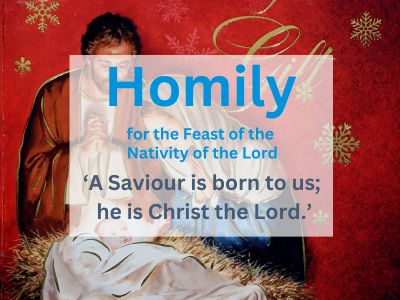
Theme: ‘A Saviour is born to us; he is Christ the Lord’ (Lk 2:11)
By Michael McCabe, SMA
Tonight we celebrate the greatest event in the history of humanity, the birth of Jesus Christ, Son of God and son of Mary, in a the town of Bethlehem over 2000 years ago – an event heralded by angels in the words of today’s gospel: “I proclaim to you good news of great joy that will be for all the people. For today in the city of David a Saviour has been born for you who is Christ the Lord” (Lk 2:12). We celebrate this event with great acclaim because it was the moment that changed human history forever, revealing the boundlessness of God’s grace and, as our second reading tells us, making ‘salvation possible for the whole human race’ (Titus 2:11).
Tonight’s liturgy pulsates with a joy that resonates throughout the universe. The responsorial psalm calls on earth and heaven to join in one great song of joy and praise:
‘Let the heavens rejoice and earth be glad,
let the sea and all within it thunder praise,
let the land and all it bears rejoice,
all the trees of the wood shout for joy
at the presence of the Lord for he comes,
he comes to rule the earth.’ (Ps 95: 11-13)
The child whose birth we celebrate this night is hailed by Isaiah, in our first reading, with the titles, ‘Wonder Counselor’, ‘Mighty God’, ‘Eternal Father’, ‘Prince of Peace’ (Is 9:5).
The gospel reading from Luke describes in concise, unadorned language how the Christ child came to be born in a manger in Bethlehem, David’s city, while Mary and Joseph were there to be registered for a census of the people. It tells us how angels announce his birth to shepherds who come to worship him. And we, too, worship him because he is Emmanuel, God-with-us. As we gaze in wonder upon the nativity scene, represented in the Christmas crib, we see the Lord of the universe as a baby totally dependent on his mother for his every need. Becoming one with us, he became subject to the joys and pains that all human flesh is heir to: the joy of loving parents, of friendship, of play and laughter, of song and dance; but also the pain of hunger and thirst, disappointment and frustration, grief and sadness.
Like all human beings, Jesus had to learn to walk and talk, to pray and study, to work and play. He would come to know the joy of bringing healing and hope to the crippled, the blind, the dumb, and those excluded from society. He would experience the pain of ingratitude and rejection, and the misunderstanding of even his closest disciples. He would also know fear when faced with the hostility of those who sought to destroy him. Finally, he would endure the unspeakable agony of a shameful death on Calvary – and all this to manifest the Father’s unfailing love for us and to show us what it really means to be human. He is indeed the ‘Bright blue Rose’ of Jimmy McCarthy’s wonderful song, whose impact on humanity continues to grow after more than 2000 years. And ‘it is a holy thing, and it is a precious time/and it is the only way/…. To ponder his death and his life eternally’.
The Christmas story recalls the birth of this unique person, the incarnate Son of God, who emptied himself of glory to be with us – who didn’t just tell us how to live but showed us by the way he lived and died. The Christmas story touches something deep in our hearts. In the words of Pope Francis, ‘Christmas is a feast that is heart-felt, participatory and capable of warming the coldest of hearts, of removing barriers of indifference towards our neighbours and encouraging openness towards others’. It challenges us to reflect on the life of Jesus so that we enter into the immense mystery of the love of God and discover the meaning and purpose of our lives and share it with others.
As we celebrate Christ’s birth this Christmas, may our hearts burn with the fire of the love he has kindled on this earth. Have a happy, peaceful and healthy Christmas.
Listen to an alternative audio Homily by Tom Casey, SMA: