
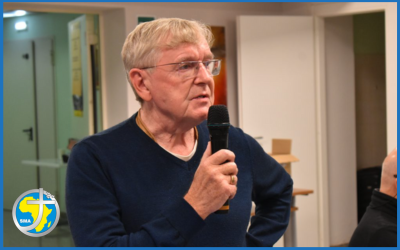
Below is an article written by Fr Dominic Wabwireh of the SMA International Media Centre in Rome. It is based on an interview he conducted with with Fr John Kilcoyne during the recent SMA General Assembly which was published on https://smainternational.site/ All the photos below are also courtesy of the SMA International Media Centre.
The ancient stones of the Eternal City have witnessed centuries of missionaries departing for distant shores. But inside the Society of African Missions (SMA) General Assembly 2025, a different narrative pulsed through the hallways, meeting rooms, and coffee breaks. Among the 55 delegates, only 11 hailed from the traditional “sending” nations of Europe and North America. The overwhelming majority – a resounding four-fifths – represented the vibrant, growing Church of Africa and Asia. Seated quietly amidst this sea of change was Fr. John Kilcoyne, an Irish priest whose nearly 30 years of leadership across Liberia, South Africa, and Tanzania embody this seismic shift. For him, this Assembly wasn’t just a meeting; it was the culmination of a lifetime witnessing mission turn full circle.
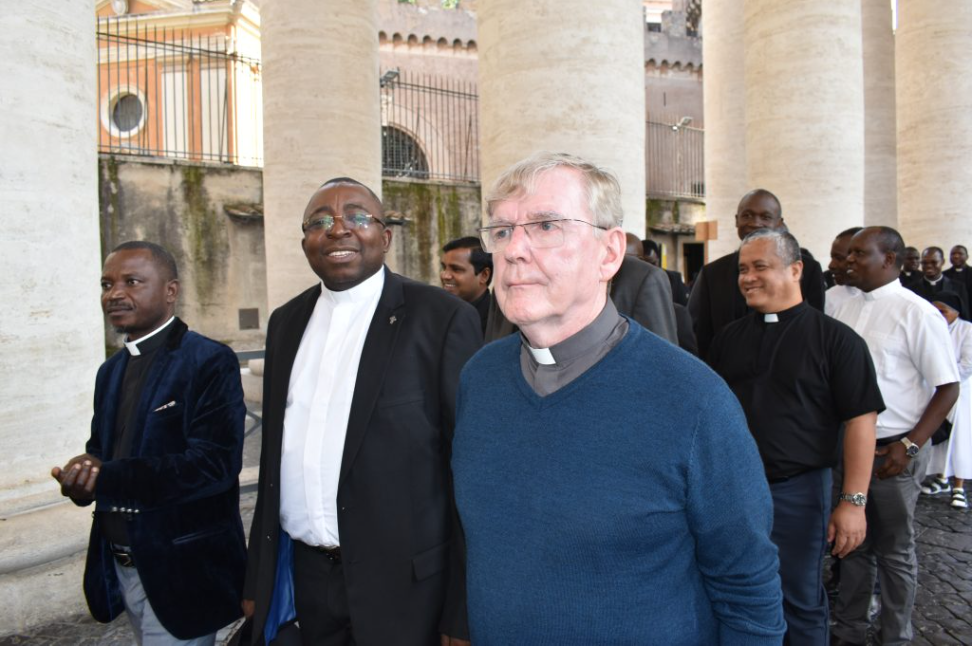
“It’s been an honour,” Fr. John reflects, his soft Irish lilt belying the steel forged in war zones and the warmth nurtured in countless African villages. Recently elected as an SMA Councillor in Ireland, the 64-year-old missionary is a living bridge between eras. As he prepares to hand over the leadership of the SMA District of Tanzania – the final chapter of his African service – His journey embodies the strength of faith, the perseverance of the heart, and the reciprocal love that fuels true missionary work.
From Mayo’s fields to Africa’s frontiers: the roots of a vocation
Fr. John’s journey began far from the equatorial heat, in the rain-washed, faith-steeped landscape of rural Western Ireland. Picture a young boy on a family farm, the rhythm of life punctuated by the Angelus bell and the nightly recitation of the Rosary. His father tilled the land; his mother balanced work in the local post office with farm duties. It was a world shaped by close-knit community and steadfast Catholic faith.
“What inspired me? Local men,” Fr. John states simply, recalling his decision to join the SMA 50 years ago in 1975. “Missionaries – SMA, Columbans, others. They were tangible proof of a life beyond our parish.” Vocation workshops in 1974-75 solidified the call, introducing him to SMA students and priests. Missionary magazines fueled a young imagination, painting vivid pictures of distant lands. “I found myself particularly drawn to Africa,” he recalls. Ordained in 1983, the pride radiating from his home parish remains a vivid memory. Little did they, or he, know the crucibles that awaited.
Liberia: from pastoral calm to the abyss of war
Landing in Liberia in 1983, the 25-year-old priest stepped into a world both challenging and exhilarating. His initial seven years were “ordinary” only by missionary standards: intense pastoral work and community development among the Bassa people in central Liberia. He learned the complex, tonal Bassa language, not just for sermons, but for confession, for intimate conversations, for life. He slept in villages, shared stories under starlit skies, celebrated Mass, and translated essential Catholic texts into Bassa – a labour of love ensuring the faith spoke in the people’s heart-tongue. The rewards were profound: “That sense of belonging, of being accepted… I once thought my mission was about evangelizing new areas, but I came to realize that the greatest joy was becoming part of the community.”
Then, in 1990, paradise shattered. Liberia plunged into a brutal civil war that would rage for seven years. Fr. John’s world became one of survival, displacement, hunger, and witnessing unspeakable suffering. “Civil war is terrible; it is always the innocent who suffer most,” he says, the weight of those years still palpable. With his colleague, Fr. Tony Jennings, and the Consolata Sisters, his mission pivoted to desperate relief efforts – feeding the hungry, offering shelter, providing solace amidst chaos. They were displaced multiple times, constantly navigating danger.
Yet, it was here, in the heart of darkness, that Fr. John witnessed the most luminous faith. “I will never forget the witness of the people – their strength, their refusal to take revenge, their commitment to Christian faith and values. They were willing to die for each other, and even for us.” His voice thickens. “That was one of the most intense and inspiring experiences of my life. Like Dickens said, ‘It was the best of times, it was the worst of times.’ The best because I never felt closer to people, and I saw real martyrs.” The war ended in 1997, leaving scars and a transformed priest. He left for studies in London, carrying Liberia forever in his soul.
South Africa: building bridges in the shadow of apartheid
By mid-1999, Fr. John found himself in a nation grappling with its own profound transformation: post-apartheid South Africa. Sent to the Diocese of Rustenburg, he faced a new linguistic hurdle: Setswana. “Without it, I would have found it impossible to minister,” he emphasizes, reiterating his lifelong conviction that language is the key to the heart. As a European in a land still raw from racial division, acceptance wasn’t automatic. “I had to learn the culture, of course, and to be accepted… But the people made me feel very welcome.”
For nine of his eleven years there (2001-2010), he served as Superior. Leadership here meant navigating the complexities of a society in flux, building trust, and fostering the SMA’s presence during a critical period. He speaks fondly of South Africa’s “culinary variety,” a small symbol of the nation’s rich tapestry, contrasting it with the Liberian staples of fufu and pepper soup that had sustained him through war.
Tanzania: nurturing a thriving future & the art of stepping back
Arriving in Tanzania in February 2012, after a sabbatical, Fr. John encountered a Church bursting with vitality. “28% of Tanzania’s 65 million people are Catholic,” he notes with evident pride. “The Church here is vibrant and confident.” He served as Vice-Superior from 2014 and took the helm as Superior in 2019 – the role that brought him to the Rome Assembly.
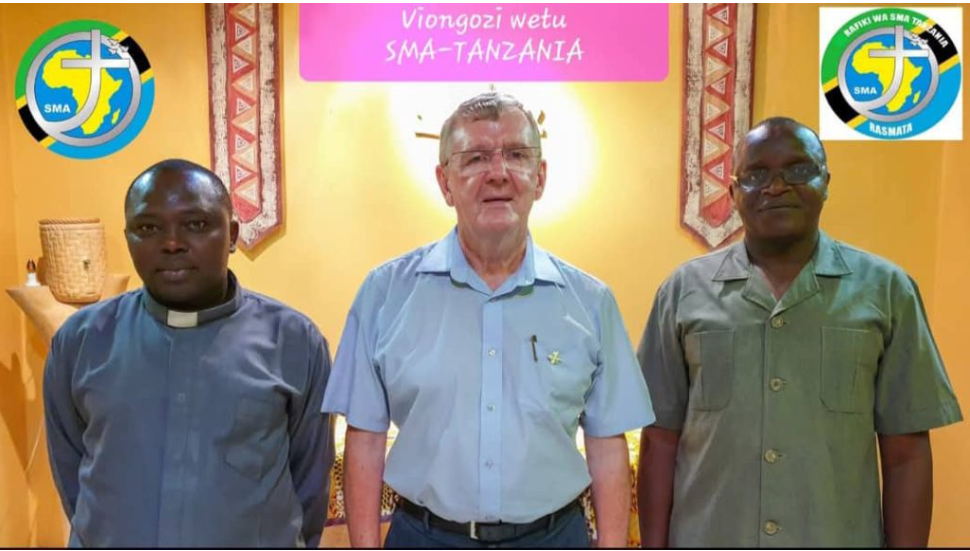
His leadership in Tanzania has been defined by strategic building for an African future. “It truly was a team effort,” he insists, deflecting personal praise towards his Tanzanian counsellors, James Shimbala (now elected to the SMA’s General Council) and Josephat Nzioka. Under his guidance, the SMA Tanzania District (a significant upgrade from a Region) blossomed: over 30 pastoral agents (priests, lay missionaries, religious sisters), a dedicated media and vocations team, a new formation house with a 200-seat chapel, and crucially, a surge in local vocations. “We now have about 24 priests… and a growing number of seminarians. We have worked hard in vocation promotion and recruitment.”
The challenges? “Change – especially change of personnel,” he admits. The constant movement inherent in a global society evolving its structures. “The second would be sustainability – trying to become more financially self-reliant.” Yet, his eyes light up discussing the future: “The biggest change will only truly manifest in the next three years… We are already approaching the numbers needed to become a Province… I can see Tanzania becoming a Province in a few years.”
The pivotal transition: why now is the time for Africa
Which makes his next decision profoundly symbolic. Fr. John will step down as Superior of Tanzania in October 2025. He will not be returning to Ireland permanently yet, but taking a break from Tanzania. The reason is clear and deliberate: “Reading the signs of the times, I believe it’s time for an African – and especially a Tanzanian – to be in charge… There are very capable young men… mature and more than capable.”
He chuckles softly, “I’ve been in leadership in Africa… for a long time… I’ve begun to feel that going to meetings is a bit like being the ‘white sheep’.” More seriously, he adds, “I feel that it is time for Tanzania… I have no sense that I should continue as leader.” Spiritually, he finds deep peace: “I feel at peace and happy with the idea that I have assisted the Tanzania unit to reach a stage where one of its local priests can be the next leader… I’m the last Irish member in Tanzania.”
This transition crystallizes the profound evolution he witnessed starkly at the Rome Assembly – the shift from the overwhelmingly European-led 2007 Assembly to the 2025 gathering dominated by African and Asian voices. “Africa, especially, has gone from being primarily a continent receiving missionaries to one that still receives missionaries but is also sending them out, even to re-evangelize former sending countries.” The era of “reverse mission” is not coming; it is here.
The heart of mission: reciprocity, humility, and fufu
Throughout his journey, Fr. John’s core understanding of mission has remained constant, yet deepened: “Mission has always been a reciprocal experience… I have learned at least as much from them, perhaps more, than they ever learned from me.” He invokes the Kiswahili word “mgeni” (visitor/foreigner): “An mgeni cannot work effectively in another country without the full support of the local community.”
This reciprocity demanded adaptation – not compromise, but immersion. Learning Bassa, Setswana, and Kiswahili wasn’t optional; it was essential for confession, counselling, and true connection. “In Tanzania, Kiswahili is absolutely essential… You simply cannot function… especially as a priest.” Learning language was learning culture, values, and the very rhythm of life. It meant savouring Liberian pepper soup, appreciating South Africa’s diverse cuisine, and sharing the simple, heartwarming chicken-and-rice meals after Mass in Tanzania – acts of communion as significant as any sacrament.
When asked for his greatest lesson, the answer comes swiftly: “Humility. I’ve learned that I could achieve very little without the support of the people I worked with… Missionary work is not an ‘I’ thing; it’s a ‘we’ thing.” He stresses the indispensable role of lay people – catechists and lay missionaries from Poland and the Netherlands – and the unwavering support from his Irish home community, a lifeline especially during the Liberian war.
Advice for the next generation: patience, presence, and letting go
To his successor in Tanzania and young missionaries everywhere, Fr. John offers hard-won wisdom: “We often speak of faith, hope, and charity. I believe a missionary should have a fourth quality: patience. Be patient – with yourself, with your leadership team, and with the people you serve.” He reframes leadership: “Leadership is not a position of authority but a position of service… Your main task is to build up the unit, empower its members… and care for their needs.”
He’d tell his younger self: “Remember you’re not superior to anyone. Respect the people you serve. Be patient. Learn the language, the culture, and the spirituality of the people. Work with them from the start.” The Africa of 2025, he notes, with its thriving local churches, is vastly different from the Africa of 1983.
What Africa teaches the world: faith unashamed
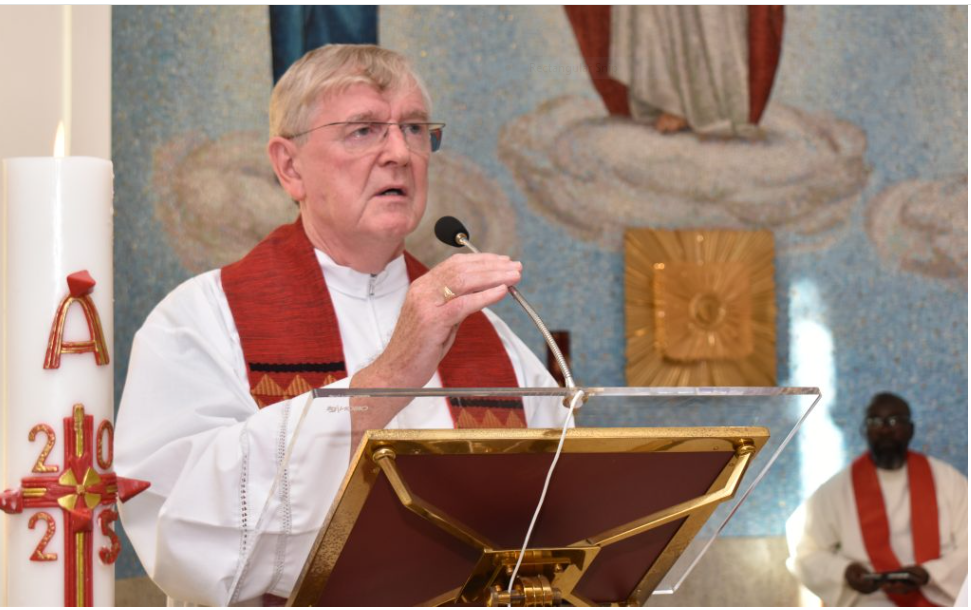
Fr. John’s perspective, forged over three decades, offers a crucial lens for a global Church sometimes wrestling with secularism and doubt. “What can the global Church learn from the African Church? More than the global Church, I’d say global society can learn from Africa,” he asserts. “In some societies, people focus only on caring for the body and forget to care for the soul. African people have not forgotten this.”
He paints a vivid picture: “In Tanzania, for example, politicians – whether Christian, Muslim, or of traditional faith – will always begin by thanking God. The African Church teaches us faith – a sincere, deep belief. When someone comes for healing prayers, they truly believe those prayers can help.” It’s a powerful counterpoint: “In parts of Europe and the West, faith has weakened. Africa reminds us that we cannot live meaningful lives on our own; we need God.”
The legacy: “helped someone along the way”
As he prepares for his next chapter – a break, then service on the Irish Council, still connected to the mission he loves – Fr. John Kilcoyne is characteristically modest about his legacy. “Simply that I have, in some way, helped someone along the way.”
But his legacy is etched far deeper. It’s in the Bassa translations still used in Liberian villages. It’s in the communities nurtured in South Africa during a fragile transition. It’s in the robust structures and thriving Tanzanian vocations poised to lead the SMA into an African future. It’s in the living testament of reciprocity – the proof that mission enriches the sender as profoundly as the receiver.
As the Rome Assembly concluded, Fr. John offered a final, heartfelt reflection, perhaps the truest summary of his 42 years as a priest and 50 years with the SMA: “I would just like to express my deepest gratitude… from home, through the different countries I’ve lived in and served in… We’ve had the occasional ups and downs… But overall, it has been a very, very good experience for me.”
The Irish farmer’s son from Mayo, who set out to change Africa, discovered instead that Africa irrevocably changed him. And in letting go of leadership, he embodies the most profound success of his mission: an African Church, confident, vibrant, and ready to send its own mgeni out into the world. The circle, witnessed in a Roman assembly hall, is complete. The mission continues, louder and more vital than ever, but now with a distinctly African voice leading the chorus. Father John Kilcoyne wouldn’t have it any other way.