
Readings: Genesis 2:7-9,3:1-7; Romans 5:12-19; Matthew 4:1-11
Theme: Jesus in the Wilderness
By Michael McCabe, SMA
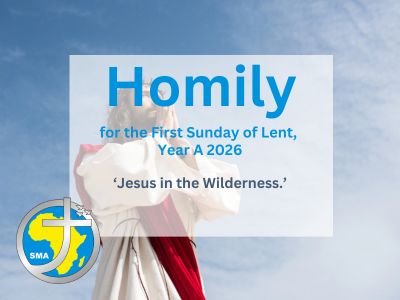
The mission of Jesus was to establish on earth God’s reign of justice, peace and love. Before he begins his mission, he withdraws into the Judean desert or wilderness, to fast and pray for forty days. Today’s gospel reading from Matthew tells us that it was the Spirit, the same Spirit who came upon him at his baptism, who led him ‘out into the wilderness to be tempted by the devil’ (Mt 4:1). Jesus’ sojourn in the wilderness was a testing time for him, leading him to greater clarity about his mission, and strengthening him to carry it out.
Until the Spring of 2008, when I participated in the Ecce Homo Renewal Programme in Jerusalem, I had only the vaguest idea of what a wilderness was like. For me, one of the highpoints of the programme was the night we spent sleeping in the wilderness. I hardly slept at all. I spent the night listening to the whistling wind and watching the myriads of stars shining more brightly than I had ever seen them before. It was an unforgettable experience that made me want to de-clutter my mind and heart, let go of things I thought I needed, and create more space in my life for the things that really mattered.
Matthew recounts three temptations of the devil that Jesus rejected: to turn stones into bread in order to feed himself; to throw himself from the highest tower of the Temple to prove the Father’s love for him; and to worship Satan in return from immense power and wealth. These temptations are presented by Satan as a test of Jesus’ identity as Son of God. At his baptism in the river Jordan the Father affirmed Jesus’ identity, saying ‘This is my beloved Son, with whom I am well pleased’ (Mt 3:17). Satan tries to deflect Jesus from his mission by suggesting that he use his divine power as the Son of God to serve himself rather than others. He even quotes scripture to support his insidious suggestions.
In each instance, Jesus rebuffs Satan, also quoting scripture. He will not be turned aside from his mission of loving service of others – a service of redemptive suffering that will lead him to the ultimate sacrifice of his life on Calvary. Finally, Matthew tells us, ‘the devil left him, and angels came and ministered to him’ (Mt 4:11).
We have just begun the season of Lent, forty days of preparation leading to the great feast of Easter. As we enter this special season, the Church invites us to accompany Jesus in the wilderness – at least symbolically – and to deepen our relationship with him. This is a time for us to slow down and take a good long look at where we are in our lives, and to try to become more aware of where we are going. Traditionally, Lent is a time when we give up things to which we have become attached, like alcohol or our favourite foods. This is certainly a part of our Lenten observance, but it is not enough. We are also challenged to strive for a more profound self-emptying. We must try to get in touch with our heart’s core for, as the Monaghan poet, Patrick Kavanagh, reminds us:
‘….God cannot catch us
unless we stay in the unconscious room
Of our hearts. We must be nothing,
Nothing that God may make us something…
God must be allowed to surprise us.
The word ‘Lent’ comes from an old English word meaning ‘springtime’. So, it reminds us of the bursting forth of new life in nature during Spring. Lent not a dreary penitential season to be patiently endured. It is a joyful season, as today’s Lenten preface reminds us: ‘Each year you give us this joyful season when we prepare to celebrate the paschal mystery with mind and heart renewed’ The season of Lent offers us a blessed opportunity to do some spring cleaning in our lives and enjoy new life as a result. The idea that the more things we have in life, the happier we will be is a popular but pernicious myth. Advertisements urge us to try everything, to leave no stone unturned. ‘More is better’ is the underlying philosophy of our materialistic world. But it is precisely this attitude which kills our capacity for enjoyment, our ability to appreciate the quality things in life, and we end up with hearts that are cold and indifferent. When we resist the temptation to possess things, we become open to the mystery all around us and come to see things as we never saw them before.
Lent, then, is a time – a grace-filled, precious time – for us to try and recover our sense of wonder at the ordinary miracles of life that surround us – basic elemental things like the changing colours of the seasons, the bursting forth of new life in spring. Let us, then, turn to the simple things, the things we take for-granted, the things that, as the poet E.E. Cummings says, ‘I cannot touch because they are too near.’ Like nature, our weary, wounded hearts, to quote Patrick Kavanagh once again, ‘need to be honoured with a new dress woven/From green and blue things and arguments that cannot be proven’ (from his poem, Canal Bank Walk). Lent offers us to opportunity to attune our hearts to the rhythms of nature, and allow them to be healed and blossom again with new life.
Listen to an alternative audio Homily by Tom Casey, SMA: